Showing posts with label '1990s. Show all posts

Monday, April 8, 2013

Unconscious London Strata/The Mammals of Victoria


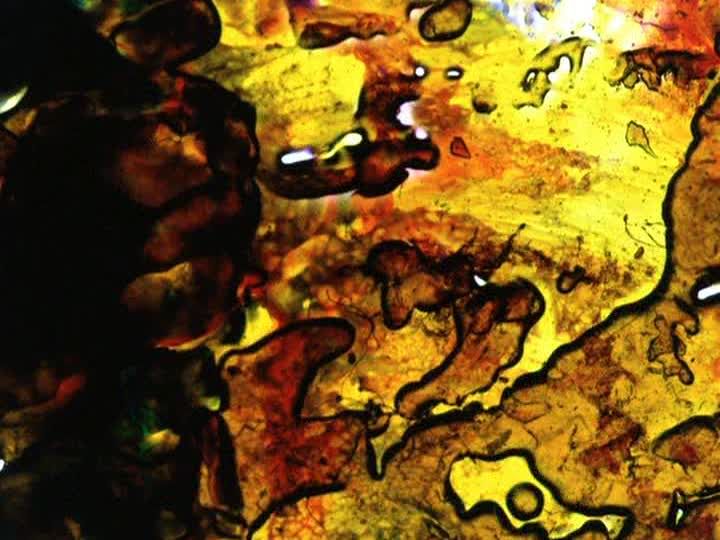
Unconscious London Strata is one of Stan Brakhage's gloriously abstract studies of light and color, with virtually no grounding in concrete forms. The film consists of a rapidly edited montage of blurred, vague images in which any physical context has been smeared away, leaving behind only layered, overlapping colors and bursts of brilliant light. The effect is beautiful and sensual, and in this case Brakhage's layered forms specifically recall the canvasses of Mark Rothko, with sedimentary layers of colors stacked on top of one another in fuzzy strata. As the title suggests, these images are often striated, colors abutting one another in hazy proximity, those beautifully grainy color fields that convey a spiritual, moving quality remarkably similar to the effect produced by Rothko's paintings.

Only towards the end of the film do these abstract fields start to cohere, at least slightly and sporadically, into recognizable images of a building, possibly (and appropriately) a cathedral. Even here, the images are by no means concrete, and the building's form is still abstracted, split apart into momentary flashes of an angled corner or a spire turned upside down. Occasionally, the flickering, shaking images resolve into a second or two of a silhouetted skyline, blocky buildings lined up along a horizon of golden light, but that image too is illusory, gone in a moment.

For the most part, Brakhage refrains from even that much of a hint of physicality. Like his even more sensuous and beautiful light study The Text of Light, this film treats light and color as absolutes, pure visual phenomena without reference or connection to the tangible sources from which these lights emanate. As with Rothko, the effect is both utterly simple and utterly breathtaking.


In The Mammals of Victoria, Stan Brakhage focuses mainly on images of the sea. This is the second part of a four-part series based on the life of Brakhage's wife Marilyn, but there's very little human — or, indeed, mammalian — presence here. Instead, the film is full of images of water in its many forms: rippling blue waves, a black nighttime ocean with speckles of light shimmering across its surface, little wavelets lapping up against a muddy outcropping in the shallows by the shore. Brakhage returns several times to that image of mud piles sticking up out of the water, at one point showing the mud crumbling as the water licks at it, slowly eroding and erasing it. The film's contemplation of nature, with humanity at most a peripheral presence, emphasizes each individual's brief span of life when compared against the rolling, unceasing rhythms of the waves and the tides, the ancient perpetual motion machines of the natural world.

Towards the end of the film, Brakhage includes a pair of evocative, mysterious shots that appear to have been taken from a moving car. In the first, two other cars speed by, their headlights briefly flaring at the camera before whipping around the curve of the road and out of the corner of the frame. The car that the camera is in then continues along the road, turning into the sun, which cuts through the trees and washes out the image in a haze of white light. In the second, simpler shot, the camera simply gazes out of the car as it approaches a modestly sloping hill in the road, approaching this point on the horizon beyond which the road can no longer be seen. The hazy, sun-dazed shot suggests the slow progress into the unknown, a graceful glide up and over a slope into the unknown world beyond. These two images add a subtle narrative component to the film, a hint of action and agency, just as the shots of people playing in the waves, which also don't appear until late in the film, belatedly introduce characters. Before this, for much of the film there's little indication of human presence at all, only an occasional blurry, blink-and-it's-gone shot of somebody wading through the water.

Brakhage is also exploring different forms of distortion: the wavery quality of an image seen from beneath a film of water, the static and flickering of a TV set, the grainy haze of low-quality film stock. Brakhage seems to be using several different types of film, contrasting the clarity of an image of rocks jutting out of the water against blurry, nearly impenetrable landscape shots. The different film stocks contribute to the film's eclectic visual style, which explores textures both smooth and rough, as well as stitching in a few short painted segments. The painted sequences flicker by quickly, and are mostly pretty routine, not at all the best examples of Brakhage's hand-painting. (An exception is a flurry of cosmic star fields and swirling galaxy-like forms that appears towards the end of the film.) The painting in this film mostly seems like a placeholder, a brief visual palette cleanser connecting photographed images, often segueing seamlessly into an out-of-focus image of lights hovering in a dark field, drawing a connection between Brakhage's photographic abstractions of the world and his painted abstractions.

Monday, January 28, 2013

Wild Reeds


In Wild Reeds, director André Téchiné dramatizes the moment right on the cusp between adolescence and adulthood, right at the moment when teens are struggling to define themselves, to cope with burgeoning sexual desires and decide what they want from life, where they're heading and what they'll be doing in the future. The film sets this awakening against the backdrop of the Algerian War, as so many French films have, juxtaposing the passage into adulthood with the loss of innocence represented by the violence and political turmoil of Algeria.

Téchiné renders this story with a wan and somewhat faded color palette, like an old photograph, worn and frayed by the nostalgia accrued in the decades between this 1962 summer and the film's production. Téchiné himself would have been 19 in the year the film is set, suggesting that he's drawing on his own experiences, his own memories of the discomfiting intimacy between his own adolescence and the background of war and confusion against which it occurred.

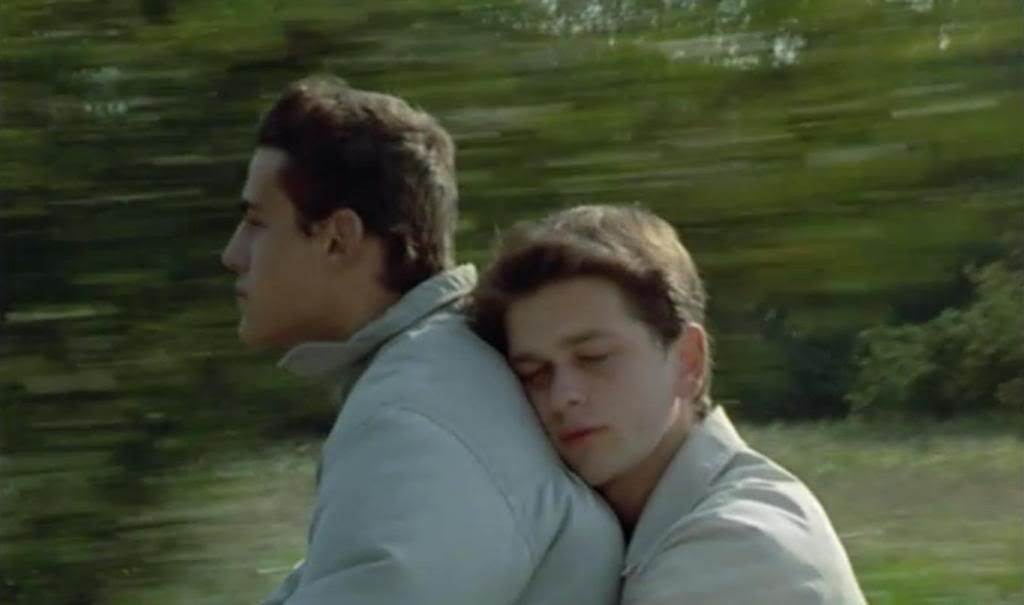
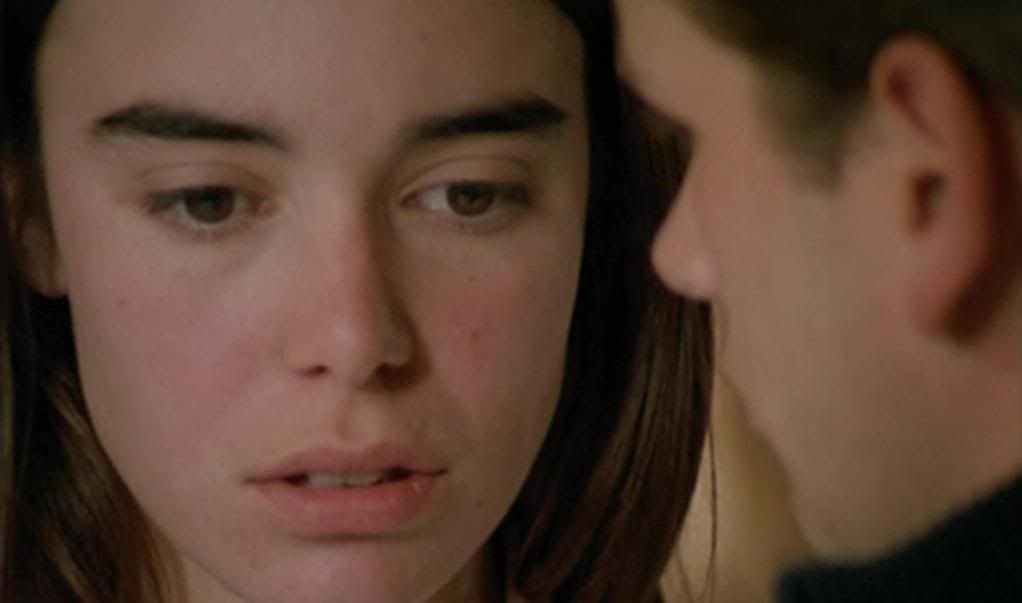
The film is elegant and delicate, the camera gently tracking around the quartet of teenagers at the story's core. There's François (Gaël Morel), who's starting to realize that he's gay, nursing an intense desire for his schoolmate Serge (Stéphane Rideau). François is also the platonic kind-of boyfriend of Maïté (Élodie Bouchez); they've been friends since childhood and are thought of as though they're dating even though nothing has ever happened between them. This neat triangle — Serge desires Maïté, who says she doesn't care about François' sudden realizations about himself, even though she's clearly shocked — is complicated by the presence of Henri (Frédéric Gorny), an arrogant and elitist youth who's immersed in the news from Algeria, where he lived until just recently.

Algeria and the politics surrounding it haunt the film, and political convictions are one of the things that these young people must come to grips with as they try to decide who they are. Henri is a far-right partisan of the French nationalist terrorist group the O.A.S., whose activities are mentioned frequently on the radio news reports that Henri's always listening to. Maïté, like her mother (Michèle Moretti), is a Communist, though one senses that she doesn't share her mother's absolutist conviction in the cause. Maïté's mother, a schoolteacher, is such a partisan that she hands out grades in her English class based on the political ideas expressed in papers, and there are references to Maïté's father leaving them because she was immersed in her cause to the exclusion of all else.


The film's dominant composition is the two-shot, as the young people pair off into different couplings, different combinations, as though experimenting to see what works. Téchiné captures them in intimate two-shots, their faces overlapping and close together, electric tension suspended in the scant space between them, their uncertainty and confusion passing between them in the glances they give each other, the hesitant intimacy of their dawning desires. For most of the film, Téchiné never even brings all of the characters together, restricting them to these alternating pairs and quasi-couples. Occasionally, Henri tries to horn in on the furtive intimacy between Serge and François, but not until the very end of the film do all the characters come together, first as a cheerful threesome that recalls Band of Outsiders or Jules and Jim, and then as a full quartet — though they quickly pair off again before the finale suggests that they're all heading in separate directions anyway.

The film is all about the contrasts and resonances between their fresh young faces. Serge, befriending François, tells him that they'll go well together because they're such different "types," and indeed they are, François delicate and boyish in contrast to the broad, tanned working class face of the farmer Serge. The sensuality between them is enhanced by the differences in their types, which is a way of saying the differences in their backgrounds, the differences in their economic class — and thus the differences in their likely futures, as Serge ultimately decides that all he wants is to stay on his family's farm, while François seems bound to graduate and head off to more intellectual pursuits.

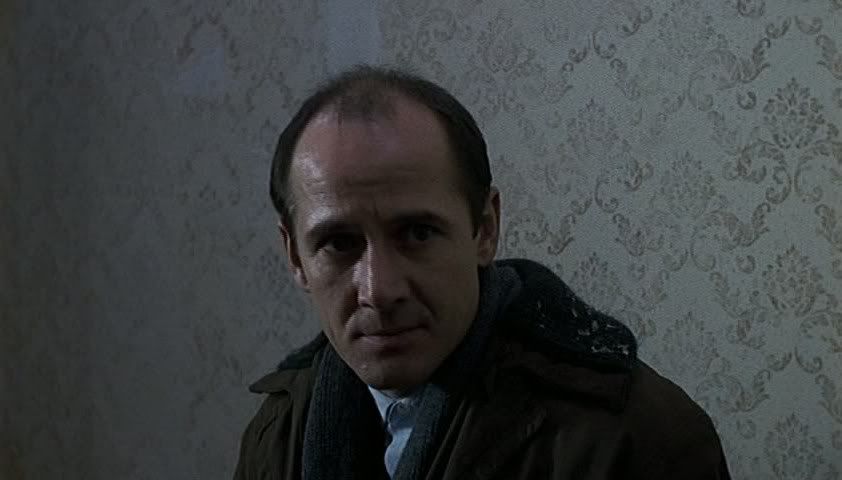
This uncertainty about the future is what makes the film so poignant, so gently moving. It's a touching, emotionally complex film with a real sensitivity to nuance: in one scene, the confused François pays a visit to the only gay man he knows, the owner of the town's shoe store, and though the man seems uncomfortable talking about his sexuality and can't help François, Téchiné grants the man a parting closeup that is searing in its directness, capturing the expression of yearning, confusion, and recognition on his face as he watches François walk away. That shot makes it clear that the man desperately wants or needs to talk to someone, but can't find the words any more than François can.

Téchiné treats his themes with delicacy and grace, never forcing an epiphany or trying too hard to resolve the ambiguity of these relationships. Instead, the film is warm and sensuous, capturing with precision and understated emotion the time in life when everything seems hazy, when political convictions and sexual desires and ambitions about life and love and work are all up in the air, and anything might still be possible. The film, though, is about the closing of those horizons, the narrowing down of all possibilities to those few that seem appealing and likely.

Wednesday, November 7, 2012

The Eye of Vichy


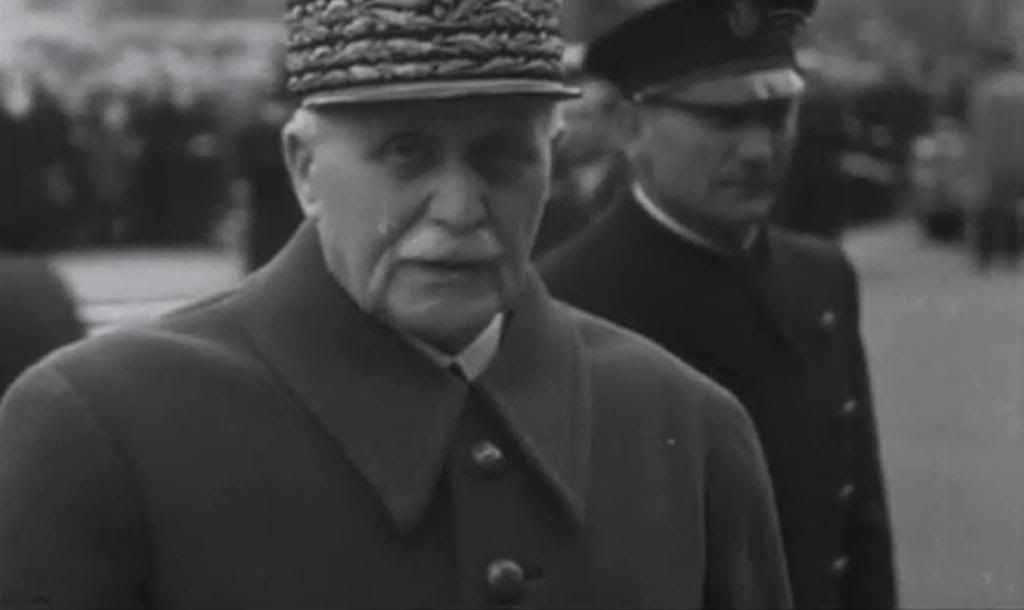
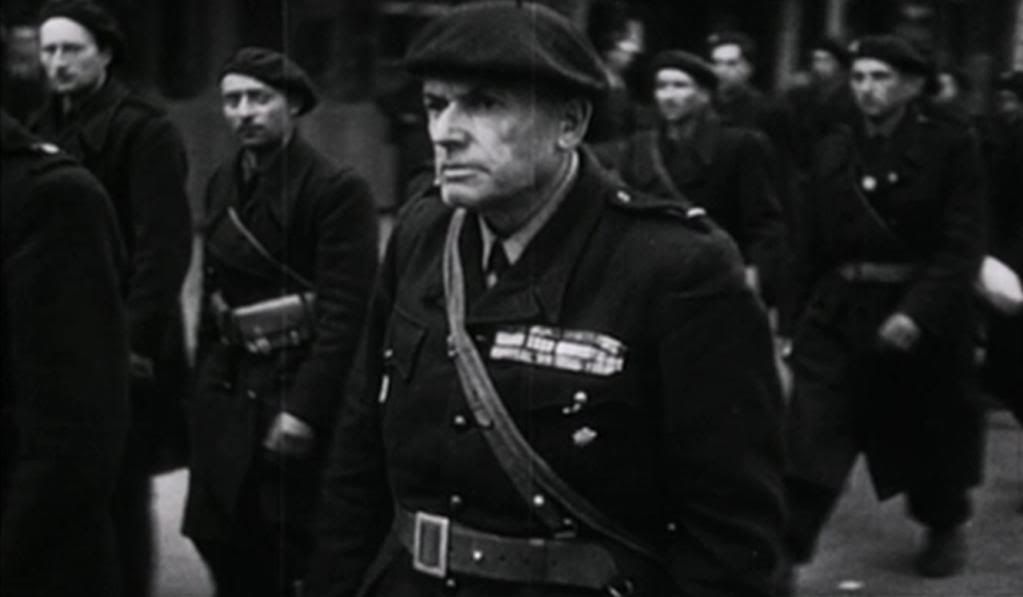
Claude Chabrol's The Eye of Vichy is a fascinating documentary that collages together newsreel footage and propaganda films from the Vichy era in France. This compilation of materials shown in French theaters between 1940 and 1944 is presented almost without comment. A narrator introduces the film with a condensed history of World War II leading up to the invasion of France and the establishment of the Vichy regime, and thereafter the narrator mostly falls silent except for providing occasional snippets of historical context. The film is thus constructed primarily from Vichy's own transmissions, the propaganda and slanted news shown to French citizens during the war. As the text at the beginning of the film says, this is France not as it actually was during this period, but as the government wished people to think it was. This is a montage of primary sources that lays bare the lies and distortions that served as a cloak for the Vichy government's sinister collaboration with the Nazis.

Much of Chabrol's fictional oeuvre is concerned with probing the pathetic absurdity and ugliness of the surface presented by bourgeois culture; his films simultaneously document the appearance and the filthy reality underneath. This documentary, otherwise so different in form and content from the rest of Chabrol's work, actually has a similar thematic focus, using the Vichy regime's self-presentation to pick at the ugly truths that are never quite obscured by the gloss of propaganda. One of Chabrol's guiding principles in his films has always been that one can tell a lot about a culture by the lies it tells (about) itself, which is why he has always been so successful in deconstructing and ridiculing bourgeois culture. Here, he turns that same incisive eye for the significance of lies on an entire government founded on lies. This seemingly straightforward presentation of those lies, with only limited overt commentary, reveals a great deal about the workings of Vichy France.

Much of the propaganda collected here is of the usual sort, idealizing and idolizing the new rulers of France — even if sometimes they're replaced, without ceremony, weeks later — and presenting rosy depictions of Franco-German harmony. One particularly twisted piece, intended to discourage French dreams of liberation, is a cartoon in which the Allies are depicted as Mickey Mouse, Popeye and Donald Duck, planning to bomb France while the British broadcast duplicitous messages of peace. Chabrol mostly lets the material stand on its own, only occasionally correcting the particularly subtle lies. The propaganda is so crude and obvious that, for the most part, no comment is needed.

At times, the propagandists can even be startlingly open about the horrors of the situation. One newsreel speaks of Resistance fighters killing two French officers, and says that 50 men have been killed in reprisal, and that 50 more will be killed tomorrow if the culprits aren't caught. It's so offhanded, so casual in the way this propaganda piece admits to mass killings — and who did they kill, exactly? Obviously, in the name of inspiring fear, the regime sometimes admitted to its own violence and repression.


Indeed, one striking feature of this footage is how often the propaganda echoes, almost subconsciously, the atrocities committed by the Nazis and their allies. The newsreels repeatedly show trains running between France and Nazi Germany, but of course these are not the trains loaded with Jewish prisoners, destined for the concentration camps. Instead, the films show trains leaving for Germany full of French unemployed people, supposedly going to Germany to work, waving goodbye with a smile as the train rolls out of the station towards the east. The trains also bring back French prisoners of war from Germany, with sentimental scenes of returning soldiers embracing their wives, childrens and dogs. In another sequence, made shortly after Germany's invasion of Russia, the French propaganda abruptly turns on the Bolsheviks with an exposé of a Soviet embassy in Paris, revealing the hidden passages and peepholes and, chillingly, some seemingly innocuous stoves that the news announcer compares, apparently without shame or irony, to crematorium ovens.

Later in the film, in one of the few overt examples of Chabrol's editorial commentary, Chabrol juxtaposes images of happy French children heading to the countryside on vacation with a dry recounting of the numbers of Jewish men, women and children arrested and shipped to camps during the same summer. The sequence continues with a documentary on the wartime gas industry in France, and another on the recycling of hair from barbershops into raw material for clothes. The narration continues to explain what the films, of course, do not, that during this period Jews were being sent en masse to Auschwitz for "immediate extermination," their bodies burnt up in ovens, their heads shaved, their possessions stripped and stolen from them before their deaths. The sequence is chilling, with the dispassionate voiceover probing the unspoken truth that Vichy hid in favor of these dry industrial documentaries, the imagery of which is nevertheless eerily resonant with the real state of things.

Another informational piece collected here celebrates the destruction of old, pre-war films to make shoe polish and nail polish, showing images of pre-war film stars melting down, piles of film stock being thrown into processing machines that turn them to muck. That disregard for celluloid must have especially galled the cinephile Chabrol, but more than that it represents an antagonistic perspective towards history and culture, a wish to erase the truths of the past and replace them with the new, manufactured history of the Nazis and Vichy. The new authoritarian regimes of the fascist block exerted complete control over the image, and any images that could not be controlled were simply destroyed. Chabrol's film is a potent and informative rejection of that ethos: rather than destroying the images of this hateful past, he assembles them into a historical record of repression and denial, incontrovertible evidence that some might like to see burnt up, recycled for consumer products. If Vichy tried to erase the past and lie about the present, this film presents these images for all to see, preserving rather than destroying the past.

Wednesday, October 3, 2012

Betty


Claude Chabrol's Betty is a devastating, moving, extraordinarily acted portrait of a lost soul whose drinking and sexual promiscuity isolate her from the bourgeois family she's married into, and from which she's eventually ejected entirely. Based on a novel by Georges Simenon, the film is a deeply affecting study of addiction and disconnection. Marie Trintignant delivers an astonishing performance as the title character, exploring the confusion, depression, and fragility of this aimless young woman — as well as the undercurrent of emotional coldness and cruelty that perhaps lies beneath her surface frailty.

The film opens with a sequence that suggests a familiar Chabrol thriller in the offing. Betty is picked up by a twitchy, increasingly creepy man who claims he's a doctor, and goes with him to a club called Le Trou, a reference perhaps to the Jacques Becker classic as well as an indication that the people inhabiting this bar have reached the bottom, that they've sunk so low they're underground and desperately trying to tunnel out. As Betty swigs glass after glass of whiskey, the doctor begins exhibiting increasingly disturbing signs that he's no more stable than the woman he picked up. His patter becomes chilling, even vaguely threatening, as he talks about dead animals and gets noticeably sweaty, not that Betty, immersed in her drinks, seems to care about her companion's unhinged demeanor. The scene seems to be building to an apex of sinister violence, particularly when the doctor, his sweaty visage framed in profile against the cool blue of a fish tank in the background, tells Betty that she has worms underneath her skin, and that he'll dig them out for her with a needle he keeps handy.

Chabrol is offering up a red herring here, setting up what seems to be a thriller of predation and violence, when in fact this is a very different kind of movie, and the encounter with the doctor is soon defused by the arrival of the kindly bar owner Mario (Jean-François Garreaud) and his lover, Laure (Stéphane Audran), who explains that the doctor is a drug addict. Far from being a violent thriller, this is a quietly intense character study, an intimate portrait of a woman who, like everyone else in Le Trou, has sunk to her seeming low point, fallen as far as she can.


Betty is taken in by Laure, a woman of the upper-class who's rejected society after the death of her husband, retreating to a nice but isolated hotel and making nightly visits to Le Trou. As Laure helps Betty to recover from her desolation, Betty's story is doled out in fits and starts via flashbacks. She'd been married to Guy (Yves Lambrecht), the youngest son of a wealthy and prestigious bourgeois family, until Guy and his domineering mother (Christiane Minazzoli) had walked in on Betty having sex with one of the many lovers she'd taken to distract herself from a numbing, alienating existence. Betty was sleepwalking through life, and Chabrol, of course, is excellent at portraying the deadening effect of bourgeois home life. Betty felt detached even from her two daughters, who were so well-cared-for by a hired nurse that Betty was superfluous, a stranger to her own children, basically only interacting with them to give them a good-night kiss. She had a seemingly ideal life, on paper at least, but it never truly felt like her life, which is why she secretly drinks and arranges her constant affairs. When she gets caught, it seems like she wants to get caught, that she's secretly setting herself up for a confrontation, for something to shake her out of this dreadful nothingness.

Trintignant is exceptional here, plumbing the depths of this woman's misery and seemingly irresistible urge towards self-destruction. One of her lovers, a medical student (Thomas Chabrol) who loves to psychoanalyze her, asks her, "you know your problem?" Betty abruptly becomes serious, intent, flatly answering, "no, tell me," her desperate need to understand herself showing through what had otherwise been a somewhat casual conversation. The way she says it, it's obvious that she really wants to understand herself and her "problem," to pick apart why she is the way she is, even if this pretentious young man with his rote recitations of Freudian subtext doesn't actually have any of the answers. It's a small moment, the nuances of Trintignant's performance embodied in every little line like this, always communicating the submerged intensity of this sad woman.

Audran, in her last role in a Chabrol film, is equally remarkable, as a woman who is in her way every bit as damaged as Betty is, but has managed to recover, to carve out a small and comfortable life for herself as a balm for her loss and sadness. She is a glimpse of a possible future for Betty, and perhaps Betty herself also sees it, because in the film's devastating and unexpected finale, Betty, selfishly rejecting the possibility of growth or true healing, simply grasps for what her friend has and takes it. Betty, beneath her hurt and her victimhood, has a cold and calculating side to her as well, a darkness that prevents her from seeing a less destructive route out of her rut. The coda, which chronicles the minimal effect of all this emotion and self-destructiveness on the chilly, perpetually polite world of the bourgeois — the world that both Laure and Betty had fled for different reasons — adds a final ironic twist to the film's bleak picture. It's a powerful and intense film that is unsparing in its depiction of the central character's weaknesses, as well as her surprising and cruel strengths.

Wednesday, September 12, 2012

Romance


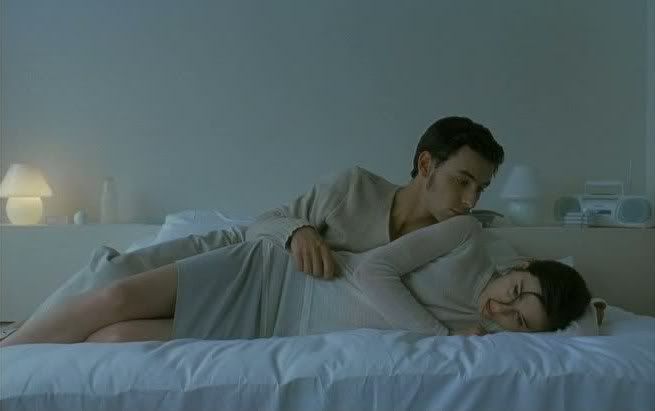
"Love between men and women is not possible." So says Marie (Caroline Ducey) towards the end of Catherine Breillat's ironically titled Romance, and the film goes about methodically proving this thesis by examining Marie's feelings about sex and her relationships with various men. Marie is in a long-term relationship, a conventionally "romantic" relationship, with Paul (Sagamore Stévenin), a handsome but passionless model who no longer has sex with her, who doesn't even want her to touch him. His apartment, where they sleep together sexlessly every night, is pure white, and they both dress all in white, virginal, unstained, totally clean and tranquil. The walls are white, the bedsheets are white, the lights are bright fluorescent white, the furniture is white. Everything is clean, clinical, untouched, and it's no wonder that there's no sex within these spotless walls, no hint of passion or tenderness. Paul is reluctant to even take his (clean, white) shirt off in bed, and Marie says she feels like she's sleeping next to a ball of cotton.

This spartan cleanliness is contrasted against the dirtiness and messiness of the sex that the increasingly dissatisfied Marie seeks out with other men, first with the muscular, sexually voracious Paolo (Rocco Siffredi), his name so similar to Paul's that Marie starts forming an almost romantic attachment to him too, and then with her boss at her teaching job, Robert (François Berléand), with whom she engages in sadomasochistic games of bondage and restraint that wind up getting her more excited than actual intercourse. Notably, Robert's apartment is decorated in red, and when he first ties her up, his red shirt against her white dress seems like a stain, as though he's going to leave bloody smears all over her from the bright red of his home, with red curtains framing her like she's on stage as she's being bound and gagged. The second time she goes to see him, she's wearing a bright red dress with black underwear, the first time she's ever worn anything but shades of white and gray, and the effect is shocking — even more so when she returns in this red dress to Paul's white apartment, her presence there suddenly standing out from the surroundings rather than fading amiably into the walls.

Breillat is dealing with sex and desire, control and submission, but it's all so schematic, so deathly dull in its rote plodding towards foregone conclusions. Towards the end of the film, Marie imagines sex as a mechanistic whorehouse where her upper and lower body are separated from one another by a wall with a hole. On one side of the wall, Paul sits beside her, holding her hand and smiling lovingly at her, while on the other side of the wall "ape-like" naked men approach her spread legs with simian lust, waiting in line and taking turns to fuck her. The symbolism is so crushingly obvious as to barely qualify as symbolism: lust and love are separated from one another, the ideal of the monogamous romantic relationship clashing against the animalistic desires of men. It's a treatise delivered with all the finesse of the porn movies whose passionless imagery of sex Breillat is drawing on here. Men are either fey automatons like Paul — whose woman-chasing seems to emerge only from a sense of duty, a sense of what he's supposed to do as a man, and who's actually implied to be gay — or big dumb studs like Paolo or remorseless ladykillers like Robert, who boasts about having had 10,000 women, including Grace Kelly.


Breillat is depicting Marie as someone who's seeking pleasure for herself, trying to break free of the idea that women don't desire sex, that women don't have the same strong lusts as men — but at the same time so much of Marie's behavior dovetails with male desires, with male fantasies of female submission and degradation. Marie is trapped, but it's not always clear by what; in any event, she's always staring at the world through the prison bars of the few stray strands of hair that break free of her pulled back hair to lay across her face. Notably, in the scene where she goes to see Robert for a bondage session, dressed in red, she lets her hair down for the first time, but is she really free, being manipulated into position by this lothario who has such naked contempt for women?

Part of the problem is that Breillat depicts all the sex as equally unappetizing and passionless, whether Marie is supposedly getting off on it or not. Towards the end of the film, she goes for a gynecological exam and is felt up by a succession of medical students, each waiting a turn like the men in her pornish whorehouse fantasy, and this clinical examination is filmed with exactly the same slightly bored detachment as the scenes in which Marie is supposed to be enjoying herself. Maybe that too is part of Breillat's thesis, that all sex is unavoidably compromised and fucked up by these weird societal ideas about men, women, relationships, desire, and love. At one point, in a rare flash of humor from this mostly humorless film, Breillat cuts from a splash of semen spurting onto Marie's stomach to a shot of a doctor spreading gel on her stomach for an ultrasound examination. That about sums it up: all sex is clinical and emotionless, and one might as well visit a doctor as get into bondage.

Wednesday, September 5, 2012

Madame Bovary


Claude Chabrol is so thoroughly associated with the genre of the thriller that it's always a surprise when he ventures outside its confines. Certainly, Flaubert's novel Madame Bovary is not what one expects of Chabrol; a period piece literary adaptation is very far from the director's familiar territory, even if this novel of a bourgeois woman's boredom and rebellion resonates thematically with Chabrol's usual topics. Chabrol plays it mostly straight, sticking faithfully to the source novel and delivering a dry, somewhat cool costume drama that doesn't really play to the director's strengths.

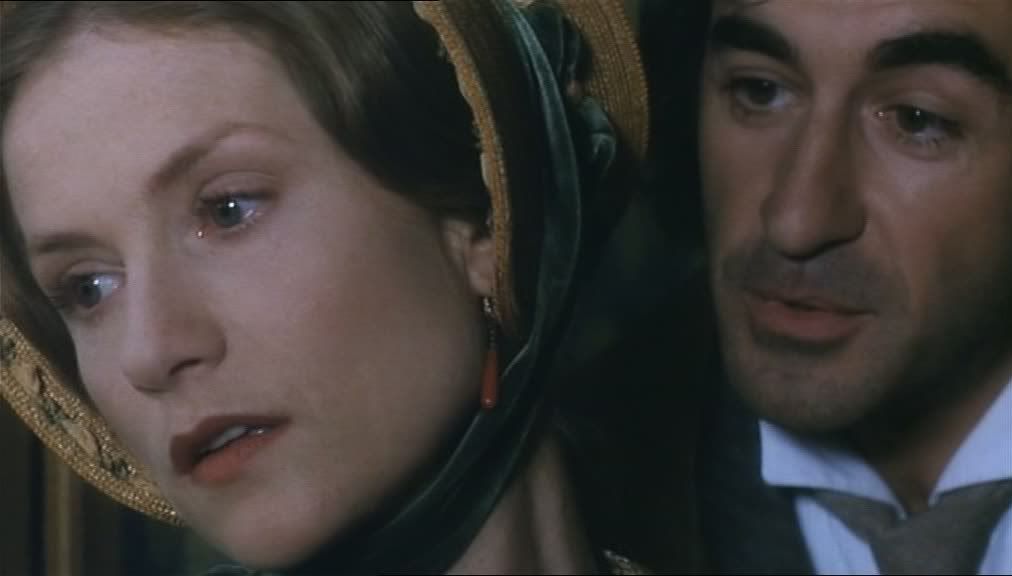
It's the story of Emma Bovary (Isabelle Huppert), married to the doctor Charles (Jean-François Balmer), who she soon realizes is a total bore, unable to provide her with the glamorous, exciting life that she dreams about. Dissatisfied with this dull marriage and her stultifying life as a homemaker, Emma alternates between periods of passionate affairs and wild spending, and periods of recommitment to the virtues of family and home. She has two torrid affairs, first with the sly playboy Rodolphe (Christophe Malavoy) and then with the sensitive young Leon (Lucas Belvaux), but neither of these loves can ultimately save her from the self-destructive streak that leads her closer and closer to oblivion.

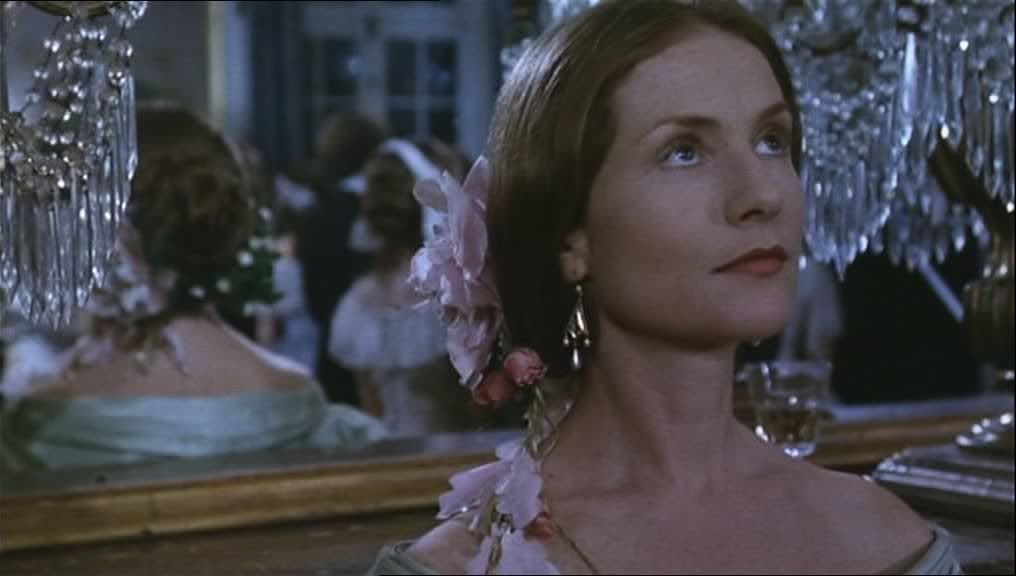
Emma is a romantic who's filled with dreams by the novels she reads as an escape from her dull, passionless husband, whose intellect she finds so wanting. Under the influence of her desire for Leon, she walks around her garden, practicing swooning declarations of love with a theatricality that obviously indicates she's acting out scenes, imagining her own life as a novel, playing herself as a character in a romantic book. She's filled with grand dreams that are very distinct from the unfulfilling life she actually leads. In one of her happiest moments, she and her husband are invited to a fancy ball by a local dignitary, and Emma is so overwhelmed by the glamour and finery on display that she nearly swoons with pleasure, drifting around the hall listening to the stimulating conversations that she'll never have at home with her husband.


Chabrol wittily stages the big seduction scene between Emma and Rodolphe by cutting back and forth between the couple and the agricultural fair going on outside. He alternates between Rodolphe's passionate come-ons to Emma and the awarding of prizes for best manure and best pigs and so on, cleverly subverting the romance of the scene with these earthy rural details. After all, for Rodolphe this is just a game, a conquest, while for Emma it's like a scene out of one of her beloved novels, the fulfillment of her dreams and secret desires — the romance is a sham, stained by baseness. When Emma rides with Rodolphe into the woods and finally gives in to her passions, it's obvious that she's acting, performing a role. She's more excited by the idea of this secret affair than she is by its reality, which is perhaps why Chabrol discreetly cuts away from the actual lovemaking. The real pleasure for Emma is not the actual sex but the romance and melodrama of it; she gets shivers of pleasure by looking in the mirror and saying, "I have a lover," pronouncing it with the wonder of a woman living out her literary fantasy.

Emma is constantly searching for something, though she's not sure what it is, and one institution that the film repeatedly holds up as inconsequential is religion and the church, which offer scant comfort. She goes to see the village priest, but he just talks past her without really hearing her; submerged in the physical problems and poverty of his flock, he's unable, or unwilling, to appreciate the more metaphysical, less tangible problems that Emma wants to tell him about. The frustration of the shot is sublimely realized: while Emma stares straight ahead, her eyes wet, struggling to express her thoughts, the priest prattles on about the problems of his parishioners, oblivious to Emma's troubles — or, perhaps, deliberately stomping over them, trying to shame her out of her misery by pointing out how many worse problems are experienced by people of lower social classes.

The film is generally well-realized and well-acted, and moments like this are staged by Chabrol to maximize the emotional and thematic subtext of Emma's various encounters. The film as a whole, however, doesn't quite connect: it lacks the satirical bite of Chabrol's best work, despite the thematic continuity with his more personal works, and too much of it feels like a scrupulously faithful condensation of the source novel rather than the work of a director applying his own voice to this material.

Friday, August 31, 2012

Jungle Fever


Considering Spike Lee's career-long examination of various American attitudes about race and culture, it's not surprising that at some point he should take a look at the concept of inter-racial relationships. Many of Lee's films have thesis-like ideas at their core, from Bamboozled's satirical dissection of the history of blackface and the issue of race in the entertainment industry, to School Daze's inquiry into divisions within the black community, to the consideration of black/white romance in Jungle Fever. Like so many of Lee's films, Jungle Fever fearlessly looks at race head-on, and like so many of his films, it's messy, provocative, awkward, contradictory, uneven — and unevenly acted — stylistically eclectic, and (over)loaded with ideas. It's never a smooth viewing experience, but then it's clearly not meant to be; its barbs are there to get caught on, to provoke viewers of any race into thinking about ingrained prejudices and the ways in which the history of race in America continues to dominate current-day interactions and relationships between races.

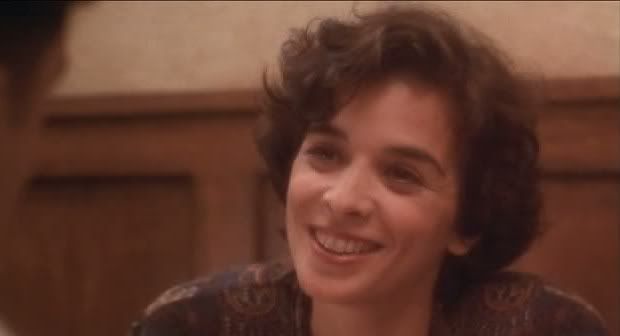
The narrative of Jungle Fever skips all over the place a bit sloppily, but basically it's about the relationship between the black architect Flip (Wesley Snipes) and his white Italian secretary Angie (Anabella Sciorra). Flip is initially antagonistic — he'd wanted his white bosses to hire a black secretary for him — but one night, working late in the moodily lit office, the pair suddenly develop a romantic rapport that leads to a night of passionate sex, even though Flip is in fact married, and seemingly very happily, to Drew (Lonette McKee). There's no explaining attraction or lust, and Flip and Angie simply give in, with predictably problematic results.

Lee places the emphasis on the reactions to this affair more than the affair itself, and at times the film seems to keep forgetting about Flip and Angie for long periods of time. Instead, he detours into scenes with Angie's former boyfriend Paulie (John Turturro) and his crude Italian buddies hanging around a convenience store, expressing racist attitudes while simultaneously lusting after the pretty, educated black woman who visits the store every morning and is friendly with Paulie. Much of the film turns around these kinds of nakedly polemical scenes, shoving character and narrative into the background for scenes like the one where Drew and her friends discuss men and skin color, Lee's camera circling relentlessly around the room while the dialogue, though apparently improvised by the actresses themselves, hamfistedly delivers these ideas.


All of Lee's films have this dichotomy, this tendency to interrupt the narrative for scenes of straightforward political and racial preaching, but Jungle Fever is probably one of his most unbalanced films in that respect: it's not as straightforwardly satirical and polemical as a film like Bamboozled, so its preaching sits uncomfortably with the moments that are more about character or narrative. A prime example is the scene where Flip and Angie visit his parents (Ruby Dee and Ossie Davis), only to have his reverend father deliver a long, to-the-camera address on the history of slavery, miscegenation, and the rape of female slaves by white masters. What could and maybe should be a character scene, about the discomfort of the couple with the reverend's distaste for their relationship, instead becomes just another of Lee's immersion-breaking history lessons, and the central relationship gets shifted more and more to the fringes of the film.

There's still some interesting material here, especially in the way Lee shows the couple receiving prejudice and judgment from all quarters, in both Flip's black Harlem community and Angie's Italian Bensonhurst community. One of Lee's recurring themes is the way that blacks and whites are trapped by race and by the racist history of this country, fated by culture and history to play certain roles, to repeat certain mistakes over and over again. There's some uncertainty here about just how real Angie and Flip's relationship is, regardless of race, but race ensures that they don't stand a chance; it's just too big a barrier to get around. Flip's sudden voicing, late in the film, of prejudiced attitudes about mixed-race children is hard to justify narratively or in terms of his character up to that point, but thematically it makes perfect sense: these ideas, ingrained as they are, are exceptionally difficult to escape, passed down from generation to generation and running through entire cultures, both white and black.

The specter of race makes it impossible to judge this relationship like any other relationship, impossible even to think of Flip's adultery as just adultery rather than a betrayal of his entire race. In that sense, the way the film keeps getting bogged down in polemics and theoretical discussions of race and history is part of the point: these issues are so tangled and complex that this story can't just be a story.

Monday, July 2, 2012

The Castle


The Castle was one of the novels Franz Kafka left unpublished upon his death, the unsettling story of a land surveyor who repeatedly and fruitlessly butts up against the unyielding absurdity of a labyrinthine bureaucracy in a snowy mountain village. Michael Haneke's 1997 adaptation of the novel is mostly faithful, both to the spirit of the work and often to its letter, liberally quoting from the novel in the narration that runs through the film. The novel is a masterpiece, one of Kafka's best and most richly layered works despite its lack of an ending; if Haneke's film is not quite as good, it's still an interesting adaptation with a lot to recommend it.

One of the characteristic features of Kafka's novel is its dense, repetitious prose, as the land surveyor K. (played by Ulrich Mühe in Haneke's film) tries to navigate a torturously complicated bureaucracy that denies ever having hired him for the post of land surveyor. The novel makes K.'s thought processes palpable, delving into his intense frustration, his stubborn determination to get past the seemingly insurmountable obstacles keeping him from satisfaction, his circuitous reasoning and obsessive rationalizations of his surreal dilemma. The novel is in the third person, but in its dense internality it often retains evidence of its origins as a first person narrative. Haneke removes much of this material, retaining only slices of the novel's narration and clipping out much of the connective tissue, with the result that the film is quite possibly even more disorienting than the Kafka source. The film's K. is far more unknowable than the novel's, his actions far more mysterious and strange, without all the explanations and rationalizations that weigh down every least action of the novel's central character.

At times, it's hard to know what someone unfamiliar with the novel would even make of this absurdist story, which so steadfastly refuses to flow smoothly from one moment to the next. Scenes begin and end abruptly, cutting to black as soon as a line of dialogue has been uttered. The film has a choppy, off-kilter rhythm that does a good job of capturing the strange qualities of Kafka's prose. K. plods through the snow, walking from nowhere to nowhere. K. meets with a succession of bureaucrats and people who he desperately hopes will have some connection to the Castle, even though his attempts never get him anywhere. He engages in an affair with a barmaid named Frieda (Susanne Lothar), because he believes that she too has some tenuous connection to the Castle. He suffers many indignities, and many confusions, and after a while he seems to forget what he even wants, why he's even trying so hard to get to the Castle.


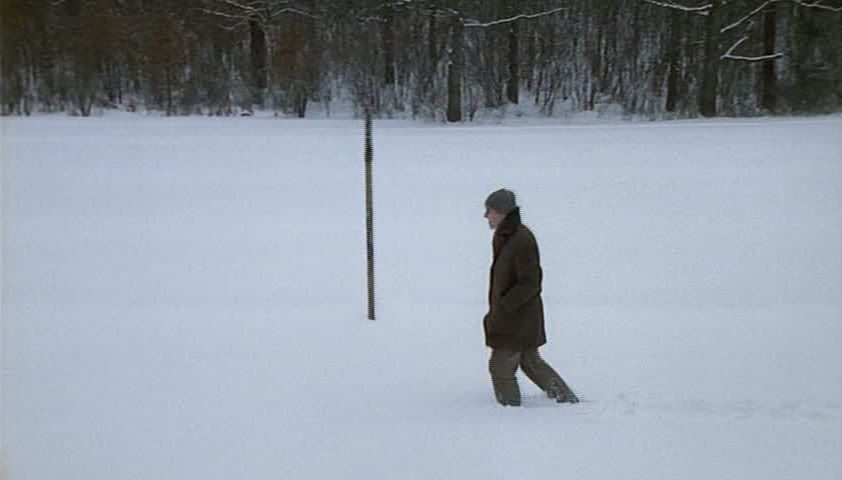
Haneke presents this material with stripped-down faithfulness, alternating short, clipped excerpts with long monologues and dialogue, often shot with extended takes; this, too, contributes to the film's skewed pacing, with truncated snippets of scenes abutting lengthy, nearly verbatim exchanges from the source material. The visual aesthetic is rough and minimal, with the town that K. arrives in rendered as a somewhat shoddy rural village of an indeterminate time period, old-fashioned in atmosphere, with a horse-drawn carriage as the only transportation, but with modern appliances like the radio that's mysteriously switched on and off during the opening scenes. Outside, there's a snowy wasteland through which K. trudges in lengthy horizontal traveling shots that follow him through the snowbanks, the background often all but obscured by the wind, which kicks up miniature storms of fluffy powder. The Castle itself, tellingly, is never seen, even though it's virtually all anyone talks about.

Haneke, following Kafka, casts K.'s two assistants (Frank Giering and Felix Eitner) as darkly comic figures of mischief and grinning malice, much like the sinister villains of Funny Games, made the same year — Haneke even cast Giering in both films, as one half of the sinister pair, Tom and Jerry, Peter and Paul, Fatty and Skinny, and here Artur and Jeremias. More even than in Kafka, the assistants provide a bizarre strain of humor here, hanging around K. like a pair of slapstick buffoons, reading a letter to him in discordant unison, running around in circles in the snow and occasionally unleashing enthusiastic self-congratulatory cheers.

The film ends, like the novel, in mid-sentence — recalling the obsessive literary faithfulness of Eric Rohmer's Perceval le Gallois, another adaptation of an unfinished work — as K. gets himself tangled up with yet another potential connection, another in a long line of people who could help him, but probably won't. One of the crucial points of both film and novel is the way in which inhuman bureaucracy reduces people to a limiting self-interest, unable to develop meaningful connections except those based on getting what one wants for one's self. Naturally, that's a theme that resonates with Haneke in a big way, and the film dovetails nicely with the director's more personal work, underlining his typical themes of alienation and the cruelty generated by governmental and societal systems. It's a fascinating film, mostly because it's drawing on a truly complex and powerful book, but also because it reflects Haneke's

Friday, May 25, 2012

Three Stan Brakhage shorts, 1995-1997


I Take These Truths is one of Stan Brakhage's painted shorts, and indeed it offers up a near-exhaustive catalog of the many styles and techniques associated with his hand-painted work. The film is characterized by its staggering diversity, its evolution from one style to another, seldom settling into any one mode for very long over its 18 minutes. Sometimes there's a kind of stained glass effect, with bursts of bright primary colors hemmed in by thick black lines. Sometimes faded colors and specks hover in a plain off-white field, leaving the frame only minimally populated for a few moments. At other times, the frame is full of bright red, blue and orange bulbs, like balloons drifting into the sky or a field of flowers. At one point, white specks flutter against a black background, like snow falling at night, and then later in the film, the black-and-white palette returns with graffiti-like almost-letters twisting and twirling against the black. The pacing is mostly extremely fast and constant throughout, but even so there's some sensory variety, from jumpy rhythms to a sensuous flow between blobs of paint to a jittery, strobing quality that makes each frame seem momentarily frozen, a paradox within the unceasing forward momentum of Brakhage's flood of imagery.

So it's a study in color, starting with a few pale washes against a white backdrop, then quickly growing more complex and stretching out in multiple different directions. Like so many of Brakhage's painted films, it confounds analysis or interpretation. The title might suggest some kind of political perspective here, but not only does the film itself contain no hint of any tangible, non-abstract content, but Brakhage himself provided an alternate explanation that completely negates any attempt to extrapolate to external factors or ideas. For Brakhage, the only "truth" is the truth of the image, the undeniable truth of what's seen and experienced by the individual. It's an experience that's exceedingly difficult to translate into words, but that's precisely what Brakhage wanted with films like this. What's "self-evident" is what is seen; what the film "means" is only its particular combination of colors, shapes and visual rhythms. It's purely about its own physical appearance, about the textures of the paint slathered directly onto the film, as well as the even more direct black-and-white segments where Brakhage scratches images right into the filmstrip without even using paint.

It's a physical effect he's going for as much as anything, rooted in the physiological truths of how the human eye works, the way we transmit images from our vision to the brain for processing, at a rapid speed that still struggles to keep up with the pace of Brakhage's constantly changing imagery. Perhaps this neurological basis for vision explains the sections of the film in which dense bundles of dark lines wiggle across a white space, images that suggest either neuron networks or clusters of chromosomes. Brakhage was always interested in what's inside us, in the way the human body and mind work. Such images hint at those fascinations without concretely embodying anything at all.


The Cat of the Worm's Green Realm explores the natural world as seen from perspectives outside of humanity. Stan Brakhage's camera digs down into the undergrowth, into the hidden miniature worlds that ordinarily escape human notice. The film is receptive to the endless beauty and variety of the natural world, to its subliminal structures, to the life and vitality encoded in even the smallest segments of the larger whole, even down to the molecular level. To that end, Brakhage probes textured closeups of veiny leaves, buds on the end of green stalks, and sedimental layers of bark, placing his view right up against the surface of things, examining the lines and gradations that are revealed at such an intimate distance, or using blurred, abstracted images to restore the tiny detail to the vaguer outlines of the totality.

Often, the frame is composed entirely of subtle gradations of green, clusters of bushes and trees blending together into a rich color field that reveals all the different possible meanings of "green." In one of the film's most memorable moments, a shot of trees and bushes slowly pulses into focus, starting as a field of blurry greenery and then gently wracking the focus back and forth, like breathing, until the leaves on the trees pop into focus, at which point Brakhage immediately cuts away, so that only that split-second of clarity remains in memory. It's startling because of how organic that process of focusing is here; it really does feel like the camera's mechanisms are synced to the gentle rise and fall of the operator's chest, his breathing contributing to the gradual slide of the image from blurry to clear in minute ticks.

The film's color palette tends towards lush natural greens and fleshy pinks, both suggesting fecundity and sensuality. Brakhage runs his camera lovingly along the surface of curving pink color-forms that might be flowers but suggest sensuality and femininity — as does the slithering, fleshy body of a worm, captured in a clinical closeup, tiny clumps of dirt clinging to its curves as it writhes around within an abstract light field. A black cat stalks around the edges of the film, often barely glimpsed, blending into the shadows, flickering through the underbrush. The cat, which occasionally stops to lick itself long enough for a closeup, is one of Brakhage's surrogates in exploring the natural world, and as the title implies, the worm is the other. Both are creatures that glide through the world much more effortlessly and smoothly than humans, much more seamlessly integrated with the dense greenery.

Brakhage seems awed by this subterranean beauty, by the impressiveness of the world's structures whether one examines them at the highest level or the lowliest. There's a sense of near-religious sentiment here, as in a shot of the sun filtering through a canopy of undulating tree branches, the effect something like stained glass, the light tinting the leaves yellowish on the sides facing up towards the sun, while underneath are darker shadows. It's a jaw-droppingly pretty image that Brakhage slowly fades to black so that shadows seem to be infiltrating this tranquil garden, blotting out the sun, spreading across the leaves like rot.


Yggdrasil is the World Tree of Norse mythology, the spine holding together the Norse cosmology of nine separate worlds, the tree from which Odin hung for nine days in order to gain knowledge. What this has to do with Stan Brakhage's film Yggdrasil: Whose Roots Are Stars in the Human Mind is not immediately clear, but Brakhage himself describes it as a response to his own Dog Star Man, a revision of his earlier cosmology. The film is dominated by muted, washed-out colors, with lots of browns, evoking the trunk of the World Tree, particularly in a repeated, painted image of brown patterns running vertically along the frame.

Brakhage here alternates between several types of footage: hand-painted stretches, photographic documents of nature and industry, and sequences in which Brakhage explores the properties of lit-up cities at night. The film is a fast-paced montage in which these different images collide against one another, spaced out between inserted pauses of black leader that introduce brief rests or create a flickering effect. The most effective images in the film are the brief shots of lights: showers of sparks from fireworks, curlicues of colored lights speed-blurred and dancing across a black frame, little twists and twirls of light from speeding cars or city buildings, hovering in the nighttime blackness. Those images often recall Marie Menken's extraordinary 1966 film Lights, though here Brakhage quickly moves on from those bursts of light each time they appear.

Also compelling is what seems to be an uncharacteristically literal shot referring to the "stars" of the film's title, in which the stars appear as bursts of sunlight dancing on the lightly rolling surface of a cloudy body of water, a star field conjured up from a stagnant pond. Despite these moments of interest, this film is something of a lesser work from Brakhage, somewhat lacking in the mystical, mythological import implied by its title.

Friday, April 13, 2012

Persian Series 1-3/Chinese Series


Stan Brakhage's painted films are extraordinarily difficult to write about. These films, more even than Brakhage's films utilizing primarily photographic images, create their own purely visual and abstract language that can not be translated easily into words. The Persian Series, an 18-film series of hand-painted, optically printed works, represents Brakhage at his most resolutely abstract, dealing purely with color, rhythm and form(lessness). The first three films in the series capture different moods, different sensations, while each maintaining a similar palette of bright, thickly clumped paints. Persian #1 is stuttery and hesitant, interspersing bursts of colorful painted hysteria with black-leader pauses, and ending with a few glimpses of blurry color forms that reveal the abstracted photographic foundation that is elsewhere either absent or all but entirely obscured by the dense layers of paint laid atop it. Persian #2 is slow and sensuous, an elegant dance of colors swirling around. Persian #3 is fast and frenetic, introducing more deep blacks and sharp-edged fractal patterns within the rapidly boiling stew of images.

These films are intense and sensually satisfying, suggesting a surprising range of emotions and sensations with their abstract paint blots. Persian #2 opens with an extraordinary sequence that gives the impression of a series of zooms in or out, the "camera" seeming to move forward and then backward. This sequence (achieved via optical printing) creates the impression of entering a tunnel, hurtling down into a wormhole carved out of black space, every color of the spectrum stretched and speed-blurred as the viewer descends towards the center of the whirlpool, only to start pulling away, zooming backwards, rejected by the black hole and its intense swirl of colors. Later in this segment, the images slow down subtly and change to a steady rhythmic beat so that it looks like a rapidly edited montage of still photographs, each seemingly random spill of paint briefly frozen in time, captured in a flash, then flickering away to be replaced by another.


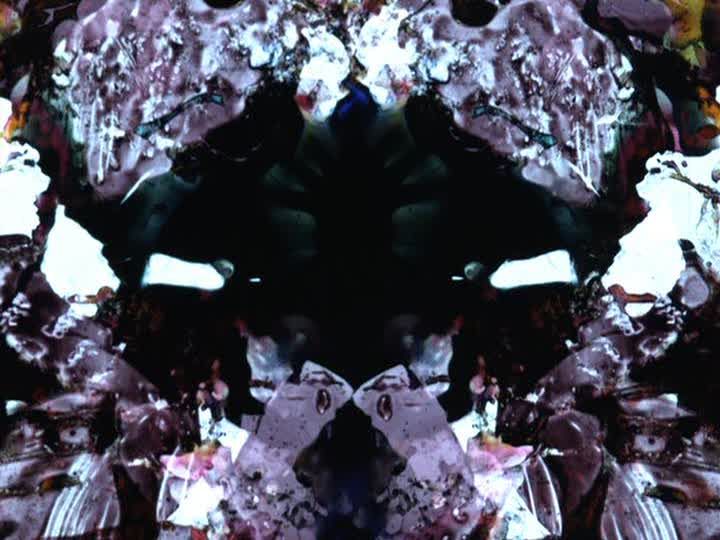
This steady pulsing is entirely unlike the frenzied montage of Persian #3, which starts fast and gradually accelerates to a mad pace that's dizzying and disorienting and utterly hypnotizing. The faster the images fly by, the deeper the viewer is encouraged to stare, the more trapped one feels by the overwhelming density of the montage. The mind nearly shuts down, short-circuited by the tremendous beauty and exhilaration of this sequence. Many of the strangely haunting fractal images embedded within this section subliminally suggest the shape of skulls, with circular forms as eye sockets and nostrils. Mortality is a common subject for Brakhage, who tends to view death as natural, part of a cycle that links birth (Window Water Baby Moving) and death (The Act of Seeing With One's Own Eyes). Here, these hints of death's head skulls are not integrated into the natural world, but provide a context-free evocation of what's hidden beneath the skin, and what is, here, hidden within the constantly shifting, unstable chaos of Brakhage's painted frames.

Such representational associations are perhaps unavoidable even with Brakhage's most abstract work: these meticulously painted frames are like Rorschach ink blots, evoking many concrete forms that may or may not have been intended as associations by Brakhage himself. But whatever can be seen within the chaos of these images is secondary to the visceral, emotional, sensual appeal of the images for their own sake.


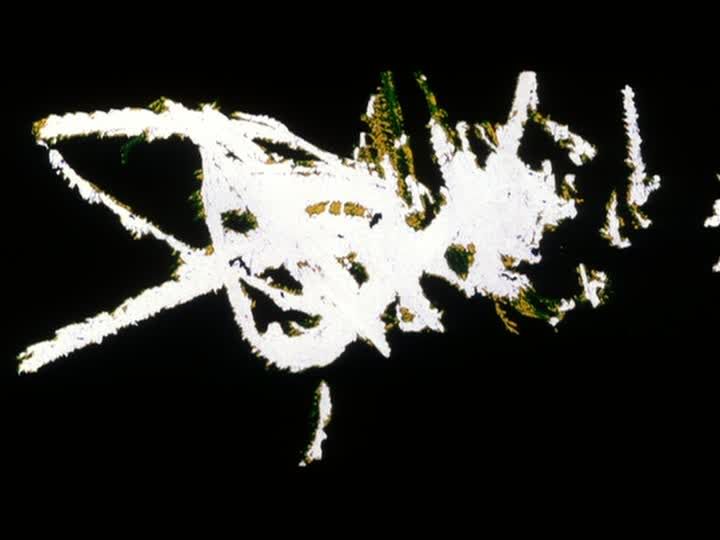
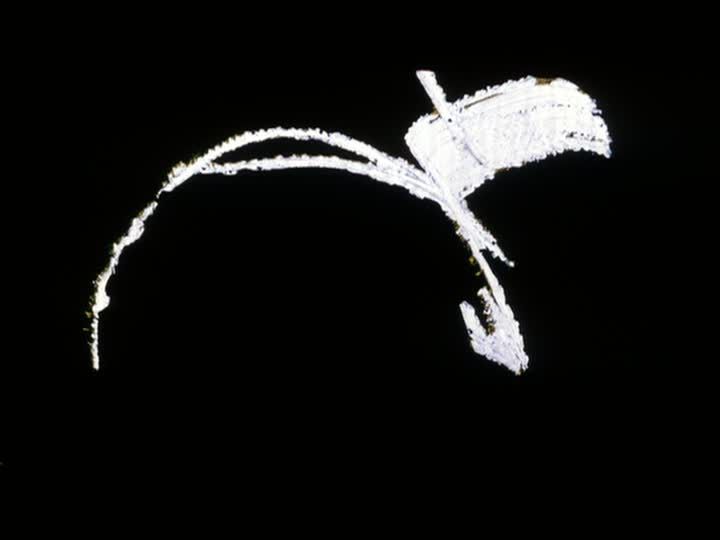
It is impossible to watch Stan Brakhage's final film, the two-minute Chinese Series, without thinking about the circumstances in which it was made. As the title suggests, the film was to have been part of a lengthy series of the kind that Brakhage had made before with the Persian Series, the Arabic Series and other serials. He completed only two minutes of the projected series before his death. The film consists entirely of white scratches on a black field: Brakhage carved these marks directly into the emulsion of a filmstrip by wetting the film with his own saliva and scratching with his fingernail. It was perhaps the only method of creation still available to the ailing filmmaker, a process of production founded from the interaction of the filmmaker's own body with the filmstrip.

It is as direct and personal a film as Brakhage ever made, perhaps the ideal of total sympathetic alignment of film and maker that Brakhage had always worked towards. Personal engagement is one of the keystones of Brakhage's art, whether he was using a handheld camera as an extension of his body or foregoing photography altogether to experiment with pasting objects directly onto the filmstrip (as in works like Mothlight) or hand-painting on film. He also often scratched and clawed at the film, as he does here, but rarely so singlemindedly, rarely as the only means of expression through which he acted upon his chosen method. Here, constrained by physical limitations, but also enlivened by aesthetic impulse — he planned to make the entire Chinese Series, however long it would have been, using only these emulsion scratchings — he pares his art down to its bare essence, and it's startling how much of the unmistakeable beauty and mystery of Brakhage's art remains intact in this skeletal form.


The images resulting from this literally hands-on process are as minimal and stark as one would expect: abstract hieroglyphics stuttering across the frame, seeming to spell out words in some indecipherable language. It's calligraphic and graceful. This not-quite-language is a poignant metaphor for Brakhage in the last days of his life, painstakingly (and maybe painfully) scratching out his last communication to the world, the very last images he'd create. There's a simple beauty to these curved white lines, their edges slightly frayed, sometimes densely hatched, sometimes forming just a few scattered, delicate tears in the surface of the film emulsion.

Monday, February 13, 2012

Sátántangó


Béla Tarr's Sátántangó is an extraordinary film, gorgeous and haunting and full of unforgettable images. Even at seven-and-a-half hours long, the film is never less than enthralling, and each deliberately framed and choreographed shot is jaw-dropping, even when nothing much is actually happening within the frame. Though Tarr isn't very concerned with narrative, there is a story of sorts here, a loose one divided into twelve chapters that overlap one another chronologically and show the same scenes from different points of view as different characters' stories intersect over the course of a couple of days. The film is set in a tiny rural Hungarian village at the start of the autumn rainy season, which the villagers are now prepared to endure, miserably, until springtime. The town is grim and ugly, a few crumbling buildings spread out across the barren, dismal countryside. The place is soggy and knee-deep in mud, and it's constantly pouring, rain streaming down the grimy windows and soaking the villagers whenever they trudge through the muddy fields that surround their homes. As the film opens, the villagers have sold off their communally owned cows and are planning to split the money and abandon the village, all of them heading off to their own personal escapes.

Naturally, they're all scheming against each other, some of them planning to steal all the money and escape on their own, until their plans are all disrupted by the return of Irimiás (Mikhály Vig, who also provides the film's eerie, minimalist music), a messiah-like con artist who'd been reported as dead a year and a half ago, but who had really been in prison with his friend Petrina (Putyi Horváth). This duo's return to town disrupts all the villagers' schemes, filling them with mingled hope and fear: they know that Irimiás will have some grand plan for their money, but it's not clear if they welcome this opportunity to be shaken out of their ruts or mourn the likely loss of their long-awaited windfall to the rogue's latest brainstorm.

This tense anticipation dominates the film's first half. Irimiás and Petrina do appear in one sequence early on, but other than this, they're spoken of more than seen for the first several hours of the film. Tarr observes how the villagers await the arrival of the mysterious duo, going about their dull and listless lives in the meantime, boiling over with frustration and confusion as they wrestle with their feelings about the returning troublemakers. Tarr's preference for long, unbroken takes — either static or slowly tracking — enhances the elongated expectation. The film is "about" its duration as much as anything, about the way time passes, about the long dead moments and empty spaces that make up a day. The film's epic seven-and-a-half hour length places the viewer in the same position as the villagers, enduring long periods of stasis and nothingness, long temps mort accompanied only by the buzzing of a fly or the loud, repetitive ticking of a clock in a depressing local bar.


The film opens with a long shot of a field of cows, the soundtrack dominated by their mooing and a droning tone in the background. Eventually, the camera begins to track sideways, away from the field, gliding along past a long wall, examining the crumbling plaster and cloudy, filthy windows that offer no view into the rooms inside. The camera's movement is slow and steady, and when it finally reaches the end of the wall, it looks out again at the cows, milling around in a courtyard in the distance, watching until they all wander away, out of sight around the corner of a building, leaving behind only a chicken strutting across the muddy open space until the image fades to black. It's a fitting introduction to the patient, unshowy aesthetic of Tarr's epic, its careful observation of the minutiae of daily life and its attentiveness to the matter of time.

Later, Irimiás and Petrina wait in a town office, and Irimiás comments that there are two clocks, neither of them correct. He poetically connects this temporal confusion to the "the perpetuity of defenselessness," before adding, "We relate to it as twigs to the rain: we cannot defend ourselves." That's the essence of Tarr's perspective on time, this relentless forward flow that cannot be paused or halted, that is always charging onward regardless of what's happening in any individual life. The emphasis on the passage of time is so essential because one of Tarr's key themes here is stagnation: time passes, and yet nothing happens, everything remains the same, the people of this town continue to wallow in misery and boredom, to simply pass the time.

Futaki, dreaming of fleeing the town with his share of the money, wants only to rent a farm where he can do nothing all day, only watch "this fucking life" go by while he soaks his feet. When Irimiás and Petrina return to town, their young hanger-on Horgos (András Bodnár) fills them in on what the town is like now — which is to say, that nothing's changed, that everything is exactly as it was a year and a half ago when they left. In this context, Tarr's deliberately eventless static views and snail-paced tracking shots accentuate the numbing, narcotic pace of everyday life in a place where nothing happens, and where even the wildest dreams of the inhabitants are boring and routine.


At other times, though, Tarr finds strange beauty and even heroism in the mundane. A drunken old doctor's (Peter Berling) trip to refill a jug of fruit brandy becomes an epic journey across the wasted countryside of the village. He staggers and stumbles through the muddy fields, the rain pouring around him, the soundtrack composed only of his heavy breathing, his raspy coughs, his burps, and the plodding steps of his feet, sticking in the mud that covers both the roads and the fields. As it gets dark, the doctor's form is increasingly hidden in the unlit night, his silhouette occasionally highlighted against the distant lights of a house or the local bar. As the doctor approaches the bar, wheezing accordion music can be heard, the first hint of the drunken revelry that will play out in later scenes inside the bar. The doctor just passes by, though, staggering into the woods, glimpsing the dark trio of Irimiás, Petrina and Horgos purposefully walking by on the nearby road. Tarr makes this simple journey across a small distance seem epic, overwhelming, taking every ounce of will and strength from this unhealthy, unhappy old man. That's another aspect of Tarr's extended duration: this is an epic of the everyday, an epic of short distances, because this town and its muddy, pathetic territory is the full extent of what these people know, it is the setting for their entire lives and thus it must be epic, because everything they are and everything they do plays out here, and a trek to get some alcohol can seem as important as Odysseus' journey home, while a short cigarette break with some plump prostitutes takes the place of Odysseus' many detours and obstacles on his way back to Ithaca.

There is an obvious political dimension to the film, as well. Tarr had wanted to adapt Lázló Krasznahorkai's novel since the 80s, but he had been unable to do so because of the threat of censorship from the Hungarian Communist government. It doesn't take much reading between the lines to see that the film is a bitter satire of the failures of communalism, exposing the ways in which, while supposedly working communally towards a common purpose, people remain atomized and isolated, concerned far more with their own selfish interests than those of the group. Irimiás himself is the most obvious symbolic representative of Communist ideas. He calls himself "a servant of a great cause" and organizes people for his schemes, but the dreams of communal success that he stirs up in others are simply smokescreens for his cons and tricks. He says he's bringing people together but he actually tears them apart and scatters them, breaking up their community under the guise of rejuvenating it. The idea of working together for a common goal is a lie, a ruse, a distraction from the essential miserableness of these people's lives. They have no sense of real control over their lives — they are defenseless, a theme that percolates throughout the film — and Irimiás' grand rhetoric gives them an illusion of power, however misguided. Really, they are defenseless before him as well.


One of the film's most notorious extended scenes is the one where a young girl (Erika Bók) tortures a cat and then kills it by putting rat poison in milk. She feels hopeless, bored, abandoned, by a family that doesn't seem to care about her much, and she takes out her own torment on her defenseless pet before killing herself as well. It's an uncomfortable sequence to watch, and not only because of its implications for the characters and themes. Tarr insists that the cat was treated humanely and not truly harmed, but it's still discomfiting to see the girl flail around, swinging the cat around with her, then trapping it in a net and shoving its head into a bowl of milk. Such moments in a fiction film always shatter the illusion of a story being acted out. It's too real, and too cruel, forcing one to think not about the cruelty of this girl, whose feelings of impotence lead her to assert her power over a defenseless animal, but the cruelty of the filmmakers who demanded that the scene be shot in this way, that these things should be done to a real, defenseless living thing.

The penultimate chapter of the film resumes the commentary on the political dimensions of Irimiás' actions. This segment consists entirely of two bureaucrats translating Irimiás' vile, hateful letter about the townspeople into more discrete and official language. Nothing can be said directly, so they have to come up with euphemisms for everything, replacing "fat sow" with "overweight," and "wrinkled worm, filled with alcohol" with "elderly alcoholic, short of stature." This sequence is rich in bitter humor, mocking the bureaucratic circumspection of these office drones while also revealing the full extent of Irimiás' deceitfulness. At the same time, Tarr focuses on the humanity of the bureaucrats, whose work — cleansing language of its richness and idiosyncrasy, reducing words to a generic gray pulp — wears them down daily. They take a break from their work at one point, sitting down away from the typewriter to have a snack, eating in silence. While they eat, they drop their businesslike demeanors, and suddenly they are just men, requiring a break from the soul-numbing stupidity of their work. When they're done eating, unfortunately, they must return to the typewriter.


Tarr often enlivens the film with subtle, bittersweet humor like this. One key sequence is the lengthy drunken dance where the townspeople, anxiously awaiting Irimiás' arrival, clumsily dance and grope one another. The scene lasts around half an hour, with the repetitive accordion music wheezing out its incessantly bouncing melody, as the revelers sway and careen off one another awkwardly. The cast was really as drunk as they seem to be onscreen, lending an air of verisimilitude to their staggering steps and lunges at one another. They seem angry one moment, joyous the next, their minds clouded, erasing themselves in this celebration. In the chapter title that precedes this segment, Tarr deems the dance the "sátántangó" from which the film takes its name, and indeed there's something apocalyptic and desperate about everyone's flailing about, their wild abandon. But it's also amusing and powerful, a rare moment of celebration in the lives of people who don't often have much to celebrate. At one point, the camera pans around the room and finds one married couple eating from opposite ends of a cheese bread, devouring it like Lady and the Tramp romantically eating spaghetti together, a hilarious and ridiculous image, if also a grossly romantic one.

Petrina is also a rich source of comedy, playing a dopey comic foil to the messianic Irimiás, even in terms of appearance. While Irimiás is striking and foreboding in his dark trenchcoat, Christ-like beard and fedora, Petrina looks like a dumpy reject from the Three Stooges, a woolen snow cap pulled down tightly over his egg-shaped head. In a mysterious scene late in the film, Irimiás, Petrina and Horgos are walking along a road through a sparsely wooded area. Suddenly, Irimiás stops and falls to his knees in the middle of the road, staring forward as though overcome with sublime religious awe. He watches as a cloud of fog rolls past, obscuring a ruined building, then blowing away in the wind. Tarr never explains this moment or the image that prompts Irimiás' awe; it's left as a beautiful and eerie image of the huckster being overcome, momentarily, by seemingly genuine sentiment. Then Petrina breaks the mood, as the trio walks away, by irreverently asking, "you've never seen fog before or what?"

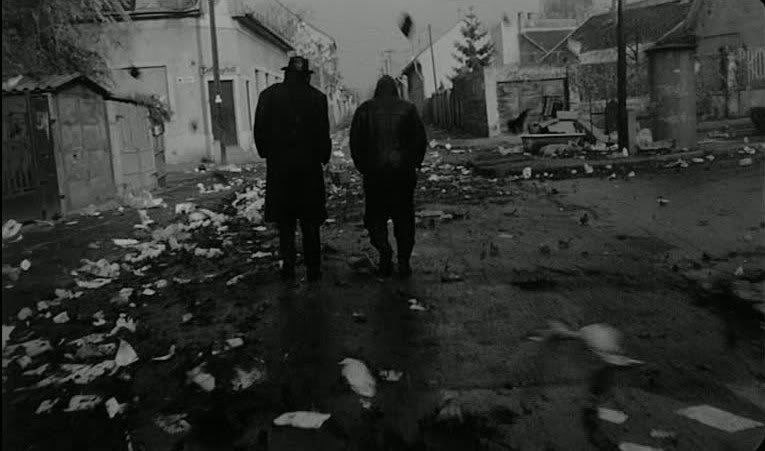
Irimiás is often associated with nearly mystical, awe-inspiring incarnations of nature. In one of the film's best shots, Irimiás and Petrina walk along a road through town as garbage flies along the ground around their feet, the wind whipping paper, cardboard boxes and other debris through the narrow path between houses. It's another somewhat apocalyptic image that's strikingly beautiful as well, capturing the stark, weather-beaten conditions of this town, but also making even this barrage of trash seem graceful and elegant.


The film is packed with gorgeous, unforgettable images like this, like the remarkable shot that keeps circling around the sleeping figures of the townspeople in the manor they've moved to at Irimiás' behest. As they sleep, and the camera twirls, the voiceover recites the dreams and nightmares of the villagers, haunted in their rest by strange visions, confused erotic fantasies, and fantastic hopes. It's a deeply affecting extended shot, because Tarr's film is all about the hopes and dreams of these ordinary, downtrodden people — and the ways in which those dreams are destroyed and corrupted by the cruel world they inhabit and the societal strictures that govern even their most secret dreams.

In the film's devastating final chapter, those dreams seem to take tangible form, writing a surreal nightmare onto the landscape of the territory as Tarr returns to the elderly doctor. He once again wanders off into the landscape, but this time, instead of stolidly plodding through the muddy fields in real time, he gets swallowed up by a strange vision, chasing the distant sound of bells to a wrecked church where a mysterious and cadaverous-looking man repetitively rings a bell and shouts. It's a strange and unsettling end to a remarkable film, and the final shot, in which the doctor slowly removes every trace of light from the image by boarding up his windows, chronicles the slow process by which the film disappears into the nothingness from which it came.

Monday, January 30, 2012

The Freethinker


By the time Peter Watkins made his massive, four-and-a-half hour 1994 video project The Freethinker, he was thoroughly outside of most conventional media structures. Watkins originally planned to make The Freethinker in 1979, as a companion piece to his 1974 masterwork Edvard Munch, but after working on the project for over two years, his funding was cancelled and filming never commenced. As a result, the film was only made many years later, as a collaborative experiment conducted with the assistance of a video production class made up of Swedish high schoolers. The students, all inexperienced with film and video before the class began, handled nearly every aspect of the production: set design, costumes, acting, camerawork, lighting, even at times writing and directing. This behind-the-scenes history informs the resulting film in very deep ways, feeding into the themes about mass media, art and social reform that Watkins' script explores.

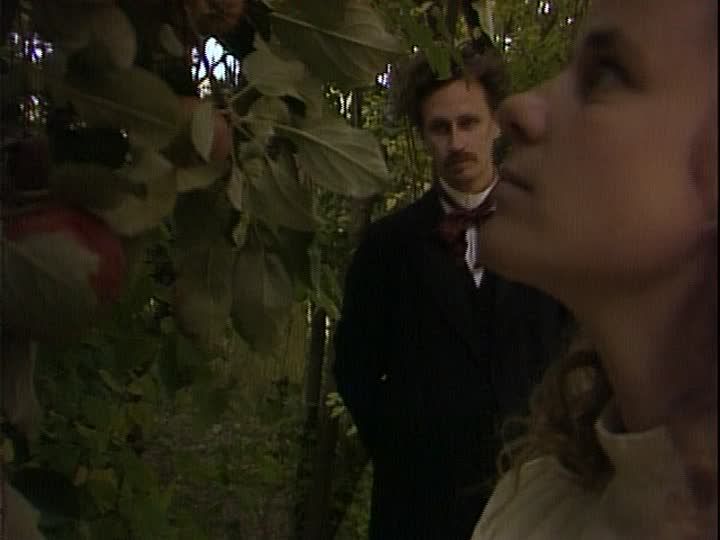
The film is nominally a biography of the Swedish playwright and author August Strindberg (Anders Mattsson), who Watkins sees as a non-conformist thinker whose radical ideas about history, religion and class caused his work to be suppressed and critiqued by the conservative institutions of his time. Watkins explicitly compares this treatment with the marginalization of his own work. It's very apparent that this examination of Strindberg's life and the conditions of late 1800s Stockholm is meant to parallel Watkins' own life and art, and what he sees as the suppression of his ideas by a mass media that has little patience for this kind of intellectual engagement.
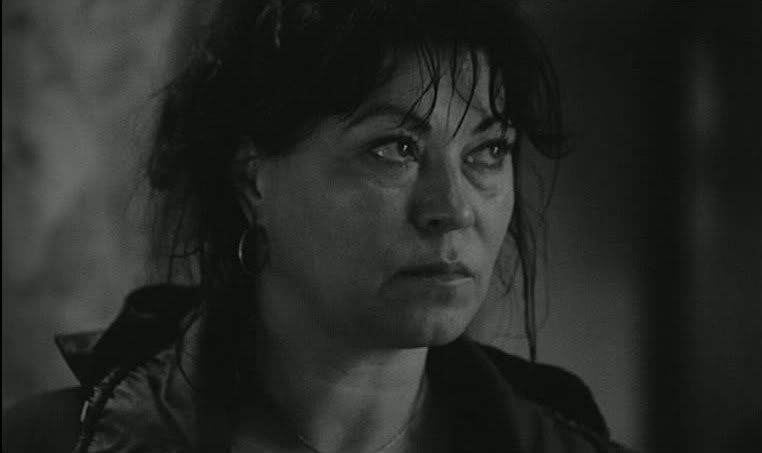
The film is thus about its own conditions of production as much as it is about Strindberg's life and work. This is obviously a work made on a shoestring budget, in amateurish conditions. It was shot on video rather than film, and the imagery is often rough as a result, the colors muted, a long way from the grainy beauty of Edvard Munch. The sets are sparse and minimal, often looking like a bare theater stage with a few props scattered around the empty space. The dramatic scenes, both those taken from Strindberg's life and those enacted from his plays, are stagey and claustrophobic, with the camera hovering close to the actors, utilizing simple compositions that place the emphasis on the raw, heartfelt performances. This parsimonious style belies the structural and ideological complexity of the film, which is, typically for Watkins, a clear-eyed and intelligent examination of the intersections between art, life and society. As in Edvard Munch, Watkins applies a non-chronological, associative editing style that juxtaposes scenes from Strindberg's life with excerpts from his plays as well as contextual material involving contemporary political and social affairs in the world around him.
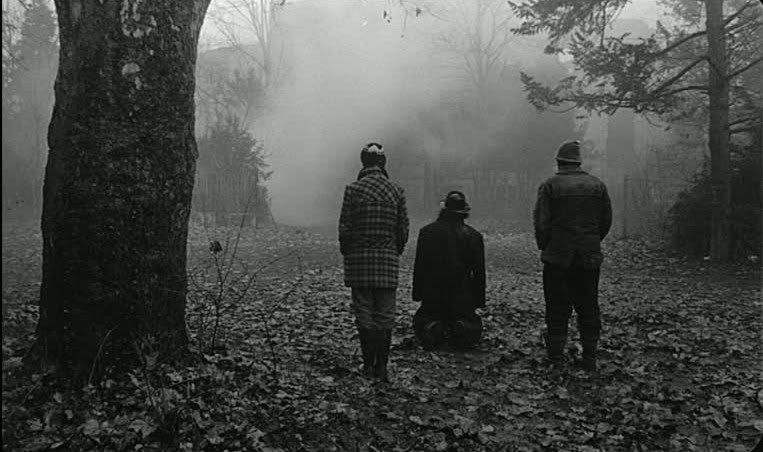

At several points, Watkins diverts from Strindberg's story to focus on the testimonies of Swedish working class people. A man working on a construction site complains that there's housing only for the rich, while the women working beside him note that they don't earn as much as the men even though they do the same work. In another scene, a family waits for a ship that will take them away from the poverty and lack of opportunities they find in Sweden, to the United States, where they hope to do better. One young woman turns towards the camera, sobbing, her face red, already regretting the necessity of leaving behind her homeland and some of her family and friends.

Such interludes help to ground Strindberg's story within the larger societal context of poverty, inequality, and unfairness, conditions that much of his work polemically rails against. Watkins adopts, as he often does, a pseudo-documentary style that speculates on what it might have been like if documentary camera crews had been on hand to question Strindberg about his ideas, to document his life and his relationships, to interview young radicals and grizzled workers in the streets about their complaints and their hopes.

At one point, Strindberg returns from exile to Sweden, facing criminal charges of blasphemy, and finds the streets full of exuberant young people celebrating his return and the boldness of his anti-orthodox ideas about religion and government. Watkins stages the scene so that it looks like a modern protest, like any number of post-1960s student movements that have taken to the streets in a celebratory mood to declare resistance. The only difference is the way the protestors are dressed. To underscore the point, Watkins inserts a title that reads, "On the same day that we filmed these scenes in 1993, the Danish police in Copenhagen opened fire on a crowd of unarmed demonstrators." The film is continually drawing such connections between past and present, suggesting that the upheavals and social changes that have taken place in the intervening years have been largely cosmetic, doing little to truly disrupt an underlying dynamic of power and control that remains solidly in place.


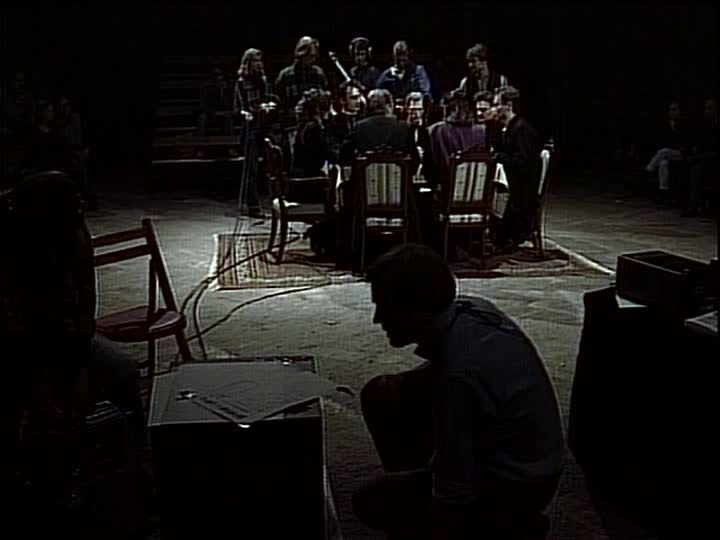
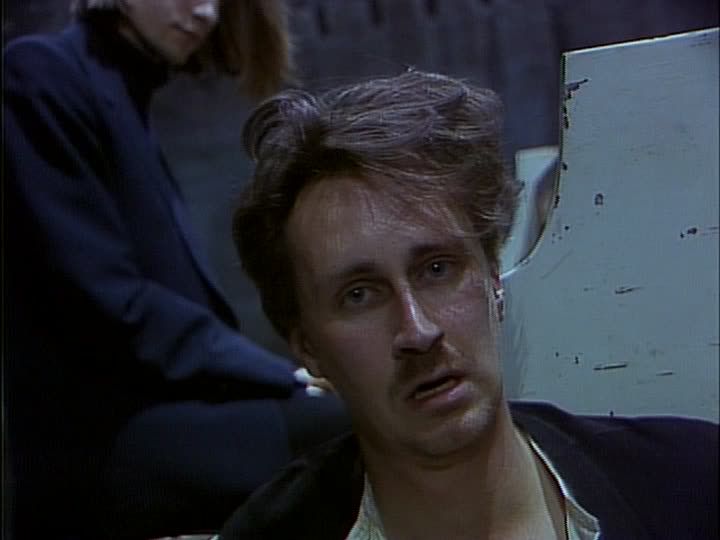
In one of the most remarkable sequences, a group of radical Swedish writers discuss the problems of their time and try to come up with a plan to address gender and income inequalities, both in their writing, and as a broad social reform program. They debate methods and priorities, trying to decide how best to excite public interest in child labor, women's suffrage and the plight of the poor. During this scene, Watkins inserts shots that pull back from the table around which the young writers are gathered to show the cameras, microphones and film crew clustered around them in the room, revealing the cinematic context of this discussion. Soon Watkins goes even further by shattering the film's reality entirely, placing himself onscreen in a discussion with the actors playing the Swedish writers. The actors remain in costume, but now instead of debating conditions in late 1800s Stockholm, they're addressing the modern world, the problems of the mass media, the apathy and lack of belief in progress that prevents modern reformers from having a real voice with which to reach people.

This transition neatly displays the parallels and differences between the two times, suggesting that today's problems are extensions of those of the past, part of the same struggle for equality and justice that has gone on in so many forms over the decade without the need for the struggle ever going away. The issues of the present — class inequality and control over the media — are the same ones that the radicals of Strindberg's time were interested in. In Strindberg's time, the newspapers were battlegrounds for ideas about social reform, with certain papers being sponsored by the rich and the monarchy to attack the ideas of those papers on the left. Even history itself was a site of struggle, as Strindberg's The Swedish People, which for the first time focused on the lives of common people in different eras, represented a challenge to traditional histories which focused on successions of monarchies and governments, wars and treaties, big events and big men. Predictably, Strindberg's history received almost unanimous bad reviews, because the newspapers were largely controlled by precisely the entrenched conservative interests who were threatened by a book that refocused the eye of history so radically and dramatically.


Much of the second half of the film is concerned with the contradictions of Strindberg's life and personality, particularly his late-in-life repudiation of his earlier support for feminism, and his increasingly bitter and contemptuous feelings for his first wife, Siri (Lena Settervall). One of the central questions of The Freethinker is the relationship between life and art, including the paradox that Strindberg often expressed ideas of freedom and equality in his writing that he seldom put into practice in his angry, troubled personal life. Watkins' associative editing style creates linkages between childhood incidents — particularly the cruel punishments of Strindberg's stern, overbearing father — scenes from Strindberg's dramas, and incidents from his long relationship with Siri, with whom he stayed for 15 years. During the second half of the film, Watkins also explores Strindberg's private life through confrontational staged interviews with the playwright, in which a modern interviewer, a member of the crew, hounds Strindberg about his treatment of his wife and children, provoking the writer while Strindberg repeatedly protests that there's more to it, that no one understands.

Indeed, this is a project about understanding, but Watkins grasps that it is impossible to fully comprehend a subject so remote from our own time. The film's analysis of Strindberg can only be built on the writings he and others around him left behind, the incomplete records of their thoughts and feelings and the events that shaped them. Watkins stages a group discussion of Strindberg and Siri in which an audience of men and women of all ages talk about the relationship between the playwright and his wife, grappling with the questions about feminism, creativity, gender and psychology brought up by this story. As one older man says, as a postscript to his own personal take on Strindberg, "there must be many views of Strindberg," many ways of understanding him and his work, many perspectives on the ideas he explored and the kind of man he was during his life.

This is the essence of Watkins' multifaceted approach to his subject, dealing with the complexities of Strindberg's persona and art, and the many possible ways of thinking about his life. The filmed discussion sessions represent an attempt to contextualize Strindberg in a modern setting, and to suggest the kind of active engagement that Watkins desires for his films: the in-film discussion is a model for the kinds of discussions that the film as a whole might prompt in its viewers, so that the discourse and analysis started by the film might continue afterwards.


That spirit of discussion goes hand in hand with the intensely collaborative nature of the film. Watkins worked closely with the students from his class, and credits a few of them with writing and directing certain sequences of the film. The production process recalls the utopian collaborative spirit of 1960s radicalism, the student protests and communes, the attempts at creating art communally rather than individually. Those projects, like Godard's Dziga-Vertov Group, rarely lived up to the promise of true cooperation and communal creation that they espoused. But Watkins' work here is no mere leftist dream, he's actually putting into practice these ideals of collaboration, and the result is remarkable. The film employs a mix of amateur and professional actors, though most of the leads, notably Mattsson and Settervall, were not experienced actors; Mattsson was ordained as a priest after the film was finished. The performances are almost uniformly exceptional, especially since Watkins asks the actors to do more than simply play a role, but also to be present as themselves, commenting on the roles they're playing and the historical figures they represent. Mattsson and Settervall in particular often face the camera in intimate closeups, speaking about Strindberg and Siri in the third person, which makes it clear than in these sequences they are not "in character."

The Freethinker is continually working on multiple levels in this fashion, blending biography, literary criticism, sociopolitical commentary and media analysis. It's an amazing film that reflects Watkins' ideas about media hegemony and its connections to class imbalance, but most importantly its polemics are integrated into a larger whole that also wrestles with the nature of art and the relationship between the individual and his or her historical and social context. Even its cooperative production seeps into the film, providing an example of an alternative media model that skirts around the corporate mass media that currently dominates the distribution of information.