Showing posts with label Stan Brakhage. Show all posts

Monday, April 8, 2013

Unconscious London Strata/The Mammals of Victoria


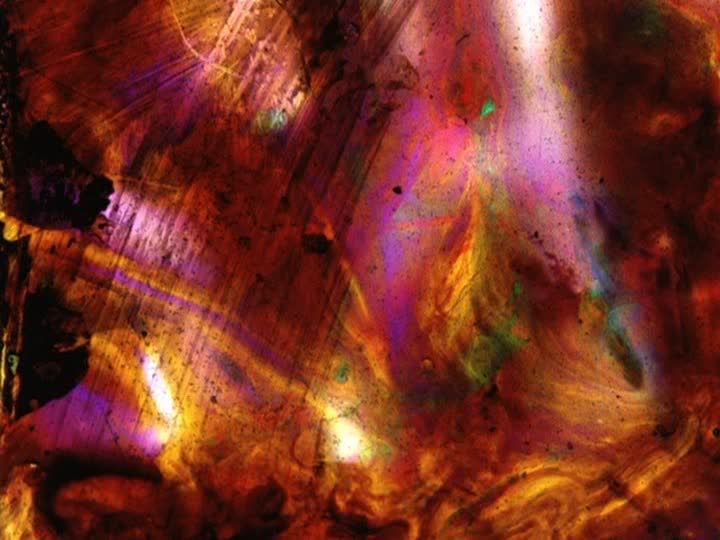
Unconscious London Strata is one of Stan Brakhage's gloriously abstract studies of light and color, with virtually no grounding in concrete forms. The film consists of a rapidly edited montage of blurred, vague images in which any physical context has been smeared away, leaving behind only layered, overlapping colors and bursts of brilliant light. The effect is beautiful and sensual, and in this case Brakhage's layered forms specifically recall the canvasses of Mark Rothko, with sedimentary layers of colors stacked on top of one another in fuzzy strata. As the title suggests, these images are often striated, colors abutting one another in hazy proximity, those beautifully grainy color fields that convey a spiritual, moving quality remarkably similar to the effect produced by Rothko's paintings.

Only towards the end of the film do these abstract fields start to cohere, at least slightly and sporadically, into recognizable images of a building, possibly (and appropriately) a cathedral. Even here, the images are by no means concrete, and the building's form is still abstracted, split apart into momentary flashes of an angled corner or a spire turned upside down. Occasionally, the flickering, shaking images resolve into a second or two of a silhouetted skyline, blocky buildings lined up along a horizon of golden light, but that image too is illusory, gone in a moment.

For the most part, Brakhage refrains from even that much of a hint of physicality. Like his even more sensuous and beautiful light study The Text of Light, this film treats light and color as absolutes, pure visual phenomena without reference or connection to the tangible sources from which these lights emanate. As with Rothko, the effect is both utterly simple and utterly breathtaking.


In The Mammals of Victoria, Stan Brakhage focuses mainly on images of the sea. This is the second part of a four-part series based on the life of Brakhage's wife Marilyn, but there's very little human — or, indeed, mammalian — presence here. Instead, the film is full of images of water in its many forms: rippling blue waves, a black nighttime ocean with speckles of light shimmering across its surface, little wavelets lapping up against a muddy outcropping in the shallows by the shore. Brakhage returns several times to that image of mud piles sticking up out of the water, at one point showing the mud crumbling as the water licks at it, slowly eroding and erasing it. The film's contemplation of nature, with humanity at most a peripheral presence, emphasizes each individual's brief span of life when compared against the rolling, unceasing rhythms of the waves and the tides, the ancient perpetual motion machines of the natural world.

Towards the end of the film, Brakhage includes a pair of evocative, mysterious shots that appear to have been taken from a moving car. In the first, two other cars speed by, their headlights briefly flaring at the camera before whipping around the curve of the road and out of the corner of the frame. The car that the camera is in then continues along the road, turning into the sun, which cuts through the trees and washes out the image in a haze of white light. In the second, simpler shot, the camera simply gazes out of the car as it approaches a modestly sloping hill in the road, approaching this point on the horizon beyond which the road can no longer be seen. The hazy, sun-dazed shot suggests the slow progress into the unknown, a graceful glide up and over a slope into the unknown world beyond. These two images add a subtle narrative component to the film, a hint of action and agency, just as the shots of people playing in the waves, which also don't appear until late in the film, belatedly introduce characters. Before this, for much of the film there's little indication of human presence at all, only an occasional blurry, blink-and-it's-gone shot of somebody wading through the water.

Brakhage is also exploring different forms of distortion: the wavery quality of an image seen from beneath a film of water, the static and flickering of a TV set, the grainy haze of low-quality film stock. Brakhage seems to be using several different types of film, contrasting the clarity of an image of rocks jutting out of the water against blurry, nearly impenetrable landscape shots. The different film stocks contribute to the film's eclectic visual style, which explores textures both smooth and rough, as well as stitching in a few short painted segments. The painted sequences flicker by quickly, and are mostly pretty routine, not at all the best examples of Brakhage's hand-painting. (An exception is a flurry of cosmic star fields and swirling galaxy-like forms that appears towards the end of the film.) The painting in this film mostly seems like a placeholder, a brief visual palette cleanser connecting photographed images, often segueing seamlessly into an out-of-focus image of lights hovering in a dark field, drawing a connection between Brakhage's photographic abstractions of the world and his painted abstractions.

Friday, May 25, 2012

Three Stan Brakhage shorts, 1995-1997


I Take These Truths is one of Stan Brakhage's painted shorts, and indeed it offers up a near-exhaustive catalog of the many styles and techniques associated with his hand-painted work. The film is characterized by its staggering diversity, its evolution from one style to another, seldom settling into any one mode for very long over its 18 minutes. Sometimes there's a kind of stained glass effect, with bursts of bright primary colors hemmed in by thick black lines. Sometimes faded colors and specks hover in a plain off-white field, leaving the frame only minimally populated for a few moments. At other times, the frame is full of bright red, blue and orange bulbs, like balloons drifting into the sky or a field of flowers. At one point, white specks flutter against a black background, like snow falling at night, and then later in the film, the black-and-white palette returns with graffiti-like almost-letters twisting and twirling against the black. The pacing is mostly extremely fast and constant throughout, but even so there's some sensory variety, from jumpy rhythms to a sensuous flow between blobs of paint to a jittery, strobing quality that makes each frame seem momentarily frozen, a paradox within the unceasing forward momentum of Brakhage's flood of imagery.

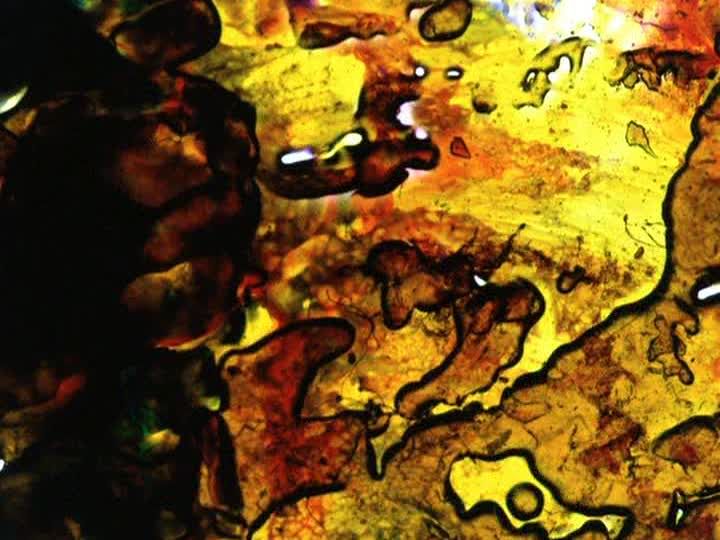
So it's a study in color, starting with a few pale washes against a white backdrop, then quickly growing more complex and stretching out in multiple different directions. Like so many of Brakhage's painted films, it confounds analysis or interpretation. The title might suggest some kind of political perspective here, but not only does the film itself contain no hint of any tangible, non-abstract content, but Brakhage himself provided an alternate explanation that completely negates any attempt to extrapolate to external factors or ideas. For Brakhage, the only "truth" is the truth of the image, the undeniable truth of what's seen and experienced by the individual. It's an experience that's exceedingly difficult to translate into words, but that's precisely what Brakhage wanted with films like this. What's "self-evident" is what is seen; what the film "means" is only its particular combination of colors, shapes and visual rhythms. It's purely about its own physical appearance, about the textures of the paint slathered directly onto the film, as well as the even more direct black-and-white segments where Brakhage scratches images right into the filmstrip without even using paint.

It's a physical effect he's going for as much as anything, rooted in the physiological truths of how the human eye works, the way we transmit images from our vision to the brain for processing, at a rapid speed that still struggles to keep up with the pace of Brakhage's constantly changing imagery. Perhaps this neurological basis for vision explains the sections of the film in which dense bundles of dark lines wiggle across a white space, images that suggest either neuron networks or clusters of chromosomes. Brakhage was always interested in what's inside us, in the way the human body and mind work. Such images hint at those fascinations without concretely embodying anything at all.


The Cat of the Worm's Green Realm explores the natural world as seen from perspectives outside of humanity. Stan Brakhage's camera digs down into the undergrowth, into the hidden miniature worlds that ordinarily escape human notice. The film is receptive to the endless beauty and variety of the natural world, to its subliminal structures, to the life and vitality encoded in even the smallest segments of the larger whole, even down to the molecular level. To that end, Brakhage probes textured closeups of veiny leaves, buds on the end of green stalks, and sedimental layers of bark, placing his view right up against the surface of things, examining the lines and gradations that are revealed at such an intimate distance, or using blurred, abstracted images to restore the tiny detail to the vaguer outlines of the totality.

Often, the frame is composed entirely of subtle gradations of green, clusters of bushes and trees blending together into a rich color field that reveals all the different possible meanings of "green." In one of the film's most memorable moments, a shot of trees and bushes slowly pulses into focus, starting as a field of blurry greenery and then gently wracking the focus back and forth, like breathing, until the leaves on the trees pop into focus, at which point Brakhage immediately cuts away, so that only that split-second of clarity remains in memory. It's startling because of how organic that process of focusing is here; it really does feel like the camera's mechanisms are synced to the gentle rise and fall of the operator's chest, his breathing contributing to the gradual slide of the image from blurry to clear in minute ticks.

The film's color palette tends towards lush natural greens and fleshy pinks, both suggesting fecundity and sensuality. Brakhage runs his camera lovingly along the surface of curving pink color-forms that might be flowers but suggest sensuality and femininity — as does the slithering, fleshy body of a worm, captured in a clinical closeup, tiny clumps of dirt clinging to its curves as it writhes around within an abstract light field. A black cat stalks around the edges of the film, often barely glimpsed, blending into the shadows, flickering through the underbrush. The cat, which occasionally stops to lick itself long enough for a closeup, is one of Brakhage's surrogates in exploring the natural world, and as the title implies, the worm is the other. Both are creatures that glide through the world much more effortlessly and smoothly than humans, much more seamlessly integrated with the dense greenery.

Brakhage seems awed by this subterranean beauty, by the impressiveness of the world's structures whether one examines them at the highest level or the lowliest. There's a sense of near-religious sentiment here, as in a shot of the sun filtering through a canopy of undulating tree branches, the effect something like stained glass, the light tinting the leaves yellowish on the sides facing up towards the sun, while underneath are darker shadows. It's a jaw-droppingly pretty image that Brakhage slowly fades to black so that shadows seem to be infiltrating this tranquil garden, blotting out the sun, spreading across the leaves like rot.


Yggdrasil is the World Tree of Norse mythology, the spine holding together the Norse cosmology of nine separate worlds, the tree from which Odin hung for nine days in order to gain knowledge. What this has to do with Stan Brakhage's film Yggdrasil: Whose Roots Are Stars in the Human Mind is not immediately clear, but Brakhage himself describes it as a response to his own Dog Star Man, a revision of his earlier cosmology. The film is dominated by muted, washed-out colors, with lots of browns, evoking the trunk of the World Tree, particularly in a repeated, painted image of brown patterns running vertically along the frame.

Brakhage here alternates between several types of footage: hand-painted stretches, photographic documents of nature and industry, and sequences in which Brakhage explores the properties of lit-up cities at night. The film is a fast-paced montage in which these different images collide against one another, spaced out between inserted pauses of black leader that introduce brief rests or create a flickering effect. The most effective images in the film are the brief shots of lights: showers of sparks from fireworks, curlicues of colored lights speed-blurred and dancing across a black frame, little twists and twirls of light from speeding cars or city buildings, hovering in the nighttime blackness. Those images often recall Marie Menken's extraordinary 1966 film Lights, though here Brakhage quickly moves on from those bursts of light each time they appear.

Also compelling is what seems to be an uncharacteristically literal shot referring to the "stars" of the film's title, in which the stars appear as bursts of sunlight dancing on the lightly rolling surface of a cloudy body of water, a star field conjured up from a stagnant pond. Despite these moments of interest, this film is something of a lesser work from Brakhage, somewhat lacking in the mystical, mythological import implied by its title.

Friday, April 13, 2012

Persian Series 1-3/Chinese Series


Stan Brakhage's painted films are extraordinarily difficult to write about. These films, more even than Brakhage's films utilizing primarily photographic images, create their own purely visual and abstract language that can not be translated easily into words. The Persian Series, an 18-film series of hand-painted, optically printed works, represents Brakhage at his most resolutely abstract, dealing purely with color, rhythm and form(lessness). The first three films in the series capture different moods, different sensations, while each maintaining a similar palette of bright, thickly clumped paints. Persian #1 is stuttery and hesitant, interspersing bursts of colorful painted hysteria with black-leader pauses, and ending with a few glimpses of blurry color forms that reveal the abstracted photographic foundation that is elsewhere either absent or all but entirely obscured by the dense layers of paint laid atop it. Persian #2 is slow and sensuous, an elegant dance of colors swirling around. Persian #3 is fast and frenetic, introducing more deep blacks and sharp-edged fractal patterns within the rapidly boiling stew of images.

These films are intense and sensually satisfying, suggesting a surprising range of emotions and sensations with their abstract paint blots. Persian #2 opens with an extraordinary sequence that gives the impression of a series of zooms in or out, the "camera" seeming to move forward and then backward. This sequence (achieved via optical printing) creates the impression of entering a tunnel, hurtling down into a wormhole carved out of black space, every color of the spectrum stretched and speed-blurred as the viewer descends towards the center of the whirlpool, only to start pulling away, zooming backwards, rejected by the black hole and its intense swirl of colors. Later in this segment, the images slow down subtly and change to a steady rhythmic beat so that it looks like a rapidly edited montage of still photographs, each seemingly random spill of paint briefly frozen in time, captured in a flash, then flickering away to be replaced by another.


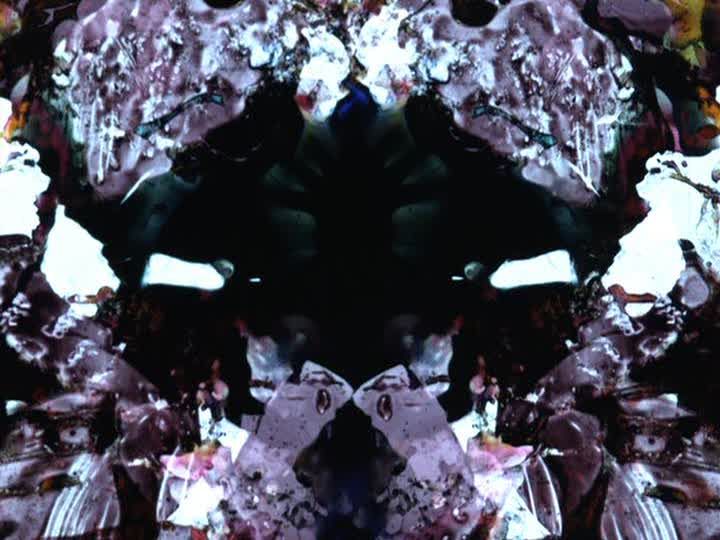
This steady pulsing is entirely unlike the frenzied montage of Persian #3, which starts fast and gradually accelerates to a mad pace that's dizzying and disorienting and utterly hypnotizing. The faster the images fly by, the deeper the viewer is encouraged to stare, the more trapped one feels by the overwhelming density of the montage. The mind nearly shuts down, short-circuited by the tremendous beauty and exhilaration of this sequence. Many of the strangely haunting fractal images embedded within this section subliminally suggest the shape of skulls, with circular forms as eye sockets and nostrils. Mortality is a common subject for Brakhage, who tends to view death as natural, part of a cycle that links birth (Window Water Baby Moving) and death (The Act of Seeing With One's Own Eyes). Here, these hints of death's head skulls are not integrated into the natural world, but provide a context-free evocation of what's hidden beneath the skin, and what is, here, hidden within the constantly shifting, unstable chaos of Brakhage's painted frames.

Such representational associations are perhaps unavoidable even with Brakhage's most abstract work: these meticulously painted frames are like Rorschach ink blots, evoking many concrete forms that may or may not have been intended as associations by Brakhage himself. But whatever can be seen within the chaos of these images is secondary to the visceral, emotional, sensual appeal of the images for their own sake.


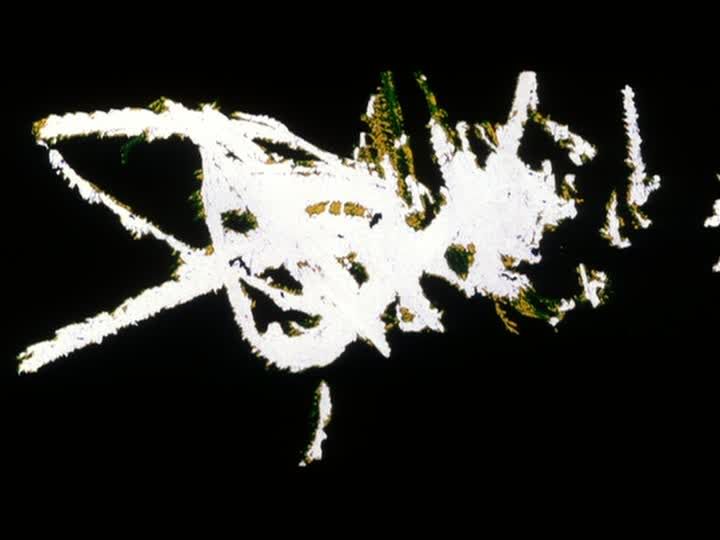
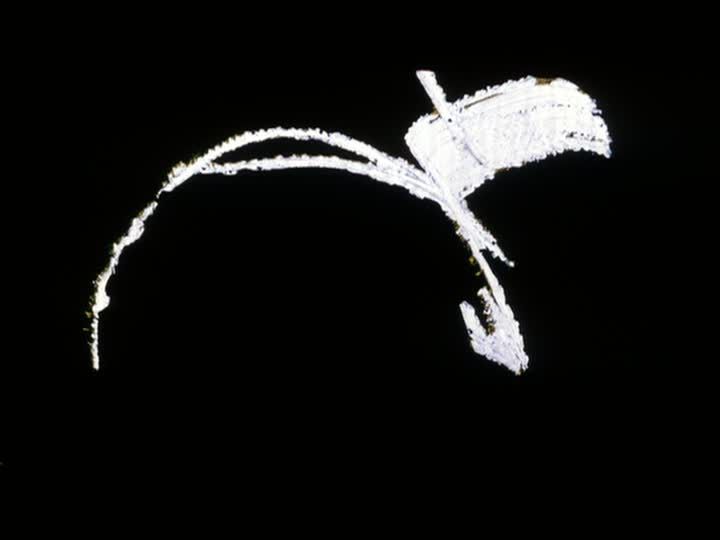
It is impossible to watch Stan Brakhage's final film, the two-minute Chinese Series, without thinking about the circumstances in which it was made. As the title suggests, the film was to have been part of a lengthy series of the kind that Brakhage had made before with the Persian Series, the Arabic Series and other serials. He completed only two minutes of the projected series before his death. The film consists entirely of white scratches on a black field: Brakhage carved these marks directly into the emulsion of a filmstrip by wetting the film with his own saliva and scratching with his fingernail. It was perhaps the only method of creation still available to the ailing filmmaker, a process of production founded from the interaction of the filmmaker's own body with the filmstrip.

It is as direct and personal a film as Brakhage ever made, perhaps the ideal of total sympathetic alignment of film and maker that Brakhage had always worked towards. Personal engagement is one of the keystones of Brakhage's art, whether he was using a handheld camera as an extension of his body or foregoing photography altogether to experiment with pasting objects directly onto the filmstrip (as in works like Mothlight) or hand-painting on film. He also often scratched and clawed at the film, as he does here, but rarely so singlemindedly, rarely as the only means of expression through which he acted upon his chosen method. Here, constrained by physical limitations, but also enlivened by aesthetic impulse — he planned to make the entire Chinese Series, however long it would have been, using only these emulsion scratchings — he pares his art down to its bare essence, and it's startling how much of the unmistakeable beauty and mystery of Brakhage's art remains intact in this skeletal form.


The images resulting from this literally hands-on process are as minimal and stark as one would expect: abstract hieroglyphics stuttering across the frame, seeming to spell out words in some indecipherable language. It's calligraphic and graceful. This not-quite-language is a poignant metaphor for Brakhage in the last days of his life, painstakingly (and maybe painfully) scratching out his last communication to the world, the very last images he'd create. There's a simple beauty to these curved white lines, their edges slightly frayed, sometimes densely hatched, sometimes forming just a few scattered, delicate tears in the surface of the film emulsion.

Thursday, January 26, 2012

The Domain of the Moment/Duplicity III/Murder Psalm


Stan Brakhage was always acutely aware of time in his work, even if only to disrupt it through layering and superimposition, the tools by which Brakhage frequently undercut the passage of time. Time works strangely in Brakhage's work: his editing is often fast, even frantic, and an image can last barely a second or two before being replaced with another, so the films seem to move very quickly, propelled forward by the perception of great speed. And yet time is also stretched and warped in his work, elongated through repetition so that a single moment can recur as Brakhage loops back to it again and again, returning obsessively to the same images and thus to the same moments in time. His layering, too, extends the sensation of time by erasing the distinctions of linear progress; all things happen simultaneously in his films, so that a Brakhage film becomes a timeless domain where one image follows another in space (the physical space of the film strip, on which in his later work Brakhage often painted or scratched directly) but not necessarily in time since the relationships between images are so blurred and destabilized. Time for Brakhage is malleable, no mean feat in a medium where time is precisely counted in twenty-fourths of a second.

Perhaps this accounts for the title of The Domain of the Moment, which is divided into four segments, each of them focusing on a different animal or animals from among Brakhage's pets. Animals, Brakhage seems to suggest, live in the moment, unaware of the passage of time, their lives built around repetition and instinct. Could there be any more perfect subject for one of his films? Brakhage opens the film with evocative, warm and beautiful images of a baby bird hesitantly staggering through some stalks of grass, pecking at food, crawling over a man's hand, running back and forth in a tank. The images are sensual and suggest the timeless, pattern-based routine of an instinct-driven animal, eating and playing and moving around, repeating the same actions over and over again. To reinforce the impression of experiencing the world as an animal, Brakhage maintains a low-to-the-ground camera that crawls among the stalks of grass with the bird, rarely showing the animal directly but instead capturing its feet, the fluffy textures of its feathers, the spikes of grass surrounding it. The intimate camera gives the impression that this scale is all there is, that a whole world is found in the modest artificial environment where the bird lives; the foliage around it is a jungle, the thin layer of dirt the earth, everything on the scale of a tiny creature.

Brakhage adopts a similar perspective for his examination of a hamster, then films an encounter between a shaggy white dog and an apparently domesticated raccoon, capturing the hesitance and lingering sensuality of the moment by endlessly drawing out the first moment of contact, with the raccoon lurking in the dark and the dog facing it expectantly. The bristly, spindly fur of the raccoon and the shaggy pile of the dog provide a study in textural contrasts, a theme carried over into the final section in which Brakhage films a snake. Its coiled, scaly body forms neatly geometric spirals that Brakhage then abstracts by blurring and overlaying them, turning those cleanly defined forms into a field of hazy rounded surfaces, sleek but finely textured at once, glistening slightly with light. Brakhage occasionally breaks away from his images of animals for painted segments that provide a very different example of sensuality and in-the-moment experience. It is as though Brakhage is acknowledging his metaphor here, making explicit the connection between his approach to art as a visceral, out-of-time experience, and what he imagines must be the similar experiences of animals with their instinctual consciousnesses.


Stan Brakhage often included images of children in his films as icons of innocence and play. His movies about children — his own and those of friends and family — reflect the spirit of domesticity and familial closeness that often runs through his work. Many of his films, as avant-garde as they are in terms of technique, have some resemblance in terms of themes and concerns to home movies, documenting private family moments, things happening around the house and in the community. Duplicity III is the culmination of a series of films titled Duplicity and Sincerity, made from 1973-1980. Duplicity III opens with images of children putting on costumes, getting ready to go trick-or-treating, which immediately suggests one meaning of the title: games, play, masking one's identity as an expression of childlike imagination. Later, he shows children dressing up for a school play, another outlet for imagination and games of "let's pretend." Often, the children are dressed as animals, and Brakhage overlays images of real animals, blurring the boundaries between signifier and signified, blending the coarse hair of a dog with a child's hair so that the two are difficult to separate. This juxtaposition suggests that a part of childlike play involves getting in touch with animalistic nature, playing at wildness and non-humanity.

There's also an element of theatricality in these games, which is especially obvious at the end of the film, when Brakhage superimposes ghostly silhouettes of kids playing parts on top of a plush red curtain on a stage. (But first, he superimposes a deer onto the stage, as though it too had a role to play as one of the original images from which all this dress-up is derived.) In his images of school plays, Brakhage is akin to a home movie documentarian, capturing childhood moments that would only be of interest to a parent. But Brakhage is not documenting a particular child's Halloween preparations or school play, he's using these images in a more abstracted way as general signifiers of childhood, and especially of the child's tendency to play with identity through disguise and role-playing. The specificity and personal significance of the home movie is expanded, in Brakhage's work, into ruminations on universal experiences and states of being.

This is a film about youth, or more precisely, it's about youth as idealized by adults. That's why the images of kids at play are so bright and joyous: at one point Brakhage shoots a little girl's hair with light shining through it so that she seems to have a frizzy halo floating above her head, making her look angelic in the sunlight filtering through her blonde hair. The pacing of the film is slow and sensuous, with a lot of leisurely cross-fades between images, layered atop one another. This layering and multiplication of images is another way in which Brakhage makes his personal documents universal, resonating far beyond a portrait of particular childhood memories. By blending together fragmentary scenes of children at play, mashing together different times, places and people, Brakhage takes the emphasis off of the individual image and puts it on the relationships and commonalities between images, the sensual qualities of light and color, the thematic continuities that drive each work.


In Murder Psalm, Stan Brakhage focuses on a largely abstract and elliptical depiction of the mysterious impulses that lead to violence. Much of the film is composed of sequences seemingly recorded off of a TV set, from news broadcasts or movies, the colors of the images dull and muted, caked in static and fuzz, so that only the vaguest outlines and impressions of the underlying image still show through. Brakhage seems more interested in the textures of the static and the flickering lines that pulse across the TV screen, so that the image beneath becomes subliminal, a projection from the unconscious. These hazy, unclear images are interwoven with outbursts of cheerful cartoon violence, clips from science lectures regarding the brain, autopsies that reveal the bloody reality beneath the skin, and a wordless psychodrama in which children wander through the woods, stare into a mirror, play and fight, nursing darker feelings beneath their childish innocence.

This is powerful stuff, slowly building a sense of dread and violence without overtly depicting the titular act of violence. The murder of the title seems continually on the verge of happening, burbling up from an unconscious mind full of images of wartime devastation, criminals and soldiers, and a child's casual, laughing cruelty towards other children. The images of brains, both models and real ones removed from dissected corpses, suggest that the origins of violent impulses arise in the mind, but the corporeal reality of the brain, bloody and covered in deep furrows, does little to probe the enigma of those violent thoughts. Thus the autopsy might diagnose the physical cause of death, but the tumultuous churning of the mind, overloaded with visual stimuli and a rush of conflicting ideas, is more elusive; the solidity of the brain barely hints at the mad processes that can go on within its neural pathways.

It's left to Brakhage's flood of imagery to suggest this violent, emotionally complex inner life, capturing the dark and murky thought process of an individual overtaken by thoughts of violence and murder. Brakhage, as usual, uses the title of his film to shade and inform the images that follow it, but this would be an undeniably dark film no matter what. Its darkness arises from the degradation of its images, the muddy, ugly quality of most of these images. Occasionally, scenes from everyday life shine out with crystalline clarity, but more often everything is vague and abstracted, the colors dull, the figures and settings obscured by the fog of TV static. Even the painted sections are wan and pale, restricted to lifeless grays and browns and dark blues, the paint thickly caked and shivering in abstract patterns that mimic the TV static. Many of the photographed segments are similarly dulled, bathed in a flat red filter that recalls not fresh blood but the caked, rusty scrapings of very old blood, evidence of an ancient murder only discovered many years after its occurrence. For Brakhage, this deliberate denial of the beauty and freshness of images is itself a form of violence, a visual equivalent of the sapping of life; the deadened colors and erasure of images in static is a filmmaker's act of murder.

Wednesday, July 20, 2011

The Wonder Ring/Reflections On Black/Sirius Remembered


Stan Brakhage made The Wonder Ring at the request of fellow avant-garde filmmaker Joseph Cornell, who wanted to document the Third Avenue elevated train in Manhattan before it was torn down. The resulting film is a silent testimony to the strange beauty to be found in even the most blighted urban relics and the dignity of the people who inhabit them. There's even something spiritual about Brakhage's images of trains and the people riding them. Seen through Brakhage's eyes, the girders of the train platforms become stained glass windows with bright light streaming through the geometric spaces between the steel beams. A simple train journey through the city becomes a ghostly ride through an amorphous realm where people and places seem to be perpetually in the process of fading away. Brakhage achieves evocative superimpositions through the reflections of figures and buildings in the train's windows, strange hybrid compositions where reflections and refractions bring together disparate spaces into a single composite image. Brakhage points his camera out at the city through the warped glass of a window as the train slowly rumbles along, and the resulting images of the buildings outside seem to waver and morph as though the city was underwater, the train a submarine passing through the rippling waves.

The effect is dazzling and hypnotic, an unforgettable experience that creates a work of great beauty, overflowing with nostalgia for something that's not even gone yet. There's great sadness in this film, a sense of loss that's communicated by all those ghostly figures, traveling around the city in an eerie haze, their forms blurry, superimposed over one another and over the landscape around them. Brakhage's images are cloudy but also somehow precise, a tension that manifests itself beautifully when, late in the film, his camera focuses on a train window where the dirt and scratches on the glass create striations in the glass, little furrows of yellowish grime or scratched markings. The view through this glass is obscured, and everything outside is blurred and warped by the marks, but Brakhage renders the marks themselves with crystalline clarity, as though these obstacles are the point rather than the view they are ostensibly blocking. Brakhage focuses on the minutiae in order to examine the world and all its objects with an eye towards the beauty, pathos and resonance of even the simplest and most utilitarian of structures. This train line had outlived its usefulness to the city's planners and leaders, and as a result it was being erased, but Brakhage, in looking at this soon-to-be-ghost, locates the aesthetic beauty that goes beyond mere utility.


Reflections On Black is a thoroughly uncharacteristic film from Stan Brakhage, though it is characteristic of his early psychodramas, made in the early 1950s before he moved away from even the suggestion of narrative to explore more abstract and purely visual realms. This film is especially unusual in that it is overtly informed by genre in a way that Brakhage's work almost never was. The title of Reflections On Black reflects Brakhage's interest in studying the absence of color and all its implications, but in retrospect it almost seems as though the film is reflecting on black as in noir, presenting a distilled essence of the film noir in these portraits of emotionally troubled couples in shadowy spaces. Brakhage's film, made during the era in which the film noir (though not yet named as such) dominated Hollywood B pictures, provides an avant-garde corollary to the shadowy tragedies proliferating in the mainstream. The film opens in abstraction, alternating pure black frames with images of shadowy figures moving through shadowy exterior spaces, evoking B movie cinematography and the iconography of the trenchcoat-wearing mystery man.

From there, Brakhage moves into a more concrete scenario, a wordless story of a man cheating on a woman with another woman, only to be discovered in the act by the other woman's other man. It's an archetypal scenario, barely developed, a template for Brakhage's shadowy study of this familiar plot. As in his other psychodramas, the narrative is melodramatic and emotionally basic; his real concern is finding a visual language to convey the intensity of the emotions at the core of the story. It's no wonder, in retrospect, that he quickly abandoned narrative more and more in subsequent works, since the vestigial plot is so clearly not what interests him. Instead it's all about the gestures, the quiver of lips, the flailing of hands, the slow, almost mechanical motion of two lovers descending into bed together as though falling in slow motion.

The film's soundtrack, provided by Brakhage, is a musique concrete sound collage of piano, industrial clatter and hum, children's voices, and other noises and musical fragments arranged into an abrasive accompaniment to the shadowy images. Sound was another element Brakhage would soon largely abandon in stripping the cinema down to what really interested him, and it's telling that here the soundtrack, like the plot material, seems extraneous and unnecessary, added on because it was expected rather than because it really changed anything. What really matters here is the primal way in which Brakhage riffs on this stereotypical B movie situation, climaxing with a mysterious and haunting shot in which the man's eyes are scratched out with a rapidly fluctuating blur of white lines drawn directly on the frame, as though Brakhage was suggesting the way in which his later, more fully developed cinema might explode unexpectedly out of this early ancestor.


Stan Brakhage's Sirius Remembered is a film about death, about the material facts of it and, perhaps, about the possibility of spiritual transcendence hidden within it. The film's images consist solely of footage of a dead dog lying in the woods, first surrounded by brown-hued fall decay and then in winter snow. The images are rapidly edited together into a repetitive, looping framework so that the film conveys the impression of death from many angles rather than ever lingering on a single view or a single perspective. The image of the dog's black, unseeing eye does recur repeatedly, however, alternately centered within the image so it disconcertingly seems to be staring out of the film, or placed in a corner so it slyly glances up or down at the rest of the image. Sometimes, the eye seems to be staring out of the frame from within the clutter of superimposed imagery that surrounds it and frames it. The fast pace of the editing places the emphasis on the passage of time, the blending of one season into another, the slow process by which the dog's earthly remains begin to return to the soil.

As is often the case with Brakhage, this film is all about texture, as the camera whips across the surface of the dog's hair, visually rhyming it with the tangle of twigs and leaves surrounding the body. At one point, the camera repeatedly pans upward, from the dog lying amidst the browning foliage to the pale blue sky with a few bare treetops reaching up. The movement suggests the passage of the spirit out of the earthly plane, away from the rot of the earth towards, well, something: heaven, transcendence, the spiritual plane. The effect is not as visceral (in any sense) or as provocative as Brakhage's aesthetic, inquisitive approach to death in films like The Act of Seeing With One's Own Eyes, but Sirius Remembered is still an interesting and formally compelling short that attempts to encapsulate death, to document the materiality of death while acknowledging the limits of such an earthbound perspective.

Monday, October 4, 2010

Burial Path/The Process/The Machine of Eden


Stan Brakhage's Burial Path, as its title implies, seems to be concerned with the burying of the dead, with mortality. If it can be said to have a narrative, it's a simple story: finding a dead bird in one's garden and burying it. But Brakhage takes this simple moment, this prosaic story, and expands upon it, free-associating around the ideas and images conjured up by this dead bird. The film opens with an image of a bird, a drawing like those found in science textbooks or bird-watching guides, and then an image of the dead bird itself, lying in the dirt. Then the associations start. The film's structure is like a moment interrupted by a diagrammatic layout of the thought process of the observer. Someone sees a dead bird in a garden, and towards the end of the film the bird is laid to rest, carefully buried beneath a thin layer of soil in the garden by gentle hands. In between, the observer thinks about birds, about death, the mind wandering at will, its musings and meanderings captured by the collage of Brakhage's images.

Frequently, these images seem to be just on the verge of focusing, wavering in this hazy state where it's almost possible to tell what's being depicted, but often the focusing stops there, or regresses into blurriness, not quite revealing the subject of the image. It's as though a memory has hovered on the edge of awareness only to slip away unheeded, the mind moving on to other things. For Brakhage, seeing and thinking are intimately linked. His cinema is all about sensation, about the process of seeing and the ways in which vision is linked to memory, intellect, decision-making, spirituality and mysticism. The film's rapid flood of images is entirely subjective and ephemeral, a loose stream of associations linking the dead bird to a flurry of birds in flight against a green-tinted sky, or a bird carefully pecking at the ground on a bright, summery day. The variety of the images suggests a span of memories, pulled from disparate situations, different emotional tones, different nostalgic moments.

Pale, faded greens, grays and blues are juxtaposed against bursts of bright, fiery red — stop light red, blood red. The film's dominant tone is muted and faded, as though worn away by the distance of the past. The sporadic moments, mostly inserts that last for barely seconds at a time, where brighter colors enter the film are thus shocking and bracing. Branches of trees are blurred into fractal shapes, hinting at clear lines and patterns in the indistinct haze, suggesting that there is a meaning, a way to make sense of the chaos, if only everything were clearer, if only the images would coalesce into some readily identifiable form. Instead, the rush of images continues, sometimes suggesting narrative moments and precise memories, sometimes evoking the concrete shape of the bird that triggered this journey, sometimes simply presenting a fog in which nothing is solid or tangible. At one point, fading out of the fog of distortion, kids in red jackets sit on a low wall, laughing — and, for just a fraction of a second, almost too quickly to be perceived consciously, Brakhage cuts in a very brief glimpse of the same shot unfiltered, unprocessed, the jackets as bright as a fire engine, the colors undiluted by Brakhage's careful process of wearing and muting. It's that longed-for moment of clarity, there and then gone again in the haze of memory, lost in the rapid pace of thought.

In the last minutes of the film, the real fire hinted at earlier makes its appearance, its flames dancing much as Brakhage had made the jittery red and gold blurs of light dance earlier in the film. It is a fire that represents, perhaps, the mortality hinted at by the dead bird, a cleansing flame that seems to be licking up towards the frame, threatening to engulf and erase everything in its fiery climax.


Stan Brakhage's The Process is a flicker film using blocks of solid color flashed up on the screen, sometimes with images lurking within the saturated color, suggesting that if only it were desaturated, a concrete image would reveal itself, the form would be visible. Brakhage is separating form and color into their pure states, abstracting color from tangible referents, treating pure red, pure blue, pure green, as things in themselves, each with its own space, its own frame. These bursts of color are alternated with prosaic images of people walking, talking, driving, their actions unclear, often shrouded in shadows or portrayed in negative, in that ghostly blue-and-black netherworld that further abstracts color from reality.

This flicker creates a feeling of impermanence. Like most flicker films, The Process is meant to be felt, to be experienced, more than actually watched. The solid colored frames create rhythms that are broken up by the actual images, like the appearance of two kids in cowboy outfits drinking sodas, or a pair of candles with their flames gently flickering in the gloom, matching the shimmery pace of the alternating colors. At one point, a figure seems to be emerging from a kind of tunnel, a hallway made to seem vast and deep by the gulf of purple light surrounding it. These images have no meaning, tell no story, present only glimpses of domesticity, play, perhaps ritual. The actual images and the colors are treated equally, as elements in Brakhage's patterns and rhythms, a pure primary color and an image of a child given the same mental and visual weight by the film's structure. Both flicker by, barely glimpsed, an afterimage on the viewer's eyelids.

This ephemeral feel translates to the film as a whole, which seems like a minor experiment from Brakhage, who is as always concerned with sensation and vision. He is playing with the formal contrast between solid colors and the messy, shadowy documenting of reality.


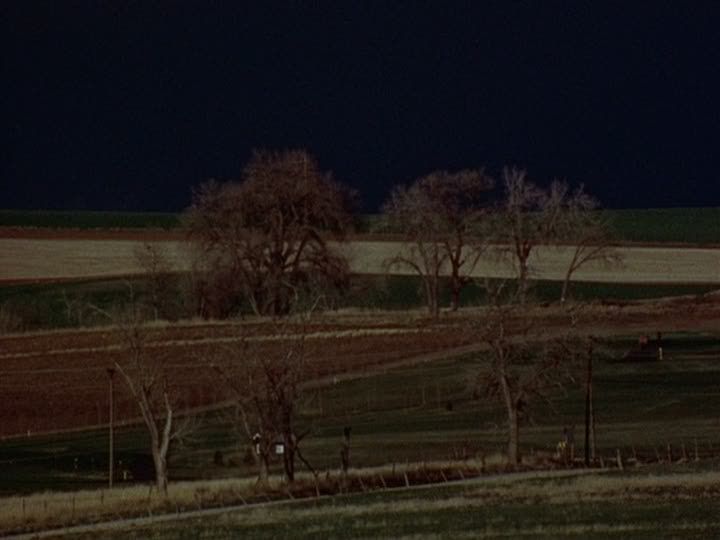
The Machine of Eden is about lighting and about scope, about distance. The film consists largely of landscape shots and skies, with comparatively judicious use of the interior domestic scenes that so often ground Stan Brakhage's films in his daily lived reality. The bulk of the film examines a few locations over and over again: snowy mountain peaks, a stretch of green farmland, a few scraggly-looking autumn trees by the side of a highway. Brakhage's camerawork is by turns graceful and jittery, sometimes resorting to whip zooms that emphasize a detail only to leap back out to the larger image, or incrementally increase the camera's distance from a particular landmark. He films mostly still skies, pregnant with heavy rainclouds or, less often, pale blue and cloudless, though at one point the image abruptly leaps into motion, the clouds spiraling and swirling together the way the paint would flow from frame to frame in Brakhage's later hand-painted works. There's a sense of distance here, of overlooking the beauty of the natural world from an abstracted viewpoint somewhere above, as though the creator implied by the title was observing his craftsmanship, eyeing the tiny details as well as the sweeping grandeur of these mostly unpopulated landscapes.

At times, Brakhage's abstraction transforms the sky into an empty color field, devoid of reference points until, during a pan across the stretch of dark blue, the tips of some even darker hills appear towards the bottom of the frame, finally introducing a hint of context to the image. The same aesthetic defines the domestic scenes, which are focused on the arm of a chair or the suggestion of a person breathing beneath the covers in bed, the only intimation of human presence the steady rise and fall of the fabric in response to the unseen person's respiration. When full human figures appear — a woman and children walking through trees — they're shot from behind, their faces unseen. It's as though Eden, that lost garden of natural beauty, is found wherever people are not, glimpsed when humanity's back is turned. Maybe that's why so many of the images in the film are dark and dim, shot with clouds running overhead, their shadows playing across the white snow of the mountains or bathing the entire landscape in a dark curtain.

Brakhage only sporadically allows the light in, in the form of a blinding orange sun that darts across the blackness of the frame, a sun that refuses to stand still. Elsewhere, a dim landscape is momentarily illuminated as the sun breaks through the clouds, casting its pure white glow over the land, melting through the gloomy and apocalyptic aura suggested by all those stormy vistas. Brakhage also mitigates against the film's deadening, harrowing visual aesthetic with a goofy insert of a goat trotting after its master, its ears flapping in slow motion like miniature wings, as though it's about to take off in pursuit of the flocks of birds that occasionally glide across the film's deep blue skies.

Monday, June 7, 2010

Desert


Desert is a phenomenally sensual, evocative film from Stan Brakhage. It is an examination of literal and metaphysical deserts, extracting the essence of the desert and exploring both the physical place and its abstract equivalent — red-hot sun, hazy heat-blurring, hallucinatory mirages, wavery color fields that suggest the horizon line dividing sand from sky. It is a film about deserts both external and internal, in keeping with Brakhage's insistence on the continuity between sensation, mental processes and the world outside. The film opens with images that are defined as desert-like only in relation to the film's title, scratched into celluloid in Brakhage's distinctive jittery handwriting just moments before. Without that context, there would be little suggestive of the desert about these abstracted fields of brown and gray, these Rothko-like color fields, divided by horizon lines that seem to shimmer in the distance. A red-brown haze is complicated by a pattern of cracks and cobbles that evoke images of dry desert hardpan. A dried-out, bare bush appears, with its spiky branches sticking up into the sky, looking like bones, a rib cage stretched out on the desert's empty ground.

This film is all about the landscape of the desert, and more a mental landscape than a tangible one. It feels like the desert. Watching it, one can feel the heat, can feel it in Brakhage's images of a shimmery yellow sun hovering in a red, gritty sky, the red thick with clusters of film grain. The landscape below is black and silhouetted, this dark land of hills and long dry plains stretched out beneath what seems to be an eternal red sky. At one point, Brakhage captures the sunset and, by placing his finger partially in front of the camera lens, distorts and warps the sun, compressing it into a flattened oval, expanding and contracting in the haze of the twilight hour. These kinds of distortions are at the heart of the film, distortions that evoke a kind of ideal desert, romanticized and haunting, the sun always in the process of setting, the land always bathed in deep shadows, the heat creating mirages that waver unpredictably at the edges of the frame, like the shot of what seems to be children playing, a flurry of unclear movement out of focus in the background. The children seem like ghosts, fuzzy afterimages that shift unpredictably in and out of view, only half-existing at the fringes of perception.


At other moments, Brakhage's images suggest a desert found within civilization: light flares shifting within an abstract space, occasionally taking form just enough to suggest that Brakhage was filming cars moving along a highway, the sun or their headlights creating reflections and star-like bursts in the grainy clouds. Brakhage captures the loneliness, the emptiness of the desert, the feeling of one lone leafy tree — an incongruous palm tree, symbol of fertility and tropicality, made to seem desert-like in its isolation — rising up out of the bare, dark hills. This is a very existentialist movie, because the desert seems to inspire such existential thoughts; there is something about the isolation of the desert that provokes the kind of bleak romanticism that Brakhage conveys so powerfully here. His images lack the clarity of specificity, though the film was shot on a trip to Southern California. There is no suggestion that this is a road trip movie, a document of a particular place or time. It is instead general, not to say generic. It is timeless rather than of its time.

In fact, Brakhage's actual locale, the place where the movie was shot, was not the desert, was in fact a tame suburban area, as seen occasionally in the shots of parking lots and highways. Brakhage is creating a mental desert out of nothing, shaping the space around him into an ideal desert where none existed in reality. Many of the film's textured shots might be interiors, even, shot out of focus in order to make them indistinct and abstract, so that they might be merged into Brakhage's desert fantasy.


This is all leading towards the film's striking final image: the sun setting rapidly and, at the last moment, transforming into a blurred purple cross of light suspended just above the horizon, a moment of profound transcendence and beauty. It's a trick of light, the way the sun morphs and shifts over the course of its descent, culminating in this spiritually suggestive final image, but then these kinds of tricks of light are never just that for Brakhage. An illusion, a manipulation, is never just an illusion to Brakhage, who sees these evocative images as truthful representations of internal, if not external, realities. If a faked, manipulated desert landscape suggests spiritual inquiry and heightened emotional states, Brakhage's warped images will privilege that subjective perspective over the more objective depiction of actual physical landscapes.