Showing posts with label '2010s. Show all posts

Monday, April 23, 2012

Certified Copy


There is a small, unobtrusive scene in Abbas Kiarostami's Certified Copy that provides a neat synecdoche for this puzzling, ambiguous, enthralling film. The writer James (William Shimell) is standing in an Italian plaza, watching an older French couple who seem to be arguing, the man yelling at the woman, who just stands there taking his abuse. Kiarostami shoots the scene from James' perspective, with the man facing away from him. From James' point of view, the woman is mostly obscured by the man's back, but when the man turns to present his profile to James instead, the scene changes, and it turns out that he's actually yelling into a phone, that he's not even angry, really, but is yelling to make himself heard over a noisy connection. From one perspective, the scene looks like one thing, but with nothing but a 90-degree turn, what had seemed like marital discord is transformed into a simple phone conversation. It's a very modern kind of joke — a public altercation between spouses becomes "can you hear me now?" — but it's also a wonderful encapsulation of the themes lurking at the core of this very slippery film.

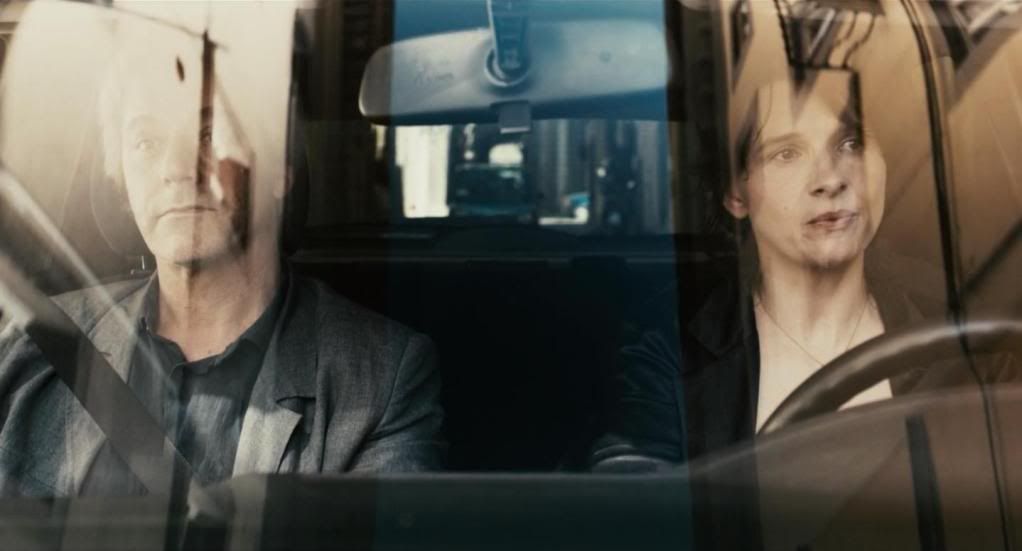
This is not the film's only unhappy marriage that might not be what it seems. Certified Copy — the film, that is; it's also the title of James' book, an essay about how copies are as valid and important as originals — takes the form of a meeting between James and a woman, sometimes credited as Elle (a name or simply a nameless "she"), played by Juliette Binoche. In the opening scenes, she attends a talk James is giving about his book but, distracted by her son Julien (Adrian Moore), she walks out after a few minutes, leaving behind her number to arrange a meeting with James. They meet, and she gets James to sign some books, and they talk about and debate some of the ideas in his book — interestingly, he seems unconvinced by his own thesis, as though his reflex is to think that authenticity matters, and he's forced himself to think otherwise for intellectual reasons.

A funny thing happens midway through the movie, though, at a small café where James steps outside to take a phone call. While he's away, the café's proprietress mistakes him for Elle's husband, and Elle goes along with the mistake, and when James returns, so does he. This goes on for a while, and then, though the precise moment is hard to pin down, at some point the ruse stops being a ruse, and they no longer seem like strangers role-playing a married couple, but like an actual married couple, unhappy, possibly separated or considering divorce. The most telling clue to this transformation is the moment when the British James, previously described as speaking only English, seamlessly switches to French as though he's always spoken it, and for the remainder of the movie the couple switches languages without warning, sometimes both speaking English, sometimes both in French, sometimes talking past each other in different languages, a perfect symbol for their disconnection.

Some interpretations of the film have tried to argue for one possibility or the other, to determine if the couple are strangers role-playing a marriage, or spouses role-playing being strangers. In other words, which half of the movie is "fake" and which is "real"? Which relationship between these two people is authentic? Is the first half of the film when they're acting, or the second half? This is, perhaps, both central to the film's point and somewhat beside it, because of course both halves of the film are equally real and equally fake. Neither argument is entirely persuasive, or rather, both arguments are persuasive at different times. In the first half of the film, they genuinely seem like strangers, their interactions hesitant and slightly awkward, and in the second half of the film they perfectly inhabit the role of a bitter couple who's been together for fifteen years and has fifteen years worth of memories, recriminations and regrets. Both possibilities are thus convincing at one time or another, because Binoche and Shimell are excellent actors who are naturalistic and compelling whether they're portraying strangers meeting for the first time or a longtime couple. In that sense, none of this is "authentic" — it's acting, a performance — and yet all of it is, because when a viewer is watching a movie, he or she is always aware on some level that it's not "real," and yet movies are still capable of sweeping audiences up in emotional narratives, producing empathetic reactions from the fakery of actors.

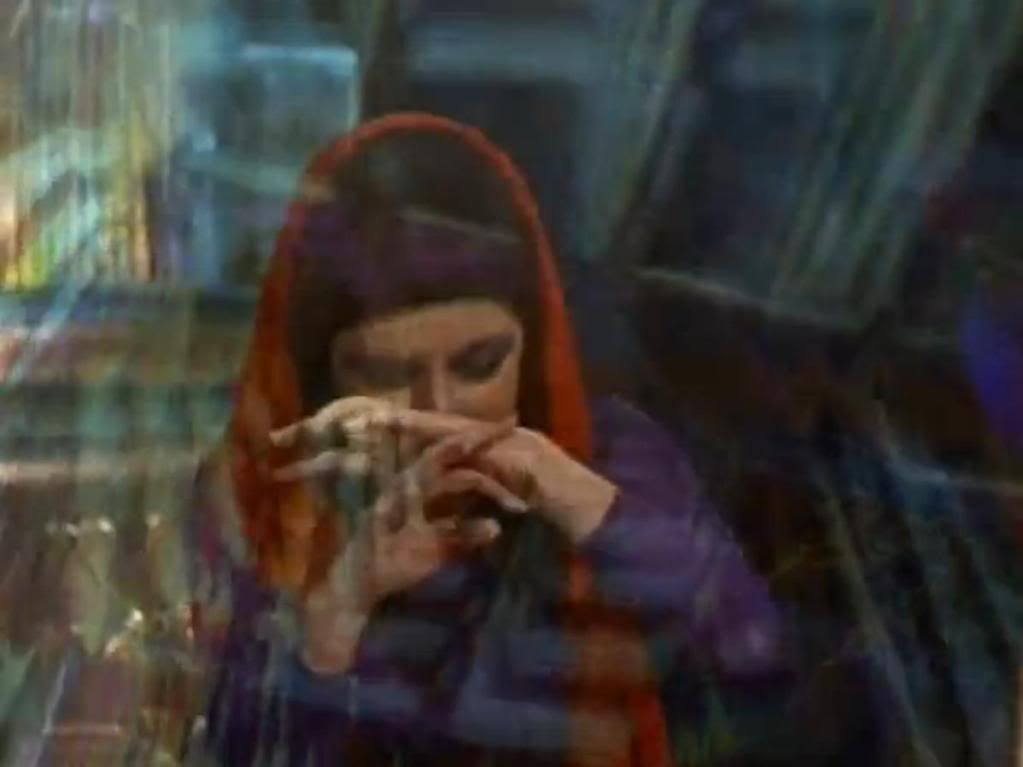
This has often been a focus of Kiarostami's work, and though on its surface Certified Copy does not deal with the documentary/fiction dichotomy that has so often been playfully tweaked and subverted in the director's oeuvre, these concerns are still implicit in the film's thematic subtext. In Shirin, Kiarostami's previous feature, he'd filmed the faces of women (including Binoche) seemingly watching a movie — except it gradually becomes clear, partly cued by Binoche's very presence, that they're not ordinary theatergoers but actresses, and all their emotional reactions are in fact performative. In the same way, Certified Copy seems designed to call attention to its own status as art, as opposed to reality.

In a way, the film is a proof of James theorem, even if James himself doesn't entirely believe in the idea: what's authentic or original doesn't matter nearly as much as one's experience. One of the things the film is about is the nature of art's meaning for different spectators, and at several points Kiarostami breaks the fourth wall, or seems to break it, in order to invite the audience to consider the film and their reactions to it. In all cases, these moments are justified within the film by being shot from the perspective of another character, so that the fourth wall is not actually being broken — and yet the subjective feeling of these shots is as though the fourth wall really has been momentarily shattered. Early on, at James' talk, his Italian translator turns to the camera and winks; he's actually looking at Elle's son, who's restlessly waiting at the side of the room, but it seems like he's literally winking at the film's audience. Later, Binoche's character gestures at the camera, waving it forward, inviting the audience to come closer; it's a gesture of intimacy, an invitation to engage more intensely with the film, and after she gestures a few times, the camera does begin tracking forward, while James, who she was actually summoning, steps into the frame. The most obtrusive of these breaks is Binoche's actual closeup wave to the camera, intended for some acquaintances but again actually directed at the film's audience.


These metafictional-but-not-actually-metafictional moments are indicative of Kiarostami's playfulness, which extends as well to the puzzle-but-not-a-puzzle narrative. Kiarostami teases the viewer by having Julien act coy about his surname, which annoys Elle, suggesting some anxiety about paternity and fathers, and lending some credence to the idea that James and Elle are in fact married or at least somehow involved. But it's equally possible that Elle has been married to someone like James, and that their falling into the routine of an unhappy marriage is an echo, a copy, of an earlier relationship. There's an element of familiarity in much of their dialogue, but not necessarily the familiarity of their specific marriage so much as the familiar patterns of discontent and alienation that afflict many couples.

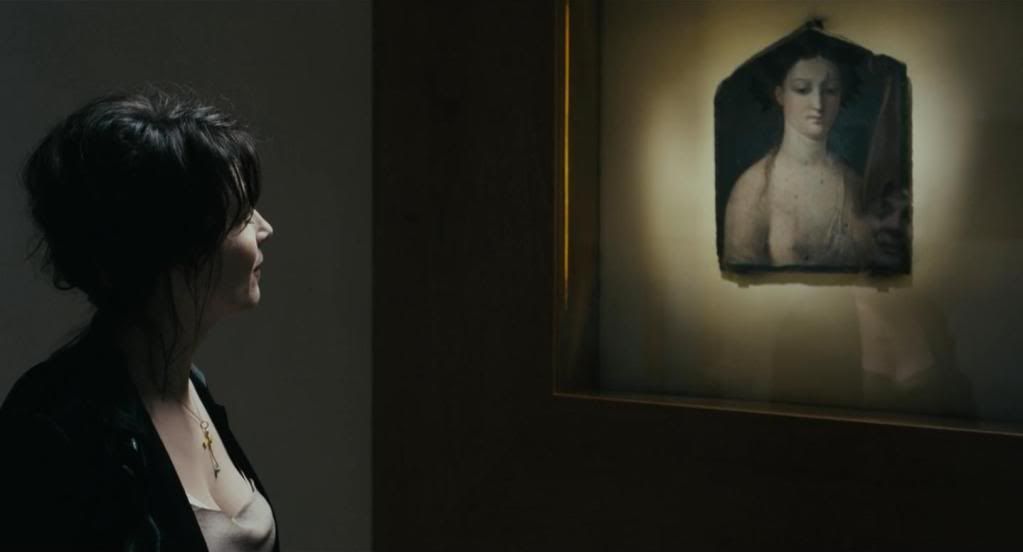
Certainly, the film is visually teeming with copies, reflections, echoes. As James and Elle begin acting like a married couple, they're walking through a town with a shrine that has particular resonance for newlyweds, so the streets are often packed with brides in wedding gowns and men in tuxedos. Weddings are everywhere, and so are mirrors, images in glass, visual copies, a further layer of reality and reflection, original and facsimile. At one point, Elle takes James to see a painting in a museum that had long been displayed as an authentic piece of ancient Roman art but was eventually revealed as a forgery. The museum chose to continue displaying it, though, claiming that the fake is as beautiful as the original; certainly, the painting had been genuinely admired for so long that it would have been a supreme hypocrisy to suddenly claim that it was without value simply because it wasn't painted when, or by whom, historians had originally thought it was. In one shot, Elle gazes up at the painting, her sensually low-cut dress echoing the bared breast of the woman in the painting, her face reflected in the glass display case like The Woman in the Window of Fritz Lang.

Lang's film — which is, after all, about an imagined, false narrative inspired by art — is just one of many cinematic references that come to mind here. Appropriately, given the obsession with originality, influence, and copies throughout Certified Copy, Kiarostami is drawing from the rich history of European art cinema. Resnais, Antonioni, Rossellini, and others reverberate through the subtext of Kiarostami's moving, ambiguous examination of marriage, art and spectatorship. In the end, it's a film about its own status as a film, its own artifice, its existence as a copy of a reality in which actors are pretending to be people who are themselves pretending. In that respect, the last shot is vitally important and extraordinarily clever: James, looking in a bathroom mirror, stares directly at the camera — seeing a reflection of himself in the audience? — and then walks out of the frame, leaving behind a view out the window at a church whose bells are chiming. The credits then begin to scroll, crucially, not across the entirety of the frame but only within the frame of the window. It's as though the bathroom has become a theater, and the window is a screen on which the world itself plays like a movie.

Thursday, April 19, 2012

The Sleeping Beauty


Catherine Breillat understands very well the appeal and the power of fairy tales and children's stories, their ability to reflect and create dreams and nightmares, to provide ideal images or give shape to primal fears. The Sleeping Beauty is her second film in a row, following Bluebeard, to deal with children's stories and fables, deconstructing these ancient tales and the lingering influence they have on children's ideas about the world, as well as what these stories can teach about growing up, love, sexuality and the differences between boys and girls. One senses that Breillat has found, in these sensual, magical films, the perfect form for expressing her provocative ideas about girlhood and womanhood.

The Sleeping Beauty is, if anything, even richer and stranger than its predecessor, following the little princess Anastasia (Carla Besnaïnou) into a dream world where she must stay for a hundred years, cursed by a witch to die but instead left in this in-between state by the intervention of three more benevolent witches. When she wakes up, they promise, she'll be 16 instead of 6, having passed through the troubling transition stage from girlhood to womanhood in her sleep. Like Bluebeard, the story is taken from one of Charles Perrault's folk tales, though here Breillat blends it with Hans Christian Andersen's The Snow Queen and renders it as a surrealist dream. Anastasia wanders from one strange scene to another, encountering a train station populated with mannequins, a wicked jailer covered in boils (who, strangely, forces her to bowl with skulls), and a band of pirates led by a little gypsy girl (Luna Charpentier). At one point, Anastasia is taken in by a farmer woman (Anne-Lise Kedvès) and her son Peter (Kérian Mayan), with whom she lives happily until Peter disappears. She spends the rest of her dream life chasing after him; in his absence, he has become her ideal man, her dream man who she'll always be chasing after.


For Breillat, childhood is an idyllic, pre-sexual Eden in which boys and girls can happily interact, and gender identity is fluid. Anastasia is a princess who wants to be a knight, and who reads about hermaphrodites in the dictionary as a bedtime story before going to sleep. When she stays with Peter and his mom, Peter and Anastasia are instantly happy together, rough-housing and playing, sleeping in one bed, curled up with their heads close together. It's the onset of sexual maturity that opens a gulf between them, as Peter enters puberty, symbolized by the sight of the lovely, chilly Snow Queen in a silvery gown like a wedding dress, followed by a snowflake drifting into his eye, changing his way of looking at the world. From that point on, he's cruel to Anastasia, and they now sleep in separate beds like a married couple in an old Hollywood movie, their perfect union and genderless play forever altered by the dawning of sexuality and the realization that childhood is moving towards its end.

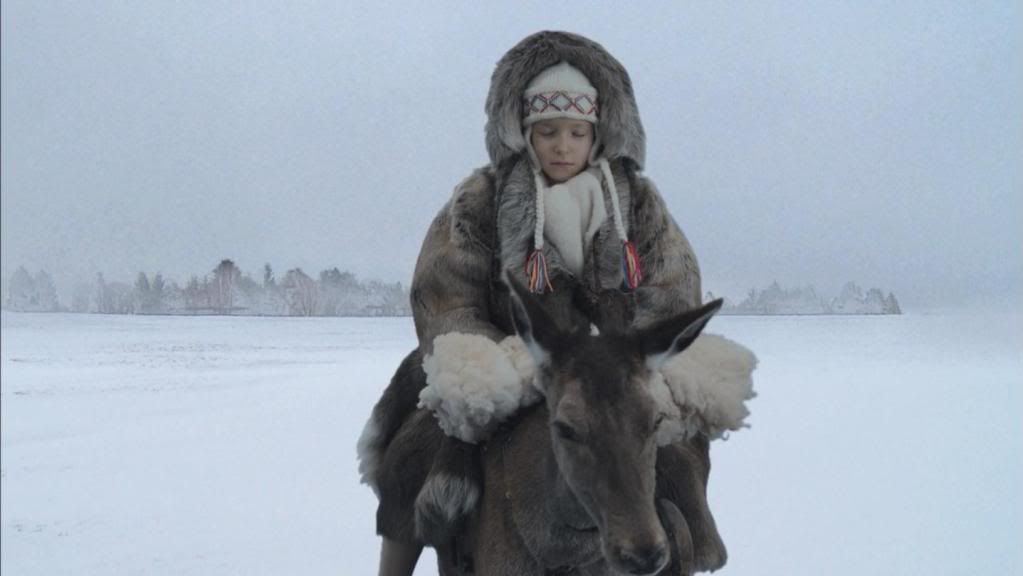
The film's style is both magical and direct, with crisp cinematography that makes these glistening fairy tale locales seem quotidian and grounded, even when they're populated by albino princes and princesses who invite Anastasia for a tea party that's more Alice in Wonderland than Perrault. In one stunning sequence, Anastasia rides a reindeer into the arctic wilds to find an old crone who controls the winds, and the snowy landscapes stretch across the screen, the Northern Lights explosively filling the sky, with the princess a fuzzy little smear in her pink coat, lost and alone in this beautiful but deadly land. The film is richly symbolic, loaded with heavy psychosexual meanings encoded in every object, every image. When Peter shows Anastasia a queen bee, folded in his hand, he tells her that it's so weighted down that it can't move, causing Anastasia, a princess who may grow into a queen, to cry out that she doesn't ever want to be like that.


The film is all about the trauma of moving from childhood's dreams and fantasies into the much less fantastic reality of adulthood. The pivotal moment comes when Anastasia wakes up at the age of 16 (now played by Julia Artamonov) into the modern era. Before this, the film had been an anachronistic mash-up of all times and no time at all, with old-fashioned costumes side by side with more modern objects and decorations, giving the surreal dream the timeless quality of a fairy tale. When Anastasia wakes up, she's in the modern world, her dress and corset and princess' demeanor now the anachronisms in a world of cars and TV and boarding schools. And she finds waiting for her, not Peter, but his descendant Johan (David Chausse), who nevertheless bears enough resemblance to her dream man that she's instantly drawn to him.

Breillat cleverly deconstructs and subverts this "happily ever after" ending by daring to ask what comes next after the sleeping princess wakes up from her curse into the arms of the waiting prince. What comes next is disillusionment: he's too eager, she's shy and virginal, reluctant to give up her virtue so quickly to a man she's just met, while he keeps trying to get away with more and more in their playful flirting. Pushed away, he hangs out with another, more accessible girl, dressed in modern clothes, making out with her while an erotic movie plays on the TV. Meanwhile, Anastasia is reunited with the little gypsy bandit girl, now grown up (and played as a woman by Rhizlaine El Cohen), and she has an erotic encounter with her that's far more sensual and satisfying than her hesitant teenage games with Johan. When she finally does go to bed with Johan, it's painful for her — Breillat cuts to them in mid-act, with Anastasia screaming, seemingly not in pleasure — while Johan is confused and hurt to find that she doesn't want him for himself but as an echo of an ideal dream man whose image she'd had in her head since childhood.


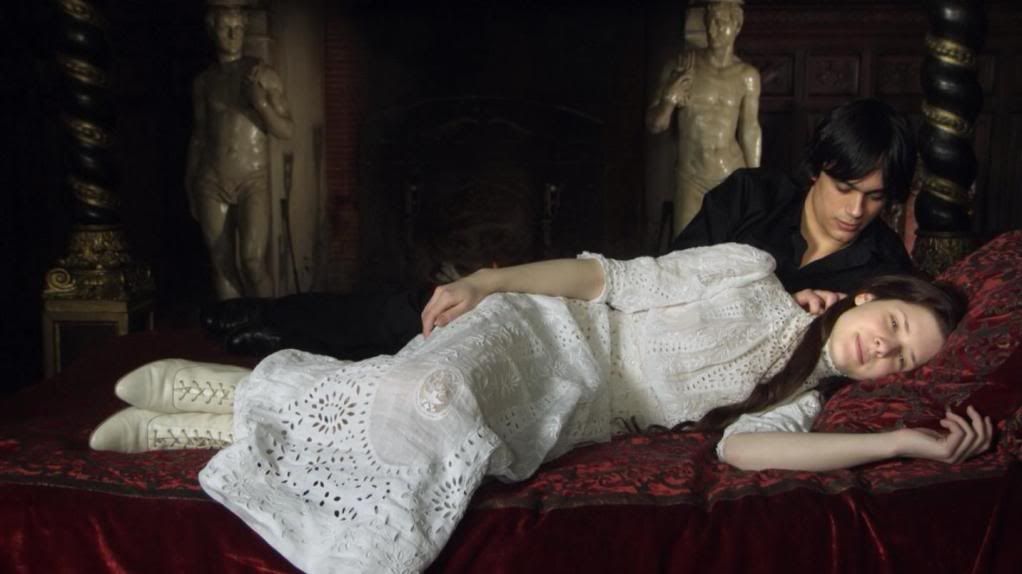
Obviously, the fairy tales that kids learn only set them up for various forms of disappointment, creating impossible romantic ideals to which the reality can never live up. After she has sex with Johan, Anastasia finally sheds her white, lacy princess' dress and the corset that had left painful-looking pink stripes across her back, for a more modern black skirt and stockings, cutting her long hair as well. The dream is over, childhood is over, and she's shed the illusion that she's a special princess, accepting that she's just another girl, in just another complex, painful, confusing, up-and-down relationship with just another boy.

In the film's final image, Johan and Anastasia lay in bed together, their heads outside the frame, red claw marks across his bare torso and tears in her black stockings; they're hurting one another, settling into a familiar kind of damaging relationship. He asks her, "Do you love me as before?" "As before," she agrees, before adding, "but this is after." This is their happily ever after, an acceptance that childhood is over, that the dreams of youth were only dreams, that they are not special or unique, not princes and princesses but common lovers, damaged by their expectations about one another and the ways in which they've so quickly disappointed one another. The fairy tale is over, but its impact on the real waking world lingers.

Friday, March 23, 2012

Four Michael Robinson shorts, 2006-2010


Probably one of the worst aspects of contemporary culture is the tendency to "ironically" appreciate the cultural relics of the past. Thankfully, there's hardly a trace of irony in the filmmaker Michael Robinson's program of delving into the trash bin of cultural history. Robinson appropriates discarded bits of pop culture not as a vehicle for retro fetishism, but in the hopes of discovering something genuine within these seemingly ephemeral media fragments: an emotion, an experience, the quality of a strong memory, an association with something concrete and true beyond the disposable realm of pop culture junk. His short video works can be watched for free on Vimeo.

These Hammers Don't Hurt Us is a work that straddles the futuristic, the postmodern, and the campy, fusing hazy computer animations in hallucinogenic neon with montaged clips from Joseph Mankiewicz's 1963 Liz Taylor vehicle Cleopatra and Michael Jackson's Egyptian-themed music video for his 1992 single "Remember the Time." Robinson is blending together the media of multiple eras, appropriating bits of kitschy cultural detritus and re-contextualizing them into something that's actually transcendent and mystical. The source material that he uses is Egyptian kitsch, a common motif in Western trash culture, which often casts the East and the Orient as sites of garish, alien ethnic spectacle, taking the myths and religions of other cultures and turning them into pop bombast.

Robinson's film attempts to channel this pop mythology in a way that reawakens the mystical potential lost in the translation to Hollywood and MTV. The computer animations recall the rainbow-colored hyperspace of 2001: A Space Odyssey, appropriate because Robinson is inviting viewers to journey into this strange, unsettling space that exists somewhere between the real, lost, historical Egypt and the pop culture approximations of that place and time, of its myths and its people. In between the hypnagogic Taylor/Jackson montages, Robinson periodically shows sparkling suits studded with bright jewels, clothing that looks like a spacesuit as imagined by a Pharaoh's wardrobe designer, simultaneously futuristic and a throwback.

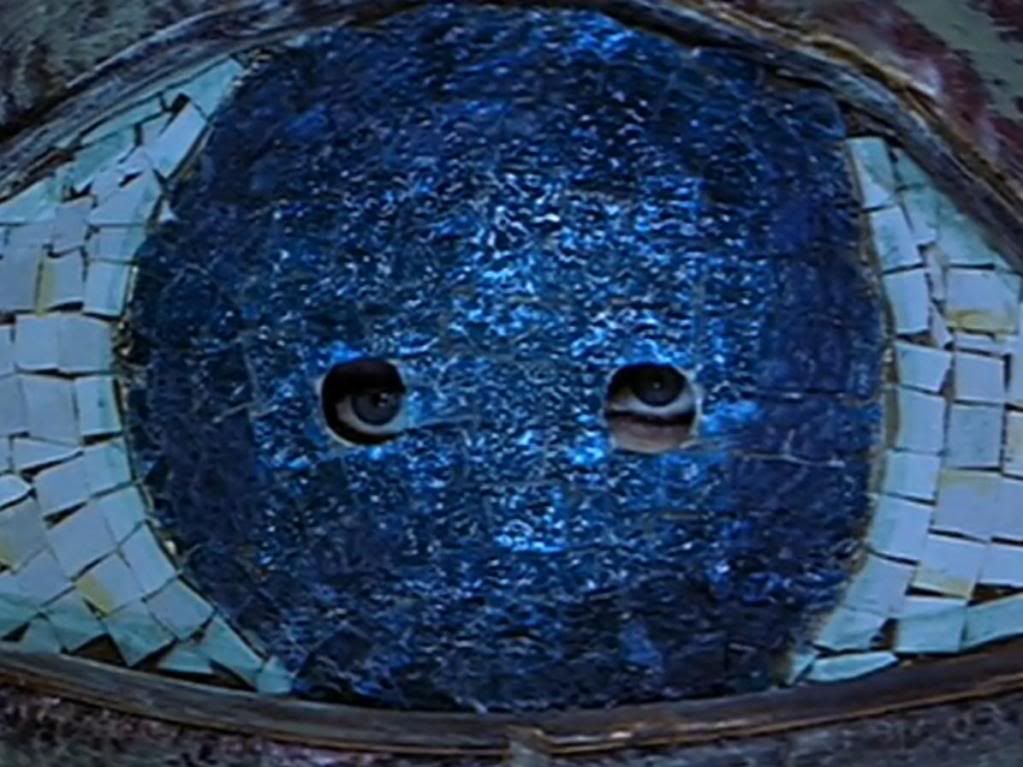
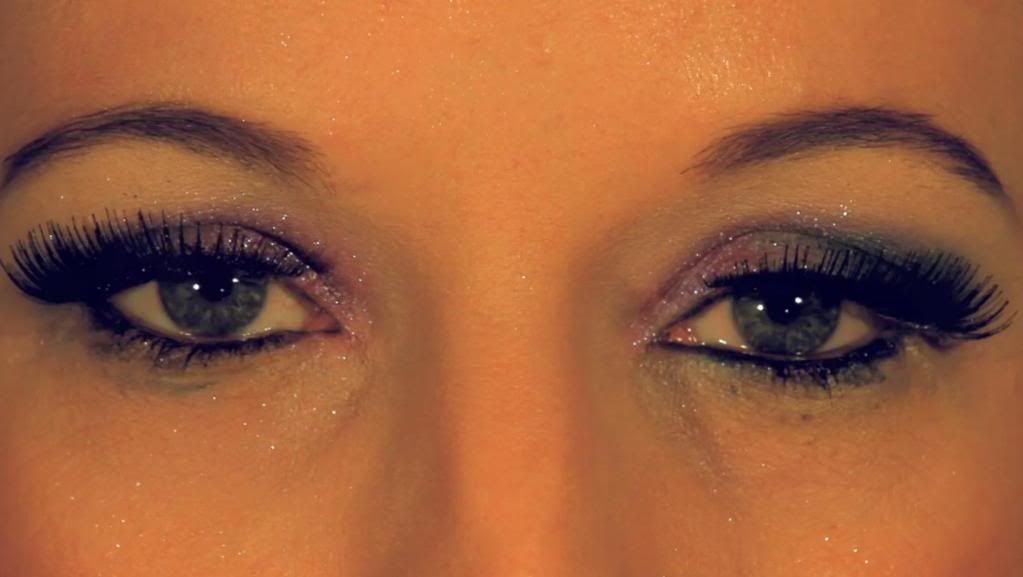
Robinson is arranging conversations between various pop culture artifacts and the real cultures they're drawing on. At one point, he ingeniously links the Taylor Cleopatra with Michael Jackson via a scene where Taylor peers out of a spyhole — a pair of eye sockets cut into a larger mosaic eye, so that Taylor's blue eyes are peering out of a larger blue eye — and sees, of course, Jackson spinning and dancing with a coterie of Egyptian slaves. Taylor's Cleopatra looks out of her version of this story into another version, a similarly profane pop vision, and over time it all becomes overlaid with Robinson's computer abstractions, neon geometric patterns strobing across the screen as though the collision of these two images is causing a rip in the fabric of space and time. Later, as ice skaters in Egyptian garb gracefully glide around, the image is manipulated, its colors flickering wildly, the imagery blurred and distorted in ways that recall both VHS fuzz and digital pixelation. In this way, too, different eras are combined, and Robinson's computer manipulations — like those of the multimedia art collective Paper Rad, with whom he seems to share some aesthetic concerns — are simultaneously state-of-the-art and deliberately lo-fi.


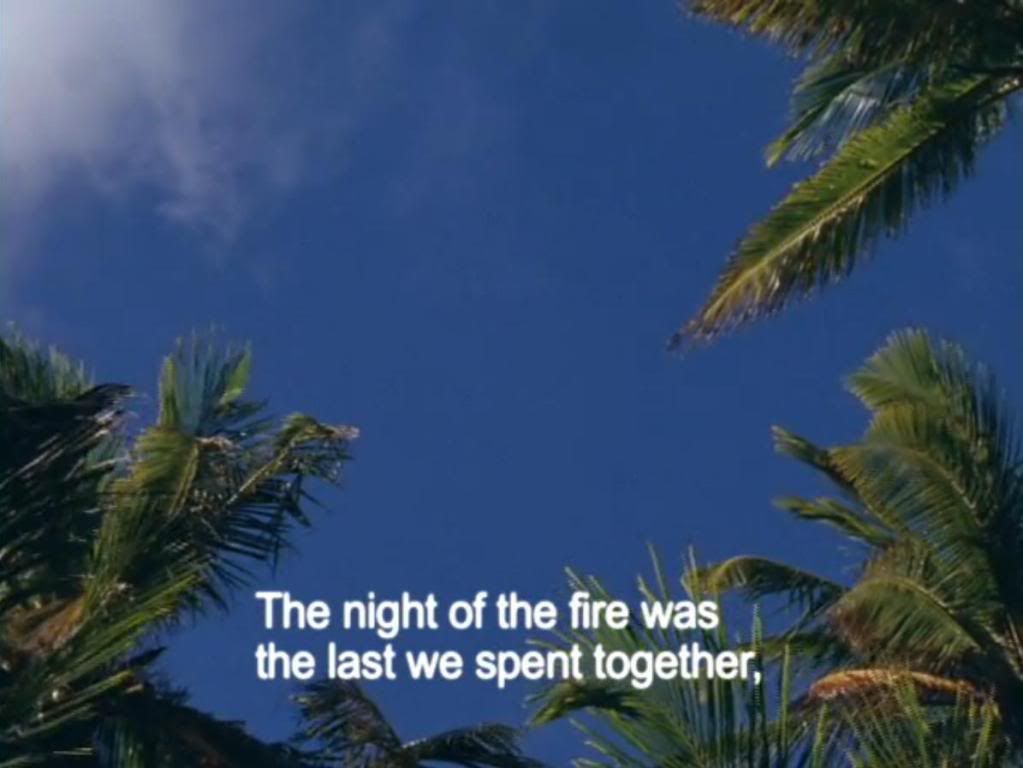
Michael Robinson's If There Be Thorns is an elliptical examination of isolation that might be described as David Lynch remaking the TV show Lost. Three figures, a woman and two men (Devon Sanger, Buck Hanson and Robinson), wander around alone in an unpopulated tropical paradise, leaving behind mysterious signs in the bark of trees or buried deep within thickets of foliage. They never meet except in the flickering, layered collages of faces that Robinson uses as interstitial material between the longer sections of these wanderers interacting with the natural world. The film never explains it symbolism, but there's something potent about the ways in which this trio marks up the world: slashes of red lipstick on a tree trunk, a bulbous egg full of nails, piles of dead brown ferns, rotting and misshapen fruits that are laid in the grass and promptly vanish. It's an iconography of death and decay, the lipstick looking like blood staining the wood, later connected with the cross of Christ as nails are driven into each of the red slash marks.

The film's story, such as it is, is communicated through onscreen snippets of prose taken from William S. Burroughs, Shirley Jackson, V.C. Andrews and Stevie Nicks, along with some of Robinson's original contributions. It's an unlikely combination of voices that is nonetheless smoothed down here into a more or less coherent narrative of separation and yearning, loss and nostalgia. This loneliness is enhanced by the minimalist soundtrack, in which a buzzing electronic ambiance periodically emerges from the whispery shushing of the wind or the chatter of insects.

Some of the imagery here is a little trite, as in the shot of one of the young men fading away like a ghost, an overly literal depiction of the film's theme of lost connections. For the most part, though, Robinson is more circumspect, implying this isolation indirectly. The three protagonists are rarely viewed in full; their arms reach into the frame, or they're glimpsed in the distance, partially obscured by foliage, or they stroll quickly by, their faces hidden from view. Even more often, Robinson's empty images of unblemished blue sky or rustling seaweed in the shallows of the ocean suggest the absence of humanity, as though all three protagonists have already disappeared, leaving behind only the abstract narrative of gaps and elisions provided by the text.


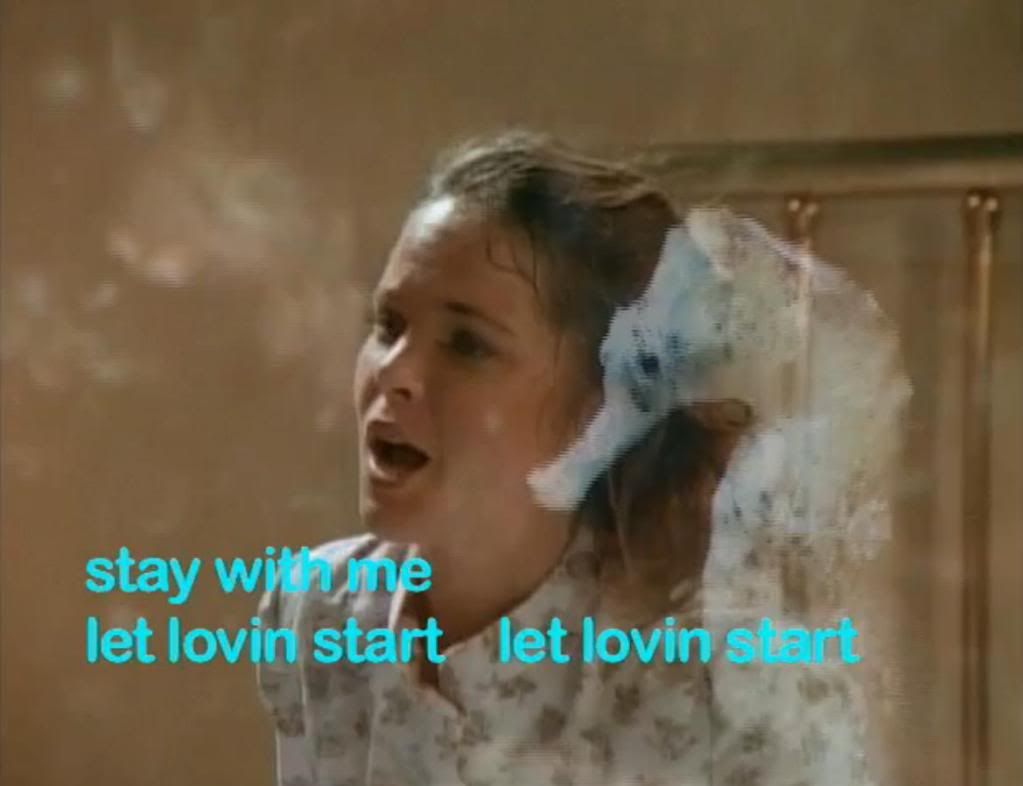
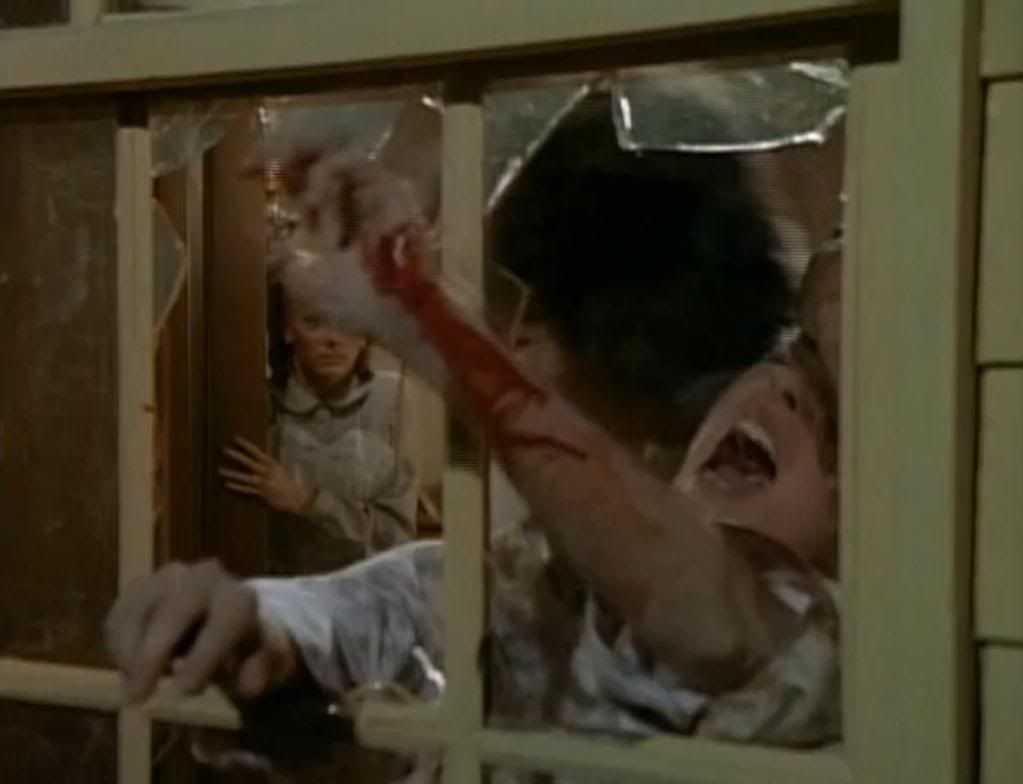
Hold Me Now is one of Michael Robinson's simplest films, and because of that it exposes the essence of his work — the strangeness of pop culture nostalgia — in an especially naked way. The film is diabolically simple: a clip from Little House on the Prairie, slightly slowed down and strobed between black frames, is overlaid with a karaoke version of the Thompson Twins' "Hold Me Now," which has no vocals on the verses and ghostly backing accompaniment on the choruses. Robinson then lays the unheard lyrics to the song on the screen as text, letting the romantic melancholy of the lyrics and the saccharine music jar against the unsettling emotions of the TV clip, in which Mary fights with Adam, thrashing on a bed and finally running across the room to thrust her hand through a window, streaming blood everywhere.

On one level, this video mash-up hinges on the rather basic irony contained in the disjunction between the yearning romanticism of the pop song lyrics and the increasing creepiness of this TV scene, snatched out of context like this. The flickering quality of the image provides a distancing effect that prevents one from watching it passively. The effect recalls the drastic time dilation of Martin Arnold, who similarly dissects seemingly innocent media to uncover more disturbing implications of sex and incestual longing, both of which seem to percolate through the Little House clip in this context as well. The song lyrics, which muse on a shattered love affair, reflect the nostalgia of this video, and of Robinson's general project, looking back to the past and finding not unspoiled innocence but something much weirder and more broken than one's memory had expected.


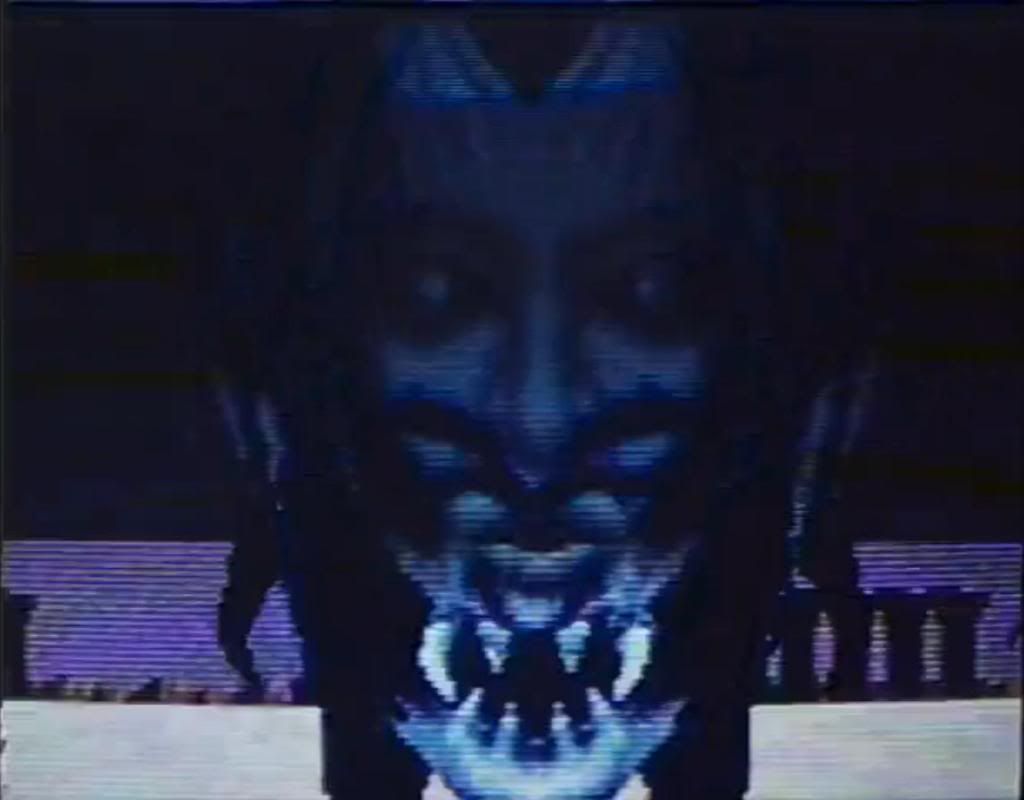
For And We All Shine On, Michael Robinson turns to the iconography of video games, particularly those crude examples dating from the dawn of the medium, the games that would have been played on the very earliest home video game systems. In between dark, mysterious bookend images of rustling trees that could be hiding any horror, Robinson crafts a montage of primitive, minimalist video game segments in which never-ending swarms of space invaders fly at the screen, waiting to be blown apart by the player. Robinson is approaching these old-school games with their first-generation graphics and lo-fi visual aesthetics not as they actually are, but as they seem to be through the filter of childhood memory. Beneath the hazy static distortion that Robinson layers over these games, they actually become eerie and creepy, their landscapes barren not because of limited processing power but because these really are remote alien horizons with monstrous creatures lurking just out of sight.

Robinson is attempting to bridge the gap between the shoddy reality of media and the out-of-proportion effect these transmissions can have on the impressionable mind. These games, as products of technology, are unavoidably dated today — just as, no doubt, today's games will soon enough seem dated and lame to future generations — but the memories of playing the games lack that retrospective perspective. When they were new, when kids were playing them for the first time, they didn't seem dated, or like products of their era, or like kitschy retro artifacts: the aliens seemed real, at least on some imaginative level, and the fun and the terror of fighting them was also real. Robinson is recreating the warping effects of memory, trying to make these clumsy digital aliens seem frightening and powerful again.

In the process, he's making a horror movie, drawing on the eternal fear of things that go bump in the night, the unseen monsters lurking in the trees that scratch against a kid's window, inspiring nightmares. He blows these hideous blocks of pixels up until they match the mythological power that they have come to possess in memory, blurring and layering the images if necessary to create composite horrors far more searing that any single frame could be. There's a powerful idea lurking in the current obsession with the retro and the nostalgic, and Robinson cuts to the core of it: the media of previous generations is so weighted with emotional import and meaning that exists almost entirely outside of the media itself, in the minds and memories of those who experienced it when it was fresh. Thus Robinson is trying to make these things new again, to recreate the sense of danger and mystery and strangeness that accrues to something that's new. He's delving into nostalgia to find the monsters lurking there, but rather than rendering them harmless through the filter of fond remembrance, he's trying to capture them in all their fearsome, memory-distorted glory, not as collections of pixels but as blurry figments of fevered childhood imagination.

Monday, February 20, 2012

Midnight In Paris


Midnight In Paris is the essence of recent Woody Allen in its purest form. This is a charming love letter to Paris, which opens with a series of crisply photographed, perfectly colored postcard images of Paris as a collection of tourist landmarks and street scenes that are familiar from the countless French movies they've appeared in. It's a glossy depiction of the latest destination on Woody's touristy trip through Europe, and this city in particular, Paris, seems to mean a great deal to him, as perhaps the place that appeals the most nakedly to the hopeless romantic in Woody.

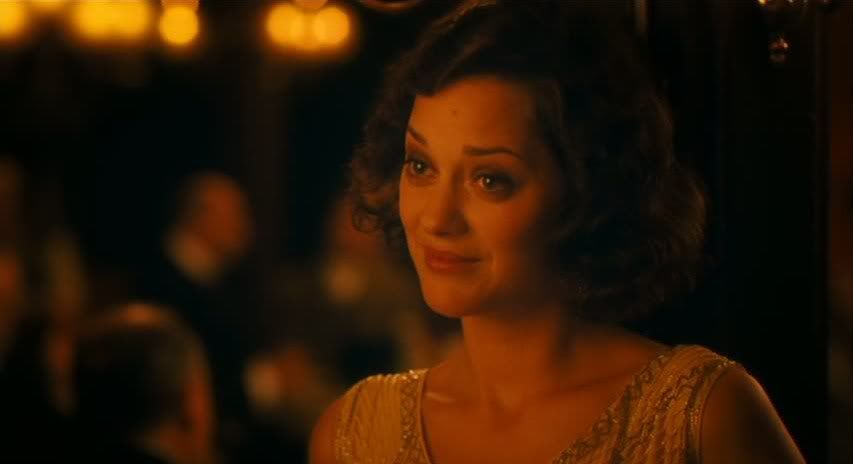
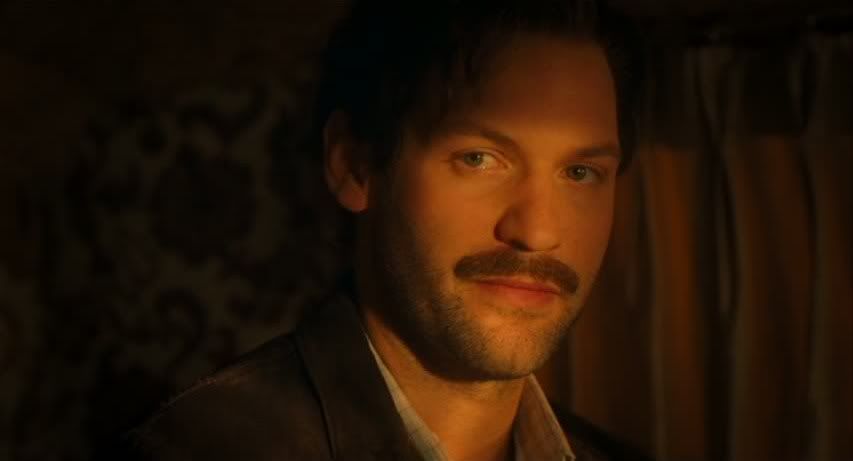
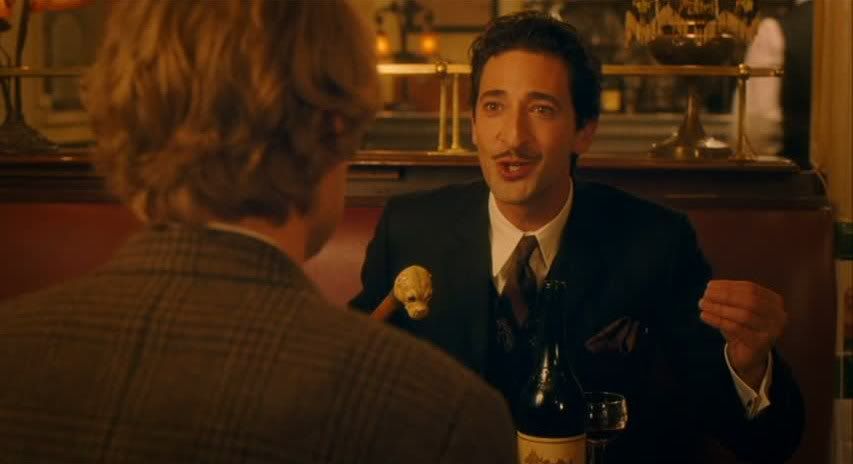
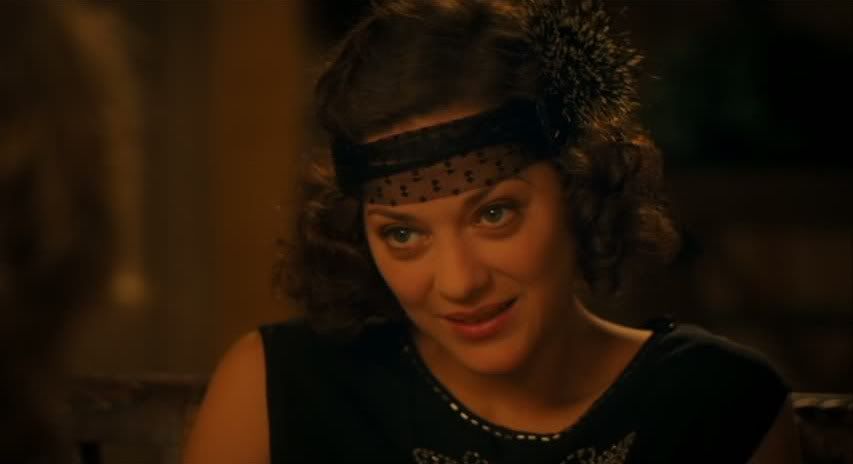
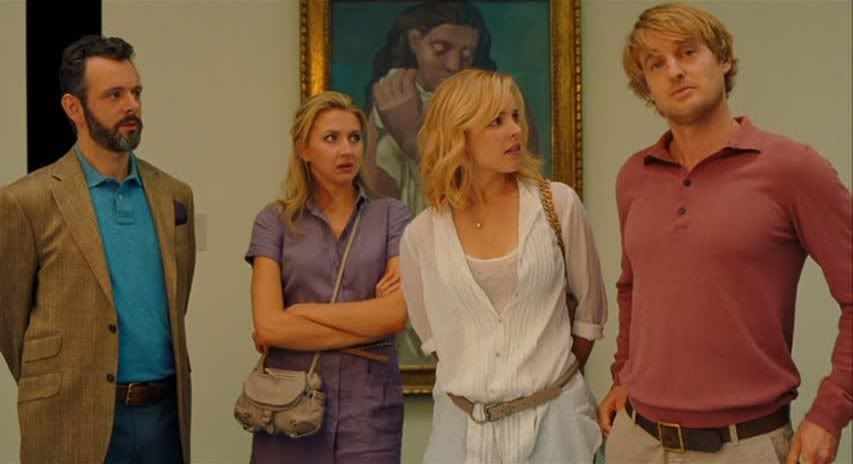
The film hits all the usual Woody notes. Gil (Owen Wilson) is a successful screenwriter who's dissatisfied with his work and wants to be a serious novelist. He's in Paris with his fiancée Inez (Rachel McAdams), who he's feeling increasingly disconnected from, while his love of the city, his association of it with art and creativity, reawakens his dormant literary ambitions. This effect is intensified when Gil, sitting on a staircase around midnight, soaking in the atmosphere of Paris, is picked up by an old-fashioned car and transported back in time, to exactly the 1920s Parisian paradise that he'd been dreaming of. He is soon at parties with Scott and Zelda Fitzgerald (Tom Hiddleston and Alison Pill), Ernest Hemingway (Corey Stoll), Gertrude Stein (Kathy Bates), and many other luminaries of the multinational Paris cultural scene of the 20s. At a party, Cole Porter sings sadly and beautifully at the piano, flappers dance, and everything seems bathed in the golden glow of nostalgia. And then there's the lovely Adriana (Marion Cotillard), a young woman who's been a lover and muse for many painters of the time, most recently Pablo Picasso (Marcial di Fonzo Bo), and who Gil instantly falls for.


It's a very simple story, with a fantasy hook that delivers the very simple point that we always yearn for an ideal past that we never experienced and that never really existed. Such desires are an escape, an outlet for anxieties about the present, rooted in the inescapable feeling that if only one had been born earlier, or elsewhere, everything would feel so much more right. Woody realizes that this is a somewhat misguided desire but he can't help feeling it anyway, and he lovingly depicts 1920s Paris as a beautiful, perfect, charming place, even while gently nudging Gil towards the realization that the past can't offer solutions for the problems of the present. The film seems torn in two, its aesthetics delivering an unadulterated ode to the beauty and joys of the past while thematically it has to lead Gil to a place where he's happy to exist in the present, to live and create in his own time instead of aching for a past that will always seem sweeter than the familiar present.

Of course, it's no surprise that Woody is much more convincing in selling the past than the present. A big part of the film's pleasure comes from the offhanded sense of awe that Gil feels when he realizes that he's been pulled back in time, and his wide-eyed joy when encountering each new famed cultural figure of the past. Woody obviously has a lot of fun with depicting all these historical icons, who are surely the director's idols as much as they are Gil's. The best and most memorable of these personae is no doubt Stoll's perfectly pitched performance as Hemingway, who speaks exactly like he writes, in a clipped, assertive, no-nonsense tone that leaves little room for debate or uncertainties. He seems like the Hemingway we might imagine from his writing, come to life, speaking a perfectly phrased short story every time he opens his mouth, unleashing a series of terse, blunt phrases connected by chains of "and." Similarly effective, though in a much different mode, is Adrien Brody's Salvador Dalí, who mutters and slurs in multilingual argot and repeatedly announces his famous surname, always with an implied exclamation point and a grand sweep of his arm. He also introduces Gil to his friends Man Ray (Tom Cordier) and Buñuel (Adrien de Van), and Woody, hilariously, has Gil give Buñuel a movie plot idea, describing the surrealist premise of The Exterminating Angel, which puzzles Buñuel as much as it's puzzled and provoked audiences since he made it. It's a bit of a cutesy time travel gag but a charming one anyway.


It's a shame that the modern story is comparatively slighted. Inez is distant and self-absorbed, and she and Gil are so clearly ill-suited for one another that it's hard to imagine how they ever got together. Her parents are used primarily for a few offhanded and easy-target swipes at Tea Party Republicans and Woody's favorite topic, clueless Americans. Woody at least seems to realize that he's being insufferable: right after Gil calls Republicans "lunatics" during a rambling rant about politics, he adds that it's okay, he can still respect those who don't think like him. Gil's present-day romantic resolution at the end of the film is also pretty unsatisfying, but maybe that's just because Cotillard's Adriana is so luminous, so sweet and smoldering, that nothing in the present seems very alluring in comparison, even Léa Seydoux's pretty but vague love interest. Maybe that's what Woody is going for here: a particular time is not tempting, ultimately, because of when it is, but because of who is there, because of the connections that one forms with other people. What Gil really learns, through his immediate and visceral connection with Adriana, is that what was lacking in his present was not necessarily a result of his era but the (lack of) genuine connections in his life.

This is a sweet, warm movie, much brighter and airier than anything Woody's made in a while. It's funny, too, though mostly at the expense of the hapless sorts who Woody sets up as targets for his mockery: the pompous Paul (Michael Sheen), who professes to be an expert on everything, and a private detective who Woody gives a minimal role seemingly just to set up the film's best and funniest throwaway time travel joke. As a bit of a meta joke, Woody even has Carla Bruni, the First Lady of France herself, appear as a tour guide, adding to the sense of this film as Woody's guide to Paris. Midnight In Paris is Woody at his most charming and romantic, quite a change from the darker, more cynical tone that's dominated most of his more recent films, both the successes like Vicky Cristina Barcelona and the more uneven efforts. It's a delicious confection, a magical realist treat that's all but impossible to resist.

Wednesday, February 15, 2012

Three Celia Rowlson-Hall shorts, 2010-2011


The short films of Celia Rowlson-Hall were recently introduced to me by Jeremy Richey, via an interview he conducted with Rowlson-Hall at his blog. She is a young filmmaker, model, choreographer and dancer who has posted many of her haunting, charming shorts online at Vimeo, where all of the films I'm writing about here can be watched for free. She's a versatile and fascinating figure whose films range from dreamlike bursts of subconscious imagery to elegant fashion showcases to cute/creepy psychodramas.

Prom Night is unquestionably her most powerful work, a dazzling eight-minute tour of the associations conjured up by the title. Throughout the short, Rowlson-Hall, who often appears as a performer in her own work, takes on a number of different roles and personae, using simple costume changes and fluid transitions to shuffle through a succession of female archetypes while dancing, alone, in a school gymnasium full of colored balloons. All the while, the Ronettes' hypnotic "Be My Baby" is looped on the soundtrack, at first blaring and then muted when the camera shifts to a more distant observation point, peering in through a window in the closed gym doors.

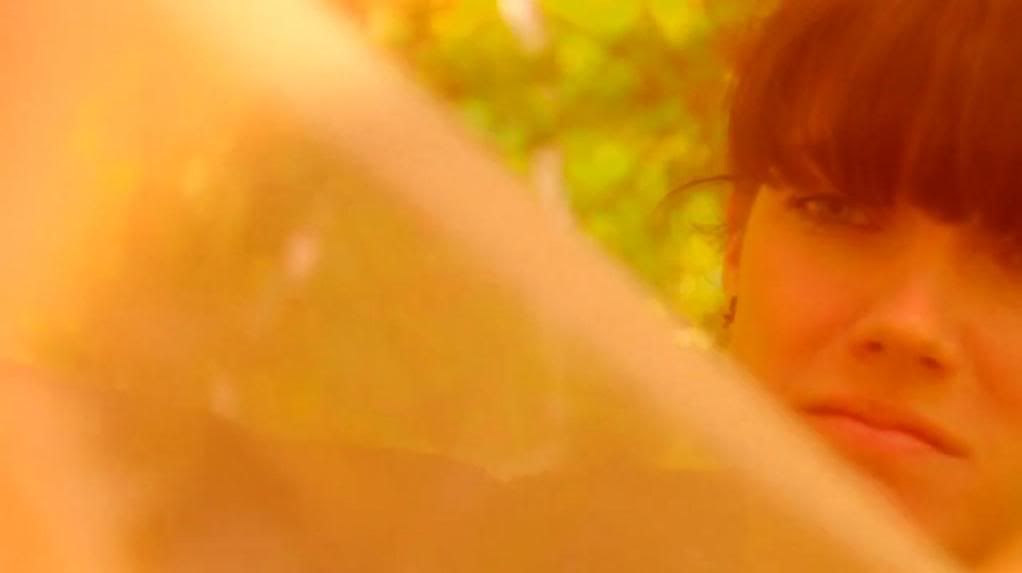
Rowlson-Hall is a dynamic screen presence, with an expressive face well-suited to the frequent closeups she gives herself. At the start of the film, she wanders at the fringes of the dance floor, sipping punch, her eyes darting around the room, nervous and excited, taking in the sights and waiting for the arrival of her date, represented by the camera's point-of-view. Then, growing bolder, she begins flirting with the camera, her dance partner, which is playfully reeled in by Rowlson-Hall's invisible fishing rod, floating closer and closer to her until the camera is directly facing her. She defuses this intimacy by making funny faces, then grows self-conscious and awkward, keeping her face mostly turned away from the camera and the dance partner it represents, only casting sidelong glances at the lens, smiling nervously and sweetly, an incarnation of the shy, excited prom date enjoying a romantic dance. Rowlson-Hall then begins reaching forward, past the camera, to take off the clothes of her "date," coming up with a suit jacket, shirt and undershirt. In the film's most startling moment, she then pulls the undershirt over her head and gathers the folds of her blue dress up around her, and for a few moments she's been transformed into an embodiment of the Virgin Mary, waving her finger, tsk-tsk, in a gesture of inaccessibility and chasteness. Only moments later, she ducks down out of the frame, and after a cut, she reappears in a skimpy red Baywatch-style one-piece bathing suit, stuffing balloons into her chest to become a voluptuous sex symbol.

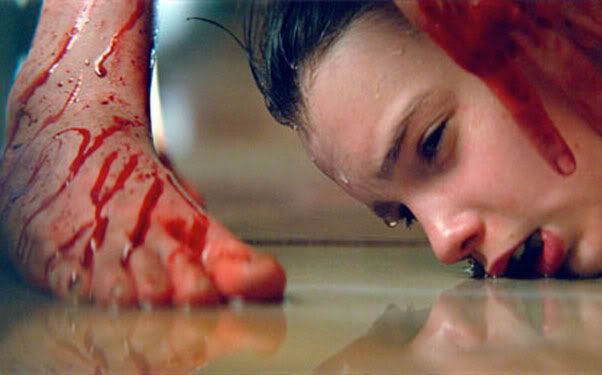
These fluid transformations suggest that Rowlson-Hall is enacting various archetypes and stereotypes of femininity, embodying alternately the demure hometown girl, the untouchable symbol of spiritual purity, the Pamela Anderson sex kitten, the lollipop-sucking Lolita, Madonna with her infamous cone bra. She even channels the ultimate prom movie, Carrie, by dumping a bowl of red punch over her head. It's a beautiful film, alternately funny and eerie, sweet and sinister, but always tinged with nostalgia. Rowlson-Hall is delving subtly into the many different meanings of the prom in American culture: as a locus of sexuality, as a stage for enactments of gender roles, as a repository for memories of adolescence, as a last ritual of the teen years before the transition into adulthood. The prom is so loaded with potential meanings, and Rowlson-Hall's exploration of this event is ambiguous and multi-faceted enough to encompass them all.

It's an evocative and mysterious film, especially in its second half, when the camera observes from a fixed point outside the gym, peeking voyeuristically in through a window, as Rowlson-Hall alternately dances energetically and wanders listlessly about. This perspective, coupled with the now-muted Ronettes soundtrack, lends an aura of aching nostalgia to these scenes, as though the mind is now wandering away from this past, the memory growing more and more distant and faded. At the same time, the film's repetition, and the never-ending loop of the arch-romantic song, suggests that the same primal scenes play out over and over again, with different girls, different dances, different gyms.


Pinata is a mysterious, emotionally draining three minutes that explores death and loss through a wordless, symbolic psychodrama. Celia Rowlson-Hall wanders through a sunny, autumnal woods scene in a black dress, kneeling by a whimsical shrine she finds in a clearing: a cupcake with a single large candle sticking out of it, which she blows out. She's commemorating an anniversary of some kind, but as the subsequent imagery reveals, it's not a birthday, and despite the balloons and streamers festooned on the surrounding branches, this is not a party. Instead, Rowlson-Hall comes face to face with a woman dressed in white (Mary Jane Ward), hanging from the trees, suspended by ropes like a swing. The woman's face is made up into a blank, mannequin-like expression, and she stares directly ahead, unmoving. It's obvious that Rowlson-Hall is a mourner, and the woman in white is a ghost, a dead woman, a lost loved one whose image continues to haunt the living.

The film's power comes from its potent examination of the grief that passes between these two women, one living and one dead. Rowlson-Hall's black-clad mourner goes through several stages in responding to this vision, first responding with unrestrained joy, embracing the dangling figure. But her pleasure soon shades into anguish and then anger, and she tears at the other woman's garments, lashing out: the implied, tearful question is "how dare you die?" The film's title is both symbolic — the hanging woman suggests a suicide, which would explain the anger and recrimination in this show of grieving — and also literal, as Rowlson-Hall begins thrashing at the hanging figure with a stick. The woman in white complies by showering colored confetti and candies into the browning leaves on the forest floor, a strange image that's both somewhat twee and genuinely disturbing.

This is an interesting film that balances its quirky imagery with the unsettling, unfettered expressions of grief that Rowlson-Hall unleashes here. She is, again, a startlingly direct and engaging actress who communicates this anonymous character's complicated tangle of feelings entirely without words, using just the expressions that flutter across her face.


Three of a Feather is an odd little short that stands apart from the solo works that showcase Celia Rowlson-Hall's dancing and wordless performances. This is a collaborative work, with Rowlson-Hall credited with writing and direction, and choreography by Monica Bill Barnes. Three dancers (Barnes, Anna Bass, and Charlotte Bydwell) dressed in white ballerina outfits with large feathers on their heads wander through a strange, unpopulated world of urban refuse and unspoiled natural beauty. Accompanied by a gorgeous piano piece by Nina Simone, they jog daintily along a deserted country road, ride a carousel like it's a subway, and fish around in a lake for coins. Occasionally, they attempt awkward, unstable dance maneuvers, their movements tentative and halting.

There's something affecting about these awkward dances, performed in empty theaters with the stage lights shining brightly on the three girls. At one point, one of them reaches her arm up in a graceful flourish, only to stop in mid-motion, her hand tangled in the feather jutting up from the head of the girl next to her. For a moment, they stand still like this, and then the girl shakes her hand loose, causing the other girl to tip over towards her, pushing off her neighbor's thigh to maintain her balance. It's a strange scene, funny and baffling, like so much of the short's imagery, but it's also poignant: the dancers try to work together, to dance together, but their graceful micro-gestures never seem to come together into a truly satisfying group performance. Instead, the choreography is willfully incomplete, suggesting lithesome grace in the simple way the dancers move and stretch, but always refraining from really pulling these isolated movements together into a sustained dance.

This is a sweet, funny, but also curiously unsettling film that doesn't quite reach the level of the films where Rowlson-Hall herself is the star; she's obviously her own best performer. But the surreal, ambiguous visual imagination on display here is still compelling, allowing for multiple ideas to flow through the elliptical story of these three dancers. The film is about distinctions of amateur versus professional, about girlhood, about the iconography of the ballerina, all of this present as teasing hints just below the surface, multiple layers to a film that can be read in several different ways.

Wednesday, September 21, 2011

Rango


The neat trick of Gore Verbinski's Rango is the way it wraps some rather adult themes (and adult references) around a pretty basic kids' movie structure. The film follows the titular chameleon, voiced by Johnny Depp, as he falls out of a moving car and stumbles into the desert, where he encounters an adventure right out of a spaghetti western. The film is packed with hip references, like an early blink-and-you'll-miss-it Fear and Loathing in Las Vegas visual gag, and more notably the obvious influence of the Sergio Leone/Clint Eastwood "Man with No Name" trilogy. Those films loom large here, as Rango arrives in a dusty frontier town populated with various grizzled species of anthropomorphic animals. Rango, who inhabited a lively fantasy world to stave off loneliness in his small tank, now presents himself as a wandering mercenary hero, ready to help the townspeople, who are suffering from a drought that threatens to eliminate their water supplies. The plot combines the Leone films with, improbably, Roman Polanski's Chinatown and its schemes over water rights.

The plot, however, is not the film's strong point by any means. Despite the sophisticated reference points, the film's narrative is a bit of a jumble, and Verbinski leans too heavily on cliché when he's not nodding to his more venerable influences. When one mid-film action sequence devolves into a noisy, silly war film parody complete with "Ride of the Valkyries" — probably the most tired musical choice it's possible to make in a movie these days — it underscores how rapidly the film veers between clever pastiche and rote regurgitation.


It's easy to forgive and forget the more unimaginative stretches, however, when Verbinski packs the fringes of the film with such a wealth of visual wit and interesting ideas. When Rango first arrives in the desert, he encounters an armadillo (Alfred Molina) who has been run over on the highway but is somehow still alive and talking as though nothing has happened. This is especially disconcerting because there's a giant truck-tire-sized cutout in the animal's midsection, but the armadillo simply wants Rango to push the two halves of his body back together again. It's a disconcerting image, particularly for a movie supposedly made for kids, and an image that suggests the twin poles of surrealism and mortality that will serve as important motifs throughout the film.

Indeed, Rango is curiously obsessed with death. A trio of musical birds provide the vibrant, Morricone-esque soundtrack for the film, while also appearing onscreen as a Greek chorus narrating Rango's adventures. From the beginning, the birds suggest that this is going to be the story of the life and death of a hero, and they begin to seem strangely disappointed when the hero continually faces death and fails to die. At one point, the birds even deliver their grim predictions while hanging from nooses. The film's biggest threat, the tremendous, vicious Rattlesnake Jake (Bill Nighy), claims to come from Hell, and his fiery eyes and seeming willingness to kill suggests that there's some truth to the claim. The grislier aspects of the film sit uncomfortably against its sillier moments and its concensions to kids' movie conventions, like the plucky love interest (Isla Fisher) and the unbearably cutesy kid (Abigail Breslin) who does pretty much nothing and serves no purpose, throughout the movie, besides saying cute things in a cute voice and batting her huge eyes.

There's tension here, because the film sometimes seem to want to offer little more than this kind of predictable, jokey entertainment, but sometimes it seems to want to tell a much more serious story. It's a story about loneliness (on the personal level for the misfit Rango, a lifetime loner who creates his own entertainment with imaginary friends because he's never had real ones) and about the costs of modernization and the impotence of common people faced with powerful political and economic interests. The latter story, the big picture social story that's derived from the example of Chinatown, crops up periodically, most powerfully perhaps when Rango discovers the body of the town's bank manager, killed and cast aside in the rush for progress. Like all the best Westerns, this is a film about the West facing its end, about the push to tame the frontier. But the theme is never fleshed out very much, so that even at the end of the film, the exact nature of the plot cooked up by the film's obvious-from-the-start villain, the turtle mayor (Ned Beatty), is somewhat unclear, and he's left to spit out rote expositional dialogue to emphasize his villainy.


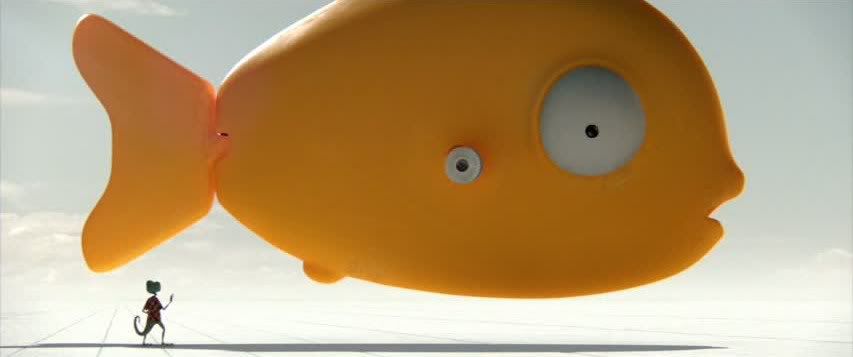
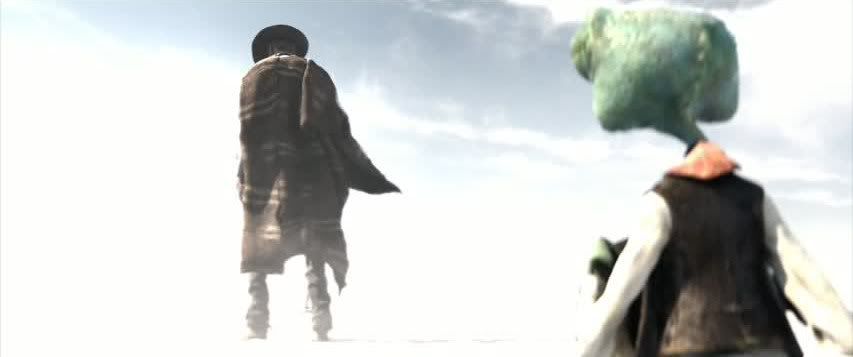
If the film's plot is sometimes less than coherent, broken up by embarassing digressions like the "Ride of the Valkyries" scene, Verbinski compensates with other pleasures. Rango's first night in the desert is visualized by a charmingly surrealist dream sequence populated by a talking windup goldfish and a disembodied Barbie torso, his only "friends" from his solitary existence. Later, in the film's best and most memorable scene, Rango actually meets the Man with No Name himself, a cartoonized Clint Eastwood (actually voiced by Timothy Olyphant) dressed in the distinctive poncho he wore in his Leone films. It's a wonderful meta moment, an explicit acknowledgment of Rango's affectionate tribute to the Leone/Eastwood collaborations. Eastwood's appearance provides a good example of the film's animation quality, too, since the caricature is instantly recognizable as the iconic actor, his face deeply lined and worn like a grizzled, aging Western hero, squinting and sneering as he dispenses advice to the tiny lizard he's inspired.

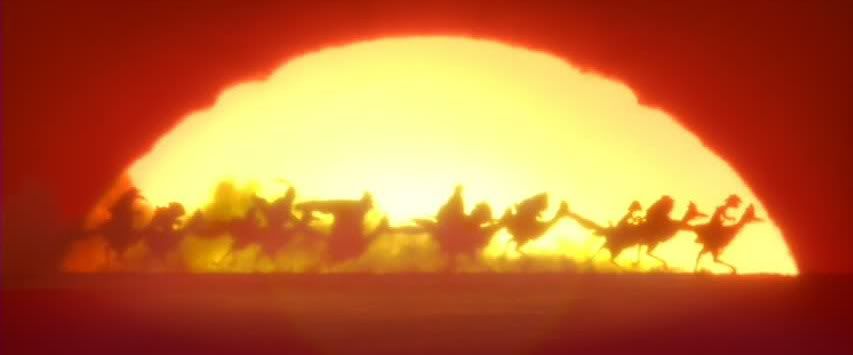
The animation is generally gorgeous in general. Not all of the character designs are as expressive and satisfying as the depictions of the Man With No Name and Rango himself, but the animation is unceasingly lovely, and all of the characters are textured and detailed so that they never seem like molded plastic (as, for example, the highly praised Pixar's human figures often do). There are plenty of visually sumptuous moments along the way, brief sequences where the action pauses to simply admire the scenery. A posse ride through the desert is particularly jaw-dropping, as the sunset desert scenery looks simultaneously realistic and colorfully stylized. The iconography of the Western is lovingly referenced in the visuals, from a shadowy figure appearing out of the shimmering heat haze of the desert to a group of riders galloping against the huge orange half-circle of the setting sun.

Rango is in many respects an interesting, if somewhat schizophrenic, work with the ambition to marry some big ideas to a rather conventional underlying structure. At its best, the film is visually dazzling, witty and a tribute worthy of the spaghetti Western influences it wears on its sleeve. At it's worst, it's cloying, overbearing kiddie fare, and those two sides of its personality are never quite resolved. Still, the film has enough ambition, smarts and style to make it a mostly enjoyable entertainment that occasionally reaches for something more.

Monday, August 15, 2011

Let Me In


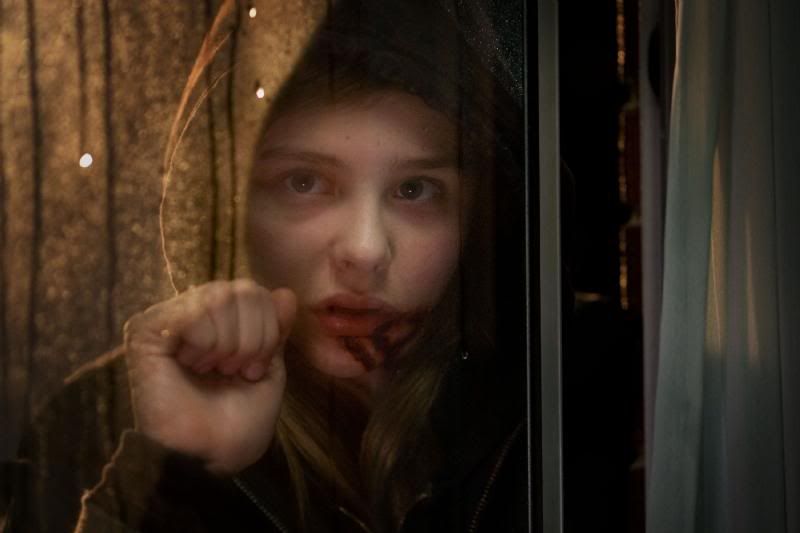
Let Me In is Matt Reeves' remake of Tomas Alfredson's Swedish vampire movie Let the Right One In, which was itself based on John Ajvide Lindqvist's novel. Reeves' film is part of a not-so-honorable tradition of remaking foreign movies — particularly foreign horror movies, and particularly Japanese horror movies — in the English language in order to make them more palatable to American audiences. The main reason for the prominence of this trend in the last decade or so is fairly obvious, as well as regrettable: the original films, for the most part, are interesting, creepy, frightening, well-made horror fare, and they would be eagerly consumed by mass audiences if not for the fact that so much of that English-speaking mass audience, certainly in the United States, is very averse to reading subtitles. Reeves' film starts with one strike against it, then, in that its origins are so blatantly commercial, motivated not by the artistic necessity of remaking Let the Right One In a mere two years after the compelling original film, but the commercial necessity.

Reeves both lives up to those low expectations and, in some ways and more surprisingly, surpasses them. The film is almost slavishly faithful to Alfredson's film: it leaves out some of the subplots and scenes from the original, but what it includes is often copied from the Swedish film, if not in exact dialogue or exact shots then at least in close paraphrases and images that evoke the mood of the original very strongly. The relationship between the perpetually young vampire Abby (Chloe Moretz) and Owen (Kodi Smit-McPhee), the disturbed, violently simmering boy she befriends, plays out very similarly to the same relationship in Alfredson's film (where the characters were called Eli and Oskar, as in the book). What's missing is the full extent of the warped, ambiguous sexuality that wafts through the original — not surprising considering American audiences' skittishness about sex and especially the developing sexuality of children — and some of the warmth and tenderness of this vampire/human friendship. A few chopped shots aside (including the infamous closeup that explicitly called Abby's gender into question) Reeves includes most of the same scenes that Alfredson staged between Abby and Owen, but some crucial spark, some energy and intensity and mood, seems to have been lost in translation. The relationship goes through the same motions and winds up in the same place, but the strange chemistry between the leads is missing the vitality and dark humor of the original.

In another respect, however, Reeves expands upon and possibly improves the original, by subtly drawing more out of the character of the older man (Richard Jenkins) who accompanies Abby and kills for her, gathering blood for her to drink from his victims. Reeves perhaps suggests the heightened importance of this character by opening the film with him, pushing back the introduction of Owen; the young boy had the first lines of Alfredson's film, creepily intoning "squeal like a pig" as he imagined violent vengeance on the schoolboys who bully him. In Reeves' film, the killings of Abby's "father" play out very differently from the corresponding scenes in the original film. Where Alfredson made the old man seem like an incompetent killer, floundering and past his prime, the father in this film simply hits a run of bad luck that leads to his horrifying climax. Jenkins also delivers a deep, powerful performance that makes this character even more poignant: he seems weary, done, tired of a long life mostly spent killing for Abby. One of Reeves' cleverest changes is inserting a brief scene in which Owen finds an old photo of Abby with a young boy who doesn't look very different from Owen himself. It's obviously the "father," and by including this detail, Reeves makes explicit a subtext that haunted the earlier film: that Abby's friendship with Owen is the beginning of a relationship very like the one she once had with the old man. This more fully developed subtext gives special weight to the scene where the old man tells Abby to stop seeing Owen: it's not fatherly protectiveness that motivates him, but jealousy, and perhaps the hard-won knowledge that a friendship with Abby isn't a gift to the young boy who is obviously already falling in love with her.


In other respects, Reeves' film simply trims a lot from the original without adding much new material to counterbalance. Alfredson's focus on some of the characters around Abby and Owen — Owen's parents, the other inhabitants of the apartment complex — is mostly reduced to a few token scenes. That's a shame, because though Let the Right One In was also always focused on the young vampire and her new human friend, Alfredson also found time to develop other characters in surprising ways. Alfredson lingered much longer than expected with one victim of Abby's bloodlust, creating pathos and horror (and also some absurdist bleak humor) from this character's fate. The few disjointed scenes with that character that remain in Let Me In don't do justice to that tonal and emotional complexity at all. Similarly, Alfredson spent time hanging out with some of the men who lived in and around this apartment complex, listening to their casual banter and their political dialogues, many of which centered on the death penalty, an important theme in Alfredson's film. Reeves moves the time and setting of the story to 80s Reaganite New Mexico, but curiously not only drops the death penalty thread but fails to develop any political context. Reagan is purposefully evoked in a striking shot in which the president's face, on a TV, is reflected in the glass door of a hospital, but this political reference is just empty window-dressing, never mentioned again.

The development of the "father" aside, what Let Me In does well is more or less limited to effectively and faithfully repeating the central ideas of Let the Right One In: the burgeoning friendship between a vampire and a malcontent loser whose violent impulses are slowly building up. The film captures the confused emotions and simmering rage of a kid who is tormented at school and ignored at home (Reeves' decision to condense the roles of Owen's parents accomplishes something similar to the more fully fleshed out portrait of familial neglect in Alfredson's film). To a lesser extent, it captures the sexual confusion of adolescence, particularly in the scene where the sexless Abby slips into bed naked with Owen, who's obviously equal parts baffled and titillated as he asks her to "go steady."

Taken on its own merits, Let Me In is a fascinating twist on the vampire myth, exploring the vampiric condition as a metaphor for adolescent fantasies of violence and revenge. The film's snowbound atmosphere doesn't come close to matching the eerie beauty of the original, which got a lot of mileage out of the contrast between pitch-black night and the fluffy white snow on the ground, but it's still effective. If the film wasn't so closely related to its superior Swedish source, it could even be considered a very fine modern horror movie in its own right. But comparing the remake to its source is nearly unavoidable, as most of the time it follows the original film slavishly, and where it departs it's usually to simplify the subtext and peripheral plots of the original. Reeves makes some intelligent decisions in adapting Let the Right One In for English-speaking audiences, and he does a decent job of repeating some of what made the original film so memorable and powerful. What he doesn't do is establish Let Me In as its own film with its own reason for existing and its own set of concerns, which would've gone some way towards legitimizing this otherwise rote remake effort.

Friday, June 24, 2011

The Conversations #26 (part 2): The Tree of Life


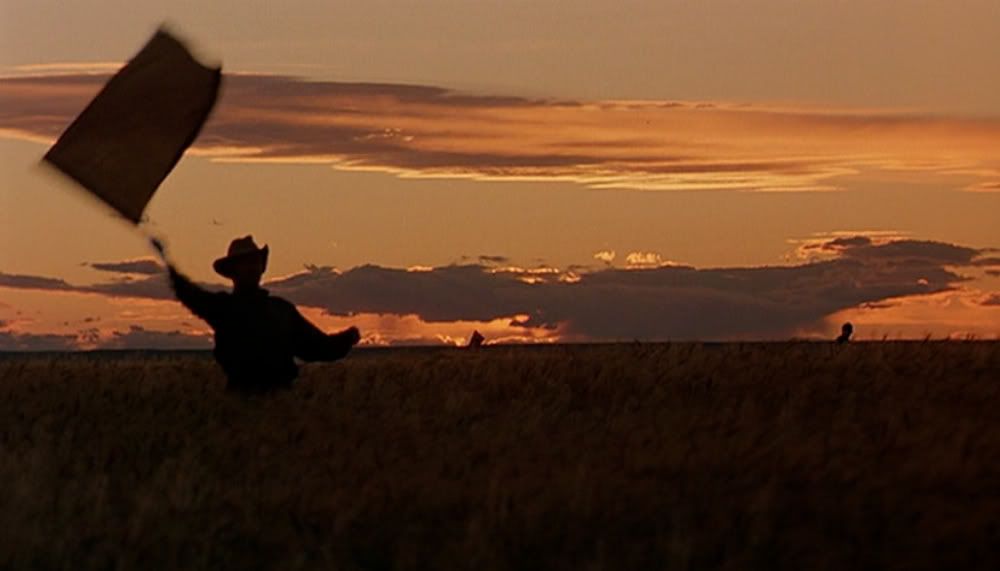
If you've seen Terrence Malick's latest film, The Tree of Life, chances are that you're as eager as Jason Bellamy and I have been to discuss, dissect and analyze this rich, dense, sometimes frustrating but always fascinating movie. In part 2 of our discussion of Malick, following up on our previous conversation about his first four films, we turn our attention to his latest film, which may well be his most ambitious yet. It's certainly a film about which there is a lot to say, and Jason and I doubtless only scratch the surface in our conversation, so be sure to join us in the comment section with your own thoughts.
Continue reading at The House Next Door

Monday, June 20, 2011

You Will Meet a Tall Dark Stranger


It's usually taken for granted, but it's a little amazing that Woody Allen, well over 40 years into his career as a writer-director, continues to be so prolific, to work at the fevered pace of a young man, delivering a film, almost without fail, every year. Granted, not every one of those films is any good — and there are plenty of people who will tell you (mistakenly, I believe) that most of them aren't — but Allen's inexhaustible desire to create, to tell his stories, remains impressive. In recent years, he's delivered at least one masterpiece (the melancholy, incisive Vicky Cristina Barcelona) and a string of variably successful tales about those characteristic Woody subjects: murder, infidelity, dissatisfaction, the desire to be creative and engage with culture. Last year's You Will Meet a Tall Dark Stranger — not even his most recent film, because as a I write this Midnight In Paris is in theaters and another film is already in the works — strikes me as an utterly typical Woody Allen film. It's not a great film, sometimes not even a good one, but rather an embodiment of the Woody ideal. It's what people think of when they think of his work: wry, cultured people cheating on one another in picturesquely filmed settings, eloquently expressing their disappointments. It feels, at times, like Woody by numbers, like even the director himself has internalized the popular conception of his sensibility and has turned out a film that diligently hits all the expected notes of a Woody Allen movie. For all that, the film is often emotionally compelling and, after a rather wan opening act, opens up into a film with some surprisingly intense emotions bubbling up beneath its familiar surface.
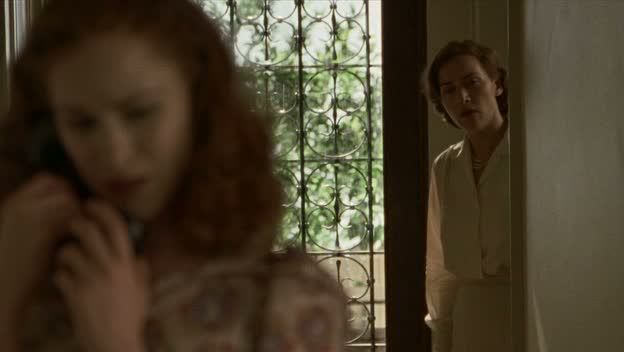
The film focuses on several troubled relationships, centering around the family of married couple Roy (Josh Brolin) and Sally (Naomi Watts). Roy's a once-successful, now struggling writer, and Sally is an assistant at an art gallery, both of them in characteristic Woody Allen professions. Sally's parents have gotten a divorce: Alfie (Anthony Hopkins) is possessed by a fear of getting old and becomes obsessed with appearing youthful and vigorous, an obsession that his wife Helena (Gemma Jones) can't share. The film follows these characters as their relationships splinter and new possibilities become apparent; this is Woody's essential subject, the follies of love and desire, intimately linked with the follies of how his characters view themselves, their ambitions and their dreams. The film's situations are familiar in every sense, all following similar romantic comedy templates: Roy becomes fascinated with the beautiful young woman, Dia (Freida Pinto), whose window faces his, Sally grows infatuated with her boss Greg (Antonio Banderas), Alfie falls for a trashy young prostitute (Lucy Punch) who he impulsively asks to marry him, and Helena begins visiting a psychic (Pauline Collins) who reassures her that her future is rosy. These various subplots are predictable, but Woody manages to extract some surprising depth from these old stereotypes.
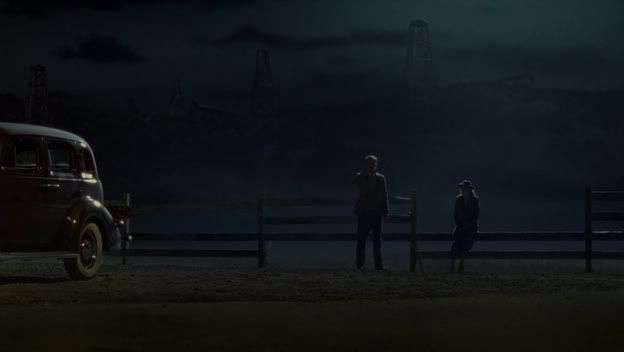

The scenes between Naomi Watts' Sally and Antonio Banderas' Greg are the film's most emotionally compelling and indeed startling moments, largely because Woody gets such a powerful performance from Watts, who becomes the fiery emotional core of this film. At one point, Greg invites Sally to go to the opera with him, and Sally, who has been nursing increasingly strong feelings for her boss, is excited for the opportunity. There's a great shot of Sally looking obviously stirred by the music at the opera, her eyes slipping sideways to admire Greg with a slyly upturned smile on her lips, her eyes shining, moved by the music and by her attraction to her companion. It's a wonderful moment, wordlessly communicating the intense emotions she's feeling, and this shot's intensity is carried over into the duo's awkward but charming conversation in the car later, as Greg drops Sally off at her home. The romantic tension lingering between the pair is obvious, and the possibility that one or both might lean over at any moment for a kiss hangs between them, unfulfilled, as they stammer and banter.

This emotional subtext is carried over into the later moment when Sally at last hesitantly admits her feelings for Greg, while he awkwardly tries to steer the conversation away from the subject without hurting her feelings, without openly admitting that he does not reciprocate her desire. But Sally refuses to drop the subject until she's gotten some closure; she is obviously determined to follow this through to the end so she knows if what she wanted could ever have been possible. Woody inserts a closeup of Sally, her mouth straining with forced smiles, her eyes barely holding back tears, her face growing increasingly red as she realizes that she's opened up her heart while Greg has shunted her feelings aside, as gently as he could but still painfully. Woody cuts between the two to emphasize the distance between the suave, unmoved Greg, who doesn't seem to fully understand his employee's overwhelming emotions, and the frazzled, disintegrating Sally, who presses on even as she realizes that she's not getting through, that any connection she imagined only existed in her head. Sally's face is heartbreaking: there's such hope in her expression, mingled with despair and desperation and also the dawning understanding that she was wrong.


At the same time, Roy is developing a flirtatious friendship with Dia, their neighbor across the way, who he spies on from his window, watching her play guitar or strip out of her clothes to make love to her fiancé. The two begin spending afternoons together, walking in the park in scenes that recall the cinema of Woody's longtime influence Eric Rohmer, particularly The Aviator's Wife, in which an afternoon spent in a lakeside park similarly flirts with infidelity. The flowery natural beauty of these scenes, coupled with the somewhat eye-rolling romanticism of the fact that Dia always dresses in red, suggests that these scenes are more symbolic than actual. Roy speaks of Dia as his muse, his inspiration, and though he desires her strongly he hardly seems to think of her as a person. That's why it's so surprising when, late in the film, Woody suddenly confronts Roy's romanticism head-on, abruptly revealing that the character's romantic conception of this affair was not necessarily shared by the director or the film. In one scene, after Roy moves out of his home and into Dia's apartment, he looks across the way and sees Sally stripping out of her clothes into black underwear, looking sexy and desirable, just as earlier he'd watched Dia. The shot reinforces the truism that one always wants what one doesn't have, and suggests the first moment of self-awareness for Roy, the first suggestion that he was chasing after a dream and might come to regret it. It's a self-awareness he flinches away from, sadly closing the blinds on the view. In another scene, Dia is angrily and tearfully confronted by her fiancé and his family after calling the wedding off, another reminder that the romantic plot between Roy and Dia is not without its casualties, that what seems so wonderful for Roy is bitterly painful for other people.

You Will Meet a Tall Dark Stranger often seems light and cheerful, if not outright comic, so such moments of emotional catharsis are bracing and powerful when juxtaposed against the generally pleasant tone of the film. It's not often a full-on comedy, though Woody's wit does cut through in places, often wedded to the film's darker emotions. In one scene, Helena says about her new boyfriend, "He left me for another woman. A deceased one. They're often the stiffest competition." And then, as though realizing that in her grief she's accidentally told a joke, adds in the same shell-shocked monotone, "no pun intended." The joke itself is classic old-school Woody humor, somewhat corny even, but it's made funny — and also sad and true — by the way it's delivered, an offhanded acknowledgment of the accidental humor that resides in even the saddest stories, a nod to the kinship between tragedy and comedy.

In that regard, this film's navigation of those two dramatic extremes is much defter than the thematically similar Melinda and Melinda, in which Allen tried to separate the two impulses to explore their connections and disjunctions. The link between the funny and the pathetic is much more organic here, and the film knowingly climaxes with dual scenarios that hint at the murder plots of other recent Allen films, without quite heading in that direction. This isn't a great Allen film. It takes a while for the clichés of the film's various plots to resolve into something deeper, and as a result the early stretches of the film are often unsatisfying and awkward. The voiceover, a convention that Woody has increasingly embraced, seems especially tacked on here, and the pat way in which the narration frames the film with references to Shakespeare is just silly. But despite these flaws the film finds Woody investing these overly familiar situations with wit and emotional life, with sparks of energy that go far beyond the basic templates that he is drawing from. Even Alfie's story — by far the most clichéd with its male crisis jokes about Viagra and dumb blondes — climaxes with a moment of surprising emotion in which the hapless Alfie suddenly channels some of Hopkins' sinister intensity, projecting the deadly-serious emotions of a man who's been treated like a punchline for too long. Such moments of emotional revelation, in which Woody unexpectedly overturns and subverts the clichés of the romantic templates that drive the film, make You Will Meet a Tall Dark Stranger much more than it initially seems to be. In a way, that's the theme Woody is dealing with here: life may follow familiar patterns, but just because a story is familiar doesn't mean that it's not real and painful and exciting and full of surprises for those actually living it.

Tuesday, April 12, 2011

Mildred Pierce (episodes 4-5)


episodes 1-2 | episode 3 | episodes 4-5

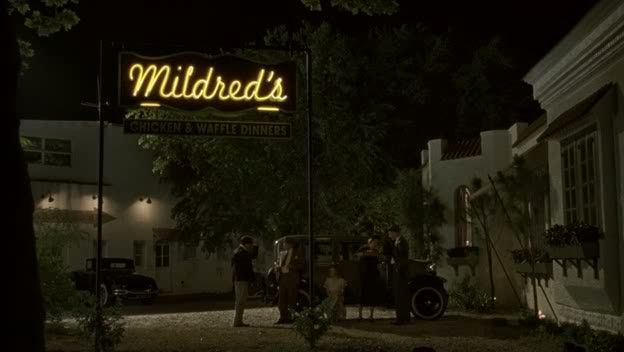
In the final two episodes of Todd Haynes' HBO miniseries Mildred Pierce, the story leaps forward in time several years after the previous episode ended with a decisive break between Mildred (Kate Winslet) and her high society lover Monty Beragon (Guy Pearce). In the ensuing years, Mildred's business has flourished and expanded, and she now has two additional restaurants as a part of her empire, run by her friends. Mildred's daughter Veda has grown up, too, a detail that Haynes lovingly lingers over during the early scene where Mildred returns home to find Veda playing the piano in the living room. The girl is only seen from behind at first, as Haynes' camera glides through the house, following Mildred as she putters about, the images recalling the scenes from earlier episodes of Veda practicing her piano. But this is not the snotty little brat of the first three parts of the series, this is Veda all grown up into a predatory diva, played by Evan Rachel Wood. And just as she was as a child, Veda is still the center of Mildred's life, the whole reason for her existence. Throughout these often devastating, potent final two and a half hours of the miniseries, Veda's dominance of Mildred's life becomes the focus of the film as well, and in the process it begins to seem like Haynes is critiquing the foundations of motherhood itself.

Mildred's story, after all, is the story of the costs of motherhood. Again and again, Mildred sacrifices everything for Veda. At a certain point, after a tremendous argument, Veda moves out of her mother's home, and Mildred spends the rest of her time trying to get her daughter back, trying to win the affection of this girl who is very appropriately compared to a rare and beautiful — but deadly — snake. Mildred allows her business to flounder, her attention wavering from her previous single-minded dedication to having a prosperous career. The whole reason for her business in the first place was to impress Veda, to be able to provide for Veda, and with Veda gone Mildred no longer seems like the strong, determined businesswoman that she once was.

Mildred also gets back together with Monty after randomly encountering him on a street corner, waiting for a bus — he's "between cars," he says, maintaining his high society composure even now that his fortunes have fallen even further. Their relationship initially seems like an improved version of their original fling. The passion is there, and Mildred's desire for Monty is reawakened once she's back in his presence. There's real if unlikely chemistry between them, and Haynes uses it as an opportunity for another very lurid sex scene: it's not often that one sees a shot of a man's head buried between a woman's legs in a staid period picture. The couple gets married, and Monty seems to have changed in substantial ways from his earlier affair with Mildred. In a key scene for his character, he shows Mildred a room he's arranged for her, decorated with mementos of her daughter and her restaurant; he delivers a moving and seemingly sincere speech about how much he admires rooms that reveal something of their owners, rooms where each object means something to those who inhabit them, and he expresses a wish to make this kind of life with Mildred. It's a very touching moment, and a genuine one, a moment that suggests that Monty has matured, that he really wants to create that happy, meaningful life with Mildred.


That touching moment of potential with Monty, the moment when it briefly seems as though a happy ending might actually be possible for this improbable couple, lingers over the remainder of the film, and makes what happens subsequently even more heartbreaking. Once Veda is back in Mildred's life, it's as though Monty has served his purpose, just as the business has served its purpose, and Mildred ignores each of them more and more. Mildred begins to seem less like the strong independent woman she had once been and more like a overbearing mother who's living through her daughter's life and accomplishments. In one scene, Monty tells Mildred that he'll be sleeping alone, leaving her to stay up late with Veda, and Mildred jokes, "I guess we're just middle-aged," but as Monty walks away down a long, shadowy hallway, shrouded in darkness, it seems obvious that he's not so flippant about his increasing (and rapid) marginalization in this marriage.

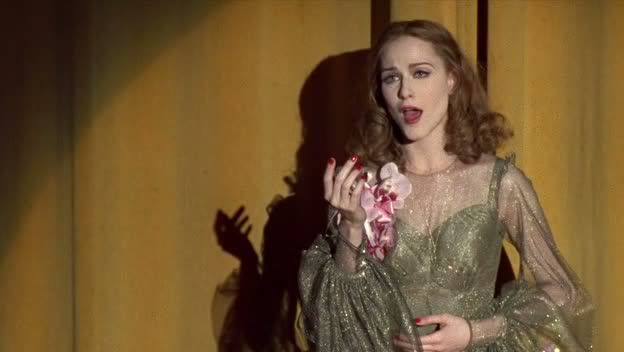
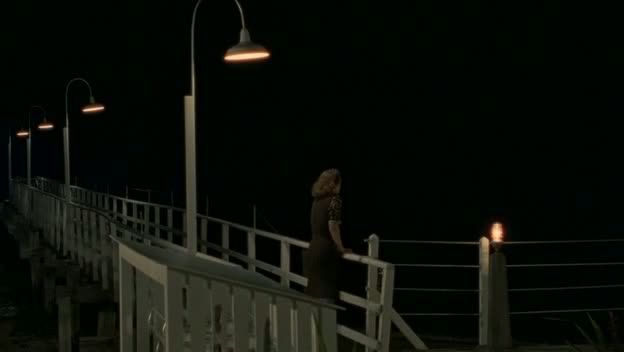
Mildred, however, seems more concerned with her daughter, since as Mildred calculated, Veda returns to her mother's life after the marriage, lured by the society wedding and the newly redecorated Pasadena mansion, so remote from the suburban Glendale mediocrity that Veda so despised as a girl. Veda, during her time away from home, has somewhat improbably become a classical opera singer after failing as a pianist, finally displaying the talent that Mildred had always sensed was in the girl. When Mildred first hears Veda sing, she's with Bert, listening to the radio, and Haynes' camera circles around the radio, focusing on the speaker and the sound mysteriously emanating from it, emphasizing the strange disconnection of this moment, the way Veda's voice emerges from the ether, the daughter who Mildred so desperately needs and hasn't seen in months suddenly crying and howling from the radio in airy, high-pitched trills. It becomes too much for Mildred: she walks away, standing by a dock in a composition that echoes a similar one from the 1945 Joan Crawford version of Mildred Pierce, although for Haynes it's not a melodramatic moment of near-suicide but a quiet interlude of contemplation.

Later, in the miniseries' biggest set piece, Mildred, Bert and Monty go to see Veda perform at the Philharmonic, a grand debut that Mildred watches with an expression somewhere between incomprehension and terror. She doesn't even look happy; she looks like she's watching a horror movie, on the verge of tears, over-awed by her daughter's talent, unable to understand how these sounds are emanating from her longtime object of fixation. At one point, Mildred borrows a pair of opera glasses, and Haynes inserts a shot of the view through the binoculars, magnifying Veda's face to reveal the sneering, angry expressions on her face as she sings, as though she's pulling her voice up from some deep, dark place within her, expressing her rage through these beautiful but demanding songs. Mildred looks away almost immediately, unable to deal with that, and she much prefers the encore when Veda unexpectedly sings a song that's implicitly meant for her mother, a song she knows her mother loves, and ends it by blowing a kiss. It's a tender gesture that might also be a sarcastic one, prefaced by an acknowledgment that she knows her mother's song doesn't belong on a Philharmonic program, just as she knows that her mother doesn't belong in the upper class.


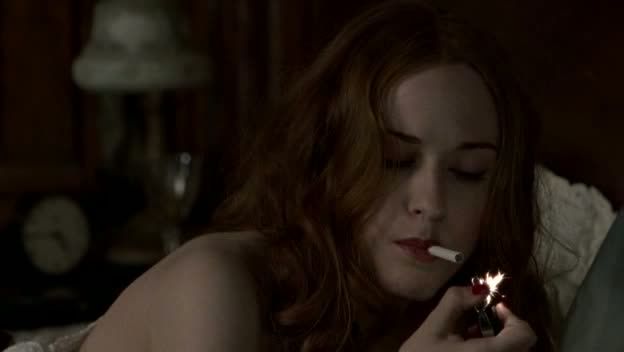
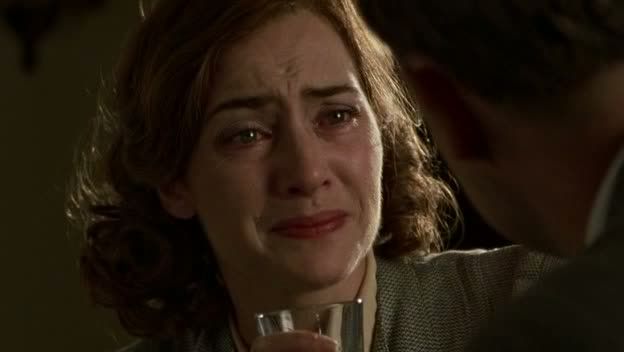
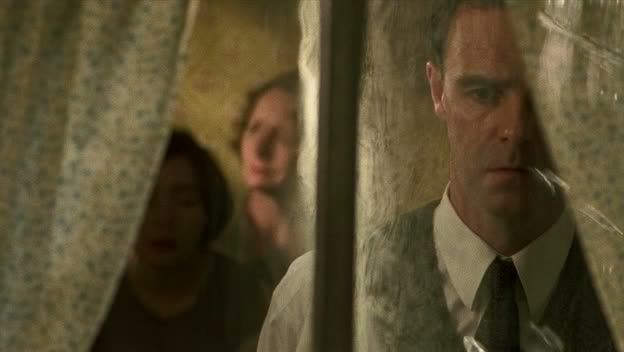
All of this sets the stage for the harrowing and unforgettable climactic scene, a masterpiece of staging, in which Mildred finds Veda and Monty in bed together. Haynes really lets the long-bubbling Freudian psychosexual subtexts come raging to the surface at this point, as Mildred slumps against the wall, her mouth slack, her eyes disbelieving and wide, looking at her daughter languidly stretched out naked in bed. Wood's performance is at its over-the-top best here, cutting loose with this chilly girl's sneering, sinister slinkiness. As her mother breaks down in shock and Monty quickly recovers his suave act, Veda becomes downright evil, the full flowering of the nasty, self-motivated, manipulative evil that had shown up in flashes previously but is really unleashed here. She casually lights and smokes a cigarette, lying in bed, the blankets loosely draped over her, falling off her shoulders, smiling her cold smile. And then, in a moment of transcendent horror, she gets up out of the bed, deliberately allowing the blankets to fall away from her long, thin — snakelike — body, and walks naked across the room, parading her body in front of her mother, then sits in front of the mirror, still nude, combing her hair. It's an eerie, dreamlike scene, a nightmare in the flesh. Veda is provoking her mother, displaying herself to her, and the moment resonates with the earlier one in which Mildred had given her sleeping daughter a kiss on the lips that was more sapphic than motherly. This bedroom confrontation is a chilling, provocative sequence, a scene of high gothic melodrama that, in retrospect, Haynes' entire series was building towards.

That's the emotional crescendo of the entire miniseries, and it's very powerful, deliberately upstaging the staid, censorship-bound similar scene in the 1945 Hollywood Mildred Pierce. Haynes, sticking close to the James M. Cain source novel, avoids the murder mystery genre plotting from the Joan Crawford movie, but his film's climax is even more lurid, even more melodramatic, rising to operatic excesses to stage this horrific primal scene. The whole sequence ends with another striking composition, after Mildred has choked Veda, straining the girl's singing voice. Veda runs downstairs, clothed now only in a thin silk robe, staggers to the piano, crouches on the bench to bang out a few discordant notes, croaking awfully, then collapses to the ground beside a puddle of her own vomit. Haynes holds the terrible, emotionally devastating, ugly moment in a long shot, encompassing the shadowy high-ceilinged room with Veda collapsed in the background, Mildred standing in the middleground, and Monty in the foreground looking on in shock. It's a harrowing moment, and contrasted against the meticulous period detail and quotidian reality that dominate the rest of the series, it's as though Mildred has suddenly been plunged into an abyss, hurtling out of her average suburban lifestyle into a psychosexual nightmare.

Following this scene, Mildred has nowhere to go but back into the comforting arms of her first husband, Bert (Brian O'Byrne), and the ordinary suburban existence they once enjoyed. She flees from her daughter, from her business ambitions, from her social climbing rise into the upper class, and returns to boring, prosaic Glendale and the boring, prosaic marriage she'd once fled. The Hollywood film played this marital reconciliation as a happy ending, if a perfunctory one, but Haynes allows the full impact of this turn of events to resonate. It all ends with Bert's hollow insistence that everything will be alright, that they've got each other, and all the while there's such earnest desperation in his face, in the way he urgently pours two glasses of liquor for them. "Let's get stinko," he says, and Mildred repeats it for the last line of the film. And then she shoots the camera a gaze of such teary, red-eyed despair that it becomes instantly apparent that things are not alright, that this is not a Hollywood happy ending, that this couple has got years of drunken denial and disconnection still ahead of them.

Tuesday, April 5, 2011

Mildred Pierce (episode 3)


episodes 1-2 | episode 3 | episodes 4-5

The third episode of Todd Haynes' new Mildred Pierce miniseries opens in the immediate wake of the second episode's tragic conclusion. The younger daughter of Mildred (Kate Winslet) died at the end of the second episode, which concluded with a discrete pan away from Mildred embracing her surviving daughter Veda (Morgan Turner), and the third part of the series doesn't gloss over this grief but draws it out, lingering lovingly and sadly over the details. In the opening shot, Haynes' camera pans across Veda's sunlit room, the morning after the last episode's conclusion, and the sunny cinematography, the bright child's toys and decorations, are enough to suggest that maybe it was all a bad dream, until the moment when Mildred's gaze lands on the empty bed of her other daughter, at the same moment as Haynes guides the audience's gaze to the same spot.

In the subsequent scenes, Mildred balances her grief against the practicality and determination that constitute her essential nature; even when she's at her darkest moment, sobbing and despairing, she has the presence of mind to think of the need for a black dress. Haynes frames this moment in one of the through-a-window shots that characterize his style in Mildred Pierce, with Mildred's husband Bert (Brian O'Byrne) in the foreground and Mildred in the background with her friend Lucy (Melissa Leo), discussing her dress size and whether she should wear a veil or not. Soon, Mildred must lay out the clothes her daughter will wear to be buried, and she carefully lays out the clothes on the bed, smoothing out the wrinkles in a dress and placing a pair of socks down one by one. After the funeral, Haynes mirrors this sequence with a shot of Mildred similarly laying out her funereal black dress, straightening it out and hanging it up in the closet, putting it away as though she could put away her grief so neatly. In its quiet, methodical way, this opening is more devastating than a more showy, melodramatic evocation of grief, because it's so horrifyingly normal.

The emotions enter a more melodramatic register later in the episode, but Haynes' emphasis on details remains a constant presence. As in the first two parts of the series, Haynes keeps calling wry attention to the economics of the time, as even after Mildred gets her restaurant up and running, she still has to keep careful track of her money, counting every dollar. More than the first episodes of the series, Depression-era politics linger in the background here, with political speeches playing on radios and the end of Prohibition triggering changes for Mildred's business. The economics of the time are also at the forefront, as Haynes again takes every opportunity to demonstrate how much things cost at this time, taking particular ironic pleasure in a stop to a gas station where a full tank of gas costs a little over a dollar.


The bulk of this pivotal episode, however, focuses on the relationship between Mildred and the fading society heir Monty Beragon (Guy Pearce), who has retained his status and the significance of his family name even while losing all of his money. As he result, he takes money from Mildred even while looking down on her, mocking her status as a lowly working woman. In that, he has a co-conspirator in Veda, who has her own pretensions of upper-class privilege, and who naturally rejoices at Monty's presence in her mother's life. The scenes between Monty and Mildred dominate this episode, as their initially passionate and intense relationship is corrupted by Monty's disdain for work, and his contempt for Mildred's working class lifestyle. In several scenes, the couple argues, trading cutting words as Mildred begins to realize that Monty is not the man she thought he was, until Monty defuses the situation by seducing Mildred.

Despite it all, Mildred still desires him, and Monty knows that at this point, sex is the one thing he still has to offer — though he jokes that he's a gigolo, it often seems to be more or less true. These scenes are painful to watch, to see this strong woman, who's worked so hard and dealt with so much, brought down by this guy who's outwardly smooth and suave but actually quite pathetic. The thing is, Mildred, unlike so many other movie incarnations of the "strong woman," doesn't turn off or suppress her sexuality in the name of her career or her family — she might be making the wrong choice with Monty, but she's making it because she remains a sexual woman throughout all of her troubles. Probably the most telling moment in that respect is the scene when Monty shows up at Mildred's restaurant, preceded by buzz and excitement over his presence, with Mildred's two other men, Bert and her business manager/lover Wally (James LeGros), wondering how such a high society legend heard about the restaurant. When Monty then casually enters the kitchen and addresses Mildred intimately and familiarly, bringing her flowers, Mildred turns and suppresses a wicked smile in a napkin. Rather than being embarrassed or awkward, she's thrilled, proud, showing off Monty like a conquest, taking pleasure in introducing him to Bert and Wally. There's a social-climbing aspect to this pleasure, sure, the thrill of having this access to high society that the others clearly envy, but it's also the thrill of showing off her sexual prowess.

Haynes ends the episode with Mildred finally rejecting Monty's advances, driving to see him and then back home again in a lovingly photographed thunderstorm that externalizes Mildred's anger and confusion. On the way there, toward Monty's spacious but disused mansion, where most of the rooms are closed up, the furniture covered in white sheets, the stormy night seems to glow with eerie headlights illuminating accident scenes and slick roads. On the way back, after Monty flippantly jokes about raping Mildred — she momentarily gives in only to push him off and run away — the night has become even more threatening, even more sinister. The night seems to close in on Mildred, dark and intense, the roads narrow and surrounded on all sides by dark tangles of trees and foliage that seem to press in on her. That's an appropriate place to end this transitional episode that bridges the gap between the opening two hours and the next (and final) two episodes, which promise to leap forward several years into the future. Haynes' Mildred Pierce continues, in its precise and evocative way, to ably balance the naturalism of Haynes' period details against the creeping melodrama that's starting to emerge from the character interactions.