Friday, October 19, 2007

10/19: Love and Death


Tonight I took a break in my Woody Allen chronology to return to an earlier favorite, Love and Death, generally considered the last of Allen's "early, funny ones" before his breakthrough into more sophisticated films with Annie Hall. But Love and Death is itself a pretty sophisticated transitional work, a step forward for Allen towards the philosophical examination and homage to his favorite directors that would characterize his later works. At this point, he was still all about the joke, and gags come fast and furious here. Every line seems designed for a laugh, and he frequently inserts an anachronistic joke or breaks the film's reality, something he would do with decreasing frequency as the years went by. In this film, though, he still wasn't averse to doing something totally ridiculous to get a laugh, though even then there are sometimes subtler shadings. An early line about Old Nehamkin and his son Young Nehamkin, and how Young Nehamkin's son is somehow older than Old Nehamkin, initially seems like a throwaway gag, part of a fluid stream of such jokes that Woody delivers in voiceover at the beginning of the film. But then, he returns to the line at the end of the film, using it as an example of how the world works illogically and mysteriously, and none of us can ever understand.

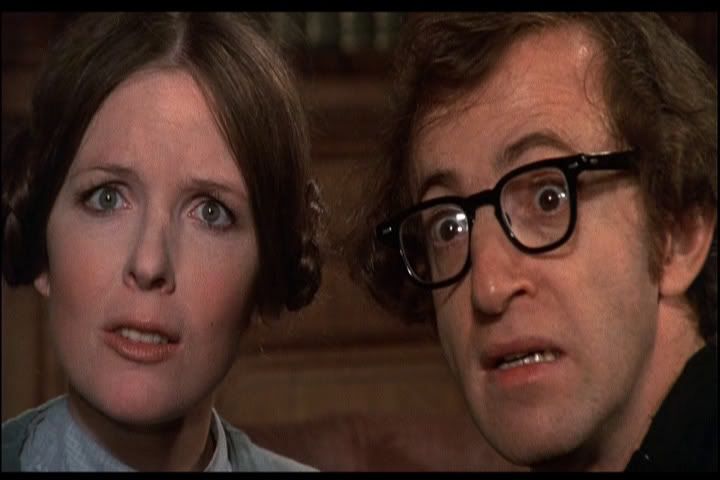
As far as it goes, that basically sums up Woody's philosophy here. The title encompasses the basic extent of the film's concerns. Woody's character, a cowardly Russian soldier, ruminates continuously on death, the existence of God, the nature of love, and the purpose of life. These are of course familiar themes to any fans of Allen's films, though here they're treated with a much lighter touch than usual. Woody is practically clownish here, as he often was in the earlier films, and he shows a willingness to do anything for the joke. The film blends several types of comedy into the mix, alternating slapstick silent comedy routines with quick-witted wordplay and hilarious parodies of Woody's heroes, like Bergman, Dostoevsky, and Eisenstein. This latter has the quality of an in-joke for art cinema fans, since nobody else is likely to get the joke when Woody inserts lengthy parodies of Persona and The Seventh Seal. There are periodic monologue scenes in which the characters, in tight close-up, turn and address the camera, looking tortured as they recite endlessly complicated monologues on morality and God. Towards the end, he has another character's face move into the frame and bisect the face of Diane Keaton, forming a warped composite face that makes a striking counterpoint to the one in Persona. He also inverts Eisenstein's famous montage of three lion statutes in increasing standing positions; Woody shows three lions culminating in a lazy one, lying with its head on its paws. Even the ending channels his hero Bergman, a hilarious deflation of the ending of The Seventh Seal, with Woody and the Grim Reaper dancing off into an orange sunset.

Obviously, these are in-jokes specifically intended for art cinema fans like Woody, and anybody not familiar with the originals is likely to just gloss over these moments. That's OK, though, because so much of these early films depend on being able to mentally skip by the moments that don't work. With such a constant flood of jokes pouring out of Woody at all times, not everything here is top-notch. The more measured pace of his later films allowed for greater consistency and deliberateness to the gags, but here he's just throwing out whatever he thinks of and hoping that some of it will work. To his credit, a lot of it does, and the relative proportion of flat humor is pretty small overall. This is one of his funniest early films as well as his smartest and most sophisticated. His films would only get better from here, as he charged right into a period of unparalleled creativity and increasing depth. But this film, positioned on the cusp of that great run, is very much worthwhile in its own right.

Thursday, October 18, 2007

10/18: Blind Beast


Yasuzo Masumura's Blind Beast is a staggering example of Japanese pinku eiga cinema, a "pink film," part of the wave of sexploitation movies that swept over Japanese theaters in the late 60s. Of course, Masumura's take on this genre, which was often nothing more than soft porn, is as highly idiosyncratic and stylishly executed as anything in his filmography. The blind sculptor Michio (Eiji Funakoshi) kidnaps the beautiful model Aki (Mako Midori), in order to use her as the subject in his project to create a new art of touching. She resists in any way she can think of, finally using psychological manipulation to turn him against his clinging, overbearing mother (Noriko Sengoku), but she eventually warms to him, and the duo engage in an escalating orgy of sensation, in constant search for greater and greater pleasure and pain.

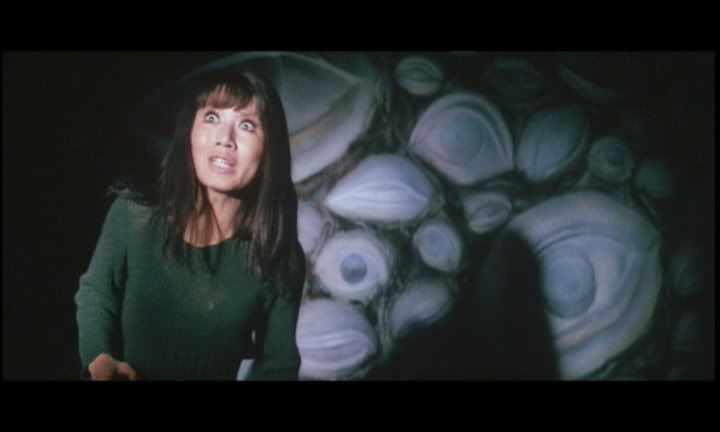
Masumura uses the simple, exploitation context of the story in order to layer on multiple meanings and ideas which are explored throughout the film. Most obvious of these, and least interesting, is the thick Freudian subtext. Michio is a virginal momma's boy who, before Aki's arrival, is content to explore sensation by becoming a masseur and creating sculptures of women's body parts. His warehouse studio is a phenomenally designed aggregation of these sculptures, the walls lined with disembodied body parts, organized by type — one wall is all lips, another all breasts. And in the center of the room are two tremendous nude bodies, which Aki helpfully points out indicate Michio's mother complex, a desire to be small in a woman's arms. Regardless of the Freudian implications, though, the set provides a stunning visual backdrop to the film. When Aki first wakes up after being kidnapped, she's bathed in total darkness and can't see her surroundings. Michio arrives with a flashlight and leads her — and the audience — on a terrifying tour of his studio's interior. As Aki flees from wall to wall, the blind sculptor advances, the beam of his light illuminating each wall in turn. We see a wall of huge ears, a wall with legs extended sinuously, a wall of arms writhing with their fingers contorted into strange poses.

Masumura and his art director Shigeo Mano had these sculptures made by a big team of art students, taking up most of their budget, but the effort clearly paid off. This is one of the most striking sets I've ever seen, and it is especially effective because of the way it externalizes the film's psychological conflicts. Michio is content in this bizarre room because it reduces the complexity of woman to dismembered parts, which he can caress in isolation, without dealing with the woman as a whole. Even his organization speaks to his inability to cope with actual humans; all the legs together, rather than all the parts of a single woman. The constant presence of these sculptures in the background means that the film is playing out in a giant reconstruction of Michio's mental landscape, writ large in the setting of the film.

The film also examines the nature of art itself, and it's surely tempting to see in Michio's manic quest for a new art, a parallel to Masumura's own career. For a director constantly obsessed with pushing boundaries and cramming his cinematic works with the most stunning imagery imaginable, there's a real link with Michio's desire to find new outlets for artistic expression, and new ways of expressing himself. The scenes where he's sculpting Aki's body, caressing her legs in order to learn their shape, establish the link between the physical act of sculpting, of creating, and the caresses of a lover. These deeply erotic scenes might be thought of as Masumura's own commentary on the sensory potential of art, and the artist's capacity to translate what he senses into new forms of expression.

Throughout the film, Masumura himself pushes the boundaries of expression, just as Michio does, in order to capture the complexities of the relationship between artist and subject. In the final twenty minutes, their relationship finally morphs as Aki softens her feelings towards her captors and they begin to develop a mutually parasitic relationship of violent sensual pleasure. I was initially wary of this change, abrupt and unexplained as it is, fearing that Masumura was merely indulging in a despicable male fantasy of rape engendering love. But it almost immediately becomes clear that this new turn of events is the logical development of the film's themes. Abandoning artwork, Michio and Aki engage in a total art of tactile sensation, their medium each other's bodies and their tools their own hands at first, and eventually whips, chains, and knives. Encased in total darkness (Aki is going blind too, in a somewhat heavy-handed metaphorical gesture), the duo caress and claw at each other, vampirically drinking each other's blood, in pursuit of the ultimate sensory pleasure. Masumura responds to this material by translating the couple's tactile excesses into an orgy of audiovisual sensations. Naked bodies blend into each other, set off from the darkness, blood flows freely and redly, and cries of mingled pain and pleasure ring out of the eerie quiet in the warehouse.

Blind Beast is a wild, powerful examination of eroticism, artistic expression, and the dangers associated with art at its extreme borders. As a channeling of pinku eiga material, it frequently verges into the lurid or the outright ridiculous — another risk of art at the edge — but its vivid imagery is constantly enthralling. Masumura takes his art right to the edge along with his characters, fearlessly following them into the abyss of sensual excess.

Wednesday, October 17, 2007

10/17: Kiss of Death


Kiss of Death is a solid mid-level noir that really comes alive in its second half, with a powerhouse supporting performance from Richard Widmark (his first role ever!) that makes it more than worthwhile all by itself. The film starts out slow and conventional, with Nick (Victor Mature) going to prison after a failed jewelry robbery, and refusing to squeal on his cohorts to get a better deal. He is a crook with a sense of honor, and moreover a crook basically forced into this life by lack of options — he can't get a job, and he has a wife and two daughters. While he's in prison this time, he befriends Tommy Udo (Widmark), a psychopathic hitman who inserts an eerily unhinged laugh at the most inappropriate places in his sneering speech. Nick also learns that while he's in prison, his wife has engaged in an affair with one of his former partners and wound up killing herself, leaving their daughters in an orphanage. The incident jolts Nick into taking action, and he goes to the DA to agree to turn over on his gang and testify against them. He also falls in love with his kids' former babysitter, Nettie (Coleen Gray), in a relationship whose basic creepiness is largely left unexplored (later, Nettie tells him, as they kiss, that she wanted him ever since she was a little girl... um, ewww).

This setup largely takes up the first half of the movie, and it's hardly compelling stuff for the most part. It is, however, necessary to establish Nick as a family man at heart, a basically decent guy who made some bad choices and now desperately wants to fix his life. This makes the film's second half, with its increasing focus on Widmark's sadistic, sociopathic Tommy, all the more terrifying and intense. We sense Nick's fears because we've already seen how much he cares for his family, how much he wants to go straight, and we feel his frustration at the continuing obstacles thrown in his path. Before he's totally free of his old life, he must live up to his deal and testify against Tommy, but the jury fails to convict the killer, and Nick knows that he's sealed his own fate and that of his family. He knows this, and the audience knows it too, because Tommy has already been established as one of the most unforgettable movie psychos of all time.

In a scene before Nick's testimony, Tommy chases another suspected stoolie, but finds that he has already fled the country. Denied his revenge, he settles for attacking the thug's crippled mother instead, tying her to her wheelchair and pushing her down a staircase. It's a stunning and horrifying moment, and one that Widmark amplifies with the intensity of his performance. Director Henry Hathaway also shows his instinct for capturing a fine performance, cutting to and holding a closeup of Widmark as he stands, leering over his wheelchair-bound victim. The shadows accentuate his twisted, cartoonish grin, his petulant whining voice seeming creepily ill-fitted to the sheer evil of his visage. And Widmark himself actually steps into the closeup, moving closer to the camera to get the effect of a de-facto zoom. Otherwise, the camera stays still for this, letting Widmark's unhinged brilliance dominate the screen. When he steps forward and looms even larger in the frame, his brows arching wildly and his mouth twisting to the side as he spits out veiled threats, the effect becomes overpowering. The moment is so intense, its mood so sustained, that it hangs over the whole rest of the film's second half. After he pushes a crippled woman down a staircase to her death, looking so gleefully creepy while he does it, Tommy takes on a totemic power for the remainder of the film. He is a symbol of death and destruction for Nick, a powerful threat to everything he holds dear.

If the rest of the film doesn't quite live up to the staggering intensity of that single closeup moment, it's more than understandable. Even so, the tense standoff between Widmark and Vic Mature (who is surprisingly good in this, considering how much I hated him in Anthony Mann's least interesting Western The Last Frontier) is very satisfying. The film as a whole provides more than enough energy to its standard script, and Widmark's scene-stealing is reason enough to check this one out.

[This post is, considering the importance of Widmark's performance here and the screencap above, my contribution to the Close-Up Blogathon currently going on until October 21, 2007.]

Tuesday, October 16, 2007

10/16: Culloden; Day of Wrath; Raw Deal


Culloden was Peter Watkins' breakthrough first film for the BBC after a string of independently produced short films got him noticed as a filmmaker. His very next film, The War Game, with its stark depiction of nuclear terror, would hit way too close to home and get him canned from the BBC, but this film, a popular and critical success, is in many ways just as uncompromising. Watkins developed his trademark pseudo-documentary style early on, and Culloden uses the technique, jarringly, to reconstruct the battle of Culloden Moor, the last land battle in Britain. The film details the defeat of the disorganized, poorly led Scottish highlander rebels by the much larger force of the British army, a bloody rout that turned into a years-long, equally bloody "pacification" operation afterwards. In its criticism of war, exposure of the class divide, and vicious mocking of official hypocrisy and deceit, Culloden is obviously a Watkins film, and it retains the righteous rage that runs through all his work.

Watkins follows the build-up to the battle with a series of close-ups on individual soldiers, as a voiceover describes the preparation, and interviews with soldiers and officers provide further context. As always, Watkins is especially concerned with social and economic injustices, and he details the ways in which soldiers were drafted by force, by economic necessity, by the subtle coercion of the clan system -- all of them fighting for the sake of much richer men who controlled their lives in every way, in battles whose causes and goals were alien to their own poor lives. As affecting as the straightforward voiceover is in getting at the root of their injustices, Watkins' use of stark, head-on close-ups of men on the battle lines is even more affecting. These haunting shots of dirt-smeared, confused and frightened faces, are among the film's most memorable and powerful images. Watkins provides the details of battle strategies, troop counts, and descriptions of period weapons, the meat of a traditional historical documentary. But while the voiceover speaks disinterestedly about such distanced, objective matters, the close-ups draw the attention immediately to the human realities behind such impersonal facts and figures. Watkins is using the form of the historical documentary, but he undercuts and subverts it at every turn, using its conventions against it in order to underscore his points about the brutality of war.

There's no room in Watkins' vision for victors either. Though the battle is a clear one-sided rout, he takes pains to humanize the grunts on the British side as well. Though their losses in physical terms are relatively minor (though, Watkins takes pains to point out, not zero either), they are equally victims of the whims of their social and economic superiors, conscripted and coerced just like their opponents. And they are also pushed into a brutal and dehumanizing campaign after the battle is over, to obliterate the remains of the Scottish rebels in an orgy of slaughter, rape, pillaging, and political sanctions. The film's anti-war outcry thus expands into a more specific protest about the use of violence to wage cultural warfare, exterminating an entire culture. In addition to being a poignant look at the lost heritage of Scotland, the last part of the film's frequent references to "pacification" can't help but point also to the then-ongoing Vietnam War and the always looming troubles in Northern Ireland, which stemmed from the same religious and cultural distinctions that caused the battle of Culloden. As a critique of war and the exploitation and brutality it engenders, Culloden is still, even now, a powerful and unforgettable film, despite its historical setting and early position in Watkins' career. He would go on to make much more incisive and complex critiques in later films, but this film proves that even his very earliest work is worthwhile.


At the core of Dreyer's unsettling Day of Wrath is a bitter opposition between vibrant sensuality and fierce repression, between the individual's will and desires and the collective morality of the community. In a small Danish village, the old woman Herlofs (Anna Svierkier) is accused of being a witch and burned at the stake, but not before she curses the local priest Absalon (Thorkild Roose) for failing to save her. Herlofs is afraid to die, and begs for a reprieve, but the pious, unquestioning Absalon never doubts that she deserves to die, and can only offer her prayers for the afterlife, a gesture she rejects as meaningless. After her death, the story focuses on Absalon's young second wife, Anne (Lisbeth Movin), who feels trapped and drained by her loveless marriage to the reverend. When the reverend's son from his first marriage, Martin (Preben Lerdorff Rye) returns for a visit, Anne falls in love with him and seduces him.

Anne is a figure of tremendous ambiguity and uncertainty in the film, an indication of the profound open-endedness of Dreyer's vision. Anne is vibrant, fiery, passionate, emotional, everything that the cold and somewhat puritanical Absalon is not. For every moment she is on screen, she is a magnetic, irresistible presence, her eyes burning with desire and frustration at her repressive circumstances. She seems like a figure completely out of place in her time, a modern woman thrust into the 1600s. In one remarkable seduction scene, she glides effortlessly around the room, circling the static Martin, her gleaming eyes always locked on him even as she moves around him. Dreyer's camera moves with her, taking on the sinuous motion of her body, framing the two together briefly, then moving on with her as she cycles around the room, until she arrives back by Martin's side. In another scene, she offers Martin water to drink from her hands. "Want more?" she asks. "Of water? No." "Then, of what?" And she gasps, "Drink!" as though giving an order, compelling him to kiss her.

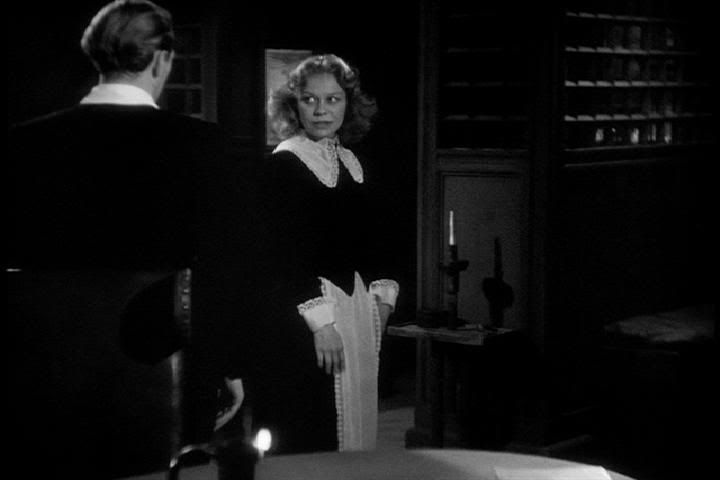
Her eyes, so remarkably dark and yet shining in the shadowy gloom of Dreyer's film, are the frequent source of comment by the film's characters as well. For Absalon, who looks on her almost paternally, they are innocent, even childlike. For his draconian, righteous mother (Sigrid Neiiendam), they burn with the fire of Satan, a sign that Anne too might be a witch. And for Martin her eyes also seem to burn, but with vitality, love, and life. The difference between the two kinds of fire is, presumably, one purely of perspective, and of attitudes towards sexuality. Anne is a defiantly sexual being, and towards the end of the film she admits to Absalon that she hates him for taking her youth from her without asking, for denying her the chance to find someone to love, to give her sensual pleasures. Earlier on, before taking up with Martin, she was so desperate for affection that she even turns to Absalon himself, telling him, "Hold me, make me feel happy." When he spurns her, coldly going to bed alone to pray and think, she turns to Martin instead, with the exact same words. She is an avatar of youth and open sensuality, desirous of intimacy and contact. For Absalon's mother, to whom sex itself is dirty and her son's marriage to a much younger woman is "scandalous," the lusty, vibrant look in Anne's eyes can only represent evil. Martin, on the other hand, young and full of life himself, is enthralled by that look, while his father, inured to worldly pleasures altogether, simply doesn't see it.

It's to Dreyer's credit that his film never entirely gives modern audiences the easy way out. It's incredibly easy to identify with Anne's repressed youth and sexuality, her longing for love and freedom. But Dreyer makes the character of Absalon a genuinely compelling figure as well, a tragically sad old man who vaguely senses that his life is ending and subtly longs for the youthful vibrancy of his wife and son. His unquestioning religious devotion and fear of sin keep him from ever approaching the sensual world, but he is not an unsympathetic character, and juxtaposed against his hateful mother, it's clear that he genuinely cares for Anne and wants to see her happy. When he hears her laughing from the next room with Martin, his mother reacts with suspicion, but he is glad to hear her enjoying herself, and pines for her exuberance. Ultimately, Dreyer's depiction of the repressor figure is as sensitive and complex as his treatment of the film's "victim," Anne.

The element of the supernatural is treated with just as much ambiguity. Anne's status as a witch is unquestioned by Absalon's mother, and even Anne herself sometimes seems uncertain of whether she really has evil power or not. The film equates, to some degree, sexual seduction with witchcraft. When Anne first seduces Martin, she stands alone, softly calling his name to herself as if in a summons; when he appears behind her, she takes it as a vindication of her charms (whether evil or simply sexual) working. It doesn't really matter, of course, whether she simply seduced Martin or used magic on him; the effect is the same. When a man falls in love, he's said to have fallen under the woman's spell, and whether it's literal or a metaphor, it raises sex to the level of the mystical. The larger point seems to be that, in a society where all sensual experience and human connection is unnaturally repressed and frigid, sex becomes magic, either evil or sublime, but always something distant from everyday experience. Dreyer externalizes this by setting Anne and Martin's affair in a grim, shadowy world, all stark and uninviting interiors. The few outdoor scenes are mostly idyllic, brightly lit interludes between the young lovers, a real contrast to the dark inside of the reverend's house, with its bare white walls and crosses casting geometric shadows everywhere. Dreyer's film is a fascinating study of repression and the struggle between individuality and societal conformity; a struggle that only takes on still greater significance considering the film was made in Nazi-occupied Denmark in 1943.


Anthony Mann's Raw Deal is a rough, no-budget B-noir of the best kind, raw and uncompromising and minimalist to the extreme. Its characters are stock cliches spitting out edgy dialogue, and its sets look like cheap cardboard, compensated for by the masterful lighting of cinematographer John Alton. Dennis O'Keefe plays Joe Sullivan, who's serving a jail term after taking the rap for his gangster boss Rick (Raymond Burr) after a robbery. His hard-edged girlfriend Pat(Claire Trevor) and Rick engineer a break-out for Joe, but neither of them realizes that Rick is hoping that Joe won't make it, so he won't have to worry about squealing. Instead, he stays on the run successfully, dragging along Pat and his lawyer's aide Ann (Marsha Hunt), who he pulls in unwillingly but soon falls for.

The film's plot combines a love triangle with an on-the-lam thriller, but otherwise it's pretty standard. It's Mann's treatment of the material, the way he burrows into this story with every trick at his disposal, that makes it truly exceptional. The eerie score, heavy on foreboding theremin sweeps, could've come from a low-budget sci-fi flick of the time, and it goes a long way towards creating the film's tense atmosphere. The story is also interesting because Pat provides the hard-boiled voiceover, inverting noir convention by narrating the story from the point of view of the long-suffering girlfriend, rather than the tough antihero. Her voiceover injects a hint of femininity into the traditionally masculine world of the film noir, though her character never really rises above the limited, passive role of women in noirs. She's there to whine at Joe, to worry, to feel jealous when his nascent attraction to Ann becomes obvious. Ann, on the other hand, is more of an active noir heroine, trying to change Joe's mind about his doomed flight from justice, and at the climax taking decisive action to save Joe's life. But even she ultimately becomes just another damsel in distress, with Joe racing to her rescue for the finale. Mann and the script seem to be playing with conventions a bit here, toying with different roles for women within the noir context, but not really venturing very far from familiar territory.

Still, bucking conventions is rarely the appeal of a 40s noir — I go to them for the dark visuals, pulpy dialogue and scenarios, and the exploration of a certain kind of moral tenor. In that sense, Raw Deal definitely doesn't disappoint. Burr gives a frightening turn as the sadistic gangster boss Rick, his eyes rimmed with black, giving him a fierce glare. In one shockingly brutal moment, he casually throws a bowl of flaming oil at a girl who accidentally bumps into him, then orders her taken away, saying "She shoulda been more careful." John Alton's moody visuals are somewhat obscured on the exceptionally dark and poor DVDs that currently exist, but even so his impeccable compositions and the contrast between dark shadows and gleaming areas of light is obvious. Especially great is the fog-shrouded shootout of the ending, with figures melting in and out of the night. This is a classic and well-executed noir from one of the genre's most interesting directors.