Showing posts with label Alexander Kluge. Show all posts

Friday, March 30, 2012

Four Alexander Kluge shorts, 1967-1973


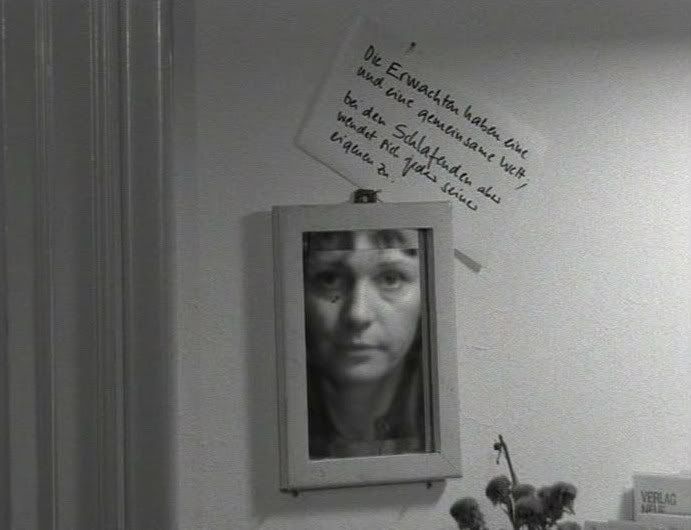
Frau Blackburn, Born 1/5/1872, Is Being Filmed is a strange early short from Alexander Kluge, which blurs the line between documentary and fiction so thoroughly and so oddly that it's hard to know what to make of it at all. Ostensibly a straightforward portrait of the elderly title character, the film barely provides any information or context about who she is or why she's being profiled in the first place. Indeed, the woman doesn't have much to say: she speaks about some stiffness in her hands, holding up a crooked finger for the camera to see, but much of the rest of her dialogue is incidental. She putters about her house, showing off her fancy china and making coffee or tea, presumably for the filmmakers, who she addresses frequently, checking to make sure that she's saying what they want her to say. These fourth wall-breaking references to the people behind the camera suggest that much of this material is staged, not at all the naturalistic observation of an old woman in her home, but a concoction of the filmmakers, who are ordering her to pretend to grind coffee and to explain her ailments. "Is that enough?" she asks them at one point, after delivering a rambling monologue.

Then Kluge utterly shatters the artifice with the appearance of a man who, an intertitle informs us, claims to be a former RAF pilot. The very fact that the title is phrased this way, that he says he's a pilot rather than that he is a pilot, already casts doubt on the whole thing. And then Kluge films the man like a moustache-twirling silent movie villain, in leering closeups accompanied by cackling laughter that isn't synced up to the image at all. The man claims to want to buy earrings from the poor Frau Blackburn, but then he addresses the camera to say that actually he's just getting her out of her house so he can rob her. Kluge then shows the aftermath of the robbery, with the old lady reacting with understated alarm at the sight of all her broken china.

It's a puzzling, intentionally obtuse film that mocks the conventions of the documentary, particularly the supposed objectivity of the filmmakers, who in this case simply stand by and let Frau Blackburn get robbed, recording the results, not intervening even when they're directly told about the robbery beforehand. The film's editing is choppy and elliptical, cutting up Frau Blackburn's words into banal phrases, devoid of context, little bits of anecdotes and biography that mean all but nothing by themselves. Baffling, curiously funny, with an elusive effect that's difficult to shake despite its vagueness, this is a typically maddening and provocative early effort from Kluge.


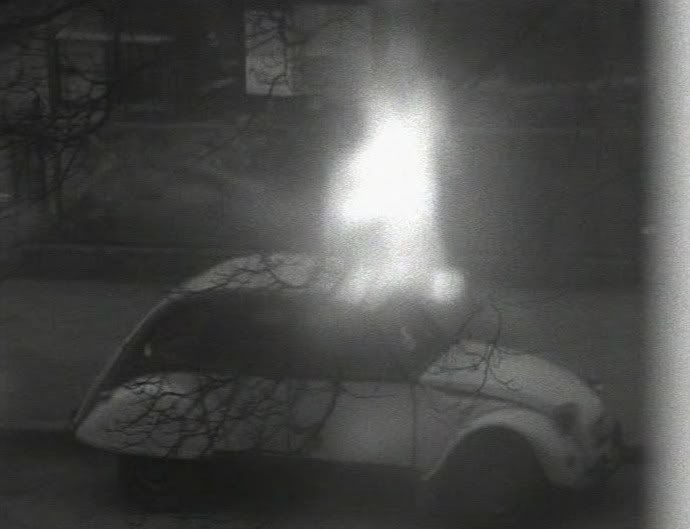
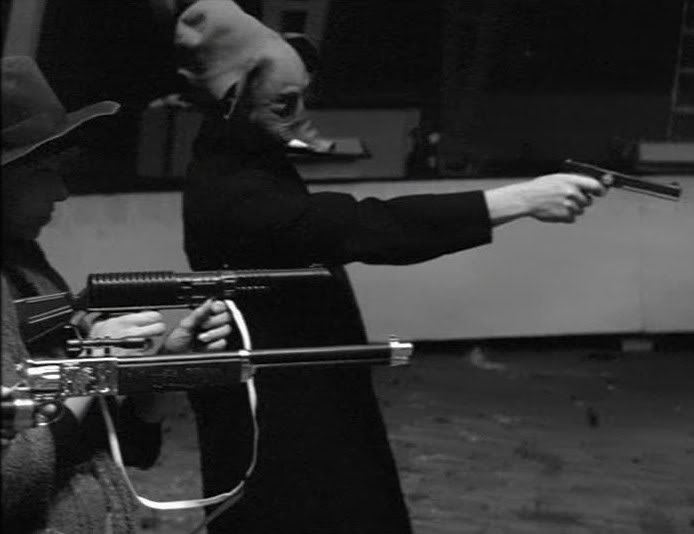
Another nigh-inscrutable short posing as documentary biography, E.A. Winterstein, Fire Extinguisher is an even stranger early work from Alexander Kluge. The film purports to tell the story of the firefighter E.A. Winterstein, but it's difficult to tell exactly what that story is from the collage of non-sequiturs and loose ends that Kluge stitches together here. The film seems to be concerned, principally, with militarism, with recurring images of soldiers drilling in formation, throwing their rifles in the air and catching them again as they march. Other images show a toy war with little mechanical cars, driven by grinning toy animals, being bombed from above as they trace their repetitive circles along the ground. Finally, Kluge collages in leftover material from his debut feature Yesterday Girl, made two years earlier, along with a sustained portrait of that film's star, his sister Alexandra, posing with religious and regal memorabilia.

It's hard to know what any of this has to do with the titular Winterstein — who appears at times in a gladiator uniform, jogging around — and the elliptical voiceover does little to clarify matters. The narration is just as free-associative as the images, jumping from one subject to the next, occasionally hinting at the life of the title subject but only as part of a larger network of allusions to history, entertainment and philosophy. At one point, the narration compares Winterstein to various Hollywood stars, presumably because just like Clark Gable and Gary Cooper, this humble fireman appears in a movie. This is another example of Kluge intentionally conflating documentary and fiction, positing them both as part of the same medium, placing the purportedly nonfictional Winterstein in the same lineage as famous actors playing roles.

In this context, everything becomes suspect, all facts become malleable, and the narration says that among the roles that Winterstein will be remembered for is a part as a judge at the Nuremberg Trials. This suggests that even pivotal events of recent history are fodder for fictionalization and uncertainty, that there's a certain element of performance and role-playing in the enactment of history. Including Nuremberg in with a list of Hollywood actors' parts is indicative of Kluge's strategy of blending fiction with reality, tangling them together until it's difficult to tell them apart.
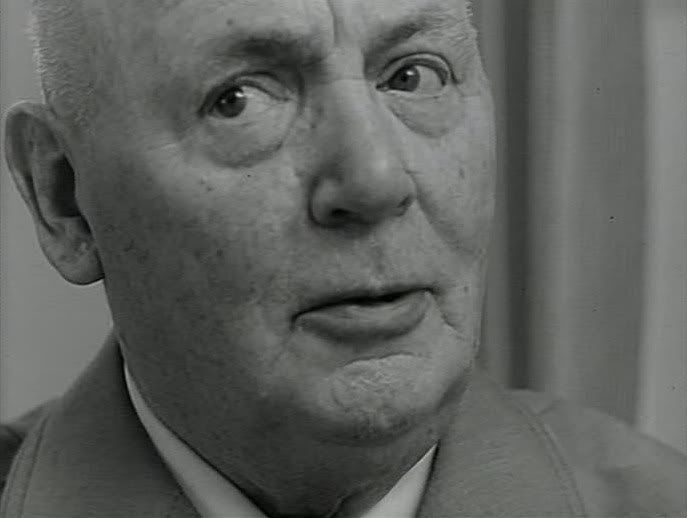

At the very beginning of Alexander Kluge's A Doctor From Halberstadt, the titular doctor, wandering through an airport, pauses in the corner of the frame and points tentatively offscreen, as though asking where he should go next. This kind of upfront acknowledgment of the artificiality of filmmaking, even documentary filmmaking, is by now very familiar from Kluge's work, and yet this half-hour short is, on the whole, one of his more straightforward portrait films. The doctor of the title is Kluge's own father Ernst, who really was a doctor from Halberstadt. Kluge observes his father on a trip to Munich, watching horses at a stable, aimlessly walking the streets, and visiting with his cousin, a judge.

The doctor recounts some horrible incidents he's witnessed in his career — presumably during the Nazi era — mixed in with banal chit-chat, photos from the doctor's childhood and past, and scenes of him trying to entertain himself alone on vacation in Munich. There's a real sense of loneliness in the shots of the doctor walking around Munich with nothing to do and nowhere to go, on a vacation but at a loss about how to enjoy himself in this strange city. The doctor occasionally displays a playful, almost boyish spirit, as in the shot of him skipping lithely over a puddle in the street or the scenes of him peering eagerly over a fence at the horses galloping around a track.

At one point, the doctor is telling a story about why he bought a car, describing a terrible crash he'd had one night on a slippery country road. After a while, the judge chimes in to clarify, saying that the doctor was riding a motorbike at the time, a detail that he obviously realized had been left out of the story and would confuse the film's audience, who would otherwise wonder what the doctor had been driving before he bought his car. This kind of metafictional playfulness crops up periodically during the film, especially in the film's last shot, a closeup of the doctor, who first looks directly at the camera and then off to the side, obviously at the direction of his son. As he looks off to the side, the doctor says, delivering the last lines of the film, "Shall I look over here? What is there to see? Rain, once again." It's the equivalent of "what's my motivation?", an actor wondering why he's doing what he's just been told to do by the director, wondering why this character he's playing, who is in fact himself, would want to look off to the side like this. It's a perfectly whimsical ending to a film that, typically of Kluge, gently teases its surface subject with submerged and difficult-to-access secondary meanings.


All of Alexander Kluge's baffling, idiosyncratic portraiture shorts seem to dance around the subject of World War II without quite touching on it directly, telling anecdotes about the wartime era or referring to it obliquely, but never as the central subject of the film. The subject is implied in every one of these portraits, though, if for no other reason than these people, real or fictional or some combination of the two, must have lived through the war, and Kluge's circumspection invites speculation about what these people might have seen or done during that period. This is especially true of A Woman From the Property-Owning Middle Class, Born 1908. The subject here is a woman, Alice Schneider, who has rebuilt her lavish lifestyle and her fine home after her original, even grander house was bombed during the war.

This film is connected in some inscrutable way with Kluge's earlier short Frau Blackburn, Born 1/5/1872, Is Being Filmed. Like the similarly named earlier film, this one concerns a woman who is displaying her collection of fine china for the documentarians, though Frau Schneider seems much more well-off than Frau Blackburn, and her collection is more expansive. Also reappearing from the earlier film is the sinister man who had robbed Frau Blackburn, and Kluge once again focuses on a closeup of the man's eyes and bushy black eyebrows. Here, though, this man seems more kindly than creepy, chatting amiably with Frau Schneider and offering her an interest-free loan rather than buying her china from her; he even helps her put away the expensive pieces, which she'd laid out on the floor in hopes of making a sale.

The film seems to rely on its intertextual connection to the earlier Kluge work for some of its meaning, juxtaposing the experience of this woman of means (her status is explicitly mentioned in the film's title, after all) against that of the comparatively average Frau Blackburn, who gets taken advantage of by the same man who is so solicitous with the richer woman. There's perhaps also a coded implication here about who made it through the war okay, ready to rebuild and reacquire, and who struggled along with very little in the aftermath of the war.

Wednesday, April 28, 2010

Part-Time Work of a Domestic Slave


Alexander Kluge's Part-Time Work of a Domestic Slave is a film that probes just how difficult it is to understand the complex workings of politics and society, and to make a difference, when society and its structures are designed to eat up so much of a person's time and energy. The film's title itself implies as much: Roswitha (Kluge's sister and frequent star Alexandra) is the "domestic slave," a housewife who must divide her time between caring for her three children and her verbally abusive husband Franz (Bion Steinborn) and working to provide for them, leaving little time for thoughts or concerns outside of family life. The film is divided roughly in half, reflecting two different definitions of Roswitha's "part-time work." In the film's first half, she works as an illegal underground abortionist since Franz has no job and she must support the family. In the second half, after Roswitha's practice is shut down and Franz is forced to get a job, she becomes involved in social and political matters, trying to learn about the world outside her family. Her part-time work thus shifts, over the course of the film, from the need to provide for her family's physical and material needs, to the freedom and time to develop her own thoughts and ideas independently of the family. It is seen as an essential trade-off: when Franz isn't working, he's free to read and think, to study with no clear purpose in sight, but once he has to get a job he all but disappears from the film. By the same token, when Roswitha stops working, her mind becomes active and engaged, and she has time to develop an interest in things happening outside of the home, outside of her immediate scope.

What Kluge is interested in here is how segmented people's lives are, how people are forced, by society's demands, to split up their lives between home and work, unable to reconcile these two separate areas. Early on, the narrator intones, with deadpan irony, "to afford more children of her own, Roswitha carries out abortions." Roswitha, of course, doesn't see the irony, doesn't understand the profound contradiction between work and home contained in this simple statement. This announcement is followed by an extraordinarily detailed abortion scene, after which, once she's dumped the tools and the little blood-encrusted fetus into a metal pan, Roswitha takes a sip of tea and offers her patient a shot of liquor. It's all so casual, so offhand; it's obvious that Roswitha turns her mind off during these procedures. She's not in this profession for radical reasons, she's not doing it to help the women who come to her (though that's part of the rhetoric she uses when talking about it), she's doing it as a way to provide for her family, as a job like any other.

This all changes once police interest forces Roswitha to drop her profession, and Franz goes to work for the family instead. Roswitha, along with her friend Sylvia (Sylvia Gartmann), becomes involved in politics and social issues, though they aren't quite sure where to start at first. Their journey into these issues ranges from a distanced observation of official announcements and policies, to analysis of media reports, to trying to find understanding through art (they memorize a Bertolt Brecht song from a record), to finally becoming directly engaged and seeing things for themselves, hands on and face to face. It is, in essence, a journey into the world, struggling through the barriers and layers of representation erected by society, heading back into the direct experience of reality. Roswitha finds no satisfaction on an official tour of "the social situation," accompanying some politicians (almost all white, older men) as they spout rhetoric and she simply watches silently. She also finds no answers in the newspapers, because she quickly realizes that what she considers important issues — matters that directly affect people's families and children, matters that affect working conditions — are of no interest to newspaper editors, who reserve the front page for staid political news. Roswitha and Sylvia wind up storming out of a newspaper's office, enraged by the editors' inability to care about real people and their struggles.


Roswitha's struggle to understand, to have an impact on the world, eventually leads her to more direct, radical political engagement, trying to excite workers into revolting against unfair practices. Her engagement has its roots, as does everything for her, in the family: her husband's company is rumored to be shutting down its plants and moving to Portugal for cheaper labor, so she fears her husband will lose his job. From here, Roswitha becomes involved in labor and union negotiations, engaging in increasingly radical acts. She breaks into the company's offices looking for proof that they're going to move to Portugal, she distributes pamphlets to the workers, she meets with union leaders who seem to lack her passion and prefer a slow, steady approach. Finally, she goes to Portugal herself and sees the building site, with crates clearly marked with the company's name; she has her proof, because she has seen it with her own eyes. Kluge films this as a moment of peace and, almost, transcendence. There is a sublime hush as Roswitha stands in front of the crates overlooking a grassy field where, presumably, the new factory is to be built. This is the moment when Roswitha has come back into contact with reality, experienced directly and without mediation; she has seen it for herself rather than relying on documents or rhetoric or newspaper accounts or conflicting rumors. It is difficult to get to this point, Kluge stresses, but very much worth it; afterward, Roswitha smiles with genuine satisfaction, even before she knows if her work has actually made any difference. It hardly matters as much as the fact that she has shed her reliance on others and experienced something of significance for herself.

The balance between this engagement with the world and the demands of family is at the heart of the film. The idea that one's family is all that matters — stressed as a supreme value of society — can, for Kluge, actually be an impediment to caring about or understanding the wider world, to embracing and feeling empathy for the needs and problems of all people rather than just one's immediate family and friends. And yet Roswitha's social and political activism originates with the family: she is driven to make things better for her family, and to do so she must become involved in matters outside of the family. It is a central and irresolvable paradox, one that Roswitha never quite overcomes. For one thing, no matter how much she learns in her new ventures, no matter how much she accomplishes, she is never able to throw off the oppressive influence of her unappreciative husband Franz, who remains nasty and judgmental to the end.

Still, Roswitha is clever and inventive in making a place for herself outside the home, using her ingenuity to circumvent the strictures of a society that doesn't have much use for a woman outside of the home. In one of the film's funniest scenes — and as always with Kluge, there's a certain absurdist humor at work in his socio-political satire — Roswitha is confronted by police seals placed on the locks of her clinic. The seals read, "any unauthorized person tampering with these seals will be prosecuted," but this won't stop Roswitha. She pays a man for his dog, and lives up to the letter of the law, if not its intent, by having the trained dog open the door with its paws; thus, no person tampered with the seals. It's hilarious and absurd, and in many ways absurdity is what's required for someone who wishes to move within the confines dictated by this social situation.

To this end, Kluge structures his film as a collage, incorporating paintings, clips of old movies, and interludes taken from children's storybooks, all of these inserted elements commenting obliquely on Roswitha's story. At the pivotal moment when Roswitha makes her decision to become involved in matters outside of the family, Kluge inserts a montage of shots of the wind blowing through branches or causing ripples in water: grainy and damaged images from older movies, poetically suggesting a change in the air. Some of the other film clips come from war movies, including one in which a soldier says that he can do anything, that's he essentially limited only by his lack of knowledge about foreign languages. These clips suggest that Roswitha lives in a man's world, where political matters are often decided by strong-willed men on distant battlefields, far from her prosaic world. Kluge similarly uses art and culture to define Roswitha's place within a long and perhaps overbearing cultural legacy: snatches of classical music frequently score scenes, while paintings show women as always being in the home, caring for children, doing domestic chores. Culture and society show no other options; Roswitha has to create them for herself.

Friday, September 11, 2009

The Indomitable Leni Peickert


The Indomitable Leni Peickert is a loose, half-hour sequel to Alexander Kluge's second feature film, Artists in the Big Top: Perplexed. This shorter work, seemingly assembled from leftover footage from the longer film, continues the story of the circus owner Leni Peickert (Hannelore Hoger) after she first abandoned her idea of a radical circus in favor of a job in television. It opens where the previous film left off, at a TV station where Leni and her friends have gathered as employees, attempting to infiltrate the corporate establishment with their own revolutionary ideas. This radicalism is somewhat undercut by the way that Kluge deliberately shoots down the low-cut blouse of one of these young revolutionaries, the camera eyeing her cleavage and then panning down, to the text she's reading, and then back up again, finding her sexuality ultimately much more interesting than her radicalism. This lascivious camera movement is then mirrored in the young radicals' plans to create "sex education" movies that somehow change the world by categorizing and numbering the sexual positions — after all, the Hindus have 365 positions already, one vapid would-be filmmaker says, and wouldn't it be better to have even more?

Even more than its predecessor, The Indomitable Leni Peickert is an inquiry into what all this chatter and ideology actually means; Kluge seems to be wondering, how much actual substance is there in all these half-baked 60s ideas about sex, free expression, equality, peace, love and all that good stuff? Is the sex film made by Leni and her friends a real expression of sexual liberation, or is it just as exploitative and perverted as Kluge's own ostentatiously ogling camera move? In any event, despite its title, The Indomitable Leni Peickert finds the titular heroine even more besieged and overwhelmed than in her first appearance, less able than ever to fulfill her ambitions and really create a lasting and important statement. She's always putting things off, dithering and delaying, telling herself that she's building foundations, that she shouldn't rush. Her plan for TV is a very long-term one, to eventually become the head of a station; in the meantime, she's just been promoted to manage the building's heating system. Later, she's fired from the station and returns to the circus, but only for commerce this time, abandoning her ambition to make a challenging new kind of circus: now she only wants to make money at it. Soon enough, she grows disillusioned with that as well and quits, or at least says she quits: in a typical example of Kluge's clever use of voiceover, the omniscient narrator announces that Leni has quit the circus and then, without acknowledging the contradiction, continues to talk about her working for the circus.

This disconnect between talk and action is at the heart of these two films, which is probably why Kluge, following earlier French avant-gardists like Godard and Debord, has so radically separated sound and image here. He allows the two halves of the cinema to exist independently, sometimes commenting upon one another, sometimes syncing up, almost as if by accident, but more often going their own separate ways.


Although in many ways The Indomitable Leni Peickert seems like simply an extension of Artists in the Big Top, utilizing the same style and exploring similar themes, it does differ in that it's more of a straightforward narrative film than its predecessor. Despite its disjunctive audio and its habit of narrating events from a distance, the film tells its story succinctly and with relative directness. The one notable exception is the denouement, which montages together classical drawings and paintings, taking Leni's struggles to a symbolic plane: through a progression of still images, these paintings tell a story of oppression and struggle between authoritarian forces and the rebellion of the masses. It's a clever way of universalizing the film's story. It transforms Leni's personal struggles — with artistic expression and with maintaining her individuality against smothering capitalistic constraints — into the larger story of the common people throughout history. It also unites Leni — and by extension, Kluge — with the artistic lineage of the West, with the artists who documented various populist uprisings of the past. This sequence suggests the interplay between art and reality, with the former both documenting the latter and echoing down through history to eventually have an influence on reality as well.

The Indomitable Leni Peickert is thus much more than a simple coda to Artists in the Big Top. It extends the longer film's themes into a broader social and political context, making explicit a few of the connections and ideas that were merely implied in the earlier work.

Thursday, September 10, 2009

Artists in the Big Top: Perplexed


Artists in the Big Top: Perplexed was Alexander Kluge's second feature, an unusual collage film that deals with the frontiers of human possibility, with the problems of creating art that truly pushes boundaries and broaches uncomfortable subjects to an audience largely unwilling to hear about anything unusual. Naturally, the film is in part about Kluge's own dilemma. Taking the circus as an unlikely metaphor for all artistic pursuits, Kluge is wrestling here with central issues: how to create art when audiences want merely to be entertained, how to balance art and commerce, how to find the proper medium in which to express one's ideas. On a narrative level, the film is about Leni Peickert (Hannelore Hoger), the daughter of a trapeze artist, who desires to create her own circus, a circus that would reinvent the form and express new, revolutionary ideas through performances with animals, acrobats and clowns. But describing the narrative does little to describe the actual texture of Kluge's film, which is comprised of a collage of improvisatory fragments and brief scenes, while on the soundtrack various competing narrators tell stories, recite philosophical ideas, laugh and read dialogues as if from plays, with identifications for the speakers. The audio frequently cuts off in midstream, and it is only sporadically synced to the actual onscreen images, instead flowing languidly in and out of sync. Sometimes a scene will start with two characters speaking to one another, but as they continue speaking, Kluge cuts away to something unrelated, or else cuts in footage where the characters simply stare blankly into the camera, while on the soundtrack their voice continues on. At other times, Kluge's jump cuts wreak havoc with the flow of time and reality, as when the glasses on the face of a journalist appear and disappear between sentences.

These multiple voices create a democracy within the film, in which no single narrative voice is dominant, and the audience's own experience of the film is privileged. The evidence of the film's construction is frequently evident, in scenes that cut off abruptly, the actors breaking into laughter or stammering incoherently as they lose track of their lines and respond simultaneously to the conditions of production. Kluge leaves these moments in. At one point, Leni's business partner Von Lupetow (Bernd Höltz, also the sound man) is eating a sandwich, stuffing it rapidly into his mouth. He laughs, spitting the food, and the scene cuts off, only to return to a straight-faced continuation, as though nothing had happened. The damage is done, though, and the rest of the scene can only be taken with a self-conscious smirk, aware of the shattering of the artifice. Elsewhere, when a female voice questions a story about a sex-starved astronaut filling up a vase with semen upon his return from space, a male narrator admits, "the story is exaggerated to emphasize the point."

These disjunctive techniques are appropriate for a film that's all about the issue of audience participation and audience connection — Kluge wants to foreground the effect of artistic techniques on those who experience an artwork. There's an undeniable playfulness to the way Kluge toys with artifice, presenting a loose patchwork that is all-encompassing enough to include both the opening's color, faux-documentary footage of Leni's father Manfred (Sigi Graue), the grainy newsreel inserts that appear throughout the film, and the crisp black and white of Leni's own story. There's play, too, in his chosen metaphor, in the idea of using the circus as a vehicle for expressing grand ideas. Leni's circus, like her father's proposed radical circus, would include animals suspended from the roof of the tent, barrier-breaking acts in which wild elephants seem to charge at the audience, and an absurd, theatrical staging of the assassination of an emperor, with all the participants wearing animal masks. It's all about confrontation, about presenting challenges to passive spectatorship. Just as Kluge's non-diegetic sound and jittery editing rhythms challenge conventional responses to a narrative film, Leni's revolutionary circus would challenge audiences to find new ways of thinking about this kind of entertainment.


Of course, implicit in this exploration is the possibility that challenges like this can push an audience too far. One of Kluge's interests here is the tension between giving an audience what they want and remaining true to one's own ideals. Ultimately, Leni's circus falls apart as she realizes that her ideas are impractical, that they can't be communicated in any real way to an audience, and that her vision is being diluted with the ideas of others, her collaborators on the project. It's a film about artistic disillusionment, then, about failure, and Kluge is open to that possibility as well. His own work is open-ended, not so much a finished project as a compendium of raw material, assembled by patchwork procedures that could result in a theoretically endless number of possible films. (The evidence of this is apparent in the short sequel, The Indomitable Leni Peickert, which seems to have been assembled in an analogous fashion from leftover footage.) Kluge knows that the upshot of artistic experimentation is the risk of losing the audience, and his resulting film is sometimes entertaining, sometimes boring or baffling, at other times enlightening and insightful, but always above all a challenge, a starting point, a call for serious thought about artistic expression.

His own starting point is announced at the very beginning, with a montage of newsreel footage from a 1939 Nazi rally, which included parades and elaborate pageantry. In light of the remainder of the film, it's obvious that Kluge is calling attention to the tremendous power of spectacle as a vehicle for expressing ideas (or ideology) in a populist form. He's implicitly suggesting: if the Nazis used performance and entertainment so effectively, could the same means be put to use in order to express anti-fascist ideas, anti-totalitarian ideas? Leni fails in her quest, but the film's answer is not so much a definitive no, so much as a "why not try?" It's the effort that counts here, the effort of grappling with the obstacles to art.

Initially, it seems like it's only money that's holding Leni back, that if she only had the resources she could express herself freely. So she experiments with various compromises and negotiations with capitalism, trying to gather the necessary funds while maintaining her independence, eventually concluding that it's impossible. Then, when a sudden inheritance — a deus ex machina inserted by Kluge as a way of working through his schematic diagram of the artistic process — allows Leni to pursue her dream unhindered by monetary woes, she discovers a whole new set of barriers: the disconnect between theory and practice, the difficulties of collaborating, the challenge of communicating with an audience. It's a rebuke to the tired old excuse that one could really make a statement if only one had the money (or if only anything, really). Kluge is advocating action, even in the face of seemingly insurmountable odds, and the scenes of Leni's radical pals endlessly debating and tossing around ideas might be seen as an implicit critique of all the empty talk floating around among leftists in 1968, none of it adding up to much at all.

Indeed, the film ends with Leni, disillusioned with the circus, taking a job in television instead, essentially capitulating to the corporations, although she tells herself she's doing it in order to one day control the TV station for her own ends. The film ends on this skeptical, critical note, but Kluge retains his optimism about the potential power of art, best expressed in the repeated declaration that work without an ultimate goal or meaning is worthless. Extrapolated to art, Kluge seems to be saying that art made merely as spectacle or entertainment is empty, and that the best art has something to say, even if it perhaps says it incompletely or clumsily: the goal is what counts. This doesn't suggest an anything goes egalitarianism, however, so much as an encouragement that everyone should try, should do their best, should like Leni attempt to make something big and dangerous and original, even if everything falls apart in the process.

Friday, May 22, 2009

Alexander Kluge's Early Shorts, 1961-1964


Alexander Kluge's first film, co-directed with his friend Peter Schamoni, was the short Brutality In Stone. It's a tightly edited essay film, mixing archival footage with images of the remains of Nazi architecture, the lingering tangible evidence of Hitler's reign. The film advances the idea that architecture reflects ideology, an idea that the Nazis themselves were well aware of. They designed grandiose buildings, modeled after Egyptian pyramids and Mayan temples, massive structures that balanced spiritual fervor with bureaucratic anonymity. In these buildings, rows upon rows of tiny windows mirrored the tight arrangements of soldiers in formation. Even buildings, for the Nazis, were warlike, and Kluge and Schamoni explore this idea by filming the remains of the Nazi architecture in ways that enhance and accentuate the violence and austerity of these structures.

Buildings jut up into the sky. Towers loom above, thrusting powerfully against the clouds. Long corridors trail off to the horizon line, seemingly endless, lined with rhythmically repeating structures like guards stationed at intervals along the hallway. Everything is composed of hard, rigid lines, reflecting the horrible precision and the grandiose ambitions of the Nazi war machine. The soundtrack is a collage of elements: audio of Nazi speeches and rallies where it's available, transcripts where it's not; descriptions of Hitler's plans for reconstructing Berlin as a drastically reimagined capital city called Germania; Nazi music and samples of lyrics. Most horribly, there's a lengthy account of the way a concentration camp supervisor methodically organized and controlled the mass executions of prisoners arriving on transport trains. The voice of the speaker is flat and uninflected, and he describes in precise terms the time tables of the trains, which were perfectly paced so as to leave just enough time for the killings and the clearing of the bodies afterward. He describes how they would keep the crowds calm, how they'd quietly shoot any rowdy elements behind the building, how they'd keep a close watch to make sure that the mothers in the crowd weren't trying to hide their babies away before heading into the showers. The bodies were burned at night, so as not to tip off those arriving on the next transport. It is all so perfectly organized; they thought of every detail, every possible impediment to their work. It is swift and methodical, and all the more monstrous for its efficiency and precision.

Kluge and Schamoni pair this terrible efficiency with images of buildings designed by the Nazis, linking the horrors of the regime with the aesthetics of what they built and left behind. The hard lines, the grand size, the flat undecorated surfaces and tiny black window holes: it's an architecture of inhumanity, created on a scale far beyond the individual. It's an architecture of aggregation, reflecting a mindset that makes mass murder not only conceivable but routine. This short visual essay was an auspicious start to Kluge's career, already displaying the abrupt, associative editing and keen, analytical mind that would characterize his first feature Yesterday Girl.


Kluge's second film was the far more straightforward Racing, a documentary about an auto race; one guesses it was a commission rather than a project Kluge initiated himself. Nonetheless, he makes it his own. On its surface, the film is just a document of a race, and its imagery is relatively conventional: cars circling around the track, spectators cheering, lap after lap of the same images repeated. Kluge's presence makes itself known primarily in the wry voiceover commentary, which purports to be objective but actually slyly undercuts the images of the race. This narration toys with ideas like the interaction between human reflexes and intelligence and the increasingly complicated machines we operate. More subversively, Kluge probes the pacifying effect of populist entertainment, which provides a harmless distraction from politics and more important social issues, and he wonders aloud why this kind of entertainment so often flirts with death and violence.

Indeed, the race ends with a fiery car crash, which Kluge cuts to immediately after showing the winner crossing the finish line. In documenting a race and its aftermath, he subtly suggests that such spectacles are an outpouring of hostility and an expression of the public's desire for close (but not too close) confrontations with mortality. At the same time, these events take the focus of public discourse off of political matters, which is convenient for the ruling classes. Even in this brief and unshowy little film, Kluge suggests the outlines of deeper ideas beneath the commercial documentary form.


Transcript of a Revolution is another collaboration for Alexander Kluge. He's credited with writing the film while Günter Lemmer is the nominal director, but such distinctions don't seem to matter that much with this particular film. It's a strange work, essentially a mockumentary about a fake revolution in the fake West Indian island nation of Las Villas. It presents itself as a objective account of the events that led to the overthrowing of the country's brutal dictator, stitched together from radio reports that narrate the film. But the imagery is a patchwork of archival newsreel footage, sequences from old Hollywood films, and clearly staged scenes in which young men in sunglasses try to act like movie tough guys.

It's bizarre and, once its intent becomes clear, kind of hilarious, seamlessly blending together footage in many different styles and from disparate origins. The various kinds of film stock grate against one another from shot to shot, and the varying content of the images creates an internal tension between documentary and fiction. When real military maneuvers coexist on an even plane with the staged antics of amateur actors and clips from mainstream movies, the foundations of this cinematic reality become very shaky indeed. And yet on its surface the film plays it entirely straight, as though it was a true report on a conflict being waged in another country. It's also an absurdist nose-thumbing at dictators everywhere, a warning that revolution is inevitable. The film closes with the people of Las Villas, having won the battle, initially wary of their deposed dictator but, within the period of a few weeks, forgetting about him altogether.


Teacher, co-directed by Alexander and Karen Kluge, is another interesting documentary from the director's earliest years. This film starts as a wickedly funny report on a ceremony for the dedication of a new school building. Kluge condenses and briskly edits together a series of very similar speeches from various school and government officials, all of whom repeat virtually the same clichés, sometimes just parroting the same phrases but shuffling the words around. It's a wickedly funny satire, but Kluge surrounds it with more serious material, slowly building towards a rumination on what purpose teachers should serve, how they can fail their students, and what the ideal of education should be.

It's clear, of course, from the way he deflates the self-congratulatory nonsense of this ceremony that Kluge doesn't have a very high opinion of the current education system he's documenting. He does, however, appreciate the possibilities of education. The film's second half is thus dedicated to three stories of teachers who were prevented, in various ways, from really attaining the educational ideal they all aimed for. The first of these teachers was an idealistic man who, throughout World War II, taught at a rural German school where he fostered independent thought and creativity in his students; needless to say, the Nazis hanged him towards the end of the war. The second teacher also taught during World War II, and had the misfortune of seeing most of his class killed during attacks by the Russians; he finally escaped with only two of his students left alive, and quit teaching thereafter. The third teacher was a woman who continually pushed back her calling to teach, aware that in the less-than-ideal circumstances of World War II or the Communist years in East Germany, she would not be able to teach the way she would want to. The result was that, except for a brief period before the Communists forced her to quit, she never taught at all.

All of these teachers were oppressed and defeated by war, dictatorship and ideology. Kluge presents their stories with a calm voiceover, accompanied by period photographs. As in his first film, Brutality In Stone, Kluge is clearly very interested in the way that Germany's unique and horrible history has shaped and deformed the country's present. In the earlier film, he studied the lingering aesthetic effects of Nazi architecture, while here he traces the influence of World War II and its aftermath on the German educational system. He clearly longs for a system that would reward rather than punish the three dedicated, intelligent, resourceful teachers he cites here, and he regrets that history has conspired to keep such people down, to promote instead empty airbags like the school officials seen at the beginning of the film.


Kluge's final short before his first feature was another deadpan documentary (or, more likely, mockumentary?) called Policeman's Lot. This film presents itself as a chronicle of the life of the former policeman Karl Müller-Seegeberg, a man who had simply rolled with the many changes to beset German culture in the previous few decades. As a policeman, he had willingly served with the Communist-leaning Prussian guards, then had switched allegiances to the Nazis when they came to power, going to Russia to fight for Hitler. After the war, however, he just as willingly became a guard for the military tribunals, and even captured a fleeing Nazi prisoner. This is a man who takes pride in his professionalism, in his strict adherence to his duty — but he has no ideology, seemingly no preference about who's giving him his orders. He is willing simply to adapt to whatever circumstances come his way, to let history flow independently of his own life. He has no moral qualms about anything he's done; Kluge does not include the trite line about "only following orders," but that is the essence of this policeman's character. He is continually trying to "prove himself" anew as social conditions change: to prove himself a good Communist, then a good Nazi, then a good democrat.

He hardly seems to know what these words mean, only that they're new masters to impress with his professional skill. He is perhaps over-zealous in this, but he shows no remorse for the time when he accidentally killed a Nazi during a riot before Hitler's election, nor for the time when the Nazis had him shoot an innocent Russian woman, nor for the time, post-war, when he stumbled across a couple making love in a park and fired his gun into the dark at them. It is, ironically, this last incident that finally gets him dismissed from the police force. This, and not his earlier atrocities, is an inexcusable act because it happened in peacetime, and because he was for once not following orders but acting on his own.

Kluge documents this proud but broken man's life in the same fragmentary style he would soon employ in Yesterday Girl, integrating uncomfortably tight closeups (textural shots where every pore is a crater, every blemish a mountain) into a dense framework of vintage footage and other inserts. But his playful, satirical spirit comes out in Müller-Seegeberg's ironic closing line, expressed in a title card at the end of the film: "I would punch anyone in the face who did not act in a democratic way."

Thursday, May 21, 2009

Yesterday Girl


Alexander Kluge's debut feature Yesterday Girl is a kaleidoscopic burst of energy, a frenetic but never haphazard film that gives the impression of an eager young director, unwilling to commit to any one storytelling mode or aesthetic, instead experimenting with anything he can think of. The result is a quickly paced collage, a jittery, jazzy patchwork that augments its sparse central narrative with myriad diversions and non sequiturs. The film owes much to the example of the French New Wave, and especially to the montage and stylistic catholicity of Jean-Luc Godard, but there is undeniably something distinctive about Kluge, something unmistakable. His rhythms are his own, as is his sense of playfulness, his unexpected detours into surrealism and absurdist farce. Kluge's sister Alexandra plays the heroine, Anita G., an obvious stand-in for the New Wave's young archetypes — she even has those big, black-lined Anna Karina eyes.

Anita is a bit of a lost soul, struggling to find her place in a society that seems to care little for her or her ambitions and desires. In the film's crisply edited opening, Anita faces a judge for stealing a sweater, a minor offense that is treated with the severity and earnestness of a murder trial. Kluge chops the scene into abrupt fragments, often filmed from odd angles, like a memorable and sustained shot of the back of the judge's head, demystifying his authority and seriousness by pointing the camera at his spiky crabgrass hair while he lectures at Anita. The trial is a farce, with the judge asking questions that clearly have no bearing on anything, then dismissing Anita's honest answers: he asks her if she's Jewish, and if she had grandparents who were victims in the Holocaust, but when she says yes he dismisses these matters as irrelevant to the trial. At one point, he bends down and reads at length from the laws on "safekeeping" and ownership, a digression that seems to have no effect on the outcome of the trial. This scene establishes Kluge's essential method here very quickly. He breaks the overall scene down into individual moments, isolated and disconnected from one another, severing the chains of cause and effect so each moment, each image, stands on its own. The cumulative effect of the scene is not the narrative details — which could be much more economically summarized as "Anita is tried and convicted for stealing" — but the impression of absurd authority, of social and political systems designed to deal with abstractions rather than living, breathing people.

This is a running theme throughout the film, as after her release from prison Anita struggles to reintegrate into a society that doesn't seem to want her. She drifts aimlessly from job to job and apartment to apartment, unable to keep a job very long, rarely getting paid, perpetually living in debt with no money. She's always just a week away from a pay check that never seems to come, and she's always getting kicked out (or sneaking out) of a succession of apartments and hotels. She drifts from man to man too, though she finally does settle down for an extended amount of time into an affair with a low-level government minister named Pichota (Günter Mack). Even this is transitory, however, since this man is married and can only meet her sporadically in secret; the affair ends without fanfare or fuss and Anita is back to drifting again.


This is a portrait of a young woman completely without recourse. Again and again, societal institutions that are supposed to help her fail to do anything. All she wants, as Kluge keeps reminding the viewer through intertitles that serve as de facto chapter headings, is a "better life," a cliché that could mean just about anything. Anita herself doesn't have any idea what it could mean, but she tries just about anything to get it. Her parole officer seems to think that prayer will help, and otherwise has Anita cycle through a series of questions to which the girl is obviously learning the "right" answers by rote. In any event, they're questions — like "what does it mean to be good?" — that could only have a "right" answer to a totalitarian. Education similarly offers no solace for Anita, as her attempts to go to university are met with smug, oblivious professors who ignore her practical questions to recite strings of abstractions. They have nothing to offer her as far as the concrete realities of day to day living. Pichota is the same; because of his wife, he can't give her any money or any other tangible help, but he does try to teach her about culture, singing through an opera with her and reading Kafka to her. She gets nothing out of it. The message is obvious: culture and education are meaningless in the absence of social and material stability, in the absence of some way to anchor one's life.

Anita never achieves this stability, and ultimately turns to the only social institution that ever provides her with any concrete answers: she gives herself up to the police and goes to prison again, where at least she knows what to expect. Kluge tells Anita's story through an astonishing variety of cinematic language. As in the first sequence, each scene throughout the film is methodically broken down, with blunt editing that serves to fragment Anita's story. Her experience of life is discontinuous, marked by abrupt breaks and disjunctions, and Kluge passes this experience on to his audience. He frequently resorts to extreme closeups, in which talking heads orate from an abstracted, empty gray space. But just as often he avoids showing the characters' faces at all, cutting to their hands or the backs of their heads or to the walls and objects around them. At other points, he inserts entire, seemingly unrelated sequences into the film, cutting away to visual non sequiturs like a shot of a rabbit that appears during a hallucinatory sequence in which Anita shoots, or more likely imagines she shoots, a police officer who's chasing her. Even time itself is malleable in Kluge's hands: the action frequently speeds up, with Anita and her pursuers racing around like Keystone Kops, and time-lapse photography condenses hours of time spent on a city street into a blurred, pulsating few seconds.

The effect of this elaborate montage aesthetic is to position Anita's story as just one element, one brick, in a mad societal structure. This also seems to be the point of the enigmatic final epigram, "we are all to blame for everything, but if everyone knew it, we would have paradise on earth." Kluge's vision of the world, on the other hand, is far from a paradise — if anything it's a dystopia — but his dense, free-associative aesthetic crafts a cogent and darkly funny critique of the systems that preside over this nonsensical world.