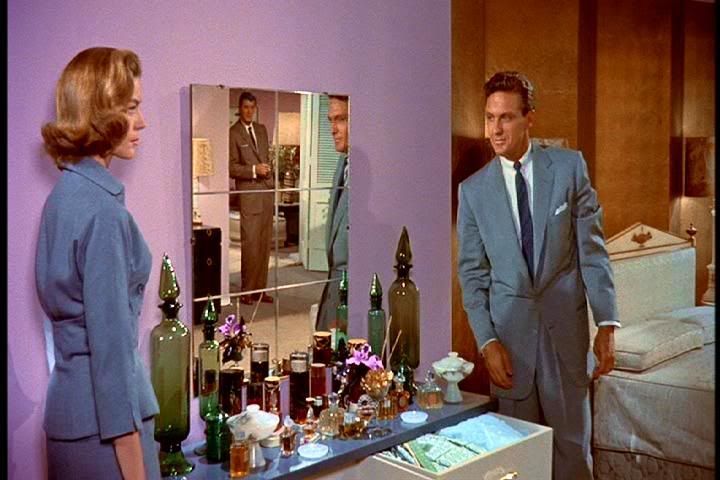
Douglas Sirk was a master of the lurid Hollywood melodrama, transcending often outrageous and contrived material with the sheer force of the emotion and the visual rigor that he invested in these stories. In films like All That Heaven Allows and Written on the Wind, Sirk found profundity and great beauty in what would have been trash in the hands of others. In Magnificent Obsession, a forerunner to the Jane Wyman/Rock Hudson pairing of All That Heaven Allows, not even Sirk can truly transcend what must be one of the worst plots and the worst screenplays in Hollywood history, a ridiculous pile-up of contrivances and silly plot twists in the service of a saccharine Christian-themed drama. It's a clunky and deeply strange film, and its absurd narrative prevents it from ever really being great, though Sirk's mise en scène and keen eye for painting in Technicolor elevate it at least to the level of a campy, emotionally intense tearjerker.
The story concerns the redemption of the callow playboy Bob Merrick (Rock Hudson), who gets a wake-up call when his boating accident indirectly causes the death of a prominent, well-loved local doctor because an important piece of medical equipment was being used to treat Bob when the doctor had a heart attack. Bob falls in love with the doctor's widow Helen (Jane Wyman), but his clumsy attempts to pursue her — using a bastardized version of the philosophy of Christian charity practiced by her husband, and taught to Bob by the husband's friend Edward Randolph (Otto Kruger) — only results in further tragedy, when an accident leaves Helen blind. It's soapy in the extreme, particularly when Bob dedicates his life to medicine, becoming a doctor and using his wealth and his knowledge in an attempt to cure Helen's blindness even as he courts the blind woman (who apparently doesn't recognize his voice) under the laughable assumed name of Robby Robinson. Once one starts trying to pick apart the plot, it's difficult to stop, so it's best to just let it be, to try to overlook the unending cavalcade of absurdities and foolishness and sudden emotional reversals, to focus instead on the undeniably rapturous power of Sirk and cinematographer Russell Metty's images, which are as always some of the finest examples of Technicolor extravagance.
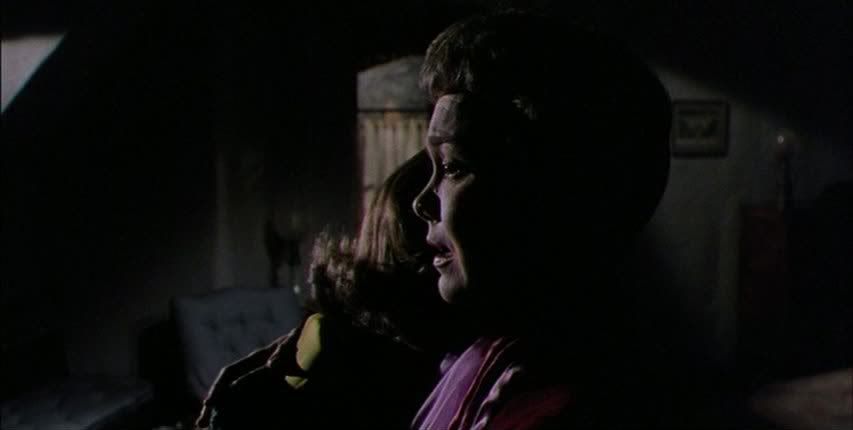
Sirk makes this insane plot come alive with the sensuous power of his images. Resonating with the theme of literal and metaphorical blindness, Sirk continually bathes the characters in alternating blocks of light and shadow, draping the film in darkness. Walking across a room, they step into the light for a moment and are then swallowed up again in darkness, the shadows falling across faces and erasing features into black silhouettes in the night. For all his obvious love of bright, pastel colors, Sirk seems equally at home in inky blackness, stretching shadows across the frame so that the characters are perpetually shuttling back and forth between seeing and unseeing, between flashes of light and dark pools in which nothing can be seen. When Helen visits Switzerland for a barrage of tests with some famed eye surgeons, her face is totally profiled in shadow until the doctor pans a small light across her face, highlighting each of her eyes in turn, creating a tiny circle of light, a pinprick reflected in her shining eye.
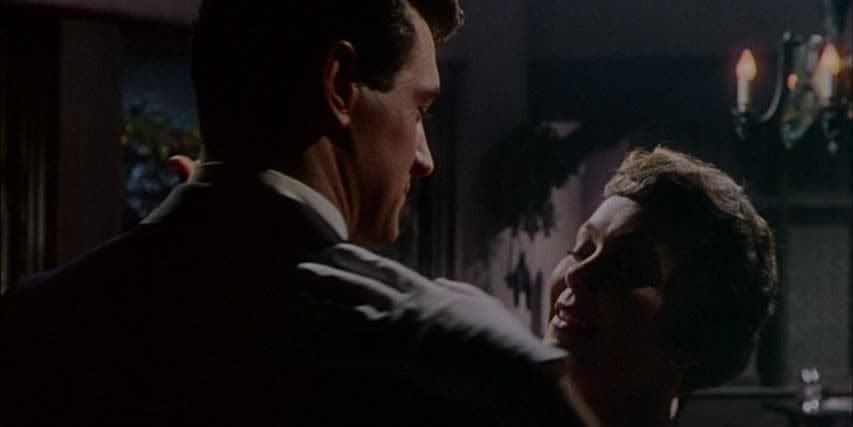
This approach reaches its apex with the scene where Bob takes Helen out for a romantic evening. The whole sequence is draped in these kinds of shadows, simultaneously creating a sumptuously romantic mood and suggesting a visual analogue for Helen's blindness, the darkness all around them shading their faces, hiding them from one another. As they dance together, they twirl and their faces are alternately shaded and lit up, passing in and out of the shadows with each turn. Sirk's aesthetic has a meticulousness that works against the raw, oversized emotions of his material. At one point, Helen, blind, picks her way across a darkened room, carefully feeling for obstacles and making her way slowly through the shadow-strewn room, until she comes to a balcony where her extended hand knocks a potted plant off the ledge. The camera follows the plant's fall down to the street below, where it shatters with a loud crack, triggering Helen's breakdown at precisely that instant, as though a starter's pistol had been fired.
In another scene, when Bob is about to perform the climactic surgery that will inevitably restore Helen's sight and redeem him from his careless and wasteful past, he hesitates until he looks up to the viewing gallery, where he sees Randolph, this film's kindly incarnation of God, looking down on them with a benevolent smile, the operating table and the doctors around it reflected in the glass around Randolph. He then steps away, satisfied that Bob will perform this task, and Sirk holds the shot of the now-empty viewing gallery, the operating room still reflected in it, visually communicating that God has done his work of inspiration, and the rest of the task must be left to the hands of man.
The film is rich in this kind of loaded visual symbolism. Sirk often transcends the frankly stupid plot with the sheer emotional power of his images, which crackle with vitality and feeling even when the twists and turns of the script barely make a bit of sense. But, even though Sirk often worked with such lousy material, and routinely transformed it into masterpieces, here, for whatever reason, he can't quite perform that miracle. The result is a film that's as visually beautiful as one would expect, and often seething with raw and over-the-top emotion, but never comes together on the multiple levels that characterize Sirk's best work.