Showing posts with label Fritz Lang. Show all posts

Wednesday, May 2, 2012

Scarlet Street


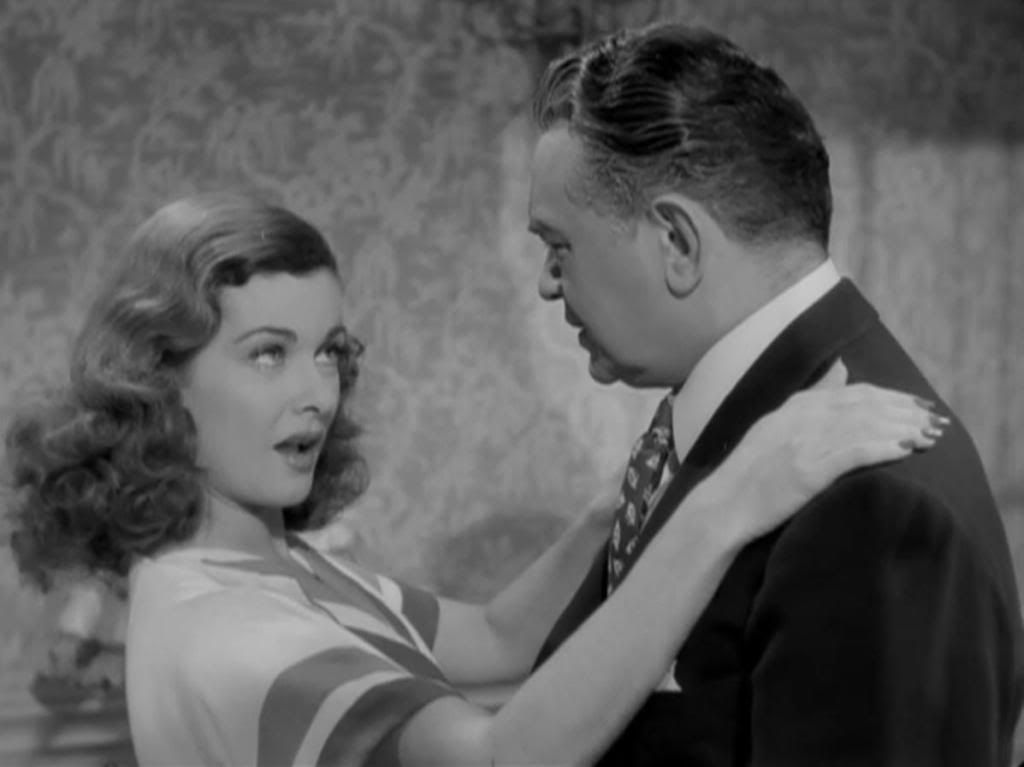
Fritz Lang followed The Woman in the Window by reuniting the same cast — Edward G. Robinson, Joan Bennett and Dan Duryea — for a second noir, Scarlet Street, a remake of Jean Renoir's classic La Chienne. This second collaboration with these actors is, if anything, even better than the first, presenting another shadowy fable of a man's downfall at the hands of a woman. Chris (Robinson) is a middle-aged cashier and Sunday painter who's given up on any hope of real happiness until he meets Kitty (Bennett), who thinks he's a successful painter and latches onto him at the urging of her leech of a boyfriend, Johnny (Duryea). This is a triangle of misplaced feelings: Chris loves Kitty, while she pines for Johnny, who seems happier when he's punching her than when he's kissing her. They're a perfect couple, in a way, because he's a sadist and she's a masochist, only attracted to a brutish man like Johnny; she can't stomach Chris' kisses, and says she'd like him better if he was crueler to her.

Bennett's Kitty is a traditional femme fatale in comparison to the more innocent character she played in Woman in the Window; whereas in that film she led Robinson's hapless protagonist to his doom without even meaning to, as though she couldn't help it, in Scarlet Street she's a knowing seductress, even if she has to be prodded into it by Johnny. She projects sex and danger from the first moment she appears on the screen, a see-through raincoat clinging to her body, a sly smirk on her face as she introduces herself with a playful bounce in her voice: "call me Kitty." She's a tough girl, casually sexy, even when she gets a drink with Chris and talks to him with a straw dangling from between her lips. When Johnny accuses her of being obsessed with sex, she immediately spits back, her voice deep and sincere, "what else is there to think about?"

In contrast, Chris is repressed and oppressed, unhappily married to a shrew (Rosalind Ivan) who he's never loved, who he married only out of a sense of desperate loneliness. When he's arguing with his wife about his paintings, he tells her, "I never saw a woman without any clothes," to which she huffily responds, "I should hope not," a perfect encapsulation of their sexless, miserable marriage. The film is full of moments like this; Dudley Nichols' screenplay crackles with clever dialogue and charged exchanges in which sex and violence are hidden within every line. The film is drenched in sex, its tension arising from the friction between the simmering repression of Chris and the over-ripe sensuality of Kitty. He asks to paint her and instead she reclines on the bed and sticks out her leg at him, stretching her foot out and telling him to paint her nails: "they'll be masterpieces." In another scene, Johnny wakes up after a drunken night and looks around the room, the camera panning over the scattered clothes and possessions of Kitty, strewn across the floor, the woman herself stepping out of an adjacent room in lingerie and an open robe.

That naughty undercurrent of sexual abandon is juxtaposed with the constant threat of violence and murder. In one darkly funny scene, Chris casually reads his wife a newspaper story about a man killing his wife, recounting the details with obvious relish, and when he adds that nobody ever gets away with it, he seems genuinely regretful. He's constantly insinuating that he's going to kill her, and in one scene she bursts in on him, yelling at him as usual, while he's carving meat. He has on an apron — a symbol, as it would be again in Nicholas Ray's later Rebel Without a Cause, of submission and emasculation — and he's holding a knife, almost reflexively pointing it towards his wife as she comes in, walking towards her with it pointed threateningly and unconsciously in her direction.

Robinson and Bennett both deliver visceral, powerful performances, and Robinson especially is fantastic as this weak-willed man who finally sees an opportunity for happiness and pleasure in his miserable life, and grabs desperately and clumsily for it. Lang examines this dark comedy of exploitation and manipulation with a rigorous, cynical eye, his camera slowly tracking in and out, catching glimpses of the characters divided, from each other and within themselves, in segmented mirrors.

The ending is especially great, as Lang abandons most of the darkly comic class subtext from Renoir's La Chienne in favor of a bleak, ironic ending that seems like a deliberate subversion of the Hays Code's ideas about crime, punishment and morality. Lang hints at a traditional Hays-era moralist reversal at the last minute, having a newspaper reporter step in to deliver a preachy monologue about how nobody gets away with murder, not really. But this doesn't lead to justice being done or order being restored, but to something even darker and more tragic, a suggestion that getting away with murder may be the worst punishment of all. The haunting final shot shows Chris walking down a snowy Christmas-time street, the crowds around him fading away until he's all alone, isolated and abandoned, plodding hopelessly away into the night, haunted by the memories of what he's done and by the illusory happiness he'd once felt before it was so violently fractured.

Wednesday, April 11, 2012

M (1931)


Fritz Lang's M was the director's first sound film, and the penultimate film he made in Germany before emigrating to the USA, fleeing the encroaching takeover of the Nazi party. It is, even today, a strikingly modern film, tackling a very sensitive subject from a surprising angle. Lang's classic tells the story of the search for a child killer who's terrorizing a German city, eluding capture while kidnapping and murdering children that he meets on the streets, luring them with candy and toys. And yet the film is not concerned with the mystery of these killings — the murderer is identified very early on as Hans Beckert (Peter Lorre) — nor is it a thriller focusing on the fear of the victims, which is the conventional approach to films about psychopathic serial killers. Instead, Lang focuses on the paranoia and other effects that these killings have on the city, as well as the killer's own feelings of terror and confusion.

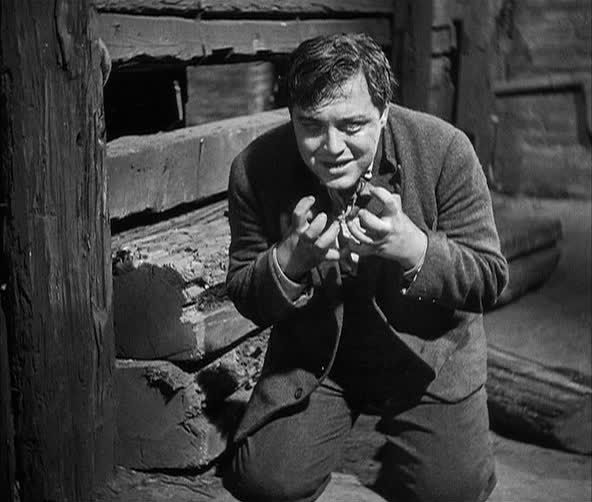
Indeed, Lang accomplishes the miraculous feat of making the killer an almost sympathetic figure in some ways, a figure to be pitied as much as despised or feared. Beckert is portrayed by Lorre as a weak, pathetic, fearful man overcome by compulsions and desires that he can't control. He's pathetic and vile, but his actions are portrayed unambiguously as the product of a mental disfigurement that he is hopeless to resist, and that apparently a stay in a mental hospital could not cure. The film does a remarkable job of portraying Beckert's crimes as a sickness, very different from the usual sort of crime, a product of a diseased mind that, as Beckert exclaims at the film's climax, "really can't help it." He is a desperate man, writing letters to the police and the newspapers that all but beg for them to catch him and stop him, and Lorre's bug-eyed, sweaty performance is incredibly powerful. After one of his crimes, Lang inserts a shot of Beckert looking in the mirror, pulling down the corners of his mouth with his extended middle fingers, stretching his face into a scowl of misery. Later, echoing this shot, he is innocently window-shopping and happens to catch a reflection of a little girl standing behind him; his face becomes deformed, his idle chores forgotten, and he begins whistling "The Hall of the Mountain King," the signature tune that stands for his compulsions.

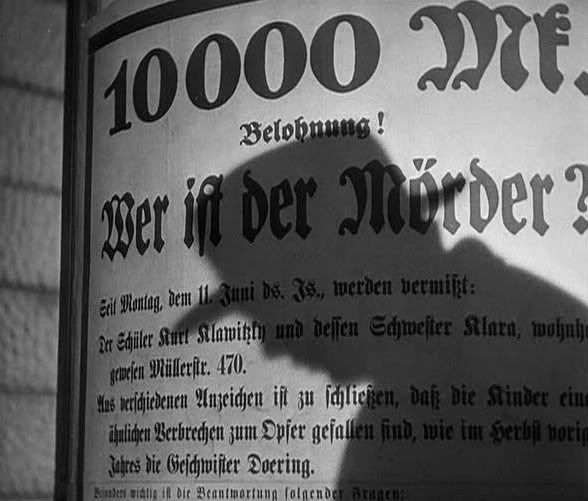
That song is virtually the only music in the film, which has no proper score and only uses whatever scant music appears within the diegesis. Towards the beginning of the film, Beckert's whistling precedes his first visual appearance, as he approaches a young girl, whistling, his shadow cast onto a poster announcing a reward for the killer's capture. It's a sinister image, and the whole scene is chilling for the suggestive way that it chronicles Beckert's predation without any overt violence. The girl's death is signaled with an evocative pair of shots: her ball rolling out of the bushes in a remote, overgrown area, followed by a shot of the smiling, human-shaped balloon that Beckert had bought for her, now drifting freely, getting tangled up in power lines. Meanwhile, at home the girl's mother fruitlessly calls out for her, expecting her home from school, and Lang cuts from the mother at the window, yelling the girl's name, to a series of static, empty, eerily silent shots of the apartment building's staircase and basement, devoid of life or movement. Lang elegantly uses such minimalist aural and visual symbols to tell his story, often replacing images of people talking with images of their shadows reflected on walls.


Lang is also concerned with depicting the killer's effect on the city. People are riled up and paranoid, and they begin responding with suspicion and violence at the least provocation: innocent men are accosted by mobs on the streets, friends accuse one another, anonymous letters point fingers at various random men, whose houses are searched and ransacked for clues by the police. The criminal underworld is also stirred up, as the police conduct raids of red light districts and bars, trying to uncover anyone the least bit suspicious, working on the assumption that the killer must be a shady character in general. These raids cause the criminal gangs, eager to catch the killer and end this intensified police activity, to start pursuing the killer themselves, aided by a network of beggars keeping an eye out for any sign of the murderer.

The general atmosphere of suspicion and persecution suggests a social and political response to this crime that is, in fact, disconnected from its origin. The cops raid bars without discrimination, arresting anyone whose papers are not in order, an eerie premonition of the ways in which the Nazis would shortly begin treating citizens. Lang was at this time growing increasingly concerned about the Nazis' ascent to power, even as his own wife Thea von Harbou, who co-wrote M with him, joined the party, alienating her from the partly Jewish Lang. Thus the film depicts a multifaceted nightmare where fear waits in every direction: a mother's fear for her child's safety, a criminal's fear of being apprehended, but also the more general fear of the innocent being sucked into the vicious whirlwind of a society riven by hysteria, as in the scenes where innocent men suffer in various ways for Beckert's crimes.


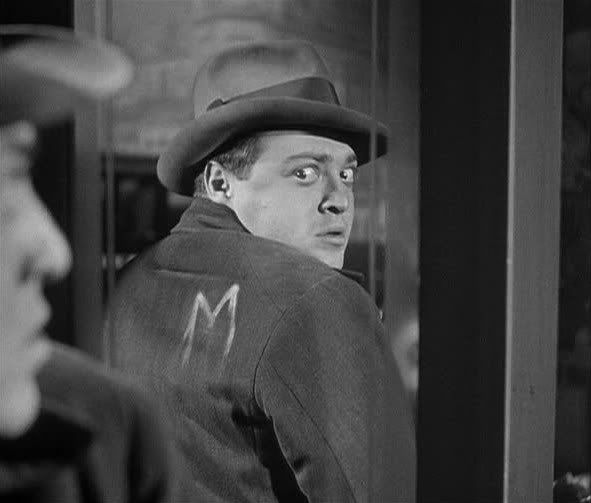
What's most interesting about M is the degree to which Lang lets all these different currents run together without emphasizing one over the other. Lang cuts between different segments of society — at one point blending together a meeting of the police and a meeting of some gangster bosses to ironically point out the similarities between cops and crooks — and different characters, never building a real solid central presence. Lorre's Beckert comes closest to fulfilling that role, though he's almost entirely absent for the first half of the film, only occasionally appearing as a reminder of the one man who's generating all the chaos in the city. Much of the film's second half, though, seems to stick closest to Beckert's perspective, particularly in the harrowing sequences where the killer is pursued through the streets by beggars, eventually cornered in the attic of a building, where the criminals track him down. The beggars even mark him with an "M" drawn in chalk on his jacket — another striking bit of Nazi foreshadowing — and the scene where he discovers this mark in a mirror recalls all the earlier mirror shots involving Beckert. Lang, interestingly, has crafted a suspense sequence in which nobody could possibly be rooting for Beckert to get away, and yet his terror, his increasing desperation, is nevertheless potently communicated by Lorre's performance and the shadowy, expressionistic mise en scène. Further enhancing the tense atmosphere is the fact that Lang shot many scenes entirely silent, only occasionally piercing the hush with bursts of clamoring police sirens or the shouts of the killer's pursuers.

M is many things: a powerful depiction of violent malaise, a searing critique of the death penalty and vigilante justice, a psychological study of fear and guilt, a vision of societal violence and fear that serves as a prelude to the rise of the Nazi Party. It remains such an affecting film in large measure because of how deftly Lang weaves together all these ideas, destabilizing audience expectations at every turn. Even today, so long after it was made, the bravery and modernity of Lang's ideas and his cinematic approach to this material is bracing and impressive.

Wednesday, April 4, 2012

The Woman in the Window


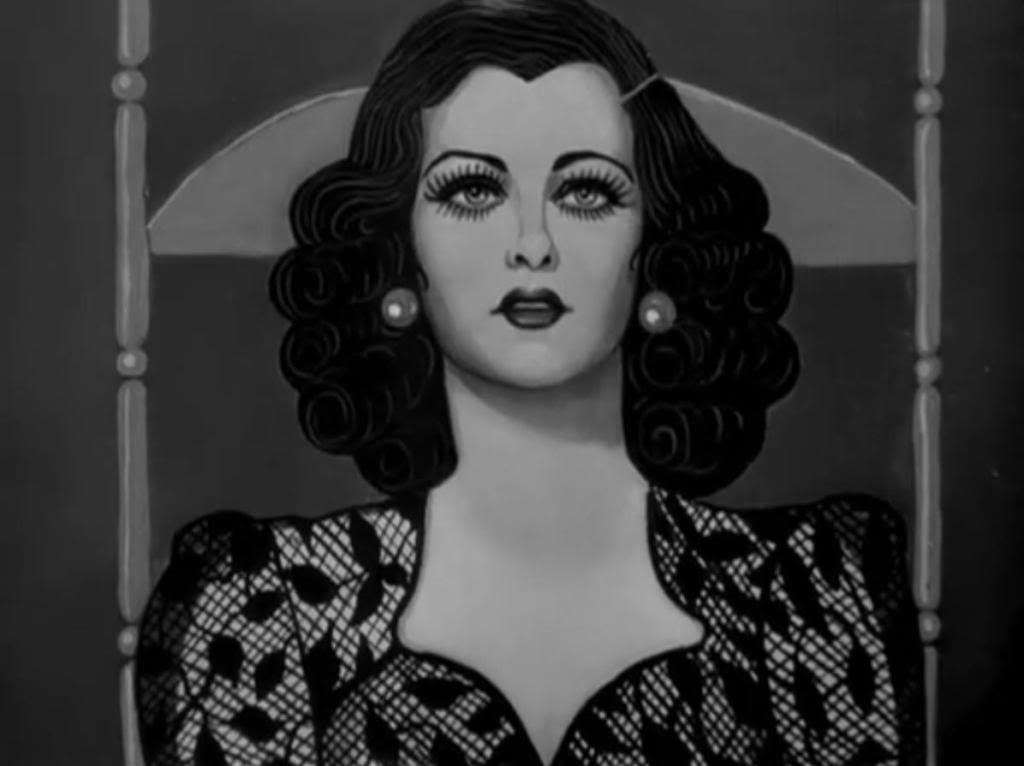
Fritz Lang's 1944 noir The Woman in the Window is in many ways a meta-noir that examines the tragic allure that draws so many doomed noir heroes into situations that are bound to end up in murder and worse. The aging professor Richard Wanley (Edward G. Robinson) is a pretty unlikely noir hero, and he seems to know it. He's settled into routine and domesticity, and even when his wife and children go away on vacation, leaving him on his own, he doesn't have anything planned beyond drinking quietly at his club, reading and smoking cigars. Naturally, he's going to be shaken out of this routine in a rather startling way, and in true noir fashion his downfall is practically preordained from the moment he sees a painting of a lovely, elegant woman in a gallery window adjacent to his club. He and his friends cheerfully discuss the woman in the painting, their infatuation with her virtually the only outlet for the sexual feelings of these thoroughly domesticated middle-aged men.

Wanley's conversation with his friends at the beginning of the film lays on the foreshadowing pretty thick, with his friends warning him that they're now too old for adventures, while Wanley insists that he has no interest in anything but going to bed early. He even tempts fate by saying that, should he encounter the beautiful woman from the portrait in the window, he'd walk right by, not even letting her sway him from his quiet, eventless night. It's of course immediately obvious what destiny has in store for Wanley, so it's no surprise when he walks outside, peering at the portrait one last time before he goes home, only to have the woman herself appear, reflected in the window. Lang telegraphs what's going to happen long before it does; even the framing and composition of the shot as Wanley looks in the window seems to be primed for the woman's inevitable appearance. Her face floats in the reflection in the glass, hovering in the blackness right next to her painted doppelganger, two alluring images superimposed. She briefly exists only as this hazy, wavering ghost image, her reality uncertain, before Lang's camera turns, with Wanley's gaze, towards the flesh-and-blood woman.

This woman, Alice Reed (Joan Bennett), leads Wanley, in total innocence, into a shadowy nightmare of murder, suspense and intrigue. The pair spends an innocent, pleasant night together, their flirtations barely edging past politeness — Wanley is married and scrupulous — when suddenly one of Alice's lovers bursts in, immediately flies into a rage, and begins strangling the shocked professor. Of course, it's the other man who ends up dead, and Wanley and Alice must dispose of the body, covering up their crime before morning comes. Lang draws out the process of cleaning up after this accidental murder, not skimping on any details, emphasizing what a difficult, physical, tense procedure it is. Every moment is loaded with the possibility of getting caught: lugging the body, wrapped in a sheet, out to the car in the rain, then driving out to the country to dump the corpse in the woods. The empty, rainy nighttime streets are eerily quiet and empty but seem loaded with danger, like a taxi dropping off a passenger just as Wanley is about to carry the body outside, or all the cops who suddenly pop out of nowhere, threatening to pull the professor over and discover his sinister cargo. One cop actually does pull him over, before Wanley has picked up the body, and sneers suspiciously at the professor's ethnic origins, in a sequence that surely must have resonated with the immigrant Lang: "Wanley, huh, what's that, Polish?" "No," Wanley replies, "it's American."


This attention to detail enhances the film's nightmarish atmosphere. Wanley is a man who's totally unprepared for this kind of intrigue, and Lang rigorously emphasizes each step of the process, as well as calling attention to all the little details of the evidence trail that Wanley leaves behind. After the murder and cover-up, the film becomes an interesting kind of forensic mystery in which the hero is the killer, watching his friend, district attorney Frank Lalor (Raymond Massey), piece together the clues and form a startlingly accurate picture of the crime. Throughout the film, Wanley's conversations with his friends, especially Lalor, keep him updated on the inexorable progress of the police, who uncover more and more evidence, all of which would point directly to Wanley if they ever got on his track. Moreover, these conversations work on a meta level to signal future plot points in an almost playful way: when his doctor prescribes Wanley medicine for nerves but warns him not to take too much, Wanley exclaims, almost excited, "poison!" It's as though he can't wait to see who will inevitably be getting poisoned via this new plot device, and neither can the audience.

This meta playfulness is carried over into the series of ironic twists that constitute the finale, with the last of these twists purportedly forced on Lang by a studio displeased with the director's original tragic ending. The studio-favored ending might seem like a cop-out if it weren't also so consonant with the film's theme of a man chasing his modest fantasies into danger and ruin. The film is a dreamlike journey through the dark side of the American city — in that respect, it would make an ideal double feature with Martin Scorsese's later After Hours — only to pull back at the last moment into safety, security, and a lack of risk. The urban environment and young women like the lovely Alice embody excitement and danger, contrasted against the stability and the safety, but also the boredom, of the nuclear family. At a key moment towards the end of the film, Wanley receives a phone call from Alice about another problem with their plans, and Lang shoots him sitting in an armchair with photos of his wife and two children prominently placed on a table beside him, reminders of everything he stands to lose, but also everything he was running away from into this dark fantasy.

The Woman in the Window is beautifully shot, bathed in shadows, with exceptional performances and witty dialogue. Robinson and Bennett make a great central couple, with Robinson playing a restrained, sophisticated man slowly being overtaken by fear, while Bennett radiates femme fatale glamour. Also notable is Dan Duryea as a sleazy blackmailer who seems to be constantly talking out of the side of his mouth. Lang shoots with precision and formal rigor, his camera constantly tracking either in or out of a scene, as though continually alternating between psychological intimacy and the forensic observation of distance. At one point, he shoots Wanley and Alice walking alongside an iron railing, the metal bars falling across their figures like prison cell doors, a familiar noir visual shorthand for a trap closing in, that's nevertheless effective nearly every time it's used. This is a potent noir that writes the subconscious psychological desires of the protagonist onto the dark, lonely city streets, suggesting that one's fondest fantasies can also be — and often are — traps. The shy, sly smile of a woman in a painting can be an invitation to adventure and romance, but also an invitation to be swallowed whole by the city's deep pools of darkness.

Wednesday, February 16, 2011

Fury


[This is a contribution to For the Love of Film (Noir), the second Film Preservation Blogathon hosted by Ferdy on Films and Self-Styled Siren. The blogathon has been organized for the benefit of the Film Noir Foundation, who do important work to restore and preserve the noir heritage. Please consider donating to the Foundation during this week. The blogathon will run from February 14-21, and during this time I'll be posting about some noirs to raise awareness of the blogathon and its worthy cause. The 1936 film I'm writing about today is based on the same story that later provided the impetus for Cy Endfield's 1950 The Sound of Fury, which is the film that is targeted for preservation by this particular blogathon.]

Fritz Lang's Fury is a harrowing film with a preachy but important message at its core. It was Lang's first Hollywood film, and it is obvious that he wanted his American debut to be a film that meant something, a film that, in a way, sent a message about what Lang saw as distinctively American values and vices. It's thus a film about justice and injustice, about goodness and corruption, about the loss of faith in the ideals upon which American democracy is built. Early on, in a scene in a barber shop, the customers discuss the American Constitution, with one right-wing man advocating for laws restricting the freedom of speech, suppressing those who say things that he disagrees with. The barber, an immigrant, speaks up, saying that the other man should read the Constitution, that such ideas run counter to the foundation of the country — he's read the Constitution, he says, because he had to in order to become a citizen, while those who are born here seldom bother. This seems like Lang's assertion of his own foreign perspective, his statement that, as an outsider, he's pointing out both what's best in this country and what threatens to destroy those great ideals, those noble concepts.

The film's central character, the ordinary working class guy Joe Wilson (Spencer Tracy), suffers the loss of faith in these ideals over the course of this film. When the film opens, he's planning to marry his sweetheart Katherine (Sylvia Sidney), although the happy couple are first forced to spend a year apart in order to save up enough money to get married. Joe's an honest, upright man, a man who tries to pass his values and ideals on to his two brothers, Charlie (Frank Albertson) and Tom (George Walcott). Charlie's caught up in some dishonest activities, running around with a mob outfit, and in many other noirs this would provide the central conflict: one can see Joe getting pulled into Charlie's criminal world, drawn by greed, forced to sacrifice his goodness and his honesty in the pursuit of enough money to reunite him with his woman. Instead, Joe pulls Charlie up into the light, convincing his brother that this flirtation with lawlessness is misguided. Lang intentionally inserts the gangster movie references as a red herring, a hint at a different kind of movie, and Joe's casual rejection of those clichés establishes him as seemingly incorruptible, unshakable in his faith and righteousness. So many noir antiheroes spiralled to their doom through this kind of temptation, but Joe is not swayed — and he spirals to his doom anyway.

Joe's sense of faith in goodness — the idea that a good life is its own reward — is eventually shattered, in the most dramatic way. The film's centerpiece is a jaw-dropping, heart-squeezing sequence of wrongful imprisonment and tragedy, as anxiety-inducing as any of Hitchcock's nightmarish "wrong man" scenarios. Joe gets mistakenly identified as being involved in a prominent kidnapping case, gets put into a small town jail, and while he's waiting for his innocence to be proven, he finds that the townspeople don't want to wait, that they want swift, brutal punishment for the man they believe to be a kidnapper. Lang's exaggerated vision of small town gossips and petty rabble-rousers transforming into a bloodthirsty lynch mob is patently artificial and stylized, but it's no less affecting for its contrivances. What matters is the impression that the institutions of civilization and democracy are horribly fragile, that at any moment the veneer of decency and justice can be peeled away, replaced by a mob mentality that overruns all of the values usually upheld in this country — or in any other country; after all, Lang had just left Germany in the early years of the Nazi government. What's striking about these sequences is that even in this nightmare vision of society run amok, Lang doesn't present the onset of hysteria and violence as inevitable: a few voices of reason do speak up and sway the crowd back from the brink, only to be overpowered again by other, less reasonable voices. And it's telling that the voice that finally does push the crowd fully over the edge is the voice of a strikebreaker, a man who'd just come from violently suppressing workers in a nearby town, and who now advocated similarly violent and horrible action in this town.


In the scene where the lynch mob starts gathering, pouring out into the streets towards the jail, a black man is nearly pushed aside by the swinging doors of a bar as the angry crowd races out. The man leaps up onto a table, hiding in the corner, out of the path of the enraged townspeople, and he remains in the back of the frame as the crowd rushes by. It's obvious that Lang is giving a little nod to this story's real subtext, to the real injustice that his film is, at root, really about. "Lynching" is a loaded word, a word with a real racial subtext to it in American history, and there's no escaping the obvious fact that all of this film's bold courtroom speeches about the prominence of lynchings in America are directed primarily at the lynchings of black men by white mobs. The film is, like many Hollywood films of the era, in code — it's quite possible that a film about a black man being lynched would have been impossible to make, and the enactment of a lynching story with a white innocent standing in for a black one allows Lang to make his observations about justice, revenge and the hatred and evil that can be so easily stirred up from petty motivations in otherwise normal people.

The lynching itself — the burning of the jail, with Joe inside, looking on in horror as law and order fall apart outside — is one of the most absolutely horrifying and sad sequences in cinema. Its impact is like slamming into a brick wall, as the fearsome, raw emotions of this sequence are unlike anything else in the film to that point. When Katherine arrives just in time to see the building engulfed in flames, with Joe at a barred window screaming, Lang holds a closeup on her stunned, horrified face, her eyes wide and glossy with tears, her mouth trembling open to murmur denials, as though she could wish away what she's seeing. These closeups are devastating, as is the hushed silence of the crowd as they watch the jail burn, stoically admiring the results of their actions, with Katherine's grief lost amidst the crowd, singled out only by Lang, who alternates closeups of Katherine with Joe at his barred window, even though the latter doesn't see his would-be bride and her horror.

The film's second half, after this pivotal event, chronicles the disruption of the American dream by this kind of hatred and violence. It is, inevitably, somewhat preachy and didactic, with plenty of courtroom speeches and showboating by the unnamed district attorney (Walter Abel), who often comes across as smug even though he's technically on the side of good. Compared to the bracing, darkly beautiful quality of Lang's images of the imprisonment and fire, it's of course a letdown when the film shifts almost entirely to courtroom theatrics, but the film's hammering sloganeering clearly comes from a place of real feeling. As a result, the film remains passionate and engrossing even when the courtroom scenes kill the momentum of the story. This is a fascinating film, a rumination on the justice system and the concept of revenge, but even when it threatens to become a wordy tract on these subjects, the film's strong emotional foundation prevents the speeches from overwhelming the characters.

Monday, February 14, 2011

The Big Heat


[This is a contribution to For the Love of Film (Noir), the second Film Preservation Blogathon hosted by Ferdy on Films and Self-Styled Siren. The blogathon has been organized for the benefit of the Film Noir Foundation, who do important work to restore and preserve the noir heritage. Please consider donating to the Foundation during this week. The blogathon will run from February 14-21, and during this time I'll be posting about some noirs to raise awareness of the blogathon and its worthy cause.]

Fritz Lang's The Big Heat is a dark, tough noir, an intense crime thriller that moves at an unrelentingly brisk pace as it delves fearlessly into the darkness of its story. It is a remarkably adult film, never wincing away from the seedy truths at its core, and for the Hollywood of its era — even in the gritty world of the noir — it especially stands out. Its dialogue is taut and punchy, dealing candidly with this world of corruption, adultery, death and disfigurement, and the sad fate of "that kind of girl." The film focuses on the scrupulously honest cop Dave Bannion (Glenn Ford), a guy with such a highly developed sense of morality that he never thinks twice about doing the right thing. When the suicide of a highly positioned police officer starts stirring up some ugly suspicions, Bannion charges into the middle of the case, even when it becomes apparent that there are some very powerful people above him who would like the whole matter to be put to rest as quickly and cleanly as possible. Bannion can't go along with that. He's got a kind of brute force morality that drives him forward, pushing at the people who'd like him to simply go away — including the dead cop's widow, Mrs. Duncan (Jeanette Nolan) and the gangster Lagana (Alexander Scourby), a powerful man with connections that run deep into the police force. Bannion doesn't have the smarts to conduct his investigation quietly or subtly, so he just keeps forcing himself on underworld contacts and on Lagana himself until someone decides he needs to be dealt with.

Bannion is setting himself up for tragedy, and of course he gets it. The film goes to some very dark places, but before it does, Lang takes pains to establish the stakes for Bannion: a very happy home life with a lovely wife, Katie (Jocelyn Brando), and a daughter. The early scenes of Bannion and his wife at home create a contrast against the darkness and corruption he encounters at work. Bannion is scraping by on a cop's salary, always conscious of the tight budget his family has to maintain, and his conversations with his wife about money set him apart from the dead Duncan, who'd transcended his cop's salary by serving on a criminal's payroll, at least until his conscience caught up with him. Moreover, the scenes between Bannion and Katie serve as a tonal contrast; these scenes are syrupy and romantic, dripping with pathos and big goopy closeups, and the bright, clean light of the Bannions' home makes it look like a cheery sitcom set as opposed to all the shadowy hotel rooms and seedy bars where the corrupt and the crooked do their deals. The couple has a light, flirtatious relationship, rooted in concrete details like Katie's habit of taking a sip of her husband's beer or polishing off his whiskey, or their gentle sparring and coded sexual banter as she prepares dinner. Their romance is pure and good, but it's obvious from the beginning that Lang is establishing this foundation for Bannion only in order to disrupt it in some way.

When the disruption finally comes, it's one of the film's most chilling scenes, a shattering break in this domestic bliss that comes just as Bannion is telling a story to his daughter. The remainder of the film ventures even further into darkness, as Bannion becomes obsessed with breaking up the ring of corruption in his city, following the chain of crime towards the men who pull the strings from behind the scenes. He particularly becomes concerned with Lagana's right-hand man, Vince (Lee Marvin), a sociopathic tough guy who takes his anger out on women more often than not. Vince has a bouncy, cheery good-time girl, Debby (Gloria Grahame), who drunkenly mocks Vince's eager obedience to Lagana, but is still happy to profit off the illegal gains from her man's shady activities.


Like so many of the best noirs, The Big Heat is about pain and rage, about revenge and justice. Lang focuses intently on both the violence and its ugly consequences, particularly when the psychopathic Vince goes too far with Debby. Vince is a brutish character, played with chilly intensity by Marvin, whose tight-lipped, stony expression perfectly captures the casually sociopathic violence of this killer. In one crucial scene, Vince utterly loses his cool and assaults Debby with a coffee pot, perhaps a nod to Raymond Burr in a similarly unhinged performance in Anthony Mann's Raw Deal.

Grahame is even better as the hard-drinking party girl who's eventually forced to sober up and face the ugly reality of the life she'd been living. As with the use of Bannion's relationship with his wife, Lang develops a contrast between the playfulness of Debby and the crude nastiness of Vince. There's also a contrast between Debby in the first half of the film and the increasingly pained, pathetic Debby in the second half of the film. Debby goes from a character of light — dancing around in Vince's well-lit apartment, cracking jokes and admiring herself in a mirror — to a woman who's afraid of the light, who wants to hide in the shadows instead. The film cleverly exploits these dichotomies between dark and light, and it's especially interesting that Lang reverses the motif for Debby. When she's in the light, she's living a corrupt life as a thug's moll, enjoying her decadent ease with dirty money paying for her shopping trips and keeping her supplied with liquor. It's only when she's swallowed up in shadows that she sees things with some clarity. It's fitting, then, that she spends the second half of the film divided in half, her face half-covered with a white bandage, the other half of her face often bathed in the richly textured shadows of Lang's images. Debby is divided between a fun, mostly carefree past that now seems lost forever, and the knowledge of the ugliness on which that life had been built.

The Big Heat is a powerful film, a stark examination of the tremendous difficulty of maintaining honor and morality in a corrupt world — an examination of the risks of speaking truth to power, and the slim rewards. In the film's final scene, Bannion has returned to the daily routine of police investigation. There is no glory, no real reward, only the resumption of relative normality, minus the horrible costs he'd already paid. That's part of what makes the film so bracing and affecting and even, despite its glossy aesthetics, somewhat realistic in its portrayal of corruption and the cost of honesty.