The nature of power, as played out through a sexual and economic game of class, property and inheritance, is the somewhat obscured subject of Peter Greenaway's masterfully baffling, frequently hilarious 1982 film The Draughtsman's Contract. This is a film in which surface appearances are very much set off against the reality underneath, a reality that can never quite be seen directly, head on, but only glimpsed out of the corner of one's eye: truth, like the living statue that mysteriously moves around the grounds of a rural mansion, rude and naked but mostly unseen by the mannered aristocrats who inhabit this estate circa 1600s England, is so elusive that one is never quite sure if one has actually glimpsed the truth or merely a figment of the imagination. Right from the beginning, Greenaway is hinting at the disconnect between presentation and truth, as during the credits he cuts away to a high society party at which the bewigged, heavily made up guests tell charmingly scatalogical and urinary anecdotes that seem to be very much at odds with their elaborately sophisticated appearances and the bemused titters with which they relate these stories of bodily function. Rarely again in the film do they ever seem to have their guards down so thoroughly, do they ever acknowledge the workings of the body so directly, but even here, their language is so ornate, their refinement so complete, that they manage to make these bawdy tales of diarrhea and peeing vigorously in buckets sound like delightful chatter over tea.
Language is very important to this film, which boasts a marvelously clever script by Greenaway in which every word, every circumspect and torturously polite turn of phrase, disguises some secondary meaning, often a naughty bit of sexual double entendre — lots of appreciative banter about fruit, ripeness, fecundity, and "the maturing delights of her country garden" — or a sly insinuation about someone or other's reputation, or a threat so carefully hidden in banal chit-chat and freighted symbols that its more sinister meaning might utterly pass over the head of the one being threatened. There's a very complex game being played here, hidden away beneath all the ostentatious politeness. The artist Mr. Neville (Anthony Higgins) is invited by Mrs. Herbert (Janet Suzman) to undertake twelve drawings of her husband's lovely country estate, which, she implies, her husband prizes as his property even over his own wife. After much persuasion, the two sign a contract that, in typically circumspect language, promises both sexual and economic remuneration for Mr. Neville's artistic services, and the arrogant young artist installs himself at the Herberts' estate, in Mr. Herbert's absence, for a period of twelve days to complete the drawings, earn his pay, and help himself to the sexual favors of the lady of the house.
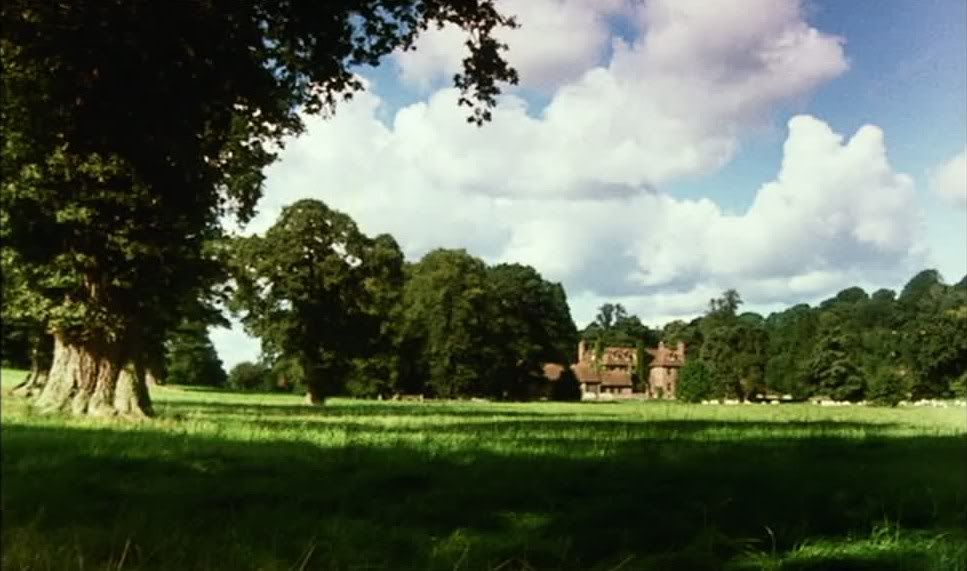
Though Neville believes himself to be the one in control, the one benefiting the most from this arrangement, the reality proves to be quite different from the appearance. There is definitely an uneven balance of power here, but contrary to Neville's confidence in his own prowess, both artistic and sexual, he is not the one with the power. He is lower-class, despite his finery and his polite manners, and none of the aristocrats ever truly accept him into their class even as they welcome him into their homes. And it turns out that they are playing a game at a far higher level than he had imagined, a game that increasingly entangles him helplessly because, not being of their class, he is utterly unequipped to engage in these games involving property and parentage. Very suggestive in this regard is the scene where Mrs. Herbert's daughter, Mrs. Talmann (Anne-Louise Lambert) explains to Neville the identity of a young boy who wanders the grounds under the care of a tutor. He's an orphan, she says, whose father died and mother converted to Catholicism, so he needed to be cared for by relatives here. "An orphan, madame," Neville sputters, "because his mother became a Catholic?" Indeed, and Neville, with his Scottish sympathies and incomprehension of the aristocrats' religious bigotry, simply proves again and again that he does not belong here, that he is not truly a part of this milieu.
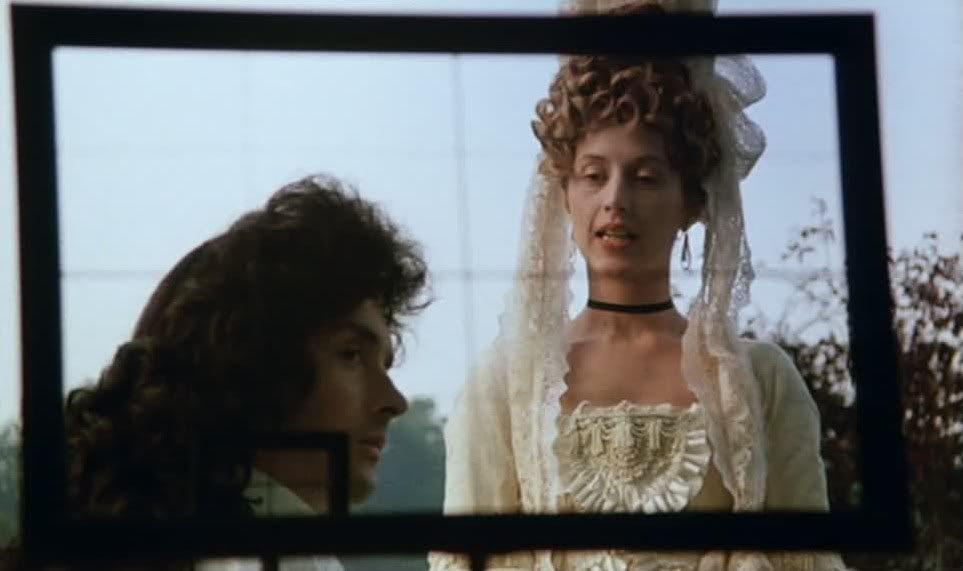
No, he is simply a tool to be used, and his drawings increasingly begin to seem like they are meant to play an important part in an elaborate plot being concocted, possibly by everyone except Neville, behind the scenes. There is considerable debate within the film, amongst the aristocrats who are privy to the drawings' contents, about precisely what kind of an "allegory" Mr. Neville is attempting to convey with these seemingly symbol-laden depictions, and one suspects that Greenaway is trying to excite the same debate regarding the film as a whole. Neville, for his part, continually insists that he simply draws what he sees, that he's merely an objective documentarian of reality, but Greenaway is undermining that artistic innocence, that naïve understanding of how art works. No drawing, no piece of art, can (or maybe should) passively document the world as it is, no matter how mechanical and purely visual Neville tries to make his art with his rigidly selected views, his viewing grid that breaks each scene into carefully composed rectangles, his totalitarian insistence that his views be uninterrupted, everything laid out exactly as he demands.
Like Mr. Herbert, who'd shaped his land into a structured, carefully manicured and maintained geometric layout in order to tame nature itself, Neville believes that he can control the world, that he can dictate what he sees and doesn't see, and thus what will appear or not appear in his drawings. But circumstances and the subtle interventions of various unknown conspirators shatter this illusion: his work is not merely innocent documentation, and his static, controlled views are increasingly disrupted by changes mysteriously wrought from one sitting to one another, clues planted, bits of evidence suggesting various covert conspiracies and activities, details pointing to murder or adultery. In other words, the carefully laid out gardens, so meticulously planned by Mr. Herbert and so thoroughly documented by Mr. Neville, are disordered and littered with evidence that the placid surface of things in only a thin, all too easily broken barrier separating polite society from all the messiness, dishonesty and ugliness of life, which keeps impolitely depositing obstructions into Neville's view, forcing him to make concessions to change and impermanence and imperfection rather than being able to craft, uninterrupted, a static, lifeless, unpopulated vision of the estate's grounds, blissfully undisturbed by any actual evidence of life or humanity.
The film is formally laid out in such a way as to both superficially confirm Neville's seeming mastery and subtly undermine it. Greenaway sticks almost entirely to static, carefully composed shots, often shot at least in part through the viewing grid that Neville uses to impose geometric order on what he sees so he can render it in his drawings. And yet Greenaway undercuts this rigidity at every turn, constantly having Neville's view obscured or interrupted by intrusive figures walking across his field of view, marring the unmoving beauty of the landscape. At one point, the director holds a shot of an unpopulated landscape long enough for the sun to be hidden by clouds and then break free, so that a long dark shadow passes across the green grass and then vanishes again, even the sky itself introducing movement and change into what Neville would like to freeze and order. When a thick gray fog rolls across the estate, Neville is unable to work, pacing impatiently back and forth while he waits for his view to clear again; if sinister aristocratic conspiracies don't undercut his dominion, then the elements conspire to remind him of his helplessness. Michael Nyman's enthralling score, appropriately enough, embodies the same dichotomy, combining courtly elegance with a propulsive, lively quality that suggests all the skullduggery and mystery lurking within the film's surface depiction of aristocratic refinement.
Greenaway's love of lists, as seen in his early avant-garde shorts and his exhaustive, exhausting first feature The Falls, persists here in the narration that meticulously describes the conditions for each of the twelve drawings. So perhaps, to some extent, Greenaway is poking fun at his own pretensions to artistic control, his own fussy obsessive-compulsiveness about naming things, about grouping objects and people, sights and sounds, into categories and descriptions, creating order through art. Key to the film is the question of the artist's responsibility to do more — as Greenaway, certainly, always has — than simply document and observe.