Showing posts with label Josef von Sternberg. Show all posts

Monday, February 25, 2013

It (1927)


Roaring Twenties sex symbol Clara Bow has always been most associated with It, the film from which she earned her most enduring nickname, as Hollywood's "It Girl." It's the film she's most remembered for today, though Bow's presence in it and its role in defining her fame are its primary points of interest. It's a slick, shallow, flimsy movie derived from the Elinor Glyn story that defined "it" as an alluring, magnetic, hard-to-pin-down quality that emanates from certain people. The film bears little relation to Glyn's story beyond that fascination with the elusive quality of "it," though it keeps referring to Glyn in a metafictional way, even having the author herself show up at one point in a hilariously clumsy promotional appearance to explain the concept of "it" to one of the characters.

The plot is beyond fluffy, with Bow playing the shopgirl Betty Lou, who falls in love with her boss Cyrus Waltham (Antonio Moreno) and doggedly pursues him, with some mishaps and misunderstandings artificially keeping the couple from truly connecting until the inevitable happy ending. It's a rather typical romantic comedy in every way, closely following a template that's become tiredly familiar, and must have been anything but fresh even when the film was new. It's all just a vague showcase for Bow, a love letter to her charms.

There's definitely something about her that could be "it." She's cute and perky, a lively if maybe over-eager screen presence whose every closeup, every winking flirtation with the camera, seems to come with an implied, "aren't I adorable?" Her cutesy mugging can be aggravating rather than endearing at times, and it's funny that part of the film's definition of "it" is a lack of self-consciousness, because Bow seems constantly self-conscious, very aware of her cuteness and her appeal, so that it often feels like she's trying way too hard to impress.


The most interesting thing about her, arguably, is her working class persona, derived from the actress' own troubled life and modest upbringing: she plays an unapologetically low-class girl who lives in a cramped apartment with an unmarried mother friend who she's helping. There's no glamour in her, except an accidental glamour arising from her natural beauty. She's also unapologetic about playing games, making love a contest of wits, flirting and pursuing the man she wants but then slapping him when she finally gets his attention and he dares to kiss her. She's flighty, silly, both fun and infuriating, in more or less equal measures. It's easy to see why she made an impact, and why this film in particular stuck as her defining moment, as she embodies a character who's a bundle of contradictions, a haphazard catalogue of feminine stereotypes: fiercely loyal to her friends, calculating in her seduction of men, dazzled by riches but offended when a man implies that's all she's after, resourceful and committed, above all, to simply having fun.

Director Clarence Badger brings an efficient, mostly straightforward aesthetic to this Cinderella fable. There are a few nice flourishes here, including, in the first shot, one of the very earliest appearances of a zoom lens, which at the time was a clunky and impractical invention that wouldn't become widely used until decades later. In another shot, Betty Lou looks around a crowded dining room for the man she's interested in, and when she finds him, the camera rushes towards him, signalling the rapturous focusing of her interest on this one point in the crowd. For the most part, though, Badger's style is unobtrusive, giving Bow lots of closeups in which to smile and bat her eyes, letting the magnetic starlet display her "it" without much interference. Josef von Sternberg, then still early in a slow-starting Hollywood career, was the assistant director and is sometimes identified as directing parts of the film uncredited, but there's little to no trace of von Sternberg's expressionist aesthetic or his sensual celebration of his leading ladies.

It is still remembered today for its association with its era and the heroine's sex symbol status, so closely tied to this film. Besides that historical interest, though, it's a pretty slight work, a curiosity that, when it doesn't feel like a barely disguised advertisement for Glyn's writing and Cosmopolitan magazine, is simply a vehicle for highlighting Bow's charisma and attractiveness. It's fluffy, but criminally for a romantic comedy, neither especially funny nor especially romantic.

Monday, January 14, 2013

The Salvation Hunters


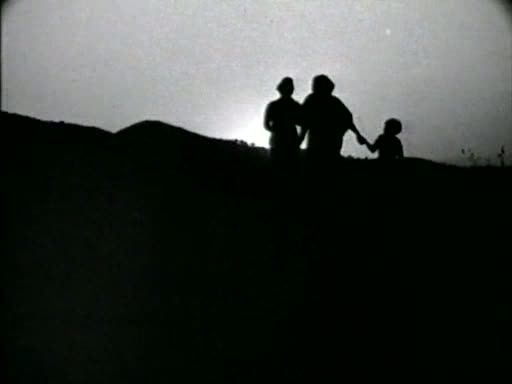
Josef von Sternberg's debut film, The Salvation Hunters, immediately gained him a reputation as a filmmaker worth watching and catapulted him to a position in Hollywood, even though this hour-long experimental project, shot by von Sternberg himself on a low budget in real locations, was anything but commercial. Purely by luck, the film got the attention of stars Charles Chaplin, Douglas Fairbanks and Mary Pickford, and the young filmmaker would soon become a Hollywood director. In this debut, the themes and aesthetics that would weave throughout the remainder of von Sternberg's career are already readily apparent in nascent form. The opening scenes, with various losers and lost souls aimlessly hanging around on the docks, would be echoed in the later classic The Docks of New York, and more generally the moody, melancholy atmosphere of this film proves that the director's aesthetic was fairly well-formed right from the beginning of his career.

The film is a loose, nearly plotless study of a trio of outcasts who number among "the derelicts of the earth," to whom von Sternberg dedicates the film in the text-heavy introduction. The film announces right up front that it's not about narrative but about attempting to photograph "a thought," and its minimal story concerns broadly defined types rather than specific characters, because what von Sternberg is really exploring is not a story happening to particular people but a universal state of being, a universal set of emotions. The characters aren't even named, they're just identified as a boy (George K. Arthur), a girl (Georgia Hale), and a child (Bruce Guerin), who together form a de facto family, united in their loneliness and their downtrodden existence. They're miserable and alone at the docks, surrounded by mud and garbage — von Sternberg captures the atmosphere of the docks so well, in closeups of rotting fish and junk barges, that one can practically smell it — so they decide to go to the city, but find that things are no better there.

The film's story is minimal, but its photography is gorgeous and haunting, and even in this first amateur work, it's steeped in von Sternberg's raw stylized emotionalism. Despite this, it seems obvious that the inexperienced young filmmaker was not yet confident enough in his visuals to let them drive the film, and the film is saddled with overbearing, pompous, self-consciously literary text scattered throughout its copious title cards. The writing drags the film down, explicitly identifying visual symbols — at one point, a title spells out that a mud-dredging claw was "a symbol of the boy's faith... that all mud could be brought up into the sun" — and hammering home the themes without the subtlety and ambiguity that would always characterize von Sternberg's subsequent films. It's a mark of insecurity; von Sternberg clearly knew what he wanted to say in this very personal debut, and though he says it very well in pure visual terms, he seemingly wanted to make sure that his message was not missed. It's unfortunate, and the constant barrage of text breaks up the flow of the images, marring the visual poetry.


This problematic wordiness aside, The Salvation Hunters is evocative and potent, and it's easy to see why it was such a hit with film artists like Chaplin and Fairbanks, if not with general audiences. Chaplin was so impressed by the film that not only did he help bring von Sternberg to Hollywood, but he immediately cast Georgia Hale as the bad girl love interest in his own masterpiece The Gold Rush, made later the same year. The Salvation Hunters itself has hints of Chaplin's influence on von Sternberg, especially in the scenes of sentimental comedy featuring the kid, a very Chaplinesque type whose sporadic antics infuse the film with an energy that's certainly not found in the downtrodden older leads.

Hale's performance, in particular, is intensely sad, her mouth permanently twisted into a frown, her eyes heavily lidded so that she seems to be staring at the world through thin slits, a cigarette lazily drooping from her lips — "good girls don't smoke," the boy tells her, taking her cigarette, and she promptly grabs it right back and resumes sullenly smoking. In one scene, she sees a dock bully get splashed with muck on a garbage barge, and she laughs for a moment before she suddenly seems to remember herself and forces her expression back to its sneering scowl. It's a focused performance of pure malice and depression, set off against Arthur's weak-willed everyman, who needs to overcome his cowardice and weakness and journey from "the mud" to "the sun."

The journey is blatantly symbolic, but what's interesting is that von Sternberg also grounds the film in a gritty, realistic depiction of the cruelties of the world. Though their story is couched abstractly in terms of "mud" and "sun," this downtrodden trio encounters all too real violence and corruption, with monstrous bullies who beat the kid and a slimy pimp who circles around the girl, trying to starve or seduce her into prostitution. That tension between expressionist, abstract symbolism and seedy realism would perhaps be more cleanly resolved in von Sternberg's later films, but here in its raw form it's still a potent combination. The Salvation Hunters is an excellent debut in general, still marked by the flaws and weaknesses that the director would smooth out with more confidence, but pictorially striking and wonderfully atmospheric.

Thursday, June 28, 2012

The Last Command


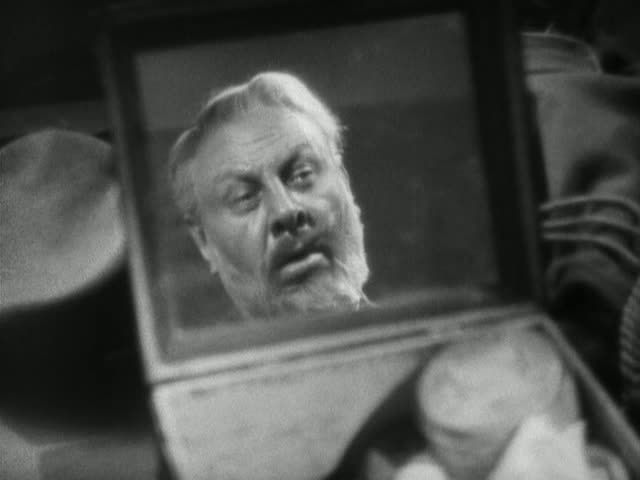
The Last Command is a remarkably clever and poignant Hollywood story, a moving tale of war, doomed love, and the ways in which Hollywood's dream factory can resonate with reality. The exiled Russian Sergius Alexander (Emil Jannings) comes to America as a poor, haunted old man, his head involuntarily shaking, reflecting an old mental trauma. Struggling to survive and make some money, he takes a job as a Hollywood extra, one of countless small-timers waiting in crowds for the chance to be a fleetingly glimpsed face on the silver screen. The irony is that, in Russia, he was a general, a cousin of the Czar himself, until the 1917 Russian Revolution toppled the czarist regime in the name of the Bolsheviks (here referred to as "revolutionists").

Josef von Sternberg infuses this tragic, melancholy story with a beautifully hazy soft-focus aesthetic, honing in on Jannings' heartbreaking performance in sensuous closeups that capture the nuances of the actor's embodiment of this crushed, broken man. Jannings delivers a real tour de force performance, his body shaking uncontrollably, haunted by the war and his humiliation, his face retaining just a trace of his former haughty grandeur in the extra's shuffling walk and heavy-lidded eyes. Then, when the film leaps into a flashback to 1917, in the days leading up to the general's downfall, he seems to be swelled with life and vibrancy, a man of pride and honor, by turns vivacious and intimidating. It's such a great performance because the shell of this man is already apparent in his shattered present-day self.

The flashback reveals how Alexander is outdone by the foolish decisions of the Czar — who seems as out-of-touch as the Bolsheviks claim, unworthy of the service of a truly honorable man like Alexander — and by the plots of the revolutionaries Lev Andreyev (William Powell) and Natalie Dabrova (Evelyn Brent). Later, in 1920s Hollywood, Andreyev has emigrated as well, serving as a director; it's Andreyev who casts Alexander as a Russian general, recreating their real life conflict, a twist that's either utterly cruel or a grand tribute to their rivalry.


The lengthy flashback sequence is especially compelling, as Alexander falls in love with Natalie, even while knowing that she's his enemy and could betray him at any moment. In one fantastic scene, he visits her in her room and notices the handle of a pistol sticking out from under her pillow, but he remains quiet, doing nothing about it, fatalistically waiting for whatever's going to happen. It's doomed romance at its best, embodied in Natalie's sad glances at this man she's growing to respect and maybe even love, while he looks at her with adoration, blinded by her dark beauty and danger. Von Sternberg has a feel for this kind of potent romantic melodrama, highlighting the tiny snub-nosed gun in a charged closeup, and then of course, instead of shooting, the woman throws herself down, her head in her arms. "From now on you are my prisoner of war," Alexander says in a title card, "and my prisoner of love."

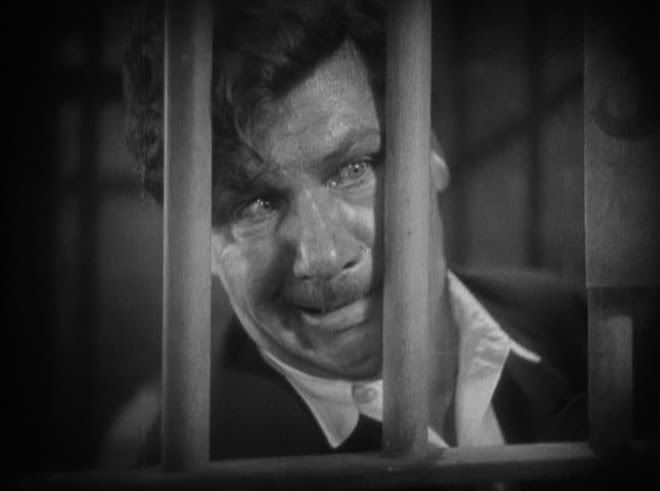
The film reaches its climax with the tragic end of the flashback and a return to the Hollywood backlot, where Alexander is preparing to reprise his historical role in a Hollywood production that Andreyev obviously intends as a propaganda piece for the Bolsheviks. Instead, it becomes Alexander's last chance to shine, his last chance to inhabit the grand role of the heroic general, his face framed against a billowing czarist flag, his eyes wild and wide, losing himself in the past. It's a great moment, the movies providing a kind of tragic closure for this man's sad life, art imitating life in every way. He's still being manipulated and defeated by his enemy Andreyev, in a way, but he's also breaking free, refusing to be confined by the movie's boundaries, briefly making it seem as though he's back at the front, rallying his troops to battle. And then he collapses, and gets a typically Hollywood epitaph from a bystander: "too bad — that guy was a great actor."

That tragicomic send-off suggests that The Last Command is a sly commentary on Hollywood's glossy approach to reality, subtly satirizing the ways in which film's power can deceive as much as inform, reducing the emotional complexity of history as it's lived to extras running around the trenches. But at the same time the movies do have great power, and Alexander's brief moment of fantasy glory suggests that this power is the power to dream, to remake reality, to transform tragedy into a profound aesthetic triumph.

Monday, May 21, 2012

The Blue Angel


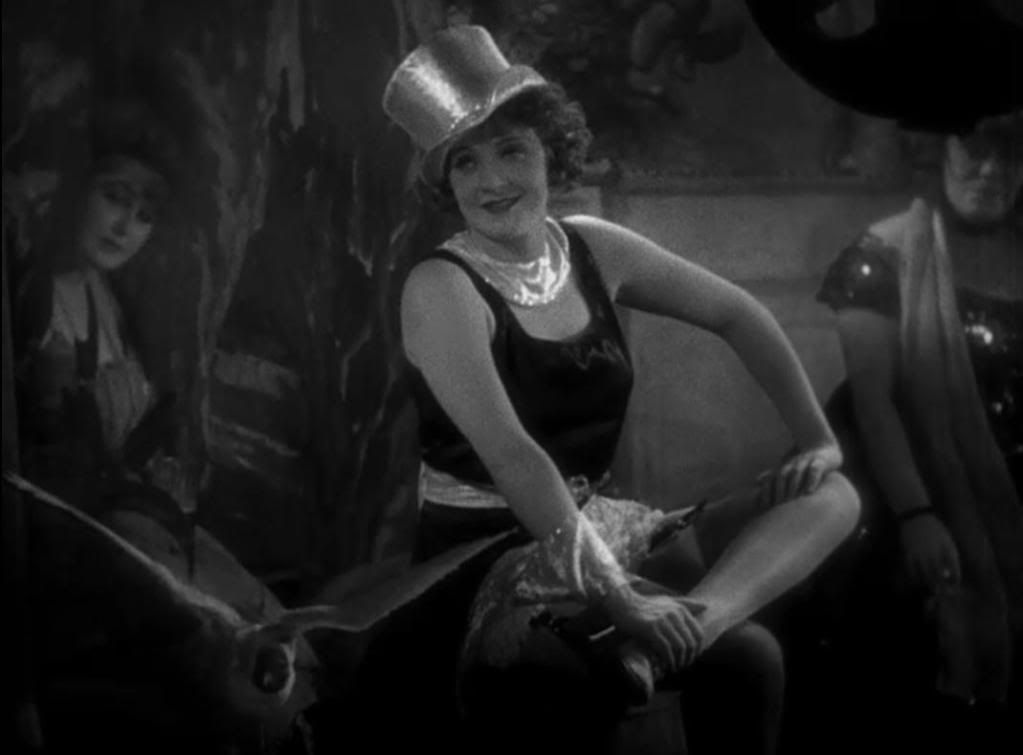
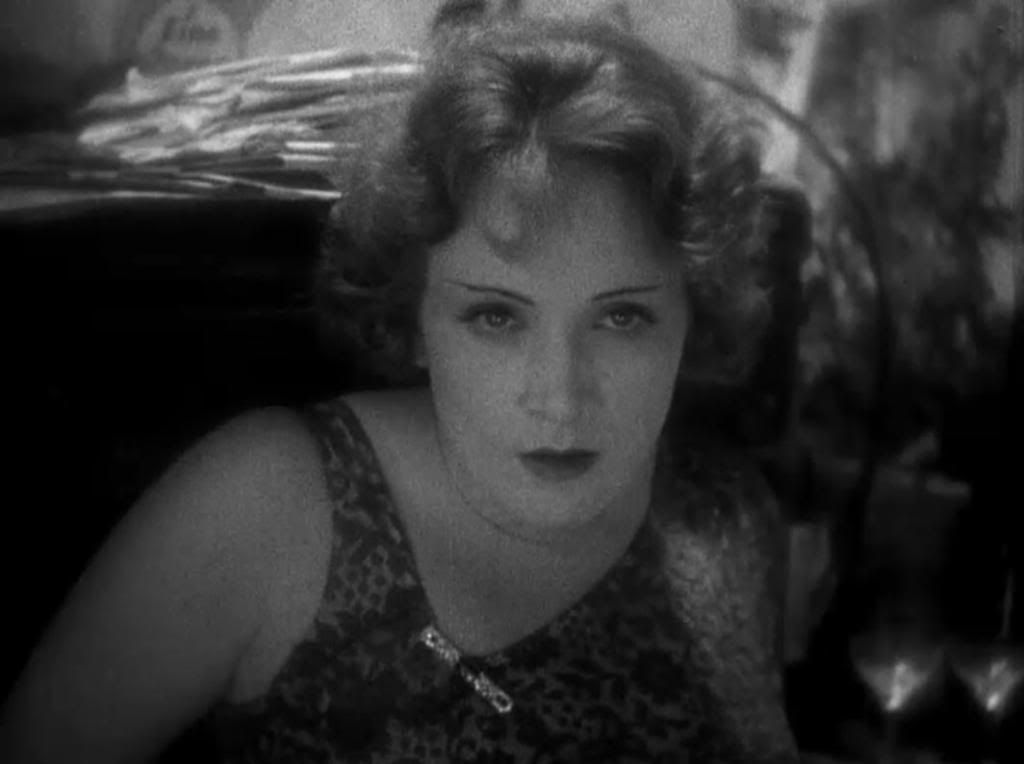
Marlene Dietrich's performance as the burlesque singer Lola Lola is one of the most iconic screen incarnations of the dangerous woman who lures a man to his destruction. This role in The Blue Angel was Dietrich's breakthrough; director Josef von Sternberg discovered her here and would make her his muse in many subsequent films. She radiates sex as the singer who wins the heart of the stuffy, sexless Professor Rath (Emil Jannings), an aging bachelor whose sheltered existence makes him especially susceptible to Lola's womanly charms. Rath initially only goes to the club the Blue Angel because he's outraged to learn that his students have been going there at night, but he keeps returning because of Lola.

The professor's fascination with the singer is charming and almost childlike; he becomes flustered and foolish in her presence, very unlike the stern disciplinarian he is with his students. This was an early venture in sound filmmaking for everyone involved, and it shows in the broad, physical performances, especially Jannings' turn as the professor. He blushes — it's obvious even in black-and-white — and sputters, his eloquence totally gone. Sternberg stages numerous deliciously naughty scenes that play up the professor's total helplessness before the spectacle of Lola. She drops her cigarette case and he goes scurrying under the table, fumbling around to recover the spilled cigarettes, but getting distracted by her long stockinged legs splayed out next to his head. "Send me a postcard," she says, her voice dripping with insinuation. Later, Rath gets drunk and wakes up in Lola's bed, clutching a doll, which he examines quizzically, like a child with a new toy. That's how he is with Lola in general, as though he's discovering women and sex for the first time, which of course he is.


The film then relentlessly, pitilessly follows Rath's downfall, his sad descent from respected professor to pathetic clown. Rath's boyish pursuit of a notorious woman like Lola causes him to lose the respect of his students and his colleagues, and he's soon drummed out of the college. In the scene where he loses his job, he sits at the front of the class, toying with a flower that Lola had given him, surrounded by mocking chalk drawings that his students had drawn on the blackboards behind him. The camera tracks back, leaving him isolated there, receding into the distance, and Sternberg repeats this unforgettable, simple but effective shot at the very end of the film. Rath then marries Lola and joins the traveling revue run by the magician Kiepert (Kurt Gerron). When Rath discovers, on his wedding night, a pile of risque pictures of his new wife, he demands that she stop selling these souvenirs. Her deadpan response is telling, and chilling, as she tells him they better hold onto them in case he's ever poor. Sure enough, Sternberg immediately cuts to a shot of Rath, some time later, shuffling through the postcards, waiting for Lola's performance to end so he can walk around from table to table, selling them to the club patrons.

The film reaches a heartbreaking, absolutely shattering climax when the revue returns, after five years away, to the Blue Angel in Rath's hometown, the first time he's been back since his disgrace. In the meantime, his relationship with Lola has deteriorated, and the childlike bliss he once felt with her has long since vanished, along with his dignity. The man who once virulently defended her virtue, calling Kiepert "a pimp" for convincing Lola to drink with club patrons, now finds himself in the same position, living off of her beauty and seductiveness, living off of her appeal to other men. Worse, Kiepert sells the Blue Angel show on Rath's name, knowing that his former friends and students and neighbors will flock to the club in order to see the disgraced old man perform as a clown alongside his sexy, provocative wife. This is the final assault on Rath's dignity, though he's perhaps even more shaken up by Lola's blatant infidelity, her flaunting of her new dalliance with a strongman who's also performing at the club.

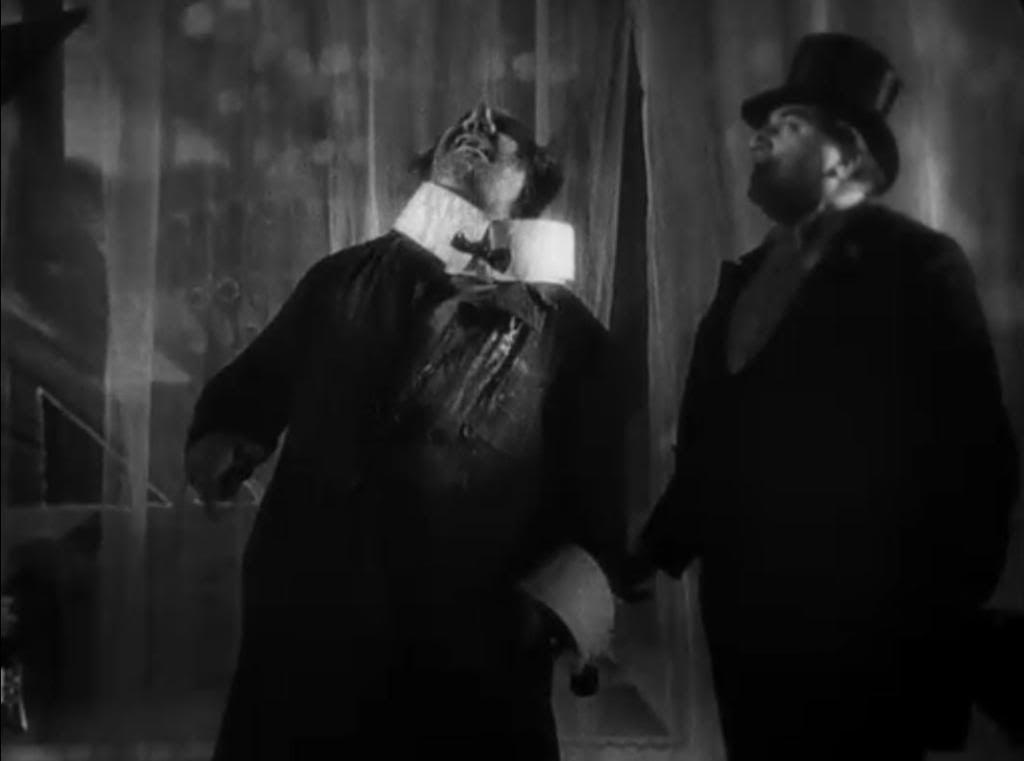
Rath's stage act is harrowing to watch: he stumbles onstage in a daze, pulled along by Kiepert, standing utterly still, his posture slumped and his face frozen, while the magician performs his tricks and gets laughs by smashing eggs on Rath's head. The show, it's clear, is only successful to the extent that it humiliates the professor: that's what everyone is there to see, and they laugh uproariously at anything at Rath's expense, while remaining silent for Kiepert's magic tricks. At a key moment, Rath is supposed to crow like a chicken while Kiepert makes eggs appear from thin air in front of the professor's face, but Rath stays silent until he sees Lola, backstage, kissing and embracing another man. Kiepert pulls him back onstage, telling him to crow, and he does, letting out an anguished, horrifying sound, a sob of fury and despair ripped from his very soul. He cries like a chicken, for the delight of the audience, but it's a heartrending sound, a sound of such raw emotion that it provides all the justification that could ever be needed for the switch from silents to talkies.


Dietrich's songs are also unforgettable, and another big reason why this was one of the very first major sound pictures. Her dry, deep delivery makes her ribald songs seem offhanded, as though she's so blasé about her own sexiness that she can simply drawl out these naughty come-on tunes. She stalks about the stage as she sings, not wiggling or dancing; there's something almost mannish and unfeminine about her stage manner, but only because she knows damn well that she doesn't have to oversell. She just has to stand there, stretching those long legs, singing those songs, and the men will helplessly fall all over her. That's why her signature song includes the oft-repeated phrase, "I can't help it," because she really can't. There's just something naturally seductive about her, a force of nature that's beyond her power to control. She really does have some feelings for Rath, it seems, and she thinks he's sweet and charming when he defends her from the caresses of other men. But everything she liked about him is worn away by the reality of living with her lifestyle, so their relationship is doomed to failure.

The Blue Angel is a tremendous film, a classic that endures for far more reasons than its undeniable historical relevance. It was the film that made Dietrich a star, and that forged the Dietrich/Sternberg partnership that would yield six more collaborations in the next five years. It also helped Sternberg transition from silents to talkies. The Blue Angel occasionally betrays its transitional nature, especially in the way sound from outside is abruptly cut off whenever a door shuts, a device Sternberg makes a bit of a gag out of during the backstage scenes. It's also notable that much of the action, particularly Jannings' comedic bits, plays out without dialogue, getting across the substance of a scene through the actors' body language and facial expressions. It's a film with one foot still in the silent era, and yet its use of sound can also be explosive and powerful, which is a big part of what makes the film so dazzling. It's the best of both worlds, straddling two very different modes of filmmaking, ushering in the new era while reaching back for some choice tricks from the old. The Blue Angel has it all: it's sexy, funny, gorgeously shot, and above all, deeply tragic.

Thursday, March 8, 2012

The Docks of New York


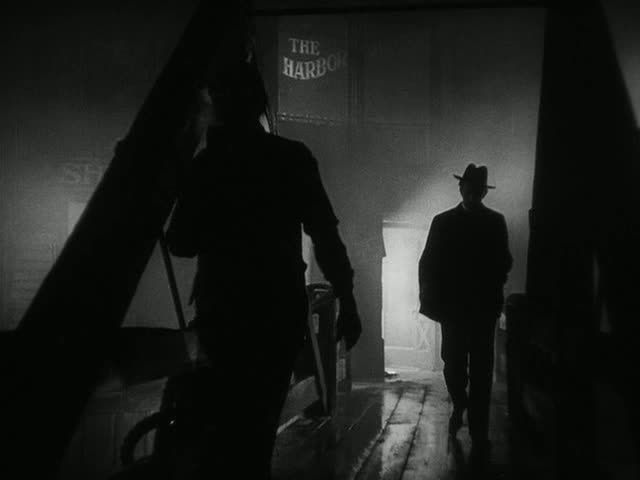
Moody, rowdy, and sensuous, Josef von Sternberg's The Docks of New York is a beautiful work of romantic expressionist cinema. Set on the docks on a one-night shore leave, the film is drenched in atmosphere. The bulk of the film takes place in a wharf tavern, crowded to the rafters with drunken revelers: sailors and stokers on leave, hard-partying women and prostitutes, drunks and tramps. Around the bar, the docks themselves are limited to a few minimalist planks of wood and a whole lot of fog, a thick soup hanging over the wharf, the water a dense black shimmering just below. It's a constrained and claustrophobic film, confined to these few minimally defined areas, essentially a rough sketch that evokes a mood. It's a place populated with rough men and easy women, all of them drifting rather aimlessly through life, desperate to grasp a few moments of pleasure before the next ship sails, before morning comes and they inevitably forget everything that happened the night before.

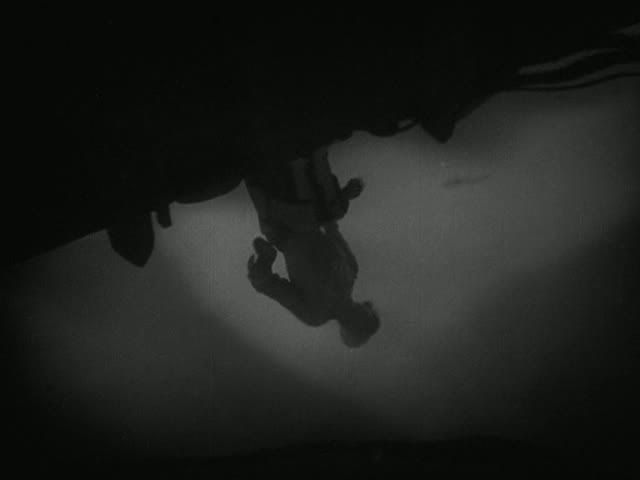
Bill (George Bancroft) is a stoker, and the film opens in a ship's hold, where Bill and the other men are streaked in grease and ash, their faces smeared with black, sweating and laboring hard in the heat. Bill's a hard, crude man, pushing around the wharf bar, always looking for a fight, pouring barrels of alcohol down his throat. He's somehow, subtly, changed when he rescues a desperate, lonely woman named Mae (Betty Compson) from the harbor after she's jumped in, trying to kill herself. Bill carries her to safety, a dark silhouette in the fog with her limp body in his arms, and when she wakes up, they develop a hesitant, charmingly unsentimental mutual attraction as these two hard-edged people trade sly banter. Over the course of a riotous night at the bar, Bill impetuously proposes to Mae, and they're married in an informal ceremony with the bar patrons cheering and shouting throughout — one of the remarkable things about von Sternberg's bar scenes is that his mise en scène is so perfect that it's easy to forget that there's no sound, that one can't actually hear the clamor that's so vividly conveyed through the silent images. There are few silent films that seem so noisy.

Von Sternberg parallels the developing relationship between Bill and Mae with the marriage of Bill's shipmate Andy (Mitchell Lewis) and his wife (Olga Baclanova). Andy's a man very much like Bill; his mannerisms are the same, he has the same crude, violent way of moving about a room by pushing everyone bodily out of his way. He's married but obviously doesn't see his wife very much. When he runs into her by chance in the bar at the beginning of the film, she's dancing with and passionately kissing another man. This unhappy couple looks at one another with nothing but resentment and contempt, their hatred of one another simmering behind every glance. They're obviously one vision of a possible future for Bill and Mae, a future that's very easy to imagine because the two couples mirror each other so perfectly: the actors are even the same types, with Bill a slightly younger echo of Andy and Mae a younger, less worn-out echo of Andy's wife.


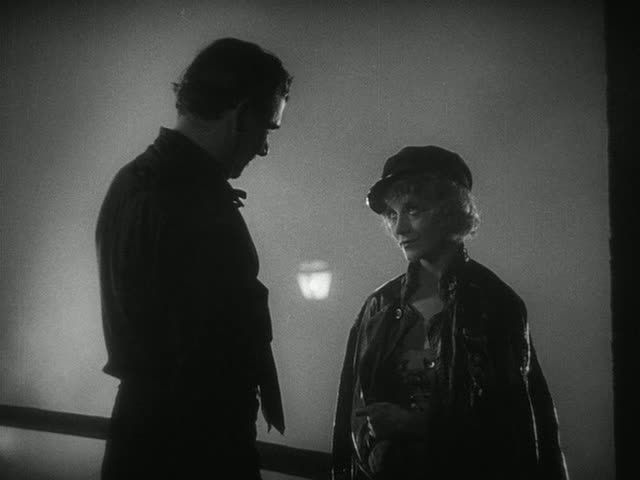
It's thus no surprise when Bill wakes up the next morning and barely remembers his wedding or his grand promises from the night before; in one chilling shot, he throws a bill down on the dresser after getting out of bed, thinks about it a moment, and drops another bill, as though he's decided that his wife at least deserves a little extra payment for his night of pleasure. It takes a long time for Bill to realize that this night wasn't so transitory after all, as this solidly unsentimental man keeps getting drawn back into Mae's orbit, for the first time finding it difficult to leave shore. For such a gritty, rowdy movie, there's a real vein of romanticism here, much of it expressed through von Sternberg's gorgeously moody dockside imagery. Bill and Mae's wedding night is capped off with a phenomenal scene of the newlyweds pausing by a railing, looking out into the fog, with Bill wrapping his coat around his bride and placing his cap on her head at a jaunty angle, as she looks up at him with those big eyes and that wry smile. It's an intoxicating moment, sweet and sad, and it only makes the subsequent scenes of an oblivious Bill waking up the next morning even more heartbreaking.

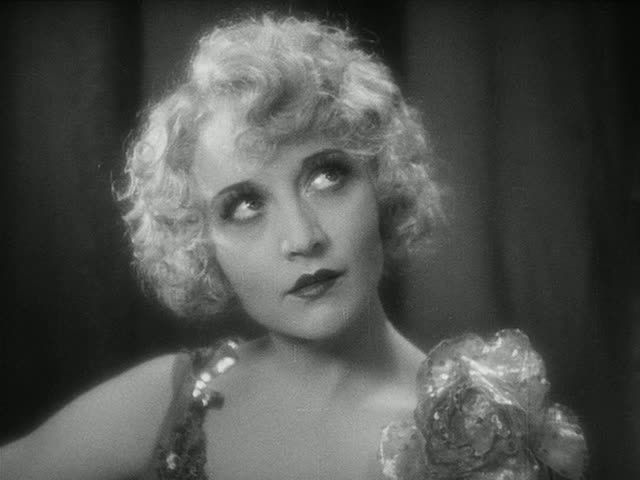
Mae is such a sweet, sad character in general, and von Sternberg's camera seems to fall in love with her long before Bill belatedly realizes that he'd like to stay with her after all. She looks up at the camera with wide eyes, the whites of her eyes shining, her mouth twisted into a sad smile that conveys the depth of her tragic life experiences. She's wise to the ways of the world, and a part of her never really expects Bill to stick around, but a much more tragic part of her hopes that he will, and it's this that comes out when, as she sews Bill's jacket, a cigarette dangling between her lips, a few crystalline tears drip down her cheeks. Von Sternberg's portrayal of her is boldly sexual and sensual — in one scene, she pulls on her dress, her long bare back to the camera as she stretches her arms up over her head. She's so perfectly comfortable in her own skin, like everyone here: the bar scenes especially are models of languid, casual posing, bodies stretched out and leaning against the railings of the bar. One of the reasons this film feels so casually realistic despite its chiaroscuro stylization is the sublimity of the body language throughout, the way every character's pose, particularly Bill's, seems to suggest imminent violence.

This is a beautiful, bittersweet film with a great deal of poetically expressed emotion in its tender depiction of a sad romance and its foggy images of the docks. Silhouettes fade in and out of the fog, the parties last all night, and in the mornings, when the alcohol has been exhausted and everyone's waking up half-naked and alone, the regrets and the sadness only return, even more overwhelming than before. If occasionally, and maybe temporarily, there's a happy ending, it's only an exception.

Tuesday, March 15, 2011

Underworld (1927)


Josef von Sternberg's remarkable silent Underworld was a template for virtually the entire gangster film genre, an archetypal film that established much of the mythos and visual language of the genre. It is also, on its own merits and regardless of its subsequent influence and importance, a bracing and powerful film, a searing melodrama with a bluntly poetic visual style. The film's story is familiar now, focusing on a brutish gangster improbably named Bull Weed (George Bancroft), a man who believes he is above the law, that he can never be caught. He literally laughs in the face of law and propriety: a big, full-throated laugh, one that requires him to throw his head back and roar with forced hilarity when confronted with those who, unlike him, fear the law, or think he needs any help. Bancroft's performance is deliberately oversized, a big, bold performance for a big, bold man whose every gesture is theatrical and exaggerated. Bull is always performing, always putting on a show as a big man — he revels in handing out money, making a show of his generosity, and an equally big show of his toughness, as revealed by his habit of ostentatiously bending coins into U shapes, his face crunched up as he strains with the metal coin, demonstrating his strength and dominance. Bancroft's broad performance is perfectly suited to this gestural, hammy, outrageous figure.

This performance, and this character, was obviously a towering inspiration for the gangster genre in the years to come, as Bancroft's Bull Weed was echoed in later gangsters played by James Cagney and Paul Muni. Howard Hawks' Scarface, in which Muni broadly mugs as a similarly unflinching gangster, was especially influenced by von Sternberg's film. This influence on Hawks would reverberate into later works, and Hawks nodded to Underworld in Rio Bravo by naming his own heroine Feathers, after Evelyn Brent's character here, and paying homage to the sequence where a bully tries to get a drunk to go fishing for money in a spittoon. In von Sternberg's film, Feathers is Bull's girl, the bully is Bull's criminal rival Buck (Fred Kohler), and the drunk is ironically dubbed, by Bull, Rolls Royce (Clive Brook), a washed-up lawyer who still hasn't sunk so low that he'll go scrambling in filth for a few dollars. Rolls Royce isn't so proud, however, that he won't take Bull's money; when Bull befriends this drunk, perhaps seeing the nascent dignity and potential in him, he sets Rolls Royce up with some money and makes him his right-hand man.

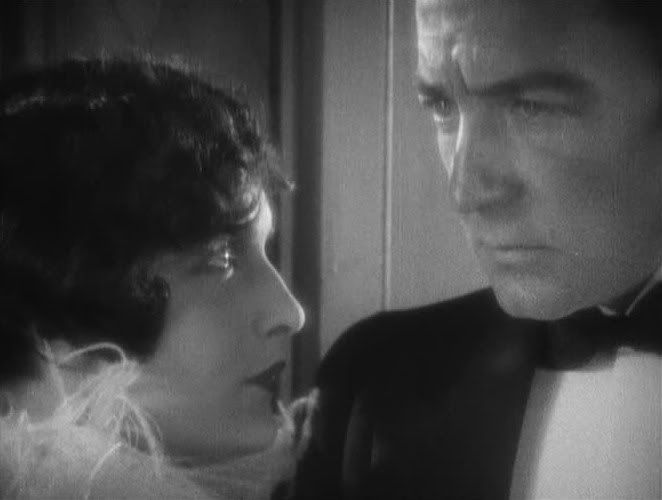
Feathers is similarly indebted to Bull, even though she quickly falls in love with the cleaned-up, intelligent Rolls Royce. She asks Rolls Royce what he was before he was picked up by Bull, and after acknowledging that he was a bum and a drunk, he turns the question around on her. The look in her eyes says it all, without any intertitle to clarify: she was obviously a lowly character, perhaps a prostitute, and now she's a woman who, covered in feather boas and dressed in glamorous clothes, can turn the head of everyone in a room when she enters. Von Sternberg stages moments like this in glossy but expressive closeups, glistening with light that reflects off the shiny eyes of the protagonists as they grapple with loyalty, desire, and shame. Feathers and Rolls Royce are deeply conflicted, in love with one another but also feeling loyalty to Bull, and simultaneously ashamed of their reliance on this gangster. They know that their lives are built on illegal activity, and Rolls Royce even helps Bull with his crimes, instructing him on how to frame Buck for a stick-up job.


Von Sternberg's aesthetic, with his intense closeups and strikingly framed medium shots in shadow-strewn back alleys and bars, is perfectly suited to this tale of pent-up and violent emotions. Bull, in contrast to Feathers and Rolls Royce, doesn't hold anything back. He expresses everything, alternating bouts of rage with fits of laughter and cheerfulness that are just as fierce. When he sees Feathers and Rolls Royce dancing, he flies into a rage, outraged not that they were dancing, necessarily, but that his assistant hadn't asked for permission first: he speaks of Feathers as though she were his property, as though Rolls Royce should have simply asked to borrow her. A moment later, the incident is forgotten and Bull is back to cackling hysterically, as though nothing had even happened. He burns hard and fast, never holding back his jealousy or his anger or his enjoyment of some bit of nonsense. Everything he feels is immediately embodied in his expressive face. At one point, while he's standing trial and awaiting his sentence, he's distracted from the judge's words by the sight of Feathers and Rolls Royce sitting together in the courtroom. Von Sternberg focuses on a closeup of Bull's face, his eyes continually shifting to the side, away from the judge, looking towards his friend and his girl together; it is a portrait of all-consuming jealousy, jealousy built from a seemingly innocent image of these two people simply sitting next to each other. In Bull's mind, it becomes an intimate moment between lovers, and von Sternberg shoots the pair as though subtly confirming Bull's suspicions in the closeness of their bodies, in the small comforting pat on the hand Rolls Royce gives to Feathers, in the confining intimacy of the way they're framed together.

What's so remarkable about Underworld is that it's a seminal film, the impact of which has hardly been blunted by all the films to follow its example. Like many of its successors, it frames its story of an unrepentant gangster in the thin gauze of a social message — and even has Bull repent in the final act, an out-of-character gesture that does little to change his essential nature. But also like many later gangster pictures, Underworld is far more convincing at establishing the fun-loving persona and larger-than-life vitality of this vicious character than it is at tut-tutting his excesses. The film is fun, and frequently quite funny, with flashes of wit in the titles, like Feathers' insult/come-on to Rolls Royce, a bit of naughty innuendo disguised with an automobile metaphor. Later, there's even a gangsters' ball where "everyone with a police record will be there," a cartoonish conceit that calls attention to the film's wry, fantastical perspective on crime and gangsterism. This is a brilliant, strikingly shot example of the American gangster icon in his early stages of development, his edges at their roughest, his nastiness cut with playfulness and joie de vivre, his brutality softened by an almost unthinking generosity and tenderness. He's the kind of gangster who will machine-gun a cop one moment and feed a kitten some milk from his finger the next, and kittens sporadically caper through the film, symbols of innocence and play, oblivious to the gunfire and violence. The film, like its laughing, scowling antihero, is rough on the outside but hides the playful, spirited soul of a kitten underneath.