Thursday, November 6, 2008

An Alphabet of Favorite Films


The Film Doctor has asked me to contribute to a meme started by Blog Cabins: a list consisting of one film for each letter of the alphabet. It's a surprisingly tough task, resulting in something very different from what I might pick if simply asked for favorite films without such restrictions. So here it is...

Alone. Life Wastes Andy Hardy (Martin Arnold, 1998)
Beau travail (Claire Denis, 1999)
Chinese Roulette (Rainer Werner Fassbinder, 1976)
Dead Man (Jim Jarmusch, 1995)
Edvard Munch (Peter Watkins, 1974)
Fanny and Alexander (Ingmar Bergman, 1982)
Gerry (Gus Van Sant, 2002)
Holiday (George Cukor, 1938)
I Heart Huckabees (David O. Russell, 2004)
Juliet of the Spirits (Federico Fellini, 1965)
Kiss Me Deadly (Robert Aldrich, 1955)
Love Song (Stan Brakhage, 2001)
Masculin féminin (Jean-Luc Godard, 1966)
North by Northwest (Alfred Hitchcock, 1959)
Only Angels Have Wings (Howard Hawks, 1939)
Playtime (Jacques Tati, 1967)
Quando l'occhio trema (Paolo Gioli, 1988)
Rebel Without a Cause (Nicholas Ray, 1955)
Sans soleil (Chris Marker, 1983)
Touch of Evil (Orson Welles, 1958)
Underground (Emir Kusturica, 1995)
Videodrome (David Cronenberg, 1983)
Written on the Wind (Douglas Sirk, 1956)
X ???
Yojimbo (Akira Kurosawa, 1961
Zelig (Woody Allen, 1983)

Consider yourself tagged if you read this, and link to your own lists in the comments so I can see.

Wednesday, November 5, 2008

Society of the Spectacle


[This post is a contribution to the Politics & Movies Blog-a-thon, running from November 4-9 at The Cooler.]

The arguments of the Situationist Guy Debord, as radical as they were at the time he first made them, might today seem somewhat familiar and even blasé, on their surface at least: culture is a distraction from material reality; it is in the interests of societal elites to keep the masses docile; workers are alienated from the results of their labor in industrial society. To some extent, these ideas have been thoroughly absorbed into radical and leftist thought in the 40 years since Debord first published his seminal 1967 tract Society of the Spectacle. And yet, there is a sense that the full implications of Debord's radical understanding of the conditions of reality has hardly been understood or acted upon. His dense, dialectical book, and the film of the same name that he made in 1973, posit an approach to cultural reality that can best be thought of as political science fiction. In examining the "spectacular" foundations of modern life, Debord acknowledges and discusses the usual meanings of "spectacle" — entertainment, advertising, consumer fetishism, the commodification of sexuality — but goes even further by suggesting that the visible world itself has become the spectacle that blinds us to the true state of things. Debord's spectacle is a politicized proto-Matrix vision in which invisible forces conspire to create an artificial reality that is utterly committed only to its own continuation. The society of the spectacle is the world itself and everything in it, a mass delusion in which virtually everyone is imprisoned, an endless cycle of repetitious labor and the empty ritual "pleasure" of vacations or weekends.

The book The Society of the Spectacle was first published in 1967 and a year later became a key text of the May 1968 student uprisings in France. It is a complex, dazzling polemic, with a distinctively French dialectical wit and a proclivity for punning language, reversals of meaning, and contradictory ideas. For Debord, contradiction is a holy grail: the spectacle that we all live is built upon a foundation of irreconcilable opposites, and to see these contradictions is to understand the absurdity of modern society. The film version, made six years later, is Debord's attempt to illustrate his text, further develop his ideas, and provide concrete visual examples of the kinds of things he wrote about. The film is also something of a valedictory for the events of May 1968, a celebration of the "formless" revolt that Debord sees as the first step in truly overthrowing the oppressive conditions of modern culture.


The film's presentation of Debord's ideas about the spectacle follows closely from the form of the original book, which consists of 221 numbered paragraphs that each present a fully formed idea. The book's structure is additive, the individual theses somewhat isolated from one another, and yet also building upon the precepts and concepts laid down in the book as a whole. The film compounds this fragmentary structure by excerpting liberally from the text, recontextualizing Debord's words as elements in the film's ever-present voiceover. This narration rarely goes silent, its rapid pace and profusion of contradictory ideas approximating the dense texture of Debord's prose, which insists on unerringly precise definitions. "The spectacle is not a collection of images," he says towards the beginning of both book and film, "rather, it is a social relationship between people that is mediated by images." These "is"/"is not" dialectics appear frequently; Debord defines his ideas by first limning their boundaries, declaring what they are not before tracing what they are. His precision can be exhausting, and it is hardly possible to exactly follow his argument at all times upon seeing the film for the first time, even with prior knowledge of the source text — one can only imagine the foundering of someone seeing the film without any sense of its context and origins. Debord's words work better in print than in film, available to extended study instead of flying by at a steady pace. To some extent he sacrifices the clarity of his writing by translating it to a different medium.

However, the film of Society of the Spectacle is hardly just a transposition of the book, and Debord's unique conception of the cinema creates a wholly new artwork from his source material. One would expect a writer with such a thoroughly developed ideology of images to think long and hard before creating his own images, lest he accidentally contribute to the spectacle he sought to undermine. Indeed, the structure of this film reflects a careful consideration of the way that text and images flow into one another, creating a commentary on images, representation, and the spectacle of culture. In this respect, it is instructive to compare Debord with another French veteran of May 1968 whose films reflect upon the relationships between images and reality: Jean-Luc Godard, of course. Godard and Debord were loose contemporaries, but they had little direct interaction, and to some extent they were opposed: Debord's Situationist International, always concerned with defining in-groups and out-groups, declared Godard to be an insufficiently radicalized reactionary. The reason for this denunciation might very well lie in the different approaches the two men took to treating images in their work.

Debord's concept of détournement — a word the Situationists coined to describe the recycling of artistic elements in a new context to express a different meaning than the original artist — is subtly different from Godard's approach to pastiche and genre homage. Whereas Godard incorporated references to literature and Hollywood film with a satirical or polemical edge, making them his own, Debord's cut-and-paste quotations are generally left whole, appropriated without authorial comment. Debord frequently inserts intertitles or on-screen text (a very Godardian touch) that either print material from his book or cite other works, sometimes with attribution (Marx, Toqueville) and sometimes without (a passage of Shakespeare's Richard III). At several points in the film, he excerpts at length from films by Orson Welles, Nicholas Ray, John Ford, Sergei Eisenstein, and others, simply allowing these ragged chunks of other films to exist, if somewhat uncomfortably, within his own. There is rarely any satirical perspective in these insertions, or even any direct correspondence with the narration. The point is simply to co-opt the spectacle, to put its images in a context where the spectacle is continuously undermined, where the contrast between the spectacular and the non-spectacular can become clear. To a similar end, Debord appropriates fashion photography and bits of soft-porn sexual images, spectacular images whose function in society is obliquely described by the voiceover. When Godard would include sexual images in the work of his radical period — as he did most radically in the abrasive Numéro Deux — his presentation of sexuality often aggressively deconstructed and defused the expected reactions. This is not the case with Debord, who allows unaltered images of commercialized sexuality to exist within the fabric of his film, trusting in the contradiction between image and text to awaken thought instead of visceral reaction. It's not always a successful tactic, since the directness of sexual images makes them particularly resistant to such attempts at recontextualization, but it is also a logical outgrowth of Debord's fundamental principles. To do more than simply show images and speak about them would be to risk becoming spectacle.


Indeed, this danger is explicitly acknowledged by Debord, in a prescient segment on the commodification of dissatisfaction. To illustrate this section, Debord chooses images of teen rock n' roll bands, their sexualized contortions and pseudo-violent spasms standing in for a more meaningful rebellion against the spectacle. Debord's basic point is that the spectacle is, at this point in history, the totality of life, and that anything can be co-opted or absorbed by this overwhelming force. In rock n' roll, youthful dissatisfaction with the conditions of life is packaged, given a concrete form and thus made salable. Revolution is channeled into loud music and sex idols, and the youth gather to witness a rock concert rather than to form a revolution. This is why Debord sees salvation in the formless, the literally unspeakable or inexpressible, that which cannot be commodified and sold to the masses. A counterpoint to youth rebellion as a commodity is proletarian revolution itself as a commodity, a reality that exists in the Soviet Union under Stalin. In one of the film's most devastating and dense scenes, Debord's voiceover describes the creation of the bourgeoisie spectacle in a nominally anti-bourgeoisie context, as footage of Stalin giving a speech plays out silently. For Debord, Stalinist oppression is quite possibly the epitome of the spectacular society, an absurd illusion in which Soviet officials must simultaneously inhabit contradictory identities: as proletarian revolutionaries and as totalitarian bureaucrats. This creates a paradoxical government whose representatives can never totally inhabit either of these opposite poles, instead vacillating between public statement of proletarian ideals and private membership in a governmental structure whose elite nature contradicts the aims of the proletariat.

This is a potent example of the illusions and disjunctions that exist at the heart of contemporary reality, and Debord's intellectual clarity and rigor help to unearth and explore these spectacular manifestations. One can assume, from the way he uses footage of Mao shaking hands with Nixon and Kissinger as an illustration of international interconnectedness, that Debord sees all the world's governments as equally culpable in holding this spectacular veil across the eyes of the masses. For Debord, to engage in more specific political critique would be to miss the point, since the world's problems are not limited by locale or government but are foundational, inscribed in the very makeup of our society. His film was radical and surprising when it was made, in 1973, and it remains today an eye-opening examination of global power, control, and oppression.

Tuesday, November 4, 2008

Here and Elsewhere


[This post is a contribution to the Politics & Movies Blog-a-thon, running from November 4-9 at The Cooler.]

As with so many of Jean-Luc Godard's films, Here and Elsewhere is an intensely mediated, indirect examination of reality (or, as Godard would probably prefer, realities). It is not so much a political film as it is about political films, about the ways in which images, sounds, and their combinations can contribute to or impede understanding. It is also a study in contrasts, with the title's dual concepts the central dichotomy at work: "here" for the familiar, the domestic; "elsewhere" for the unfamiliar, the foreign. This dichotomy arises, naturally for Godard, in the very process of making his film. Here and Elsewhere began in 1970 as a project for Godard and Jean-Pierre Gorin's Dziga Vertov Group; the duo visited Israel to make a film about Palestinian guerrillas, only to have the film fall apart unmade once they returned to France with their footage. Five years later, Godard completed the film with his new partner Anne-Marie Miéville, and the result is as much a commentary on the unfinished film and its failures as it is a film about the Israeli/Palestinian conflict.

In its finished form, the film opposes the original material, the footage from Israel, against new footage shot "here," in France, of a typical working class family, who are mostly depicted watching TV. The suggestion is of a French family receiving images and sounds from a foreign place, from "elsewhere," a mysterious locale removed both in distance and time. The elapsed time creates profound discontinuities between the images of the Palestinians and those of the French family, and Godard continually points out this disjunction by reminding us, in voiceover, that most of the people in the images from "elsewhere" are now, just five years later, dead. The film thus contains the proof of its own irrelevance as a piece of propaganda: the battles it attempts to represent and to awaken understanding of are long since fought and lost, presumably replaced in the present by new conflicts and new fighters. There is a sense of sadness in these images, which are now in a sense out of date, disconnected by half a decade from the place and time they captured.


Godard goes beyond the specificity of this particular instance, however, to suggest that images are always disconnected in this way from the reality they represent. The Dziga Vertov Group films evinced a distrust of images for this very reason, preferring to trust in sound. Here and Elsewhere is arguably a more sophisticated take on this philosophy of images and sounds: both are distrusted, and at the same time the film invests both components of the cinema with the potential for revolutionary education. Towards the end of the film, Miéville utters what might be the film's defining line, "learn to see here in order to understand elsewhere." The process of learning described involves both critiquing the conventional use of images and developing new ways of treating them. The film's critique of cinematic images is most cogently stated in a series of scenes where Godard demonstrates the ways in which cinema's method of showing images, one after another, is limited. In one scene, a group of five people parade in front of a camera, holding up images from Israel one by one, speaking a slogan as their image gets its time in the frame.

This is an undoubtedly limited way of exploring complicated realities, and throughout the film Godard posits several alternative ways of presenting images to facilitate greater understanding. One of the most common is the chain of images presented simultaneously on the screen, so that each link in the chain can be seen at every moment. A series of three small monitors hold photo cells, which Godard switches in and out in one scene to demonstrate various chains of causality, violence, and oppression: a photo of Nixon, a photo of a bomber plane, a photo of a group of revolutionaries. Godard views these strips of images as an improvement of cinema, a way of demonstrating the relationships between images in a more permanent way, without trusting the "memory" of the cinema that requires relationships to exist between frames that flicker only briefly on the screen. Another of his characteristic techniques of handling images, familiar from his 70s video work, is the overlapping and juxtaposition of multiple images in relation to one another. Here and Elsewhere contains some of his most radical usage of the technique prior to his much later Histoire(s) du cinema project, which could be said to revolve almost entirely around juxtapositions of this type. In one scene, Godard displays an image of an old Socialist with "Lenine" written on his upturned palm, then washes a second image across the screen, fading the old man into a crowd of 1930s Popular Front radicals, then to the image of Hitler. The images suggest the connections between socialism "then and now," a counterpoint to the film's title, while also interpolating the fascist enemies of socialism. The juxtaposition also serves as a reminder of how easily populist movements can be co-opted for fascism; Godard flashes the word "populaire" on screen across the images of both Hitler and the socialists, rapidly cutting between the opposing forces to link them in unexpected ways.


To some extent, this tendency towards equivalence is betrayed by Godard and Miéville's differential treatment of the Israelis and Palestinians in the footage from 1970. An image juxtaposing Hitler with Israeli Prime Minister Golda Meir, while the letters of "Israel" slowly morph into "Palestine," is controversial, to say the least: there's obviously a huge distance between the two political leaders that Godard's image purposefully elides. Similarly, the film condemns Israeli-committed atrocities but fails to do the same for those brutalities inflicted upon Israelis. At one point, Miéville's voiceover appears to support the 1972 abduction and murders of the Israeli Olympic team at the Munich games. She faults the abductors for their mistaken agenda and tactics — she says that, instead of demanding that Palestinian prisoners be released, they should have used their leverage to get images of their people's plight broadcast on international TV — but she does not condemn or even question the necessity of the killings. There is something academic and distanced in this revolutionary zeal, a perverse willingness to advocate violence and bloodshed from an armchair position outside the action. It is also by no means a foregone conclusion that the film's wholesale application of revolutionary socialist rhetoric to Palestinian guerrilla fighters is a comfortable fit. It is interesting to consider the Palestinians' lost homeland and conflict with Western capitalist powers in the context of Marxist class struggle, but class is hardly the only pertinent consideration. Certainly, this must be the only film to discuss the Israeli/Palestinian conflict in such depth without even once mentioning religion.

These limitations and paradoxes are of course familiar components of Godard's political perspective, which incorporates self-questioning dialectics with polemical rhetoric, often allowing contradictory elements to bump right up against one another. That's certainly the case here, where the entire film is founded on a system of oppositions: between 1975 France and 1970 Palestine, foreign and domestic, seeing and hearing, film and still images, politics and everyday life. In bringing together all these opposing forces and interrogating them, Godard and Miéville are attempting to posit a new form of political discourse, one which finds common ground and points of resonance without regard to national borders, instead emphasizing class unity. The film attempts to forge connections between the oppressed and their counterparts "elsewhere," while simultaneously drawing the connections between their oppressors: Nixon, Brezhnev, Golda Meir, Hitler. The film is predicated on the French family depicted as "here" realizing that the Palestinians they see on TV are in fact their mirror image. Godard holds up images of the distant oppressed to the oppressed at home, hoping to create a new consciousness. If the film doesn't quite succeed at that, it is nevertheless a flawed but fascinating document of Godard's emergent video-editing techniques and his vision of their political potential.

Sunday, November 2, 2008

T-Men


In Anthony Mann's seminal noir T-Men, as in his later morally ambiguous Western cycle, there are the makings of the kind of tough-minded, hard-edged, beautifully shot morality studies that Mann continually returned to. Here, he is slightly hamstrung by his material, an über-patriotic story that attempts to mythologize the agents of the U.S. Treasury Department as they ferret out counterfeiters and alcohol bootleggers. The script is an obvious piece of propaganda that aims to overcome the unglamorous nature of this work, propelling the "T-men" to the level of tough-guy feds who never rest until they get their man. The film opens with a mock-documentary sequence featuring a Treasury official reading a prepared statement about the functions of his department, then introducing the sample case that constitutes the film proper. This is naturally cheesy material, made worse by the overbearing voiceover that mars much of the film's first hour, a tell-don't-show omniscient narrator who delivers the party line about the bravery of the T-men and the greatness of Uncle Sam. Any other director, saddled with such a self-evidently mediocre script, would simply churn out the kind of moralistic low-budget gangster pieces that thrived on the lower half of double-bills in the 40s. Instead, Mann and ace cinematographer John Alton crafted an often-stunning piece of art from this crude foundation, cramming the film with gorgeous visual effects and even subtly working against the film's propagandistic agenda.

The film follows Treasury agents O'Brien (Dennis O'Keefe) and Genaro (Alfred Ryder) as they attempt to infiltrate an elusive mob running a large-scale counterfeiting operation out of Detroit and Los Angeles. The two agents go undercover as criminals, slowly working their way up the chain of command in order to locate and apprehend the top levels of the criminal organization. Along the way, Mann and Alton engineer endless opportunities for visual experimentation. A stakeout scene, with O'Brien tailing the counterfeit ring's middleman, nicknamed "the Schemer" (Wallace Ford), becomes an exercise in creative cinematography: long shots of shadowy streets with the agent sulking in pursuit, then a wonderful sequence in a club where O'Brien hides in a phone booth, and the interior of the club is seen reflected in the glass in front of him. In other places, unusual camera angles create emphasis or highlight points of interest. In one scene, O'Brien has hidden a counterfeiting plate under a sink and is trying to retrieve it while both he and another hood are washing their hands in the cramped bathroom. Mann positions the camera below the duo, looking up at the plate taped to the sink's underside, with the two men towering above. It's a perfect vantage point that allows an unobstructed view of O'Brien's surreptitious attempts to grab the plate without arousing his companion's suspicion. The tension in the scene is subtly ratcheted up by the perspective, which emphasizes what's going on in a way that a more conventional view would not.


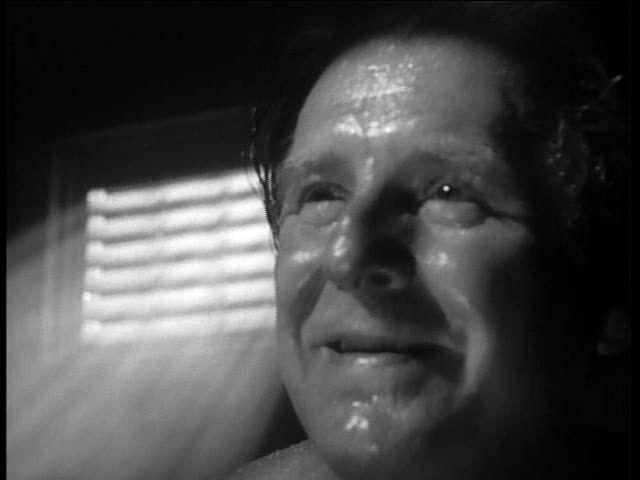
In ways like this, Mann and Alton's visuals bring a great deal to a script that would otherwise have been entirely forgettable. In addition to the handicap of the pro-government propaganda, the script lacks the typical noir flair: its dialogue is nearly as flat and unexceptional as the droning narration, and the characters have little of interest as individuals. There are not only one but two femme fatales (including Mary Meade as a mob moll), but virtually nothing is done with either, and they wind up being just forgettable bit parts. Even the two leads don't have much opportunity to do more than spit out generic tough-guy lines. However, Mann is able to infuse several scenes with emotional frisson despite the blandness of the script, suggesting without words the intensity that is required of the biggest scenes. The film's unspoken emotional center is clearly the scene where Genaro, while undercover and walking with the Schemer, accidentally runs into his wife Mary (June Lockhart) and her friend. The friend recognizes him and calls him by his real name, while he steadfastly denies that he knows them. He finally comes face to face with his wife, who realizes that he can't blow his cover, and with a straight face she says that her husband is much taller and more handsome, then drags her friend away. It's a riveting scene, and Mann locates all the tension in tight closeups on Genaro's face, his forehead knotted and drawn taut around his slitted eyes. Everything in the scene is there in his face: his fear of being outed joined with the agony of having to deny his own wife, having her right there in front of him and being unable to kiss her, embrace her, even acknowledge that he knows her. The script itself never does anything to establish the importance of Genaro's marriage, to suggest the depth of his love for his wife or his concerns for her safety, and she appears and disappears for one scene only, never to be seen again. This one scene nevertheless perfectly captures the feelings churning beneath the surface; it's all there in Mann's closeups, in the tension around Genaro's eyes or the few tears dotting his wife's cheeks after he leaves.

This economy of expression, necessitated by a minimalist, even bland story, is carried over into a later scene where O'Brien has to witness a murder committed by the counterfeiting gang and can't react without blowing his cover. Just as in the scene with Genaro, Mann keeps the tension localized in the area around the eyes, his closeups capturing the deep shadow-filled lines etched into the agent's face by what he sees. In a film where the dialogue is as emotionally inert as a cardiogram flatline, Mann and Alton extract the maximum of affect from their actors' faces, inscribing the narrative's emotional undercurrents in a coded language of shadows, pointed looks, and worry lines. The effect is often startling, as a powderkeg of emotion seems to be ready to blow right beneath the film's cool surface. It's even possible to read in O'Brien's face at this moment the stirrings of a subversive question: is this worth it? Is stopping the flow of fake money worth letting a murder happen right before my eyes? He seems on the verge of acting, blowing his cover, doing something, his conscience straining against the strictures of his orders. By the film's cruel logic, these agents should be willing to pay virtually any price — even their own lives — for the sake of halting the economic and social crimes they investigate. Mann's film never explicitly questions this assumption, instead simply documenting, with his characteristic moral and visual rigor, the progression of violence and brutality necessary to put an end to this ring. The question under the surface, "is this worth it?" is never verbalized but lingers potently in the background, unasked by the screenplay, floating like smoke through the shadows with which Mann and Alton flood the frame.