[This review has been cross-posted at Decisions At Sundown, a blog started by Jon Lanthier and dedicated exclusively to the Western genre. From now on I will be cross-posting all of my Western reviews with this blog, where I am one of several contributors.]
The Treasure of the Sierra Madre
[This review has been cross-posted at Decisions At Sundown, a blog started by Jon Lanthier and dedicated exclusively to the Western genre. From now on I will be cross-posting all of my Western reviews with this blog, where I am one of several contributors.]
The Treasure of the Sierra Madre is John Huston's epic exploration of American greed, paranoia and violence, of the ways in which material wealth can corrupt the soul. It's a dark, relentless parable, setting up its central tensions very early on and then simply letting its characters slowly build up pressure until they inevitably boil over. Dobbs (Humphrey Bogart) is an American drifter in Mexico, scraping by without any dignity by begging for coins from American tourists. A running gag throughout the first segment of the film is Dobbs' habit of asking for change from the same American man in a clean white suit (played by Huston himself in a cameo). He asks the man for change three times, each time in the same way, each time receiving a coin, but finally the man blows up at him and asks to be left alone. It's both a moment of humor and a demonstration of just how pathetic and beaten-down Dobbs is; he hadn't realized that he was continually begging from the same man because he never looked people in the eye when asking for money, looking only at their hands and the money itself. Dobbs is a slave to money, debasing himself for it, obsessed with getting more of it. He soon meets a fellow American bumming about, the equally poor but slightly less desperate Curtin (Tim Holt), and the two of them decide to hook up with a wizened old prospector named Howard (the director's father Walter Huston) to look for gold.
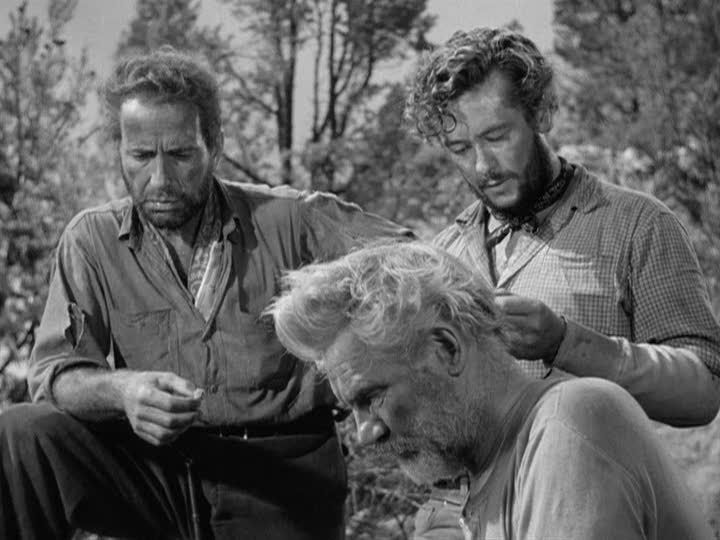
This trio heads off into the mountains together to search for gold, but it's obvious from the beginning that there's too much tension between them for this to end well. Huston masterfully foreshadows the explosions to come, in tightly packed frames where the characters seem jammed together, pressed against one another, their fates intertwined as they share the same cinematic space. In one early shot, Dobbs and Curtin shake hands, agreeing to become partners, and Huston frames Howard in the background, looking on sadly at the hands joining in the foreground. It's obvious that he already knows: this union will be only temporary and fragile, will shatter as easily as two hands drawing away from one another after a handshake. (Or as easily as the film's illusion of verisimilitude is shattered whenever Huston awkwardly stages a fistfight.)
Throughout the film, Huston's images have this kind of clarity and insight into his characters. His deep-focus compositions are strikingly beautiful, but more than that they have texture, they have weight to them. The scratchy beards of the prospectors look as sharp and spiky as the spines of cacti in the rocky area around their camp. The dirt and exhaustion of their labor is palpable; they move with the feel of men who have actually just spent all day in the sun hauling rocks and swinging pickaxes. Huston immerses his audience in this world, and thus he allows the quarrels between the men to develop organically from their frustrations and daily toils. Dobbs' innate greed and ornery nature, already evident in the early scenes of him as a beggar in a Mexican town, becomes even more dangerous once he's at the gold mine.
In one of the film's most telling early scenes, immediately after Dobbs had begged enough money to get himself some food, he is approached by a young Mexican boy (played by a very young Robert Blake, of all people) asking for money for a lottery ticket. Dobbs simply snarls at the kid and tries to chase him away, even throwing a glass of water at his face. Dobbs has no sympathy for those like himself, no understanding of the parallels between his own situation as a beggar and that of this boy — once he gets some money, he doesn't care about anybody else. It's as though he's forgotten that only an hour earlier he'd been approaching strangers as well, begging for money without even a lottery ticket to offer in return. Later, when he's dreaming of what he'll do when he's rich with all his gold, he describes a rich man's day of indulgences: a Turkish bath, ordering fancy food at a restaurant, and treating the staff with contempt. Dobbs seems to see money as an excuse to act superior to others, to become what he hates when he's poor.

There's a not-so-subtle socialist undercurrent to the film in scenes like this, and at times it's startling just how much Marxist critique Huston was able to smuggle into the film. At one point, Howard all but quotes from Karl Marx, applying the labor theory of value to the search for gold, theorizing that gold is valued so highly because its price factors in
all the labor that went into searching for it, not just of those who actually found it but of all those men who didn't find it as well. More pointedly, Dobbs is oblivious to his own class status, and he's such a miserable figure because he never recognizes any companionship with those who struggle, like him, for every coin that falls into their hands. Instead, Dobbs — like Curtin and Howard to a lesser degree — embraces the race for wealth, the all-encompassing greed that dictates that there is never enough. Instead of truly uniting himself with his partners, developing a trusting, mutually beneficial relationship, he sabotages everything with his paranoia and every-man-for-himself ethos.
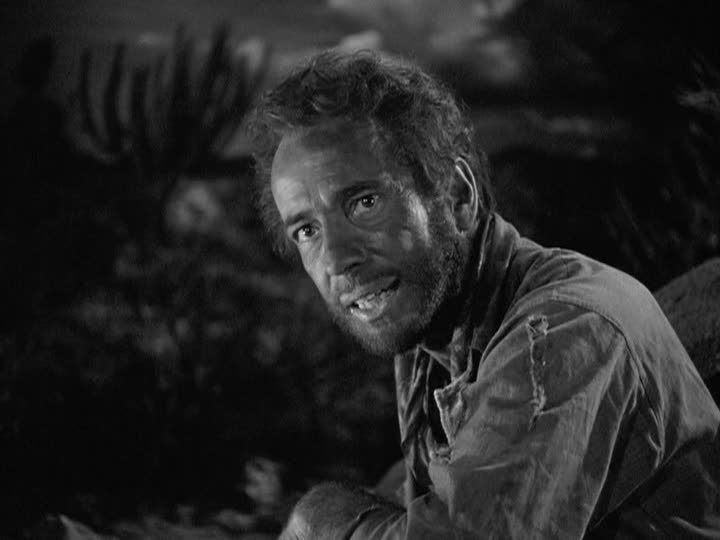
Dobbs is, essentially, the ugliest incarnation of a popular American icon, the rugged frontier iconoclast, striking out on his own to make his fortune. Huston completely undermines this figure, suggesting that his determination is far from admirable, and Bogart plays Dobbs with ratty, nervous energy: he's both hunched-over and wrapped up into himself. He's cruel and vicious, a hard contrast against the compassionate, righteous Curtin and the vivacious, doggedly cheerful Howard. As Howard, Walter Huston continually steals the show, infusing his character with a touch of the eccentric old codger charm of a Walter Brennan role, as well as a quiet dignity and decency that shows through especially in the scene where he tries to read the last letter a dead man had received from his wife, and keeps stumbling over the words but determinedly pressing on. He's at his best, though, in the film's final moments, when he reacts to tragedy and defeat with hearty, heaving gales of laughter, his body shaking, his mouth wide open, letting out gasps and howls of convulsive laughter. It's the only possible reaction to the unfairness and absurdity of what's happened, the way all his struggles and labor have led, ultimately, to nothing, at least in material terms.
For Dobbs, of course, such laughter would never be possible. He's too obsessed with money to ever laugh so genuinely over its loss. He's trapped by money, and trapped by the things it drives him to do. In one of the film's most memorable shots, Dobbs lies down for a guilty, sleepless night beside the campfire, and Huston has the flames lick up across the frame, obscuring Dobbs' face from view, swallowing him up. Dobbs is sentencing himself to Hell, to a self-imposed Hell of greed and perpetually unfulfilled desires. He can never have enough, and so he's devoured and cast aside, with no one to protect him and no one to mourn his loss.