Here's a friendly reminder that next Monday, on August 17, the next TOERIFC discussion will be taking place over at Fox's place, Tractor Facts. Fox has selected Rainer Werner Fassbinder's The Merchant of Four Seasons as this month's film, so anyone who's interested in joining the conversation should watch the movie and then stop by Fox's site on Monday for what's sure to be another productive, lively film club meeting. If you haven't participated in TOERIFC before, there's no formal membership or requirements other than a familiarity with the movie of the month. Anyone can participate, and we hope that lots of people will. So don't be shy: come by and join the conversation. See you there.
Tuesday, August 11, 2009
August 17: TOERIFC discussion of The Merchant of Four Seasons
Here's a friendly reminder that next Monday, on August 17, the next TOERIFC discussion will be taking place over at Fox's place, Tractor Facts. Fox has selected Rainer Werner Fassbinder's The Merchant of Four Seasons as this month's film, so anyone who's interested in joining the conversation should watch the movie and then stop by Fox's site on Monday for what's sure to be another productive, lively film club meeting. If you haven't participated in TOERIFC before, there's no formal membership or requirements other than a familiarity with the movie of the month. Anyone can participate, and we hope that lots of people will. So don't be shy: come by and join the conversation. See you there.
Labels:
TOERIFC
Monday, August 10, 2009
Frenzy
Alfred Hitchcock's penultimate film, Frenzy, was also his return to his native England after a lengthy absence. The familiar territory seems to have done him some good, as Frenzy is a self-assured, energetically made film. It's certainly an improvement on his previous two pictures, Torn Curtain and Topaz, undeniable low points in which the director seems to have been only sporadically engaged by his own material, demonstrating mere flashes of his previous brilliance. Which is not to say that Frenzy returns Hitch to the top of his form, but it does display his characteristic wit and verve, his morbid humorous streak and eye for striking compositions; despite the subject, one of the suspense master's darkest, Hitch actually seems to be having fun again.
Of course, this fun is problematic, since the film is about a sexual deviant raping and killing women in London. Hitch has a rather perverse idea of fun, and this is perhaps the film that most clearly displays his own deviancy: his ambivalence towards women, his simultaneous repulsion from and fascination with sex, his masochism towards his characters. In many ways, Hitchcock's own perspective on this material is best represented by the early scene in which a group of pub patrons discuss the "necktie murders" and speculate about what's going on. They're clearly excited and particularly interested in the sexual component of the crime. An elderly bar maid seems almost turned on when she asks a customer, "he rapes them first, doesn't he?" A pair of customers, meanwhile, trade quips about the murders before one of them concludes that the whole thing is good for tourism: "Foreigners somehow expect the squares of London to be fog-wreathed, full of hansom cabs and littered with ripped whores, don't you think?" One can sense Hitchcock's dry, morbidly blunt wit in these lines, and in many others like them scattered throughout the film. Not since The Trouble With Harry has Hitch joked so blithely about death.
But this is a much darker film than The Trouble With Harry, in which the titular corpse was merely an inconvenience for a group of easygoing country folk. Frenzy is decidedly more ambivalent about death: Hitchcock's gallows humor rubs uncomfortably up against some of the most startlingly violent sequences in his entire filmography, scenes reminiscent in their grim, realistic violence of the brutal farmhouse assassination at the center of Torn Curtain. The two different approaches to violence are apparent even in the very first scene, in which, after Hitch's roving camera pans majestically down the length of a London river during the credits, he takes up a vantage point looking down at a politician's speech. The speech, about purifying the river of its pollution and garbage, is interrupted when the body of a naked woman comes floating up to shore; the scene is both bitterly ironical and horrifying.
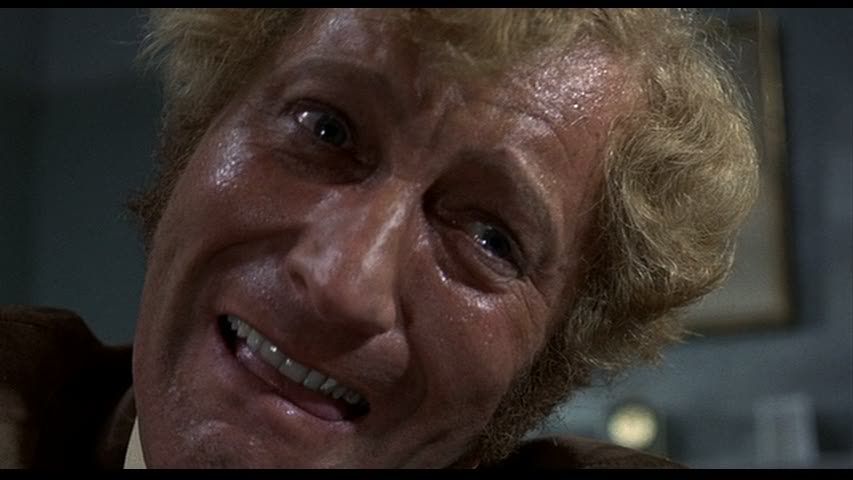
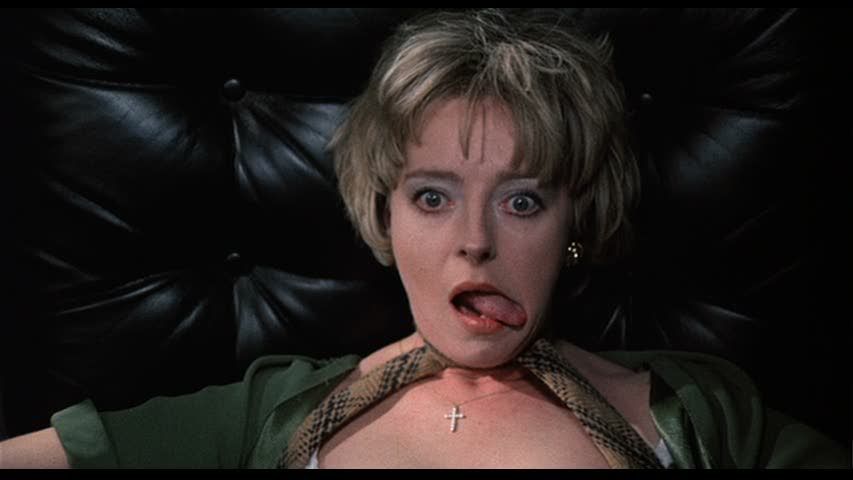
Later, there's certainly no trace of this dark humor in the scene where the necktie killer, Bob Rusk (Barry Foster) rapes and then strangles a young woman named Brenda (Barbara Leigh-Hunt). Hitch shoots the scene almost entirely in alternating closeups between the increasingly sweaty, contorted face of the killer and the dispassionate look on Brenda's face as she's raped, quietly reciting prayers and trying to distance herself from what's happening to her. The scene is horrifying, as much for its small details as anything: Hitch inserts closeups of Bob removing his victim's bra and then, later in the scene, another of her discretely covering up again, trying to salvage her dignity even in the midst of a rape. The actual murder is then filmed in tight closeups, cutting briskly between the killer's distorted face and his victim's gasping sputterings, her hands scraping at the tie wrapped around her throat. Hitchcock caps off this horrific sequence with a shot of Brenda's corpse, the tie still wrapped around her throat, her mouth gaping open with her tongue sticking off to the side. It's a cartoonish, grotesque image, following up on the queasy horror of the rape and murder itself, and visually it rhymes with the closeups of Bob during the murder, his tongue protruding slightly from between his lips in his excitement. The whole sequence is one of Hitchcock's most unsettling and explicit, replacing the artful misdirection of many of the master's earlier films — like the famous shower scene in Psycho — and instead forcing his audience to confront this violence directly: face to face, as it were.
In spite of the especially dark and lurid approach to the violence, in other ways the film is familiar territory for Hitchcock. It's a "wrong man" thriller, since the murdered Brenda is in fact the ex-wife of down-and-out former military man Dick Blaney (Jon Finch). Blaney is the focus of the film's opening, as he loses his job as a bartender, flirts with his girlfriend Babs (Anna Massey), and goes to visit his ex-wife, having several very public arguments with her that will, to say the least, look very bad when she's murdered the next day. Naturally, Blaney instantly becomes the top suspect as the necktie killer, and he goes into hiding while trying to figure out how to clear his name and catch the real murderer. Actually, though, in many ways Hitchcock seems to be only going through the motions of his usual wrong man storyline, perhaps because Finch is such a bland actor and Blaney such an uninteresting, unsympathetic everyman hero, a whiny jerk who treats the women in his life rottenly. Hitchcock seems much more interested in the charming but sinister Bob, who occasionally slips subtle misogynist comments into his conversations, indications of the inner darkness that otherwise only appears during his murders; mostly, he's a well-respected businessman, running a fruit stand where he chats amiably with everyone in the neighborhood.
Hitchcock also gets a lot of fun out of the Scotland Yard detective investigating the case, Inspector Oxford (Alec McCowan). This fine chap doesn't seem to do much actual policework, mostly just hanging around thinking and waiting for the solution to fall into his lap, which eventually of course it does. In the meantime, Hitchcock takes great delight in the inspector's domestic dilemma: Oxford's wife (Vivien Merchant) has developed a passion for gourmet cooking, and has stopped making the simple, substantial meals he enjoys, opting instead for bizarre delicacies like a grotesque-looking soup with huge chunks of black and tentacled seafood floating in its murky broth, or pigs' feet served in a creamy white sauce, or tiny little roast birds with virtually no meat on them. Hitchcock lingers over these odd, unappetizing meals, and the inspector's teeth-gritted reaction as he struggles to choke them down (or dispose of them otherwise) without indicating his displeasure to his wife. The food is baroque and ugly, and as he eats the inspector invariably discusses the particulars of his case, adding to the nauseating quality of these scenes.
Food and murder are also mixed memorably in an outlandish sequence in which Bob, after murdering a woman, realizes that she had grabbed a potentially incriminating tie pin off his jacket and still held it in her rigor mortis death grip. The trouble was, he'd just thrown her in a sack of potatoes and left her in the back of a truck, and when he goes back out to retrieve the pin, the truck driver heads off onto the road with Bob and the body still in the back. The scene is staged as an almost comic suspense sequence, which is interesting since it places the audience in the position of rooting for the killer to hide the evidence of his horrible crime. The driving score suggests suspense, but the action of the scene itself is absurd, as Bob digs through a bag of potatoes, trying to uncover the body, getting the stiff feet rammed into his face, scrambling among rolling potatoes, and finally finding that the girl's hand is wrapped so tightly around the pin that he has to actually break her fingers one by one to retrieve the evidence. It's just another example of how unusual Hitchcock's perspective on death is here: he certainly has no respect for the dead, no discretion, and his portrayals of death are messy and ugly and brutal, as well as somewhat silly. Maybe that's the point, that there's no dignity in death, no sense in appealing to "good taste" when it comes to such horrid things. Instead, he wallows in the ridiculous and horrifying aspects of these crimes, never flinching away no matter what happens.
Labels:
'1970s,
1972,
Alfred Hitchcock,
classic Hollywood
Sunday, August 9, 2009
Funny People
At this point in Judd Apatow's career, after three films as a writer-director and numerous other projects in which he's had varying input, it's obvious that, if nothing else, he has ambition and ideas far beyond just pumping out an endless stream of mainstream "dude" comedies with lots of penis jokes. Of course, that's what the Apatow comedy factory is known for, and certainly not without ample justification, don't get me wrong. But his films also have heart, and even sometimes soul. He's clearly interested in the thematic implications of his stories, and in the emotional arcs of his characters. His films are seldom just the raucous, foul-mouthed buddy comedies they're unfailingly advertised as, although none until now have been quite as challenging or unusual as his latest film, the Adam Sandler/Seth Rogen vehicle Funny People. None of this should suggest, though, that, ambition and heart aside, Apatow's films are entirely successful. Just because he has ambition doesn't mean he fulfills it onscreen. In fact, in three directorial features thus far, Apatow has still not made a truly great film, nor even a film that's good all the way through. What he does well seems to come only sporadically, mixed in with liberal doses of what he consistently manages to screw up: his incomprehension of female characters, his uneven sense of pacing, his increasing tendency towards bloat and excess (I breathlessly await his five-hour Michael Cera-starring awkward romance comedy). Funny People, his third feature, displays all these conflicting tendencies. In many ways it is his best movie yet, his most mature and smart, and yet it is also his most uneven and frustrating.
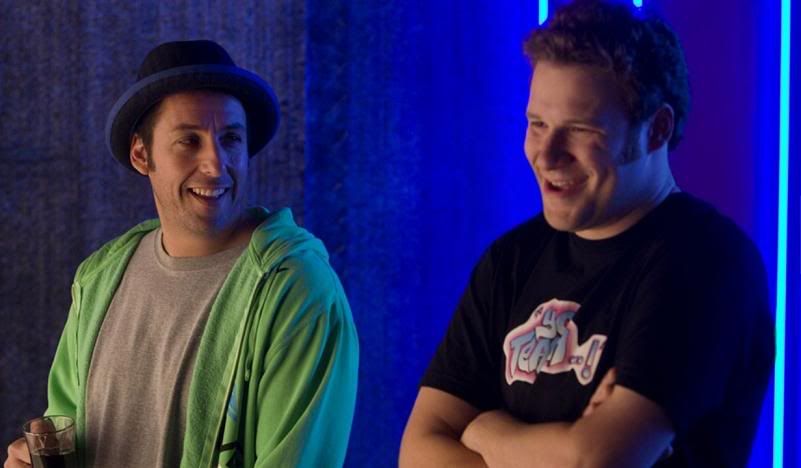
It's certainly his most serious movie yet, if only because of its subject. George Simmons (Sandler) is a popular comedian and movie star — with a string of very Sandler-esque awful hit movies behind him — who discovers that he is dying of a terminal disease, taking an experimental medication with only an 8% chance of helping him. After receiving this news, he goes back home to his tremendous and stuff-crammed house and watches images of himself on a wall of TV monitors: there are images from his goofy and ridiculous movies, but the images that touch him are the ones of him as a young, awkward, nervous comedian. In an attempt to recapture this lost youth, he begins returning to comedy clubs, doing stand-up again. He befriends the struggling young comic Ira (Rogen) and abruptly offers the younger man a job as his assistant, writing jokes for him, opening for him on tours, and generally just hanging out with him. George is a typical lonely, successful man, a man who feels that he has to pay everyone just to be around him — at one point, a band he's jamming with interrupts a song to quietly tell him they're into overtime now.
Of course, anyone who's seen this kind of movie knows that George's time with Ira will reawaken him to the pleasures of life when he was younger, the things he's lost track of with fame and fortune. Apatow's themes tend to be along well-traveled lines like this, but he treats these familiar emotions with such sincerity, such warmth, that it's affecting anyway. Sandler certainly helps, turning in the kind of sensitive, multi-layered performance that anyone who saw Paul Thomas Anderson's Punch-Drunk Love has known the comic was capable of. His ashen, deadened reaction to his confrontation with mortality is completely realistic, as is his habit of softening the blow with laughter. One of the best scenes in this respect is one in which a German doctor (Torsten Voges) with a voice like Werner Herzog tells George that he's dying and things are looking bad. George and Ira take the news silently, looking blankly back at the man, but they then dissipate the tension by mocking the doctor's accent, pushing off one another until they've both nearly forgotten the devastating news.
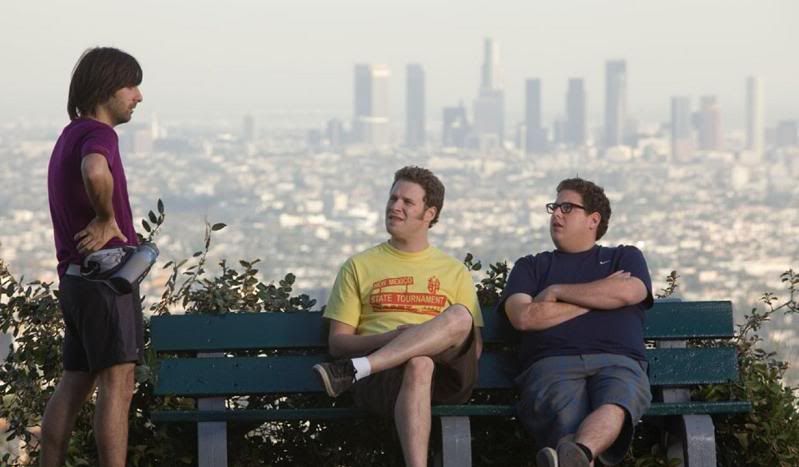
Scenes like this aren't exactly funny, but they're amusing and believable for the characters. Actually, the film is seldom just funny for its own sake: it's funny when the characters are funny, and just as often it elicits bittersweet smiles rather than outright laughter. It's a surprisingly low-key comedy, one in which the humor arises organically from long scenes of awkward pauses and uneasy banter, when a stray line will suddenly sparkle with the verve of great humor. It's no coincidence that the process of writing jokes is central to the film, that Apatow shifts fluidly between bullshit sessions in which George and Ira, or Ira and his friend Leo (Jonah Hill), will trade lines, and scenes of actual stand-up routines in which the jokes play off of live audiences. The humor is constantly in flux, constantly being polished and refined right there within the film. Perhaps the funniest moment in the whole film, though, is a cameo appearance in which Eminem asks Ray Romano if he wants to fuck, much to the chagrin of the man everyone's supposed to love. But it's telling that Slim Shady also dispenses some heartfelt words about fame, second chances and what to do with one's life. Fart and cock jokes aside, few things in this film are there only for the laughs; Apatow is purposefully working towards an examination of how the selfish, immature guys who are often the subjects of his movies can turn their lives around and learn to stop hurting those around them.
So that's the good stuff. Sandler and Rogen are great, turning in substantial performances, both funny and moving. It's also interesting to see an Apatow film in which, in contrast to the infantile wish fulfillment of Knocked Up and The 40 Year Old Virgin, his self-absorbed male character has to realize that he actually isn't the best thing for the girl he loves, that his second chance does not include a second chance with her. Ah, her. No one who's written about this film has been able to resist commenting on the utter misguidedness of the film's late detour into a romance between George and his "one who got away," Laura (Apatow's wife Leslie Mann). It truly is baffling. The film is at its best when it's a formless, nearly plotless, meandering exploration of the stand-up comedy milieu, peppered with cameos by a lot of comedians who are no longer in the public eye very much (including Paul Reiser, a typically abrasive Norm MacDonald, and Andy Dick amiably sending up his own persona). But at some point in this sprawling epic, Apatow decided he needed a more conventional plot, and so he has George and Ira go to visit Laura, who's now married to Clarke (Eric Bana), with whom she has two kids (played by Apatow and Mann's own young daughters). She's still mad at George for his habitual cheating on her twelve years earlier, which ended their relationship, though now she finds herself in the same position with her philandering businessman husband.
Quite simply, the film goes off the rails at this point. Mann is a decent comedic actress, but she just can't sell her character's enduring love for George, and the scene where she breaks down and expresses her love to him after all these years apart is just embarrassing. Worse, Apatow drags this extended sequence on and on and on... and on and on some more. There are countless outs, countless points where it seems like it's about to end, and then it just doesn't. It's seemingly endless, to the point that the film just stops dead, and all of the earlier threads are more or less dropped in favor of some tired drama cycling around Laura's marriage and children. Apatow loses track of important characters, especially Ira's entertaining friends Leo and Mark (Jason Schwartzman), as well as Ira's infatuation with a young comic named Daisy (Aubrey Plaza). This loose-limbed, unpredictable film at some point settles down into a trite romantic comedy, then a romantic drama, before the denouement finally (and belatedly) makes something interesting of George's romantic obsessions and the way he's blowing his second chance to make something substantial of his life.
All of this might not have been so unbearable if there was any sense that Apatow knows how to write a convincing female character, or that he really cares what the women in his films are thinking. But his script puts his poor wife through a thankless series of reversals and unbelievable emotions, asking her to construct a character out of a set of contradictory and inconsistent actions. There's nothing she could've done to make Laura, as written, an actual living, breathing person rather than a walking plot device to reflect George's maturation, or lack thereof. It's similarly apparent that Apatow has no idea how to make Daisy a vibrant, fully developed character on a par with the guys. Instead, he just has her tell vagina jokes to match the penis jokes of the men (Sarah Silverman, in a cameo as herself, does the same). For a film that is frequently so funny and real and moving, it's a shame that Apatow keeps sabotaging himself, shifting away from his strong points into maudlin, unconvincing romance. Funny People is not the great film that one senses Apatow may have in him someday, if he continues along his own path to maturity. It is, however, an interesting film, a daring attempt at a comedy that just isn't all that funny. As an experiment, it has to be considered a failed one, but there's enough substance and wit and real feeling here to make it worth seeing anyway.
Labels:
'2000s,
2009,
American cinema
Friday, August 7, 2009
Perceval le Gallois
Eric Rohmer's Perceval le Gallois must surely be a shock to those familiar with the French New Wave auteur's chatty, philosophical modern films. This deeply strange, idiosyncratic film is adapted from an unfinished 12th Century adventure poem by Chrétien de Troyes. The film follows the adventures of a Welsh youth named Perceval (Fabrice Luchini), who had been raised in isolation and ignorance by his mother following the deaths of his father and two brothers, all of them knights. His mother, wishing to keep her youngest and sole living son safe, ensured that he would never hear any stories of knighthood, knowing that if he ever heard of these adventures he would leave her. Sure enough, when Perceval one day encounters a procession of knights in the forest near his home, he is enchanted by their armor and weapons, amazed by their beauty, and he immediately sets out to become a knight himself. The story is standard, an Arthurian romance in which Perceval encounters various challenges, must right wrongs and woo damsels and fight duels, while learning about the world and the codes of chivalry and honor. He progresses from a callow, ignorant youth into a man of the world, mature and self-possessed, seeking to understand things and to correct his path when he does wrong.
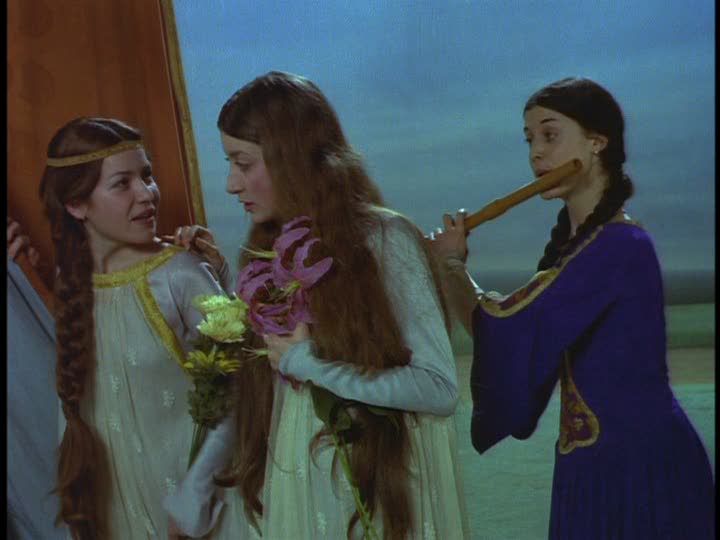
What makes the film so unsettling, however, is Rohmer's odd, heavily stylized treatment of Perceval's narrative. The film is set in a theatrical, patently artificial world, with no attempt at naturalism or realism. Perceval wanders on horseback across a cramped stage where the backdrop is a painted wash of muted blues to represent the sky. The trees in the forest are abstract sculptures, and the sets are wooden and tiny: entire castles and towns, coated in gold paper, are dwarfed by the horses. In order to convey the impression of riding for long distances, Perceval most often guides his mount in circles around the stage, and each time he comes across a new castle, it is obviously the same awkwardly built little construction with different banners hanging from the walls. The mise en scène deliberately undermines the narrative at every turn, creating a strangely magical artificial world in which the poetry of the narration takes on an otherworldly quality.
This narration too is unusual, mingling stylized poetic speech with gorgeous singing, set off against medieval orchestrations for flute and stringed instruments, along with occasional cymbal crashes and bird calls for sound effects. The film is populated with a roaming band of singers and instrumentalists — among them Solange Boulanger, Catherine Schroeder, Francisco Orozco, and flutist Deborah Nathan, and many others — who play various roles depending on the setting, justifying their presence at the fringes of the narrative. Their presence, and the film's metafictional structure, is more reminiscent of the contemporaneous films of Jacques Rivette than of Rohmer's other work. The characters often speak in the third person, prefacing their dialogue with "he said" or "she said." At other times, they sing stage directions and descriptions of action before speaking their lines. This frequent stylized disruption of the narrative gives the film a haunting, dreamlike quality. Rohmer's approach to this material privileges its medieval origins and its mythic grandeur, and yet he doesn't try to realistically recreate the time in which it is set. Instead, his film gives the impression of antiquity while always maintaining a modernist perspective on the past, a slyly ironic sensibility that stands aloof from Perceval's story, observing from the distance of several centuries.
This is most readily apparent in the film's absurd little improvisational touches, like the way Perceval, riding nobly off into a painted sunset, is forced to duck to get under an overhanging tree, or the way, during one of his many fights, he has to quickly adjust his crooked helmet to push its central cross-beam back into place. There's something endearingly rough and loose about this film, in the way its narrative skips around from place to place without regard for continuity, eliding long stretches of time and important details. The narration sometimes comically comments on what it's leaving out, particularly when the original text leaves out a description of a feast Perceval enjoyed one night: Rohmer shows the table being set up, but then his camera pans away to a servant, who says that he will not describe what was eaten, since the tale says only that they ate well. The fights too are incompletely described, and the sung narration wittily apologizes for this fact with a rhetorical question: "They fought at length/ I could describe each blow/ but is it worth your time and mine?"
Obviously, this is far from a conventional Arthurian romance, since Rohmer makes no attempt to smooth out the bumps in the original poetry's incomplete narrative. Late in the film, the story shifts, without explanation, to an account of the adventures of Sir Gauvain (André Dussollier) as he tries to clear his name of a false accusation. If Perceval's story is about a selfish, arrogant youth maturing and learning about life, Gauvain's tale is of an already-mature and good-hearted man retaining his good nature even when everything seems to conspire against him. The narrative leaves Perceval behind without fanfare and follows Gauvain until it reaches what seems to be a climax: he's trapped in a city whose inhabitants mistakenly believe he killed their king, and he's facing an angry mob intent on getting revenge. Here, Rohmer abruptly cuts away, in the middle of a clearly unfinished scene, and returns for a short time to Perceval, before again detouring into a stylized, theatrical staging of the death of Christ.
Rohmer's strategy of discontinuity here is almost academically faithful to the original text, which was left unfinished upon Chrétien's death, and later added to by other poets. Both central stories, of Gauvain and Perceval, are left incomplete, cut off at pivotal moments, with Gauvain facing a horde of angry peasants and the prospect of either clearing his name or losing his life, and Perceval facing a moment of possible spiritual redemption. Neither knight gets to complete his arc, neither gets to fulfill his destiny by playing out the remainder of his undoubtedly heroic story. This abrupt ending leaves Perceval in an especially perilous place as a hero. He is a decidedly ambiguous character, in many ways rather foolish and brutish. His youthful inexperience and lack of knowledge about the world sometimes causes him to behave awfully, as when, early on in the film, he misunderstands his mother's advice about the proper way to treat maidens, and forces himself upon a young woman (Clémentine Amouroux), kissing her and stealing her ring.
Throughout the film, scene by scene, he begins to learn more about the ways of the world and the proper behaviors for a "worthy man." A nobleman (Raoul Billerey) teaches him about the virtue of silence, the finer points of combat, and also about mercy and compassion for a knight who loses in battle. The nobleman's lovely niece, Blanchefleur (Arielle Dombasle), teaches Perceval about love, about how to defend a woman and also how to romance her, how to love her. A supernatural experience in a vanishing castle teaches him that sometimes, what's good advice in one situation might not serve him well in another — taking his mentor's advice too literally, he errs by staying silent when he should have spoken. These incidents each advance Perceval's maturation, and yet the film cuts off at a point when he has just realized how badly he has neglected his spirituality, and also how badly he has treated his loving, grieving mother, who died when he abandoned her. The film leaves Perceval forever stuck at a moment of indecision and penitence, trapped between youthful ignorance and full adulthood.
This story of arrested maturation is off-kilter and often goofy, shot through with low-key humor, particularly in the giggling asides of the singing servants who comment on the main action. There's also a raw poetry to Rohmer's idiosyncratic approach, a strange beauty in his flat, stylized imagery. In one of the film's most arresting and unusual sequences, Perceval is riding through a stark white, snow-covered plain, framed in his red armor against a gray sky, through which flies a flock of animated birds. Rohmer cuts briefly to an animated closeup of one of these birds, wounded and bleeding into the snow. The marks it leaves behind, three bright red spots on the white ground, remind Perceval of his beloved Blanchefleur, and the abstract bloodspots fade into an image of her face, one spot the bloody smear of her lips, the others the color on her rouged cheeks. It's a haunting silent interlude, a reverie of love and longing, and the sudden intrusion of traditional animation into the film's theatrical world is another of Rohmer's disjunctive techniques. What's striking about the film in moments like this is how emotionally affecting it can be despite its arm's length distance from its material, its artificial sets and textual fidelity. Rohmer has created a romantic fantasy of startling clarity and ethereal beauty.
Labels:
'1970s,
1978,
Eric Rohmer,
French cinema,
musicals
Subscribe to:
Posts (Atom)