[This review has been cross-posted at Decisions At Sundown, a blog started by Jon Lanthier and dedicated exclusively to the Western genre. From now on I will be cross-posting all of my Western reviews with this blog, where I am one of several contributors.]
Howard Hawks'
Rio Bravo is the pinnacle of the director's late style, in which he increasingly stripped his films down into ambling, nearly plotless examinations of his signature themes and the interactions of his characters. Hawks' cinema was always more about relationships than stories: relationships between male friends, between men and women getting to know one another, between professionals working on dangerous jobs together.
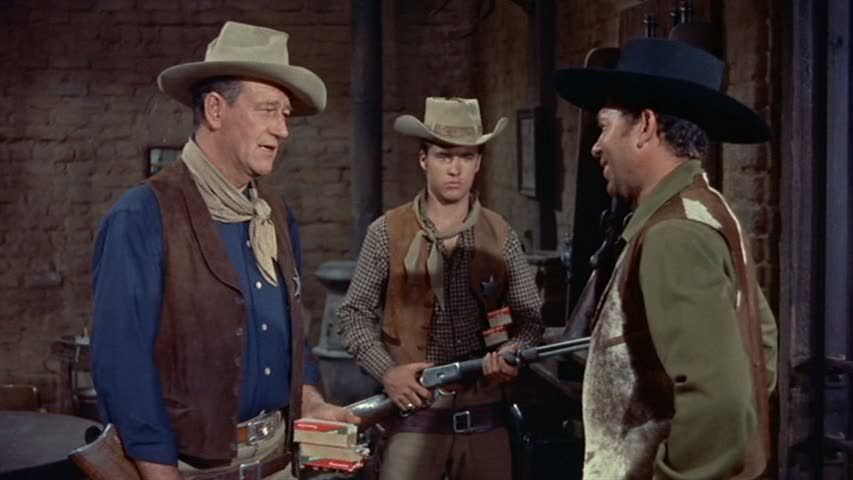
Rio Bravo is about all these things, and as in much of Hawks' other late work, all the extraneous stuff, like the narrative, is pared away to focus more directly on these relationships as they develop and change. The plot itself is utter simplicity. Small-town sheriff John T. Chance (John Wayne) arrests Joe Burdette (Claude Akins), the brother of the notorious outlaw Nathan Burdette (John Russell). Chance holds Joe in the town's tiny jail, while Nathan schemes to break his brother out. The film was famously inspired by Hawks' well-known hatred of Fred Zinnemann's
High Noon, in which Gary Cooper's small-town sheriff must plead with the unwilling townspeople to help him face off against an outlaw who's coming for revenge. The macho Hawks obviously despised this show of weakness, and conceived of Chance as standing virtually alone against the encroaching outlaws, aided only by a motley assortment of true friends: the drunken former deputy Dude (Dean Martin), the old cripple Stumpy (Walter Brennan), and eventually the quick-shooting young Colorado (Ricky Nelson).
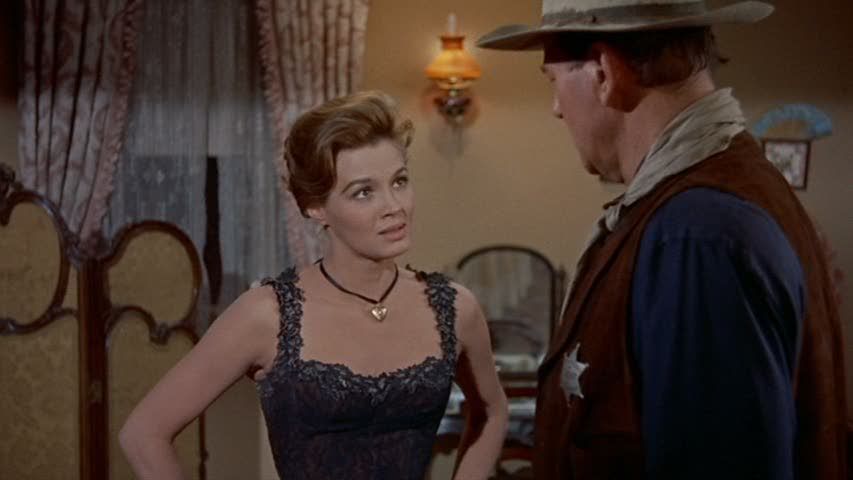
From this slight material, an archetypal white hat/black hat story, Hawks developed one of the great works of cinema. His patient pacing allows plenty of time for the character arcs to develop naturally. Dude was once a proud, tough man, brought low by a woman and reduced to a pathetic drunkard, memorably introduced in the opening scenes stooping to pick up a coin that a man throws into a spittoon for him. Throughout the film, he struggles with his alcoholism, trying to regain control of himself, to reassert his dignity and intelligence and bravery, as well as his formidability with a gun. Chance is, in comparison, a bedrock of stoic self-confidence and moral rigor, though Hawks emphasizes that he's merely human too by including all of the fumbling, awkward love scenes with Angie Dickinson's ambiguous bad gal Feathers. These scenes play off of Wayne's own obvious discomfort in romantic scenes, infusing a layer of metafiction into each of them: is Chance thrown off balance by Feathers, or Wayne by Dickinson? Seemingly the only thing that can ruffle Wayne's drawling onscreen persona, pushing him out of his comfort zone, is the presence of a pretty girl, a fact Hawks would take advantage of again in
Hatari!, to equally amusing effect.
There's a lot more going on in this film, too, even as virtually nothing actually happens. The film simply rambles along, the connective tissue between set pieces often consisting of lengthy scenes where the characters just sit around and shoot the breeze. Much of the film takes place in the tight, constricted space of the jail, where Hawks is comfortable filming tight, constricted compositions crammed with people. The joy of the filmmaking is palpable in every frame; there are few Hollywood movies that are so relaxed, so carefree. Watching
Rio Bravo feels like spending a few hours on the set with Wayne, Brennan, Martin and Nelson, hanging out, cracking jokes, sparring sometimes in jest and sometimes in earnest, shifting between the two so smoothly that it's hard to tell when the characters' jokes bleed over into genuine hurt. The film is packed with incident, but somehow it never seems to add up to a real forward-moving plot, perhaps because the whole film is based around stasis: it's a waiting game. That's what gives it its unique charm.
The easygoing pace also allows Hawks the time to examine his themes and characters in depth, with subtle touches rather than broad gestures. There's surprising nuance and emotion in set pieces like the one where Stumpy nearly blows off Dude's head when the latter enters the jail unexpectedly. On its face, its a comic bit of action, a near-miss that the men can laugh about because it wasn't a hit. But it also lays bare some of the deeper emotions at the core of the story. Stumpy doesn't recognize Dude to begin with because the former drunk has cleaned up and gotten sober, has taken a bath and donned some new clothes, replacing his old threadbare, filthy rags. He looks like a real man again, and Stumpy, accustomed to seeing him as a ragged beggar, doesn't even realize it's him. It mirrors the earlier scene where the rancher Pat Wheeler (Ward Bond) doesn't recognize Dude because he'd never seen him sober before. Underneath the violent humor of the incident, there's this poignant undercurrent, as Dude is reminded yet again of how far he'd fallen, while Stumpy, behind his ornery chatter, is horrified by what he almost did to his friend.

Hawks treats these complex emotions seriously, but he never allows them to truly overwhelm the film's surface charm, its low-key wit and humor. After all, this is a film in which, at a pivotal moment, the characters decide to take a break and have a good old singalong, showcasing the star voices of Nelson and Martin. It's a wonderful moment, a perfect indication of the film's total commitment to its anti-narrative languor: when the tension is at its peak, the final showdown approaching, the characters break out into not just one but
two folksy songs in a row, as though they had all the time in the world. Dude is lying on a cot with his hat shading his eyes, Colorado plays the guitar, and Stumpy hollers and plays the harmonica, all while Chance looks on, smiling benevolently, too stiff to join the fun but not to enjoy it. Indeed, one would have to be pretty stiff not to enjoy this film, which encourages the audience to revel in the sparkle of the dialogue and the ways in which the charming personalities of these likable actors blend seamlessly into their characters. Hawks, though he appreciated fresh faces too, was always adept at using star personalities in interesting ways, zeroing in on the essence of an actor and channeling that into his or her onscreen persona.
Here, the confined space of the jail allows Hawks to play these personalities off of one another, ricocheting Brennan's manic grouchiness off of Martin's slouching, half-speed delivery, while Nelson's boyish confidence resonates as a nascent version of Wayne's mature persona, his unflappable manliness. The film juggles these different personalities admirably, and the film's tone shifts smoothly between comic patter, hesitant romance, slow-building suspense, and action. Indeed, despite the laidback pace,
Rio Bravo boasts some exceptional action sequences, not only the justifiably famous final shootout, in which Chance and his allies finally defeat the bad guys with dynamite, but also an earlier scene in which Chance and Dude track an assassin to a saloon filled with Burdette's men. This scene is formally precise, rigid in its geometry and use of the bar's space. It's through angles that Chance and Dude control the room, lining up the men at gunpoint in a straight line on one side of the room. The way Hawks frames this scene emphasizes how the two heroes remain on opposite sides of the room, both angled towards the disarmed bad guys, forming a triangle with the bar at its base and its point balancing on the line of criminals. The scene's denouement, in which Dude discovers the hiding assassin by noticing the man's blood dripping down into a glass of beer from above in the rafters, is similarly precise in its formal mastery.
For all these reasons and many more,
Rio Bravo is one of Hawks' most sublime achievements: it's more like an old friend than a film, a familiar place to visit and revisit over and over again, always enjoying the company and the ragged charm of its storytelling.

 Todd Haynes' Safe is a creepy, oblique horror movie about the horror of the "normal" life. It's a horror film in which there is no creeping monster behind the sedate suburban façade, no locus of evil that preys on the frazzled housewife Carol (Julianne Moore). The suburbs themselves are the source of the horror here: the ornately empty houses, the bored chatter of housewives with no real interests and nothing to talk about, the antiseptic routines of daily life, the lack of connections even to her own family. For the gay Haynes, straight existence itself is terrifying, a hellish, deadened nothingness with few escape routes. The first half of this film, in which Carol is isolated within her own palatial home as though stumbling in a narcotic daze, is a kind of warm-up for the pastel-colored Sirkian mise en scène of Haynes' Far From Heaven, in which he channeled Sirk's brightly colored vision of suburban Americana and the social ills lurking underneath. Safe is more oblique than both Sirk himself and than Haynes' later Sirk pastiche. There's something chilly and suffocating about this film, in the weirdly distanced interiors, so carefully set-decorated and lit, their precise geometric contours and patterned colors isolating Carol within a space where nothing betrays a hint of life or motion or vitality. Haynes' camera simply sits at a distance, observing stoically as this ordinary woman comes apart at the seams, becoming convinced that her very environment is trying to poison her.