Monday, February 1, 2010

The Darjeeling Limited


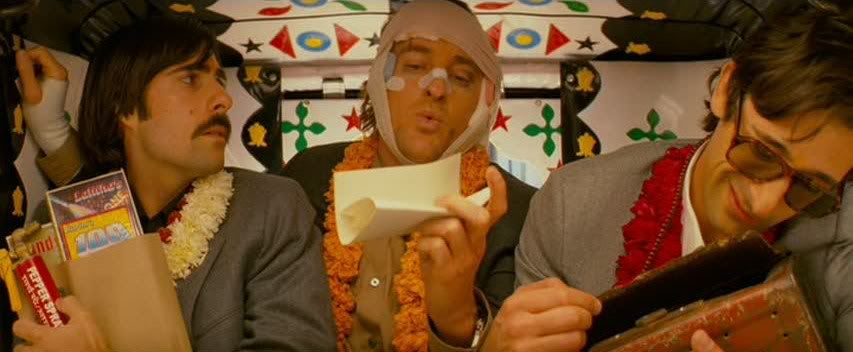
The Darjeeling Limited, Wes Anderson's fifth film, is built around a metaphor so blunt and on-the-nose, so obvious, that it's either ridiculous or brilliant. A trio of brothers — Francis (Owen Wilson), Jack (Jason Schwartzman) and Peter (Adrien Brody) — have been feeling lost and aimless following the death of their father. They meet up a year later in India, taking a trip around the country while lugging around the huge collection of luggage left behind by their father after his death and divided amongst the three brothers. Yes, they're carrying around the baggage of the past, the baggage that represents their relationship with their father, with their distant, flighty mother (Anjelica Huston), and with each other. It's fairly naked symbolism, handled with Anderson's characteristic wit and attention to detail. The luggage — all matching pieces in orangish brown with fanciful designs and their father's initials embossed on the cover — stands for everything that's preventing these brothers from functioning properly, as people or as brothers.

Jack is plagued by a troubled relationship with his ex-girlfriend (Natalie Portman), whose continuing hold on his mind and emotions is demonstrated in the short film, Hotel Chevalier, that serves as "part one" of The Darjeeling Limited. Peter is running away from his pregnant wife, afraid to face the responsibility of fatherhood even though he says he loves his wife; it's obvious that he's been scarred by his experience of family life and doesn't think he can handle a new family of his own. Francis, for his part, got in a car accident and spends the entire film in bandages; he lets slip only late in the film, in that typically offhand Anderson way, that he crashed on purpose, meaning to kill himself. Before that, he takes his bandages off and observes his still scarred face, dryly noting, "I guess I still have some healing to do." It's the kind of dual-meaning line that is perhaps a little too pat, a little too direct in its resonances. Like the use of the dead father's baggage as a metaphor for, well, baggage, lines like this make the film's themes — recovering from the past, the wounds caused by family, the struggle to come to terms with one's self — seem like Hallmark sentiments, too cute and clever to really cut deeply the way Anderson no doubt intends.

That's an accusation lobbed at Anderson's cinema in general, of course, but The Darjeeling Limited seems to take this particular aspect of his work to an extreme that's a bit hard to take. When the three brothers try and fail to save an Indian boy from drowning in a river, it's a turning point in their relationship and in their vision of themselves, a moment when they finally experience something beyond themselves, beyond their egocentric fascination with their own small problems. It should feel monumental and sad; instead, at the funeral for the boy, Anderson shoots the three brothers walking in slo-mo through a scenic panorama, while a jaunty Kinks tune plays on the soundtrack. It's a favored device for Anderson, whose use of music is generally impeccable, but here the tone is all off. He doesn't seem to have the gravitas to handle a moment like this, which is odd from the director who treated the attempted suicide of Luke Wilson's character in The Royal Tenenbaums — set to Elliott Smith, a perfect choice — with a raw energy and intensity that is much missed here. None of this film's characters or situations have that same weight or impact, perhaps because they too easily descend into the kitschy, finicky excesses that mark Anderson's worst moments as a director.

None of this is to say that The Darjeeling Limited is a complete failure, because it's far from it. It's simply the first Wes Anderson movie where the long-held complaints of his detractors seem appropriate. The movie is never less than enjoyable, but it's also a bit hollow, a bit superficial, especially in its treatment of the entire country of India and all its people as a symbolic background onto which these troubled white men can write their own problems and insecurities. To some extent, the film mocks this kind of outlook, particularly in the way the obsessive, detail-oriented Francis plans out an entire step-by-step itinerary for their supposedly spiritual journey. It's like they see the route to enlightenment and self-fulfillment as a process that comes with written instructions, that they can simply follow the steps and they'll be reborn. India is thus just a background for them, a symbol of purity and spirituality, a whole country that they can use to help them become better people. It would be a potent critique if Anderson wasn't often guilty of the same thing, using the scenery and the people as props, especially in the funeral scene, in which the death of this boy merely serves as a way of forcing these brothers, finally, to deal with the death of their father, whose funeral is intercut as a flashback into the funeral of the Indian boy.

Still, The Darjeeling Limited does have many of the charms and pleasures of Anderson's better work, as his usual eye for detail results in many subtle interconnections. He uses objects to probe character and set up events better than anyone, as in the scene where the three brothers begin buying things at an outdoor market, and these objects (Peter's shoes and snake, Jack's mace) resonate throughout the rest of the film, triggering various incidents and adding to the richness of the film's texture. The film is centered around objects, and some of the best scenes involve the brothers bickering over the things their father left behind. Peter, in his grief, has been gathering up various small reminders of their father and using them for himself: sunglasses, a razor, a lighter. This doesn't sit well with Francis, who keeps making a gift of and then demanding back a ridiculously expensive belt which Peter finally throws at his brother's already-wounded face. The scene culminates in a hilarious, out-of-control, nearly slapstick chase/fight when Jack gets some use out of the pepper spray gun he'd bought in the market.

Anderson also gets a lot of comic mileage out of Jack's writing, which Jack insists is fictional even though his brothers read it and recognize direct autobiographical accounts of their own lives. This pays off at the end when Jack reads aloud from a story that, in fact, is a direct translation of some dialogue from Hotel Chevalier, and he finally admits that his stories are factual. Like most of Anderson's best moments, it's both funny and poignant, a reflection of this character's continuing obsession with the past. It's also one of several callbacks that more or less validates the function of the slick Hotel Chevalier, which doesn't stand alone from its companion film very well at all. There's definitely an undeniable kick, though, when Jack in Darjeeling Limited turns on his iPod to a certain Peter Sarstedt tune that is, apparently, his seduction music of choice.

This film suggests how thin the line is in Anderson's cinema between deeply felt emotionalism and a mere accumulation of mannered tics. The Darjeeling Limited crosses back and forth across that line several times, occasionally mining the same moody, complicated depths as Anderson's other features, but more often coming across as a shallow imitation of his best work.

Thursday, January 28, 2010

The White Ribbon


Michael Haneke's The White Ribbon, his first German-language film since his original Funny Games from 1997, is a searing, enigmatic allegory, a depiction of horror and cruelty overtaking a small German town on the eve of World War I. The film is powerful and quietly moving, slowly building a sense of pervasive dread as the town's routine business is disrupted by explosions of horrifying violence and brutality, by incidents that expose the everyday nastiness lurking beneath the rural calm that the town presents on its surface. What makes the film so effective as an allegory is that, as in Caché, Haneke withholds all easy answers and all resolutions; the film is a mystery with no solution, leaving its ultimate meaning to the viewer. It is also perhaps Haneke's most emotionally rich film, built around a large cast of complex, ambiguous characters, people beaten down and made cruel by the harsh surroundings and morally fallow ground of the countryside.

The film is an angry indictment of the hypocrisy and violence that resides within these seemingly decent folks, many of whom are obvious symbolic stand-ins for various social institutions, all of them equally corrupt: the aristocracy, the proletariat, the church. The Pastor (Burghart Klauβner) might preach decency and goodness in mass every week, but with his own children he is a brutal disciplinarian who reacts to the slightest infraction with hands-on correction. When his oldest children Klara (Maria-Victoria Dragus) and Martin (Leonard Proxauf) are late for dinner one night, he responds by sending all the children to bed without dinner and delivering ritualistic whippings the next morning. He also marks the kids with the white ribbons of the title, which are symbols of purity and innocence to continually remind them of the qualities they should aspire to. This man of God is obsessed with his abstract values, but in putting them into practice he's cruel and intractable, refusing to understand whatever's going on behind his children's blank, mysterious faces. The town doctor (Rainer Bock) is even worse, a nasty man with all kinds of secrets lurking within his home. He's sexually abusing his young daughter, who he creepily insists looks just like his dead wife, even as he's also having sex with his matronly midwife (Susanne Lothar), who he treats with contempt and outright cruelty, scorning her love.


Meanwhile, the Baron (Ulrich Tukur) and Baroness (Ursina Lardi) are aloof from the others in the town, projecting an aura of privilege and exploiting the labor of the commoners — they send one woman, too weak to do heavy harvesting work, into a dangerous area of a sawmill, where she falls through the rotted floor to her death. This is only one of the horrifying incidents that begin to affect this town, as the people's behind-the-scenes petty cruelties and domestic evils are written onto the very surface of the town, in one public spectacle after another. The doctor's horse is tripped by a thin wire and the Baron's son Sigi (Fion Mutert) is hung upside down in a barn and beaten badly, among other tragedies and acts of violence, all of them utterly mysterious, none of them ever solved. It is as though the people of the town are finally revolting against the brutality and indifference they experience behind closed doors every day. It is never clear if there is one perpetrator behind all these crimes, or if they are each the products of specific vengeful quests. As in Caché, Haneke leaves the mystery's solution fuzzy because the "who" matters far less than the symbolic import of these acts. As in Caché, the mystery here is not a matter of plot and action but an internal mystery, a mystery of the soul, a mystery about how violent acts are passed down through generations and how the chain of violence might be broken if only one generation would refuse to continue the cycle.

Often, these crimes are committed against or involve the town's young, who are affected in various ways by the sins and violence of their elders. This is the film's central thrust, the ways in which innocence is corrupted or destroyed in the presence of evil, a struggle that is far less abstract for Haneke than it is for the town's Pastor. All of the town's children are wounded by the older generation. Some of these kids maintain their innocence and innate goodness. The pastor's youngest son is a sweet, caring boy who takes in a wounded bird and agrees that after he heals it, he will set it free, even though the prospect obviously makes him sad — and then, when his father's bird dies, he offers his own as a replacement, a selfless act that seems to move even the unshakable priest. The doctor's young son is a similarly angelic young soul, who when his father is injured packs up his clothes and sets off on a journey to see his dad in a nearby town. The midwife's son Karli (Eddy Grahl) is another avatar of innocence and purity, and he has to suffer because of it, beaten and bloodied merely because of his guileless lack of the corruption that flows through so many of the town's other inhabitants, adults and children alike. Another child who suffers in innocence is the steward's daughter Erna (Janina Fautz), who says that she has precognitive dreams of horrible things about to happen; when she predicts the beating of Karli, the police hound and question her, believing that she knows who did it, causing her to break down in frustrated tears.

While many of the town's children represent purity and goodness in this way, there are others for whom the corruption of their parents seems to weigh heavier. Martin and Klara, certainly, are haunted by the great demands placed upon them by their religious father. In one of the film's most telling — and darkly humorous — scenes, the Pastor confronts Martin, who is increasingly looking sickly and depressed, his eyes ringed with black, his face sunken in and his eyes skittish. The Pastor responds by telling the boy a lengthy story about another boy who showed many of the same symptoms, eventually broke out in boils all over his body, and died. And what caused this, the priest asks? The boy was exciting his "nerves" in a forbidden place, of course, a ludicrous euphemism for masturbation. The scene would be hilarious if it weren't so depressing, if the Pastor didn't display such a profound ignorance of his son and such disinterest in actually getting to the bottom of what is obviously bothering the boy. Instead, he responds by tying Martin to his bed every night, so that he can't touch himself in the night. Could this really be what was bothering Martin, this guilt over masturbating? Or was he haunted by something darker and more real, something his father will never be able to understand or even glimpse because his mind is too fenced-off? The Pastor is too rigid in his ideas about sin, discipline and self-control to even imagine having a candid conversation with his children about anything.


These are the questions at the core of The White Ribbon: how guilt and sin flow through generations, affecting the young and innocent in unpredictable ways, sometimes corrupting their decent souls and sometimes simply injuring them, scarring them in ways likely to echo throughout their lives. Haneke's basic theme here is that innocence can't last, that goodness is ephemeral and quiet in comparison to the overpowering darkness of violence and hatred. The doctor's son, early in the film, asks the midwife about death, and with wide eyes listens as she bluntly tells him, trying to dull the impact by repeatedly stressing that this will happen only in "a very long time." He gets the idea anyway, and his awareness can't be taken away from him; he understands things with a new completeness, instantly getting that the stories about his mom being away on a trip had simply been a euphemism for this new concept called "dead."

The film is unrelentingly bleak and sad at moments like this, capturing the dawning of understanding and the accompanying loss of innocence; Haneke laments this loss, and treats it as a richly emotional moment. Only the film's narrator, the local schoolteacher (Christian Friedel) and his fiancée Eva (Leonie Benesch) are ultimately able to maintain their innocence and goodness. They aren't showy about it in the way of the Pastor, but they are moral and chaste in all their interactions, possessed of a basic deep-down goodness that sets them outside of the town's horrors, and outside the horrors of history as well, their simple romance unshaken by the reverberations all around them. As the narrator, the teacher's sporadic voiceover steps in to position this story as a thing of the past, and thus as a lesson about the present — but a lesson whose meaning isn't necessarily clear. The film would be nearly unbearable if not for Haneke's suggestion, in the story of these two characters, that there is light and goodness within all the darkness, that there are those who remain unstained by the bloody crimes happening all around them.

Haneke's dark wit also leavens the grim mood, revealing itself in subtle ways throughout the film, particularly in his cutting. At one point, as the teacher romantically plays the organ for Eva, Haneke cuts him off in mid-note and abruptly cuts to a farm scene, with a pig squealing on the soundtrack, dissonantly continuing the music. Even better is the moment when, after Martin confesses to his father that he was masturbating — more out of resignation than because it's actually the truth, most likely — Haneke cuts immediately from the boy's downturned face to the doctor in mid-orgasm, having disinterested sex with the midwife. These bleakly humorous transitions characterize this film, which maintains Haneke's general wry, distanced observation of his characters' follies and cruelties. He captures their misery and brutality in stark black and white, leaning towards washed-out whites in many scenes, giving the film a very clean, crisp, wintry atmosphere, best portrayed in several shots of snowy whiteout landscapes, as pure and untouched as a child's conscience. The film's bleak aesthetic and emphasis on long takes — a funeral plays out entirely in a single wide shot, a horse-drawn carriage waiting in the snow to pull the coffin — recalls the cinema of Béla Tarr, one obvious reference point for a film that's both completely Haneke and also something of a departure for him.

Monday, January 25, 2010

4 Adventures of Reinette and Mirabelle


The title characters of Eric Rohmer's 4 Adventures of Reinette and Mirabelle can be seen as Rohmer's incarnation of his New Wave contemporary Rivette's Celine and Julie. Reinette (Joëlle Miguel) and Mirabelle (Jessica Forde) are, in fact, the Celine and Julie of the mundane. Their "adventures," divided into four segments as the title suggests, are not fantastical or magical, as in Rivette's film, but prosaic. If Rivette's film is all about wonder and fiction, about playing games and going to the cinema to experience (and manipulate) stories, Rohmer's film is about the more ordinary adventure of forming and keeping friendships. In the first of the film's four segments, Reinette, a painter living alone in the country for the summer, first meets Mirabelle, a student from the city whose bike has a flat. Reinette repairs the flat and the two girls slowly become friends as they spend the next several days at Reinette's rustic home. While there, Mirabelle learns about farming and country living, and the girls try to wake up just in time for the so-called "blue hour," the single moment every morning when there is total silence. This conceit, in which the natural world provides nearly spiritual catharsis, is reminiscent of the driving force behind The Green Ray, in which the heroine's romantic quest is symbolized by the desire to glimpse a fleeting phenomenon that sometimes occurs just at sunset.

Although Rohmer transcribes the basic set-up of Celine and Julie Go Boating from the mystical territory of Rivette's film, Rohmer does preserve the sense of charm and humor that characterized his obvious influence. His heroines are bright, pretty young girls whose adventures are always light-hearted and marked by a sense of fun and playfulness, and above all by an openness to the possibilities that present themselves. Each of these four segments revolves around a new set of ideas, a new set of opportunities for these girls to interact with one another and the world around them in ways that reveal and explore their conflicting moral perspectives and priorities. Rohmer is examining the ways in which, from a common bond of friendship and affection, these new friends probe their different outlooks on life and morality. It's a typical Rohmer subject, starting from the dawning of a friendship and then revealing, in one incident after another, just how different these girls actually are in how they think about the world and each other.


In the film's second segment, Reinette has taken Mirabelle up on the latter's offer to come to Paris as her roommate while Reinette enrolls in art classes. It's the film's most straightforwardly comic segment, as Reinette has to deal with a rude waiter (Philippe Laudenbach) whose patter and arbitrary restrictions are absurd and frustrating. Reinette tries to pay him, but she only has a large bill that he insists he can't break — and since she doesn't have anything smaller, he treats her as though she's unable to pay, trying to stiff him, and even suggests that she was the same girl who had run out on him without paying on a previous day. This is especially maddening to Reinette, because as it emerges throughout the film, one of the principal differences between her and Mirabelle is the two girls' respective attitudes towards regulation, justice and order. Reinette seems to believe, implicitly and unquestioningly, in the rightness of the law; she believes that bad acts will/should be punished and that goodness will be rewarded, and that the rules should always be followed. Mirabelle, on the other hand, is more of a free spirit, unconstrained by such restrictions and aware that the world is often unfair, that Reinette's clichéd certainties don't always pan out. Lacking her friend's faith in justice and rules, she doesn't feel that same obligation to law and order. So while this is a genuine dilemma for Reinette, once Mirabelle arrives, the answer seems simple to her: the waiter is a jerk, so the girls take off, with Mirabelle in the lead dragging her friend along.

This theme, the subtext in this comic tale about the waiter, comes to the fore in the third segment, in which the two girls encounter panhandlers, swindlers and a kleptomaniac. These incidents provide the friends with an opportunity to discuss doing good, punishing bad, and the proper way to deal with breaking the rules. The central incident of the story is Mirabelle's observation of a shoplifter (Yasmine Haury) at a local market. Rohmer takes an interesting approach to this incident, first showing it in a wordless sequence as Mirabelle follows the shoplifter and the two store security personnel (cameos by filmmaker Gérard Courant and Rohmer favorite Béatrice Romand) who are keeping an eye on her. It's wonderfully staged, with a keen sense of comic timing as the shoplifter is trailed by the store guards who are in turn trailed by the curious Mirabelle, all three groups walking across the frame in sequence through the market's aisles. Mirabelle then recounts the whole story to Reinette — including the part where she cleverly helped the shoplifter get out of the store without getting caught, although she was then unable to give the woman back her ill-gotten goods. The scene essentially plays out twice, once visually and once in words, so that Rohmer can show the reactions of Mirabelle (bemused) and Reinette (horrified) to this anecdote.

Basically, the shoplifter's tale provides an opportunity for Reinette to discourse on right and wrong; she can't comprehend why Mirabelle would intervene like that to help a woman get away with stealing. Later, her outrage finds another outlet when she misses her train and winds up hanging around the train station for an afternoon, observing the swindlers and panhandlers doing their work. Ironically, Reinette herself is placed in the same position, since she needs change to make a phone call, but she doesn't seem to realize that she's doing the same thing these beggars are doing, asking strangers for money. Then she accosts a swindler (played by Rohmer regular Marie Rivière) who's giving passers-by a story about having her purse stolen. Here, Reinette's abstract morals are confronted with a reality more complicated than she'd expected: the swindler breaks down and cries about her troubled life and her desperate need for money, shaming Reinette out of her comfortable moral superiority.


The final segment continues this emphasis on economics and the struggle for money, as Reinette tries to sell one of her paintings, hampered by her rash bet that she can maintain a vow of silence for an entire day. Class is one unspoken subtext running through the film, actually, even though of all the French New Wave greats Rohmer is often thought of as the filmmaker least concerned with such socio-political matters. But in this fourth section Reinette is struggling to make her rent, afraid that she'll have to go back to the country since she's unable to make a living in Paris. Instead, she goes to see a pompous art dealer (Perceval le Gallois star Fabrice Luchini) who spits out so much overly analytical nonsense about her painting that, at first, he doesn't even realize that she's not talking. Nevertheless, he's the one in the position of power, and only the intervention of Mirabelle, rebellious as ever, is able to destabilize things and switch the upper hand to the younger, less financially secure girls. (The film's final line, then, is a wryly ironic reminder that even this small victory has no real impact on the capitalist, who ultimately retains his power and his profit.)

This is an especially rich film, with a wealth of substance and depth in the way it explores a burgeoning relationship and all the moral, political and philosophical ideas that flow between these two intellectually curious and lively friends. Rohmer focuses on his titular heroines in a playful way, reflected in the primary colors that flow through the film, often in the girls' clothes — most often bright red and blue — and the striking static compositions. The film's visual aesthetic shifts from the warm natural palette of the opening scenes, with fields of tall grass swaying in the wind and thin veils of drizzling rain, to the more minimalist austerity of the city, where the girls, in their simply colored outfits, are often set off from the bare white walls of their apartment. Above all, the film is a quiet delight, possessing a more directly humorous sensibility than Rohmer usually displays. Several scenes here play out as skits, especially Mirabelle's final showdown with the art dealer, in which she overpowers him with the sheer profusion of her chatter. That's a distinctly Rohmerian ending, if nothing else: victory is achieved through an excess of talk, even if the film as a whole is equally defined by its quieter, more graceful moments.

Thursday, January 21, 2010

For a Few Dollars More

[This review has been cross-posted at Decisions At Sundown, a blog started by Jon Lanthier and dedicated exclusively to the Western genre. I cross-post all of my Western reviews with this blog, where I am one of several contributors.]

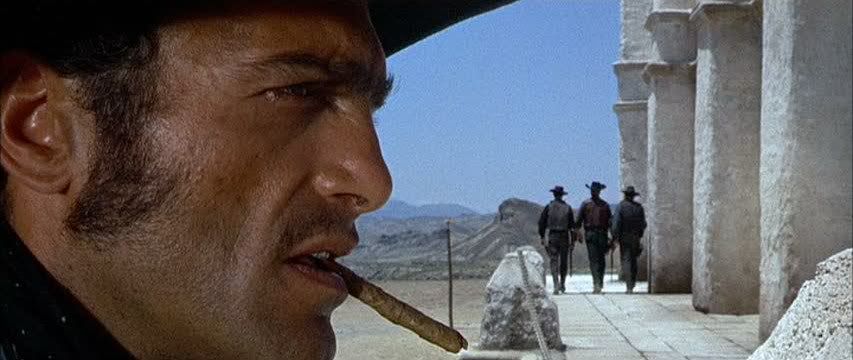
For a Few Dollars More is the second film in Sergio Leone's "Man with No Name" trilogy, his spaghetti Western cycle starring Clint Eastwood. In each of these films — the trilogy is bookended by Fistful of Dollars and The Good, the Bad and the Ugly — Eastwood doesn't actually play an unnamed character, but three different more-or-less anonymous drifters, mercenaries and bounty hunters. He might have a name (in this film it's Manco) but he doesn't seem to have a past or a sense of place. He simply wanders through forbidding desert landscapes in his distinctive poncho and cowboy hat, with a cigarette clenched between his gritted teeth. He's fast on the draw, laconic, and has a strong sense of morality and right. He is, in other words, the archetype of the Western hero, and the power of Leone's films comes from the way he riffs on these familiar tropes, mythologizing and stylizing the Western gunfighter into a truly outsized figure. He takes a cultural icon that had already permeated popular mythology, and amplifies it into something operatic.

A large portion of the credit for this achievement must of course be shared with Leone's collaborators, notably Eastwood and composer Ennio Morricone, who provided the famous music for all three films and many of Leone's other works. Morricone's music defines the spaghetti Western: his distinctive twangy compositions, collaging together traditional Western motifs with sweeping orchestral strings, dramatic vocals, and goofy sound effects, are instantly recognizable and synonymous with Leone's cinema. And Eastwood, of course, was in the early stages of defining the tough guy persona that would become his career trademark. He carries over the same props and costume from film to film, always smoking the same cigarettes and wearing the same poncho. It's an unconventional garment for a gunslinger, and one that gives Eastwood a kind of grandeur to his movements. When he knows he's going to need his gun, he simply tosses the poncho up across his shoulder, exposing the holster at his hip. Leone seems especially attuned to details like this. The way a man wears his gun, the way he smokes a cigarette, the way he draws and fires, says everything about him. In this film, he emphasizes the way the vicious outlaw El Indio (Gian Maria Volonté) smokes in a strange way, the cigarette held between his middle and ring fingers, his whole hand placed across his mouth to smoke as though he was trying to mute himself. Eastwood, meanwhile, lights his smokes with the match elegantly cupped inside his hand, so that he seems to be lighting the cigarette, unseen, on his palm. When Eastwood describes the way another bounty hunter wears his gun, an old man instantly knows who he's talking about, because such things are signifiers of identity in this world.

This attention to detail extends to the three-part introduction, following Leone's favored method for introducing and contrasting his central characters; it's a technique he'd use again for The Good, the Bad and the Ugly, where even the title indicates Leone's preference for dealing with his characters as sets of opposing traits. The opening two sequences follow first the bounty hunter Mortimer (Lee Van Cleef) and then Manco as they each track and kill a target for pay. The differences in their methods, in the flourishes of their technique, highlight the differences between the characters; for Leone, style is character. Mortimer is calm and steady, slow-moving and graceful. He follows a fleeing bandit without getting ruffled by the man's evasions and attacks, and finally unfurls a blanket full of rifles so he can calmly unseat the man from his horse from a great distance. Then, as the criminal wildly fires his pistol, hitting only the dirt at Mortimer's feet, the bounty hunter carefully assembles his own pistol, with a rifle stock attachment so he can steady his aim on his shoulder. He takes his time, sets up his shot, and dispatches the outlaw with a single shot right between the eyes. Manco, in contrast, is more spontaneous and also has a component of moral engagement in his hunting. He finds his target and then engages the man in an impromptu card game, a game of chance that, though his target never suspects it, has the man's life as its stakes. Manco wins and tells the man that he's lost his life, and in the resulting fight he uses his lightning-fast draw to dispatch both his target and three other outlaws. As he's leaving town, he then takes the opportunity to castigate and expose the corrupt local sheriff.

The impression is that, while Mortimer is a cool professional just doing a job, Manco is a raw moral force, relying on his inherent superiority — both morally and in terms of skill — to get him through everything. To some extent, the remainder of the film will complicate this relationship and stand it on its head. In the end, Mortimer has more of a personal, vengeful stake in the hunting of the bank robber El Indio, who is revealed in flashbacks to have raped Mortimer's sister and led to her eventual death. Both Mortimer and El Indio carry watches with pictures of this woman inside, making them mirror images, each haunted by what happened to her — Mortimer because she was his beloved relative, El Indio because, as Leone eventually reveals, the woman killed herself rather than letting him take her, an insult which devastates the proud bandit.


El Indio is the third point of this triangle, and the third man introduced in the opening sequences. He is shown being broken out of jail by his gang, killing his cellmate and heading off to a hideout that's set up and presented like a church. At one point, Indio steps up into an elevated area that's an analogue for the lectern, and gives his men a speech about their next job; Leone inserts a shot of the space's high, V-shaped rafters, which cause the outlaws' words to reverberate magnificently. This religious satire is a consistent undercurrent in the film. The first shot after the opening credits is a closeup of a gold-embossed Bible being read by an unseen man on a train, who everyone assumes is a reverend. But as soon as he lowers the book, revealing the chiseled, hardened face of Lee Van Cleef, his eyes squinting coolly, there's no doubt that he is not a man of God. It's a subtle joke about appearances and surfaces: Mortimer may be reading the Bible, but one look at him is enough to suggest that he is actually a killer, a hard man who's seen much bloodshed in his life, that he couldn't be any holy man. Appearances mean everything here, which is why Leone focuses so intently on the iconography of the Western, the gestures and accoutrements.

In fact, at times the film seems to be nothing but gestures. The plot is simple: a dangerous bandit has escaped from prison, with a massive reward offered for his capture, dead or alive, and two bounty hunters set off after him, sometimes competing and sometimes agreeing to work together as partners. Within this minimal framework, Leone riffs on the mechanics of the shootout, the showdown, the stylized rituals by which rugged Western men test their mettle against one another. When Manco and Mortimer first meet, they engage in a playful duel, with an undercurrent of danger, by shooting at one another's hats. It's a process of sizing up the other man, testing his nerves, testing his skill. If they were not assumed to be equals, there would be an element of humiliation in it when Manco shoots Mortimer's hat off his head and then shoots it away whenever the older man stoops to pick it up. But Mortimer maintains his even-keeled demeanor and then shows up his adversary with his own showy gunplay, and Leone cuts away to them sharing a drink together, professionals with a healthy competitive respect developing between them. The other major gunfights in the film are staged as showdowns where Leone cuts precisely between closeups, watching the men's eyes and faces, watching their hands poised above their gun butts, watching them prepare, internally, for the violence to come. The actual bloodshed is swift and over in a moment. It's the build-up, the accumulating tension, always set to Morricone's grand music, that Leone is concerned with.

This tension builds throughout this sprawling, patiently paced film, which packs in a lot of action — including an explosive bank robbery — but never seems to be moving at a truly frenetic pace. Instead, Leone seems to be steadily building up towards the grand climax, the showdown between Mortimer and Indio, with Manco standing by as a kind of referee to make sure the fight goes smoothly. This is another rehearsal for the threeway shootout that caps The Good, the Bad and the Ugly, another of Leone's moral climaxes.