Jason Bellamy and I have now completed the latest installment of our ongoing Conversations series, in which we discuss various films and filmmakers in back-and-forth debates and discussions. This time around, we tackle Robert Altman's Nashville, discussing its politics, its music, and the intricacies of Altman's distinctive aesthetic. There's plenty of disagreement between us this time around, so don't expect a straightforward tribute to an acclaimed masterpiece. As you'll see, we've approached the film from very different perspectives. I think the clash is interesting and perhaps revealing about the nature of Altman's dense, challenging film. This is the first of our conversations to be posted at the new home of the House Next Door as the blog for Slant Magazine, so check out the new site. As usual, Jason and I hope that our piece will be only the start of the larger conversation; we welcome reader comments and hope there will be some lively discussion revolving around this one.
Wednesday, February 17, 2010
The Conversations #15: Nashville
Jason Bellamy and I have now completed the latest installment of our ongoing Conversations series, in which we discuss various films and filmmakers in back-and-forth debates and discussions. This time around, we tackle Robert Altman's Nashville, discussing its politics, its music, and the intricacies of Altman's distinctive aesthetic. There's plenty of disagreement between us this time around, so don't expect a straightforward tribute to an acclaimed masterpiece. As you'll see, we've approached the film from very different perspectives. I think the clash is interesting and perhaps revealing about the nature of Altman's dense, challenging film. This is the first of our conversations to be posted at the new home of the House Next Door as the blog for Slant Magazine, so check out the new site. As usual, Jason and I hope that our piece will be only the start of the larger conversation; we welcome reader comments and hope there will be some lively discussion revolving around this one.
Labels:
'1970s,
1975,
Robert Altman,
The Conversations
Monday, February 15, 2010
Bonnie and Clyde
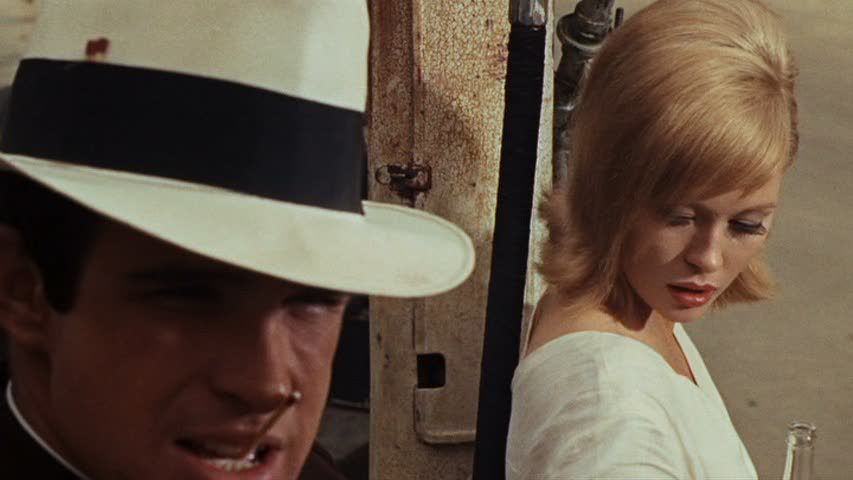
Arthur Penn's Bonnie and Clyde is well-known as one of the first films to bring a new, tougher sensibility to mainstream Hollywood filmmaking, a sensibility that would come to define the new American cinema as the 60s transitioned into the 70s. It is an openly violent and sexualized vision of the famous criminal couple, testing the boundaries of screen representation. This is apparent right from the opening scene, in which Faye Dunaway's Bonnie lounges around naked in her room, then sees Warren Beatty's Clyde outside trying to boost her mother's car. Penn's camera does a clever little dance insuring that Dunaway shows plenty of skin without really revealing anything, as jagged jump cuts slice away whenever her motion within the frame threatens to bring her nudity across the line of acceptability. The jump cuts also stagger a closeup of Bonnie's face as she pounds on her bedpost in frustrated boredom; the jittery editing of this scene both enhances the sense of the character's anxiety and calls attention to the teasing nudity. It's an announcement that the film is going to be all about pushing boundaries, toying with the kinds of things that would have been censored in earlier eras. Penn's jump cuts also announce the influence of the French New Wave on this new Hollywood aesthetic — and indeed, both Truffaut and Godard had been associated with the film before Penn took over as director — but the bigger influence seems to be the simple desire to do things that wouldn't have been possible just a few years earlier.
The result is that Bonnie and Clyde is both startlingly modern and very of its time. Its modernity is most apparent in the performances of Beatty and Dunaway, who carry the film and bring edge and grit to their romanticized gangster characters. Beatty's Clyde Barrow is a slick, sly hood, a small-timer who projects an image far above his station, radiating an effortless cool that's easily punctured whenever he's in a tight situation, when he sweats and grits his teeth in fear. As Bonnie tells him early on, he makes a good sales pitch, but inside he's actually got nothing to sell. As for Dunaway, her Bonnie Parker is a potent screen presence, all raw sexual energy and barely controlled smolder. The film throws her and Clyde together almost instantly, without introduction, and her first few minutes in his presence are an absolute joy to watch. They walk down the street together, exchanging playful banter, Dunaway swaying girlishly, as though she's a Southern belle being courted rather than a small-town waitress flirting with a criminal stranger. Bonnie watches Clyde with mild suspicion but, more than that, a predatory desire. She eyes him voraciously, wrapping her lips around a Coke bottle and pensively tonguing the bottleneck: it's a provocative and exhilarating image, promising a film that really embraces this naughty, playful approach to these famous bank robbers.
The film certainly does have a propulsive, invigorating energy, especially in Dunaway's best moments, like her posing for a photograph with a pistol and a cigar borrowed from Clyde, or her passionate tongue-kissing with a captured Texas ranger who had been hunting the gang. At times, Dunaway seems to be driving the film all by herself, projecting a magnetic intensity that threatens to overwhelm anything else that happens to be going on in the frame with her. Even Beatty's manufactured cool can't compete with his costar's raw power.
As much as these performances bring to the film, Bonnie and Clyde is flawed from conception, since it romanticizes and mythologizes the titular couple pretty much from the word go. For all the undeniable modernity of the film's gunfights, the film is still seeped in corn and sentiment, like all the rustically impoverished caricatures who the couple encounters along their journey. These representatives of the lower class are ostentatiously intended to symbolize the duo's nonconformity and fight against the banks and the authorities. In fact, the film seems to take this nonsense mythology at face value, while also making Dunaway's Bonnie veer into unfortunate feminine hysteria that's inconsistent with her character's harder edges. Nothing Dunaway does can completely overcome the straitjackets placed on her character by the script, which makes her cling pathetically to the sexually disinterested, possibly impotent Clyde. True, in the later stretches of the film, Bonnie betrays a longing for a different life, but it's still unfortunate that the film doesn't have more of a perspective on her character's attachment to Clyde, which is simply taken for granted rather than truly developed or explored.
As a result, the film is most notable, beyond its noisy, bloody gun battles, for the subtleties of its performances. In one scene, Bonnie and Clyde and their gang pick up a young couple after stealing their car, and drive around with them, turning an initially threatening situation into a fun, free-spirited drive. But then, when the man announces that his profession is an undertaker, Bonnie abruptly demands that they kick the couple out of the car. A troubled expression flashes across her face at this moment, and it's clear that there are multiple layers to this brief scene: not only is Bonnie envisioning her own likely death, but she's perhaps sensing that this young man and his girlfriend were getting sucked into the dangerous orbit of the gang's criminal activities. There's a sense that Bonnie saw her own seduction into crime being repeated, and didn't want to see more innocents corrupted and transformed by this violent, criminal life.
Penn also gets a marvelous performance out of Gene Hackman, as Clyde's brother Buck. Hackman is loose and jovial here, the kind of guy who likes to slap his buddies on the back and eagerly tells his jokes over and over again whenever he thinks he has a new audience; the kidnapping scene's funniest moment is seeing the kidnapped couple laughing over Buck's favorite joke, as the rest of the gang glumly overact their boredom with the punchline. But there's also a deeper subtext to Buck's bonhomie, witnessed in an early scene when he's first reunited with Clyde and his initial enthusiasm slowly fades as he realizes that he actually has nothing in common with his outlaw brother, nothing to talk about. Instead, the two men sit in awkward silence for a few moments, with Buck hooting and hollering, trying to drum up some excitement about all the fun they're going to have together. Then, a moment later, "what are we going to do?" Michael Pollard, as the gang's slightly slow-witted hanger-on C.W. Moss, is equally good, bringing sensitivity and pathos to his hero-worshipping third wheel. Only Estelle Parsons, as Buck's wife Blanche, is grating and aggravating, turning her character into a shrill caricature of weak femininity, another sign of the film's dismal perspective on women.
On the whole, Bonnie and Clyde is driven by the quality of its performances, by the multiple layers and nuances these actors bring to their legendary characters. The script isn't always as satisfying, and Penn's handling of this material often turns the true bank robbers' story into artificial hokum. When Bonnie first realizes that Clyde isn't a "loverboy," the script pours out a load of bullshit about how Clyde nevertheless saw something special in Bonnie — Bonnie buys it, which is realistic enough considering her insecurity and desperation to escape her small-town ennui, but Penn seems to expect the audience to buy it as well, to see this tale as a tragic love story. At its worst moments, the film verges on melodramatic myth-making, but its better instincts often win out, bringing dark wit and bracing violence to this distinctly American story of greed, adventure-lust and the romanticization of antiheroes.
Labels:
'1960s,
1967,
classic Hollywood
Friday, February 12, 2010
Blogroll changes and other announcements
This is an announcement that I've made some long-overdue adjustments to my sidebar blogroll. Namely, I've cleaned up some dormant sites, and I've added a number of blogs that I've been reading for a long time now and which have become regular visits for me. My blogroll is intended to reflect the sites I visit daily, or as often as they update anyway. However, of late I've been incredibly behind in keeping my blogroll up-to-date, since I don't really use it or look at it much myself — instead, I follow a very large number of blogs and keep up with their posts through their feeds. So it took me a while to realize that my sidebar wasn't really reflecting the blogs and writers I regularly read. That's now been corrected, though I can't promise I've caught everyone who should be added: if you see this and think you should be there, don't hesitate to let me know. Anyway, below are the great blogs that have recently been added to this list. If you're not reading these already, check them out.
Elusive As Robert Denby (Troy Olson bills himself as being new to movie writing, but he's insightful and intellectually curious, and has of late been posting some great round-up posts gathering together various 2009 films.)
Goodfella's Movies (Dave seems to be continuously running one epic project after another; first he reviewed his favorites movies for every year from 1930 to 2008, and if that wasn't ambitious enough, he's now writing about his top 100 noirs, too.)
Hugo Stiglitz Makes Movies (Kevin Olson's writing is consistently sharp and entertaining. Enough said.)
The Last Lullaby (and) Peril (At filmmaker Jeffrey Goodman's blog, he's following Dave in writing about his favorites from each year of cinema, from 1926 to 2008.)
The Long Voyage Home (Doniphon is another smart writer with some very good taste.)
Medfly Quarantine (Ryan Kelly doesn't post nearly often enough, but when he does it's almost always with an exhaustive, formally engaged piece.)
Not Just Movies (Jake Cole is a remarkably prolific and insightful writer I only recently discovered. He's currently tackling, among other things, the ambitious project of watching all of Jean-Luc Godard's films for the first time, in as close to chronological order as possible.)
The Passionate Moviegoer (Joe Baltake's blog is notable for his crisp, stylish writing and dedication to promoting obscure and lesser-seen films.)
The Sun's Not Yellow (The new blog of Joel Bocko of The Dancing Image, a home for various essays and think pieces on film.)
Unexplained Cinema (One of Greg Ferrara's blogs, now resurrected as a place to explore cinema entirely through frame grabs and sequences of images; it's fun and thought-provoking in roughly equal measures.)
Wonders in the Dark (This site, home to Sam Juliano and to Allan Fish's ongoing countdown project, probably needs no introduction. Lots of great writing and discussion.)
So that's that. A couple more housecleaning matters:
1) As most of you have no doubt noticed, The House Next Door has found a new home as the blog for Slant Magazine. This means that my conversations with Jason Bellamy have found a new home as well, though nothing is really changing behind the scenes at the House. Those pieces will continue on a more or less monthly schedule as usual. In fact, within the next week or so, our latest conversation, about Robert Altman's Nashville, should be posted at the House. I'll announce that when it's up. There is also some VERY exciting news about the Conversations series in the works, but it's still too early to say anything more.
2) I am currently assembling a big post or series of posts for this blog about the best comics of the previous decade, from 2000-2009. I know, this is a movie blog, but comics are also very important to me, and I try to write about them sporadically, so within the next week or two I'll be dedicating a few days to this list. Comics don't get a whole lot of respect as an artform — although that situation has certainly improved in recent years — so I hope by posting this list here I'll maybe get some people who don't normally read comics interested in checking out a title or two.
So that's the latest news and updates. Look for more film reviews next week.
Wednesday, February 10, 2010
Lights
[This is part of a series of posts in which I explore the work of the Austrian DVD label Index DVD. This company has released a great deal of valuable European experimental cinema onto DVD, naturally focusing on the Austrian underground but occasionally branching out as well. Index's DVDs are distributed in the US by Erstwhile Records, so anyone intrigued by Index's catalog should take a look and support the fine work both these companies are doing for obscure and avant-garde cinema. The short film discussed below is one of four included on Index's DVD of the documentary Notes on Marie Menken; that film is reviewed here and the other shorts are reviewed here.]


Marie Menken's Lights is a film of such joy, such pure sensual beauty, that it is breathtaking and overwhelming. In just seven minutes, with a breakneck sequence of abstract, colorful images of lights floating in a black nighttime field, Menken delivers an intoxicating visual experience. It's an abstracted vision, like the work of Stan Brakhage, a celebration of light and color in which each frame is alive with furious scribbles of blurred light and tangled rainbow beams. It's as though Menken is drawing with light by shaking her camera, unleashing small hash marks of white light and amber curlicues that twist around each other. Through Menken's expressive stylization, the marks and lines of these lights become a form of handwriting, an abstract language inscribed in the twists and turns of motion-blurred neon, car brake lights and Christmas decorations. The film was assembled over the course of three years, during which Menken shot Christmas window displays and other seasonal decorations, working mostly late in the night, when she could be alone in the darkness with these vibrant beacons.


The resulting film is truly a visceral experience like no other, matched only by the best of Brakhage's light works. Menken molds and shapes light into alien structures, destabilizing the familiar into a blur of fleeting sensory impressions. The film opens with shots of multi-colored Christmas lanterns hanging in a tree. Menken's camera at first patiently pans across these lights, capturing their vibrant glow, their definite shapes: bell-like cups when viewed from the sides, becoming sun-shaped circles with white-hot centers when viewed from below. Then her camera begins to shake, to disrupt the stability of these images, transforming the concrete into the ephemeral. Little white dashes dance across the frame, moving parallel to the motion of the camera, sometimes darting sideways across the frame, sometimes falling like rain. Menken's moving camera creates designs by stretching out a single point of light into a line, as though tracing with a white pen across a black sheet of paper.
From this dazzling abstraction, Menken steps back to reveal the source of these light patterns, as she twirls her camera around to make the giant Rockefeller Center Christmas tree do a 360-degree turn through the night, and then sets off on a whirlwind tour through the city's streets. Everywhere, there is light. A church is defined by the lights at its borders, the black foundation of the building seemingly a negative space surrounded by crisp rows of circular lights. Menken captures momentary hints of religious sentiment amidst all this bombast: a cross in lights, glowing palely in utter darkness, a rapid tracking shot across a nativity scene where Mary and the wise men are bathed in a gaudy Las Vegas neon aura emanating from somewhere nearby. These are ephemeral reminders of the origins of this celebration, the reason for all this festivity and brilliance. Blink, and you'll miss it: a recurring theme in Menken's fast-paced, sensually exciting work, of which this film is quite possibly the apex.


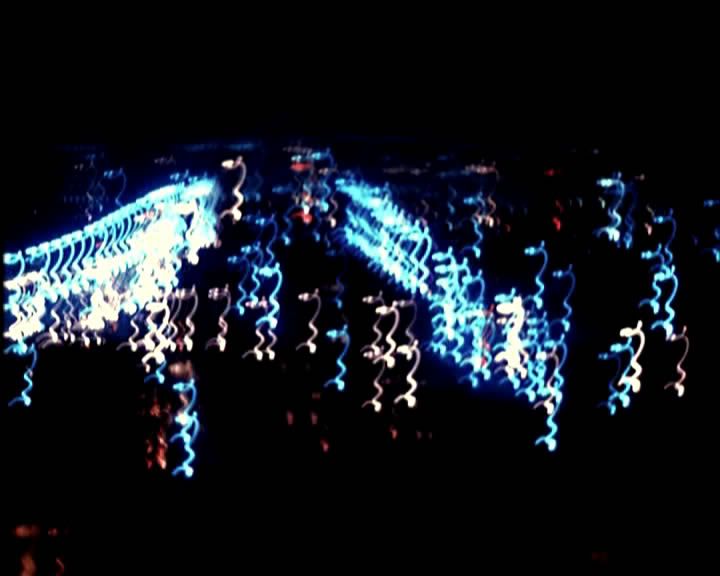
From here, she's back out into the streets: images of cars, their brake lights glowing red, set off against blue dots the origins of which are more obscure. And then she shatters even this hint of the familiar, further blurring the speeding traffic into curving, bouncing lines, a trail of red lights tracing across one side of the frame with shaky white lines staggering across the other. As the pace picks up, Menken ventures further and further into abstraction, layering multiple exposures and reducing all the light and motion to cryptic calligraphic marks in the darkness, squiggles and check marks and amorphous suggestions of form. Tight clusters of these marks seem to dance across the frame, as though performing some arcane choreography, a Busby Berkeley number as performed by a chorus line of neutrons and electrons, a subatomic musical extravaganza taking place in a silent vacuum.
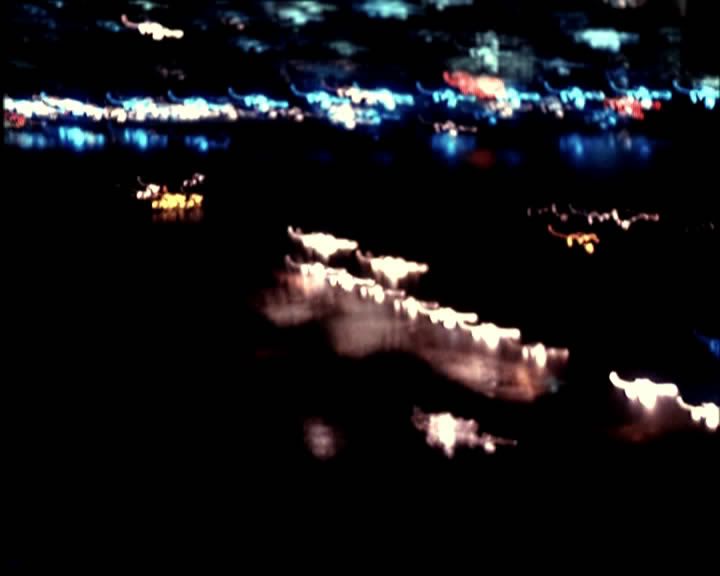
Increasingly, Menken abstracts the imagery even as she incorporates more recognizably photographic exposures. A star field in which gray scratched lines hover like graphite scrapings or stalks of spiky grass. A skeletal outline of a metal globe, gray spirals, splotches of red like blood or paint, dots of light in the dark. A long view of the city skyline from across the water, with strange UFO-like bursts of light floating in the darkness.


These images are haunting and beautiful, and Menken's approach makes Lights a kind of sensory fever dream. She makes these external phenomena — the properties of light as it is refracted and processed by her camera — internal and introspective, dream images dancing across the inside of the viewer's closed eyelids. It is a deeply subjective perspective, utilizing objective phenomena, like the way light behaves when it is photographed in certain ways, to create a complex inner landscape. And in its off-kilter beauty, it is a surprisingly moving film, discovering pathos and warmth in its brilliant abstractions. I was originally planning on writing about this film as part of yesterday's post about four other Menken shorts, but I thought it deserved its own separate tribute. Plus, as you can no doubt see, I just couldn't stop grabbing screen captures; the visual imagination and beauty of this film is simply inspiring.

Marie Menken's Lights is a film of such joy, such pure sensual beauty, that it is breathtaking and overwhelming. In just seven minutes, with a breakneck sequence of abstract, colorful images of lights floating in a black nighttime field, Menken delivers an intoxicating visual experience. It's an abstracted vision, like the work of Stan Brakhage, a celebration of light and color in which each frame is alive with furious scribbles of blurred light and tangled rainbow beams. It's as though Menken is drawing with light by shaking her camera, unleashing small hash marks of white light and amber curlicues that twist around each other. Through Menken's expressive stylization, the marks and lines of these lights become a form of handwriting, an abstract language inscribed in the twists and turns of motion-blurred neon, car brake lights and Christmas decorations. The film was assembled over the course of three years, during which Menken shot Christmas window displays and other seasonal decorations, working mostly late in the night, when she could be alone in the darkness with these vibrant beacons.
The resulting film is truly a visceral experience like no other, matched only by the best of Brakhage's light works. Menken molds and shapes light into alien structures, destabilizing the familiar into a blur of fleeting sensory impressions. The film opens with shots of multi-colored Christmas lanterns hanging in a tree. Menken's camera at first patiently pans across these lights, capturing their vibrant glow, their definite shapes: bell-like cups when viewed from the sides, becoming sun-shaped circles with white-hot centers when viewed from below. Then her camera begins to shake, to disrupt the stability of these images, transforming the concrete into the ephemeral. Little white dashes dance across the frame, moving parallel to the motion of the camera, sometimes darting sideways across the frame, sometimes falling like rain. Menken's moving camera creates designs by stretching out a single point of light into a line, as though tracing with a white pen across a black sheet of paper.
From this dazzling abstraction, Menken steps back to reveal the source of these light patterns, as she twirls her camera around to make the giant Rockefeller Center Christmas tree do a 360-degree turn through the night, and then sets off on a whirlwind tour through the city's streets. Everywhere, there is light. A church is defined by the lights at its borders, the black foundation of the building seemingly a negative space surrounded by crisp rows of circular lights. Menken captures momentary hints of religious sentiment amidst all this bombast: a cross in lights, glowing palely in utter darkness, a rapid tracking shot across a nativity scene where Mary and the wise men are bathed in a gaudy Las Vegas neon aura emanating from somewhere nearby. These are ephemeral reminders of the origins of this celebration, the reason for all this festivity and brilliance. Blink, and you'll miss it: a recurring theme in Menken's fast-paced, sensually exciting work, of which this film is quite possibly the apex.
From here, she's back out into the streets: images of cars, their brake lights glowing red, set off against blue dots the origins of which are more obscure. And then she shatters even this hint of the familiar, further blurring the speeding traffic into curving, bouncing lines, a trail of red lights tracing across one side of the frame with shaky white lines staggering across the other. As the pace picks up, Menken ventures further and further into abstraction, layering multiple exposures and reducing all the light and motion to cryptic calligraphic marks in the darkness, squiggles and check marks and amorphous suggestions of form. Tight clusters of these marks seem to dance across the frame, as though performing some arcane choreography, a Busby Berkeley number as performed by a chorus line of neutrons and electrons, a subatomic musical extravaganza taking place in a silent vacuum.
Increasingly, Menken abstracts the imagery even as she incorporates more recognizably photographic exposures. A star field in which gray scratched lines hover like graphite scrapings or stalks of spiky grass. A skeletal outline of a metal globe, gray spirals, splotches of red like blood or paint, dots of light in the dark. A long view of the city skyline from across the water, with strange UFO-like bursts of light floating in the darkness.
These images are haunting and beautiful, and Menken's approach makes Lights a kind of sensory fever dream. She makes these external phenomena — the properties of light as it is refracted and processed by her camera — internal and introspective, dream images dancing across the inside of the viewer's closed eyelids. It is a deeply subjective perspective, utilizing objective phenomena, like the way light behaves when it is photographed in certain ways, to create a complex inner landscape. And in its off-kilter beauty, it is a surprisingly moving film, discovering pathos and warmth in its brilliant abstractions. I was originally planning on writing about this film as part of yesterday's post about four other Menken shorts, but I thought it deserved its own separate tribute. Plus, as you can no doubt see, I just couldn't stop grabbing screen captures; the visual imagination and beauty of this film is simply inspiring.
Labels:
'1960s,
1966,
avant-garde film,
Index DVD
Subscribe to:
Posts (Atom)