Friday, May 6, 2011

Lettre à Freddy Buache/Changer d'image


Commissioned to make a film about the Swiss town of Lausanne on the occasion of the five-hundredth anniversary of the town's founding, Jean-Luc Godard responded in the form of a videotaped "letter" to his longtime friend and associate Freddy Buache, the founder and director of the Cinémathèque Suisse. Lettre à Freddy Buache is basically a film about Godard's refusal to make the film, or about the failure to make the film, or even more pointedly, about what Godard predicted would be the perception of his failure. Speaking in voiceover, Godard adopts an intimate, conversational tone appropriate to a letter to a close friend. His narration is almost conspiratorial, including by implication Buache, and the eventual viewer of the film, in his musings on how best to represent or not represent a particular place.

The film alternates between three basic types of footage: Godard in his editing room listening to records and playing with sliders and buttons on audiovisual equipment; scenic tracking shots of the Swiss countryside in which Godard's camera restlessly wanders about as if in search of the one right image; and images of people walking around the city, drastically slowed down with the choppy slow motion video manipulation Godard had developed in his late 70s video experiments and especially in his then-recent 1980 return to cinema, Sauve qui peut (la vie). The footage of Godard himself emphasizes that this is a personal response, not an impersonal documentary or generic tribute but the work of an artist who is thinking and shaping his material. As in much of Godard's post-1967 oeuvre, the film is very much rooted in technology, in the reality of the editing methods applied to the footage, and in the exigencies of shooting. At one point he inserts a sequence of himself arguing with a local police officer who hassled the crew for stopping by the side of a highway to film. The policeman tells them that they can only stop for emergencies, and Godard's reply — delivered in a tone of voice that suggests it's the only rational response — is that this is an emergency, that the light would soon be gone and, with it, the opportunity to capture this particular image. For Godard, this is undoubtedly a moral question; it is vitally important to find the right images, to capture a particular moment before it is lost forever, and the failure of the police officer to understand that urgency is, from Godard's perspective, the failure of much of society to understand the importance of cinema, the potential of cinema, and by extension the responsibility of the artist to think, to document, to express his or her ideas.

The other two categories of images here are thus embodiments of Godard's thought process, his uncertainty about whether a place can best be represented by its landscape — its light and its colors — or by its people. In his musings, which have the quality of thinking aloud, drawing connections to Picasso or Wittgenstein, Godard suggests that, in filming Lausanne, there exists tension between the greens and blues of nature — the sky above and the foliage below — with Lausanne itself in the middle, gray and rocky, made of stone and concrete, manmade buildings sandwiched between a bright blue sky and the lush greens of nature. It's a perverse and implicit rebuttal of the commission's purpose: asked to commemorate the founding of a town, Godard all but laments that it was ever built, his sweeping images of natural splendor jutting up against the boring grays of the city itself.

Instead, Godard suggests that the soul of the place, the thing worth commemorating and talking about, is the people who live there, and his slow motion images of people captured on the streets have a sensuous quality that's a parallel to his gorgeous tracking shots of cloudless skies and the shade under dense trees. These images have a dual purpose implied by the film's final text, an onscreen dedication that calls this short "en souvenir de Robert Flaherty et Ernst Lubitsch." In other words, Godard's images of people arise both from the ethnographic impulse to observe and study, and from the desire to tell stories, to create fictions and narratives from people's faces, their movements. It's this tension, Godard suggests, that is valuable and worth exploring, and that's why he couldn't make a film about Lausanne and made this instead, a film in which Lausanne is more or less a departure point for the filmmaker's ideas on form and the reality/fiction dialectic.


Changer d'image was another commissioned project for Jean-Luc Godard, a short film prompted by the one-year anniversary of the election of the leftist French president François Mitterrand. Godard, naturally, takes this subject as the implicit basis for his subsequent film, and never explicitly mentions anything about Mitterrand or French politics or the occasion being commemorated. Instead, the commission seems to have made him consider the subject of "change," broadly speaking, and he sets out to examine not only what it means to change, but how to represent and envision that change in the form of images, of art. In other words, like the roughly contemporaneous Lettre à Freddy Buache, Changer d'image is not, strictly speaking, the fulfillment of a commission but an essay about how to fulfill the commission, an essay on the question of whether it can even be fulfilled at all.

To tackle the problem, Godard turns by analogy to his experience in Mozambique during the early 1970s, where he was enlisted to advise that country's new Marxist government on their television plans, and to produce original content that would create a new, radical form of television. The project never went anywhere, and Godard's voiceover analyzes the ways in which political upheavals in that country conspired with the difficulty of the project itself to prevent his success. He quite literally beats himself for the failure, showing images of himself, shirtless and strapped to a chair, being beaten and tortured by someone who's questioning him about cinema and television. It suggests how Godard sees his position with respect to governments and the other institutions and organizations that ask him to create what amounts to art on demand: as a torture victim being asked questions he can't possibly answer. He's holding up his various failures and aborted projects, wondering why it's so difficult to change things, to create something new.

The film opens, in a poignant and stripped-down visualization of that difficulty, with Godard seated, his back to the camera, in front of a white screen. This image persists throughout virtually the entire 10-minute film, sometimes alone, sometimes superimposed with others. It is as though the director is facing a quite literal blank canvas as he wonders aloud how to fill it, while the voice of an unseen woman questions him about change. He seems uncertain, except that he knows what the image of change is not: it is not the televised news, the endless debates and discussions of politicians talking about reform, a word that suggests slow and incremental alterations whereas "change" is harsh and speedy. After a while, the question-and-answer format is replaced by a third-person voiceover that refers to Godard, the director, the artist, as "the idiot," a variation on the similar roles he'd play as the holy fool in later films such as King Lear or Keep Your Right Up. Godard sees the artist as a fool, an idiot, because he believes in change, in the possibility of creating images that foster or document change, even though it's a quixotic and near-impossible task. But the artist keeps striving, through self-flagellation and the burdens imposed from outside, to create change.

This romantic image of the artist-filmmaker is offset by the film's final lines, an anecdote Godard tells about his grandfather driving the young Godard and his siblings around. The grandfather always drove very slowly, and the children in the back always shouted at him to go faster, to change gears, the cries devolving eventually to "change, grandfather, change," with the grandfather simply responding with a petulant whine. The film abruptly cuts off in mid-whine, a high-pitched sad sound of a grumpy old man resisting change, and Godard's implicit question to himself is: has he become the grandfather, or is he still the child in the back seat shouting "change," even knowing that his words are fated to have no effect?

Thursday, May 5, 2011

Fallen Angels


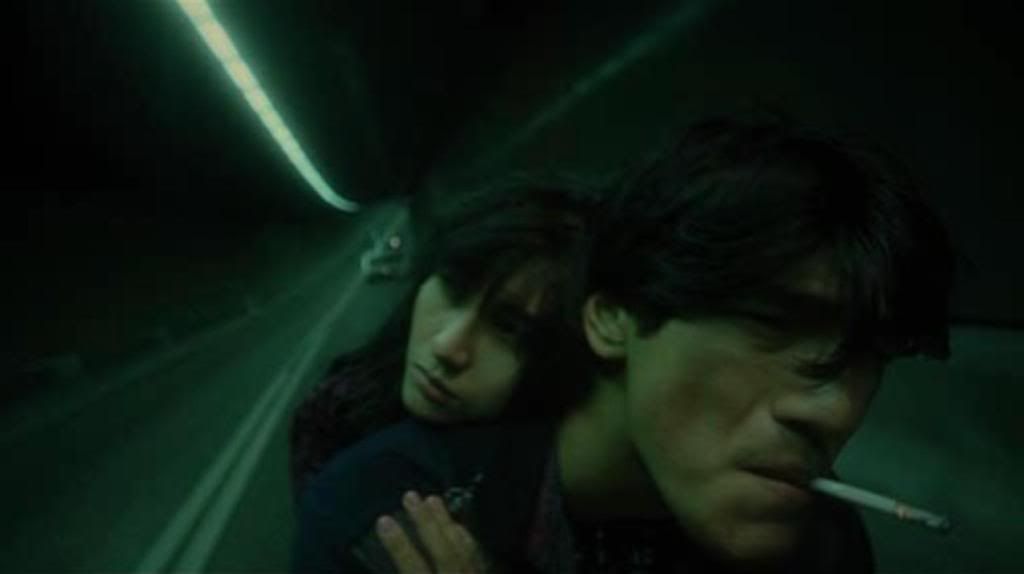
Fallen Angels is a moving, hilarious, poppy, absurd, moody film about urban disconnection and loneliness, alternately contemplative and hyperactive, filmed with the characteristic punchy stylization of director Wong Kar Wai. The city (Wong's Hong Kong home) is a peppy, colorful place, neon and bright, its colors brilliant, shining bright in the seemingly perpetual night: beautiful and dangerous. The film concerns itself with the people who live their lives almost wholly at night, shunning the daily nine-to-five grind in favor of nights packed with activity, with crime and romance and desperate attempts to connect with other wanderers of the night. In this city, it's often raining, the streets are slick and shiny, and time moves unpredictably, sometimes racing by in the blur of time-lapse traffic scenes, sometimes slowed to a crawl. The city's night is populated by a professional killer (Leon Lai) who wants to quit his job, his agent (Michelle Reis) who arranges his kills without ever meeting him in person, the mute He Zhiwu (Takeshi Kaneshiro) who spends his nights in closed stores, reopening them without their owners' knowledge and forcing passersby to partake of his wares, the emotional young woman Charlie (Charlie Yeung) who's obsessed with a guy who's left her, and the punky Blondie (Karen Mok) who just wants somebody to think she's special, to remember her.

These various drifters and loners collide off one another in the night, careening around on their oddball errands, their violent missions, their melancholy unkept dates in various smoky bars. As Zhiwu says, he's always looking to find "friends and confidants," so he "rubs elbows" with anyone he meets, which in his case usually means dragging his unwitting victims, kicking and screaming, into bizarre transactions. Running a laundromat, he forces a bum to get his clothes washed. Taking over a grocery store, he tries to convince a lady to buy eggplants — hilariously, she thinks it's improper since she's single, and what would people think? — and then saddles her with a tremendous watermelon. He keeps running into the same unfortunate guy (Fai-hung Chan) over and over again, first giving the guy a hair washing and shave under duress, then riding him and his extended family around the city in an ice cream truck, gorging them with cones and tremendous sundaes with candles flaring on top like it's a big birthday celebration. These surreal crimes are a weird way of getting attention, connecting with people — Zhiwu sees it as a kind of service, a way of making people happy in unexpected ways.

It's also a way to break through the barriers preventing communication. Zhiwu can't talk because there was an accident with expired pineapple, an in-joke based on the character with the same name and played by the same actor in Chungking Express, who was also obsessed with pineapple, and who says, as this Zhiwu does later in the film, that everything has an expiration date. The other characters in the film don't have Zhiwu's extreme communication problems, but they're similarly disconnected, isolated from one another in various ways. The killer and his partner communicate with one another primarily through technology. She faxes him maps of the locations for his missions, hand-drawn with marker, her little personal touch added to an impersonal business. Otherwise, they communicate through numbers: through the numbers of answering machine services, a common device in Wong's films, or the number of a particular song on a jukebox that the killer leaves as a message to his partner when he wants to quit. Unable to tell her his feelings face to face, he leaves a number that leads to a song about breaking up.

In the same way, he leaves behind clues for her in the apartment where he stays while on his missions. She's in the apartment before the killer, cleaning it and setting it up for him, much like Faye Wong's character in Chungking Express, rearranging the apartment of the man she loves to help him forget his ex-girlfriend. Wong films these scenes to emphasize the parallels and the disjunctions: the killer and his partner inhabit the same space in subsequent scenes, separated by time but not by space. Later, after the missions, she goes through the killer's trash, because it helps her learn about him, to feel close to someone she never actually meets face to face. And, as the killer reveals later, he knows she does this and deliberately leaves behind evidence of his actions and his personality, knowing that she'll be able to piece together information about him through what he throws away. In this way, they become closer while remaining at a physical remove; it is as close as they get to connection, as close as they get to really knowing another person intimately.


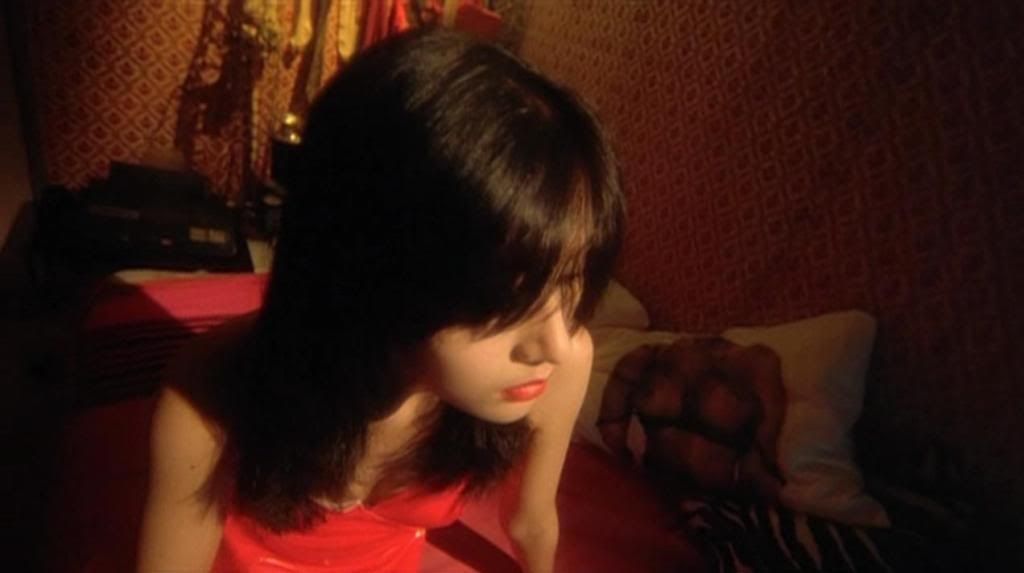
For the killer and his partner, this distance is something they try to maintain, even if they don't really want to; they pose, keeping their cool, playing their roles, even if they secretly yearn for something deeper, something more real. Towards the beginning of the film, the killer's partner says that she's not interested in any of the "friends" she visits, that it's all anonymous and impersonal for her, that these targets don't mean any more to her than the man she sics on them. She tries to live up to that image, projecting an aura of untouchable cool: her bangs combed over her forehead and hanging down into her face, nearly covering her eyes completely most of the time, as though if she hides her eyes, she can't see or, more importantly, be seen. She is, like so many of Wong's characters, an icon of cool with her rubbery fetish dresses and her bright red lips, her garters and her cigarettes, sexy and cool, remote, simmering and chilly at once. It's only in private that she betrays her reserves of feeling, masturbating violently and passionately in the empty apartment whenever the killer isn't there; in public she appears as the cold professional that her job requires her to be.

The killer is similarly haunted by emotions that don't suit his profession. He yearns, like so many other killers and criminals in the history of genre fiction, for an ordinary life, for this one last job to be his true last one; he wants to find a girl he can love, he wants to settle down. He occasionally runs into people who recognize him from a more innocent time; he wryly notes, in voiceover, that "even if you're a killer, you still have classmates from grade school around." When he meets a cheery old school friend who's about to get married, the guy tries to sell him an insurance policy, but he won't get one because it only reminds him that he wouldn't have anyone to name as a beneficiary. He's living an entirely solitary existence, with no friends, no family, no real life other than traveling from place to place, living for a day at a time in apartments scrubbed clean by his partner, killing people in a burst of gunfire and then moving on to the next mission.

The yearning for connection in this film is intense, as every character wants someone or something they can't have, while somehow remaining isolated from the people who do cross their paths. Zhiwu tries to connect with the chatterbox Charlie, a romance that seems counterintuitive but somehow perfect — a man who can't talk and a woman who can't stop pouring out her every feeling in a torrent of talk and tears — but she's still hung up on her ex and barely registers Zhiwu's presence. Blondie wants the killer, and is in fact convinced, whether rightly or wrongly, that they'd once dated and he'd simply forgotten her, but he only wants company for the short term.

Wong situates these gloomily romantic stories and characters within a glitzy, hyper city that seems to be losing its collective mind, unleashing bursts of unpredictable violence that recall the abrupt transitions from calm to bloodshed in his directorial debut As Tears Go By, or the climactic gunfight in Days of Being Wild. The overall atmosphere of slowly simmering heartache — all those shots of lonely people in lonely bars, bathed in neon glow — is thus constantly threatened by outbursts of absurdity or over-the-top violence. The most notable is a surreal but gory fight that suddenly breaks out in a restaurant around Charlie and Zhiwu, with a man named Blondie — the name of the girl who Charlie believes stole her man, though she seems to have a very different story from the Blondie who hangs around with the killer — at the center of the brawl. The sequence is frantic and motion-blurry, a frenetic outpouring of kinetic knife-fighting and screaming, streams of blood and people running desperately through the chaos.

These outbursts add to the sense of emotions flaring out of control; the city seems to reflect the turbulent confusion and desperate longings of these people, or perhaps it's the other way around. Either way, the landscape of Fallen Angels is emotionally explosive, with Wong's bold aesthetics creating the impression that the characters' feelings are being written onto the surface of the film, inscribed in every shaky pan and every over-saturated color.

Wednesday, May 4, 2011

Le Trou


Jacques Becker's final film, Le Trou, is a thrilling and powerful prison break drama that chronicles, with narrowly focused concentration, the attempt of a group of cellmates to break out of jail by tunneling beneath their cell into the sewer system. The film is stark and economical, with no intrusive music on the soundtrack, no elaborate plotting, and a bare minimum of character detail. Becker includes what he absolutely has to in order to tell his story, and strips away all the excess fat, leaving only the raw, vital essence of the prison break saga. The characters are generic, with no real back stories. The initial schemers in the escape plan are the experienced prisoner Roland (Jean Keraudy, who participated in the real life escape on which the film was based), Manu (Philippe Leroy), Geo (Michel Constantin) and Monseigneur (Raymond Meunier). The only information provided about any of them is that all of them are facing long jail sentences, and one or two of them could potentially be sentenced to the death penalty. Becker doesn't provide any information about their crimes; it's obvious that they're career criminals with violent pasts, and that they have a very strong incentive to escape or else at best they'll be spending the rest of their lives in prison.

This tight-knit group is disrupted by the arrival of Claude Gaspard (Marc Michel), who's moved into their cell from a cell block that's being repaired. The men accept him after initially sizing him up, and after some debate and uncertainty they inform him of their plan and include him in the escape attempt. Gaspard, nevertheless, is very different from the other men. He is not a hardened criminal but a man who has been unlucky, who has been placed in this situation more or less by accident. He was in a quarrel with his wife where she pulled a shotgun on him, and in the ensuing struggle she was wounded. Jealous over Gaspard's affair with her younger sister, the wife filed charges of attempted murder against him. Obviously, although he too is potentially facing a long stretch in prison, Gaspard is in a very different situation from the other men, and they remain somewhat uneasy around him, slightly suspicious of him even as they proceed with their plot.

Their plan involves digging a hole in their cell that will eventually lead through some underground passages to the sewer system. Once they gain access to the sewers, they find that it's necessary to dig a second and much larger hole to get around a concrete obstruction blocking the sewer tunnel. The tension in the film is sublime and at times unbearable. Every physical action becomes an exercise in suspense. When the prisoners first begin digging the hole in their cell, Becker holds a closeup on the growing hole itself, with the prisoners clustered around it, taking turns using a small piece of metal to crack the concrete floor.

The sequence plays out nearly in real-time, with the concrete shattering into small chunks, the sound of the hammering and the clinking together of the rocks and debris amplified on the soundtrack. The prisoners are hoping that the noise blends into the general clatter of the prison, where everyone is working during the day, and the lengthy, intense sequence emphasizes the hard work of breaking through the floor. The accumulation of tension through the nearly dialogue-free emphasis on manual work recalls Jules Dassin's Riffifi, another film in which the patient observation of physical processes is integral to the film's effect. The audience must wait with the men, anxious that they'll be caught at any moment. Every similar sequence of physical labor is extended with similar patience and intensity. A scene in which two of the prisoners file through a metal bar is achieved with time-lapse rather than in real time, but the effect is the same. The prisoners pause after every twenty filing motions to listen for guards, at which point the camera pans upward from the bar and the small slit in it to the face of the prisoner, his eyes alert, holding his breath as he listens for a sign that someone might be approaching.


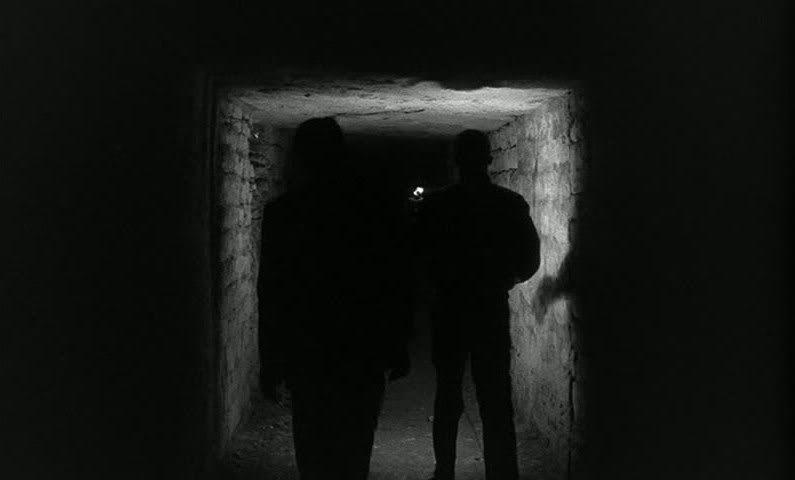
The whole film is similarly tense, with an emphasis on time passing, on sand filtering through the makeshift hourglass the men create with two glass bottles and a handful of pilfered sand. Becker resorts to time-lapse sequences when he needs to, to show the hole in the sewer slowly widening, getting scooped out more and more as the men dig night after night. More often, events play out in something like real time, especially the lengthy scouting expedition when Manu and Roland first explore the area beneath the prison, searching for their way out. During this scene, the action proceeds at a deliberately slow pace as the men creep through the underground passages in the dark, dodging patrols by the guards, the only light coming from the small flame they construct with a bottle of ink. Becker often shoots down the dark corridors, that small light receding, the figures of the men getting swallowed up in shadows as they vanish into the distance.

The film's aesthetic is minimalist and claustrophobic, rarely leaving the confines of the prisoners' small cell or the tunnels beneath the prison. One exception is a very brief scene in which Gaspard gets a visit from Nicole (Catherine Spaak), his wife's sister and his lover, a scene shot entirely in glossy closeups with a wire screen overlaid on their faces, separating them. It's a brief glimpse of the outside world, a beacon of hope that confirms that Gaspard is not like the others, that there's a chance for him to get out of this situation through ordinary means, without tunneling into the ground. Gaspard, it seems, is going along with the men to some extent because he feels accepted, like part of a group, working towards a common goal. The men are self-sufficient and close in every way, sharing everything they have with one another, totally trusting one another to carry out this plan. Gaspard, seeing them work together and joining them in this work, is moved by the closeness of the group, by their spirit of stoical cooperation, their manly code of honor. As Monseigneur says at one point, a man should be totally self-sufficient in this way, even asexual; he says that men should stay away from women, and when a fellow inmate makes a knowing joke in response, he adds "no men either." This group of prisoners has formed an insular society of their own, closed off from the outside world, calmly and methodically executing their plans with a precision that can only come from total focus and determination.

Becker exhibits a similar focus in his filmmaking. Le Trou is a single-minded examination of the preparations for the escape attempt, with very little surrounding material. Even the portrayal of day-to-day prison life isn't overloaded with excess detail, presenting a barebones vision of ordinary prison routines. Rather than emphasizing the injustices of prison life, as many prison dramas do, Becker provides a few small examples of the kinds of petty inconveniences and invasions of privacy that prisoners deal with: random searches, the constantly alert gaze of the guards, the occasional hassle from a stricter guard. For the most part, though, the conditions in this prison aren't especially harsh, and it's the basic sense of confinement, and the threat of long years of similar restriction, from which these men wish to escape. That's what makes this film so simple but undeniably powerful, capturing with patience and an acute grasp of physicality the experience of prison and the mechanics of the breakout preparations. From its slowly building opening to its startling conclusion, Le Trou is a stunner of its genre.

Tuesday, May 3, 2011

Tropical Malady


Apichatpong Weerasethakul's third feature, Tropical Malady, is a film split in two, comprising two very different perspectives on the connection between two men. In the first half of the film, Weerasethakul tells a meandering, nearly eventless little love story between two men, the soldier Keng (Banlop Lomnoi) and the illiterate country boy Tong (Sakda Kaewbuadee). In the second half of the film, Weerasethakul — inspired in equal parts by Thai folklore and the jungle adventure novelist Noi Inthanon — tells the story of a soldier (Lomnoi again) who travels into a jungle where villagers and cattle are going missing, and is stalked and haunted by the ghost of a shapeshifting shaman (Kaewbuadee) who often takes on the form of a tiger. The two halves of the film have diametrically opposite tones: a light, sensual mood that infuses the first half, with its constant shifts between urban modernity and tranquil rural lands, and the dark, somber and frightening aura that hangs over the second half's shadowy nighttime images.

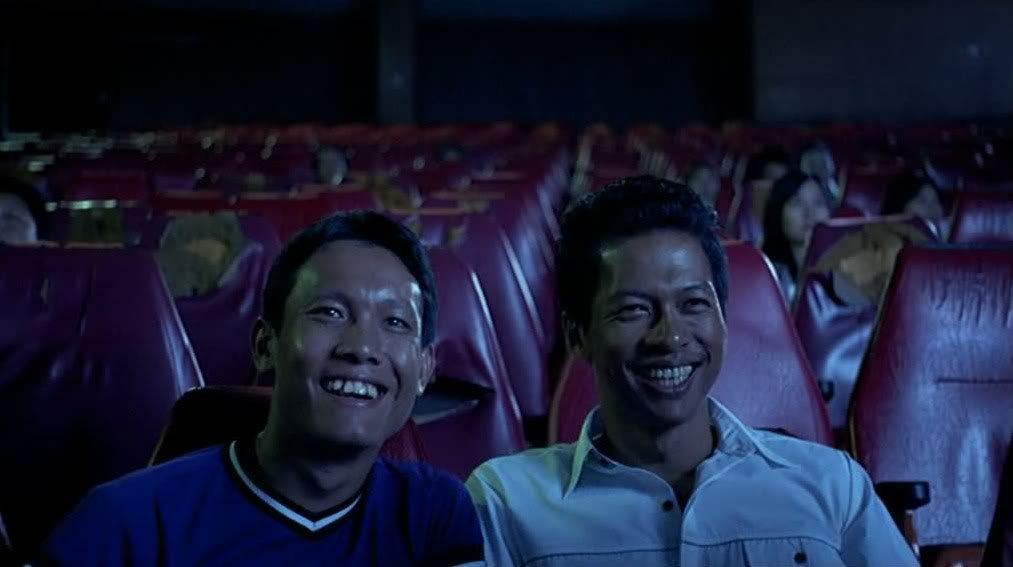
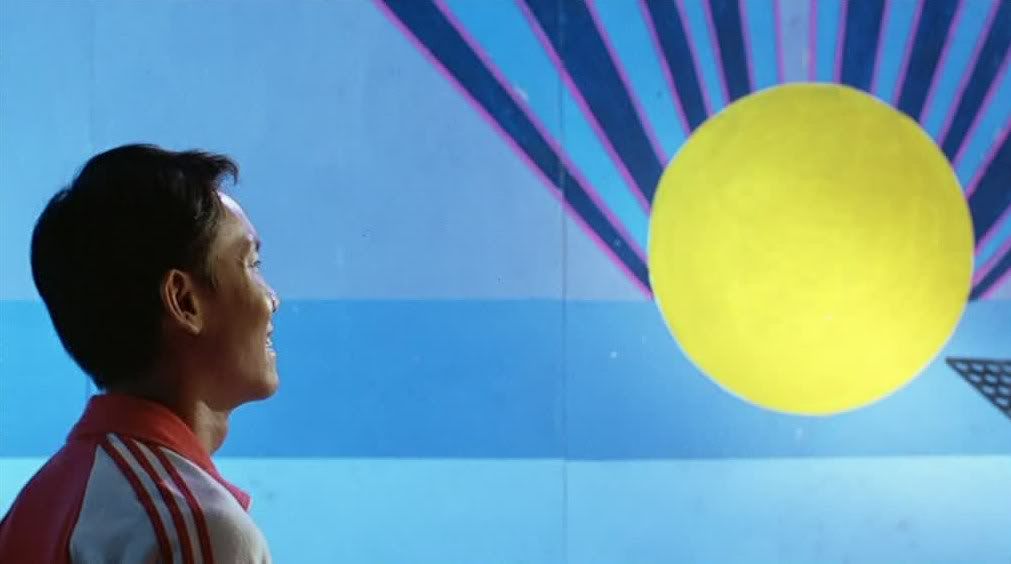
The first half of the film concerns the slow, hesitant progress of a burgeoning affection between these two men who initially don't know one another very well at all. There is great tenderness and warmth in Weerasethakul's depiction of this relationship, which exists on a hazy borderline between masculine friendship and romantic courtship. In one scene, Keng politely, formally asks Tong if he can lay his head across the other man's lap, and Tong replies "no" before, with a sheepish grin, adding that he really means "no problem." Keng tells Tong then that he'd like to serenade him, that he'd like to play the guitar for him like the romantic heroes of movies, which suggests that the two men are casting themselves in a grand screen romance. In other scenes, they goof around and play like brothers or playful best friends, their physical contact ambiguous, half romantic and half aggressive. When they go to see a movie together, Keng caresses the other man's knee and starts working his hand up the inside of his thigh, but Tong turns it into a game by crossing his other leg over Keng's hand, crushing it between his legs, and they struggle a bit with each other, smiling the whole time. There are indications that Keng is comfortable in his gay identity and probably has been for a long time: he encounters several other men who he seems to know, greeting them with nods and big smiles, and there are intimations of cruising in his bathroom encounter with one man. Tong, on the other hand, is bashful and seems inexperienced, and his awkward interactions with Keng reflect an uncertainty about what exactly is happening to them.

Weerasethakul simply observes the halting progress of this relationship, which culminates in a strangely erotic and mysterious scene in which the two men kiss and lick one another's hands, the most intimate contact they've had with one another, at which point Tong turns and walks away, disappearing into a dense, dark jungle, swallowed up by the black night around him. It feels like a moment of finality and rupture, and it is, for after this, Keng's motorcycle ride home transitions seamlessly into images of him back in the jungle with his army unit, looking at pictures of Tong. At this point, the film breaks apart and the second half of the film, titled "A Spirit's Path," is introduced with a second credit sequence, as well as the recitation of the legend of a shaman spirit who haunts a certain jungle area, playing tricks on the nearby villages. Keng, possibly in a new form as a different soldier, enters the jungle searching for this spirit, for the supernatural tiger that stalks the region, killing livestock and people.


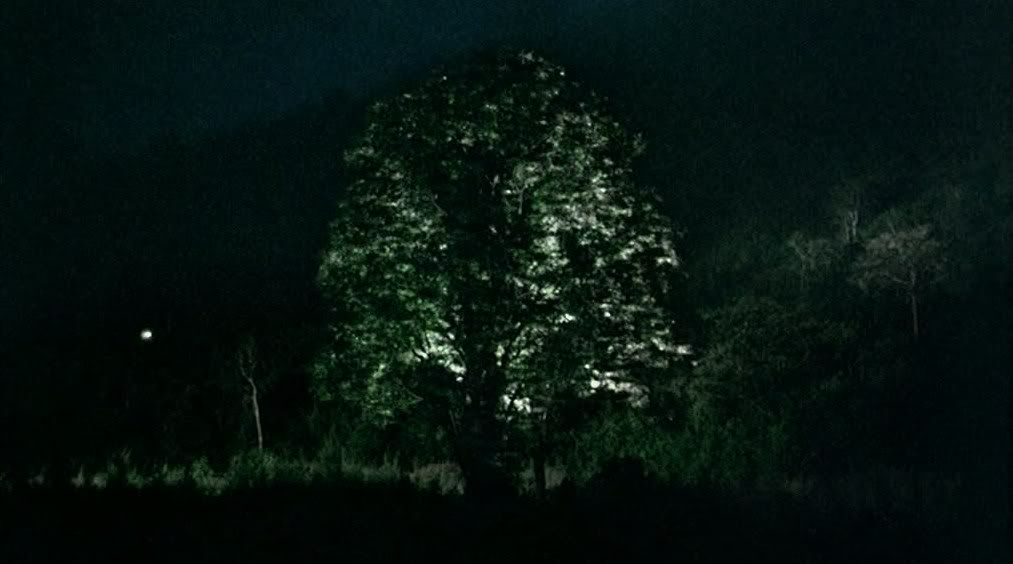
The second half of the film begins quietly, as the soldier wanders through the jungle, picking bugs off his skin, trying to keep warm in the night, listening to the mysterious rustling, crackling, chirping sounds of the jungle, which fill the soundtrack. But these prosaic, tranquil moments soon give way to an increasingly surreal and unsettling sequence of events, as the soldier fights with the shaman in his incarnation as a naked man, is warned of the dangers of the jungle by a monkey whose squealing language is mysteriously translated in subtitles, encounters the pale ghost of a dead cow, and comes face to face with a chirping firefly that might be a wandering soul, winding its way towards a tree lit up in the grainy night with thousands of similar pinprick lights. As the images and events become stranger and stranger, the soldier seems to be wandering through the dark jungle in a daze, lost in the shadows. The screen frequently goes black, or nearly black, and all sense of logic and stability is lost as the soldier stumbles towards his hysterical final confrontation with the tiger itself, a panting, hulking beast that fixes the soldier — and the camera — with an unforgettable, hungry stare, a stare that suggests that the tiger is sizing up the film's audience as prey.

The relationship between the film's two very different halves is unstated and elliptical, but the continuity in the actors, if not the characters, suggests that the second half of the film is a parable for the ferocity and danger of love, for the intensity of the connection that can bind two people together. The modern world, perhaps, is sometimes inappropriate to convey those intense emotions, the kind of emotions that defy words and explanations. In one scene in the film's first half, Tong and Keng visit a mall and Tong wanders up to a big advertisement for cell phones, adorned with the English words "connection" and "communication," but in fact the trip to the mall seems alienating and disconnecting, and Weerasethakul films Tong adrift in a sea of shirt racks and sale posters as though this was the jungle for him. In contrast, the scenes in the actual jungle convey a mysterious and otherworldly connection between the two men, or between the man and the tiger, who are drawn to one another and may kill one another or, in the suggestive words of the monkey, the man may be devoured by the tiger and enter its world. That's passion, violent and potent, infused with ancient myths and inexplicable occurrences.

The past and the modernized present coexist in Weerasethakul's cinema, blending into one another in interesting ways. Fables and legends linger on, as in the mention of an old uncle who could remember his past lives — an idea that was obviously percolating for Weerasethakul long before he made his most recent feature, Uncle Boonmee Who Can Recall His Past Lives, in which that conceit, tossed off in a few lines of dialogue here, is expanded upon. Shortly after this exchange, an older woman recounts a Buddhist parable about a monk who gave a pair of poor farmers a magical gift of gold and silver, which the men promptly lost through their greed for more — and the woman humorously, unexpectedly expands the parable through an anecdote about a similar situation on the Thai version of the TV game show Who Wants To Be a Millionaire. Fables, myths and legends remain relevant and alive in Weerasethakul's films, sometimes overshadowed by the bombast and chaos of modern life but never extinguished altogether. Such stories still resonate in the present, mysterious and beautiful and sometimes frightening.