Wednesday, August 10, 2011

White Material


In White Material, Claire Denis returns to colonial Africa, the site of her debut feature Chocolat and her sensual masterpiece Beau Travail. Building upon the foundation of those earlier visits to the continent, White Material is dark and strange, overflowing with violence and foreboding. It's also much more abstracted than Chocolat's grounding in colonial Cameroon: this film's setting is an unnamed African country on the brink of post-colonial chaos, with French rule being replaced by a simmering war between the new, corrupt African government and the rebels roaming the country armed with rifles and machetes, blocking off roads and seizing whatever they can from the few whites who haven't already fled. The film is an allegorical fever dream of war and disintegration, the bitter fruit of years of colonial rule and post-colonial breakdown.

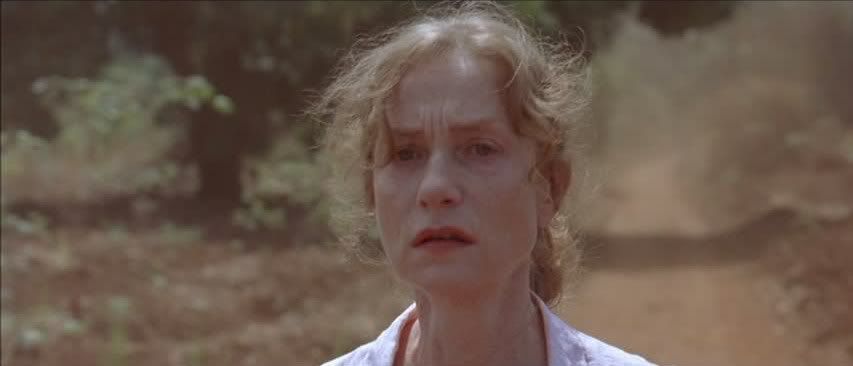
Early on, the plantation manager Maria Vial (Isabelle Huppert) sees a French military helicopter circling her land, warning her by megaphone that she should flee, that the French are pulling out and she won't be safe. They leave behind a land wracked by poverty, brimming with hostility. The French who formerly held all the land and all the wealth have seemingly transferred their privilege to a new government, who either accepted it as a gift from the fleeing colonizers or seized it in the process of evicting their former overlords. The people still have very little, they are poor and frightened, surrounded everywhere by war and rebellion and hatred when all they really want is to go on living their lives and providing for their families.

In her own way, at a grander scale, that's all Maria wants as well. She is fabulously privileged, with a large coffee plantation and a nice, spacious home, but she too only wants to protect her family, to protect what she sees as hers, to go on with life as she knows it even after it becomes obvious that things are changing, becoming too unstable, for the old ways to hold on any longer. Maria represents the "white material" that serves as a code word for the contempt of the blacks for their former masters. The "white material" is the things owned by the whites, but also their skin itself, a constant reminder of the old regime, the way things used to be. Maria and her family remain improbably pale, un-reddened by the hot African sun that's constantly beating down on them. Their seeming inability to tan is symbolic, as though they are not really tangibly there, as though the sun's rays don't really touch them. They are ghosts in this land, ephemeral presences soon to vanish as their time has past.

They each seem to realize it, though they deal with in different ways. Maria's husband André (Christopher Lambert) is lazy and useless, giving up his hold on the plantation and trying to negotiate a graceful way out, for himself at least. His father Henri (Michel Subor), who owns the plantation, is sickly, dying, nearly silent, roaming through the grounds as a mute observer to the ruin of his home, his presence a reminder of Subor's similar roles as a post-colonial relic in Denis' Beau Travail and L'intrus. Maria's son Manuel (Nicolas Duvauchelle) copes especially badly, even lazier and more useless than his father; the land, and the colonial system in which he grew up, has made him weak and pathetic. He lounges around all day, rarely ever getting out of bed, rarely leaving the darkened room where he's surrounded by fans, shielding him from the sun and the heat. He doesn't work, unlike his mother, who's not afraid to get her hands dirty doing the same work she hires local Africans to do for her: she could have thrived anywhere, one senses, but her son is a true child of the colonialist system, bred to do nothing. In the second half of the film, a close encounter with death finally drives the young man mad, and afterward he stalks through the film, his head shaved like a skinhead, his mouth twisted into a permanent smirk, his chest bare and his skin still remaining that milky pale color even after days spent running around the African plains in this fashion.

The film is elliptical, its chronology fractured, so that it opens with the blood and fire of the inevitable denouement before sifting back through layered flashbacks that explore the slowly building sense of dread leading up to this fiery climax. The music of Denis' frequent collaborator Tindersticks adds to the mood of desolation, as they provide one of their finest scores, a creeping, repetitive set of minor-key themes that periodically build to a throbbing, thudding outburst of rock as though the tension has to be released somehow. And still the pressure builds. Denis sets the film in an unnamed country that could be any number of African countries at any number of points in Twentieth Century history, and the result is a film that feels timeless and yet grounded in historical reality in that this scenario has played out, with subtle variations, numerous times in recent memory.

This is a full-throated cry against the horror and insanity of war, especially the particular kind of bloody, pointless war that has broken out in Africa again and again in the wake of the colonial era: the war of the oppressed against the oppressed. Even the rebel known only as the Boxer (Isaach de Bankolé), a symbol of resistance to the people of the country, seems horrified by this war when he stumbles across a church where the priest has been slaughtered and laid out on the floor in the position of a crucifixion. Was the man killed by the Boxer's rebels, or by their enemies? It hardly matters; the war's cruelty and pointlessness eventually swallows everyone up. As the Boxer first peers into the Church, a graceful camera move causes a ghostly crucifix, way back in the darkness, to drift across the frame, momentarily visible in the shadows before sliding back into them. That's how fleeting any kind of grounding or comfort is in this insane context, where all mooring has been removed. There are only momentary glimpses of humanity to be found here. Maria cares for the wounded Boxer, promising to get him medicine from a small village pharmacy that still struggles to maintain order and stability, scantly defended by a single armed guard, a meager defense against the chaos erupting all around them. Even Maria is eventually corrupted by this climate of hysterical violence, and when she snaps her actions are every bit as senseless, as pointless, as everything she's seen happening and everything that's happened to her as she tried to hold on to the remnants of her life.

White Material is a chilling, harrowing film, a potent depiction of the insanity of violence. Denis' elliptical editing creates a drifting, sensuous quality that contrasts against the mood of impending doom that slowly becomes inescapable. It's a filmed nightmare of a scenario that, despite its horrific abstraction, feels all too real and familiar.

Monday, August 8, 2011

Close Encounters of the Third Kind


Steven Spielberg's Close Encounters of the Third Kind perfectly captures the fear and the fascination that the unknown holds for humanity. The film focuses on the utility worker Roy Neary (Richard Dreyfuss), who's sent out into a remote country area to investigate a rash of mysterious power outages and instead comes into close contact with inexplicable sights that seemingly could only be alien ships. From that point on, Roy becomes obsessed with what he saw and felt, obsessed with getting answers, some explanation for his bizarre experience. The film is about the possibility of alien life coming to Earth, but more than that it's about the larger search for meaning, for understanding, the desire to make some sense of life, the universe and everything.

Spielberg is well-suited to capturing the mingled wonder, fear and confusion that characterize the film's complex mix of emotions and tones. Although Spielberg opens with a scene in which the French scientist Lacombe (Francois Truffaut) tracks the signs of the aliens' arrival on Earth, and returns to Lacombe at intervals throughout the film, the real substance of this movie is the effect of such unusual events on ordinary people. When Roy first encounters the alien ships, he's driving along on a deserted, pitch-black country road, lost and struggling with maps to try to find out where he is. Behind him, a set of lights pulls up in the window behind his head, and he gestures for them to pass by; they do, as a car impatiently goes around his truck. The next time some lights pull up behind him, Roy similarly waves them on and returns to his maps, so that only the audience sees that the lights go up, revealing a distinctly un-car-like shape hovering behind Roy. Spielberg's visual playfulness makes moments like this even more potent: witty, awe-inspiring, surreal and yet also somehow ordinary, the extraordinary seeping into the prosaic without warning, upturning all expectations and altering even one's basic presumptions about the way things work.

Roy's experience is indirect — mailboxes vibrate, all the metal in his truck is pulled momentarily up into the air by an electromagnetic force, and a bright light shines down on him, burning his face as he cranes his neck out of the truck's window to bask in its blistering beauty — but he'll soon see even more startling sights. Spielberg's presentation of the alien spacecraft is just as casually awesome, showing these hovering ships surrounded by halos of light, speeding down highways in convoys, turning whimsical circles in the air, trailed by a small ball of red light that seems to be scurrying to keep up with the larger ships. The imagery is spectacular but also grounded, suggesting that there's some kind of order and purpose to the ships' configurations and actions, even if it's a purpose that's obscure to those who witness these events.


Roy, along with fellow witness Jillian (Melinda Dillon), begins to get visions of a mountain that seems to have some importance to the aliens, but his family, especially his wife Ronnie (Teri Garr), is unsympathetic to his increasing obsession. Roy loses his job and begins spending his nights with fellow obsessives and curiosity-seekers, hoping to see something again, to get some confirmation that he wasn't just crazy. Nevertheless, there's more than a little humor in Spielberg's portrayal of Roy, who totally loses touch with ordinary day-to-day life in the aftermath of his "close encounter." At one point, Roy, finally having a clear vision of the mountain image he's been trying to capture, begins gathering plants and dirt and bricks from his yard, throwing them through the window into his house, as his distraught wife tries to stop him. He's oblivious, so caught up in his own excitement that he can't understand why no one else shares his thirst for answers. Later, after he's constructed a massive sculpture of the mountain in his living room, he looks out the window, his face covered in clay and grime, the mountain towering over his shoulder, and looks around at the beautiful sunny day outside. His wife and kids are gone, and his neighbors are playing and enjoying the day, puttering around in their gardens and playing with their children, and the contrast between inside the house and outside emphasizes the total disconnection that Roy feels. He's seen something he doesn't understand, and now he only wants, or needs, to know more, to make sense of it all.

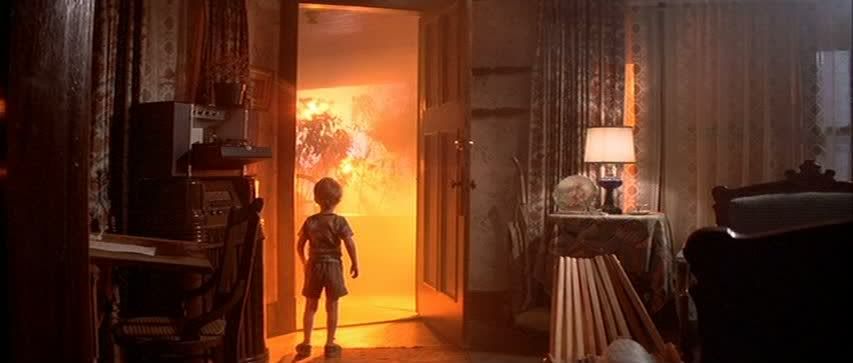
At other times, Spielberg plays this confrontation between humanity and the aliens as a horror movie, as when the ships surround Jillian's house. She struggles to close everything off, to keep the aliens out, and Spielberg shoots the sequence as horror, emphasizing Jillian's fear, even while her son Barry is as excited and curious as Roy is. The boy opens the front door as his mother desperately struggles to close off the house, and outside the open field around their home has been transformed into a glowing orange landscape, alien and strange, infused with the light of the ships hovering above. In another shot, Spielberg shoots down a chimney as Jillian fumbles around inside, trying to close the flue; the point-of-view shot suggests that an alien is scurrying down the chimney towards her as her hand blindly flails about for the lever. Perhaps the most chilling image, though, is the shot of screws turning themselves, rising out of a floor grating and falling out to loosen the grate.

The film does such a good job of evoking complicated, contradictory emotions about the aliens that the ending, in which Spielberg finally reveals the aliens as a benevolent presence (one even smiles at Lacombe), can only be a disappointment. The film is about the unknown, about mystery and awe and the struggle to understand, and the final confrontation between the humans and the aliens preserves this sense of wonder and uncertainty right up until the moment when the aliens are revealed as the typical large-headed humanoid creatures that we've so often imagined them to be in popular representations. When the humans try to communicate with the aliens by using a musical language — not fully understanding what's being said except that some kind of back-and-forth communication is happening — that's beautiful and mysterious. The aliens, in their rubber costumes, obviously fake even when they're shot through a haze of light obviously intended to maintain some distance and mystery, are a bit of a letdown in comparison to the unsettling, wondrous effects that came before. Still, Close Encounters of the Third Kind is a powerful, deeply affecting film that shares its protagonist's sense of gape-mouthed fascination with the prospect of life beyond Earth.

Wednesday, August 3, 2011

Films I Love #54: Mr. Klein (Joseph Losey, 1976)


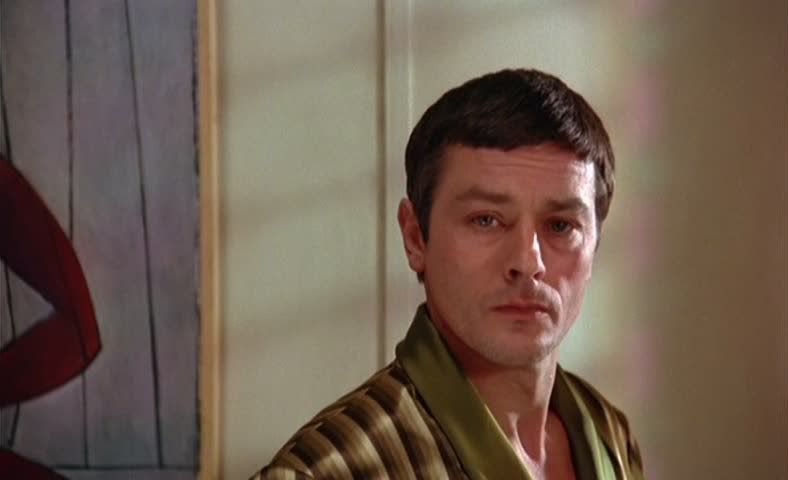
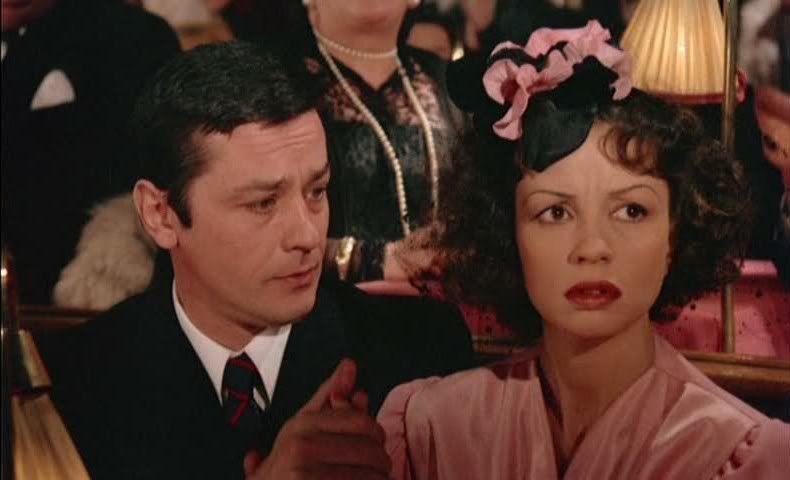
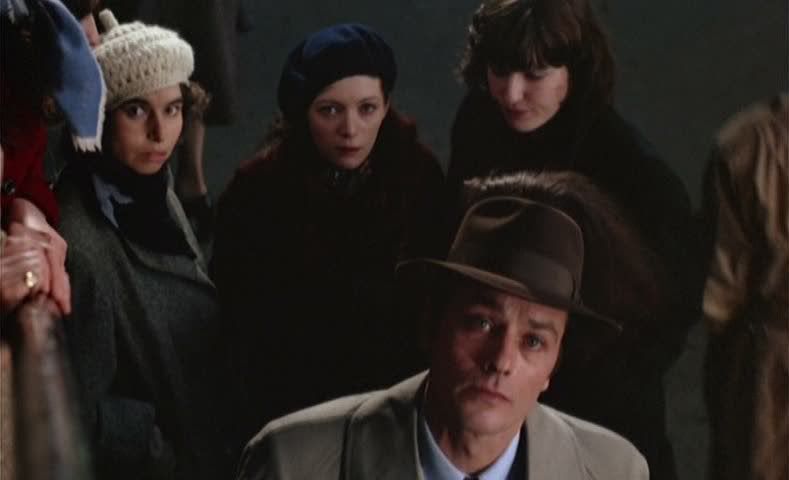
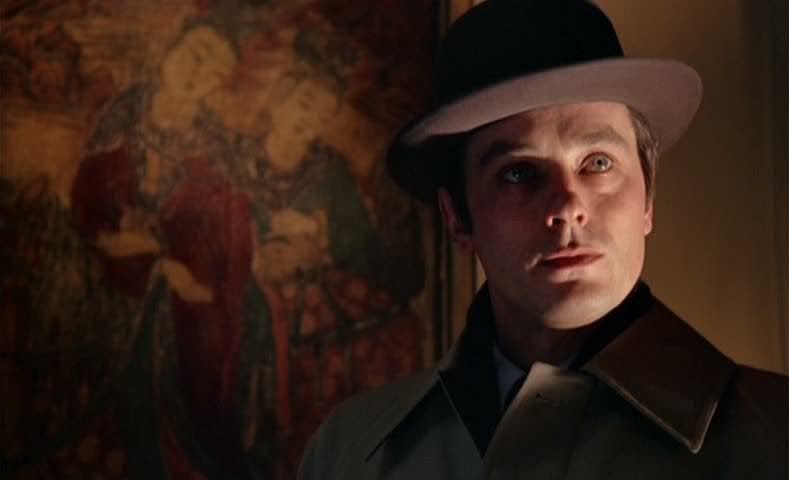
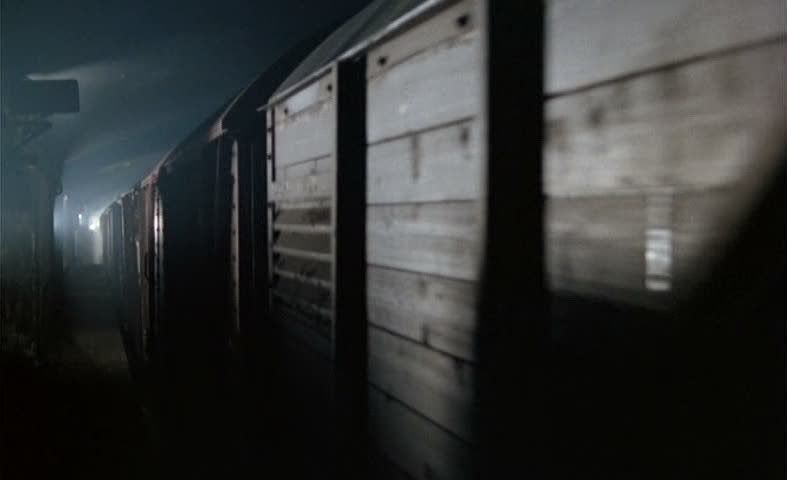
Joseph Losey's Mr. Klein, made in France during the director's long post-blacklist exile from the US, is a chilling (and chilly) parable about identity, fascism, exploitation and oppression. Set during World War II in occupied France, the film centers around the titular Robert Klein (Alain Delon), an art dealer who exploits the situation in his country by buying cheap paintings from fleeing Jews, who are mostly looking to get just enough money to escape the increasingly restrictive Nazi regulations. Klein is indifferent to those he exploits, caring only about his own luxurious life, until one day he receives a Jewish newspaper addressed to him. He realizes, soon enough, that there is another Robert Klein in Paris, a Jew disguising himself as a collaborationist Frenchman, and he becomes obsessed with ferreting out this other Klein, this mirror image alter-ego. This, in turn, attracts the attention of the Vichy police, who become suspicious of this Klein as well.

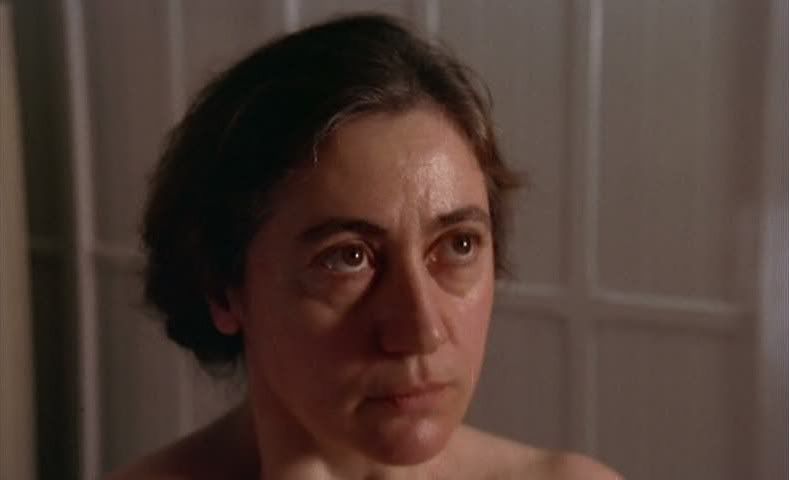
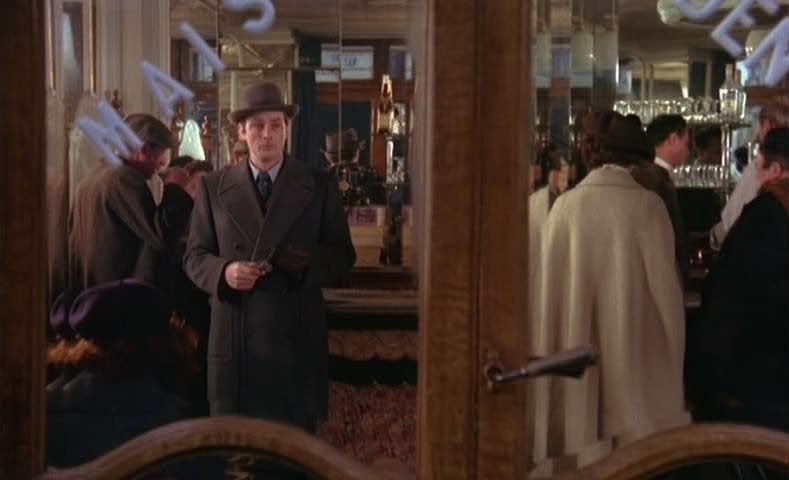
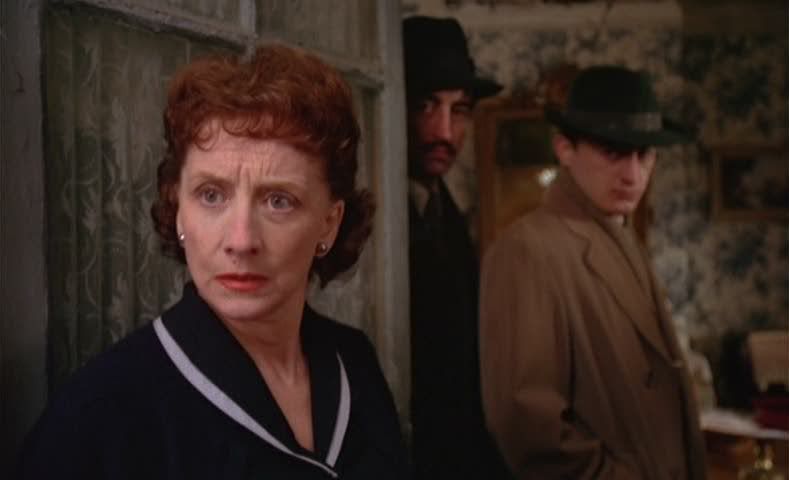
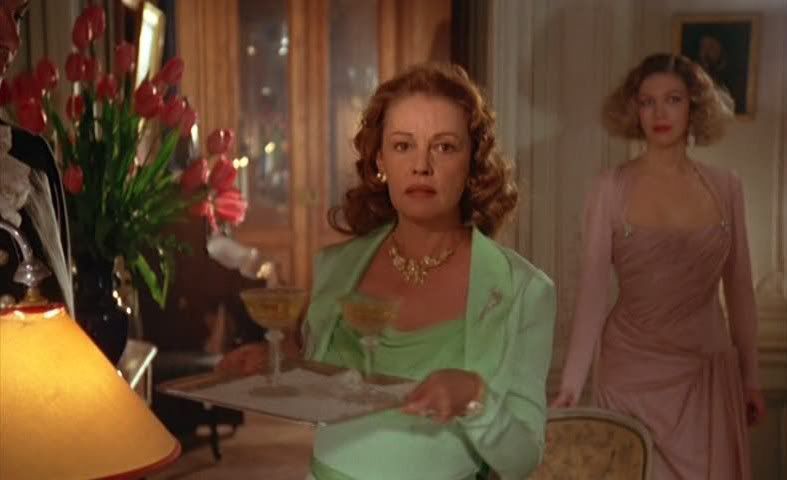
Losey's mise en scène is methodical and austere, evincing a cold distance that suits the abstract story of a man losing himself in a doppelganger he never quite meets. The multiple shots of Klein standing alone in a tightly wrapped overcoat and hat, isolated even in crowd shots, deliberately echo the hyper-cool image of Delon from his iconic role in Le samouraï. He wanders around, earnestly staring with his cold blue eyes, encountering various mysterious figures who fail to aid him in his search — with an impressive supporting cast populated with the likes of Jeanne Moreau, Juliet Berto, Francine Bergé, Michael Lonsdale and Rivette muse Hermine Karagheuz. The film's most stunning scene, however, is its first, a seeming non sequitur in which a doctor examines a naked female patient, clinically reciting various attributes that suggest an "inferior race." The cold horror and bureaucratic precision of this scene sets the tone for the remainder of the film, immediately establishing Klein's milieu as one in which human beings are treated like animals, their teeth examined like racehorses — an association recalled in the next scene, when Klein's pampered mistress examines her own teeth while applying lipstick. Losey's unforgettable film is concerned with this matter-of-fact horror, and with the oblivious mindset that ignores such things, insisting that everything is normal, everything is OK, even in the face of tremendous evidence to the contrary.


Monday, August 1, 2011

American Boy: A Profile of Steven Prince


In 1978, Martin Scorsese followed up Taxi Driver and New York, New York by making American Boy: A Profile of Steven Prince, a short documentary about a man who had appeared as an actor in small parts in both of Scorsese's previous fiction films. Prince had had an active life: he was a road manager for Neil Diamond for several years, and had been a heroin junkie as well, though by the time this film was made he was apparently clean. Years of hard living are written on his gaunt, drawn face. He's a distinctive character, with nearly skeletal features, brown and rotting teeth, bulging eyes, and a nervous, jittery manner. He is also an oddly compelling storyteller who recounts, in his cracked and agile voice, various alternately hilarious and harrowing stories about his family, his drug use, his experiences in his many odd jobs, and his encounters with crime and the law.

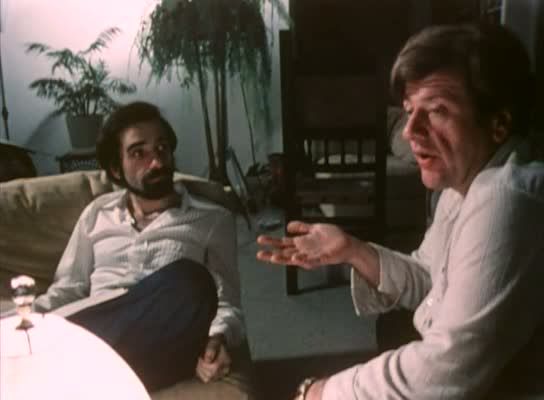
The film's style connects American Boy to Scorsese's other great documentary of the 70s, Italianamerican, his ode to his parents and the Italian immigrant communities they grew up in. The content and tone of the two films could not be more different, but in terms of style and approach there is considerable overlap. The two films demonstrate above all Scorsese's love of talk, his appreciation for people who can tell stories about their lives in ways that are both entertaining and enlightening. As in the earlier film, in American Boy Scorsese doesn't do anything flashy or distracting, he simply trains his camera on his subject in a casual, comfortable setting and lets Prince talk at length. Scorsese himself is often on camera, just hanging out in the corner of the frame, listening to Prince's stories with genuine interest. The film was shot in someone's living room, with friends gathered around as if for a party; people are frequently glimpsed drinking and laughing in the background. Obviously, this is the kind of context in which Prince is used to telling his stories: he comes off as someone who delights in telling shocking or funny stories to get a reaction out of people at parties. The film gives the impression that Scorsese and his friends have long been listening to Prince telling his stories, and finally decided that it would be a good idea to capture this unique personality on camera.

Prince's stories are often funny, though there's a real note of sadness that coasts along beneath the surface. He speaks about a friend who he didn't know was an alcoholic, and a party on the friend's boat where Prince filled a pitcher with vodka and served it to his friend as "water" in front of all the friend's family who were trying to keep him away from booze. The story climaxes with hilarity (the friend crashes the boat into a sandbar and tries shooting off flares to alert passing boats, but "it was the fourth of July; everybody applauded!") but at the same time there's no escaping the melancholy and self-destruction that drifts through so many of Prince's stories, about himself and those around him. Some of these tales are truly harrowing. He visits a drug den and is so oblivious that he actually sits on a dead man without realizing it, but what's really chilling is his casual attitude about it, even now, while retelling the story. It suggests a man who is very used to death and waste, as does his insistence even now that if he has to die, the best way to go is with a drug overdose. "You just get higher and higher and higher and higher and higher..."


Though Scorsese tries to stay out of the way, for the most part, it's obvious just how much he's guiding the film's progress in subtle ways. Despite the film's off-the-cuff aesthetic, Scorsese doesn't make any attempt to disguise the more manipulative and artificial aspects of the film. In the film's opening minutes, as in Italianamerican, he leaves in his banter with the technicians and camera operators and on-camera subjects about when they're going to start filming, leading into the film proper with an acknowledgment that this is a film, that it's not as spontaneous as it seems. Prince himself arrives early on, apparently to the surprise of Scorsese's actor friend George Memmoli, who promptly gets into a prolonged wrestling match with Prince that raises questions about how much here is being scripted versus how much is pre-planned.

There are other touches of Scorsese the filmmaker here and there, like when he addresses the editor with a note to cut something out of the finished film — though of course it's ultimately left it. But the artifice becomes especially obvious in the film's final scene, when Prince discusses a phone call with his father that apparently moved him a great deal. There are suggestions throughout the film that Prince loves his family very much; in the early scenes of the film, he talks about them with real affection and nostalgia, remembering funny and vivid scenes from his childhood, appreciating the obvious strength of his parents in particular. Scorsese's decision to cut in happy home movies from Prince's boyhood is obvious as a way of reinforcing the contrast between the happy, innocent kid in those movies and the troubled addict he later became, but it's also a way of connecting the boy with the man in deeper ways. It's a humanistic gesture that rejects the too-easy judgmentalism of those who would likely condemn Prince for his drug use and his wild life. In the final scenes, Scorsese seems to be probing for some sign of the boy still residing behind the man's nervous laugh and wide eyes. He has Prince tell the phone call story three times on camera, coaching him about what to say and how to say it, reminding him of details he'd left out, trying to reach the real essence of what Prince feels about his father and his family. It's remarkable because while this approach lays out the fact that the filmmaking is manipulative and not naturalistic, each successive iteration of the story really does seem to tap a little deeper into the emotion of the story. It's as though, in retelling it, Prince is slowly letting his guard down, moving away from the persona he uses when trying to entertain people. He's clearly moved by his father's understanding and tacit forgiveness, and though he doesn't quite verbalize it the emotions show through anyway.

American Boy hints at just how much of Scorsese's thematic and character material he has always found in the real people he knows. Steven Prince is a perfect Scorsese character, a haunted man with a real self-destructive streak, a charming but troubled figure who's stumbled through violent episodes and darkly comic vignettes with a certain amount of casual disregard for the insanity of life.