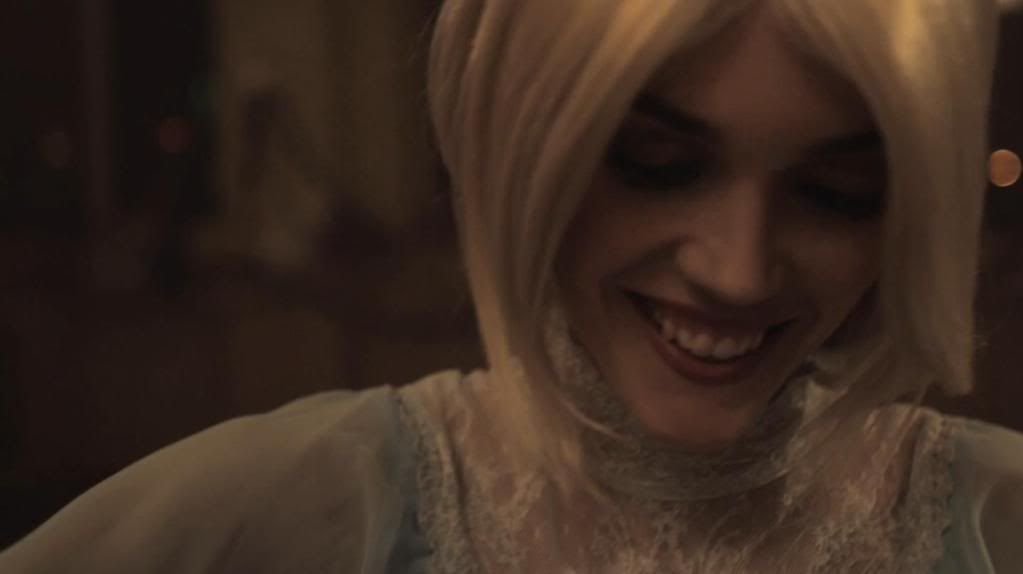

The short films of Celia Rowlson-Hall were recently introduced to me by Jeremy Richey, via an interview he conducted with Rowlson-Hall at his blog. She is a young filmmaker, model, choreographer and dancer who has posted many of her haunting, charming shorts online at Vimeo, where all of the films I'm writing about here can be watched for free. She's a versatile and fascinating figure whose films range from dreamlike bursts of subconscious imagery to elegant fashion showcases to cute/creepy psychodramas.
Prom Night is unquestionably her most powerful work, a dazzling eight-minute tour of the associations conjured up by the title. Throughout the short, Rowlson-Hall, who often appears as a performer in her own work, takes on a number of different roles and personae, using simple costume changes and fluid transitions to shuffle through a succession of female archetypes while dancing, alone, in a school gymnasium full of colored balloons. All the while, the Ronettes' hypnotic "Be My Baby" is looped on the soundtrack, at first blaring and then muted when the camera shifts to a more distant observation point, peering in through a window in the closed gym doors.
Rowlson-Hall is a dynamic screen presence, with an expressive face well-suited to the frequent closeups she gives herself. At the start of the film, she wanders at the fringes of the dance floor, sipping punch, her eyes darting around the room, nervous and excited, taking in the sights and waiting for the arrival of her date, represented by the camera's point-of-view. Then, growing bolder, she begins flirting with the camera, her dance partner, which is playfully reeled in by Rowlson-Hall's invisible fishing rod, floating closer and closer to her until the camera is directly facing her. She defuses this intimacy by making funny faces, then grows self-conscious and awkward, keeping her face mostly turned away from the camera and the dance partner it represents, only casting sidelong glances at the lens, smiling nervously and sweetly, an incarnation of the shy, excited prom date enjoying a romantic dance. Rowlson-Hall then begins reaching forward, past the camera, to take off the clothes of her "date," coming up with a suit jacket, shirt and undershirt. In the film's most startling moment, she then pulls the undershirt over her head and gathers the folds of her blue dress up around her, and for a few moments she's been transformed into an embodiment of the Virgin Mary, waving her finger, tsk-tsk, in a gesture of inaccessibility and chasteness. Only moments later, she ducks down out of the frame, and after a cut, she reappears in a skimpy red Baywatch-style one-piece bathing suit, stuffing balloons into her chest to become a voluptuous sex symbol.
These fluid transformations suggest that Rowlson-Hall is enacting various archetypes and stereotypes of femininity, embodying alternately the demure hometown girl, the untouchable symbol of spiritual purity, the Pamela Anderson sex kitten, the lollipop-sucking Lolita, Madonna with her infamous cone bra. She even channels the ultimate prom movie, Carrie, by dumping a bowl of red punch over her head. It's a beautiful film, alternately funny and eerie, sweet and sinister, but always tinged with nostalgia. Rowlson-Hall is delving subtly into the many different meanings of the prom in American culture: as a locus of sexuality, as a stage for enactments of gender roles, as a repository for memories of adolescence, as a last ritual of the teen years before the transition into adulthood. The prom is so loaded with potential meanings, and Rowlson-Hall's exploration of this event is ambiguous and multi-faceted enough to encompass them all.
It's an evocative and mysterious film, especially in its second half, when the camera observes from a fixed point outside the gym, peeking voyeuristically in through a window, as Rowlson-Hall alternately dances energetically and wanders listlessly about. This perspective, coupled with the now-muted Ronettes soundtrack, lends an aura of aching nostalgia to these scenes, as though the mind is now wandering away from this past, the memory growing more and more distant and faded. At the same time, the film's repetition, and the never-ending loop of the arch-romantic song, suggests that the same primal scenes play out over and over again, with different girls, different dances, different gyms.
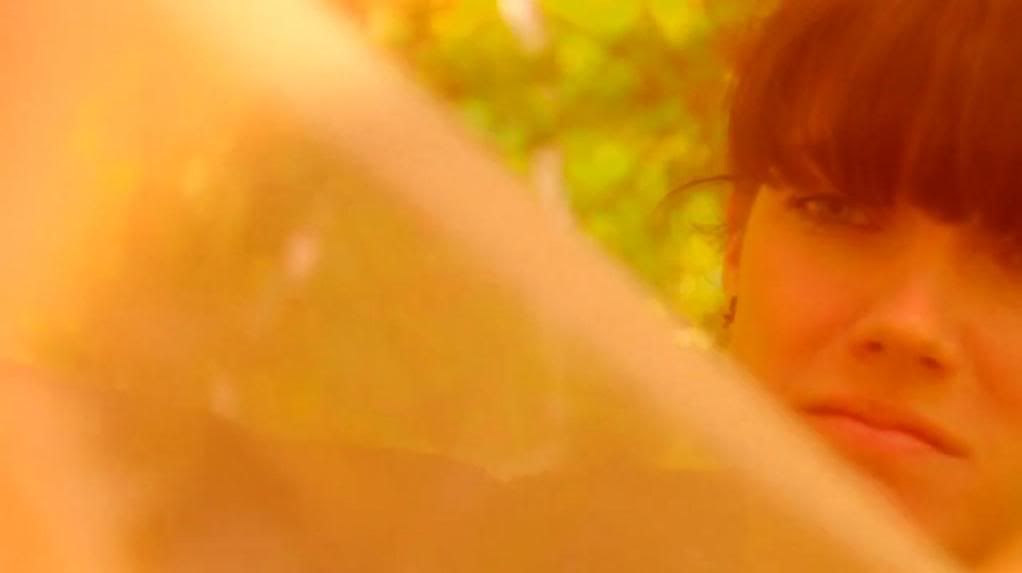

Pinata is a mysterious, emotionally draining three minutes that explores death and loss through a wordless, symbolic psychodrama. Celia Rowlson-Hall wanders through a sunny, autumnal woods scene in a black dress, kneeling by a whimsical shrine she finds in a clearing: a cupcake with a single large candle sticking out of it, which she blows out. She's commemorating an anniversary of some kind, but as the subsequent imagery reveals, it's not a birthday, and despite the balloons and streamers festooned on the surrounding branches, this is not a party. Instead, Rowlson-Hall comes face to face with a woman dressed in white (Mary Jane Ward), hanging from the trees, suspended by ropes like a swing. The woman's face is made up into a blank, mannequin-like expression, and she stares directly ahead, unmoving. It's obvious that Rowlson-Hall is a mourner, and the woman in white is a ghost, a dead woman, a lost loved one whose image continues to haunt the living.
The film's power comes from its potent examination of the grief that passes between these two women, one living and one dead. Rowlson-Hall's black-clad mourner goes through several stages in responding to this vision, first responding with unrestrained joy, embracing the dangling figure. But her pleasure soon shades into anguish and then anger, and she tears at the other woman's garments, lashing out: the implied, tearful question is "how dare you die?" The film's title is both symbolic — the hanging woman suggests a suicide, which would explain the anger and recrimination in this show of grieving — and also literal, as Rowlson-Hall begins thrashing at the hanging figure with a stick. The woman in white complies by showering colored confetti and candies into the browning leaves on the forest floor, a strange image that's both somewhat twee and genuinely disturbing.
This is an interesting film that balances its quirky imagery with the unsettling, unfettered expressions of grief that Rowlson-Hall unleashes here. She is, again, a startlingly direct and engaging actress who communicates this anonymous character's complicated tangle of feelings entirely without words, using just the expressions that flutter across her face.

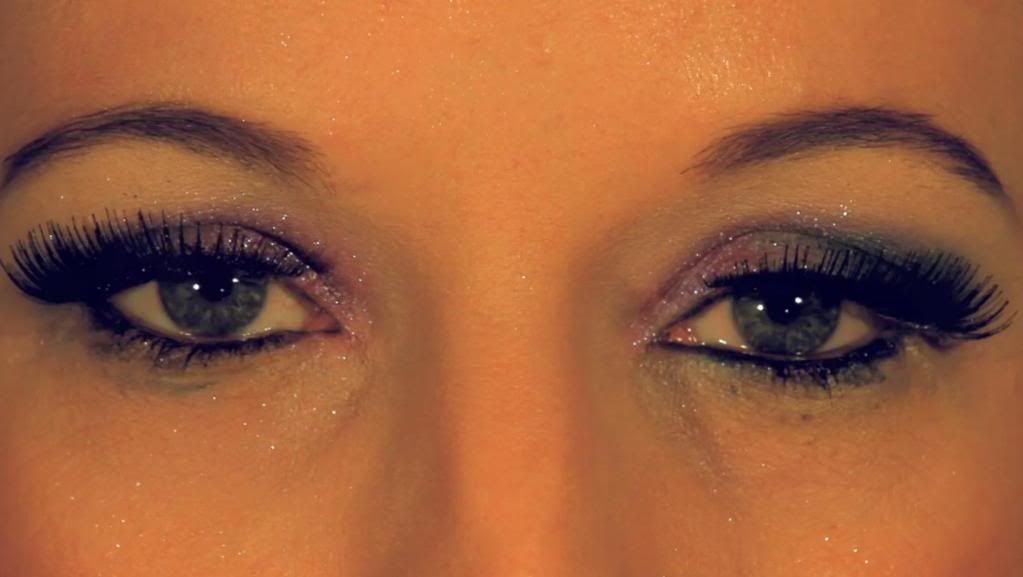
Three of a Feather is an odd little short that stands apart from the solo works that showcase Celia Rowlson-Hall's dancing and wordless performances. This is a collaborative work, with Rowlson-Hall credited with writing and direction, and choreography by Monica Bill Barnes. Three dancers (Barnes, Anna Bass, and Charlotte Bydwell) dressed in white ballerina outfits with large feathers on their heads wander through a strange, unpopulated world of urban refuse and unspoiled natural beauty. Accompanied by a gorgeous piano piece by Nina Simone, they jog daintily along a deserted country road, ride a carousel like it's a subway, and fish around in a lake for coins. Occasionally, they attempt awkward, unstable dance maneuvers, their movements tentative and halting.
There's something affecting about these awkward dances, performed in empty theaters with the stage lights shining brightly on the three girls. At one point, one of them reaches her arm up in a graceful flourish, only to stop in mid-motion, her hand tangled in the feather jutting up from the head of the girl next to her. For a moment, they stand still like this, and then the girl shakes her hand loose, causing the other girl to tip over towards her, pushing off her neighbor's thigh to maintain her balance. It's a strange scene, funny and baffling, like so much of the short's imagery, but it's also poignant: the dancers try to work together, to dance together, but their graceful micro-gestures never seem to come together into a truly satisfying group performance. Instead, the choreography is willfully incomplete, suggesting lithesome grace in the simple way the dancers move and stretch, but always refraining from really pulling these isolated movements together into a sustained dance.
This is a sweet, funny, but also curiously unsettling film that doesn't quite reach the level of the films where Rowlson-Hall herself is the star; she's obviously her own best performer. But the surreal, ambiguous visual imagination on display here is still compelling, allowing for multiple ideas to flow through the elliptical story of these three dancers. The film is about distinctions of amateur versus professional, about girlhood, about the iconography of the ballerina, all of this present as teasing hints just below the surface, multiple layers to a film that can be read in several different ways.