Saturday, September 6, 2008

Scarface (1932)


Howard Hawks' original Scarface is not only the blueprint for Brian De Palma's 1983 remake, but for the entire genre of gangster pictures to come, all of which would aspire to be as crude, violent, and angry as this one, only to inevitably come up short. After all, it's hard to top the performance of Paul Muni as the ambitious thug Tony Camonte, who starts out as the right-hand man to Prohibition-era beer runner Johnny Lovo (Osgood Perkins) but clearly wants much more. Even saddled with one of the world's worst fake Italian accents, Muni delivers a powerhouse performance, slurred and brutish and lurching, equal parts menacing and unbearably silly, with his cocky salutes, the jagged scar down his cheek, his sheer dumb insistence on getting everything he wants. What he wants includes control over both the south and north sides of Chicago (the latter of which he'll have to wrest away from an Irish gang whose accents are almost as embarrassing as the Italian ones), the love of Lovo's snooty, standoffish girl Poppy (Karen Morley), and for everyone to listen to his word as final. This includes his free-spirited sister Cesca (Ann Dvorak), who Tony defends from suitors with violent rage that betrays more than a hint of incestuous desire, a subtext that comes triumphantly to the surface in the film's final act.

Tony's rise to power and his inevitable equally violent fall are couched in a narrative framework of political propaganda, starting with the film's opening title urging citizens to petition the government to do something about rampant gangsterism. The film itself contains numerous topical references supporting gun control, the deportation of immigrant criminals, and, most puzzlingly of all, continual snide references to the writ of habeus corpus that protects people from being held by the police without charges. This odd sloganeering sits uneasily in the film, especially when the action pauses for heartfelt proselytizing from the police chief or some other public figure. The hectoring tone is very much at odds with the rest of the film's blunt depiction of Tony's crude, casually evil lifestyle, which does not (as some critics contended at the time) glamorize the gangsters but mocks them, satirizes their crudity and the ignorance that makes them turn to violence without thinking first. In one of the more subtle scenes, Tony and his mob attend a play, and in between acts the crew turns into amateur art critics, commenting on the play and wondering which guy the girl will pick, while Tony discourses on the way the rain effect is created. They're philistines putting on airs, monkeys dressed up in nice clothes, who only care how the story will turn out. When they have to leave in the middle of the play to murder a rival gangster, Tony leaves one of his thugs behind so he'll know how the play ends. One of the film's preachy speeches rails against encouraging gangsters by treating them like jokes, but elsewhere Hawks makes a compelling case for the power of satire. What else to think of Angelo (Vince Barnett), Tony's inept secretary and henchman, who can never quite figure out how to handle a phone call for his boss? Angelo's appearances are basically all hilarious routines that blend silent comedy slapstick with the verbal dexterity of a Marx brothers skit, and they contribute to the film's basic thrust, which is to make these gangsters look ridiculous, but no less dangerous in their stupidity and lunacy.

Muni in particular plays Tony pretty close to the edge of madness, starting out as simply a cock-sure young thug looking to make his mark, but soon escalating his intensity to manic, eye-popping levels. By the film's stunning final sequence, a wild shootout with the cops who have him surrounded, he's raving, his shouts turned into incomprehensible gibberish, his walk as stiff and lurching as a movie monster; he makes his final stand clutching a machine gun, stumbling around, and screaming in his own nonsense language, a steady stream of hate spewed at the world with machine gun speed. He makes Pacino's later over-the-top take on this character look positively controlled and mannered by comparison; you can always understand Pacino, at least.


Stylistically, the film is as unfettered as its title character, with Hawks employing a fast-and-loose style that skips and jitters in time with the plot. The film's style is encapsulated in the famous transition where a calendar's days fly off as a machine gun fires in the background, giving a new violent twist to the old device for conveying the passage of time; the film moves to the rhythm of gunfire. Hawks' camera slows down when it needs to, panning languidly across large rooms to take in the entirety of a scene, though there are times — particularly in the early stretches of the film — when the narrative threatens to get bogged down in too many talky, static scenes where the camera simply sits in a corner and watches, a relic of early sound picture styles. More often, though, Hawks' style is punchy and fast, matching Tony's quick-talking bravado and rugged machismo with a camera that swings around to track car chases and exchanges of gunfire, or more patiently wafts across a row of shadowy figures projected on a wall, moments before they're eliminated in a haze of bullets. The photography in the night scenes is especially striking, taking advantage of the obviously artificial, constructed Hollywood version of Chicago to create some wonderful proto-noir effects with shadows: an assassin meanders along the wall in shadowy reflection, signaled only by his cheerful whistle as he prepares to kill a rival; the camera looks down on a murdered body, criss-crossed by shadows that seem to form an "X" running across his body.

Scarface is the prototypical gangster movie, a rough and ragged classic that overcomes its occasionally clunky style and moral overlays with the sheer intensity of its aesthetics and performances. Muni is the indisputable center of this chaos, but he gives up at least a few bites of scenery to Boris Karloff as a mannered rival gangster, and especially to Ann Dvorak as Tony's vampy sister, who's best when she acts like a silent star, projecting with her wide eyes and sexy, hip-swaying dance, rather than letting loose her screechy overacting voice. The film is an utter joy, by turns funny and violent and vulgar and sexy, a visceral explosion of the id that only purports to be a staid anti-gangster picture.

Wild Man Blues


Barbara Kopple's Wild Man Blues, a documentary of Woody Allen's 1996 European tour with his New Orleans-style jazz band, confirms what everyone has long suspected, that Woody Allen the man is pretty much the same person that audiences have come to know from the characters he plays in films. He's neurotic, compulsively nervous about everything from boat rides to his own health, and he's very funny, in the casual, natural way that his conversational style tends to hone in on jokes at every opportunity. Woody's idol Groucho Marx was famous for always being in character, on camera and off, and it seems as though Woody has achieved a similar fluidity between his public and private personae. Kopple's cameras follow Allen rigorously throughout his whirlwind tour, capturing him on-stage with his band and off-stage in a variety of settings, from the required meetings with foreign dignitaries to signing autographs for fans to lounging around in hotel rooms with his sister Letty Aronson and his then-girlfriend, soon-to-be wife Soon-Yi Previn. Kopple catches many an unguarded moment, including some wonderfully intimate time spent with Woody and Soon-Yi, but what's remarkable is that the film hardly reveals anything new or particularly surprising about the director — instead, it often feels like watching a Woody Allen movie.

What is revealing in the film, though, is the attention given to Allen's music, which is often given short shrift in discussions of his work, but which he apparently considers a very important part of his creative life. Allen took up the clarinet as a very young man, moved by his longtime love of jazz, and he has been performing in jazz bands for longer than he has been making movies — he first started sitting in with some New York groups early on in his stand-up career in the 60s. Seeing Woody on-stage in this context is a new and seldom explored dimension to the performer. His love of jazz — and specifically this outmoded, rarely played form of New Orleans jazz — fits comfortably with his general nostalgic outlook, his affection for old artforms, for places with a sense of cultural history, for earlier eras. Kopple captures his performances with fluid, expressive camerawork, going for intuitive framings and reframings, the camera restlessly roaming over the faces of the players. The music is vibrant and fun, and the best parts of the film are its concert segments.

Unfortunately, Kopple doesn't focus as much as one would expect on the music itself, which is somewhat disappointing. Throughout the film, Woody laments that many people only go to these concerts for his celebrity status, not for the music, and Kopple's documentary occasionally seems to fall into the same trap. She's very interested in the reception Woody gets abroad as compared to in the US, and in his relationship with Soon-Yi, but to some extent the concerts themselves get short shrift. There are only two long, uninterrupted excerpts from the performances, one at around the halfway point of the film and the other towards the end, from the group's final concert of the jaunt, in London. Many of the other performances are chopped into very small segments, or worse yet interrupted by unnecessary voiceovers from Woody or his band leader and banjoist, Eddy Davis. It's rare that Kopple provides an opportunity to watch a performance develop over time, to get a sense for the structure of a whole song or the interplay within the band, or the ways in which their sets develop from night to night. Considering Woody's obvious desire for people to take his music seriously, it's unfortunate that the documentary itself mostly treats the music as filler, chopped up and played in short excerpts that serve as dividers between the material from backstage and during off-hours. It's not really a document of a working band and their music so much as it is a profile of a famous figure who just so happens to be touring in a band at the moment.


That said, the two occasions when Kopple does choose to focus on the music at greater length are very enlightening indeed. The excerpt from the band's final London concert provides a great opportunity to watch the improvisation within the band, the way the three horn players — Woody, trombonist Dan Barrett, and trumpeter Simon Wettenhall — pass off solos to one another in turn, a perfect example of the sensitivity to jazz structures and development over time that is missing from the rest of the film. Even better is the earlier long concert segment, in which Kopple excerpts a lengthy part of a performance starting with Woody's clarinet solo and running straight to the end of the song. Woody's solo is somewhat unusual, marked by very breathy, wheezy playing that mostly just sends air circulating through the instrument in quick, choppy breaths, only sporadically generating any actual notes. The music seems to emerge, tentatively, from the constant bed of static generated by the soloist's breathing. This tender, mournful solo, sometimes lapsing towards the threshold of inaudibility, surprisingly elicits laughter from the audience, who seem to think that Woody's kidding around, that his failure to produce clear melodic notes is a joke. They're seemingly unaware that his playing is intentional, and derived from a long lineage of similar techniques running through jazz history, and especially common in free jazz and post-jazz experimental musics. It's a telling moment, indicative of a gulf between the audience and the musicians. Woody knows full well that most in the audience are not there because of a genuine love or understanding of jazz, but because he's a famous director and media figure.

One only wishes that Kopple, having obviously grasped the importance of this moment by singling it out and dwelling on it, would have followed up on it, delving further into Woody's feelings about his music. She lets Woody talk about his music but seldom goes further into it with him. Some of the only direct, interview-style questioning in the film occurs towards the end, and it concerns Woody's relationship with Soon-Yi and the scandal that followed. Kopple also fails to really visualize some of Woody's most interesting observations about his music, like his repeated discussions of the balance he tries to strike between throwing out one "crowd-pleaser" after another and playing some more difficult, esoteric material. One would guess that Woody's breathy solo falls into the latter category, while most of the rest of the music in the film is relentlessly upbeat, danceable, and fun; certainly crowd-pleasing. But the film never develops any sense of how the band balances these two tendencies in concert, or how they structure their sets in general. There is some discussion of changing sets between nights, and Woody's conscious attempts to make some nights more challenging than others, but Kopple's presentation of the music in mostly sound-bite fragments doesn't provide any sense of how this actually works, or what the difference might be between one night and another. There's a disconnect between Woody's serious, intellectual consideration of his own music and the essentially fluffy presentation of that music in the documentary. The music segments are always enjoyable, not to mention beautifully and inventively shot, but there remains a sense of missed opportunities every time Woody makes an analytical statement about the music that is not followed up in the concert extracts.


Though this failure to really explore the band's music in depth is unfortunate, Kopple's attention to Woody's behind the scenes life does yield some interesting results. One of the most welcome of these is the most uncensored, unfettered view possible of the relationship between Woody and his young love, who at one point he playfully introduces as "the notorious Soon-Yi Previn." It is impossible to walk away from this film with anything other than a positive view of this relationship, which seems genuinely loving, affectionate, and comfortable. The couple, captured in quietly intimate moments by Kopple's unobtrusive camera, completely dispel the taint of perversion and iniquity generated by the rumor-hungry press who hyped up Woody's love for his then-girlfriend Mia Farrow's adopted daughter into a scandal of mammoth proportions. Kopple patiently accumulates a portrait of the couple through a wealth of details: Woody's casual compliments, Soon-Yi's gently scolding tone, the affectionate way she kisses his head when he's feeling sick or complaining about something or other, the way she squeezes his arm on a cozy gondola ride in Venice, their playful joking around with one another. Best of all is a great scene where Soon-Yi talks about Woody's films, admitting that she's never seen Annie Hall — which Woody says is the only one she should see — and that Manhattan is her favorite, while she says that she couldn't sit through Interiors. It's a warm, funny, unguarded moment, one of many in the film's backstage footage.

Wild Man Blues is not the in-depth examination of Woody Allen's under-documented music that it might have been, but it is nevertheless a certain delight for any of Woody's fans. For its joyous, lovingly filmed music, and its intimate documents of Woody's private time, the film is one of the best touchstones for those who wish to know what the famous director and actor is like when he's not making movies.

Thursday, September 4, 2008

A Girl Cut In Two


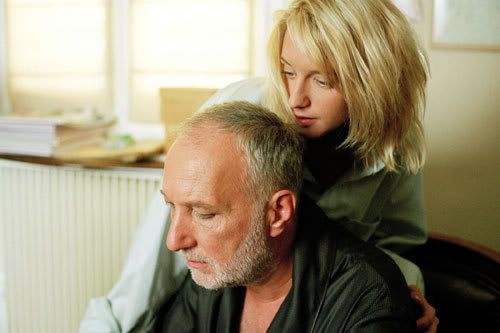
Claude Chabrol's latest film, A Girl Cut In Two, is two hours spent with some of the most smug, obnoxious, hypocritical people you'd never want to meet — and who, despite the time spent with them in their upper-class milieu, you never really do get to meet in any meaningful way. Chabrol, always a detached director, seems here less interested than ever in character psychology or the exploration of motivations, and more interested in surfaces, appearances, and language. One of the main characters, Charles Saint-Denis (François Berléand), is a writer who is obsessed with quotation, who likes to end conversations by using someone else's words; an odd tic for someone who produces his own original words for a living, but a very appropriate indication of the kind of distance that Chabrol is striving for here. The film continually raises questions about its characters and then refuses to answer them, discreetly looking away at pivotal moments, either directly (a cut to black prematurely cuts off the film's shocking climax) or indirectly (key conversations drift along on the soundtrack while Chabrol's camera wanders off elsewhere to shoot walls or flowers).

The girl of the title is the TV weather girl Gabrielle (Ludivine Sagnier), a charming, naïve young woman who soon attracts the attention of two rival men who already have a somewhat mysterious antipathy towards each other: the writer Saint-Denis, a local celebrity of sorts, and the spoiled, arrogant Paul Gaudens (Benoît Magimel), the heir to a fortune earned by his father and squandered in idleness ever since. The story is somewhat typical, as Gaudens becomes infatuated with Gabrielle, who leads him on but always stops short of returning his affections, instead throwing herself wholeheartedly at the much older Saint-Denis, a compulsive womanizer who seems mainly to be using her, enjoying her youth and her capacity for sexual molding. "I'll teach you," he says, and teach her he does, indoctrinating her into a sexually subservient role in which she'll do anything for him, from dressing up with a tail of peacock feathers to spending a night at a shady swingers' club where he passes her around amongst his friends. The material is sordid, but Chabrol's camera is discreet almost to a fault, suggesting a great deal without ever showing a thing. The film is inscribed with a curiously bourgeois outlook, in which whispers and rumors convey the plot more so than what is actually seen. In this upper-class country town, the sordidness of the inhabitants' lifestyle is papered over with a tastefulness that doesn't stop some of the more juicy rumors from being circulated in private: the incident involving Gaudens, some friends, and the kidnapping of a group of underage girls; the goings-on at a private little club where the upstairs room, never shown, seems to hide all kinds of debauchery; the suggestions of homosexual encounters in the pasts of both Gaudens and Saint-Denis. The connection between these two men, the source of their mutual hatred for one another, could lie in any of these distasteful little stories, which provide so little outrage from anyone. When Saint-Denis tells his puppy-dog-faithful wife Dona (Valeria Cavalli) about the rumors regarding Gaudens and the young girls, and the way his family connections got the whole incident covered up, all she can muster to say is, "I never judge anyone." This lack of judgment, this utter black hole of morality, sucks all of these people into its orbit; they won't judge, because they're all just as guilty.

Chabrol's bourgeois satire may be slightly passé to the extent that he's satirizing this amoral outlook — so the rich are despicable, you say? — but the film is more interesting and complicated in its consideration of chauvinism and the role of women. Chabrol has often been indicted for the misogyny of his male characters, and it's easy to imagine the same mistaken interpretations cropping up here. In fact, the film is a somewhat devastating critique of the limited options open to women in a society that continues to view them first and foremost as sex objects. The lovely Gabrielle experiences this subtle restriction firsthand, as no man she meets can fail to tell her how beautiful she is. Underpinning her every interaction with her boss or her male coworkers at the TV station is an unspoken sexual bargaining, communicated in looks and too-long touches, a sense that these men are constantly feeling her out, trying to leverage their influence on her career into sexual favors. As is characteristic of these people, they're too discreet to come right out and say it, but it's obvious anyway, apparent in everything they do and say. Gabrielle is surrounded by men who want her, which makes it hard to see why she might see something different in Saint-Denis, who she falls for almost on sight. Chabrol never explains this relationship, but he does convey its intensity: the only sexy moment in this nearly passionless film is a tight closeup of the couple sharing a playful, teasing series of kisses.


Despite this passion, what Gabrielle never seems to realize is that Saint-Denis is just another version of her slightly grabby boss, admittedly somewhat more suave and self-possessed but no less sexually manipulative or exploitative. And yet she runs to this man with giddy love, cheerfully lets him demean her, collapses into a zombie-like isolation and depression when he leaves her. Gabrielle is a bit of a naif, but she's also the only character in the film who lets a genuine sense of her feelings shine through, while everyone else is hiding in plain sight. At one point, when Gabrielle and Saint-Denis are at the height of their very public affair, she somewhat regretfully says that this is all having a great effect on Saint-Denis' wife Dona, who mopes around and cries all the time now. But when Dona appears in the next scene, she's in good cheer, teasing her husband and bantering with him and the couple's good friend Capucine (Mathilda May), a sexually voracious older woman who's frequently at the same sex club as Saint-Denis. Only Gabrielle seems to be really affected by things, although Paul, who's forthrightly childish in his spoiled insistence on getting his own way, seems to have the same capacity for emotional expression. The difference is that he's continually being pulled up short by an ambiguous friend, valet, or bodyguard who's always hanging around nearby, ready to stop Paul from going too far — which he accomplishes with a simple gesture, placing a hand gently on his shoulder, that is strangely imbued with a homoerotic subtext and emphasized by the way that Chabrol films these moments, the hand always emerging from offscreen with a jarring detachment from whatever's going on in the scene.

This detachment extends, in various ways, throughout the film, which is alternately intriguing and infuriating in its refusal to delve very far into these mostly unlikeable characters. The flat tone occasionally gives way to touches of wry, dark comedy — especially from the fey, needy Paul and his precisely caricatured upper-crust family — but for the most part Chabrol keeps the proceedings dry, even arid. One gets the sense that he directed the entire picture with one eyebrow strenuously raised, and no other expression on his face. Which is why the final sequence, in contrast, is so deeply moving, and so puzzling in relation to the rest of the film. As Chabrol unexpectedly literalizes and visualizes his title — that perfect metaphor for a girl not only torn between two men but torn apart by a societal framework with no respect for her — he lingers on a gorgeous, affecting, poignant closeup of Gabrielle, struggling to appear as detached and unconcerned as everyone else in the film, but still unable to keep a single tear from running down her face. It's an extraordinary moment, one that drives home just what a good choice Sagnier was for this part: capable of girlish glee and darker, more subtly shaded emotions alike, she possesses the film's only real beating heart, and she keeps it alive pretty much singlehandedly.

Wednesday, September 3, 2008

Force of Evil


Force of Evil is a dark, unflinching look at a society in which criminality has become so commonplace that it's practically become a business. This is a film about characters who keep forgetting, or wanting to forget, that they're not actually honest men, that they're crooks. This is especially true of Joe Morse (John Garfield), a mob lawyer who makes the transition from representing his clients to helping them set up their "business deals," to being actively involved in every aspect of their organization. Throughout all this, Morse keeps telling himself — and anyone who'll listen — that he's just a lawyer after all, that soon he'll help introduce legislation to transform these underground organizations into just a few more legitimate businesses. It's obvious that neither Morse nor anyone else believes this self-justification, but one of the film's primary themes is the ways in which people lie to themselves in order to get what they want but know is wrong — Morse has even turned this ethos into a tortured morality in which, he says, the only "natural" human reaction is greed, not guilt.

This blunt, economical noir is one of the few credits for writer and director Abraham Polonsky, whose career in cinema was tragically truncated by the Hollywood blacklist. Certainly, it wouldn't be hard to detect Polonsky's socialist bent simply by watching this debut feature, which makes the not-so-subtle point that racketeering is not really so different from other businesses in a capitalist society — it's only a grander form of thievery, a difference of scale rather than kind. As Morse's brother Leo, Thomas Gomez plays this aging racketeer like a frazzled businessman, in over his head, not wanting to make his living by robbing from others but unable to see a clear alternative; after all, he did basically similar things when he owned a gas station earlier in his life, except he made less money then. This blunt social commentary is matched by the often awkward narration, which is the film's one real weakness. Garfield's voiceover, mercifully limited to a few scenes, conveys the world-weary noir mood, but the writing lacks any verve, bogging down in too many repetitions and trotting out cliché after cliché. This is odd, because Polonsky's dialogue is frequently sizzling, funny and sexy and hard-boiled, all punch and pepper. His writing seems to thrive whenever he goes for pulp — which, thankfully, is most of the time — while his narration reeks of literary pretensions and strained profundity.

The voiceover is pretty much the only real caveat, though, in a film that otherwise rigorously develops its slow-burning plot. This is a morally engaged noir that deals openly with intricate issues of culpability, social responsibility, and justice, sometimes with ham-fisted preachiness — like a brief moralizing speech about the importance of acknowledging psychological ailments, obviously shoehorned in for the sake of the out-of-place message — but more often with intelligence and subtlety. The Morse brothers present a dichotomous moral character study, one feeling forced into evil and the other talking himself into believing that he's good, even though they both wind up being complicit in the same evil system. The duality of their relationship is both built into the script, and inscribed in the phenomenal performances by Garfield and Gomez: the former smooth, untroubled, and fast-talking, and the latter a sweaty, overweight neurotic, his eyes bulging, seemingly always just one piece of bad news away from a heart attack.


The doubling of characters is also carried over, albeit in a less fully developed way, to the two women in the film, the girlish Doris (Beatrice Pearson), who works for Leo's numbers racket but quits in a moment of conscience, and the prototypical femme fatale Edna (Marie Windsor), the wife of Joe's gangster client Ben Tucker (Roy Roberts). Doris might easily have been just another in a long line of sappy, unbearable heroines coming out Hollywood, but there's much more to her than a cute face and a plucky attitude. Pearson was a stage actress who made her movie debut in Force of Evil, then quickly returned to the stage for the rest of her career, obviously a loss for the movies on the evidence of this performance. She brings a subtle blend of emotions to this complex character, who projects such innocence and all-American cleanliness, and yet who has served as secretary for a numbers runner for years. She's a good girl with a criminal record, and she's undeniably drawn to Joe's roguish charm and his unabashed advocacy for naked self-interest and criminal greed. The sexual frisson between her and Joe is downright hot: not their curiously passionless kisses, but the quick-witted dialogue they throw back and forth, which crackles with the unsaid seduction going on between them. When Joe tells her he's celebrating "a clear conscience," she primly asks, "Oh, whose?" Certainly not Joe's, but probably not hers either. She's all mock-innocence and widened eyes, but her pouty mouth is just as likely to twist into a bit of a smirk as it is to patiently wait for a kiss. Next to her, the film's real femme fatale seems almost boring, even though Marie Windsor is a joy even in a somewhat small role, as the gangster's wife who keeps hitting on and tormenting her husband's lawyer more out of boredom than anything else.

Polonsky's first directorial effort inevitably makes one bemoan his shortened career. His visual sense is well-developed even on his first foray behind the camera. He has a crisp, clean sensibility, an eye for realistic street scenes and expressionist shadowy interiors alike. He creates a strangely unpopulated, artificial-seeming city that only occasionally opens out into brightly lit views of its buildings and facades, but seldom its people: the streets of this city are mostly empty. This emptiness is carried through in every frame of the film, especially in the undecorated white walls of the mobster Tucker's home, against which any human figure stands out like a filthy blotch on the unblemished white. In one striking sequence, as Tucker and Joe walk down a white staircase, Polonsky shoots from above in a long shot, letting them get lost in the nearly abstract maze of lines and shapes formed by the stairs, the railing, and the shadows strewn across the wall. Polonsky uses these striking effects sparingly, letting his dramatic framings accentuate the action: looking up from the bottom of a staircase at Joe, framed in shadowy profile; seeing Joe's face move, in close-up, through the criss-crossing areas of light and shadow in an abstracted composition. Force of Evil is a true classic noir, one of the shining masterpieces of the genre.