Monday, June 6, 2011

Saving Private Ryan


It has been said that all war movies are ultimately anti-war. The implication is that it is impossible to show the reality of war — the death and destruction, the dismemberment, the endless struggle over just one more patch of land like any other — without showing its horror, brutality and pointlessness. It has also been said, however, that no war movie can ever truly or completely be anti-war. By the nature of the war movie genre, it is inevitable that these films will be exciting and visceral, that they will show the bravery and honor of the soldiers, who are always at their bravest precisely when they are delivering grand, solemn speeches about how they're not brave. If Steven Spielberg's Saving Private Ryan proves the truth of one of these axioms, it is the latter rather than the former. Spielberg's film is all about the honor of war, the bravery of the soldiers. Saving Private Ryan has often been praised for its realism, for its truthfulness to the experience of war, but Spielberg's idea of realism is hiring real amputees to play soldiers who get their limbs blown off. It's shallow realism, a thin coating of the real over a foundation of Hollywood contrivances and rote recitations of familiar ideas.

The script (by Robert Rodat) makes repeated use of the words of Abraham Lincoln's letter to the widow Bixby, who lost five sons in battle during the Civil War, the key words of which refer to those who offer their lives as a "sacrifice upon the altar of freedom." (There's a metaphor for Spielberg's "realism" here, since history has shown that the letter was mistaken, and at least three of those sons didn't die in combat.) This letter is read early on in the film by a general upon learning that three brothers have died within a week of one another during the invasion of Normandy, during World War II. A fourth brother, James Ryan (Matt Damon), has air-dropped into a chaotic region, his location and status unknown. The film bears the name of this Private Ryan, and it's this man, who remains offscreen for much of the film, who serves as the focus of the subsequent action. Later, the words of the Bixby letter are repeated in voiceover, and again they seem like brazen manipulation, an unthinking regurgitation of grand words with a grand name to somehow legitimize them.

Such sentimentality is at odds with the battle scenes, in which Spielberg tries to be unstinting in his depiction of the horrors of war. The celebrated opening (which kicks in after a lame and thoroughly Spielbergian framing device) is a nearly half-hour re-enactment of the invasion of Normandy, a bloody and relentless sequence. The opening minutes of this sequence are especially striking: as the troop boats drift towards the shore, Spielberg shows the men inside the boats, praying and muttering to themselves, throwing up, shaking with fear. And then the boats arrive at the beach, and the gangway at the front lowers to allow the soldiers to charge off... and the enemy machine guns open fire, cutting down whole ranks of soldiers where they stand, before they have a chance to take so much as a step forward. Within seconds, a whole boat's worth of men has fallen, each line collapsing riddled with bullets, clearing the path for the next men behind them to be shot as well. It's horrifying, this devastating slaughter, and the rest of the sequence only intensifies the sensation of being surrounded by death. It's loud and visceral. Limbs fly, the bottom half of a man's body disappears into an impact crater, blood spurts, bullets ping off metal, medics struggle to staunch the flow of blood from men who are soon dead, either from existing wounds or new ones, as bullets continue to fly. In one shot, Captain John Miller (Tom Hanks), dazed from an explosion, watches as a soldier with his arm blown off wanders aimlessly in a circle, stoops down, and stands back up holding his own detached arm before strolling away like a zombie.

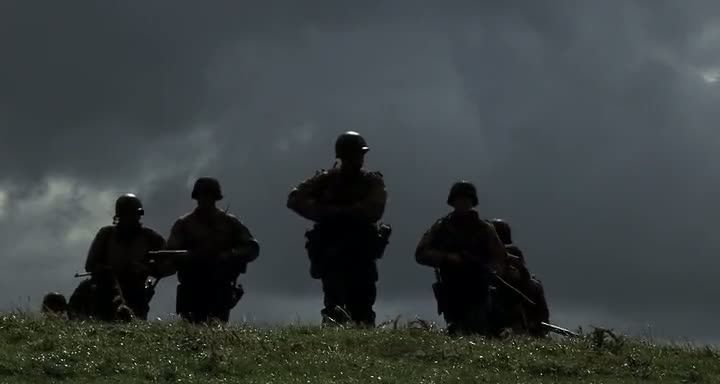
This is powerful stuff. But the film's visceral feel for combat and death doesn't really carry over into the scenes after the battle of Normandy, when Miller's unit is tasked with the mission of locating the missing Private Ryan and bringing him back safely, so that his mother will not have to hear that her fourth and final son has also died in combat. Miller's men resent the mission, resent being asked to risk eight lives for the sake of one, and though Miller mostly tries to keep his reservations to himself, he too is unhappy with the job. He loves and cares for his own men and feels the pain of losing each one, but Ryan, as he says himself, means nothing to him. The bulk of the film consists of this small group's trek across a battle-fraught stretch of France where German and American troops square off in various ruined small towns.
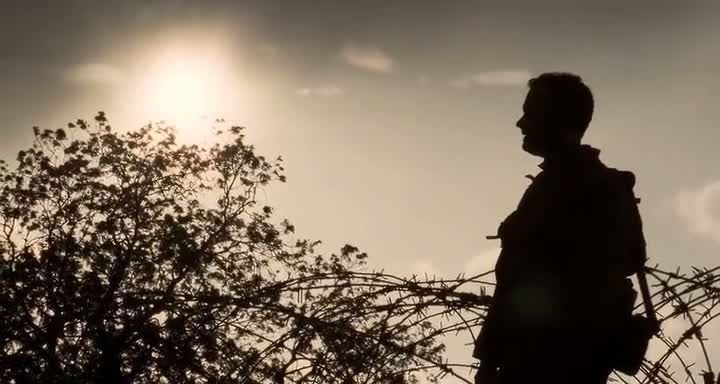

When the soldiers aren't engaged in battle, Spielberg and the script mostly resort to war movie clichés, like one man's never-sent letter to his parents, taken after his death by another man in the unit and then passed from one man to the next as those carrying it are killed in action. Another man regrets a childhood unkindness to his mother. Another man is Jewish and never gets tired of shouting his religion at German soldiers. The home and pre-war occupation of the guarded, private Miller are the subject of a pool in his company, and of course at a key moment he must deliver a big (and unbearably maudlin) speech about what he did before the war. The action is realistic and visceral, but when the soldiers put down their guns there's nothing but obvious scriptwriters' devices and Hollywood speechifying, a reminder that for all the blood and missing limbs Spielberg displays onscreen, this is still just another in a long line of Hollywood war movies, and a rather traditional one at heart.

There is one cliché that Spielberg and Rodat go to great lengths to subvert, and that's the cliché of the cowardly or incompetent soldier who redeems himself at the last moment in a grand act of bravery. Corporal Upham (Jeremy Davies) is a translator and map-maker who has never seen combat, but who joins the unit because Miller needs someone who speaks both French and German. Upham cowers at the fringes of each battle, watching from the sidelines, but in the film's final battle, a desperate struggle to hold a bridge against German tanks and infantry, he's tasked with running back and forth among the American positions, carrying ammo where it's needed. At some point, his already modest courage utterly falls apart, and he can barely do more than whimper and cower in a corner, trying to hide from the Germans. There is a certain moment that seems to be building towards Upham's redemption, but that redemption never comes. The tension of the scene arises almost entirely from the way Spielberg cleverly sets up expectations for a very conventional resolution: one expects Upham to finally man up and come to the rescue, but it never happens. It's a bracing defiance of convention from a filmmaker who is usually conventional, and purposefully so, even at his finest moments. So it's worth noting that Spielberg defies the convention in order to reinforce another, solidifying Upham's status as the cowardly and ineffectual intellectual figure. He also ties this cowardice to one of the film's most laughable contrivances, the German soldier who Upham had earlier defended from summary execution, only for him to return at the climax, once again killing American soldiers. It's outrageous, especially since it winds up suggesting that Upham was wrong, earlier in the film, to oppose the summary execution of a surrendering enemy soldier. The film seems to be singularly lacking in the perspective that enemy soldiers are, like Miller and his men, mostly just ordinary men doing their duty for their country. Instead, Spielberg, with his blockbuster instincts, has to make this random German soldier the villain of the piece, and everything surrounding Upham and the German soldier is so irredeemably muddled that it's not really clear what, if anything, the film is trying to say about this situation.

Sometimes a movie that isn't very good can still be interesting. A movie that fails in a thousand ways can still capture the imagination, provoke thought, deliver startling insights. Spielberg's movie is the opposite. Saving Private Ryan is a "good movie" that's not that interesting, a well-made war picture with no particularly fresh or interesting insights, only confused messages and silly regurgitations of clichés and leftovers from countless other war movies. In isolated scenes it sometimes seems like a fine film, and at its best it's undoubtedly a great action movie. There are scenes here, moments of awful beauty, that must surely rank among the most powerful cinematic encapsulations of the wartime experience. The red waves washing up over the bodies of men and beached fish at the end of the battle of Normandy, bloody waves gently rolling into the shore, are haunting and unforgettable (though borrowed from Sam Fuller, a towering influence on this film). The film's non-battle scenes don't often rise to this level, though, and the film is torn between two modes, between stark realism and Hollywood artificiality, without ever quite settling on one or the other.

Thursday, June 2, 2011

Cold Water


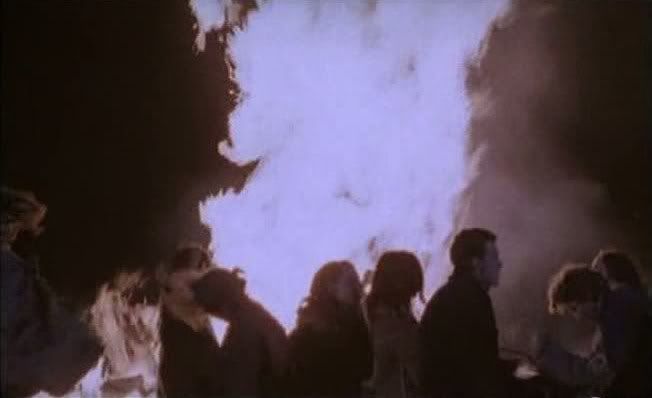
The key sequence of Olivier Assayas' Cold Water is a lengthy party thrown by a large group of teenagers at an abandoned house (a scene that would recur in different form in Assayas' later Summer Hours). Assayas' camera winds through the party, democratically encompassing all of the action in long tracking shots that show the teens dancing, smoking drugs after meticulously arranging the materials to fill a pipe, setting a massive bonfire in front of the house and dancing in front of it. As the soundtrack collages together Janice Joplin, Alice Cooper, Creedence, Bob Dylan, Leonard Cohen and Nico — appropriate to the setting of 1970s Parisian suburbs — Assyas' camera weaves around, capturing seemingly off-the-cuff compositions in which no one ever stands still, in which everyone is perpetually in motion. Outside, he frames the teens dancing to Creedence in front of the bonfire, flailing their limbs as others pile on more twigs and branches from around the spacious grounds of the country home, and the record periodically skips, starting over with the rollicking opening riff of "Up Around the Bend" after a nasty scratching noise. Every so often, the camera captures the leads, the disaffected teens Christine (Virginie Ledoyen) and Gilles (Cyprien Fouquet), dancing or kissing in the midst of this frantic, beautiful teenage paradise.

Only Assayas could make this anarchic scene so beautiful, so graceful. He obviously appreciates the lyricism and poetry in this teenage wasteland, the sense of alienation that's palpable and unavoidable for these kids. The flames, bright and yellow in the background, cast a golden glow on the faces of the partying teens, and their party is equal parts celebratory and destructive. They take apart the house, throwing chairs and pieces of window frames into the flames, shattering windows, and they dance around the flames as though celebrating a pagan ritual. But their faces are mostly smiling; they're free and happy, if only for the immediate now, and the hints of danger and rage that periodically threaten to boil over mostly center around Christine, the disturbed young girl who's desperately acting out as a defense against a father who's uncaring and disciplinarian and a mother who's too busy trying to sort out her own troubled life to do much good for her daughter. Christine is always running away, always in trouble, and anytime her father catches her he simply sends her to a clinic where they drug her and confine her, trying to wear down her rebellious impulses.

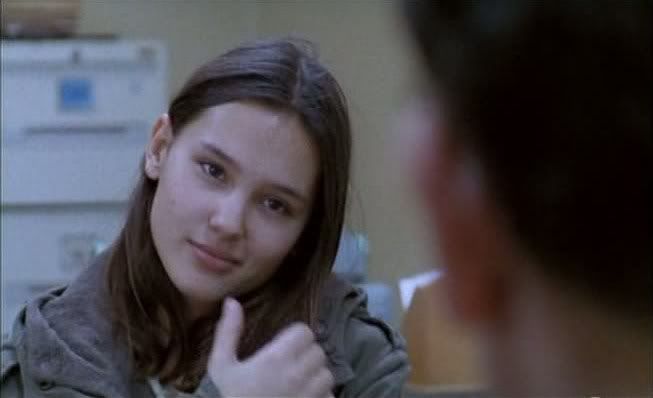
Early on, after Christine is caught while shoplifting with Gilles (who, leading a more charmed life than his girlfriend, manages to escape), she faces a police counselor who clearly wants to help her, who looks at her with frustration in response to her insolent stare and refusal to answer his questions seriously. Assayas is always framing Christine in tight closeups that emphasize her young, beautiful face and the utter inscrutability of her expression. She's often seen through some kind of filter, with a blurry windowframe partially obstructing the view of her face, making it difficult to get close to her. When she's sent to the clinic by her father, she sits patiently waiting with her suitcase in her lap, arranging her hair in front of her face, closing herself off from what's around her as though constructing a defense. (Later, when she chops off some of her hair, her new shorter haircut makes her look more open, more vulnerable, as though she's lost some of the shields that had protected her.)

She is a mystery, locked up inside herself, unable to express what she wants or what's bothering her — when asked a question about herself, by well-meaning authority figures like this one, she responds with mischievous pranks or impenetrable silence, simply fixing him with that inexpressive stare. She's unable to articulate what she wants, or she knows it won't do any good. Her experience with authority figures like her parents or the clinic nurses who want only mute obedience has not suggested that anyone's listening to her when she expresses her own opinions and her own desires. She's a totally lost girl.


Gilles, on the other hand, has advantages that Christine does not: he's a middle class boy with a well-off family, and when he gets in trouble, as he inevitably does, his family bails him out and smooths things over. His situation is coming to a head as well — his parents, divorced like Christine's but without the same sense of instability, have decided to send him to boarding school — but his home life is not nearly as dire as Christine's. His father, at least, tries to understand him, to communicate with his son, and when Gilles is upset at the threat of boarding school his father comforts him. It's obvious that while Gilles' acting out could be merely a phase of teenage rebellion, the destabilization of Christine's life is much more enduring.

There's a gap between them, the gap of class, exacerbated by Christine's mother (Dominique Faysse), who has an Arab boyfriend named Mourad (Smaïl Mekki), which Christine knows very well is viewed as an additional mark against her by the custody courts. But Christine's mother and Mourad are the ones who actually care about the girl, who want to help her even though they're unable to; her father (Jackie Berroyer) barely even listens to her, and the first chance he gets he simply sends her off to a clinic. Assayas films her father at the clinic talking to a doctor, seen through a window, the words they exchange inaudible — it's far more than he ever says to Christine, anyway. Virtually his only audible dialogue in the film is in a scene where he scolds and implicitly insults one of his employees while giving the man an assignment; one can see quite easily the nature of this cold, petty man and what his relationship with his daughter must be like.

The heart of Cold Water is this gap between generations, as well as the gap of class. The film opens with Gilles' Hungarian grandmother telling stories, in Hungarian, about World War II, stories that can't possibly mean anything to the kids she's speaking to. They're barely listening, and when they finish their breakfasts they rush off; they've got their own problems, and the past of their parents and grandparents couldn't seem more remote. Later, Assayas inserts a shot of the grandmother silhouetted in the dark, quietly praying under her breath, ending with a hushed "amen" — it could be a prayer for her lost grandchildren, for the aimless younger generation she doesn't understand, for her own burdens that they could never understand. It's a sign that, though this is a film that is totally on the side of the kids, a film that intimately understands teenage suffering, Assayas is also sympathetic to older value systems, including a spirituality that's as foreign to Christine and Gilles' generation as World War II stories.

The option of prayer isn't available to Christine and Gilles. With no parents, no stable value system, no idea what they want or what's expected of them, they're wandering aimlessly through the fog, sometimes literally as in a haunting sequence in which Gilles sneaks out of his house into a foggy evening, walking through a multicolored autumn forest and then riding his bike into a gray cloud that soon swallows him, erasing him in the dense smoke curling around him. This image of erasure and nothingness is echoed in the film's unforgettable final image, a blank piece of paper that reflects the inability of these teens to communicate, to make themselves heard. They're not even sure what they could say, what they could write, how they could capture what they're feeling and thinking in mere words. The film's title refers to that final scene, set by the side of a cold river in the middle of winter; the world is cold, and these teens huddle together to keep warm, but even with each other they can't quite communicate. They don't want to be alone, that's all they know — anything else is mysterious, inexpressible, and a blank page might be the only thing they leave behind in the world.

Tuesday, May 31, 2011

Happy Together


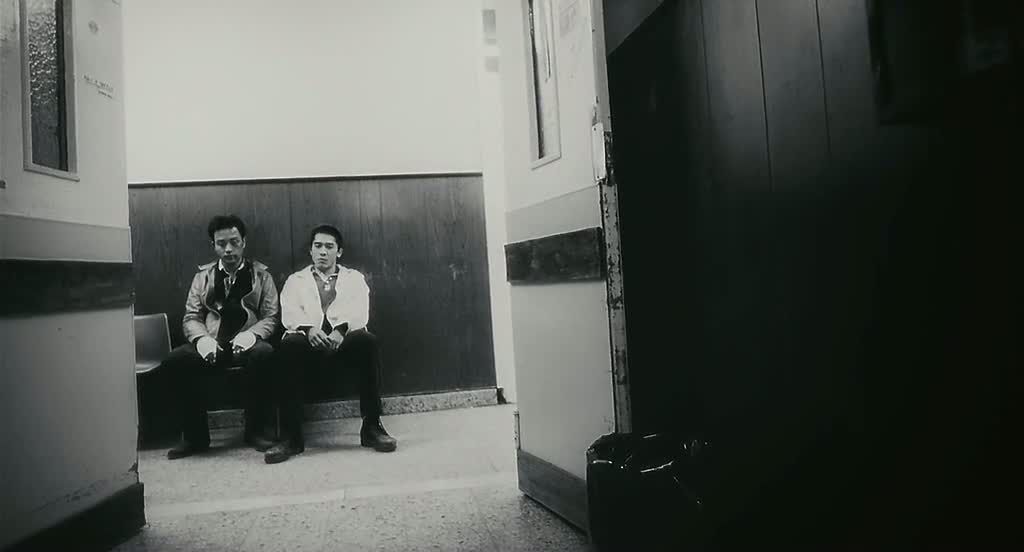
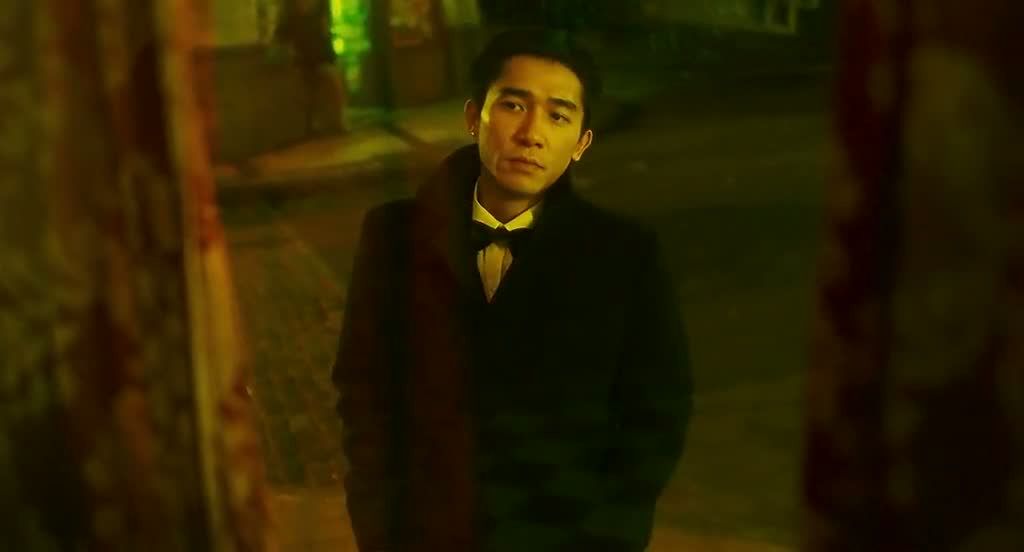
The films of Wong Kar Wai are often about people who feel very intensely, who love and hate with a fiery passion that bursts out in the garish, expressive aesthetics of the films. In Happy Together, Wong examines this kind of passion especially intimately, through the gay relationship of Ho Po-wing (Leslie Cheung) and Lai Yiu-fai (Tony Leung), who visit Argentina together as a way to reinvigorate their on-again-off-again relationship, but wind up instead merely replaying the same troubles they always have. The film is a powerfully focused examination of this disintegrating, up-and-down relationship, capturing the violent emotions, the heartbreak, the longing and desire, and the fleeting moments of happiness that are like the glue holding this fractured romance together, momentarily bridging the gulf that's widening between these two men.

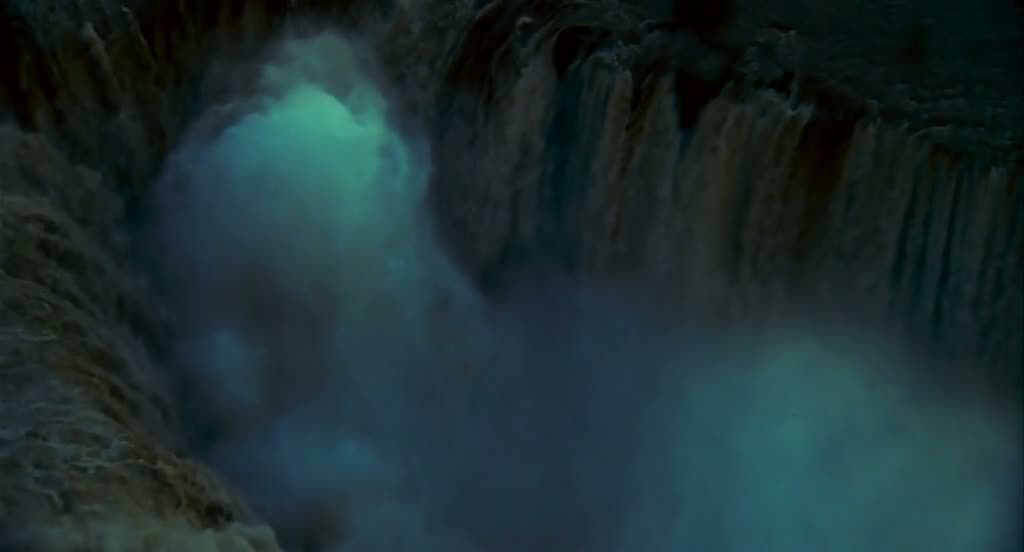
That gulf is represented, in many ways, by the waterfall at Iguaza, which they promise to visit together during one of their happier moments. The falls, seen on a lamp that Yiu-fai bought — a bright and gaudy representation of the falls, lit from within by a rotating cylinder that makes it seem as if the water is glistening in the sunlight — come to represent for Yiu-fai the potential for happiness and togetherness. This trip is something they planned to do together, a goal for their relationship, a sight they could share. Wong visually suggests that it's also an abyss that might swallow them whole. An image of the actual falls is inserted early on, as a response to the hopefulness that Yiu-fai has for the trip, but the image of the reality is very different from the lamp's sunny depiction of natural splendor. It's a sensuous color image of the waterfall, all dark blues and jungle greens, inserted into the mostly black-and-white opening section of the film. The camera slowly turns around the falls, capturing the slow churning of the water and, increasingly, the drifting white smoke that begins to fill the frame as Wong's graceful camera move pushes the tumbling water itself off to the sides. In stark contrast to Yiu-fai's optimistic desire to see this place with his lover, the image is dark and sinister, an image of destruction and apocalyptic grandeur: it is a seemingly bottomless pit, filled with smoke from the violent churning of the water as it crashes into the reservoir deep below. It's a gorgeous but foreboding image, a suggestion that what waits at the end of the trip is not reconciliation but erasure, heartlessness, brutality, the cold and cataclysmic violence of nature.


That image, so frightening and intense, lingers over the rest of the film. When that tracking shot of the falls predictably recurs at the end of the film, it provides a kind of melancholy closure, as one lover sees the falls in person, the water rushing down towards him, its spray drenching his face, while the other is left with the lamp, a gaudy and false facsimile of the real place. That's the essence of the film, the moment it's journeying towards, as Yiu-fai struggles against the confining boundaries of his unhappy relationship with Po-wing, a relationship where it's not clear who needs the other more, who's keeping who prisoner.

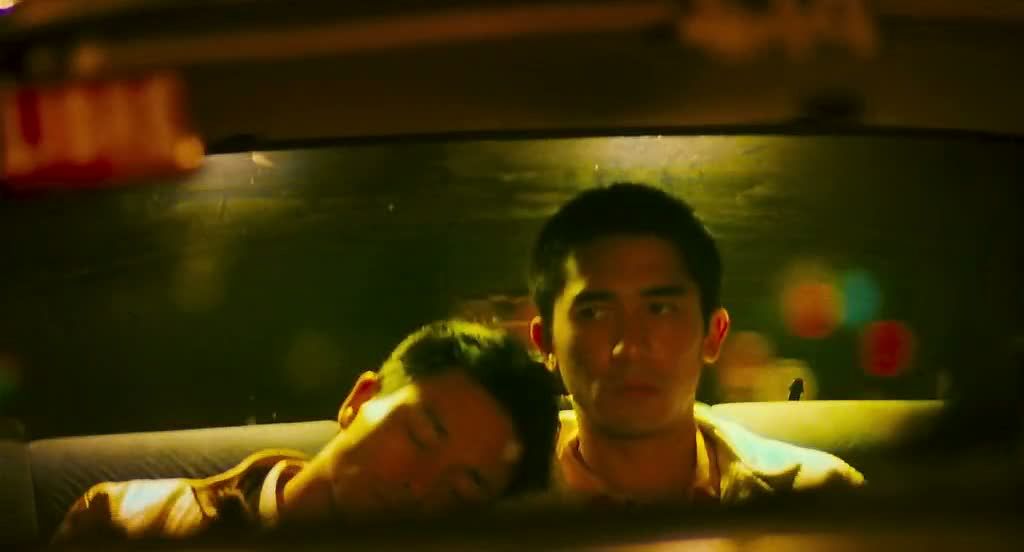
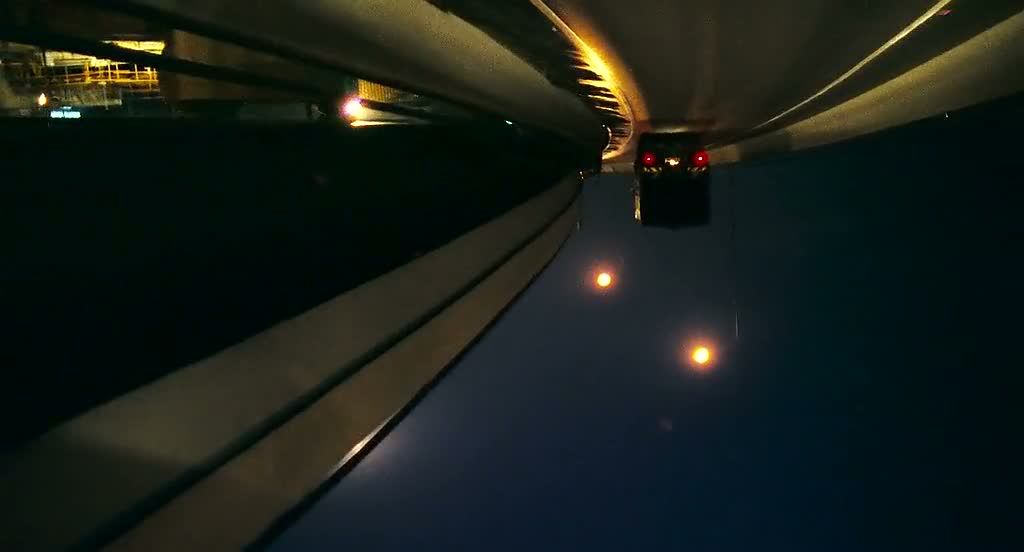
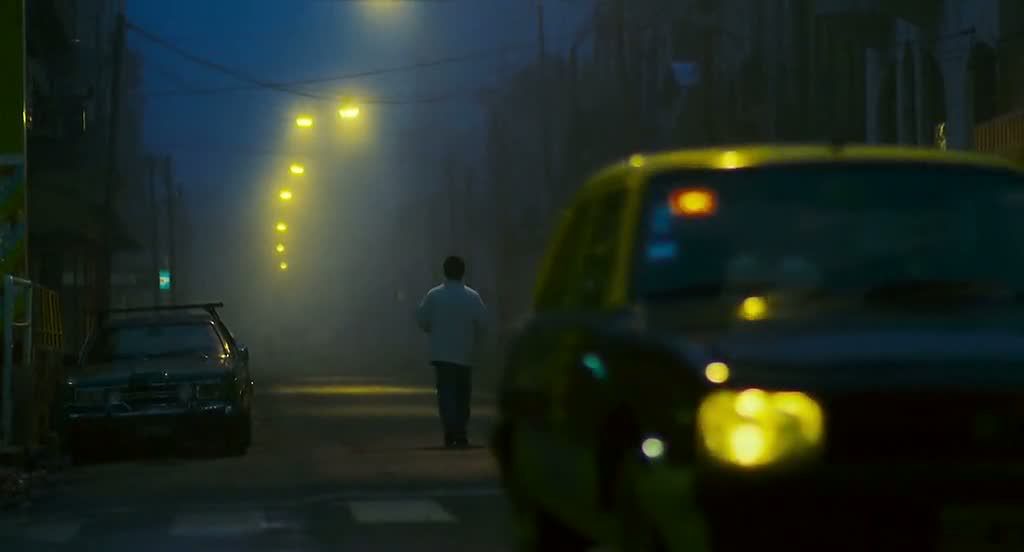
That dynamic plays out within some of Wong's most potent and beautiful images, as captured by his usual cinematographer Christopher Doyle. Though set mostly in Buenos Aires, Wong finds in this city a Southern hemisphere counterpart to his home base of Hong Kong, which perhaps explains the sequence where Yiu-fai, realizing that he is in the other half of the world from his home, imagines what Hong Kong would look like upside-down. The answer, as envisioned by Wong, is indeed turned upside-down but not otherwise that different, as he finds in Buenos Aires a similar late-night neon vibe, all hazy lights and poetically empty street scenes, occasionally interrupted by a bright, summery daytime scene where the sun fades the images to a white glare. That impression is introduced slowly into the film, as most of the early scenes play out in a crisp, high-contrast black-and-white, with only selected moments rendered in the characteristic warm, brilliant colors of the Wong/Doyle collaborations. When, after Yiu-fai and Po-wing are reunited following some time apart, the film explodes into full, sumptuous color during their cab ride back to Yiu-fai's apartment, it's as though the fullness of the couple's conflicted emotions have finally exploded to the surface of the film.

Despite these strong emotions, Happy Together is more relaxed and languid than previous Wong Kar Wai films, in which unpredictable violence could erupt at any moment, and this film looks forward to the slow, sensuous rhythms of In the Mood for Love rather than the the frantic tempi of most of the preceding films. The body of the film focuses on the lovers' uneasy reunion, as Yiu-fai tries to hold onto the unstable Po-wing, who obviously needs and cares for Yiu-fai but still can't help straining against the bounds of their relationship, going out, sleeping with other men, prostituting himself with American tourists. The relationship settles down slightly when Po-wing is beaten up by some of his clients for stealing a watch, and Yiu-fai tends to his lover during his recovery. The scenes of tension and arguing are offset by scenes of surprising tenderness and affection, like a sequence where Po-wing teaches Yiu-fai to dance, and the dance slowly becomes a gently swaying embrace. This scene, like the opening's disarmingly explicit and erotic sex scene between the men, establishes the stakes of their troubled love, the real depths of feeling upon which their often fractious relationship is built.


There's also tenderness in the depiction of Yiu-fai's friendship with his restaurant coworker Chang (Chen Chang), which is contrasted against the doomed love affair at the center of the film. As Yiu-fai's relationship with Po-wing collapses, his connection — platonic and hesitant, though not without suggestions of attraction and intimacy — with Chang deepens. Chang is a typically eccentric Wong character, a young man who had been nearly blind as a child and who had, as a result, developed extremely sensitive hearing and an ability to detect the smallest nuances of emotion in people's voices. He also, despite his displacement in South America, has the stability of home and family that the rootless Yiu-fai, wandering in a foreign land and disconnected from a family that's all but disowned him, only wishes he could someday return to. Those longings, the heartache and sadness of these aimless men, are expressed in typical Wong fashion. Chang carries a tape recording of Yiu-fai's tears to the "end of the world," a lighthouse in the far south of Argentina, where, it is said, his worries can be dissipated; it's a moment that looks forward to the similar scene at the end of In the Mood for Love. Po-wing also enacts the ritual of visiting his lover's apartment while Yiu-fai is not there, cleaning the place and rearranging things, a form of intimacy without direct contact that weaves through Wong's films.

Happy Together, like nearly all of Wong's films, is a deeply moving and rich work, a film about dislocation and the longing for stability. These characters have drifted far from home, isolated from their families and their homes, and they unsteadily try to make their way in an unfamiliar land even as their emotions overwhelm and unbalance them. Turned upside-down from their homes, they rush towards the churning abyss, towards the end of the world, and then pull back towards redemption and rebirth at the very last moment.

Saturday, May 28, 2011

The Conversations #26 (part 1): Terrence Malick


The latest conversation between Jason Bellamy and me has now been published at The House Next Door. With The Tree of Life just now arriving in at least some theaters, we take the opportunity to address the first four features of director Terrence Malick: Badlands, Days of Heaven, The Thin Red Line and The New World. It's a lengthy overview of the director's career and aesthetic so far, and within the next month we'll be following up with a second conversation, focusing on The Tree of Life itself.

As always, we welcome your input, so go take a look and join the conversation. Malick is a direct who seems to inspire great passion and affection, but also some equally strong dislike. We think that both sides of that debate are likely to find some ideas to agree with and take issue with in this conversation, so we hope there will be a lively conversation in the comments.

Continue reading at The House Next Door