Wednesday, June 29, 2011

Les Cousins


Claude Chabrol's second feature, Les Cousins, is, like his first film Le beau Serge, a study of opposites and dichotomies: urban/rural, innocent/worldly, intellectual/physical, sheltered/experienced. In Chabrol's first film, a bookish young man returns home to the small town where he grew up and finds that his childhood friends have grown hard and mean in the years he's been gone. In this second film, the roles are reversed: Jean-Claude Brialy, who played the naïve intellectual of Chabrol's first film, now plays the decadent Paul, whose country cousin Charles (Gérard Blain, who played the tough, drunken Serge in the earlier film) is coming to visit. Charles' arrival in Paris, to go to school in preparation for a big exam, introduces him into Paul's wild, extravagant lifestyle. Paul first appears in a long dressing gown, gesturing boldly with a cane, delivering grand orations, with his older friend Clovis (Claude Cerval) hanging around nearby, seeming equally decadent and strange. The relationship between these two men initially seems homoerotic, and that doesn't entirely change when the orgiastic atmosphere of Paul's lifestyle becomes fully apparent. The unworldly Charles seems to have landed in the company of people whose pleasure-seeking approach to life is very different from his own stolid work ethic and dependability.

The true nature of Paul and Clovis is quickly revealed in an early scene in which one of Paul's former conquests shows up at the apartment, tearfully telling Paul that she's pregnant and has just confronted her parents with the revelation. Paul and Clovis cluster around the girl, one leering over each of her shoulders, and Chabrol's tight compositions position them as opposite voices perched like an angel and a devil on each shoulder. In fact, they're two devils, both of them pressuring her to get an abortion, with the confused girl looking back and forth between them, helpless, unable to resist their insistence. Paul, with his satanic beard and cool, suave manner, seems especially like a vision of the devil as a perpetual seducer, a conscience-negating voice whispering in one's ear, luring the unsuspecting into his lair. He's not content living a life of dionysiac excess himself; he's a kind of recruiter for the cause, and he's not satisfied unless everyone around him seems to be having as much fun as he is.

Maybe that's why Paul's parties seem so loud and desperate. Everyone's always shouting and screaming and laughing too loudly, there's always some grandiose entertainment (like a bare-chested escape artist who sings operatically throughout his act), and Paul himself struts around putting on Mozart and Wagner records or declaiming theatrically in German. Indeed, there's something Germanically shrill about Paul and his scene, and Paul's games of dress-up also flirt with fascism and militarism, which seem to fascinate him, as does the unloaded revolver that he likes to aim at people, clicking the trigger on its empty chambers. It's as though, if there isn't a constant din, if everyone isn't making noise at the tops of their lungs, then no one's having any fun. That's a problem for Charles, who just wants to be left alone to study in quiet. Charles has his own insecurities, and he doesn't seem to realize that Paul's flashy exterior hides the hollow emptiness that might be glaringly obvious at these parties if anyone would ever shut up for even a second.


At one of these parties, Charles meets his cousin's friend Florence (Juliette Mayniel) and falls immediately, passionately in love with her in his naïve way. She seems touched and charmed by his earnestness, his complete honesty and openness. When they walk outside, leaving behind one of Paul's frenetic parties, Charles spills his guts to her soon after their first meeting, telling her about his love for her, about his sheltered country life, about his insecurity and feelings of inferiority in comparison to his more outwardly confident, social cousin. Florence is obviously drawn to Charles, though, despite his clear difference from her own social scene. Chabrol captures her talking to him with shining eyes, smiling and reassuring him, both of them bathed in shadows in the night. It's a very romantic image, which is why it's so startling when, in the film's second half, Chabrol cruelly subverts and undermines this moody romanticism.

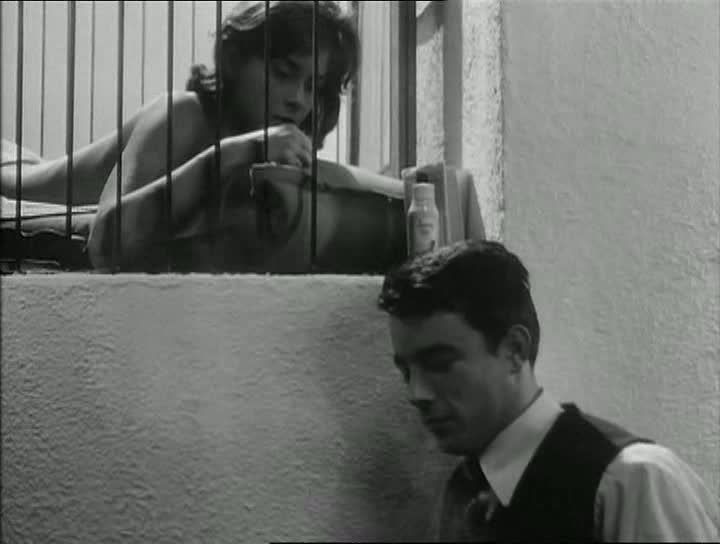
When Paul finds out how seriously his cousin has fallen for Florence, and how seriously she's taking this blossoming affair, he sets out to push them apart, apparently merely because this kind of seriousness has no place in his life of parties and casual dalliances and drink-fueled orgies. In one scene, Clovis uses his persuasive, insistent voice to push Florence and Paul towards one another, standing between them as they move closer and closer together, his words urging them towards one another, urging Florence to abandon her brief dream of forming a more stable romantic relationship with the kind, innocent Charles. Instead, she reaffirms her commitment to Paul's promiscuous lifestyle, briefly settling into an affair with Paul and then discarding him to move on to someone new. Lounging around the apartment with Paul, sunbathing in just her panties, Chabrol traps her between the metal bars of a railing that makes it look as though she's in prison. She's a vision of languid sexuality and sensuality, but she's in a cage.

All of these characters are. Chabrol's aesthetic is already developing into the subtly stylish, clinically observational style that characterizes his mature work, in which he examines the pretensions and follies of the bourgeoisie. His camera glides in slow, creeping circles around these characters, a predatory crawl that makes them seem hemmed in on all sides. At a key moment late in the film, when Charles is nearly overwhelmed by the conflicting pressures weighing down on him, the camera spins in a dizzy circle around his room, reflecting the ways in which his whole value system has been utterly disorientated. Despite the thematic continuity and casting overlap of Les Cousins with Chabrol's first film Le beau Serge, Les Cousins already feels like more of a proper Chabrol film. It's an unsentimental film that dissects both the freewheeling amorality of people like Paul and the working class optimism of Charles. The former squanders his bourgeoisie privilege and intelligence (he aces his exams without studying, while the harried and distracted Charles fails even after all his hard work) and the latter is unprepared for the cruel truths of a world that doesn't conform to his idealistic hopes.

Tuesday, June 28, 2011

The Romance of Astrea and Celadon


Eric Rohmer's final film, The Romance of Astrea and Celadon, is a charming, deeply felt ode to the follies and pleasures of devoted love, a fitting subject for this last statement from a director who always concerned himself with both the emotions and the philosophies of love. The film opens with some text that suggests Rohmer's unique approach to realism and fidelity to his sources. The film is adapted from a 17th Century romance set in 5th Century Gaul, so its sense of period realism is of course already at a remove: the denizens of one century imagining what the inhabitants of another thought and acted like, and then Rohmer enters the picture to imagine about those imaginings, at an even further remove. Even so, he acknowledges that unfortunately he had to change the setting of the story, since the Forez plain that served as the original story's setting is no longer as pastoral and serene as the story requires, having been overrun with "urban blight" in the intervening centuries. The text conveys Rohmer's regret at having to make these kinds of changes, necessary as they are in adapting a story that's so remote from the modern era. It's a sly introduction to a film that purposefully places itself in an alien time and place, with foreign customs and ways of thinking that seem absurd and goofy to modern sensibilities. The sense of distance allows Rohmer to remain true to the spirit of the old source while always maintaining his own modern perspective on the material.

The film is a love story between the two title characters, the shepherdess Astrea (Stéphanie Crayencour) and her lover Celadon (Andy Gillet). Theirs is a Romeo and Juliet-style forbidden love, since their families have long quarreled over a trivial slight from the past. In order to disguise their affair, Astrea tells Celadon to pretend to be in love with another girl, but, due to his strong sense of duty and obedience, he pretends too well and causes Astrea to reject him in a fit of jealousy. He tries to kill himself, apparently succeeds, and is washed up in a land down the river, ruled over by nymphs and druids. This basic scenario prompts a convoluted series of misunderstandings and ruses that keep the lovers separated for the remainder of the film, with Astrea believing her beloved to be dead and Celadon refusing to return to her due to his strict adherence to his code of love. She told him never to come near her again, and though she now desperately wishes he were back with her, alive, he remains true to her final words to him.

Rohmer portrays love as a folly and a madness, a delirious devotion to a pure and impossible ideal. Much of the film is devoted to philosophical debates about love and religion. Celadon's brother Lycidas (Jocelyn Quivrin) represents the side of love and devotion in rhetorical battles with the lascivious singer Hylas (Rodolphe Pauly), who represents promiscuity and lust. In these discussions, Lycidas comes across as cool and collected, a rational proponent of love with his wife smiling sweetly by his side in mute agreement. Hylas, for his part, seems half-mad and wild-eyed, a Dionysian figure of lust and pleasure, his mouth constantly twisted into a sneer and his eyes popping with exaggerated desire. At the same time, Hylas' skepticism seems founded when Lycidas says that one who's in love literally becomes his beloved. Even the most cool-headed love, like the seemingly ideal relationship between Lycidas and his wife, contains an element of irrationality, a gap over which one must make a leap of faith without questioning or trying to understand the ineffable. The romance between Astrea and Celadon combines the stolid devotion of Lycidas with the mad lust of Hylas, and Rohmer suggests that perhaps this madness, which seems so absurd and even silly, is true love.


Indeed, the film's plot grows increasingly wild with each new wrinkle. In the final act, Celadon impersonates a girl, the daughter of a druid (Serge Renko), in order to remain close to his beloved without revealing his identity to her. The premise is fundamentally absurd, and must have seemed so even on the page, but when it's actually enacted and visualized it becomes a hysterical farce. Celadon, for all the talk of how pretty he is and how girlish he looks, is thoroughly unconvincing when disguised as a girl. The druid even explicitly says that he has a herb that will hide Celadon's beard — but then, in the subsequent scenes where he appears as a girl, he has a prominent five o'clock shadow that can't be missed. It's yet another example of the sly wit of Rohmer's literary adaptations: he remains fanatically true to the letter of his source even when the result onscreen is silly and hilarious, even when his images directly contradict the text. Perhaps this is a metaphor for love itself. Rohmer's devotion to his text risks absurdity even as the lover does in professing his adoration for his beloved, remaining true to strict codes of behavior that have meaning, if at all, only for him and his love. True love, in this film, creates its own world and its own rules, as remote from ordinary reality as this film seems from the present world.

Rohmer explicitly links this mad devotion to religion and spirituality, which abut romance throughout the film. The gods of the film are Roman gods, but the conversations between Celadon and the druid, which center around whether there are many gods or a single god with many aspects, obviously refer to Christianity without naming it as such. At one point, the druid, having tried to explain some of the "mysteries" of his faith, such as the division of a single god into several secondary aspects and the birth of one aspect of god from a human virgin, finally looks to heaven and declares that he can say no more, lest he taint the mystery. In a nice, subtle touch, Celadon's eyes follow the druid's towards the top of the frame, as though trying to see what the holy man sees above them. Love and religion are the twin "mysteries" of the film, the twin madnesses that possess human beings and make them behave in ways that may seem absurd or illogical or out-of-touch with the world. Thus, though the film's final act — in which a comical, "lesbian" desire develops between Astrea and Celadon, apparently without the former realizing that the latter is actually her lost (male) lover — can only be described as a farce, it's a farce with real feeling animating these unbelievable actions and contrivances.

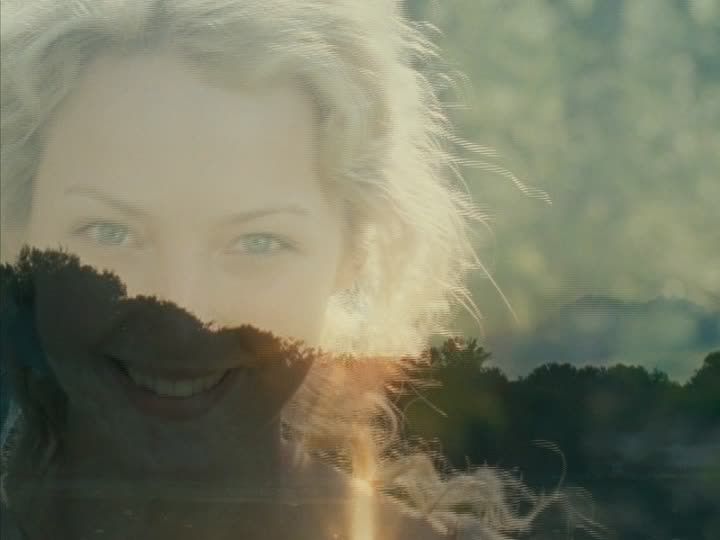
Rohmer was always concerned with characters who stuck to rigid codes, embodied in the conflicted Catholic moralism of My Night At Maud's or the idealistic search for an abstractly "perfect" love in films like The Green Ray or A Winter's Tale. It's fitting that Rohmer ended his career with The Romance of Astrea and Celadon, since this film presents a vision of that kind of philosophical purity taken to its (il)logical extreme. Its pastoral beauty provides a languid setting for these musings on love, especially in an interlude where Celadon wanders through the forest, singing about his love as images of natural splendor fade into idealized images of Astrea smiling sweetly, flirting with the camera. This is a film that pays tribute to youth and beauty, to those who madly pursue ideals rather than settling for the more accessible pleasures that the world has to offer. It is a sublimely goofy film, and it's not the least bit ashamed of it.

Monday, June 27, 2011

Record Club #2: Brand New


It's time for the second discussion of the Inexhaustible Documents Record Club, which hosts monthly music conversations about albums chosen by various club members. This month, Kevin J. Olson of Hugo Stiglitz Makes Movies has chosen Brand New's album The Devil and God Are Raging Inside Me. He has now posted about the album over at his blog, and he invites anyone who's heard the album and would like to participate to join him in the comment section for a discussion of the album. The first Record Club post, about the Congos' Heart of the Congos, was a fun and lively discussion, and I expect that this will be, too. I'm going over to Kevin's place now, and I hope everyone will join us there.

Join the discussion at Hugo Stiglitz Makes Movies

Friday, June 24, 2011

The Conversations #26 (part 2): The Tree of Life


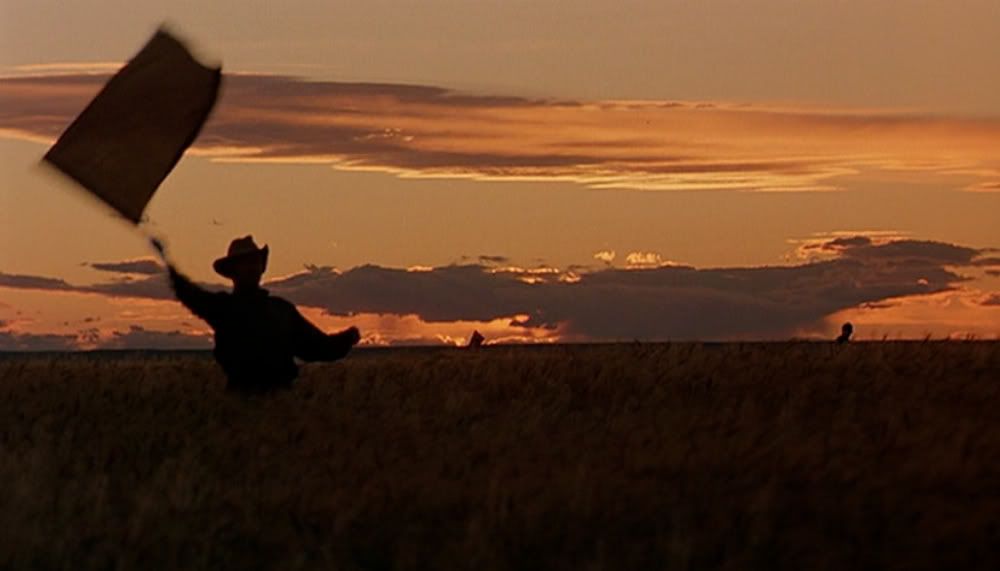
If you've seen Terrence Malick's latest film, The Tree of Life, chances are that you're as eager as Jason Bellamy and I have been to discuss, dissect and analyze this rich, dense, sometimes frustrating but always fascinating movie. In part 2 of our discussion of Malick, following up on our previous conversation about his first four films, we turn our attention to his latest film, which may well be his most ambitious yet. It's certainly a film about which there is a lot to say, and Jason and I doubtless only scratch the surface in our conversation, so be sure to join us in the comment section with your own thoughts.

Continue reading at The House Next Door