The fifth discussion for the Record Club takes place today, and it is hosted by Jamie Uhler at the multi-author blog Wonders in the Dark. Jamie has picked the album The Holy Bible by the Manic Street Preachers, and he has written a fine introductory post as part of his long-running series "Getting People Over the Beatles." Now it's time to join the conversation in the comment section. I hope to see you there!
Thursday, September 29, 2011
Record Club #5: Manic Street Preachers
The fifth discussion for the Record Club takes place today, and it is hosted by Jamie Uhler at the multi-author blog Wonders in the Dark. Jamie has picked the album The Holy Bible by the Manic Street Preachers, and he has written a fine introductory post as part of his long-running series "Getting People Over the Beatles." Now it's time to join the conversation in the comment section. I hope to see you there!
Labels:
music,
Record Club
Wednesday, September 21, 2011
Rango
The neat trick of Gore Verbinski's Rango is the way it wraps some rather adult themes (and adult references) around a pretty basic kids' movie structure. The film follows the titular chameleon, voiced by Johnny Depp, as he falls out of a moving car and stumbles into the desert, where he encounters an adventure right out of a spaghetti western. The film is packed with hip references, like an early blink-and-you'll-miss-it Fear and Loathing in Las Vegas visual gag, and more notably the obvious influence of the Sergio Leone/Clint Eastwood "Man with No Name" trilogy. Those films loom large here, as Rango arrives in a dusty frontier town populated with various grizzled species of anthropomorphic animals. Rango, who inhabited a lively fantasy world to stave off loneliness in his small tank, now presents himself as a wandering mercenary hero, ready to help the townspeople, who are suffering from a drought that threatens to eliminate their water supplies. The plot combines the Leone films with, improbably, Roman Polanski's Chinatown and its schemes over water rights.
The plot, however, is not the film's strong point by any means. Despite the sophisticated reference points, the film's narrative is a bit of a jumble, and Verbinski leans too heavily on cliché when he's not nodding to his more venerable influences. When one mid-film action sequence devolves into a noisy, silly war film parody complete with "Ride of the Valkyries" — probably the most tired musical choice it's possible to make in a movie these days — it underscores how rapidly the film veers between clever pastiche and rote regurgitation.
It's easy to forgive and forget the more unimaginative stretches, however, when Verbinski packs the fringes of the film with such a wealth of visual wit and interesting ideas. When Rango first arrives in the desert, he encounters an armadillo (Alfred Molina) who has been run over on the highway but is somehow still alive and talking as though nothing has happened. This is especially disconcerting because there's a giant truck-tire-sized cutout in the animal's midsection, but the armadillo simply wants Rango to push the two halves of his body back together again. It's a disconcerting image, particularly for a movie supposedly made for kids, and an image that suggests the twin poles of surrealism and mortality that will serve as important motifs throughout the film.
Indeed, Rango is curiously obsessed with death. A trio of musical birds provide the vibrant, Morricone-esque soundtrack for the film, while also appearing onscreen as a Greek chorus narrating Rango's adventures. From the beginning, the birds suggest that this is going to be the story of the life and death of a hero, and they begin to seem strangely disappointed when the hero continually faces death and fails to die. At one point, the birds even deliver their grim predictions while hanging from nooses. The film's biggest threat, the tremendous, vicious Rattlesnake Jake (Bill Nighy), claims to come from Hell, and his fiery eyes and seeming willingness to kill suggests that there's some truth to the claim. The grislier aspects of the film sit uncomfortably against its sillier moments and its concensions to kids' movie conventions, like the plucky love interest (Isla Fisher) and the unbearably cutesy kid (Abigail Breslin) who does pretty much nothing and serves no purpose, throughout the movie, besides saying cute things in a cute voice and batting her huge eyes.
There's tension here, because the film sometimes seem to want to offer little more than this kind of predictable, jokey entertainment, but sometimes it seems to want to tell a much more serious story. It's a story about loneliness (on the personal level for the misfit Rango, a lifetime loner who creates his own entertainment with imaginary friends because he's never had real ones) and about the costs of modernization and the impotence of common people faced with powerful political and economic interests. The latter story, the big picture social story that's derived from the example of Chinatown, crops up periodically, most powerfully perhaps when Rango discovers the body of the town's bank manager, killed and cast aside in the rush for progress. Like all the best Westerns, this is a film about the West facing its end, about the push to tame the frontier. But the theme is never fleshed out very much, so that even at the end of the film, the exact nature of the plot cooked up by the film's obvious-from-the-start villain, the turtle mayor (Ned Beatty), is somewhat unclear, and he's left to spit out rote expositional dialogue to emphasize his villainy.
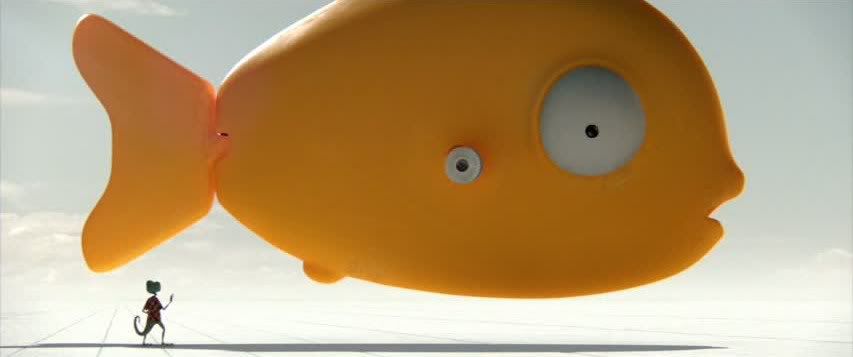
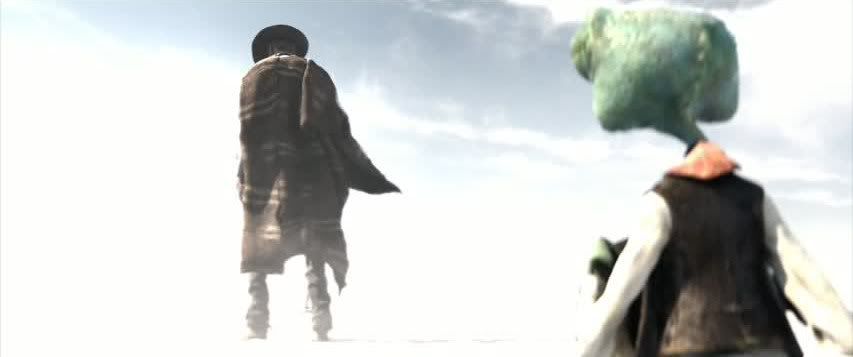
If the film's plot is sometimes less than coherent, broken up by embarassing digressions like the "Ride of the Valkyries" scene, Verbinski compensates with other pleasures. Rango's first night in the desert is visualized by a charmingly surrealist dream sequence populated by a talking windup goldfish and a disembodied Barbie torso, his only "friends" from his solitary existence. Later, in the film's best and most memorable scene, Rango actually meets the Man with No Name himself, a cartoonized Clint Eastwood (actually voiced by Timothy Olyphant) dressed in the distinctive poncho he wore in his Leone films. It's a wonderful meta moment, an explicit acknowledgment of Rango's affectionate tribute to the Leone/Eastwood collaborations. Eastwood's appearance provides a good example of the film's animation quality, too, since the caricature is instantly recognizable as the iconic actor, his face deeply lined and worn like a grizzled, aging Western hero, squinting and sneering as he dispenses advice to the tiny lizard he's inspired.
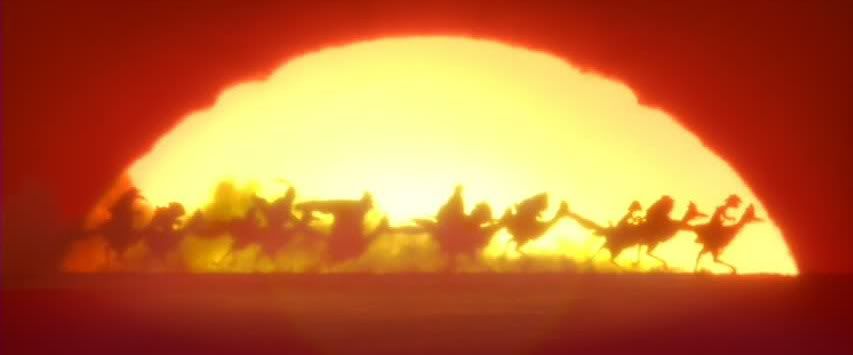
The animation is generally gorgeous in general. Not all of the character designs are as expressive and satisfying as the depictions of the Man With No Name and Rango himself, but the animation is unceasingly lovely, and all of the characters are textured and detailed so that they never seem like molded plastic (as, for example, the highly praised Pixar's human figures often do). There are plenty of visually sumptuous moments along the way, brief sequences where the action pauses to simply admire the scenery. A posse ride through the desert is particularly jaw-dropping, as the sunset desert scenery looks simultaneously realistic and colorfully stylized. The iconography of the Western is lovingly referenced in the visuals, from a shadowy figure appearing out of the shimmering heat haze of the desert to a group of riders galloping against the huge orange half-circle of the setting sun.
Rango is in many respects an interesting, if somewhat schizophrenic, work with the ambition to marry some big ideas to a rather conventional underlying structure. At its best, the film is visually dazzling, witty and a tribute worthy of the spaghetti Western influences it wears on its sleeve. At it's worst, it's cloying, overbearing kiddie fare, and those two sides of its personality are never quite resolved. Still, the film has enough ambition, smarts and style to make it a mostly enjoyable entertainment that occasionally reaches for something more.
Labels:
'2010s,
2011,
American cinema,
animation
Thursday, September 15, 2011
New Comics Blog (and DC's New 52, Week 2)
Following up on last week's post about the first week of DC's New 52 comics, I'm starting a new comics blog that will host my week-by-week thoughts on the new DC comics and any other comics that I'm reading every week. The new blog is called Thinking in Panels, and will be my forum for these weekly summary posts and anything else I'm moved to write about comics. I hope to see some of you there!
So check out this week's DC New 52 post over at the new blog, and be sure to bookmark or follow the site to check out future comics postings over there.
Labels:
comics
Friday, September 9, 2011
DC's New 52, Week 1
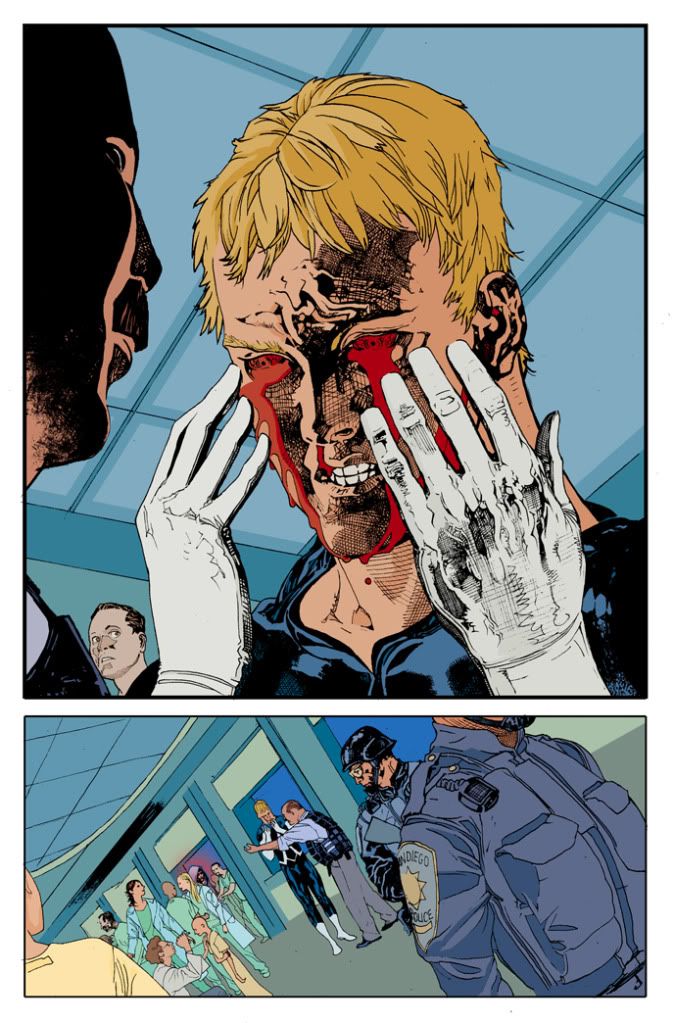
Beginning this month, DC Comics is completely rebooting its entire line of comics, starting every comic over from issue #1 and re-imagining their characters, not entirely from scratch but definitely making some changes. It's a move intended to bring in new readers to the continuity-heavy world of superhero comics, and since I've only occasionally read DC superhero comics myself, I figured this was a good time for me to check out what they have to offer. This month DC is unfurling 52 new issue #1s, and I'll be reading all of them and briefly reviewing them here, week by week. This week, I review the 13 first week titles, plus Justice League #1, which came out last week as the debut of the new line. I rank them below from best to worst; by my count there were 3 very good DC comics this week, a few more that were variably enjoyable and/or promising, and then some mediocre junk. Anybody else following this initiative?
1. Animal Man #1 - This book is just fantastic. I wouldn't be surprised if this winds up being the best out of all 52 comics when this month is over. It's a mix of family drama, horror, and superheroics, balancing all these different tones without seeming all over the place. Writer Jeff Lemire packs a lot into 20 pages, economically reintroducing this character, his family, and the themes and conflicts that will drive his story. And the art, by Travel Foreman, is amazing, especially since it shifts fluidly from sketchy domesticity to punchy superhero action to surrealist, horrifying dream sequences. This looks more like an indie book than a big DC superhero title, so the aesthetic is especially striking and invigorating in this high-profile context. The art is so attuned to the nuances of the storytelling, and the style morphs to fit each new wrinkle perfectly. This is a must-read book, one that already seems poised to match the high standard of Grant Morrison's classic run on this title.
2. Swamp Thing #1 - Definitely the second-best book this week, though not remotely in the same jaw-dropping way as Animal Man. Instead, this is just a solid introduction with some very good storytelling by Scott Snyder. I'm not very clear on what exactly is going on with this character, not having followed the pre-reboot DC universe, and in that sense this book doesn't seem as new-reader-friendly as most of the others. The character's history is left pretty vague and confusing, maybe deliberately since I sense that a big part of the book's early arc is going to be figuring out just what's going on with Alec Holland. But the essence of the character and his status quo come across and there are some great sequences of horror that really make me excited to see where this is heading. The whole scene where the big threat is revealed is chilling and creepy and genuinely frightening; I won't spoil it but it's true horror brilliance, wonderfully visualized by Yanick Paquette.
3. Action Comics #1 - I really dig Grant Morrison's new take on Superman as a populist crusader with an attitude, definitely a fresh perspective on the character. It's obvious that Morrison is deliberately taking a different approach from the mythic boy scout of his fine All-Star Superman miniseries. Even Superman's costume feels more approachable and human. The first half of the issue really pops as it introduces this new Supes in action. The second half gets a little jumbled and isn't as strong, but overall this is still quite good. It's also the most straightforward comic I've read from Morrison in a while.
4. Justice League #1 - This issue is actually from last week, since it was the debut of the new DC line. It's pretty good, nothing mindblowing or anything, and I don't know why the debut of a whole new reboot wasn't made more exciting, but it's still not bad. Mostly based around some amusing banter between Batman and Green Lantern, and then the badass new Superman shows up at the end. It's more a teaser than anything else and it works in that sense, but it's not much of a story. This issue takes place five years earlier than most of the other reboot titles (with the exception of Action Comics) so it's meant to show the early days of the new status quo, when the heroes are just getting to know each other.
5. Batgirl #1 - Just a fun, basic superhero story with a lot of heart and emotional complexity. I like that in restoring Barbara Gordon to the Batgirl costume, they've kept her history from Alan Moore's The Killing Joke, so that trauma continues to haunt her even though she's regained the use of her legs. That darkness is contrasted against a refreshing enthusiasm in the dialogue and narration that's really infectious, and makes her seem like a girl who's just happy to be out kicking ass. Not exactly substantial, but pretty enjoyable nonetheless.
6. Stormwatch #1 - This is visually pretty interesting. Every few pages there's some slightly nutty cosmic concept that provides a very striking image. (Although the character drawings are a little stiff.) The problem is that the characters are all so flat and undistinguished, and writer Paul Cornell seems to know that a lot of readers will be unfamiliar with these characters, so virtually all of the dialogue is exposition and explanation. Lots of characters talking about themselves, explaining their powers, saying things to each other that they really have no reason to say except to explain something to the reader. That could get better now that the 1st issue is out of the way, but it still suggests a pretty unimaginative sensibility that jars against the visual imagination on display here. I'll check out a couple more issues of this to see which direction it heads.
7. OMAC #1 - A book that's totally in love with Jack Kirby. Not even a pinch of originality here, but it's fun enough, lots of Kirby dots everywhere, lots of superpowered enigmas pummelling each other. Entertaining and fluffy as hell. I imagine the Kirby pastiche will get old fast so I'm not sure how much longevity there is in this concept, but as a single issue it's a blast.
8. Detective Comics #1 - Pretty standard, even generic Batman stuff. There's lots of Frank Miller-style "I am the terror that flaps in the night" overwrought "gritty" writing. Not terrible, but not especially interesting either. And the Joker isn't funny, which is always a bad sign. The last page is nicely creepy, though.
9. Batwing #1 - Even more standard and generic than Detective Comics, despite this being about an African Batman, a protege of Bruce Wayne. Not exactly bad, but there's not much to it. It's one of those books where it's hard to point to what's missing except, well, anything that would differentiate it from countless other nondescript hero comics.
10. Justice League International #1 - I guess this is supposed to be the lightweight, fun, funny book where a bunch of D-listers hang out. The problem is that while it's certainly lightweight, it's not fun or funny at all, so it's pretty lame and pointless. Really bad dialogue, really bad all around.
11. Static Shock #1 - Yet another really boring one. It's trying for the light-footed teen superhero style of early Invincible, but its attempts at hip dialogue seem forced and the wisecracking tone doesn't produce any actual humor.
12. Green Arrow #1 - Not sure what to say about this other than it sucks. Totally generic, every line of dialogue is a clunkily delivered cliche, the art is static and bland, and all the Youtube references are obvious, desperate grabs for relevance that fall far short of the mark. This is somebody's laughable idea of "media criticism" I guess.
13. Men of War #1 - This. is. so. goddamn. boring. There were 2 stories in this, both straightforward war stories full of all the clichés you'd expect. I got through the first but my eyes started to glaze over just thinking about reading the second.
14. Hawk and Dove #1 - There might be 2 panels in this whole thing where someone isn't grimacing with that same damn I'm-squeezing-out-a-poop-right-now expression on their face. Actually, Hawk is the one who always looks like that. Dove, with her constantly gaping mouth, looks either perpetually surprised or like she's always ready to give a BJ. Rob Liefeld, man. This is terrible.
Labels:
comics
Subscribe to:
Posts (Atom)