Showing posts with label 1923. Show all posts

Wednesday, November 14, 2012

Three Ages


For his first feature film after a string of shorts, Buster Keaton hedged his bets slightly by making Three Ages, a parody of D.W. Griffith's Intolerance that was designed so that, if the feature had failed at the box office, it could have been split into three of the shorts that were at that time Keaton's more familiar format. The presence of co-director Edward F. Cline, who worked with Keaton on many of the comic's shorts, also announces this film's continuity with the shorter works that preceded it. The film succeeded, though, and Keaton's feature career was launched. Like the Griffith film it's based on, Three Ages relates parallel stories in multiple historical eras, in this case three romances, set in prehistoric times, the era of the Roman Empire, and modern times.

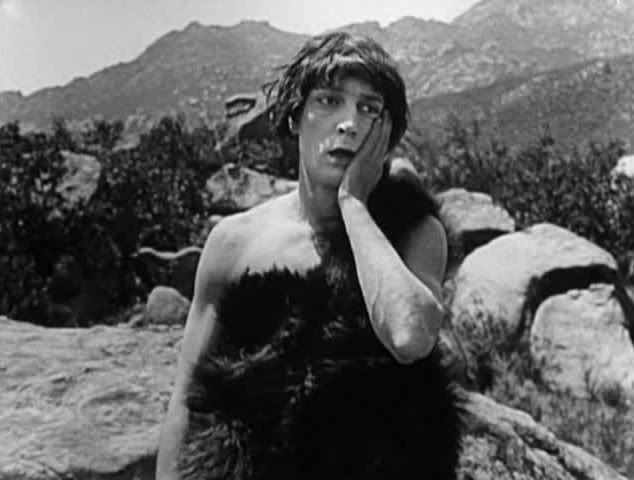
In each of these three eras, Keaton runs through the same basic story: he's a good guy pining over a girl (Margaret Leahy), who loves Keaton but is for various reasons pushed towards a more successful but brutish rival (Wallace Beery). Keaton's the lover, the sensitive guy the girl really likes, but in each of these stories he's lacking the socially accepted status symbols of masculinity and success: most obviously, in the modern story, the girl's mother compares the two suitors' bank books and finds that while Beery has a hefty account, Keaton keeps his meager savings in the "Last National Bank." In the historical stories, there are different standards — brute strength in caveman times, army titles in the Roman era — but the concept is the same, that Keaton's sensitive little lover doesn't measure up to what's expected of men, especially men trying to win a woman.

Of course, that's part of the joke, and defying expectations is essential to Keaton's comedy: this unassuming little man with the stoical expression is capable of graceful feats of daring that are as exciting as they are funny. Here, Keaton has plenty of chances to display his stunning athleticism and genius for comic staging as the various stories come to a climax with thrilling chases and contests in which Keaton must defeat his rival and win the girl. There's a football game in which Keaton performs a series of acrobatic dodges around various tacklers and scores a touchdown with the ball clutched between his feet. The Roman story climaxes with Keaton using a spear to pole-vault off a horse into a window, a gag that he'd repeat for College, though there the pole-vaulting would be performed, at much greater height, by an Olympic athlete.

Keaton's inventiveness and carefully paced gags are best displayed here in the chariot race in the Roman sequence. For this frantic race, Keaton chains together a string of hilarious, clever gags, starting with the fact that he comes to the race ready for the snow with a team of dogs and sled runners instead of wheels. The gags flow fast and furious once the race begins, too. Keaton stops to grab a spare dog from his chariot's trunk to replace a tired-out "front wheel." The dogs go off-course to chase a cat, but Keaton turns this distraction around by tying the cat to a spear and dangling it in front of the sled dog team, urging them on. Keaton is always at his best in moments like this, displaying this kind of do-anything intelligence, a canny ability to turn anything into a tool, in ways that are not only richly funny but strangely practical.

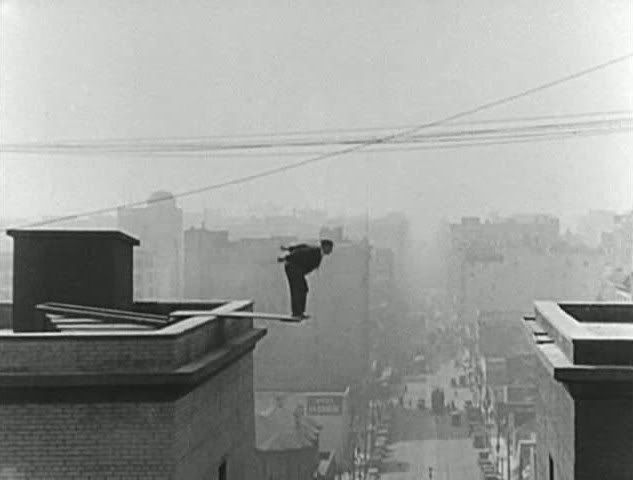
Also dazzling is the chase climax to the film's modern story, in which Keaton runs from the police in a mad race to get to the church where the girl is set to marry Beery. The scene is built around an accident: Keaton tried to perform a daredevil leap from a wooden plank across the space between two buildings, but he fell short, slipping off the second building and falling into a net. He was injured in the fall, but he then proceeded to use his mishap as the foundation of a new sequence, elaborating on it with a complex series of secondary falls, through a series of awnings, onto a drainpipe, through the window of a firehouse and down the fire pole. This is Keatonian inventiveness at its finest again, making use even of a dangerous mistake and turning it into an opportunity for what wound up being an even better gag than if he'd actually made the jump.

Three Ages is consistently driven by this kind of daring and cleverness. It's not one of Keaton's very best films, and its three-part structure makes it feel like a collection of shorts woven together rather than a true first leap into feature filmmaking — that would come soon enough with the great Our Hospitality. But it's a typically funny and frenzied Keaton film with plenty to recommend it.

Friday, November 9, 2012

A Woman of Paris


Charles Chaplin's A Woman of Paris was a very conscious departure for the writer/director/comic. Chaplin had just begun making features, and now he was ready to expand beyond comedy, for the first time making a film in which he did not star, and which was a serious drama with virtually no humor whatsoever. It was also an attempt to provide a showcase for Edna Purviance, who had been Chaplin's most prominent leading lady since his Essanay period; Chaplin wanted to make her a dramatic star rather than just his comic foil. Chaplin was very aware that this change might not be welcomed, and he defensively prefaced the film with a letter handed out to audience members, warning them not to expect a typical farce with the Little Tramp. It didn't help: the film was a flop, and Purviance never became the silent star that Chaplin had wanted to make of her.

It's not hard to see why the gambit failed: under the weight of expectations, A Woman of Paris couldn't help but be a disappointment, or at least a shock to the system. It's a straightforward, subtly acted romantic melodrama that veers into tragedy several times over, with little in common with the famous Tramp's other films to that point. Taken on its own merits, though, it's a fine example of this kind of 1920s moralist tragedy, simple and direct and boasting a number of especially nuanced portrayals. It's only by comparison with the rest of Chaplin's oeuvre that one feels something missing, the supple balance of comedy and sentiment that characterized his best works, here with the comedy removed to focus exclusively on darker emotions.

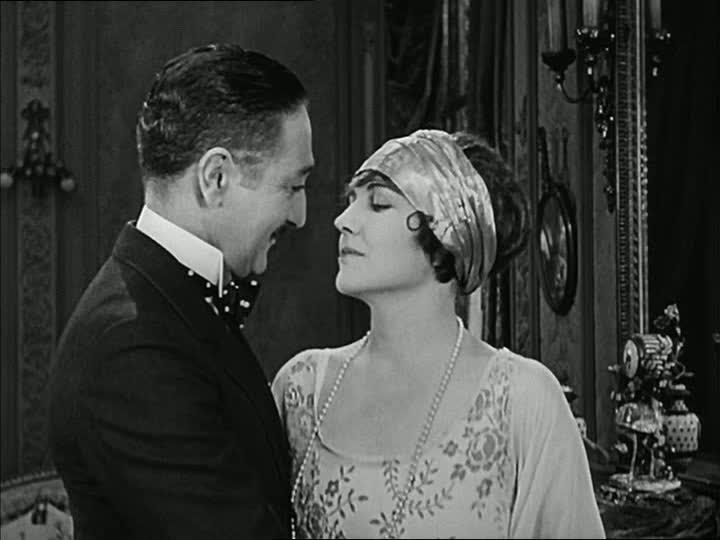
Purviance plays Marie St. Clair, a young woman preparing to run off to get married with her sweetheart Jean (Carl Miller), a young artist, even though their parents disapprove of the affair and try to keep them apart. Their hopeful young love is shattered, though, when a tragedy prevents their elopement, and they wind up going separately to Paris and living very different lives. While Jean lives with his mother as a starving artist, Marie becomes the mistress of the playboy Pierre (Adolphe Menjou), who keeps her in a luxurious apartment and gives her a life of leisure and pleasure, even though he's due to marry someone else. She's a fallen woman now, but interestingly, Chaplin makes this life look fun, and Menjou delivers a surprisingly sympathetic performance as the corrupt, decadent ladies' man. There's real affection between them, maybe even something like love, and the chemistry between them complicates the film tremendously, pushing it beyond its moralistic melodrama.


The performances in the film are naturalistic and subtle, creating real pathos for these characters. The film may not have made Purviance a star, but it probably should have. She has a warm, unstudied humanity to her that was always evident in her work with Chaplin but is especially apparent here, where she finally gets a spotlight all to herself. Her character reacts to the twists and turns of her life with a laugh and a shrug, trying to project an aura of carefree indifference, but Purviance always lets the woman underneath the flapper shell shine through, more upset and hurt by the men in her life and their cruelties than she ever lets on. And yet Marie tries to make the best of it all, even when she's reunited with Jean and is torn between her life of comfort and the possibility of rekindling what they once had, if it's even possible. Marie is an interesting character, and only at the end of the film is she finally confined to the conventions of the 1920s melodrama, forced to pay for the misunderstandings that had ruined her life, giving up her partying for an existence dedicated to service, caring for orphans to replace the family that she might've once had with Jean if things had gone differently.

Before this disappointingly pat ending, and despite the more melodramatic contrivances of the script, Chaplin does a fine job of exploring the subtle, contradictory emotions at the heart of the film's relationships. Aided by the exceptional performances of Purviance and Menjou in particular, the film is awash in sadness and loss. It's not surprising that Chaplin, chastised by audience disinterest, returned immediately to comedies, and Purviance's career unfortunately all but ended here. It's not quite a shame — there's no question that Chaplin's comedies would always be his most enduring works — but A Woman of Paris represents a different and rather interesting side of Chaplin's art, focusing on the emotional richness that also always made his comedies so distinctive.

Tuesday, February 28, 2012

Our Hospitality


Our Hospitality was the second feature Buster Keaton made, and the first that truly told a full feature-length story (the Intolerance parody Three Ages was essentially three shorts combined into a larger structure). This film, set in the early 1800s, is derived from the notorious Hatfield/McCoy feud, depicting the bloody rivalry tearing apart multiple generations of the Canfield and McKay families in the rural South. Keaton, along with co-director John G. Blystone, takes his time setting up the dramatic stakes in a prologue, in which two of the latest male heirs of these two families kill each other in a gun battle, after which the last surviving McKay, then just a baby, is sent to New York to grow up far away from the feud. The film then jumps forward twenty years, as the young McKay (Keaton) returns to the South to claim his inheritance, meets a young woman (Keaton's wife Natalie Talmadge) on the train journey, and realizes only too late that she's actually the daughter of his mortal enemies.

Because of this patient approach to the narrative, the film has a pleasant, easygoing pace as it meanders along, wandering through several different modes: deftly performed physical comedy, romance, and increasingly frenetic action that's balanced somewhere between comic slapstick and genuinely thrilling stunt extravaganzas. The film never quite becomes a manic comedy, because that's not what Keaton's after here, instead balancing the humor with the romantic drama and the carefully researched period detail. Particularly in the first half of the film, Keaton indulges in a lot of low-key humor based on the changes wrought in society since the film's 1830s setting, mocking the then-modern state-of-the-art technology and pointing out just how much progress had been made in the intervening years, to get up to the 1920s cutting edge. (Of course, seeing the film now only exaggerates this dimension of the film, since the modern viewer is even more struck by the rapid pace of change and the technological gap between past and present.)

Early on, an intertitle prepares the viewer for a shot of the New York intersection at Broadway and 42nd Street, then cuts to a dusty view of two crisscrossing dirt roads flanked by small wooden stores and homes, where a traffic pile-up of a peddle-less bicycle (a hilariously awkward conveyance in retrospect) and a horse-and-buggie causes one observer to remark, "this is gettin' to be a dangerous crossin'." Then comes the fantastic train ride, for which Keaton recreated the "Stephenson Rocket," which is basically a very small train of passenger carriages tied together and harnessed to a wood-powered engine, propelled along a shaky and uneven rail line.


The train journey, on which the bumps and mishaps of the primitive train push McKay and the Canfield daughter into intimacy, the girl clinging fearfully to the young man, is a comic masterpiece with one great gag after another. The gentle pacing gives the impression that each joke is carefully calibrated and considered, the gags spaced out, each one methodically developed and thought out. There's little trace of frantic slapstick farce in Keaton's deliberate gags, which have a formal logic and precision that makes them seem almost inevitable. At one point, the train is stopped by a donkey that's stubbornly blocking the way, and after much effort the conductor decides that it's easier to drag the tracks' path a few feet to the right than it is to move the donkey, and he creates the new curved path without fuss. Later, in one of the best gags, a mishap with a track switcher separates the engine from the rest of the train, sending them forking off on parallel paths. Keaton's staging is absolutely brilliant, shooting from directly behind the train so that at first it seems as though nothing has happened until the paths begin curving away from one another and the separation is revealed. In a subsequent shot, the distracted conductor, belatedly realizing that the rest of his train has disappeared, stands up into the foreground of the frame, comically peering all around for the missing cars, which are of course gliding along on the nearby track in the background.

This careful framing and meticulous feel for set-up means that Keaton's comedy never feels truly out of control here, and this even extends to the subsequent Southern sequences, in which McKay courts the lovely young woman he met on the train while her family tries fruitlessly to kill him to fulfill their old debt. McKay evades their attempts, at first accidentally and innocently — coming upon one of the Canfield sons trying to unjam his pistol to shoot McKay, McKay grabs it, gets it to fire, then walks away, thinking he's done a good deed — and then cleverly exploiting the rules of Southern hospitality, since he can't be killed as long as he's a guest in the Canfields' home. This leads to some funny antics with McKay dodging quickly in and out of the house, with the Canfields chasing him and firing at him the moment he sets foot past a threshold.

The film's epic finale is its real highlight, though, less comedic than truly action-packed, as McKay flees one of the Canfield sons across a steep rock face, down into a roaring river, briefly crossing paths with yet another train, before tumbling towards a waterfall for the climactic set piece in which McKay teeters on the edge of the deadly falls, trying to untangle himself from a rope in time to rescue his beloved, who's also drifting towards the precipice. Keaton performed all the stunts himself, and proves himself as adept an action hero as he is a comedian; his daring rope swing to grab the girl just as she falls off the waterfall is breathtaking. Keaton, with his mild-mannered, slightly sharp-edge face, is so unassuming that his physicality is stunning, eliciting equal amounts of shocked laughs and gasps of awe. Our Hospitality is a fantastic showcase for his many talents, both in front of and behind the camera.