Showing posts with label 1924. Show all posts

Friday, November 2, 2012

The Saga of Gösta Berling


Bleak, wintery and expressive, Mauritz Stiller's The Saga of Gösta Berling is a three-hour silent epic bursting at the seams with sturm und drang hysteria. The story of the disgraced former priest Gösta Berling (Lars Hanson), adapted from Selma Lagerlöf's novel, is a succession of tragedies, one after another, as the defrocked Gösta seems to bring bad luck to anyone who associates with him. The film is as much the story of the woman around him as it is of Gösta himself, since the former priest is often the least interesting figure in his own story.

Indeed, the women are the dominant figures here, from the scheming Mãrtha Dohna (Ellen Hartman-Cederström) — who sets Gösta up to marry her stepdaughter Ebba (Mona Mårtenson) merely because Ebba will be disinherited if she marries a commoner — to Margaretha (Gerda Lundequist), the domineering Major's wife who runs her castle with an iron hand and a fierce manner. Then there's Elisabeth (Greta Garbo), who marries Mãrtha's son Henrik (Torsten Hammarén), an overly formal stiff who's constantly gaping foolishly like a fish out of water. This was the 19-year-old Garbo's first major part: Stiller discovered her, renamed her, and cast her in the role that would first send her to fame. She's already electric here, projecting a raw quality that contrasts nicely against the rounded softness of her face — no trace here of the hard edges and stern expressions that she would be famous for later in her career. Garbo's Elisabeth starts out as a minor figure in the film, one woman among several whose lives are touched, generally for the worse, by Gösta's presence, but later in the film she returns and becomes increasingly prominent in the final hour.

Garbo is introduced in anything but a glamorous way, snacking and casually chatting with her new husband as they return from their wedding in Italy; she's eating the last of the food from her home country, and at one point she puts her fist over her mouth to cover a very un-lady-like belch. This little touch is characteristic of this film, which has a very uncouth, raw sensibility. The most appealing aspect of Gösta Berling is its rude, lewd approach to the stuffy period drama. The characters are all trussed-up and confined by billowing, extravagant clothes, the men choked up to their chins with high collars, the women hiding beneath massive floppy hats and layers of coats and dresses, thick furs shielding them against the winter chill. The Major's wife, trying to convince Gösta not to commit suicide, goes to great effort to untie the thick ropes wound around her torso, holding her heavy winter coat in place, and as she tells him the story of her love affair and her unhappy marriage, her coat and scarves hang down all around her, thick piles of clothes that seem to physically weigh her down. It's as though the fashion of the period and the layers amassed against the cold are trapping the characters, and they rebel against this stuffiness with outbursts of visceral bad behavior, drunken revelry and outrageousness, like Gösta's elaborate opening prank with a shaggy devil, or the food fight that interrupts a society banquet.

The devil at the beginning of the film, a dancing trickster who wouldn't be at all out of place in a contemporaneous German Expressionist film, is a harbinger of things to come, bursting into being out of a puff of smoke and a few flames that prefigure the fiery catastrophe of the climax. The film becomes really unhinged in its final hour, breaking free of the sometimes plodding chamber melodrama of the earlier sections in favor of a desolate, searing extended climax set almost entirely in the chilly wastelands around Margaretha's home. Stiller builds an absolutely stunning atmosphere throughout these sequences, as the castle is set on fire, smoke drifting everywhere in thick white clouds, the flames licking over everything. It's hellish and harrowing, the fire lighting up the night, igniting a series of melodramatic confrontations that clear the way for Gösta's last act redemption — everything has to be razed to the ground in order to rebuild, the sins of the past wiped clean.

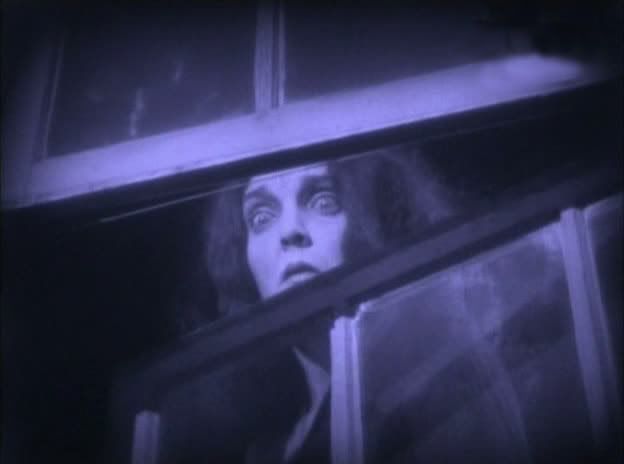
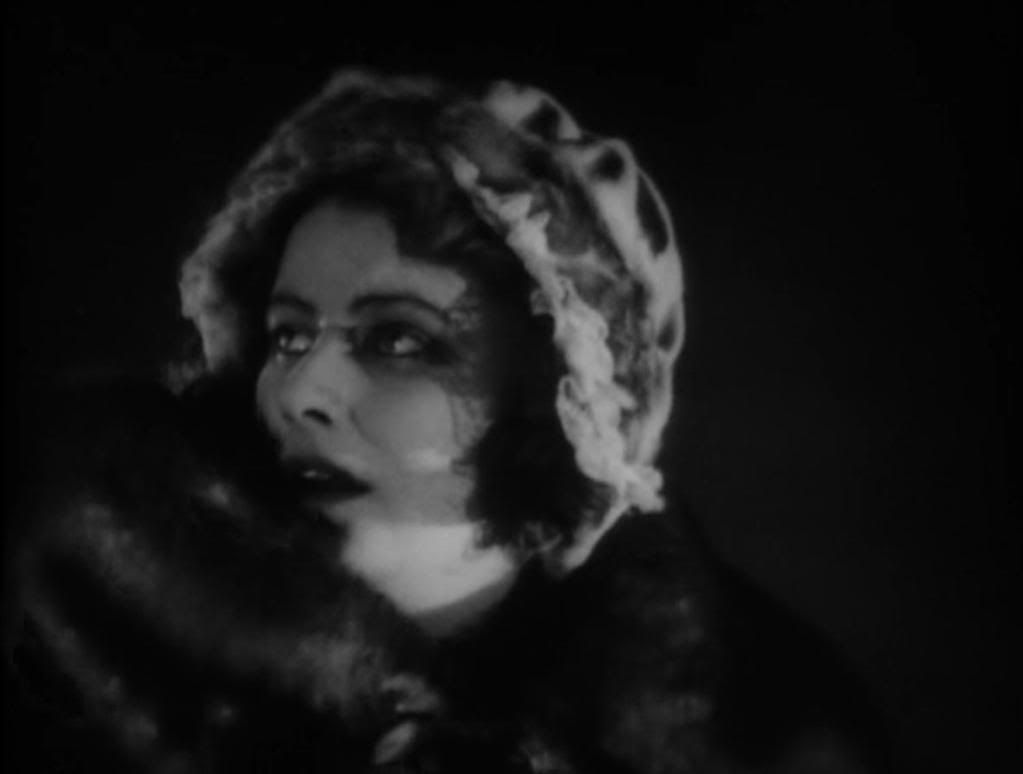
The hellish fire of this climax is juxtaposed against the icy wastes of the surrounding area, the mountains of snow, the frozen lake across which Gösta and Elisabeth race in an eerie late-night ride, pursued by feral wolves, Stiller mostly focusing on Elisabeth's terrified face glowing palely in the darkness. Stiller makes excellent use of the icy territory, making the cold and the ice palpable. The characters are always bundled up, smothered in furs and blankets, and their breath makes icy puffs of condensation in the air in front of their mouths. Stiller makes the landscape bleak and foreboding, a snowy tundra with the wind whipping, knife-sharp, across the lake, the dark sky hanging low, the moon casting only a diffuse glow over the grim, grainy darkness. The scene where Gösta's sled is chased by the wolves is especially compelling, with Gösta determinedly whipping his horse to run ever faster, while Stiller periodically cuts to minimalist long shots, panning with the sled as the dark blots of the wolves give chase.

The film isn't always so bracing, and at three hours its pacing is sometimes slack, with one melodramatic twist after another. The performances, too, are mostly broad and stagey, especially Hanson's Gösta, but Stiller does make good use of the frequent poignant closeups of the film's many suffering, tormented women. In one of these shots, Elisabeth's gaze drifts rightward, flicking briefly up to look directly into the camera, as though seeking solace there, then turning back to her husband, who's upbraiding her for her interference in the relationship between Gösta and Ebba. This is a story of suffering and redemption, in which the moral hypocrisy of polite society creates a cycle of punishment and disgrace that's finally only broken with a happy ending that at last clears away the ice and snow, and the fire too, in favor of the blossoms of spring.

Friday, September 21, 2012

The Finances of the Grand Duke


Though The Finances of the Grand Duke was F.W. Murnau's second straight literary adaptation in collaboration with screenwriter Thea von Harbou, it is a very different film from its moody, poetically melancholy predecessor, Phantom. It's a peculiar film for Murnau, a rapidly paced comic adventure that packs an epic serial's worth of action, disguises and revelations into a short, breezy comic thriller. The plot is chaotic and confused, obviously greatly condensed from Frank Heller's source novel, and most of its chapters begin with a lengthy title card introducing the new characters being added to a large and ever-growing cast of conspirators, counter-conspirators, dukes and princesses in disguise, financial speculators, revolutionaries and tricksters.

The plot concerns the impoverished and debt-plagued kingdom of Abacco and its cavalier Grand Duke (Harry Liedtke), who goes on the run with his financial minister Don Paqueno (Adolphe Engers) in order to avoid his debtors and possibly arrange a marriage to the far richer Princess Olga of Russia (Mady Christians). These royal plots are surrounded by a baffling array of shenanigans with various players trying to get control of Abacco or make money off the confusion that reigns in the struggling kingdom. The action is frantic, the film's humor arising mostly from the sheer overwhelming profusion of interlocking plots and strange occurrences, like one conspirator who's distracted at a key moment by a pair of animal impersonators. They're not the only characters in the film who engage in masquerade and disguise, as Olga is on the run from her notoriously cruel brother, falling in with the name-shifting Philipp Collins (Alfred Abel), a smirking spy, forger and con man who comically disguises her with drawn-on facial hair and sunglasses.

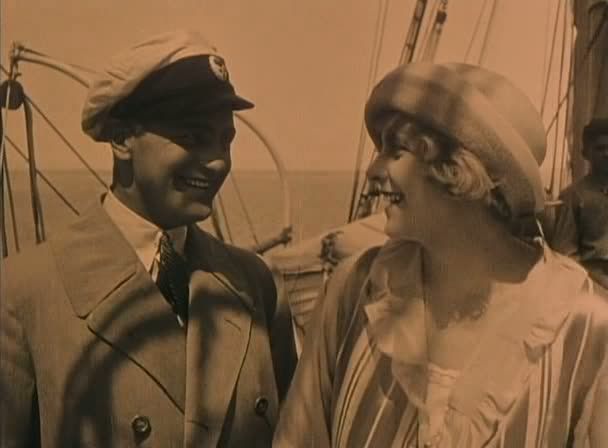
The film's madcap pace and slightly goofy pile-up of intrigues makes it very entertaining, but it's also a typically stylish film from Murnau, with his usual meticulous mise en scène. Murnau, together with cinematographer Karl Freund, shot much of the film in natural locations, with occasional expressionist two-dimensional sets mixed in, and the gorgeous seascapes, rocky vistas and Mediterranean locales add to the film's sense of globe-trotting adventure. There are numerous striking shots: images of sailing ships isolated in endless expanses of water, rocky coastlines with picturesque old ruins crumbling into the cliffs, underground grottoes where unscrupulous schemers discover mineral lodes and plan to exploit them.


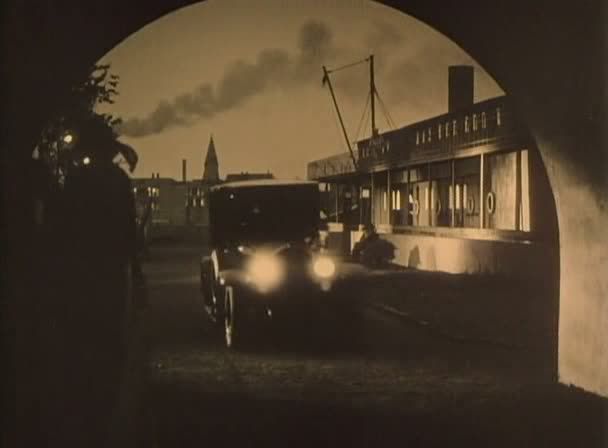
There are also some very compelling, shadowy urban images that create a mood of late-night scheming and diplomatic espionage. When Collins meets Olga for the first time, rescuing the mysterious woman from her pursuers, Murnau cuts away several times to atmospheric images of the foggy, shadowy city. Fog rolls across the frame, obscuring the streetlights that cut through the darkness, as pedestrians stroll through the smoke across a bridge. The naturalistic cityscapes and sunny shorelines are contrasted against scattered moments of expressionist stylization, like a scene where Olga and Collins conspire against a backdrop of jagged, painted houses silhouetted on the set behind their car. In other scenes, cars cut through the night, speeding through the crowded city in a frantic chase, and a train sits waiting to depart, unleashing rolling clouds of steam before chugging slowly forward out of the station, nearly filling the frame with its black bulk.

At times, Murnau's imagery is playfully striking, as when a story about a "saucy little woman" is followed by a jaunty closeup of the woman in question, turning her head to smile at the camera, before her face fades into an image of the circus big top where she works. The film is fast and frenzied, packed with this kind of visual panache, making it a very pleasurable experience, uncharacteristic of Murnau in its story and tone but not in its style.

Monday, September 17, 2012

The Iron Horse


John Ford's epic silent Western The Iron Horse was the director's first major statement in the genre that, more than any other, would become synonymous with his career. He'd made many Westerns before, churning out low-budget B-movie oaters throughout the silent era, but this was his first large-scale statement in the genre. His ambition seems obvious in the title cards that introduce the film, paying tribute to Ford's hero Abraham Lincoln and announcing that the film's chronicle of the construction of America's "first transcontinental railroad" would be "accurate and faithful in every particular of fact and atmosphere." This isn't just a film, he seems to be announcing, it's history.

That's bunk, of course, and as history the film is utterly suspect from virtually the moment it begins. Typically of the Hollywood Western, this is a mythological, romanticized depiction of the westward expansion, one in which the white heroes must struggle against the odds, fending off Indian attacks and the cruel assaults of the elements in order to fulfill their destiny of pushing into the unpopulated wilds of the west. The film's tone towards the Native Americans who are actually in those lands is obvious in the way the title cards keep announcing how "inevitable" it is that the white man should take over the entire country. The Native Americans who resist this expansion, the film suggests, are merely standing in the way of destiny, which means they're destined to be crushed. How dare they oppose "the inevitable"? How dare they oppose progress?

The film's ahistorical steamrolling of the non-white is obvious throughout. The title cards casually announce at one point that "there is no white labor" for the building of the railroad, so "it is necessary to bring in Chinese for the task." There's no mention, of course, of the fact that the Chinese laborers were paid less than white counterparts, and despite the acknowledgment that most of the laborers were Chinese, most of the onscreen work actually shown within the film is performed by white Irish and Italians. The discriminatory laws that applied to the Chinese are made into a joke in a courtroom scene where Ford makes light of the fact that shooting a Chinaman is a lesser offense than shooting a white man. The mass killing of buffalo to feed the railway employees — one major source of Native American anger at the rail's invasion of their lands — is also glossed over.


Ahistorical and ideologically suspect as it is, The Iron Horse is also often a grand piece of entertainment. Its scope is truly epic, and Ford's images have a real grandeur to them, a feel for landscape and crowded scenes. The hard work of the railroad workers is viscerally felt, and there's a sense of realism in Ford's recreations of their struggles. Horses trudge through deep snows, pulling locomotives. Men hammer rhythmically at large spikes. One sequence documents the process by which the movable railroad towns settle in one place for a while before leaving it behind as a ghost town, always moving with the forward advance of the tracks. As the town moves, Ford shoots a wagon train running side-by-side with an actual train, the soon-to-be obsolete form of cross-country travel helping to build its own replacement.

The film is dominated by sequences like this, which focus on the big picture at the expense of individual characters. There is an individual story here, built around Davy Brandon (George O'Brien), a Pony Express rider whose father had dreamed of building a transcontinental railroad before being killed by Cheyenne, led by the sinister white outlaw Deroux (Fred Kohler). After a prologue in which Davy appears as a boy before his father's death, the character doesn't return as an adult until almost an hour into the film, confirming the dominance of large-scale historical storytelling over character-based drama. Davy's presence provides at least a hint of the usual Hollywood hero-centric drama, but the film is about historical processes and feats accomplished by groups and societies rather than individuals. Even Davy's romance with Miriam (Madge Bellamy), the childhood sweetheart he was separated from, is eventually paralleled with the building of the railroad. Only when the tracks are completed can their love be consummated, the two lovers coming together from opposite ends of the country at precisely the moment the tracks are joined.


At its best, the film's epic storytelling is very satisfying. There's a sense of scale here that's truly exhilarating, particularly in the inventively staged battle scenes — one Indian attack is staged with the shadows of the attackers projected onto the side of a train, while the climactic battle is all dust clouds and sweeping overhead shots that take in the whole battlefield. Ford similarly pulls back for a grand cattle cattle drive sequence, whereas the countless images of men at work on the rails are invariably captured in densely packed frames that emphasize the sweaty, choreographed simultaneity of their labors. Indeed, the film is at its best when it's abstract like this, since the usual Fordian diversions into ethnic comic relief are especially grating here, and the characters, mostly treated as cogs in a massive machine, aren't well-developed enough for the sporadic shifts to dramatic narrative.

What the film is really celebrating is the moment that the United States became truly united, when it began to take on something like its modern form — pushing further and further into the so-called "wild" lands populated by non-whites, slowly absorbing the entire expanse from east coast to west, linking it all via technology. It's no coincidence that Ford makes sure to note that, when the rails are finally connected in the middle of the country at the end of the film, the news is rapidly spread around the country via telegraph, instantaneously alerting people way back on the east coast to the news. The modern America is forming here. Within the course of the film, which spans years, the Pony Express and the wagon train are made largely obsolete by the telegraph and the locomotive. In the last shot, Ford has people posing for a photograph by the side of a train, a precursor of the cinema, which would be another of those world-shaking, transformative technological leaps forward. This is, after all, a film about technology more than anything else, about the way in which a country was built through a unique combination of rapid technological advances, hard work, and, buried in the film's subtext but rarely acknowledged, exploitation and genocide.

Monday, August 20, 2012

Greed


Erich von Stroheim's Greed is one of the cinema's most legendary lost films, another in a long line of compromised, butchered, hacked-up could-be-masterpieces from the unlucky director, whose complete vision rarely emerged intact from the studio assembly line. Greed suffered perhaps more than any of his other works: originally nine hours long, it was sliced apart multiple times by studio-hired editors who finally produced a two-hour release version, at which point the remaining seven hours of celluloid were recycled and discarded. Von Stroheim said of the editor who put together the final cut, "the only thing he had on his mind was his hat." It's hard to know what other outcome von Stroheim expected, and it's hard to know why the studios let him film these unwieldy epics in the first place when they knew they'd never screen anything even vaguely resembling the full cuts. Von Stroheim's massive projects were destined to fail, destined to be destroyed and compromised, resulting in a career strewn with wrecked partial films. He was too ambitious, and too unconcerned with commercial and practical considerations, for the era in which he lived and worked.

Greed is especially compromised; whereas von Stroheim's earlier Foolish Wives feels nearly like a complete work despite the similarly massive edits to the director's original vision, the incompleteness of Greed is very apparent. This is true of both the two-hour theatrical cut and the four-hour "reconstruction" that attempts to approximate some of the original film's narrative through the use of still images and text taken from Frank Norris' novel McTeague, the source that von Stroheim was scrupulously adapting here. Greed's fragmentary nature is obvious in either form, at times verging into incoherence, and whole characters were almost entirely chopped out of the shorter two-hour cut, so there are characters and subplots that only appear in the still frames that attempt to bridge the gap between von Stroheim's original vision and the ragged remains left behind by the studio intervention.


Neither existing version of the film is especially satisfying, though the broad outlines of von Stroheim's vision can still be discerned. This is an almost unrelentingly bleak film, and even the prospect of enduring nine hours of this misery, to end up in the film's harrowing Death Valley climax, is exhausting and disheartening. As the title implies, this is a study of avarice, of people corrupted by the love of money above all else. At the center of the film is the dentist McTeague (Gibson Gowland), a brutish lout with a quick temper and a slow intellect, who falls in love with Trina (Zazu Pitts), the cousin and girlfriend of McTeague's best friend Marcus (Jean Hersholt). Marcus, learning of McTeague's desire for Trina, graciously steps aside, until Trina wins five thousand dollars in a lottery shortly before getting married to McTeague. Marcus, who could have tolerated his friend taking his girl, now grows jealous of the couple's newfound riches.

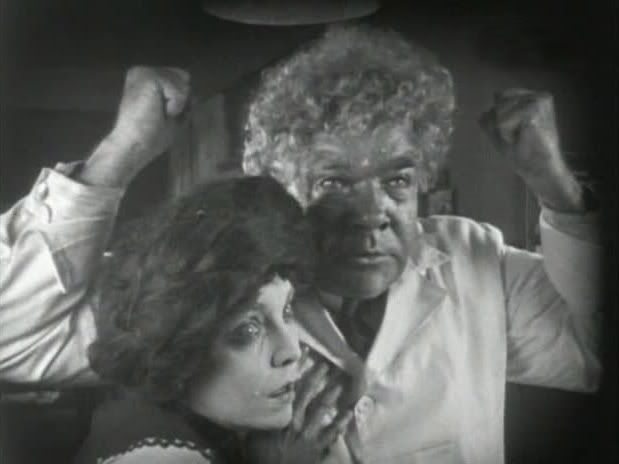
This is a pretty miserable excuse for a love triangle. Indeed, McTeague and Trina's romance is curiously ambivalent and inconsistent, and one senses it's not entirely because of all the missing footage: sometimes this ill-matched couple seems drawn together, and sometimes they barely seem interested in one another. McTeague's marriage proposal is offhanded, as though they might as well get married just because they can tolerate each other, while Trina, with her drawn face and wide eyes, looks perpetually frightened of this bulky lug of a man. McTeague is capable of both great violence and surprising tenderness — he's introduced kissing a wounded bird and then throwing a man off a cliff for mocking his affection for the bird — but the moments of actual sweetness and love between the couple are rare. Even the moment where McTeague first grows obsessed with her is tinged with creepiness: she's his dental patient, drugged and passed out, and he leans in to smell her hair and kiss her before operating on her teeth. Once they're married, Trina grows more and more caricatured as a miserly witch who caresses her hordes of gold while denying McTeague even a nickel for a bus fare.

Everything is drawn broadly here, with bold, over-sized performances that project the intense, unrelentingly ugly emotions at the core of this story. Among the plots trimmed from the theatrical cut is the side story of the junk dealer Zerkow (Cesare Gravina) and Maria (Dale Fuller), who he marries only because of her (possibly imagined) stories about a treasure trove of gold plates she once possessed in her childhood. This subplot echoes the increasingly unhappy romance of the leads, and foreshadows the grisly end of their tale. Zerkow is a rather nasty and obvious anti-Semitic caricature, a grasping, greedy Jew who's only obsessed with gold, but he barely stands out here because nearly everyone in the film has the same traits, the same lust for gold (inevitably tinted yellow whenever it appears), the same singleminded fixation on riches to the exclusion of all else.


Von Stroheim is crafting a mocking satire of middle class desires, which is especially apparent during the lengthy wedding sequence. While Trina and McTeague are getting married, a funeral procession passes below, the black-clothed mourners passing by on the street, visible as a long parade through the window behind the preacher who's officiating the wedding. After this gloomy association of marriage with death, the wedding becomes a series of materialist rituals: the bride and groom greedily open the gifts, and then everyone stuffs their faces in an orgy of gluttony. After the wedding is over, as the guests are leaving, Trina becomes overcome with fear: she's terrified of the wedding night physicality to come, the encroaching loss of her virginity. She looks at her new husband with eyes wide, covering her mouth as though shivering before a monster, and then she sees him replaced by an image of a bird cage with two birds trapped inside. That's the life she sees before them, a mutual prison with no hope of escape.

Clearly, von Stroheim isn't especially interested in subtlety, and Greed is an interesting, unresolved blend of theatrical overstatement and quotidian realism. Von Stroheim was apparently committed to capturing the full sprawl of Norris' novel with all its detailed depictions of poverty and daily money woes for the lower middle-class, living check to check and juggling bills to survive. Traces of this sensibility survive in the extant versions of the film, always balanced against the more melodramatic, grotesque exaggerations of the performances and the over-the-top characterization of nearly everyone as being cartoonishly overcome with lust for gold. In the most literal depiction of that lust, slightly trimmed and censored for the theatrical release, Trina actually strips naked in order to crawl into a bed strewn with gold pieces, so that she can feel the gold against her bare skin.


Von Stroheim's aesthetic naturally tends towards the grandiose in this way; he unfailingly thinks big, which is perhaps why he kept trying to make nine-hour movies and why he filled those enormous canvases with bold, expressive symbolic images. When Marcus is in the middle of a seemingly jovial, friendly conversation in which he tells Trina and McTeague that he's going away, von Stroheim cuts away and inserts an interlude of a cat squinting hungrily up at McTeague's caged birds. The symbolism is obvious, and undercuts the seeming sincerity of Marcus' promise that "bygones is bygones." In the subsequent scene in which McTeague receives a letter ordering him to stop practicing dentistry without a license, a cat stalks around the frame in the background, still eying that bird cage, connecting this incident back to Marcus, who apparently provided the information about McTeague's illegal business.

Von Stroheim, channeling Norris, is creating a sustained, narrowly focused study of the grim fate awaiting all of these money-obsessed people. The only small bright spot of decency in the film, ironically all but chopped out of the theatrical cut, is the sweet, shy romance of two good-natured elderly neighbors whose pure, kind love provides a contrast against the selfishness and nastiness that corrupts and destroys the other relationships in the film. Although the film is horribly mangled at only two hours, and not much better in its awkwardly reconstructed form, it's also hard to imagine it at nine hours, which would have to seem overwhelmingly excessive for such a singleminded study of a simple theme.

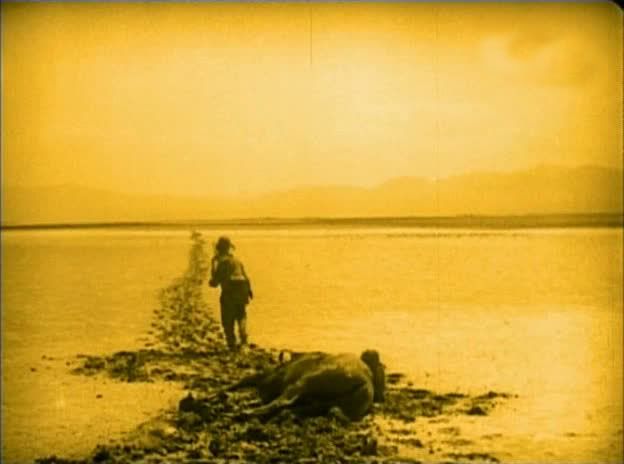
In any event, Greed is a flawed, fascinating, incomplete epic, from its bleak opening portrait of McTeague's youth with a drunken, philandering father and unhappy mother, to its harrowing, sun-drenched Death Valley climax, which von Stroheim, to the chagrin of his crew, insisted on shooting in the actual sweltering Death Valley heat. As with many of the director's excesses, it's hard to say what effect this verisimilitude had, but the sequence is undeniably powerful, with its minimalist desert vistas coated with a pale yellow filter to evoke the heat pouring down from the sun overhead. Whatever Greed might have been if its full version had remained intact, it has survived as a mere scintillating fragment of what must have been a great and possibly insane landmark of the cinema.

Tuesday, April 3, 2012

The Navigator


In The Navigator, Buster Keaton plays Rollo Treadway, a wealthy society heir with a very unsentimental idea of love. He simply decides one day that he'd like to get married after seeing a happy newlywed couple outside his window, and he promptly makes all the arrangements before strolling across the street to tell the woman he has in mind (Kathryn McGuire), another socialite. She says no, and Keaton, his deadpan expression never changing, just turns around and returns home without another word.

Through a mishap, the pair then winds up together on a drifting ocean liner, the only people aboard as the giant boat floats out to sea. For a while, they're unaware of each other's presence on the boat, and Keaton makes the most of the sequence where they wander around the boat, constantly missing each other by just a second, one going up a ladder while the other goes down a different ladder, darting through corridors at cross purposes, crossing paths but never so much as catching a glimpse of the other person. Keaton's sense of timing is impeccable: his comedy has a precise geometric formalism that's perfectly timed and laid out. He places his camera in ways that emphasize this timing, shooting down a long corridor with the characters running in circles, one bounding into the frame in the foreground at precisely the moment that the other disappears around the far corner, out of view.

When they finally collide into one another and realize that they're not alone on the ship, there follows a lengthy, brilliant and ultimately touching sequence in which these two spoiled rich youths struggle to fend for themselves. Earlier, Keaton's Rollo had gotten into his limo for a simple ride across the street — the car only had to make a U-turn to arrive at the destination — and had obliviously tried to take a bath in his clothes, suggesting just how helpless he is, how dependent he is on servants and luxury. When he's left on his own, the results are predictably comical, and the film's funniest sequence is the one where the two hapless socialites try to prepare breakfast, making "coffee" with a few uncrushed beans and seawater, throwing a handful of eggs into a massive pot of boiling water and then fishing around to find them again, trying and failing to open cans of food with a butcher knife.


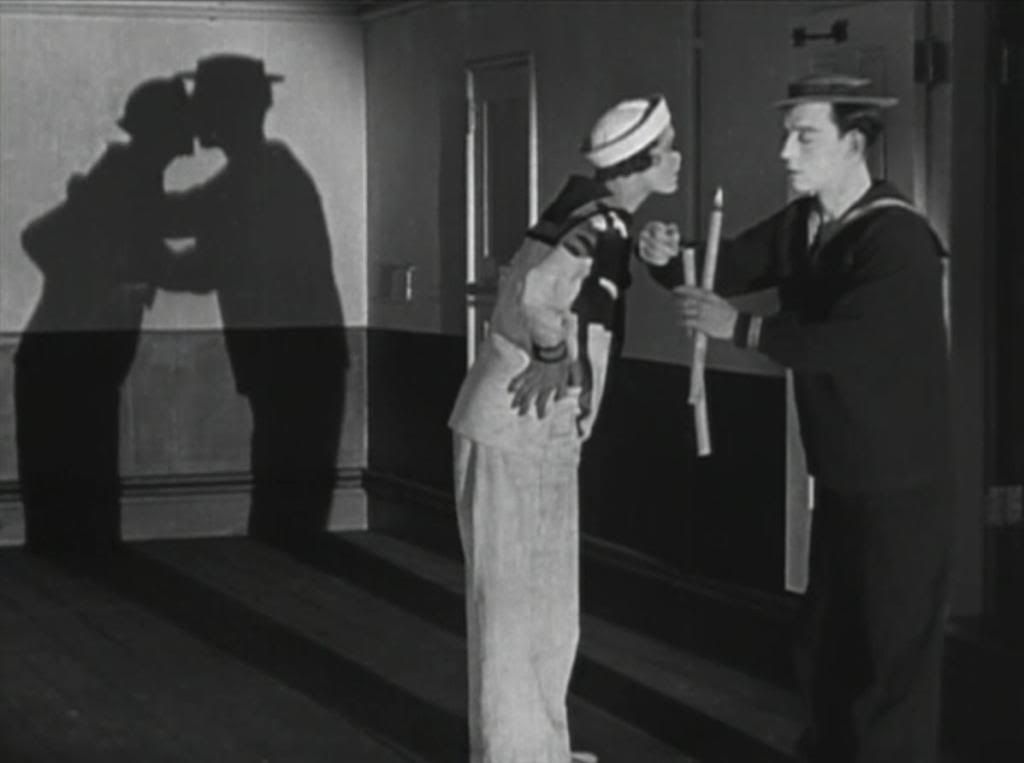
It's unrelentingly hilarious, and it pays off in a big way later in the film when a title card provides an ellipsis of several weeks, after which time the couple have adapted to their circumstances and evolved a whole succession of Rube Goldberg-esque contraptions to perform their morning chores. It's great stuff, with these wealthy, sheltered socialites learning to do things for themselves, to make inventive use of their surroundings. They perform the same tasks that they'd earlier struggled with so comically, now having remade the ship's kitchen in clever ways that demonstrate how they've learned from their mistakes, transforming the place into a complex series of levers and makeshift devices that help them through their morning tasks. They've also found shelter, after the slightly melancholy comedy of the sequence where they'd wandered all around the ship, trying to find a comfortable and safe place to sleep, spooking themselves with fireworks mistaken for candles and a creepy portrait of the ship's captain (co-director Donald Crisp) that Keaton mistakes for a sinister-looking man peering in through a porthole. Keaton's attempts to comfort and help his companion reveal a tenderness and compassion not revealed by his characteristic stoic expression and the deadpan way he'd approached romance earlier in the film. This undercurrent reaches its apex with a wonderful shot in which Keaton and McGuire struggle to light some candles while their shadows seem to kiss on the wall behind them, enacting the romance that they never quite consummate in the flesh.

After all this equally poignant and hilarious build-up, the film's final act is a bit of a letdown, as Keaton and McGuire run into an island full of cannibals and have to fend off the vicious natives. The racial caricatures are unfortunate, but mostly these sequences are disappointing simply because they're not at the same level of formal ingenuity and hilarity as the rest of the film. One exception is the famous scene where Keaton, in a diving suit, goes underwater to repair the ship's hull before the natives can reach them. It's an example of Keaton's physicality and preference for realistic stunts, as he really dives under and enacts a series of pantomime gags, like washing his hands in a bucket and then drying them off with a rag. Best of all is his fight with a pair of swordfish, one of which he wrestles into submission and then starts using its nose to duel with a second, bigger fish that appears. The submarine gag at the very end of the film is also a nice final note, especially the dazzling 360-degree spin in which everyone within the sub struggles to stay upright.

Coming after the viscerally exciting Our Hospitality and the absolutely brilliant Sherlock Jr., The Navigator feels like a bit of a step down for Keaton, but certainly not a big one. Its best gags have the director's characteristic precision and unparalleled sense of space, as well as being side-splittingly funny and thematically resonant. The film's theme is awareness: these sheltered people, locked off in a world of privilege at the beginning of the film, gradually become aware of the necessity of paying attention to the world around them, caring for other people, and working together to survive. By the end, these hapless socialites have become inventive and lively, propelled into constant motion and constantly ingenious use of everything they can lay their hands on. This includes each other, too: in one very suggestive shot, McGuire uses Keaton, in full diving gear, as a boat, straddling him and paddling back to the safety of their ocean liner.

Tuesday, March 20, 2012

Sherlock Jr.


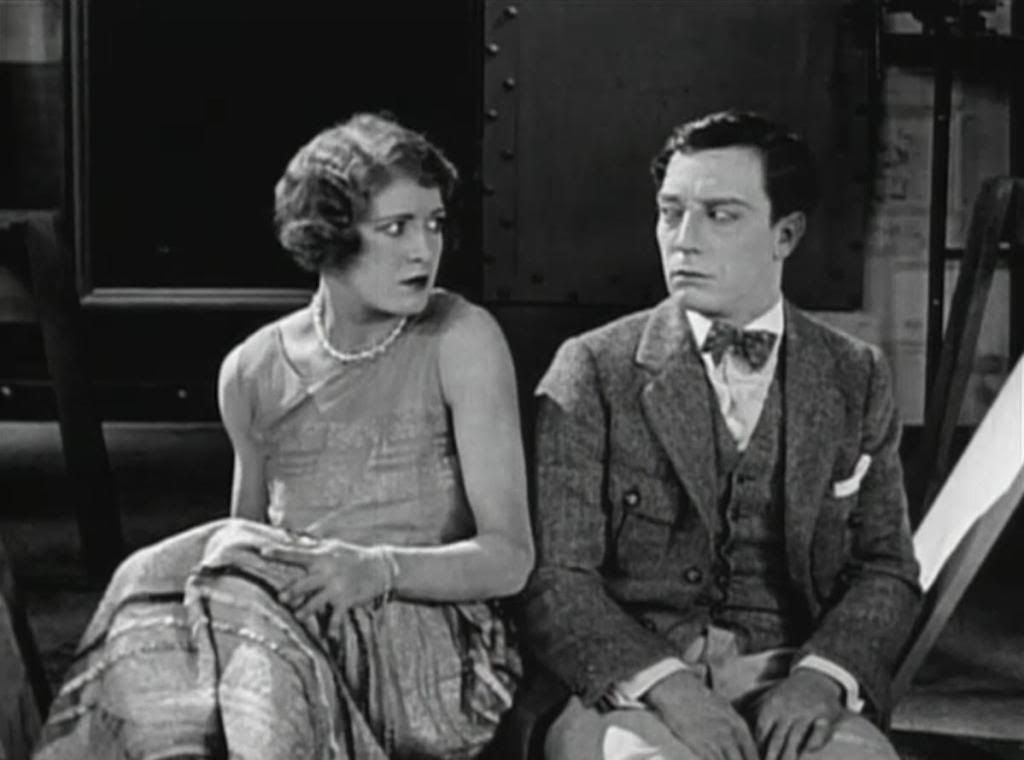
Sherlock Jr. is one of the cinema's greatest tributes to itself, a dazzling, relentlessly inventive ode to the movies as an escape, a source of dreams and a fantastical reflection of the real world. Buster Keaton's five-reel, 45-minute short is crisply, quickly paced, with not a second of waste, not a frame that isn't absolutely essential to the film's hilarious and strangely moving vision of the cinema's magical power. Keaton plays a hapless young movie theater projectionist who's also studying to be a detective and scraping together whatever cash he can get to woo his girlfriend (Kathryn McGuire). When he's framed for the theft of a pocket watch belonging to the girl's father, Keaton tries to catch the real crook (Ward Crane) in a hilarious scene where he shadows the taller man, walking immediately behind him and mimicking his every gesture. When this fails, he returns to the movie theater, dejected, a failure as a detective and miserable over the loss of his girl.

He then falls asleep, and what follows implicitly links the cinema to dreams, as Keaton nods off in the projection booth and has an out-of-body experience, his ghostly doppelganger stepping out of his sleeping form and into the movies. It's a fantastic, and fantastically funny, sequence, as the projectionist imagines the figures on the screen transformed into ones from his real life, enacting a mystery drama derived from his own experience with the purloined watch. Except, in this dream/movie, he can actually be the hero, the world's greatest detective, Sherlock Jr., dapper and sophisticated in a top hat and nice suit, a master intellect who can outwit any criminal. It's pure wish fulfillment, as the young loser imagines that he can catch the crooks and get the girl — and then, in Keaton's master stroke, he wakes from the dream movie into another movie, the movie Keaton's making, and he gets the girl after all.

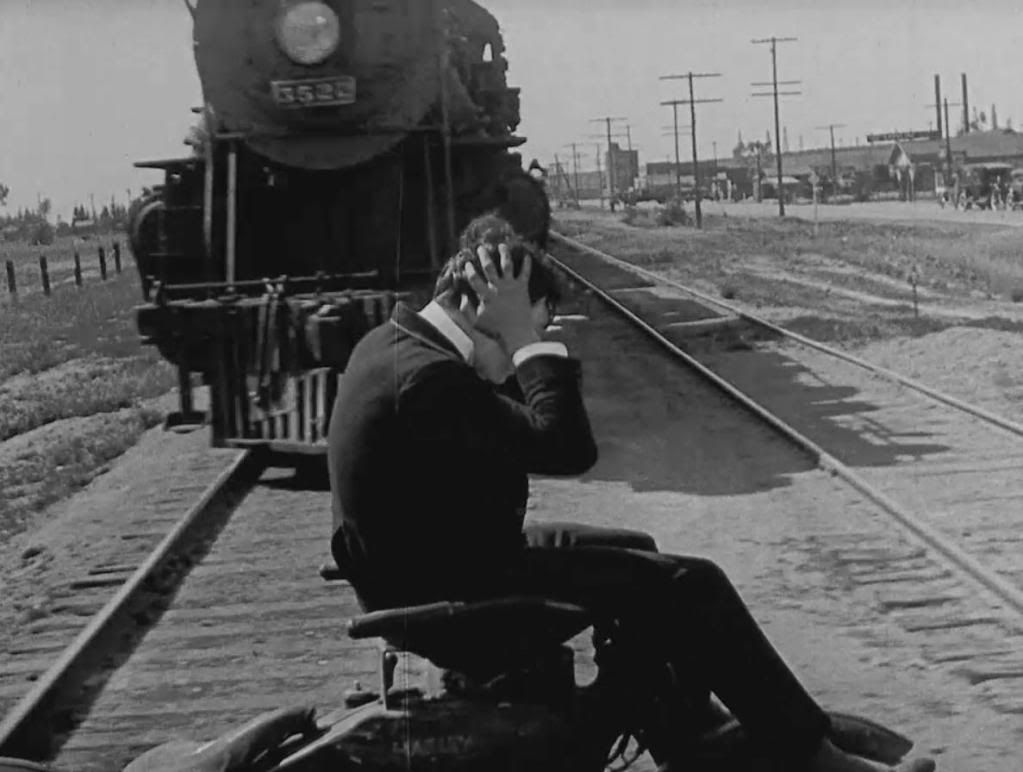
Before he can get to this point, though, he has to pass through a cinematic gauntlet in which his greatest enemy is not a petty crook but a basic cinematic tool, the edit. Once Keaton steps up onto the movie screen, he's not fully integrated into the film that's playing. He's immune to the cut, so he remains the one constant as the scene changes, which leads to some hilarious visual gags. For a few minutes, the movie on the screen, following absurdist dream logic, ceases to be a coherent drama and starts randomly cutting from one strange locale to another, always with Keaton propelled across the cut into one outrageous situation after another. He balances on the edge of a cliff, runs from hungry lions, almost gets run over by a train and the traffic on a crowded street, and gets soaked by waves while perched on a rock in the middle of a choppy sea. It's both a devilishly clever comic showcase and a lovingly meta ode to the power of this cinematic tool, which can seamlessly bridge such tremendous gaps in location, having Keaton jump into the air to dive into the water but instead land headfirst in a snowbank, his feet kicking in the air.


Keaton's projectionist eventually manages to slip into this cinema dream world, inhabiting the role of the detective, fending off the sinister maneuvers of the crooks who concoct endless death traps that he flawlessly slips around, always intuiting their evil intentions before they can spring the trap. In the movies, the hero always wins, the bad guys always fail, and one senses that this young projectionist, like so many others, was first seized by his desire to be a detective while watching screen detectives much like this one. He inhabits an archetypal role, taking on a character type that had inspired him to try to shape his real life to match the movies, to become a detective like the ones on the screen — but only in dreams or the movies can such archetypes actually exist.

The whole dream sequence is remarkably fun, and occasionally surreal, as when a mysterious cross-dressing vendor helps Keaton evade the crooks by inviting the detective to jump through his chest and somehow flip through a false wall hiding behind the vendor. That's a bit of pure movie magic that doesn't really make a shred of sense; it's a flight of fancy that could only work in the movies. The same goes for the hilarious scene where Keaton leaps through a window in which he'd previously set up a readymade disguise. Jumping through the window, he also jumps through the clothes and lands outside dressed up as an old woman. That transformation is an echo of the one that propelled Keaton into the movie universe in the first place: he passes through a screen and comes out the other side magically changed, the usual rules suspended.

The ending, in which Keaton covertly watches a movie hero to figure out the right gestures to romance his girl, suggests that, though the movies are dreams, they're dreams with tremendous power. Keaton is exploring how we learn to act by watching the movies, how we derive our templates, both romantic and professional, from the things that happen up on the screen. In this way, the movies become, not only dreams, but wellsprings of reality, feeding back into the world models of behavior, the dream influencing and reshaping reality itself.

Monday, March 5, 2012

The Last Laugh


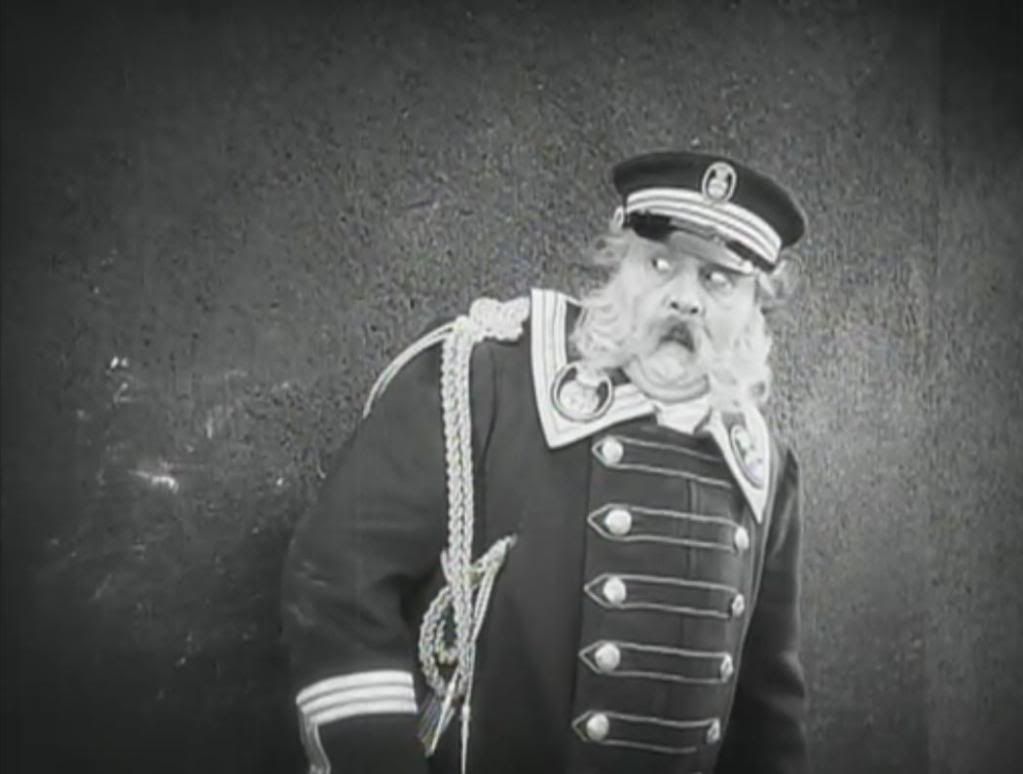
The Last Laugh was a crucial landmark in the history of the cinema. F.W. Murnau's 1924 classic was a dazzling technical feat that signaled several significant leaps forward in the early cinema: not only was it a work of pure visual artistry, with no dialogue intertitles, but Murnau and his crew (a prestigious group including cameraman Karl Freund and assistance from Edgar G. Ulmer) invented the first dolly shots in film and the first uses of subjective camerawork. Murnau freed the previously static camera from its moorings, and the results were stunning. The film's expressive, potent style movingly renders the story of a hotel porter (Emil Jannings) who is demoted for being too old and out of shape to properly do his job anymore. This is an unrecoverable blow for him, because everything he is, his entire sense of self-worth and identity, seems to be tied up in his job. In the film's opening scenes, he struts around the hotel, with bellboys scurrying to assist him in his work, and he obviously takes great pride in his puffed-up image, with his ornate, militaristic uniform. He waddles from the hotel to the curb, guiding guests in or out, summoning cabs, carrying bags, his girth straining proudly against the stiff front of his uniform with its rows of shiny buttons.

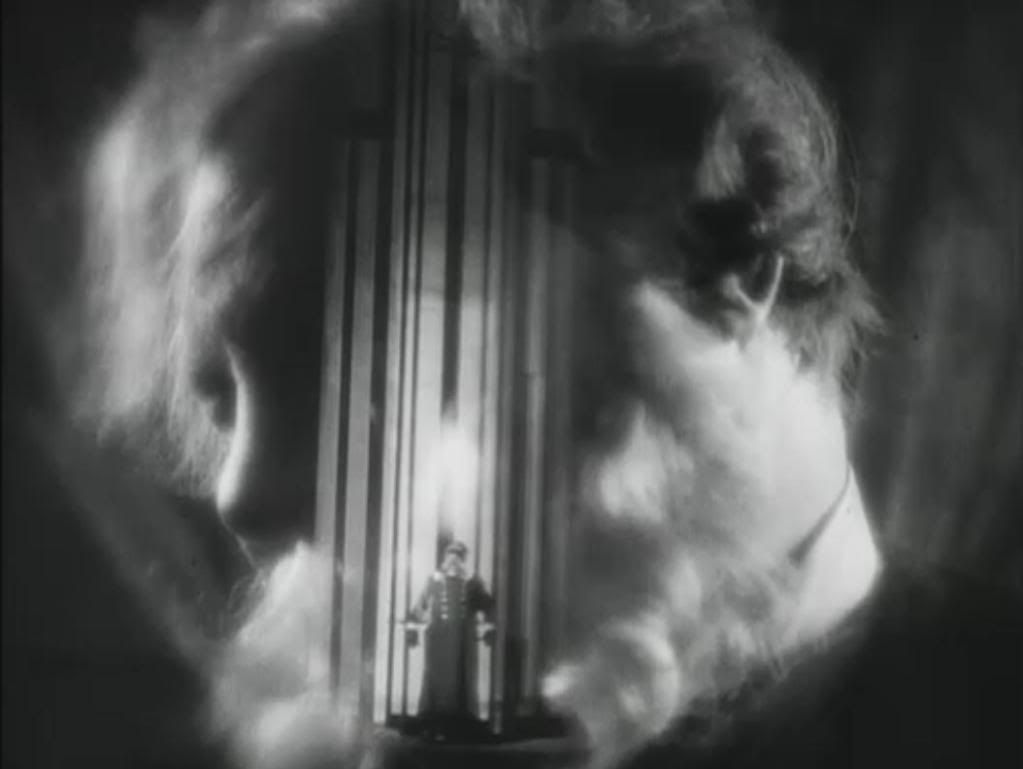
At home, he is equally proud, and when he enters the courtyard where he lives, everyone jumps to attention as though greeting a visiting dignitary, the men doffing their caps while he salutes. He walks stiffly, in obvious pain, his huge gut thrust out in front of him, exhausted from a hard day of work but still happy with his self-image, his view of himself as someone important. Even if it takes a tremendous effort to keep his back straight after each day, he endures the discomfort for the sake of the pleasure he gets from feeling so important and respected. When he's demoted from this proud position, his grand uniform rudely stripped from him, it shatters his world so badly that he can never recover, his job was so integral to his feelings of self-worth and happiness. The world is literally bent out of shape: leaving work after finding out about this change, the porter feels as though the hotel itself is going to crush him, in an extraordinary effects shot where the building seems to warp downwards towards the old man.

Later, drunk at a wedding, the porter sways and staggers, and the camera sways with him, tracing jittery arcs around the room from the old man's point of view, as his gaze drunkenly skips around the room. This subjective perspective aligns the audience with the old porter's attempt to erase his feelings of failure and abjection in revelry. This then fades into a dream sequence in which everything is hazy and distorted as though in a funhouse mirror, while the porter fantasizes about being restored to his old job and displaying a feat of tremendous strength, easily hefting a bulky trunk above his head with one hand. It's a fantasy of power and control, an assertion of the masculine virility that he now feels he's so completely lacking. This is a depiction of a society in which those who are past their peak are cast aside without further care, their will to live drained by the cruelty of the world's disregard. Even the porter's own family, when they learn of his new lowered status, quite literally recoil from him in horror, as though they're seeing a monster. It's almost comically exaggerated, but it makes the point: if a man's self-image is so thoroughly dependent on such shallow signifiers, on shiny uniforms and hollow prestige, then it is very easy indeed to tear him down and destroy him.


There's also a class component to this story, in that the porter's pride in his job and his uniform only causes him to be content in his relative poverty. He returns home to a decrepit, cramped tenement apartment and struts around as though he's an important and wealthy man, but actually he's a servant with a nice costume and an inflated sense of his position, which distracts him from his actual class status. Jannings' performance is remarkable, communicating all this complex emotion and social angst through his body language and his expressive eyes, about the only part of his face that's visible behind his ornate facial hair. When the porter learns of his fall from grace, he tries to keep up appearances by stealing back his old uniform, but it proves to be not enough. Whereas he used to return home with his chest puffed out, walking with a regal manner, his confidence is shaken now, and he skulks into the courtyard, hunched over, anxiously looking around as though he wants to simply disappear into the shadows. He has to remind himself to stand up straight and try to project confidence, but as he walks towards his apartment, his slouch returns, slowly but surely, and soon he's scurrying home past the laughter and disapproval of the neighbors who were once so awed by his seeming dignity.

The film has no textual titles except brief ones at the beginning and before the tacked-on, studio-mandated epilogue. Murnau and screenwriter Carl Mayer convey everything entirely through visuals, through performances. The complete lack of dialogue text is very refreshing, preventing the film from getting bogged down in endless reading breaks between images. Even in the one scene where Murnau uses text within the mise en scène, this text isn't simply a static paragraph. The porter learns of his demotion to restroom attendant through a letter, and Murnau displays this letter onscreen. But when the porter gets to the part that is for him the key phrase — the humiliating line that attributes this change to his "age and frailty" — the camera tracks along the words, following his eye as he takes in this disheartening phrase. The image then begins to blur, as if with tears, confirming that this is the first subjective shot in the film — and the first subjective shot in the then-short history of moving pictures! Even with the novelty long since faded, shots like this are incredibly affecting and bracing, as are the graceful tracking shots that zero in on the porter's distraught face at key moments.

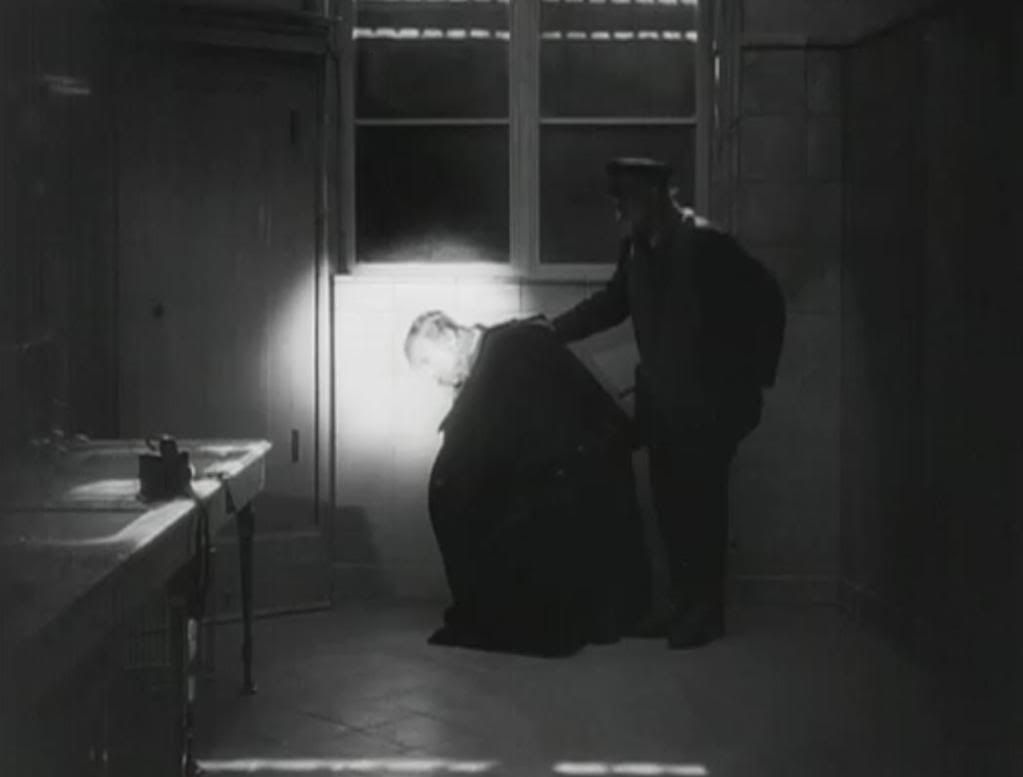
The film proper ends with a haunting, stark shot of the porter slumped over in the restroom, totally broken and resigned to his fate. Murnau and Mayer wanted to end the film with the protagonist's sad death, completing their theme of a man crushed by his society's limiting ideas of a man's worth. The studio wanted a happier resolution, though, and Murnau and Mayer technically fulfill that mandate with a cynical, absurd epilogue that's practically dripping with sarcasm. It's even preceded by a title that explicitly identifies this ending as a deus ex machina, an intervention of the filmmakers with no relation to reality. In this ending, the porter is saved from his fate by an unlikely inheritance from a wealthy stranger, and he celebrates his good luck lavishly while doling out gifts to other unfortunate souls. The whole thing plays out as a ridiculous fantasy where it's entirely obvious that the director and writer have nothing but contempt for this addition to their art, and this tone winds up undermining the happy ending that the producers had wanted. In its very unreality, this epilogue simply reinforces the theme, since only an openly unrealistic miracle can save this sad man from what otherwise seemed an unavoidable and dismal fate.