Showing posts with label 1931. Show all posts

Friday, May 4, 2012

City Lights


City Lights was an anachronism when it first appeared, a new silent production from Charles Chaplin, one of the masters of silent comedy, at a time when the rest of Hollywood was eagerly embracing the arrival of sound. Released in 1931, when silent film was all but dying out, the film opens by immediately mocking the talking pictures, with a scene where a group of local dignitaries deliver speeches commemorating the unveiling of a statue. As they speak, the synchronized soundtrack (Chaplin's one modest concession to the new technology) features muffled nonsense noises, as though Chaplin is making a point, up front, of how irrelevant and silly so much dialogue is — as Norma Desmond would say in Sunset Blvd., it's all just "talk, talk, talk," and Chaplin for one doesn't need it.

In fact, City Lights has only what is absolutely necessary; it's a tightly constructed and incessantly funny flick that's also a moving love story between Chaplin's Tramp and the blind flower seller (Virginia Cherrill) with whom he falls in love. Though the Tramp, as ever, is broke and destitute — in the opening scenes he's sleeping curled up in the arms of a statue — he is determined to help the struggling blind girl and her grandmother (Florence Lee), who face eviction from their apartment while dealing with the girl's poor health. Obviously, this is a story about class, as with many of Chaplin's greatest works, and underneath the film's gentle humor and its romantic warmth lies a bittersweet awareness of the struggles of the working class. In the very first scene between the Tramp and the flower seller, he buys a flower from her, scrounging around in his pockets for the money to give her, and not accepting any change back. As they're talking, an obviously wealthy gentleman runs by, not even glancing at the Tramp or the flower girl, as though they're invisible to him, with no possibility of registering in his mind as he gets into his fancy car. Though he could certainly afford a flower, it would never occur to him to pause and buy one.

Chaplin develops a similar dynamic with the character of the millionaire (Harry Myers) who the Tramp befriends by saving the distraught rich man from killing himself over his divorce, in a very funny and fluidly paced slapstick scene in which the two men not only repeatedly fall into the water, but more importantly, continually teeter on the edge of falling in. (Chaplin knows well that so much of comedy is about restraint and teasing, as when he has the Tramp continually stepping just to the edge of a hole that opens up in the sidewalk, unseen, behind him. We expect the Tramp to fall in but somehow it's even funnier that he doesn't, at least not right away.) The Tramp and the rich man provide another of the film's allegories on wealth, because when the rich man is drunk, he considers the Tramp his best friend for saving him, but whenever he sobers up, he completely forgets about the homeless wanderer who'd rescued him. Thus he alternates between embracing the Tramp as a friend and ordering his servants to kick Chaplin out of his mansion, which the snooty servants very eagerly do.


This commentary on class awareness runs all through the film. The flower girl mistakenly believes the Tramp to be a rich gentleman, and when, in the film's justly legendary final scene, she learns his true identity, Chaplin simply inserts a laconic title card with a rich double meaning — "yes, I can see now" — before Chaplin's endearing final grin. That scene is all about the closeups, the faces, Chaplin hiding his mouth with a flower before finally showing his toothy smile for the final image, the flower girl letting so many emotions ripple across her face as the full import of the Tramp's charity towards her really hits home. Cherrill delivers a wonderful, charming, moving performance, and Chaplin's closeups of her, throughout the film, never fail to be tinged with an element of rapturous awe, something spiritual in the way he idealizes her as an avatar of goodness and purity and feminine beauty — which of course is the way the besotted Tramp sees her.

Of course, the film is also stacked with one delightful comic set piece after another, delivered with the sure hand of a director and performer at the very peak of his talent. Especially marvelous is the boxing match, which has a fluidity and grace to it that couldn't be more different from the crude slapstick violence with which Chaplin started his career at Keystone Studios; here, the boxers really seem to be dancing, a three-way dance that involves a referee who insists on sticking himself right in between the fighters, who trade blows by craning their arms around the other man. The sense of movement here is exhilarating, as the boxers twirl around, sometimes changing "partners" so that one of them is actually squaring off against the referee instead of one another.

City Lights is a marvel of the cinema, a warm and funny classic bursting with the simple humanity of Chaplin's Tramp. Its ending, with its rich emotional complexity and ambiguity, provides one of the most eloquent proofs of the enduring power and beauty of silent film, because with just a few words and those glorious closeups of the leads, Chaplin says so much without actually saying a word aloud.

Wednesday, April 11, 2012

M (1931)


Fritz Lang's M was the director's first sound film, and the penultimate film he made in Germany before emigrating to the USA, fleeing the encroaching takeover of the Nazi party. It is, even today, a strikingly modern film, tackling a very sensitive subject from a surprising angle. Lang's classic tells the story of the search for a child killer who's terrorizing a German city, eluding capture while kidnapping and murdering children that he meets on the streets, luring them with candy and toys. And yet the film is not concerned with the mystery of these killings — the murderer is identified very early on as Hans Beckert (Peter Lorre) — nor is it a thriller focusing on the fear of the victims, which is the conventional approach to films about psychopathic serial killers. Instead, Lang focuses on the paranoia and other effects that these killings have on the city, as well as the killer's own feelings of terror and confusion.

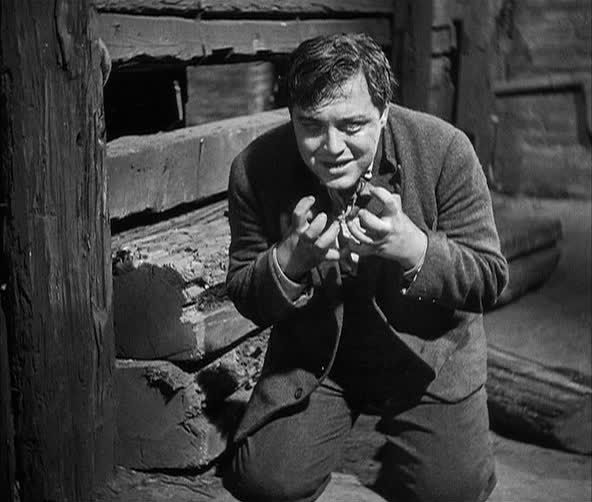
Indeed, Lang accomplishes the miraculous feat of making the killer an almost sympathetic figure in some ways, a figure to be pitied as much as despised or feared. Beckert is portrayed by Lorre as a weak, pathetic, fearful man overcome by compulsions and desires that he can't control. He's pathetic and vile, but his actions are portrayed unambiguously as the product of a mental disfigurement that he is hopeless to resist, and that apparently a stay in a mental hospital could not cure. The film does a remarkable job of portraying Beckert's crimes as a sickness, very different from the usual sort of crime, a product of a diseased mind that, as Beckert exclaims at the film's climax, "really can't help it." He is a desperate man, writing letters to the police and the newspapers that all but beg for them to catch him and stop him, and Lorre's bug-eyed, sweaty performance is incredibly powerful. After one of his crimes, Lang inserts a shot of Beckert looking in the mirror, pulling down the corners of his mouth with his extended middle fingers, stretching his face into a scowl of misery. Later, echoing this shot, he is innocently window-shopping and happens to catch a reflection of a little girl standing behind him; his face becomes deformed, his idle chores forgotten, and he begins whistling "The Hall of the Mountain King," the signature tune that stands for his compulsions.

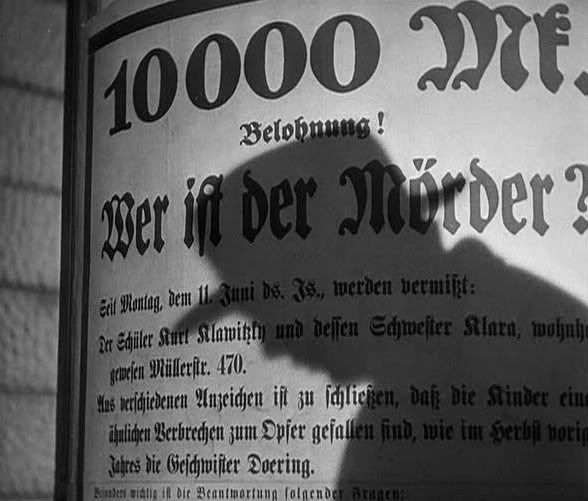
That song is virtually the only music in the film, which has no proper score and only uses whatever scant music appears within the diegesis. Towards the beginning of the film, Beckert's whistling precedes his first visual appearance, as he approaches a young girl, whistling, his shadow cast onto a poster announcing a reward for the killer's capture. It's a sinister image, and the whole scene is chilling for the suggestive way that it chronicles Beckert's predation without any overt violence. The girl's death is signaled with an evocative pair of shots: her ball rolling out of the bushes in a remote, overgrown area, followed by a shot of the smiling, human-shaped balloon that Beckert had bought for her, now drifting freely, getting tangled up in power lines. Meanwhile, at home the girl's mother fruitlessly calls out for her, expecting her home from school, and Lang cuts from the mother at the window, yelling the girl's name, to a series of static, empty, eerily silent shots of the apartment building's staircase and basement, devoid of life or movement. Lang elegantly uses such minimalist aural and visual symbols to tell his story, often replacing images of people talking with images of their shadows reflected on walls.


Lang is also concerned with depicting the killer's effect on the city. People are riled up and paranoid, and they begin responding with suspicion and violence at the least provocation: innocent men are accosted by mobs on the streets, friends accuse one another, anonymous letters point fingers at various random men, whose houses are searched and ransacked for clues by the police. The criminal underworld is also stirred up, as the police conduct raids of red light districts and bars, trying to uncover anyone the least bit suspicious, working on the assumption that the killer must be a shady character in general. These raids cause the criminal gangs, eager to catch the killer and end this intensified police activity, to start pursuing the killer themselves, aided by a network of beggars keeping an eye out for any sign of the murderer.

The general atmosphere of suspicion and persecution suggests a social and political response to this crime that is, in fact, disconnected from its origin. The cops raid bars without discrimination, arresting anyone whose papers are not in order, an eerie premonition of the ways in which the Nazis would shortly begin treating citizens. Lang was at this time growing increasingly concerned about the Nazis' ascent to power, even as his own wife Thea von Harbou, who co-wrote M with him, joined the party, alienating her from the partly Jewish Lang. Thus the film depicts a multifaceted nightmare where fear waits in every direction: a mother's fear for her child's safety, a criminal's fear of being apprehended, but also the more general fear of the innocent being sucked into the vicious whirlwind of a society riven by hysteria, as in the scenes where innocent men suffer in various ways for Beckert's crimes.


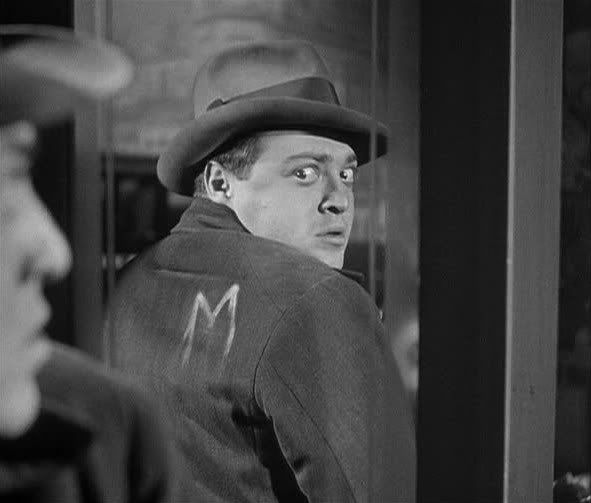
What's most interesting about M is the degree to which Lang lets all these different currents run together without emphasizing one over the other. Lang cuts between different segments of society — at one point blending together a meeting of the police and a meeting of some gangster bosses to ironically point out the similarities between cops and crooks — and different characters, never building a real solid central presence. Lorre's Beckert comes closest to fulfilling that role, though he's almost entirely absent for the first half of the film, only occasionally appearing as a reminder of the one man who's generating all the chaos in the city. Much of the film's second half, though, seems to stick closest to Beckert's perspective, particularly in the harrowing sequences where the killer is pursued through the streets by beggars, eventually cornered in the attic of a building, where the criminals track him down. The beggars even mark him with an "M" drawn in chalk on his jacket — another striking bit of Nazi foreshadowing — and the scene where he discovers this mark in a mirror recalls all the earlier mirror shots involving Beckert. Lang, interestingly, has crafted a suspense sequence in which nobody could possibly be rooting for Beckert to get away, and yet his terror, his increasing desperation, is nevertheless potently communicated by Lorre's performance and the shadowy, expressionistic mise en scène. Further enhancing the tense atmosphere is the fact that Lang shot many scenes entirely silent, only occasionally piercing the hush with bursts of clamoring police sirens or the shouts of the killer's pursuers.

M is many things: a powerful depiction of violent malaise, a searing critique of the death penalty and vigilante justice, a psychological study of fear and guilt, a vision of societal violence and fear that serves as a prelude to the rise of the Nazi Party. It remains such an affecting film in large measure because of how deftly Lang weaves together all these ideas, destabilizing audience expectations at every turn. Even today, so long after it was made, the bravery and modernity of Lang's ideas and his cinematic approach to this material is bracing and impressive.

Monday, April 2, 2012

La Chienne


Bleak, tragic, affecting, and at times surprisingly humorous, Jean Renoir's La Chienne is the melancholy tale of a poor schlub who gets in way over his head. Maurice Legrand (Michel Simon) is a low-level cashier, a reserved, quiet guy who's the butt of everyone's jokes because of his social awkwardness and his notoriously nasty wife Adèle (Magdeleine Bérubet). She shrilly browbeats him over the most insignificant things and is constantly comparing him, unfavorably, to her dead first husband, a war hero whose dashing portrait she proudly hangs in the parlor as a reminder of all the ways in which Legrand fails to measure up. Simon delivers a sensitive, heartbreaking performance as this broken and beaten man, his tall frame constantly stooped over, his face droopy and locked into a frown of resignation. He's a forgettable lump of a man, plodding tiredly through life, his only pleasure coming from his painting — a hobby that his wife takes every opportunity to insult him about.

As sad as his life is, though, his attempt to escape this pathetic existence only gets him into even more trouble, when he falls in love with the prostitute Lulu (Janie Marèse). Lulu's a crass opportunist who latches onto Legrand only to get money for her pimp and boyfriend Dédé (Georges Flamant). Legrand, naïve as he is, adores Lulu and doesn't even realize that she's only using him while pining for Dédé, who's as disinterested in her as she is in Legrand. This dysfunctional love triangle plays out with brutal emotional honesty. Even as Legrand's earnest love leads him to ruin, Renoir explores the cruel irony of Lulu being mistreated in turn by Dédé, who never displays a moment of tenderness with her, roughly grabbing her face to kiss her, after which she beams with joy; she's as oblivious as Legrand is.

What's great about the film is the somewhat haphazard unpredictability of its plotting and its juggling of tones. It's a twisty film where the reversals and ironies are anything but cheap, but instead provide bitter commentary on the follies of the characters and the society in which they live. Probably the best example is the subtle humor of the scene where Adèle's "dead" husband Godard (Roger Gaillard) returns, thinking that Legrand would pay him off to stay away, but instead the unhappily married Legrand is all too eager to simply step aside, responding with exaggerated courtliness to the other man's attempted bribery. It's hilarious to watch the dawning fear on Godard's face as he desperately lowers his bribe demand and begins to realize that his plan might backfire on him.


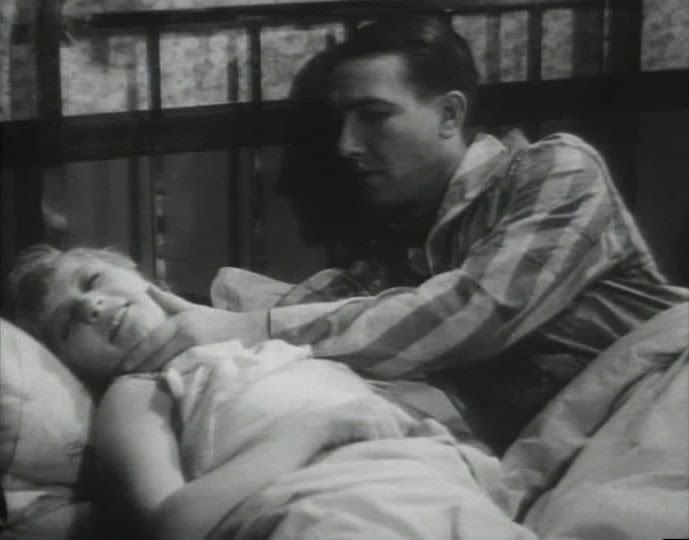
Renoir's style gives the film a deceptively off-the-cuff look, contributing to its low-key realism, but there's great precision in these seemingly casual images. In particular, Renoir often shoots frames within the frame, which call back to the film's opening, a fourth-wall-breaking Punch and Judy introduction which frames this story as an explicitly fictional narrative and promises, somewhat facetiously, that there will be no moral to the story. The prevalence of frames and mirrors surrounding these characters, creating additional layers within the film frame, is a reminder of the dramatic artificiality of this story. In one such shot, Legrand comforts Lulu, sitting on the bed and embracing her, framed by a window, flanked by flowers sticking up from the bed in front of the window. This striking shot recurs in a very different context later in the film, but these frames are everywhere: in the mirrors that reflect Legrand as he shaves, and in the deep focus shots that show Legrand's neighbors doing household chores in the windows across the way.

Even more powerful is the pivotal moment when Legrand discovers Lulu in bed with Dédé. There's a long silence as Renoir cuts to outside, the camera peering through the window at the lovers in bed, then tracking to the right to reveal Legrand standing in the doorway, looking in at them. The distance of the image reflects Legrand's sudden feeling of disconnection, as though he's floating outside of himself, looking in on this scene from a safe distance. Renoir then cuts directly to a closeup of Lulu, lamely trying to justify her actions, which shatters the shocked contemplation of the exterior shot. Renoir also gets a lot of mileage out of the slanted street in front of Lulu's house, and the twisty, shadow-strewn expressionist staircase that leads up to her flat. Her place seems to be built on unstable ground, and all these jagged, crooked lines and serpentine curves emphasize just how far off the straight and narrow path the normally conservative Legrand has wandered whenever he goes to visit her.

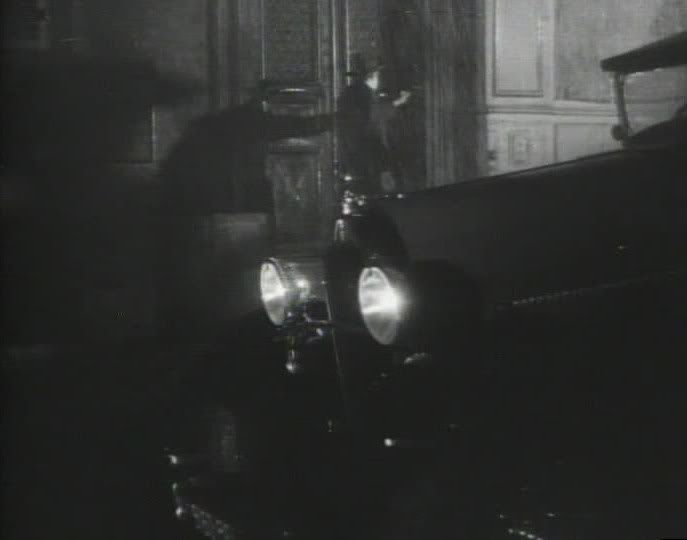
The film almost gleefully embraces the moral confusion of its protagonist, whose very normality ultimately allows him to, quite literally, get away with murder. Towards the end of the film, Renoir cleverly shows Legrand slouching discretely away, unnoticed, while the flashy pimp Dédé pulls up in a fancy new car. The film's conclusion suggests that Legrand, a respectable member of bourgeois society and a white collar worker, doesn't have to pay for his actions, at least not in a legal sense, when there's a far less respectable scapegoat at hand. The film ends with a weirdly tragicomic epilogue, in which Legrand and Godard meet up as hobos, years later, both of them gruff old men cackling about their shared fate. When Legrand confesses that he has become a murderer since they last met, Godard simply stares at him for a moment and then shrugs, "it takes all kinds." This cheerful amorality is part of Renoir's vicious satire of the bourgeois, and this ending serves as a prelude of sorts to Boudu Saved From Drowning, in which Renoir again directed Simon as a tramp stomping on middle class respectability; by the end of La Chienne, Simon's Legrand seems primed to become Boudu. La Chienne ends with Legrand telling Godard, without irony, "life is beautiful." As the two men walk away together, Renoir pulls back, through a window that's then revealed as the proscenium of a theater, the curtain falling on this sordid little human drama.

Friday, February 3, 2012

Limite


The Brazilian writer and poet Mario Peixoto directed his only film, Limite, when he was very young, and he never made another film. Limite thus remains as a romantic one-off artifact, an often forgotten and neglected avant-garde work. The film has a simple and iconic scenario, in which two women (Olga Breno and Tatiana Ray) and a man (Raul Schnoor) drift on a boat, their clothes worn and torn, their food supply nearly exhausted, their expressions downtrodden and miserable. As they sit in the boat, aimlessly floating on the tranquil water, they remember their pasts and tell their stories to one another. One of the women is an escapee from prison, and the man was involved in a tragic love triangle that ended with the loss of his lover, but their stories aren't the real focus of the film. The flashbacks are elliptical and abstracted, with very little true narrative content. The only intertitles appear, jarringly, in a brief stretch late in the film, during a conversation between the man and a rival suitor (Brutus Pedreira), both of them mourning their lost love. During this conversation, the film unexpectedly veers into the territory of the traditional silent melodrama, with Peixoto filming the charged glances that pass between the men while the titles relate the few lines of tense, angry dialogue that constitute almost the entirety of the film's verbal content, though there is also some onscreen text from a newspaper that relates the story of the woman's jailbreak.

These snippets of text are Peixoto's only concessions to narrative momentum. The rest of the film teeters on the edge of abstraction, and the narratives, such as they are, are vague and simple. Peixoto seems less concerned with conveying tangible details or telling particular stories so much as exploring iconic situations. He's interested in emotional content in its raw form, so the stories related through the flashbacks sketch out only the outlines of these characters' lives, emphasizing the pain and anguish they feel rather than the particular events that brought them to this state. Peixoto relies on the viewer to connect the dots, to be swept up in the emotional poetry of these often-empty natural landscapes, melancholy small town streets, overcast skies and ocean waves.

Unfortunately, it can be a challenge to do the work required by Peixoto. The film often feels as empty and uneventful as its landscapes. The film is relentlessly slow-moving, and often dull, especially in the first half when Peixoto holds many seemingly endless long shots of people simply walking, shot from multiple angles and sustained for several minutes at a time. The abstracted narratives and stark, patiently paced imagery can be trying, as there is often very little context for any given shot, and thus very little cause for the emotional investment that Peixoto demands. He's reaching for visual poetry rather than narrative, but too often I just didn't feel the poetry of his images, I couldn't access the emotions he's expressing. The imagery is generally too plain, too static and repetitive, to hold up the film in the absence of any other content.


Which is not to say that the film is entirely disappointing. Its best sequences are poetic and moving in mysterious ways that are difficult to articulate, and for every aimless shot of someone walking along a country road, there's an image of startling emotional immediacy. At one point, one of the women, upset about something, goes out to a cliff overlooking the sea and the curving shore below. The camera, looking over her shoulder, begins to sway and shake in sympathy with her mental turmoil, turning in graceful arcs from the shore out into the water, and then beginning to spin rapidly, the whole scene turning upside-down and tracing 360-degree circles. This disorientation perfectly reflects the mental state of the woman, who is wracked by a mysterious despair that drove her to this desolate outcrop.

In another sequence, the man recalls his love affair in a methodical progression of shots, most memorably a closeup of hands clasped together as he walks along a jetty with a woman, surrounded on both sides by water. The man and woman go bathing together in a lake, and afterwards he carries her out of the water like a groom carrying his bride across the threshold — is this a romantic image, or did she die? it's not quite clear — and then Peixoto inserts a montage of natural images. The whole sequence is then repeated with the man and the woman fully removed: their footprints are visible in the sand on the jetty, and then Peixoto shoots the rest of their walk with the figures absent, ending with a shot of the footprints being washed away by the waves washing up on the shore. It's a beautiful and simply powerful evocation of lost love, an affair ending, all traces of its romance being erased as it fades into memory. At moments like this, Peixoto's imagery is direct and evocative, economically stating a strong and familiar emotion with a few elegantly montaged images.

At other times, Peixoto's less direct visual poetry can be equally affecting, as when the film climaxes with a few minutes of waves crashing against rocks, frenetically collaged together with rapid editing far more jagged and fast-paced than anything else in the film. There's a literal dimension to this sequence, as a representation of the stormy seas that ultimately wreck the boat at the end of the film, but more importantly it's an entirely abstract emotional climax, a peak of frenzied feelings and desperation, the turmoil of the water standing in for the turmoil in the minds of the protagonists. The film has some excellent sequences like this (a meta scene in which a laughing audience watches a silent movie is another) but they're spaced out by long dead stretches, patience-trying sustained shots and slack pacing. Limite is not quite the lost classic of avant-garde cinema that it's often held up as, but it's definitely an interesting experiment, and in its best moments it achieves a stark emotional purity and simplicity that is very appealing indeed.

Monday, March 22, 2010

Tokyo Chorus


Tokyo Chorus is an early pre-war silent film from Yasujiro Ozu, whose silent work generally reveals quite a different director from the later static, patient sensibility of his mature oeuvre. Of course, there is still a continuity in terms of themes and subjects connecting these earlier silents to the sound films. Tokyo Chorus is, like almost all of Ozu's films, concerned with domesticity and family relationships, and with the changes wrought on the family by outside pressures and developments. In Ozu's post-war films, these pressures take the form of encroaching Westernization, of the old traditional ways transitioning into a new modern sensibility. Obviously, there are some slightly different concerns at the core of this pre-war film, made in 1931 with the Great Depression affecting Japan as much as any other country — as one character jokes early on, "Hoover's policies haven't helped us yet," a wry punchline made even more bitterly ironic by the retrospective knowledge that Hoover's policies didn't help anyone very much.

The film centers on one family struggling to make ends meet during this difficult economic time. Shinji (Tokihiko Okada) is introduced as a rebellious, goofy schoolboy, but a few years later he has a family: a wife (Emiko Yagumo), a son (Hideo Sugawara), a daughter (Hideko Takamine) and a baby. Ozu introduces Shinji in a lengthy and near-slapstick sequence as a stern school teacher (Tatsuo Saito) tries to maintain control over a rowdy line of students (though, admittedly, the fact that all these schoolboys look like grown men initially makes it hard for an outsider to figure out the context of this scene). Ozu pans across the line of students, his camera moving across a diagonal composition that is repeated several times throughout the film. Such motion would later become rare and uncharacteristic in Ozu's post-war work, but here his aesthetic is not pinned down to the static, low-height observation that would come to be his most salient visual characteristic. Instead, Ozu's camera tracks along with the characters as they walk, or passes along rows of people lining a street.

During the opening scene, Shinji and the other students goof around and play, as the instructor makes disapproving notes in a little book, calling them out to examine their outfits and their posture. Shinji gets in trouble for not having a shirt on under his jacket, and is left sitting alone, picking at something (bugs? stray threads?) on his pants as the rest of the students are led away. This introduction establishes the film's broad sense of humor, telegraphed through the loping gait of the students as they act surly towards the teacher, or the instructor's head-bobbing bounce as he surveys them. From this opening, Ozu cuts away to a few years later, when Shinji is working at an insurance company. It is not stated directly, but the gap is meant to represent the onset of maturity, the rowdy schoolboy gaining responsibility as he settles into life with a family and a respectable office job.


This stability is disrupted when Shinji loses his job after defending an older employee who he felt had been unfairly fired: his earlier insouciance towards authority manifesting itself again in an act of benevolent defiance. The scene is nearly played for comedy — Shinji and his boss get into a slowly escalating shoving match by tapping each other on the shoulder with fans — but there's no mistake that the consequences of this lost job are truly dire for a man with a wife and three children in the middle of a terrible depression, with no jobs available. The central theme of the film is this man's struggle to maintain his family's honor and his own self-respect when faced with the loss of his profession and, with it, his claim to respectability. Honor is central to the film, especially as expressed in the way that Shinji's wife looks at him; Ozu captures the impact of a look, the humiliation of seeing her husband in a menial job that is beneath his station, a job he only got because of a chance encounter with his sympathetic former teacher.

What's interesting, though, is that Ozu ultimately critiques, in his own indirect way, the concepts of honor expressed here. Shinji's wife at first resists her husband "stooping" to a job carrying banners to advertise his former teacher's new restaurant; when she sees him doing this, she is humiliated. In fact, it's a rare moment when Ozu reinforces her feelings with an intertitle that outright says she's humiliated; Ozu generally uses such titles sparingly, preferring to capture such emotional nuances in the actors' performances, using the editing to emphasize certain glances and expressions. This, apparently, was a beat that Ozu felt the need to hammer home more forcefully, however, hitting his audience over the head rather than risk anyone missing the wife's sense of disgrace. She tells Shinji that he should remain proud and not do anything so obviously beneath his status. But Shinji resists, insisting that he is doing the right thing, that all a man in his situation can do is take whatever opportunities come to him. His wife soon gives way as well, agreeing to help him in his new job and supporting him until, at the end, his former teacher comes through with an offer of a better job in education. The lesson seems to be that abstract concepts like honor and pride are not nearly as important as putting food on the table for one's family, just as keeping up appearances must be secondary to providing the necessities of life for one's loved ones.

Tokyo Chorus is a fine film if not a particularly distinguished one. It reveals Ozu's nascent sensibility in its earliest state, as he deals with his usual themes — family dramas, the conflict between traditional values and changing conditions, the rhythms of domestic life — in a less formally rigorous way than he would in later years. The film is unfailingly direct and straightforward in its approach, telling a simple story simply. It is thus not quite a peak Ozu film, but perhaps an important work in his development, a step towards the greater depth and aesthetic richness of his later films. It is, regardless, an affecting film, particularly in two scenes between Shinji and his teacher. In the first, when the teacher offers Shinji a job, the latter offers some token resistance based on honor, saying that if the teacher merely feels pity for him, then he can't accept, but that if it's a gesture of friendship instead, he can. Shinji is essentially constructing a way for him to take the job and still feel like he's not sacrificing his honor; Ozu captures the desperate yearning on Shinji's face as he fears that perhaps his teacher will withdraw the offer, and the knowing nod from the teacher as he accepts this face-saving gesture. Later, in the final scene, Shinji's former classmates have gathered together for a reunion, and are singing a song together. Shinji and the teacher both join in, but as Ozu cuts between closeups of the two of them, isolating them within the crowd, their faces are troubled briefly by sadness and introspection before they regain their composure and join the celebration. Even in a relatively straightforward and conventional film like this, Ozu asserts his mastery with shots like these, shots where complicated emotions arise from his probing of the faces of his actors, and the juxtapositions between uplift and loss that flow through this film.

Wednesday, January 14, 2009

The Criminal Code


[This is a contribution to the Early Hawks Blog-a-thon hosted right here at Only The Cinema. It will run from January 12 to January 23, 2009.]

Howard Hawks' second sound film was The Criminal Code, a hard-edged prison drama about the promising young Bob Graham (Phillips Holmes), who finds his life detours onto a very different path after a nightclub fight leaves another man dead. Graham comes before the tough, monosyllabic D.A. Mark Brady (Walter Huston), who is not nearly as sympathetic as he is practical: there's an election coming up, and even if he knows that the death was an accident and could be classified as self-defense, he feels the pressure to go for a murder charge instead. Graham winds up with ten years in jail, the passage of time slowly eating away at him until Brady, with his political career not panning out as planned, is reassigned as the prison's new warden. It's a taut psychological drama, focused not so much on concrete action as on the philosophical and emotional undercurrents involved in this story. Brady's idea of justice as a D.A. is "an eye for an eye," which he insists is the foundation of the legal system. "Somebody's gotta pay" when a crime is committed, he says, an expression that implies it doesn't really matter who pays. So the film is actually about the redemption of both its leads: Graham, crushed by his years in prison, must learn to be a honest, decent man again, while Brady, faced with the consequences of his sometimes laissez faire judicial philosophy, must rethink his concepts of justice and fairness.

It's a relatively simple narrative then, and Hawks is saddled with a screenplay that often seems to be padding its length in order to obscure this basic simplicity. Once the action moves to the prison, it pretty much stays there, and there are often long, drawn-out dialogue scenes in which nothing much happens, simply to pass some time. The static setting and uneventful plotting especially become tiresome in any of the scenes between Graham and Brady's daughter Mary (Constance Cummings), who predictably falls in love with the young convict who's trying to reform. It doesn't help that Graham, as sketched by the uneven Holmes, isn't much of a character. Holmes acquires some much-needed grit in the scenes where Graham, transformed by his years in prison, becomes hard and short-tempered, or else lapses into a zombie-like walking sleep. But his idea of playing a normal, decent guy is to drain every trace of bite or personality out of this poor shell, leaving a gaping hole of charisma and actorly presence in the screen.

To a large extent, this hole is filled by Walter Huston. Huston is a magnetic presence, an overpowering actor who dominates any scene he's in; he frequently seems to be acting in another, better movie from the rest of the cast. No matter what the tortured, melodramatic dialogue might be, Huston manages to make it sound magnificent, brilliant, emotionally charged: listening to him is inspiring and exciting even if the actual words he's saying would be dead on the page, as they sometimes are here. He even manages to invest the depths of his character into Brady's habitual repetition of the monosyllabic "yeah," an all-purpose bit of verbiage that he spits out as punctuation, a challenge, a sign of resignation, a question, an indication of thought, and only occasionally as an actual affirmation. The actor uses his character's general taciturnity to his advantage: as shaped by Huston, Brady comes across as a man with a sharp intellect who thinks before he speaks, so his few explosions into impassioned speechifying are endowed with a greater profundity than they would have if this preachy verbalizing was his norm.


But if Huston dominates the film, chewing through its uneven script like the cigar he frequently chomps, Hawks must also be credited with infusing life into the corners of the film, sketching details and nuances around the edges of Huston's performance. Hawks most obviously comes alive in the film's opening scene, which follows a couple of cops who can't stop arguing about a game of cards even long enough to go investigate a murder. It's a hilarious bit of business, achieved with the frenetic, overlapping soundtrack that would later be known as one of Hawks' most characteristic touches. The cops' running argument is carried through from a scene by the telephone, where they get the call to head out to the nightclub, to a sped-up sequence where the car arrives at the club, to the actual investigation itself, even reappearing on the fringes of several subsequent scenes as Graham is brought before the D.A. for the first time. It's so great — and so out of tune with the rest of this rather dour film — that one inevitably wonders if Hawks spontaneously added the whole bit himself, just to liven things up.

Hawks' touch is also felt in the scene where Brady, while being shaved by one of the prison barbers, engages the man in idle conversation, during the course of which he learns that he was the one who sent this barber to prison, and that the crime was slitting a man's throat. As the barber runs his razor along Huston's exposed neck for the last time, Hawks focuses on Huston's upturned head, one of his eyes visible from this angle, staring off to the side with restrained concern. The film even boasts the prison version of the typical Hawksian mourning sequence, when Graham learns by telegram that his mother has just died. His cellmates pass the telegram around, glancing at it disinterestedly, then attempt to defuse their friend's inevitable breakdown by prodding him into continuing the game of checkers that had been interrupted by the news. This pointed nonchalance in the face of death, the attempt to ignore it with frivolous fun and surface celebration, is a constant in Hawks' films, perhaps most poignantly captured in the cheerful drunken wake for a dead aviator in Only Angels Have Wings.


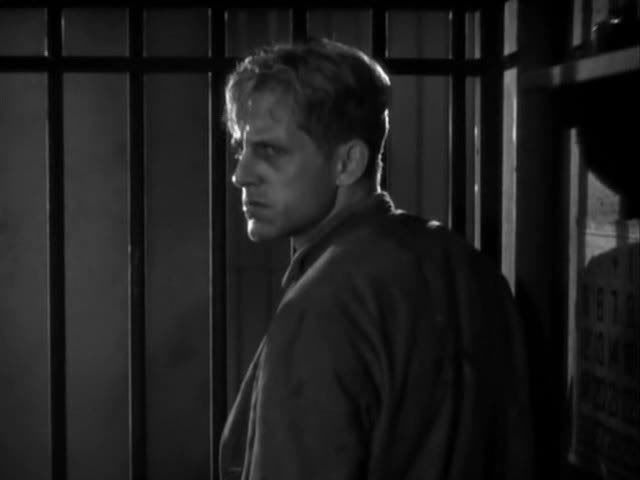
These typically Hawksian moments abound, particularly in the director's handling of the film's two best acting assets. Huston of course is always great — especially when he stoically faces down a whole yard full of restless prisoners — but Boris Karloff threatens to steal the whole film away from everyone in his relatively few brief scenes. This was Karloff's first major picture, and his role as the hulking murderer Galloway led directly to his famous part in Frankenstein. It's easy to see why: he brings a sinister intensity to Galloway, with his tightly cropped bowl haircut, outsized body, and an overhanging brow that casts heavy shadows over his glinting, shard-like eyes. In his early scenes as Graham's cellmate, he stays mostly in the background, an unobtrusive minor character until Hawks abruptly highlights Karloff's frightening visage in a blurry, massive closeup as Galloway fantasizes about finally getting his hands on a "squealer." But Galloway is also, intriguingly, somewhat sympathetic and humanized; his devolution into an obsessed killer largely developed, it's implied, because of the actions of the manipulative chief guard (DeWitt Jennings).

Later, Hawks brilliantly stages a murder scene by focusing on Galloway's huge, unmoving back, his posture erect and his form towering over his intended victim, who cowers before him. The scene remains motionless for a few long, breathless moments, so that the focus of attention becomes the thin sliver of light that plays along the well-polished blade that abruptly appears in Galloway's outstretched hand. Moments like this obviously stand out from the sodden mush that often surrounds them in this film. It's a film where the parts are greater than the whole, perhaps because the vibrant, interesting scenes are often separated from each other by intermittent fallow patches. Working with substandard material and only two actors who possess sufficient fire and energy for a Hawks film, the director nevertheless makes The Criminal Code a worthwhile and often even fascinating drama.