Showing posts with label 1933. Show all posts

Wednesday, April 27, 2011

Passing Fancy


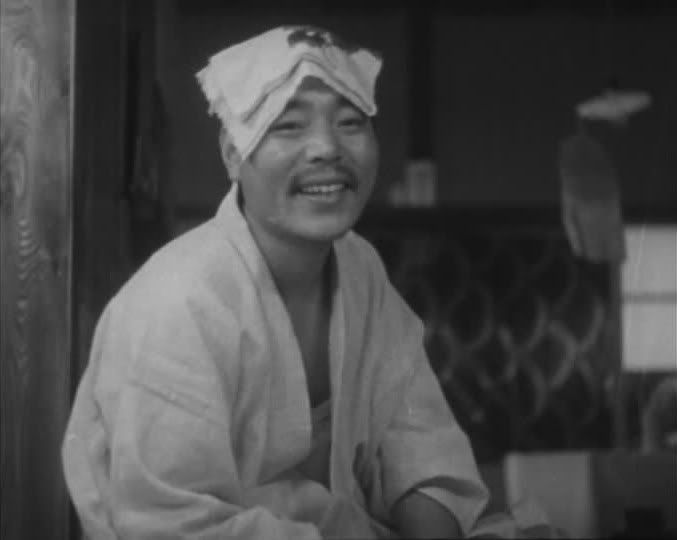
Passing Fancy is an early silent comedy by Yasujiro Ozu. Although many of Ozu's silent films are quite different from his later works, in Passing Fancy Ozu's mature style already seems to be almost fully developed. The film is a charming family comedy about the single dad Kihachi (Takeshi Sakamoto), his son Tomio (Tomio Aoki), and his friend Jiro (Den Obinata), and the tension that enters their simple lives when they meet the homeless and unemployed young woman Harue (Nobuko Fushimi). The middle-aged Kihachi immediately likes the much younger woman, helping her get a job and a place to stay at a neighborhood restaurant while courting her in his goofy but charming way. Harue, though, thinks of Kihachi as an uncle and prefers the younger Jiro, who makes sure to keep her at arm's length, though one suspects that despite his insistence that he doesn't like her, he's only pushing her away out of loyalty to his good friend.

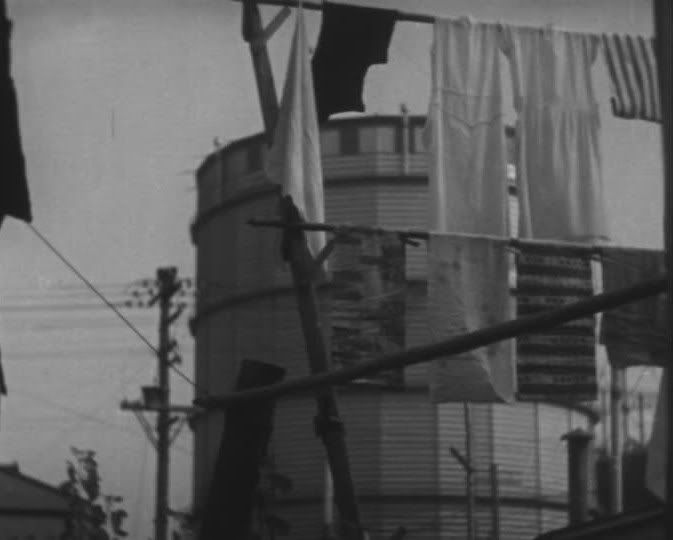
The film is mostly shot from Ozu's familiar low vantage point, his aesthetic already well-established by this time. In his films with children, the low camera placement seems to take on an additional purpose, as the low-to-the-ground framings are perfectly suited to a child's proportions — Tomio fits comfortably within the frame no matter how low the camera is placed — while the adults seem to tower outside the frame, their legs entering the frame before the rest of their body begins to appear in view. The compositions of the film are as meticulous and deliberate as later Ozu, with a constant awareness of how objects and people are arranged within the static frames; there is no camera movement, an aesthetic choice that would be totally codified in Ozu's late color films. As in his later work, striking use is made of bottles and other household objects positioned to counterbalance the actors within the frame; often the actors are placed into the background with some domestic object highlighted in the foreground. Ozu also periodically inserts static shots of the surrounding buildings and water towers to establish the setting, early examples of the "pillow shots" that would become such a powerful aesthetic devise in the director's postwar oeuvre.

Though there are elements of drama and melancholy in Passing Fancy, the film is largely a comedy, not so much in terms of broad slapstick as in its gentle but pervasive comic tone. Even at the height of the film's downtrodden section, when Tomio falls ill and Kihachi worries that the boy might die, Ozu breaks the tragic mood with a comic series of intertitles when Tomio's teacher asks Kihachi how the kid got sick, causing Kihachi to respond that "he ate fifty sen worth of sweets all at once," then enumerating all of the different flavors of candy the boy had eaten. Obviously, the illness isn't meant to be taken entirely seriously, but Kihachi's worries are heartrending anyway. Similarly, there's a strain of comedy running through the film centering on economic concerns in Depression era Japan, a concept introduced in the most humorous possible way in the film's opening scenes. At a theatrical performance, several men in the audience see a coin purse sitting on the ground and discretely peek inside, realizing that it's empty and then discarding it, only to have another man pick it up in the hopes of finding something inside. Ozu milks this gag for its gestural comedy, and also for its suggestion of poverty so extreme and common that none of these men think twice about trying to scrounge for money anywhere they might find a few coins. The physical comedy is then extended with a sequence where several men get up and dance around as though they have bugs crawling around in their clothes, another sign of the squalor of this neighborhood.

That economic hardship defines the film in many ways. Kihachi is embarrassed by his lack of financial security, by his inability to give his child everything he'd like to, and his desire for more leads him to extravagantly give the boy a coin, which Tomio then uses to gorge on candy since he's not used to having any money at all. More seriously, Kihachi proves incapable of paying the doctor who cares for his son, and scraping together the money for the medical bills proves to be an exceedingly difficult task. It quite literally takes the efforts of nearly everyone he knows to pay the doctor, with his community of friends and neighbors coming together to help him and his son.

Ozu often seems constrained by the stylistic conventions of the silent cinema; Japan was slow to switch to sound, and though Ozu often gets by here through gestural acting within the frame, this is a rather dialogue-heavy film with a lot of information and emotion conveyed through the text. In the scene where Harue and Jiro argue over her lack of romantic feelings for Kihachi, Ozu unleashes an uncharacteristic barrage of dialogue intertitles, alternating between static, repetitive images of Harue and Jiro, with more or less the same closeup of each repeated over and over again in between titles. It's one of the moments when the limitations of silent style for Ozu become obvious, as his visual sensibility must be subsumed to the necessity of staging a lengthy and emotionally complex conversation entirely in text.

Such glitches aside, Passing Fancy is a warm and gently funny work. The film's story is minimal, which allows Ozu to develop his characters and to use his slow, observational visual sensibility to create a portrait of an era and a neighborhood. The rich sense of community, the half-comic depiction of economic woes, the emotional nuance of the characters as they make the best of their limited circumstances, it all adds up to a lovely film that's very much attuned to the social milieu in which it is set.

Saturday, January 17, 2009

Today We Live


[This is a contribution to the Early Hawks Blog-a-thon hosted right here at Only The Cinema. It will run from January 12 to January 23, 2009.]

Today We Live finds poor Howard Hawks valiantly struggling against the maudlin, lumpen nature of the stock WWI melodrama he's been saddled with, trying to throw some jolts of energy into an odd, limping script. The film's most interesting subtext is its occasional flirtation with turning a typical love triangle into a square by adding the leading lady's possibly too-affectionate brother into the mix. There's a strange, unsettling pleasure to be found in this straight-faced perversity, in the way that Hawks plays up the film's sexual roundelays. Diana (Joan Crawford) is at the center of these games: she's engaged to Claude (Robert Young), who has been best friends with her brother Ronnie (Franchot Tone) since all three of them were youngsters. The three have grown up together, and maintain such a tight camaraderie into adulthood that Claude seems to be engaged to Ronnie just as much as he is to Claude, while Diana sometimes nearly seems to be marrying her own brother. It's an incestuous set-up; Diana and Claude are hardly ever alone, preferring to stroll arm-in-arm with Diana in between her brother and her lover. When they're all together, they patter back and forth in the kind of jesting, referential language that can only pass between people who have spent their whole lives together.

However bizarre the whole thing is, the trio seems happy enough, even though the two buddies are continually going off to war, and can only visit with Diana for very brief periods of time. Enter Bogard (Gary Cooper), a rich American who is coming to take over Diana's ancestral home for obscure reasons that aren't quite explained in the film — something to do with the war effort, one supposes. He shows up at a bad time, immediately after Diana has learned that her father died in combat, but she makes a brave effort to mask her feelings and show the visitor around as though nothing has happened. There are a lot of barely contained emotions in this film, a lot of holding back tears and putting on a jolly façade. The film's emotional palette seems equally derived from British "stiff upper lip" decorum — the characters other than Bogard are all meant to be Brits, though only Crawford does even a passable job of pulling it off — and from the usual Hawksian emphasis on good cheer in the face of death.


In this respect, the film is often reminiscent of Hawks' first sound film The Dawn Patrol, which used similarly clipped tones and abrupt pseudo-British speech rhythms to suggest the emotionally conflicted atmosphere of war. Today We Live recycles some of the footage from the earlier film's bombing raid scene for its aerial footage, although Hawks apparently also pilfered liberally from Howard Hughes' Hell's Angels for some more aerial footage. But the film is most reminiscent of The Dawn Patrol in its adaptation of the earlier film's condensed, laconic vocabulary; it's very rare that anybody says a complete sentence here, instead spitting out disconnected phrases and words. The characters say "right" and "stout fellow" more than anything else, this latter often directed as Crawford's character, who is praised like one of the guys for keeping her emotions in check. One is reminded also of the drunken wake in Only Angels Have Wings, in which Jean Arthur's Bonnie Lee is first tentatively accepted as one of the guys because she's able to put on a brave, cheery face rather than bawling.

To a large extent, this is what Crawford is asked to do throughout this film: there's scene after scene of her looking glamorous (often in outrageously avant-garde couture) while holding back tears. The problem is that the melodrama isn't really grounded in anything, and when Crawford essentially sticks to the same emotional register for nearly two hours, it simply becomes tiresome (or a guessing game of sorts: is she going to react to anything with something other than restrained tears and a fake grin?). These problems become apparent when, early on, Diana and Bogard abruptly declare their love for one another after hardly sharing a scene together. The film was cut substantially before release, with nearly 20 minutes hacked out of Hawks' original cut, and one can only conclude that the natural development of this romance was left on the cutting room floor. If so, things don't get much better even in the presumptively uncut later sections, because the supposedly loving couple proceed to spend much of the rest of the film apart, with only brief scenes together scattered here and there. In a way, it's a good thing; it's not like the glam, wide-eyed Crawford ignites any chemistry with taciturn, stone-faced Cooper.


Despite this romantic foundation, it's typical of Hawks that the core of the film is actually an extended pissing match in which the three men size each other up and test each other's limits. There are two lengthy scenes, one directly following the other, in which the men take turns testing one another. Bogard is in the air force, a bomber pilot, and he looks down on Ronnie and Claude, who man a small boat on mysterious but obviously dangerous missions from which they often return wounded. Despite this, the boat crews are routinely mocked by the other military men, who tend to assume that these little boats don't leave the harbor, and that their crews know nothing of real combat. It's with this mindset that Bogard brings Claude along on one of his bombing runs, enlisting him as a gunner; he intends to shock the cheerful young man by showing him what "real war" is like. Claude of course keeps his head, blasting enemy planes out of the sky with a broad grin on his face the whole time. Despite the recycled footage in this sequence, which is not nearly as well-paced or as skillfully assembled as the viscerally thrilling battles in The Dawn Patrol, Claude's gleeful shooting is a blast. Hawks follows this scene with one in which the boat guys return the favor by inviting Bogard along, proving that their work is equally dangerous and important. It's a great bit of Hawksian dick-measuring, a game of "who faces death more bravely?"

But the film's finest hat-tip to mortality is the hilarious funeral for Claude's poor pet cockroach, an unlikely victim of German gunfire. The airmen hold a lavish funeral for the roach, flanking his matchbox home with candles and singing drunken songs of mourning for the little guy. No one was better than Hawks at turning funerals into causes for celebration and morbid humor, and this short bit has to rank up there with the best Hawksian wakes. Even better is the earlier scene when Diana helps Claude and Ronnie catch this roach in the first place. She scurries around on the floor, grinning widely, and then Hawks inserts a closeup of the roach crawling across a woman's hands, joining Crawford's glamour and femininity to this image of filth and abjection. It's a bizarre and memorable moment.

Today We Live is at its best when Hawks is able to bring out such nasty, uncomfortable, conflicted emotions in this story, to exploit the weird incestuous triangle at the story's core. Because really, Cooper's Bogard is almost extraneous to the film's romantic substance. The real sexual tension is between the brother, the sister, and the best friend, as exemplified by the scene where Claude and Diana tell Ronnie, somewhat shamefacedly, that they "didn't wait" (a bold moment even by pre-Code sexual standards). Ronnie's response, of course, is a joyful smile spreading across his face, to express his profound happiness that his best friend is having sex with his sister. Hawks has a lot of fun with this stuff, bringing his playful sensibility to this often tired material whenever he can. But as good as the film often is in isolated moments, he ultimately isn't able to elevate the film much above its standard melodramatic plot.