Showing posts with label 1935. Show all posts

Thursday, February 19, 2009

Mad Love


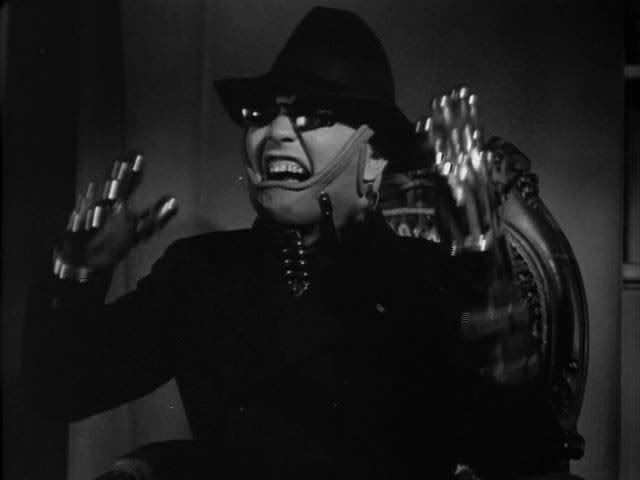
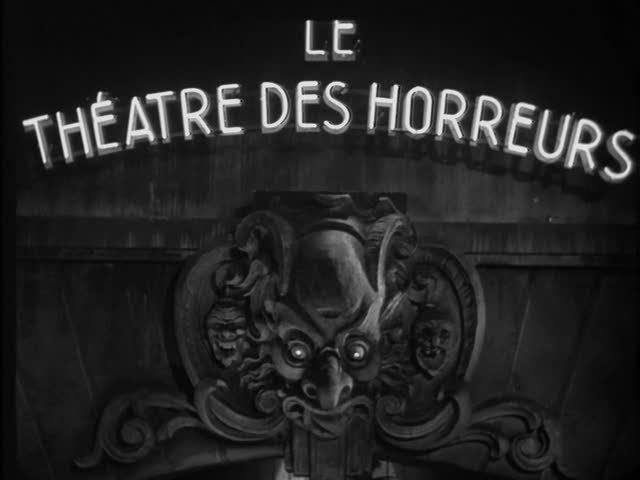
Mad Love is a stunning work of baroque horror, a bizarre masterpiece from expressionist cinematographer-turned-director Karl Freund, Freund's final feature as a director before he retreated behind the camera for good. It's a truly depraved film, populated with a memorable array of eccentrics and grotesques, living up to its title in its exploration of deranged desire and obsession. At its core is an impossible love story, the desire of the kindly but slightly creepy master surgeon Gogol (Peter Lorre) for the beautiful actress Yvonne (Frances Drake), who he watches on stage every evening. Yvonne performs at a horror showcase where her specialty is subjecting herself to elaborate tortures as part of the theater's macabre plays: tales of revenge and betrayal where Yvonne plays women who would rather be tortured than reveal the names of their illicit lovers. Gogol watches her voyeuristically, hidden behind curtains in a balcony where Freund splits the doctor's face in half, half darkly shadowed and half exposed to the light, with one bug eye staring out at the actress' struggles and tribulations. This is a twisted sadomasochistic relationship, with Gogol clearly becoming aroused by Yvonne's struggles in the rack, her increasingly distraught screams — screams that could just as easily be cries of passion as of pain.

And yet, in spite of his nightly enjoyment of Yvonne's mock torture — and his habit of attending guillotine executions with a certain morbid glee — Gogol is outwardly a good man, a dedicated surgeon who refuses payment from his often needy clients, specializing in restoring children and wounded soldiers to full health after dreadful injuries. He is such a decent man that even after the married Yvonne scorns him, telling him that she's leaving the theater to be with her husband Stephen (Colin Clive), he still goes far beyond his duty in an attempt to restore her pianist husband's hands after a train accident crushes them to a pulp. The problem is that in order to perform this miracle, Gogol fits Stephen with the severed hands of the recently executed knife-throwing murderer Rollo (Edward Brophy). These new hands have a life of their own, and as Stephen begins struggling with an incomprehensible urge to handle knives, and even to commit murder, Gogol's obsession for Yvonne begins boiling over. He even cohabits with a wax statue of the actress he adores, buying expensive gowns and lingerie for the waxwork and having his drunken housekeeper (May Beatty) comb the figure's hair.

The film's lurid, psychosexual subtexts are obviously complex, and Freund exploits the story's nightmarish Gothic mood by bathing everything in rich shadows, allowing Lorre's wonderfully nuanced performance to create both sympathy and horror for the mad doctor. Gogol is a sad character in many ways, a man who has mastered science but who finds himself unable to understand why women turn him away, why he cannot earn the love he so desperately desires. The horror of Gogol in the later half of the film, unhinged and laughing madly, even concocting an outrageous disguise to pass himself off as the resurrected corpse of Rollo, is set up by his sensitive, quiet performance in the film's first half.

The film is also bolstered by its great cast of character actors and bit players, who flesh out the film's edges with their eccentricities and humor. As the drunken housekeeper who tends to the waxwork Yvonne and begrudgingly answers the door with a parrot perched on her shoulder, Beatty is particularly hilarious. When the real Yvonne comes to the door of Gogol's house at the climax, the housekeeper, already shaking and suffering from double vision after downing a bottle of cognac, is horrified to find that the statue has escaped, and rushes the girl back upstairs to return her to her spot. Freund also gets some great mileage out of a running gag involving an enterprising reporter (Ted Healy) investigating the mysterious goings-on at Gogol's home. Trying to find out what the doctor has done with the corpse of Rollo, the reporter asks the housekeeper, but she thinks he's talking about the wax figure of Yvonne, with predictably funny misunderstandings resulting. The film is brief, barely over an hour long, but Freund packs a great deal of material into it, shifting ably between tones and styles without making it too jumpy or uneven. Predictably, only the romance between Yvonne and Stephen seems to get short shrift: as usual, the villainy and bizarre sexual and emotional undercurrents of the story are much more interesting than the romance. Otherwise, the film perfectly balances its horror with comedy, tragedy and pathos, creating an enduring B-movie classic.

Tuesday, January 20, 2009

Barbary Coast


[This is a contribution to the Early Hawks Blog-a-thon hosted right here at Only The Cinema. It will run from January 12 to January 23, 2009.]

Barbary Coast is a fine, solid melodrama that is nevertheless an anomaly in the early career of Howard Hawks. The film bears little trace of Hawks' imprint, perhaps because he came to the project relatively late: MGM's Samuel Goldwyn had been developing the idea for a long time, shuffling it through an endless series of directors, screenwriters and stars before finally handing the reins to Hawks. The director does an admirable job of shepherding the film through to completion, but the film, as entertaining as it often is, with plenty of memorable images scattered throughout, seldom actually feels like a true Hawks film. It's a story set in Gold Rush era San Francisco, and the film's primary aim is undoubtedly to capture something of the wild, lawless, sin-and-decadence aura of the city, a tall order in the context of the newly enacted Hays Code.

Even so, the film's best sequences tend to be the one that establish this milieu, that depict the setting in broad strokes. The opening is as atmospheric and foggy as the very similar opening of Hawks' later Only Angels Have Wings, as a ship pulls into the San Francisco harbor, carrying among its passengers Mary Rutledge (Miriam Hopkins), who is coming to the city to marry a man she doesn't love, but who she knows will at least give her security and stability. Instead, she finds that the man has been killed after losing all his money at a casino owned by the powerful Luis Chamalis (Edward G. Robinson), who is the de facto ruler of the city on the strength of his crooked gambling palace. The opening is moody and dark, depicting Mary's arrival in the city amidst the all-encompassing fog, as she is instantly surrounded by the local men, excited by the incredibly rare arrival of a fresh-faced, glamorous woman in this muddy, filthy, rough-and-tumble town. She's propelled through the streets, literally carried aloft by the men over mud puddles, and her winding way through San Francisco, towards Chamalis' Bella Donna, provides an excuse for a tour of the city's vices and dark character. Ruffians chase "Chinamen" through the streets, taunting and threatening them, and a montage within the casino itself cuts fluidly among all the fights, drunken carousing, womanizing, and gambling going on in this den of sin. It's a great opening, evocative and beautifully shot as Hawks' conscious tribute to the nighttime cinematography of Josef von Sternberg's films.


Most of the rest of the film takes on a more conventional template, focusing in on the story of Mary and her tormented relationship with the slick, nasty Chamalis. Mary, shedding her scruples, latches onto the casino owner, becoming both his girl and the prize attraction at his crooked roulette wheels, where men are happy to lose all their money just for the privilege of standing next to this beautiful, flirtatious woman. Of course, it's not long before the obligatory second man arrives to complete the triangle, in the form of the New York poet Jim Carmichael (Joel McCrea). Carmichael's the usual handsome dud one expects in these kind of romances, but at least there's a great scene where, after discovering that Mary is actually one of the "harpies" of San Francisco who lures men to give up their gold, the two wayward lovers engage in some spiteful, sharp-tongued repartee across a roulette table.

For the most part, though, the romance subplot limps along in the background, with the foreground devoted to actorly grandstanding. Robinson and Hopkins are of course both great, in a certain hammy, over-emoting way. Robinson, with his wide froggy lips, slit-eyed glare and faux-gentlemanly airs, projects a slimy good humor that's perfect for this expansive gambling don. And Hopkins has a fiery intensity that's equally well-suited to her down-and-out lady, willfully shedding the respectability of her past to become a cheating, bad-hearted "harpy." She acts, as so many actresses of the time did, primarily with her eyes, with the glinting steel of her stare that could communicate so much barely restrained hatred and anger. As good as these two leads are, though, Walter Brennan often threatens to take over the film in his bit part as the crafty harbor rat Old Atrocity, a nasty old coot who's cheerfully proud to live up to his name. The gangly, wheezing Brennan is simply hilarious, which is perhaps why Hawks kept bringing his character back in for a surprising number of scenes. It's a bit part that seems to keep expanding, and one suspects that Brennan was Hawks' real interest in the film. Even the inevitable reformation of this jolly old crook is handled with aplomb, with Brennan's bemused line that he "feels like a pure white kitten."


The scenes with Brennan and the atmospheric opening aside, the film's best sequence is one in which the men of the town, organized as vigilantes to finally fight back against Chamalis, lead one of his thugs (Brian Donlevy) on a grim march through the town's back streets, conducting a mock trial along the way. The march ends with a hanging, and Hawks lets the tense mood of the sequence linger over the subsequent scene where Chamalis and his corrupt judge friend (J.M. Kerrigan) discover the hanging corpse, whose shadow is reflected on the wall behind them. The film is at its best in expressionist moments like this, when the town's seemingly constant coating of fog lends it some Gothic atmosphere to elevate its conventional melodrama. The finale, with its tacked-on happy ending and the abrupt, nonsensical reversal of Chamalis from unfeeling baddie to sympathetic good sport, threatens to dissipate some of the good will earned by the film's better moments. Ultimately, though, this is a fine if unexceptional melodrama, buoyed by some vibrant performances. It's a decent film by Hawks, even if it never actually feels like a Hawks film.

Wednesday, December 31, 2008

The 39 Steps


The 39 Steps is a fascinating early film from Alfred Hitchcock, made five years before he left Britain to begin making films in America. It's a loose, free-spirited thriller, ragged around the edges, sloppily plotted, and often unevenly paced, but the director turns it into a near-masterpiece almost in spite of itself. Its subject is pure Hitchcock, an early stab at the kind of "wrong man" thrillers that would soon become his most characteristic works. Ordinary businessman Richard Hannay (a suavely charming Robert Donat) stumbles into an international espionage plot when he brings home a mysterious foreign woman (Lucie Mannheim) after a vaudeville-style show. She's wearing a black lace veil and speaks with a sinister accent, so of course she turns out to be a mercenary spy, working for the British government to prevent some military secrets from leaving the country in the hands of an enemy spy (Godfrey Tearle). The only thing she manages to tell Hannay before she's abruptly murdered in the middle of the night is that the spy ring's leader is missing the tip of his pinky finger, and that she had planned to meet a man in a certain town in Scotland next. Hannay, quite naturally suspected of his guest's murder, flees towards Scotland with both the police and the spies on his tail.

This is essentially the blueprint for the typical Hitchcock plot, with details, incidents, and set pieces that would form the foundation for many of his later films: the man on the run for his life, the girl he meets who suspects him at first but comes to believe in him, the passionate kiss to throw pursuers off the trail, the showdown in a public place. The film begins and ends with scenes at vaudeville performances, where Hitch takes advantage of the crowds to enhance the suspense and mystery, particularly during the opening sequence where a gun fired from an anonymous figure in the crowd triggers a riot as everyone flees the building. There's a lot at stake here, and Hitch treats the dramatic moments and suspense showcases with suitable seriousness, but in many other ways he maintains a light touch. The plotting is often haphazard, as is the geography, and Hannay's journeys from one place to another are elided with simple and sometimes jarring cuts. His truncated stay in a country farmhouse is enhanced by the way that Hitchcock creates some makeshift drama surrounding the suspicious, curmudgeonly old farmer and his much younger, obviously dissatisfied bride. It's Hitchcock's eye for detail — his willingness to slow the pulse of the plot down long enough to linger on little bits of business like this — that enriches his storytelling. He seems to recognize that his plot, however exciting and suspenseful the situation might be, is rather basic; the appeal of the film lies not in the story but how it's told.


To that end, the film is often also funny, mingling generous doses of humor with the suspense. This is especially true once Hannay gets entangled with Pamela (Madeleine Carroll, who has the wry smile and wide eyes of a great screwball heroine), the girl who he first meets when he comes up with the ingenious idea to kiss her on the train, in the hopes that the police will overlook him. Pamela seemingly hasn't seen enough spy thrillers, because she defies genre expectations by not believing this stranger's overblown spy story and immediately giving him up to the cops instead. When he runs into her again later, Hannay is forced to deliver a stirring political speech after ducking into a random building during a chase; the people inside mistake him for a politician they'd been waiting for. Of course, Pamela herself soon arrives with the real politician in tow, and in the confusion that results, the duo winds up handcuffed together, pursued by a pair of spies posing as police. The whole thing is disarmingly preposterous, especially when they check into a motel together, posing as eloping newlyweds so in love that they can't stop holding hands. There's a fantastic scene where Hitchcock, already a dirty old man before his time, gets some chaste sexual humor out of Pamela taking off her stockings while handcuffed to Hannay; he keeps the camera at knee level, following the arc of her hands as she strips off the leggings, dragging Hannay's hand along her leg in the process.

The film's tonal shifts from spy thriller to low-key comedy are handled with characteristic smoothness by Hitchcock, always a consummate pro at juggling diverse moods and styles. He keeps everything crisp and breezy enough that one hardly notices just how slight and silly the whole affair is, right down to the question of the murdered woman that started it all: the film never answers who killed her anyway, or why whoever did it didn't just kill Hannay, who was sleeping in the next room, at the same time. One might as well ask about Hannay's miraculous escape after being shot at close range, an event so improbable that Hitchcock can hardly even bring himself to show it: he simply cuts from the seeming murder to a scene of Hannay explaining why he wasn't killed. It hardly matters. Indeed, the flippant way that Hitch shrugs off nonsense like this only makes the film more enjoyable. All of Hitchcock's films have ultimately inconsequential MacGuffins that drive the plot and necessitate the suspense sequences, and in this case the ostensible MacGuffin is the government secret being smuggled out of the country. But really the whole plot itself is one big MacGuffin, a highly artificial way of throwing an ordinary guy into a dangerous situation and setting him loose. Hitchcock is having fun with this, not worrying about tight plotting or plausibility. He's more interested in the action set pieces or the easygoing humor of his reluctantly united couple — or for that matter the technical jolt he gets out of blending a woman's scream into the shriek of a train whistle. It's a fun, lively thriller, an early indication of the great director's genius at work.