Showing posts with label 1964. Show all posts

Monday, May 7, 2012

Maurice Pialat's Turkish Chronicles


Though Maurice Pialat began making short films and documentaries in 1951, at the age of 26, it wasn't until 1968 that he completed his first feature, L'enfance nue. The years before this were a long period of experimentation, using whatever materials he could get with limited means to create a series of rough amateur works that both presaged and overlapped with the nascent French New Wave. This period was capped off by the director's 1964 trip to Turkey, where, using spare reels of film stock taken from Alain Robbe-Grillet, he made a series of six fascinating, poetic documentaries about the country. These Turkish films, each of them around 10-15 minutes long, represent the finest accomplishment of Pialat's early work, with the director turning his keen cinematic eye and feel for observation on this foreign land, its culture, its architecture and its history.

All of Pialat's Turkish films are uniquely interested in the country — especially Istanbul — as it was, not just as it is at the precise moment that Pialat is filming it. History informs these films in a big way, with the voiceover narration (which incorporates excerpts from various authors) introducing tension between the images of the modern-day city and the descriptions of incidents from its long and rich history.

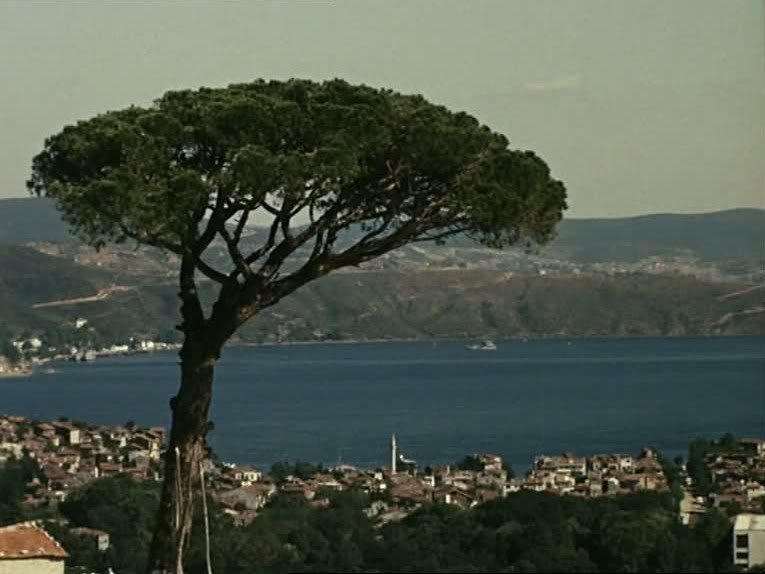
The first film in the series, Bosphore, is also the only one that was shot in color, presumably because most of the stock that Pialat could scrounge up was black and white. Pialat makes good use of the color here; this is a strikingly beautiful film where each composition is richly layered and perfectly balanced. In the Istanbul harbor, boats drift by while a bright green flag flutters in the breeze in the foreground. Rippling light patterns are reflected off the water onto the red-brown wood of a ship's hull. Pialat foregrounds distinctively misshapen trees with the city stretching out beneath these bursts of green, a tightly coiled maze.

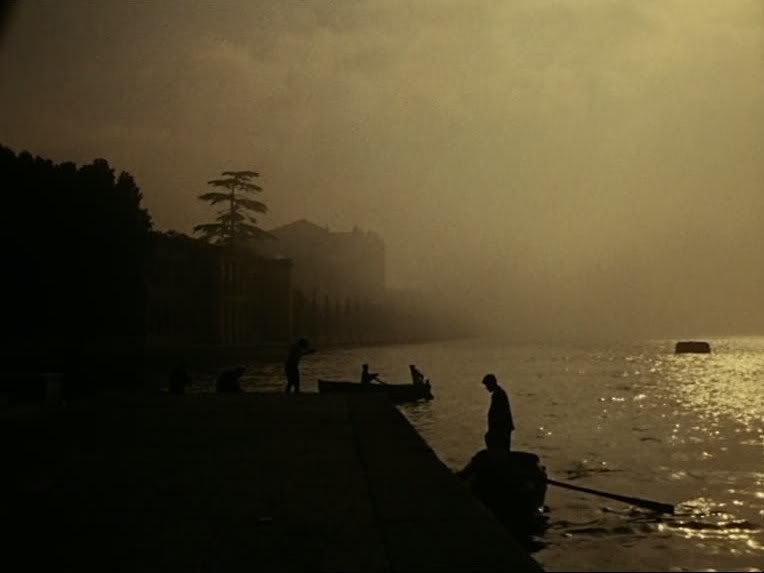
Most memorable of all are the hazy, foggy images of the Istanbul harbor, with black silhouettes of ships drifting through the thick air, shadowy figures working on the shore, while the voiceover speaks of "ghost ships" gliding through the fog. This port connects Turkey with the rest of Europe via ferries that continually make the trip back and forth. Turkey is in a unique geographical position, straddling Europe and Asia, bordering both southern Europe and the Middle East, and Pialat offers up hazy, almost mystical images of the port that provides these connections. The history of Europe's interactions with Turkey are a major subject of these films, drawing a contrast between Turkey's current place in the world and its ancient status as the center of the Ottoman Empire, which at one point represented a threat to Europe and a major flashpoint in the ongoing conflict between the forces of Islam and those of Christianity.

These themes are introduced in outline here; whereas the other Turkish films tend to be tightly focused on a single event or theme, Bosphore serves as an overall introduction to the series, a portrait of the city as a whole. At one point, Pialat draws a visual and verbal comparison between the minarets of Islam and the towers erected by the oil industry, suggesting an implicit connection between the two aspects of the Middle East most often emphasized by foreigners to the region. More than that, though, he's bridging the gap between past and present, between the old world of the Ottoman Empire and the new, modern world of industry, international trade and communion with Europe. Towards the end of the film, Pialat holds a long, arcing tracking shot from a boat as it glides past an ancient, crumbling cathedral surrounded with wooden scaffolds, a city's heritage under construction, the beauty of the old world peeking out from beneath the façade of modernity, the old and decaying being restored to some semblance of its former glory. It's an elegant encapsulation of the film's themes: the old restored, through modern means, to resemble a modern conception of what it might have looked like when it was new.

Byzance is a bleak, melancholy film about the history of religious conflict and conquest that characterized the relationship between the Middle East and Europe for so long. It is specifically about the Ottoman Sultan Mehmed II and his defeat of the Byzantine Empire at Constantinople in 1453, pushing the Roman Empire's reach back from the borders of the Middle East. The sounds of cannon fire, military drumming, and battle cries accompany the images of modern-day Istanbul, as the voiceover (assembled from texts by the Austrian writer Stefan Zweig) describes the battles and military maneuvers that led up to this decisive moment.

This film is about the ways in which history can be seen as a series of erasures, one event building on top of the others in never-ending layers to create the present. Pialat shows an Islamic mosque that, the voiceover says, was once a Christian cathedral, until the city was conquered, the church's Christian mosaics whitewashed from its pillars, the cross taken down from atop the dome, repurposed by the conquerors for their own religion. The victors get to define what lasts and what doesn't, what gets passed down to future generations and what gets wiped away, never to be seen again.

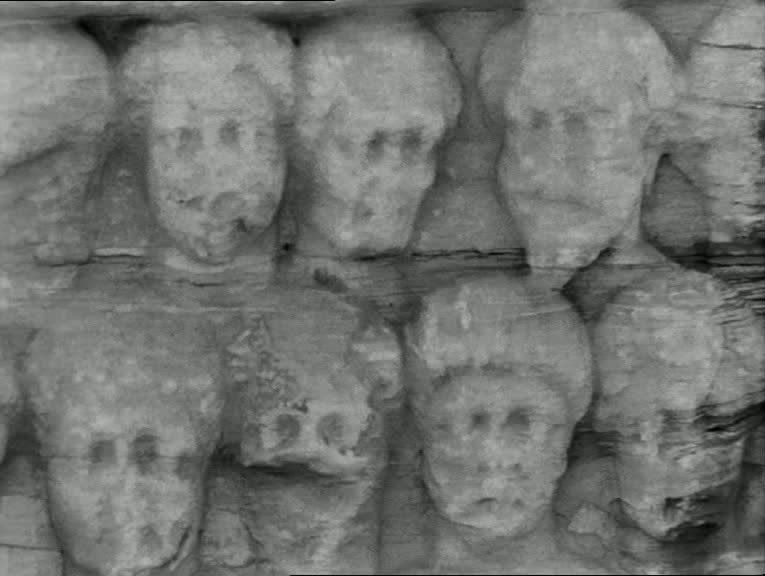
Istanbul is of course a perfect site for this kind of inquiry, since it has had such a long history of change and reversals, conquest and repurposing. Even the city's name is fluid, and Pialat shifts constantly (not just here, but throughout the Turkish series) between calling it Istanbul, Constantinople, and Byzantium, the name of the city before Mehmed II sacked it and absorbed it into his own empire. Pialat is acknowledging that his images represent only the top layer of history, the accumulated sediment of many centuries that has built to this precise historical moment, to this particular image. The film's final image is an especially poignant examination of the ways in which time shapes and reshapes a place's character, through processes both natural and human. Right at the end of the film, Pialat tracks along a wall of stone faces, starting with some that have been relatively well-preserved and gradually panning until the wall is increasingly smooth, the details of the faces eroded and erased, their features blank, lost to history.
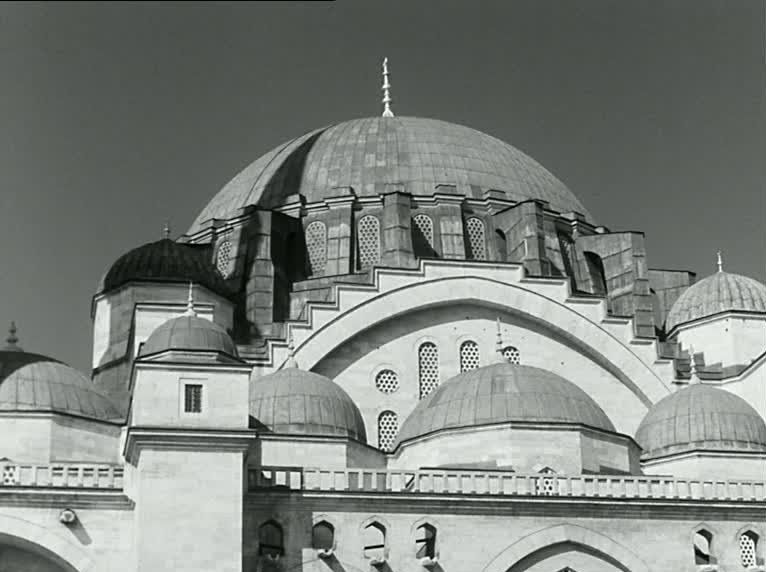

La Corne d'or is mostly concerned with religious ritual, examining the mosque (and former cathedral) discussed in Byzance. As a contrast against Istanbul's status as a center of historical religious conflict, Pialat — drawing here on texts by the French poet Gérard de Nerval — also describes the city as a place of strange ethnic and religious harmony, with representatives of various cultures and religions living in close contact. He emphasizes the city's hybrid culture, its blend of Southern European and Arab influences, reflected in both its people and its very construction.

Pialat seems fascinated by the architecture of Istanbul, and in this short especially he's expressing his love for the look of the city, its sprawling density and complexity. He composes several crisply edited montages that examine the city's architecture from multiple angles and perspectives, observing closeup details and cutting from there to the macro structures that form larger geometric patterns stretching out across the city. Pialat's images emphasize the design tension in Ottoman architecture between hard geometric lines and rounded domes, simultaneously suggesting rigidity and fluidity, contributing to the city's fractal-like networks of tightly packed buildings.

Of course, this density is also a reflection of the poverty that afflicts many of the city's people. At one point, the voiceover compares Istanbul to a stage set best admired from afar, without peeking backstage, because its rigorous beauty and historical richness obscures the poverty that is rampant in many of its neighborhoods. This passage has the feel of a self-correction, with Pialat acknowledging that his romantic, poetic images of the city's beauty risk obscuring some of the human dimensions of the people who live there.
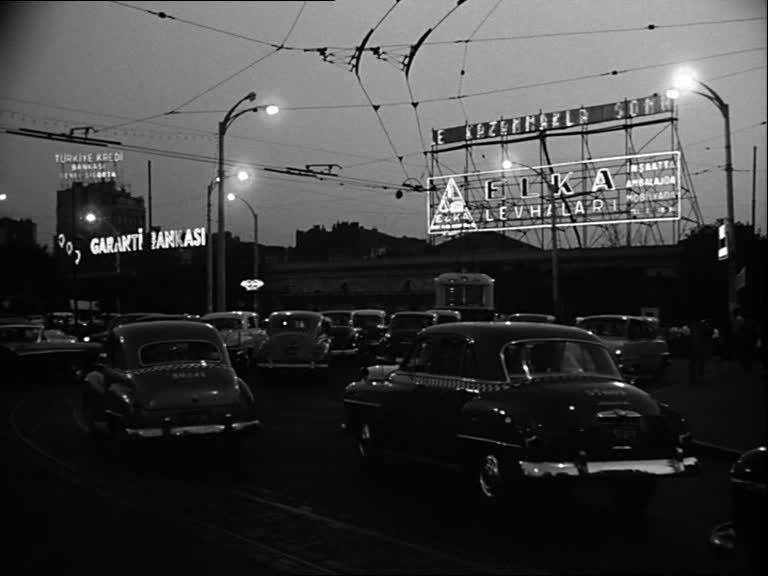
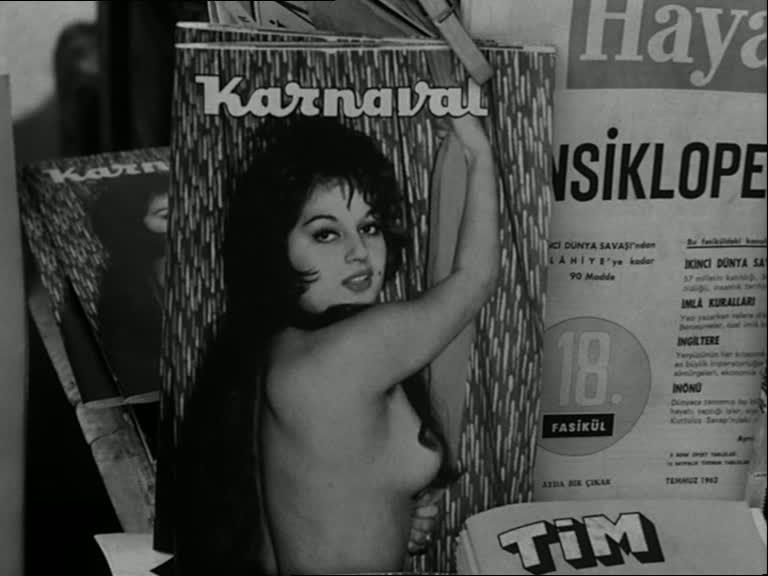
Istanbul is probably the most conventional documentary of Pialat's Turkish series, providing a general profile of the titular city, its different neighborhoods, and the different cultures and ways of living that coexist within its sprawling borders. As the other films in the series also suggest, Pialat sees Turkey, and Istanbul in particular, as a junction point between Europe and the East, between the old and the new, between history and modernity. That's the subject of this film as well, capturing the way that modern Istanbul is split between sections where it looks just as it did in Ottoman times, sections that are more European in character, modernized industrial districts, markets that have one foot in the old world and one in the new. In one early shot, Pialat captures the city at night, bathed in neon, crowded with cars that speed recklessly through streets not meant for such traffic, its modernity coexisting somewhat uncomfortably with all the ancient architecture and other reminders of its historical roots.

At one point, Pialat explores a market that was once the greatest in the world until an earthquake devastated it. This somewhat melancholy segment describes how the market was rebuilt in 1889, and now looks like a typical mall, full of cheap junk for tourists to buy. The voiceover says that, to really know what this grand market was once like, one can only rely on the romantic accounts of ancient travelers who witnessed it firsthand. The narration then falls silent as Pialat's camera observes the somewhat chintzy reality of the modern market, so different from its former glorious reputation. It's a subtly sad and ironic commentary on the limitations of the modern world: the supposed advances of progress don't always lead to something better, and the cost of Istanbul's place in the modern world is the loss of some of the things that once contributed to the city's distinctive character.

Pialat also comments upon the intrusion of a Western conception of sex: nudie magazines with naked women smiling from the newstands, large billboard advertisements with women in their underwear, selling sex to men, and burlesque shows with dancers in skimpy outfits, belly-dancing to Arab music, somewhere between a traditional performance and a strip show. This is probably the most explicit sign of the changes wrought in this culture by contact with the West: in a culture where women are only just starting to earn some independence, and many still wear veils and traditional garb, this highly sexualized, lurid imagery is nevertheless already starting to appear everywhere.


Maître Galip is the most poetic and powerful of Pialat's Turkish Chronicles, using the poems of Nazim Hikmet to accompany a series of evocative images of ordinary working class people in Istanbul. This was the film that Pialat himself claimed was the most complete realization of what he was aiming for with his Turkish documentaries. It's not difficult to see why this was his favorite: here he abandons the historical commentary and documentary observation of the other shorts in favor of an emotional emphasis on the lives of the poor and the unemployed.

The film's final section is accompanied by a poem in which the title character, Mr. Galip, wonders, at various points in his life, why he can't go to school, why his family's so poor, why he must work so hard in his father's shop, why his father has to close his shop when bigger factories are opened up in the town, and why he's perpetually out of work. It's a moving account of the struggles of the lower class that's as universal as it is specific to Istanbul or Turkey. At the beginning of the film, the narration starts with the local, observing how many factories are in Istanbul and yet how many people are out of work, then wonders how many factories are in the world, and how many men have no jobs everywhere.

In the final part of the film, as the narration walks through the stages of Galip's life, Pialat accompanies the lines with images of children, then teens and young men, and finally older men for the part of the poem when Galip realizes that he is 52 years old, two years older than his father was when he died, and yet no better off than previous generations, who also struggled in poverty. Pialat uses a lot of closeups throughout this film, strikingly composed images that focus on the faces of random people encountered in the streets.

As with the segment on the commercialized market in Istanbul, this film is dealing with the sadder fallout of modernization, as old family businesses shut down, replaced by factories where jobs are unstable and men are continually being laid off, their functions no longer necessary. The film is so striking because of the juxtaposition of Hikmet's poetic ruminations on unemployment and poverty with Pialat's crisp images of rundown neighborhoods and men stooped with hard labor. Pialat's pride in this film is well-justified: it is undoubtedly the best of his Turkish documentaries, dealing concisely and movingly with the human toll of the meeting between Europe and the East that Pialat sees in Turkey.
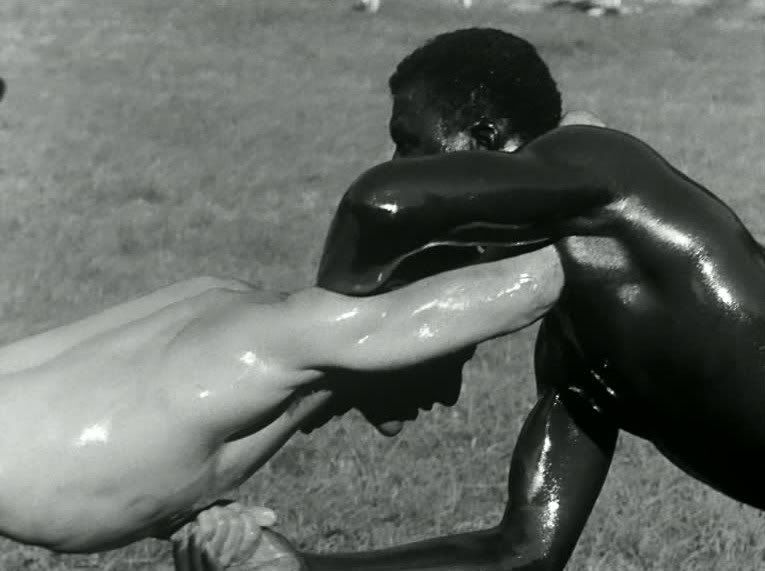
Pehlivan focuses on a three-day wrestling competition, an ancient tradition that dates back over a thousand years to the time of the Ottoman Empire, originating in the games the soldiers would play to entertain themselves in between battles. Maybe that's why there's more than a hint of homoeroticism in the way the wrestlers oil themselves up with grease, making sure to cover every inch of their bodies so that their opponents will be unable to get a grip. Pialat's closeups emphasize the men's muscular bodies jammed together and sliding off one another, posed in intimate, twisted arrangements, struggling desperately for a grip on each other's bodies. Arms are jammed down pants, one of the only places there's some potential for a handhold, and the whole thing is very suggestive and sensual, a form of intimate male contact that's sanctioned as a show of strength and masculinity.

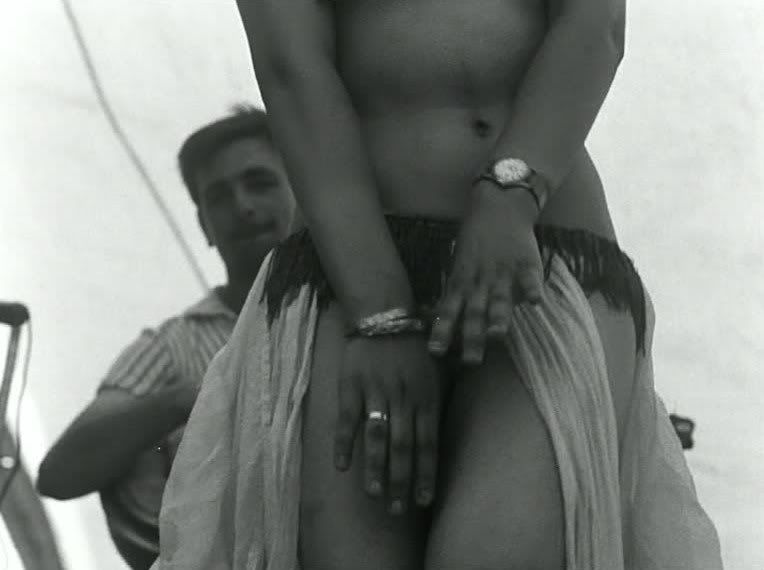
These are the pehlivans, which the narration says means "wrestler, paladin, knight," all three meanings implied by the same word, connecting this sport showcase to the very real battles and conquests described in the earlier shorts in the series. Pialat contrasts all this "male exhibitionism" against the accompanying strip shows where curvy gypsy girls shake and dance in barely there bikinis, allowing their clothes to shake off their bodies, flashing the audience, smiling the whole time, while the men hoot and whistle. It's a pretty provocative parallel that Pialat is drawing here, suggesting that male sexuality and female sexuality have found very different culturally mandated outlets that nevertheless are somewhat similar in providing opportunities for the admiration of the human form. Just as the men display their muscular physiques when they wrestle, dressed only in their identical black, oiled-up pants, their bodies glistening as they roll around in the grass before a large and appreciative audience, the women display their bodies in a show that's framed quite differently but amounts to the same thing. As in many cultures, the male displays require some macho justification, while the women's shows are transparently sexual in nature, but the suggestion is that sport of this kind is just sex in disguise.

Monday, March 19, 2012

The Umbrellas of Cherbourg


The Umbrellas of Cherbourg is one of the most moving and heartbreaking love stories in the cinema, an absolutely stunning musical masterpiece that sets its bright, colorful visual palette and sweet, soaring music against an increasingly bittersweet emotional range. Divided into three parts — departure, absence, and return — Jacques Demy's sublime musical is the story of a love affair haunted by the separation of war. Geneviève (Catherine Deneuve) is a young girl madly in love with the mechanic Guy (Nino Castelnuovo), but their sweet, innocent affair is torn apart when Guy is called up into the army, sent to Algeria for two years. As in so many French films of this era, Algeria looms large, a tear in the fabric of life, an absence that's felt at home in the missing young men, the years of longing and waiting.

The film is an interesting type of musical in which every single line is sung, but it rarely feels like there's a proper song: instead, all of the dialogue is more-or-less naturalistic speech that's simply sung instead of spoken. Even the most banal lines, like Guy's interactions with customers and his boss at the gas station where he works, are liltingly timed to Michel Legrand's alternately jazzy and romantic music. This style can be somewhat distracting and artificial at first but it quickly comes to seem as natural as if the characters were simply speaking. By setting everything to song, it never seems as if the music is interrupting the diegesis, cutting off the naturalistic flow of life with a musical number. Rather, life itself, with all its joys and tragedies, its banal incidents, its great loves and great sadnesses, has been transformed into one big musical number, a 90-minute musical number that encompasses both the innocent sweetness of young love and the much more complex, melancholy, mysterious loves and losses that build up over the course of the years.

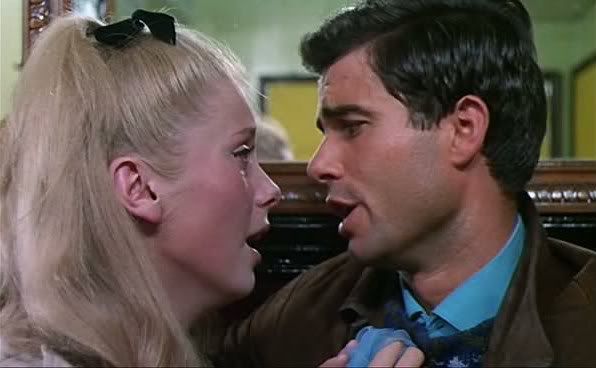
The first part of the movie, which is almost saccharine-sweet with its constant tender embraces and cooing declarations of love, ends with Guy and Geneviève being split apart as he heads off to the army and the war. At one point during their goodbyes, he says that he knows she'll wait for him, but Demy films it in a way that suggests exactly the opposite. Before that point, he'd captured the young lovers in a two-shot, huddling together in a booth at a bar, but then Demy pans right to focus on Guy's face as he stares off into space, away from Geneviève, saying that he's sure she'll wait. Because she's not in the frame, one is left to wonder if he's being presumptuous, demanding that she wait rather than letting her say it herself. Demy then pans back to Geneviève, who demurely agrees, but the damage has been done: Demy's cinematic separation of the lovers at this decisive moment has seemingly fated them to separation in life as well. The camera's graceful movements all but inform us: Geneviève will not wait.


This is followed — after a goodbye sexual dalliance in Guy's bed, next door to the room where his godmother, Élise (Mireille Perrey), lays dying — by the deeply romantic sadness of the lovers' parting at a train station. Demy's camera tracks backward as Guy backs away from Geneviève in the station's bar, a gap of negative space opening up between them, expanded by the camera's movement away from them. Then Geneviève desperately runs to fill that gap, but outside the process begins again, as Guy steps onto the train, which begins rolling forward, Demy's camera tracking along with it. Geneviève follows alongside it for a few more moments, repeating "I love you," but once she stops walking, both train and camera continue rolling along, leaving her ever further in the distance, her figure shrinking into the background as the train departs the station, smoke billowing onto the platform to further obscure her from view.

In Guy's absence, Geneviève learns that she's pregnant with his child, but over time she also realizes that, contrary to what she'd believed, she can imagine herself living without him. Earlier, when Geneviève was grieving over her departed love, her mother (Anne Vernon) told her that, "people only die of love in movies," a line that, since this is after all a movie, would seem to be freighted with tragic foreshadowing. But this is a movie that uses its deceptively artificial aesthetic to cut right to the core of some very real emotions, and Demy has something much sadder and more complex in store for Geneviève than the melodramatic convention of dying from a broken heart.

At the heart of this dazzling musical is the revelation that life is not often as neat as the movies, that the romantic ideals of musicals are seldom fulfilled as cleanly as Hollywood happy endings would imply. At one point, Geneviève sings, "I would have died for him. Why aren't I dead?" She looks right into the camera with a tearful, red-eyed expression, genuinely confused and hurt by the realization that her love for Guy has been fading in his absence, that she's been able to go on with her life and even entertain thoughts about another man, when before Guy left she'd sworn to wait for him forever. She'd imagined that life would be like a melodrama, that she couldn't live without her lover, but she finds that in reality, unlike the movies, memories can fade, life can go on, and there are endings that aren't quite happy, but aren't quite unhappy either, that the sadness and the pleasure of life can be tangled and intertwined so completely that it's difficult to separate one from the other.


The other man who enters Geneviève's life in Guy's absence knows this truth very well indeed. Roland (Marc Michel) is a successful diamond dealer and world traveler who becomes friendly with Geneviève and her mother after Guy leaves. Roland comes to the film several years after the events of Demy's first feature Lola, in which he got his heart broken by the title character of that film and set off on the adventures that apparently made him a rich man. He never forgot Lola, of course, as evidenced by the sequence where he tells Geneviève's mother about his past and Demy cuts away to a graceful circular pan around the market where Roland and Lola had last met in the earlier film. It's a melancholy callback, a metatextual sequence that suggests that film is memory, that to remember Lola is to remember the events and the locations of that other film, briefly weaving them into this new film. Roland's interactions with Geneviève and her mother also recall the earlier film, in that Geneviève's mother is obviously attracted to Roland — as a mother had been in the other film, while he pined over Lola — but Roland is infatuated with Geneviève herself.

Their love affair lacks the passion of Geneviève and Guy's love: Roland courts the girl by asking her mother for her hand in marriage, before he's even spoken much to Geneviève herself. It's a very unromantic affair, and Geneviève's decision to marry him seems to be more pragmatic than anything, influenced by his stability and the fact that he's not swayed in his love for her when he learns that she's already pregnant with another man's child. Their wedding is conveyed with a few economical shots, starting with a tracking shot through a bridal shop filled with mannequins in gowns, in the midst of which Geneviève, staring into the camera through the thin gauze of a white veil, seems as plastic and distant as the mannequins, her expression blank and unreadable. Demy cuts immediately to a very similar shot of Geneviève at her wedding, still staring blankly into the camera, then pulling back to a two-shot of the couple kneeling, their hands piously pressed together in prayer, an image of formally, religiously sanctioned love very different from the passionate clenches of Geneviève and Guy from the film's first section.

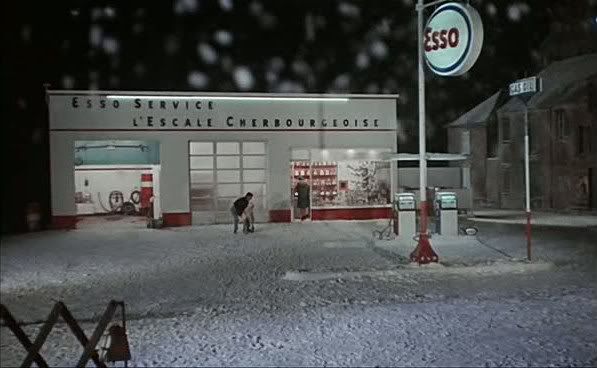
Guy also gets his own bittersweet ending, as Geneviève disappears for the film's final section and Guy finally returns from the war with a limp and a haunted expression, only to realize that his love is not waiting for him. Instead, he's gradually awoken out of his self-pity by the patience and caring of his godmother's long-suffering nurse, Madeleine (Ellen Farner), who Demy had repeatedly hinted was harboring a shy crush on Guy. It is perhaps telling that Demy establishes a visual parallel between Geneviève and Roland's wedding and the shot of Guy and Madeleine at Élise's funeral, also sitting side by side in a prayerful posture. As with Geneviève and Roland, this is not a relationship of great passion, and it might be thought that Guy is just settling for a second choice, but Demy intentionally leaves it ambiguous just how much or little he actually feels for Madeleine. This is especially true of the deeply affecting final scene, in which, years later, Geneviève and Guy finally meet again, at the snowbound gas station that Guy now owns and lives at with his wife and their son. It's a beautiful and mysterious scene, overflowing with complex emotions that mostly go unstated in the polite, slightly cool conversation of the former lovers. Demy masterfully resists resolving the tension or answering any of the questions left lingering about these two characters and their paths in life. Instead, they briefly meet and part, separating just as Guy's new wife returns, and Demy's camera drifts up and away, through the fluttering snowflakes, the gas station a little oasis of light in the darkness of the night, as though the happy domestic scene that now plays out is encased in a snowglobe.

Monday, May 9, 2011

Red Desert


Michelangelo Antonioni is the cinema's greatest chronicler of the modern era's disconnection and dehumanization, of the existential dilemmas created by the modern way of life. His first color film, Red Desert, is yet another entry in his peak period's run of intense, stylistically profound variations on that signature theme. The film is set in a modern industrial zone, not an urban center but a desolate country harbor colonized by smoke-spewing factories, massive ships that drift by in the omnipresent fog, oil drilling platforms out in the ocean, barely visible from shore. The landscape of the region is a cold, foggy, smoke-filled wasteland, a bleak territory of small mud-puddle lakes with sleek black surfaces, chemicals glistening in multiple colors, green scum leaving behind a thick crust on the shore. It's always overcast. There's always a thick fog hanging in the air, making everything fuzzy and gray. The credits roll over a series of out-of-focus shots of the region, of smokestacks and gray factory buildings and grim landscapes that nearly look post-apocalyptic in their indistinct desolation. The first in-focus shot, after the credits, is a closeup of a plume of fire erupting from a factory smokestack. The symbolism could not be more obvious: this is Hell, a strange Hell where the air is cold and the only heat comes from the factories' never-ending industrial processes, from the burning of chemicals.

Wandering through this landscape is Giuliana (Monica Vitti), her crisp green coat a striking contrast against the colorlessness of the land around her. She seems to be dazed, utterly lost, acting in inexplicable ways. She's walking with her son, but seems to keep forgetting about him and leaving him behind, letting him wander off by himself, then belatedly remembering that he's with her. As the film progresses, it becomes apparent that she's losing her mind, a not so surprising state of affairs in a place like this. Giuliana's husband, Ugo (Carlo Chionetti), is an industrialist himself, a manager at one of the local factories, so in a sense the environment that's poisoning Giuliana is in part created by her own husband, who doesn't seem to understand his wife at all. Ugo seems to think of his wife's odd behavior and increasingly obvious depression as inconveniences, minor female hysteria that would go away if only she'd stop thinking about it. He is constantly away on business, leaving her alone, and when he hears that she's been in a car accident and is in the hospital (an event that happens before the start of the movie but lingers over everything that happens subsequently), he doesn't even return from a business trip once he learns that she's going to be alright.

Initially, it seems like Ugo's friend Corrado (Richard Harris) might be able to wake Giuliana out of her misery and aimlessness. He takes an immediate interest in her, really looking at her and trying to engage with her in a way her husband doesn't. They begin to seem like a couple, as wherever they go, Corrado walks with her at her meandering, dawdling pace while her husband impatiently strides ahead, all business. Corrado is also involved in industry, but unlike Ugo he seems conflicted by his work; he's been in many different businesses, always moving from place to place, simply abandoning his life and starting anew somewhere else. In one early scene, Ugo makes calls around to several factory managers he knows, trying to find workers for Corrado's newest project. Antonioni cuts to each place Ugo calls in turn, emphasizing the similarities between them: wherever he calls, smoke spews in the background, the clatter of industrial machinery nearly drowns out the conversations, huge pipes and banks of electronic devices with blinking lights and gauges dwarf the human workers. This is industry, this is progress, making every place the same, erasing the distinctions between places to install a uniformly sleek and gray modern façade that covers up one place after another. Maybe that's why Corrado is never satisfied no matter where he moves; each new home, each new city, is modeled on the old one.


If Ugo is indifferent to the costs of modernization — even laughing at a story of a restaurant customer who complained about fish that taste like petroleum — Corrado seems to feel a small measure of the discontentment that affects Giuliana so dramatically. In a meeting with his new workers, towards the end of the film, Corrado's gaze wanders over the workers' faces but drifts away from them towards the stacked crates behind them, towards the cracked paint on the walls of the warehouse. Antonioni's images create the impression that in this environment, the faces of the men, often filmed out-of-focus, are simply another part of this inhuman landscape, and the gaze inevitably glosses over them to look at the surroundings instead. It is a glimpse of how Giuliana sees her world, as a place where humanity itself is being effaced by its own creations, by its piles of consumer goods and the massive factories dedicated to their production.

Antonioni's aesthetic constantly reflects this dehumanization and destabilization. The ugly gray surroundings of the area are reflected in Antonioni's bleak, strikingly composed images, in which the color seems to have been drained out of almost everything, leaving behind pale, washed-out hues. Often, the background is made blurry and abstract, isolating Giuliana from her surroundings, so that her crisply focused face is contrasted against the out-of-focus haze of factories and industrial parks. The omnipresent fog adds to that hazy feeling, especially in a scene by the docks when Giuliana, Ugo and their friends run through the fog, disappearing into the gray tendrils that wrap around them. Standing in the fog, the people seem to be fading in and out of view, partially obscured, their expressions unreadable due to the filtering overlay of the fog. Giuliana faces her friends and her husband and sees only the uncomprehending blankness of their faces; they seem separated from her by an uncrossable gulf.

This is a potent depiction of a world in which human connection seems impossible. At best, there are cheap and tawdry facsimiles of connection, like a party that Giuliana, Ugo and Corrado go to with some friends, where everyone talks incessantly about sex and the whole thing seems constantly on the verge of breaking out into an orgy. The orgy never happens, though, in part because all these upper-class blank slates seem too lazy, too bored, even to really have sex — their lascivious but empty chatter is contrasted against a young working class girl who says she'd "rather do certain things than talk about them." But talk is all these bored bourgeois can muster. Even Giuliana's interactions with the men who love or want her seem oddly impersonal. Her husband, who ignores all her concerns and doesn't seem to know what to make of her depressed manner, paws at her and kisses her while she sobs and moans; unable to understand her pain, he tries to smother it with sex, not getting — or not caring — that she isn't likely to be soothed in this way. Ultimately, Corrado can only resort to the same solutions; when Giuliana comes running to Corrado for help late in the film, he takes advantage of her confusion and sorrow by taking her to bed, caressing her and stripping her while she cries, alternately pushing him away and seeming to pull him closer. Her isolation and anguish is so intense that she needs some companionship, some comfort, but none of these men can offer it to her in any real and lasting way.


After Giuliana and Corrado make love, the hotel room, which had previously had white walls, is suddenly painted a pale pink, and even the coffee cups on the bedside table are pink, as though the whole room had become a womb of flesh, encompassing the lovers, as though their skin-on-skin contact had begun to spread to the objects and constructions around them. This is a film about how environments and surroundings affect human relations and psychology, but the reverse is also true: modern people create the environments in which they live. Just as it's humanity's obsession with progress that leads to industrial expansion and pollution, this scene reflects the wish that human connection, however fleeting, could counteract the suffocating and alienating effects of the world. Instead, sex and "love" only offer up more pain and disappointment. Even motherhood is unsatisfying to Giuliana, whose son is virtually a mute prop, as disconnected as his mother, and who already shows signs of his mother's unpredictable responses to this alienating environment.

There is at least one beacon of light in this desolate world: the human imagination and the capacity for hope, the capacity to dream of a better world. At one point, trying to keep her son entertained while he's ill, Giuliana tells him a story, but it's no light bedtime story. It's a haunting parable of unspoiled natural peace and the constant threat of disruption that arises from human presence. In this story, there's a beautiful beach with pink sand and clear, blue water, and the only person around is a young girl with darkly tanned skin who swims in that bright blue water and lounges on the beach all day, as long as the sun is out. The style of this sequence differs drastically from the rest of the film, as the bright colors and clean, bold images contrast against the drab tones and fog that persist outside of this dream world. As Giuliana's voiceover describes the beauty of this place, the images present an idyllic paradise, totally unspoiled, no human activity except for the girl's unhurried, isolated enjoyment of the place's beauty. The only sound is the water lapping up on the shore, a hushed whisper accompanied by Antonioni's remarkably sensual closeup of the tiny waves lapping up against the shore, kicking up swirls of pink sand that turn the crests of these wavelets a pinkish hue.

This idyll is interrupted by the appearance of a mysterious boat, unpopulated by any visible human crew, which simply turns into the inlet, seems to look around, then sails away. It is an obvious indication that this isolated place could be spoiled at any time, that the big ships of industry, so inhuman and strange, could pull in at any time, muddying up that crystal-clear water, spewing filth to cover up the delicate pink of the sand. After the ship leaves, the story goes, the whole cove sings as a kind of beautifully sad warning, or a protest, a song of heartache and fear. As Giuliana's voiceover says that the cove was like a living being, Antonioni films the curved pink rocks surrounding the water like a woman's body, admiring the glistening accretions of sand and crystal in these rocks, admiring their graceful curves that at times look like a woman's breasts or the curve of her hips. In this deeply affecting parable, this place of natural beauty becomes a woman, welcoming and pure, whose beauty is threatened by the rape of industry.


That story is a vision of the world's beauty that seems far removed from reality as Giuliana knows it — but not from reality altogether. It's the world as it could be, and the world as it still is in some places. The mere possibility of this fantastic beauty, of this total communion between humanity and nature, is enough to soften the hard edges of industrial existence. Another scene, earlier in the film, seems like a slightly surreal dream but with a much less optimistic message. Giuliana wakes up in the middle of the night and finds, in her son's room, a grinning robot running back and forth on autopilot, crashing backwards into the wall and then running up against her son's bed, grinning all the while. Giuliana turns off the robot, which remains in the lower left corner of the frame, staring at the camera with glowing eyes, as she checks on her son. When she leaves and shuts the door, restoring the room to darkness, those glowing eyes are all that remain, two yellow orbs floating in the dark, an eerie mechanical stare watching over the sleeping boy.

That image is indicative of the film's general tone of industrial malaise. The soundtrack buzzes and hums with the sounds of machinery, the high-pitched subliminal whine of power transformers, these real sounds matched in the low-key electronic score of Vittorio Gelmetti, which burbles up every so often to further deepen the sense of anxiety. Antonioni carefully calibrates every aspect of the film so that each image becomes an expression of the characters' isolation, and the weight of the world that they feel so acutely. The scenery is almost studiously bland and gray, sometimes literally, as when Giuliana sees a fruit vendor whose wares are all painted gray, as though covered in a layer of ash. In Corrado's hotel, the whole lobby is a clean, clinical white, even the plants, their white stalks emerging from white soil and white pots. Antonioni has crafted a precise and deeply affecting portrait of the destruction of the human soul in the metal jaws of industry — and the nature of the continuing psychological and physical struggle against the oppressive environs we've created for ourselves as a society.

Thursday, February 24, 2011

Before the Revolution


In his second film, Before the Revolution, Bernardo Bertolucci, infected with the enthusiastic cinephilia of the French New Wave, and obviously impressed by the films being made by his peers in France, leapt headfirst into the new cinema, adopting its style and concerns for his own, translating the style to a post-war Italy in a mood of uncertainty and instability. The film's characters are haunted by "fevers" of one kind or another, and the film itself is heady with the fever of moviemaking, the passion for images that capture, in their immediacy and vibrancy, the mood of an entire generation of cinema-hopping would-be revolutionaries. Fabrizio (Francesco Barilli) is a young man on the cusp of adulthood, unsure about where his life is headed, swept up in the idealism of Marxism. He joins the Communist Party, under the guidance of his teacher Cesare (Morando Morandini), but he remains aimless despite his newfound convictions, and when his friend Agostino (Allen Midgette) dies in a drowning accident that might be a suicide, he really comes unmoored. Over the course of a summer following his friend's funeral, he engages in a passionate but ultimately unhappy love affair with his visiting aunt, Gina (Adriana Asti), and in the process replaces his youthful idealism with a more "adult" attitude that might be called pragmatism or, less euphemistically, fatalism.

Bertolucci's film is very much of its time, in every way. It captures a precise and very important moment, not only in this young man's life, but in the history of Italy and Europe at large. Just as Fabrizio, poised on the verge of adulthood, could continue to engage with the world and with his strongly held ideals or retreat into bourgeois security and emptiness, the forked road ahead for Europe must have looked very similar at the time, in the years leading up to the peak of the student rebellions in May 1968. In retrospect, Bertolucci's film is "before the revolution" that would briefly sweep across the western world in the late 60s, and his pessimistic ending — a declaration that, for aimless young people like Fabrizio, it's always "before" a revolution that never comes — is a bleak but accurate prediction of the disappointments to come.

The film is of its time stylistically as well, in that it's drowning in style. Bertolucci was invigorated as a filmmaker by the French New Wave, and it shows in his jittery appropriations of their restless aesthetics. In one scene, early on, as Gina talks about death, Bertolucci uses zooms and pans the way Breathless deployed jump cuts, with seeming carelessness, a casual disregard for the rough edges, for what's left out. Gina theatrically plays with the camera, turning away from it and then abruptly thrusting back, widening her eyes at it like a melodramatic primadonna, and the camera's zig-zagging motion further discombobulates the composition. The camera is constantly zooming in, focusing momentarily on her eyes or mouth, then losing track of her as she moves away, briefly lingering off to the side, in the texture of her hair, before she bobs back into the frame. The effect is distracting more than invigorating, as Godard's early, jazzy innovations were, but maybe that's the point: it's style for its own sake, style divorced from content. The hyperactive gesticulations of the camera mirror the restlessness of the protagonist: in a later scene, as Fabrizio shifts nervously from one seat to another while trying to explain his discontent to Cesare, the camera pans drolly back and forth, as though amused by the young man's indecision, amused by his very bourgeois, entitled troubles.


At another point, Fabrizio goes to see Godard's A Woman Is A Woman, but he barely pays attention, and afterward is deaf to his friend's rhapsodic words on the film's style — ah, the friend says, realizing that his friend is in love, it's not a matter of style but of content. But is it? This friend parrots back many of the favored sayings of the Cahiers du cinema critics — morality is a matter of tracking shots, and tracking shots are a matter of morality — and rattles off lists of movies and directors ("you can't live without Rossellini," he shouts to Fabrizio as a parting shot) but he doesn't seem to have much to say about anything that he can't see in a theater. For him, Anna Karina will someday define his generation in the same way that Louise Brooks and Bogey/Bacall had defined earlier ones — a prescient prediction, that, but not one that does anything to help Fabrizio figure out just where his own life is heading.

Bertolucci at times seems to care more about his camera's meanderings than about the self-absorbed whining of his protagonists, or about the actors, who deliver fine, emotionally naked performances (especially Asti) into a vacuum of motivation and emotional grounding. Again, that's part of the point: these bourgeois dreamers, trying to break free, trying to live their own lives, hardly know why they're suffering or why they're feeling what they're feeling, and the film's jumpy, elliptical style breaks down their pointless love story until it feels as empty and silly as it is. It's all about style in search of some content.

Which doesn't mean that Bertolucci doesn't locate some genuinely affecting images within all this stylistic grandstanding. The scene where Fabrizio confronts Gina after she's been unfaithful to him is a case in point: Fabrizio walks away, disgusted, and Gina starts to follow him, walking away from the man she'd been with. She reaches a corner, stops, and in closeup looks toward Fabrizio, who's only an indistinct blur in the back of the frame, and then she looks back towards the other man, Bertolucci's camera panning to follow her gaze, finding another indistinct blur, another gray nothingness moving away from her. Quite literally, wherever she looks, she sees disconnection and emptiness, sees other people moving away from her until they seem to be swallowed up whole by the landscape. In another great sequence, early on, Agostino plays on his bike, drunk, and the camera gets drunk with him, wavering as the young man wheels by, standing on the bike's seat or putting his legs up over the handlebars, falling over again and again. The framing is lazy, drunken, often capturing an out-of-focus image of the young man wobbling by on the bike before he crashes to the ground, falling off camera, the image getting blotted out by some obstacle or another. It's a wonderfully offhand and playful encapsulation of this kind of aimless goofing around, capturing among other things the hint of homoerotic fascination that the watching Fabrizio nurses for his friend.


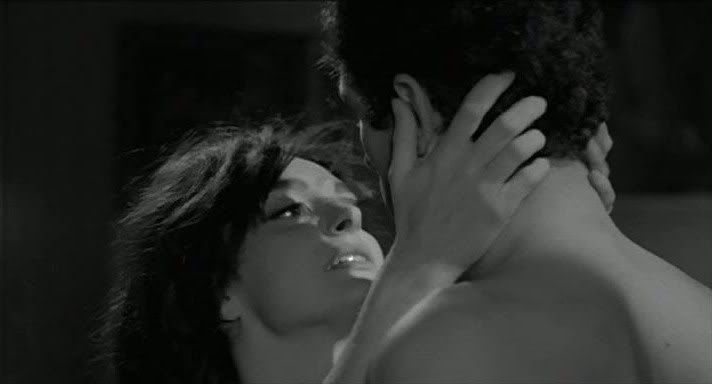
This is all Bertolucci's loving ode to his French contemporaries, to the cinema. Whatever the themes of Fabrizio's struggles with his political consciousness and his doomed love affair, the film is at least as much about the cinema as it is about anything that happens outside the frame, in the real world. Casual references to French filmmakers like Godard and Resnais abound, as do namedrops of the Hollywood auteurs, like Hawks and Hitchcock, so adored by Cahiers du cinema. There's a color sequence when Gina views Fabrizio through a camera obscura, and the resulting scene somehow simultaneously pays tribute to Hollywood technicolor and silent comedy. When Gina and Fabrizio make love for the first time, they self-consciously fall into the same pose, the same shadowy lighting scheme, as the similarly ill-fated couple at the beginning of Resnais' Hiroshima mon amour — another couple doomed by misunderstandings and miscommunications, by unbridgeable gaps dividing them from one another. By the end of the film, when Fabrizio vainly tries to find Gina within the shining white maze of an opera house, only to finally find her so they can talk past one another, the lovers seem to be reliving another Resnais film, trapped within the alienating façades of Last Night At Marienbad.

At times, this endless referentiality makes Before the Revolution seem like a cineaste's dream, a young man's film (Bertolucci was only 22 when he made it) about youthful fascinations with cinema and politics, youthful ambitions and desires, youthful introductions to love and disappointment. For all the verve of its style, the film is a dark vision; it's a film about idealism made by a young man obviously already tinged with his own streak of cynicism. The film's arc is relentlessly downward, as embodied in the treatment of Fabrizio's fiancée Clelia (Cristina Pariset) at the beginning and end of the film. In an early scene, Fabrizio goes to see Clelia for what he says is the last time: he just wants to look at her one last time before making a break with his bourgeois existence, and indeed she won't appear in the film again for most of its length. Fabrizio finds her in a church, with her mother, and Bertolucci films it like a holy moment: the actress is stunning, radiant in closeup, and she's chatting with her mother, smiling, while the soundtrack remains silent, the substance of her words unimportant in comparison to the stark beauty of that image, a beautiful woman who represents everything Fabrizio is leaving behind. Or everything he'd like to leave behind, because in the end he finds that he can't, and his fiancée returns, still with nothing to say, still just a smiling, flawlessly pretty symbol of a certain kind of life. Earlier in the film, that brief glimpse of her seemed vaguely spiritual and affecting, but upon her return she comes to represent staid bourgeois marriage and the abandonment of youth's ideals. This is a bleak ending, though not as bleak — or as darkly hysterical, or as emotionally shattering — as the film's very last shot, a freeze frame that implies that the whole cycle of youthful idealism and disillusionment is about to begin again.

Monday, July 27, 2009

Man's Favorite Sport?


Man's Favorite Sport? finds Howard Hawks revisiting and recycling situations and ideas from throughout his career, most obviously from the comedy of humiliation films he made with Cary Grant. Indeed, this film is a remake of Hawks' screwball classic Bringing Up Baby, and the director even wanted Grant and Katherine Hepburn to reprise their earlier roles. Instead, Paula Prentiss took the role of Abigail, the ditzy, slightly daffy girl who causes so much trouble for Rock Hudson's staid, stuffy Roger Willoughby. Roger's a fishing expert at a sportsman's store, but he hides a dirty secret: he's never actually been fishing and all his knowledge comes from listening to those who actually have. However, his secret is endangered when Abigail and her friend Easy (Maria Perschy), who work at a prestigious fishing tournament, get Roger entered into the tournament, thinking that such a well-known expert will bring publicity to the event.

Once he's in the tournament, it falls to the two girls to actually teach him how to fish so his secret won't be revealed. The result is a silly, low-key, occasionally awkward film, a retread of Hawks' earlier comedies without quite reaching the heights of comic genius he so often scaled in the past. Certainly, Hudson and Prentiss are no Grant and Hepburn, as far as romantic comedy couples go, and the antagonistic chemistry between them only sparks sporadically, while many scenes play out stiffly and uncertainly. There's actually much more vitality in the relationship between Abigail and her German friend Easy. The two girls have a very natural friendship, exchanging mischievous glances and smiles, trading off quips and virtually finishing one another's sentences — it's a playful, fun to watch friendship that brings to mind Hawks' treatment of Marilyn Monroe and Jane Russell in Gentlemen Prefer Blondes. Playing off of Perschy, Prentiss is relaxed and witty and fluid, while in her scenes with Hudson she often tries to affect a nervous energy that doesn't quite come off, especially when she slips into a deep-voiced purr to convey her excitement.

Hudson, for his part, isn't a born comedian, but he gamely plods through the film's slapstick gags and verbal sparring, and it's not really his fault if a lot of the physical humor seems flat and unfunny. At their best, the scenes of him trying to catch fish are fast-paced and frenetic, as the inept fisherman goes splashing around in the water, literally taking a flying leap to grab an escaping fishing rod or nearly backing up into a bear. At their worst, these scenes are stiff and extended for way too long, with Henry Mancini's bouncy score rather desperately trying to make the images seem humorous even if they're not.

Actually, though, the film's best scenes have nothing to do with fishing, which is just a pretext for another of Hawks' explorations of the way antagonism between men and women can be a prelude to love. Roger is continually subjected to one embarrassment after another on account of Abigail and Easy, as the girls put him into one tough position after another. Because of them, he falls upside down into a car, gets stuck in a sleeping bag, is trapped in a pair of inflatable waders that flip him upside down in the water, and gets put in a fake cast that makes him arm stick up in the air like he's permanently giving a salute. Many of these situations have a distinctly sexual component, as when he gets his tie stuck in the zipper on the back of Easy's dress (a scene recycled from Bringing Up Baby) or when he comes home to find Abigail asleep in his bed (a repeat of a scene from Hatari!). The girls, particularly Abigail, are constantly getting him into compromising situations, seducing him through humiliation without even seeming to realize it themselves. In one especially racy scene, the two girls are talking to Roger at a campsite during a rainstorm, their backs facing to the camera, and the water pouring down their backs makes their shirts see-through, revealing the lack of any bra underneath. Roger's stammering attempts to tell them what's happening are hilarious, as is the girls' nonchalance about their de facto nudity.


The film is especially great in the few scenes featuring Roger's fiancée Tex (Charlene Holt), who doesn't appear for more than a few minutes but makes quite an impression in her brief screentime. Her arrival is perfectly timed to cause the maximum problems for Roger: he's got Abigail sleeping in his bedroom, while he spent the night in a sleeping bag in the living room. When Tex walks in, Easy is there as well, trying to unzip him from his sleeping bag. Tex's bemused, chilly reaction is brilliant, maintaining a cordial smile, enjoying Roger's squirming discomfort, and casting bitchy double entendres at the German girl. "Oh, so you're Easy," she deadpans, her inflection leaving no doubt that she's aware of the double meaning. Even better is her retort to Roger's lame excuse for the situation: "Oh, just trying out some new equipment?" she drawls, casting a sidelong glance at Easy as she says "equipment." It's a subtly funny, delightfully naughty scene, encoding sexual puns into the dialogue, and Holt plays it perfectly; Tex seems to relish tormenting her wayward man, at least until Abigail stepping out of the bedroom makes the scene seem much less innocent.

Scenes like this have the energy and wit of the best Hawks comedies, even if other sequences show the director recycling old ideas or engaging in uninspired sight gags. The film is drastically uneven, and it's not helped by its relentlessly studio-bound aesthetic. After the gorgeous, unforgettable African vistas of Hatari!, it's disappointing for a Hawks film to look so flat. Its colors are bright and its compositions as perfectly framed as ever in Hawks' work, but there's still something off-putting about the film's artificiality, which seems to be of a piece with the occasional stiffness in the performances. The best Hawks films are driven by naturalism — not realism, because nobody used as much stylized dialogue as Hawks, but naturalism in the sense of the flow of the conversations, the way the characters interact with ease and wit. In a Hawks film, one believes in the various relationships between the characters because the words flow between them with such snap and verve. Here, this flow is often disrupted.

Still, the film remains interesting in the context of Hawks' continued fascination with male/female dynamics and sexuality. When Roger is talking on the phone with Tex, trying to make up with her, on her end she's wearing a filmy, flimsy bit of lingerie, looking unbelievably sexy, as though suggesting what Roger's going to miss out on. In contrast, Abigail looks awkward and ungainly in her night clothes; not unattractive, by any means, but somehow a little dorky, her long thin legs sticking out of very short pants, her slender body all angles and sharp corners. One of the film's main differences from its predecessor Bringing Up Baby is that in the Grant/Hepburn film, Grant's fiancée was distinctly unappealing, a businesslike secretary with no passion in contrast to Hepburn's wild unpredictability. Here, Tex is sexy and genuinely likable, possibly even more so than Abigail. Hawks deliberately plays up Tex's appeal even though the film's only possible outcome, really, is that the hero winds up with Abigail; it accentuates the unpredictability of love, its lack of logic or rationality. It's a film about a guy who falls in love with a woman who does nothing but aggravate and inconvenience him, but it doesn't have to make sense. It's just love, and when Roger and Abigail kiss Hawks cuts away to black and white footage of two trains crashing together. He outdoes Hitchcock's famous fireworks kiss by suggesting that love isn't just bright and pretty and exciting, it's as inevitable and as dangerous as a violent collision.

Sunday, March 1, 2009

Woman in the Dunes


Hiroshi Teshigahara's collaboration with the novelist Kôbô Abe yielded a stunning, beautiful body of work centering around themes of alienation, modernity and identity. The most famous of these films is Woman in the Dunes, faithfully adapted from Abe's novel of the same name. As with all of Abe's work, both the novel and the film are infused with a spirit of deadpan surrealism, the character of which can especially be seen in Abe's male protagonists, who tend to accept whatever outrageous, outlandish occurrences happen to them with a degree of stoicism and a disarming lack of surprise. They may struggle against the cruel vagaries of fate that create their predicaments, but they never seem startled by the cruelty, never react with the visceral emotion one might expect. In one of Abe's later novels, a man begins sprouting vegetables from his skin and reacts only with a vague curiosity, happy to have such a convenient source of nourishment. The unnamed protagonist of Woman in the Dunes is not quite as unflappable, but he does seem strangely detached from the strangeness of the problem he faces.

He's an entomologist on a three-day vacation at the beach, hunting for rare insects in the sand — he wants to make a name for himself by discovering a new variant species of sand beetle. While at the beach, he discovers he's missed the last bus and is forced to stay the night at the home of one of the villagers. This village is rather unusual, however, buried beneath the sand, with solitary homes located at the bottom of deep sand pits, reachable only by rope ladders. The man spends the night there, in the deeply buried home of a local woman (Kyôko Kishida), but when morning comes he finds that he has been trapped: the rope ladder is gone, the sides of the pit are too steep and the sand too loose for escape. He is expected to be this woman's "husband," because now that her own husband and daughter have died, she needs a man in the house to help her with the village's nightly task of shoveling away the sand that slides down into the pit every day. The man rebels against his imprisonment, resisting in various ways, but the casual absurdity of Abe's writing carries through in the way this surreal situation is presented without fuss or drama.

In this respect, Teshigahara's lush, sensuous images are a perfect complement to Abe's sensibility. The understated surrealism of this story is enhanced by the director's tactile images, which give a sumptuous hyper-reality to everything that's happening. The texture of sand naturally defines the film, sand like a liquid, sand running in rivers and currents, pouring down slopes, oceans of sand stretching as far as the eye can see, striated with regular patterns. The sand is everywhere, forming the very fabric of the landscape, the fluid, shifting foundations of everything within sight, and yet it is also granular, composed of millions of tiny particles, clinging to the smooth surfaces of skin, dot-like grains of sand caked or dusted across every inch of open space. Teshigahara frequently inserts abstracted closeups, panning across the skin of his two protagonists, exploring the textures of skin roughened by the sand clinging to it, the grit filling the pores, running through the lines and indentations in naked flesh.


There's a sensuous, sexual quality to the film, which confines this man and woman in close quarters together, surrounded on all sides by the womb-like walls of the pit they live in. They are thrown together as though married, and their peculiar circumstances unite them in the shared work of keeping the sand from closing in — it is an enforced but powerful intimacy. The man initially resists this imprisonment, questioning this ridiculous way of living, which he likens to trying to build a house on water. His acceptance of his new situation is in some ways predicated on his acceptance of Abe's own central theme: that all ways of living are inherently absurd, that the conditions of life itself are ridiculous and surreal, that human civilization is in large measure a struggle to impose meaning and order upon chaos and insanity. Before his captivity, the man is already alienated from this society, feeling overwhelmed by the pressures of life, the obsessive cataloging of people. One of his internal monologues lists the prodigious number of ID cards and documents that society has produced to give people identities and specific places in the social order, to define what they can and cannot do, who they are and what their function is.

This man is a part of this system but feels lost in it, and his chosen profession is a pitiful attempt to find an identity for himself: he believes that by discovering a new species of insect, his name will be immortalized in science text books, in however small a way, and that his identity will be secure. The trap he finds himself in is thus a brilliant metaphor for life as Abe sees it: we're all just shoveling sand, biding time, throwing ourselves into pursuits that seem to us to have varying levels of usefulness or nobility, but which in fact are simply distractions, ways to pass the time of life. Woman in the Dunes is a deeply existentialist film, a film that deals with the question of what life means at its root level. Are we all just filling up the time while we're here? What does it mean to live? To do anything? If we're teachers or scientists, people whose lives have purpose and rationality, is what we're doing really of more value, ultimately, than shoveling sand?

Tuesday, January 29, 2008

Marnie


Whenever Alfred Hitchcock indulged his intense interest in Freudian psychoanalysis, as he did to greater and lesser degrees in many of his films, it always promised a truly bizarre experience. It's thus no surprise that Marnie, one of his strangest films, is also probably his most overtly psychological, even including the psychoanalytic thriller Spellbound, which in comparison seems positively down-to-earth. Marnie opens as though it's a conventional thriller, with a mysterious woman, seen only from behind at first, leaving the scene of a robbery where she stole $10,000 from her employer — shades of Psycho, and the woman is even named Marion, just like Janet Leigh's Marion Crane. The opening sequence of the film is masterfully orchestrated, from the first shot after the titles, a closeup on this woman's bright yellow bag, slowly pulling back to watch her walk along a train platform, to the hotel room scene where she changes her identity, removes the black dye from her hair, and is finally revealed in a closeup. This is Marnie (Tippi Hedren), and her introduction, with the sustained mystery about her identity and the intrigue of the robbery and fake IDs, is a classic Hitchcock setup.

That the film starts in such classic suspense territory only to retreat into a dark character study of tortured psychology and manipulation, might have been a surprise to the few people who bothered to show up for this flop at the time, unless of course they'd already seen Vertigo a few years earlier. Indeed, Marnie is structured, in some superficial ways, much like its spiritual predecessor in Hitch's oeuvre. In both films, the first hour or so is essentially a thriller/mystery with a man tracking and trying to understand a woman, before a pivotal change thrusts the male protagonist (Jimmy Stewart in Vertigo, Sean Connery here) into an ambiguous, cold, and psychologically fraught relationship with the target of his pursuit. The differences, though, are perhaps more profound. Whereas in Vertigo Stewart's character is central to the narrative, here Connery is definitely a secondary figure, a businessman who all but forces Marnie to marry him in order to "protect" her from committing further crimes or getting in trouble for the ones she's already committed. Connery's struggle to understand Marnie is sidelined; Marnie herself is the film's center. In this sense, Marnie might be thought of as an answer to Vertigo's Madeleine, who is only ever seen voyeuristically, through the eyes of a male viewer. Marnie, though still a sex object to be possessed, is at least privileged as the center of the narrative and the film's subject; the film shows her unfiltered by her pursuer's gaze in a way that Vertigo never does.

Nevertheless, Marnie also finds Hitchcock revisiting the necrophiliac theme that underlies Vertigo's second half, here in a chilly (and chilling) scene in which the sexless Marnie finally gives in to her new husband's advances on their honeymoon. Hedren's blank-faced stare, flawless makeup, and carefully pinned hair make her look like a mannequin, a doll, as Connery embraces her and kisses her unmoving face. It's a deeply unsettling scene, with Hitchcock cutting around the immobile Marnie, shooting from odd angles that accentuate the hard lines of her face and her stasis as Connery engulfs her. The marriage's consummation is implied with a shot of Marnie's head moving backward, the camera tracking with her, followed by a shot of Connery that zooms in on his eyes. Hitch then discreetly pans away towards the window, but the lingering distastefulness of this frigid sex scene nevertheless leaves its impact.

The marriage between Connery and Hedren is fraught with these kinds of scenes, so unsettling because they so thoroughly upset the idea of what marriage should be like. At times, it seems like Hitch himself is even sympathetic to the paranoid Marnie's terror of the opposite sex and her disgust with sexual relations, and Connery's character often comes across manipulative and conniving. His marriage to Hedren, though in some ways selfless and even weirdly loving, is tainted by more than a hint of sexual blackmail, as he himself acknowledges to her, and whatever his intentions he becomes one more in a long line of men using women for sex. When Marnie exclaims, "I'm just something you've caught! You think I'm some sort of wild animal you've trapped," Connery coolly replies that she's right: "I've tracked you and caught you and by God I'm going to keep you." This predatory view of sexual relations is maintained throughout the film (up until the predictable cop-out ending), and subtly echoed in the scene where Marnie goes out on a hunt and witnesses a pack of dogs snarling and gathering around some prey.

Obviously, the film is rich in such subtextual psychological and sociological dimensions, and in this regard Marnie is fascinating, subject to almost endless unpacking of its underlying themes. On a surface level, though, the Freudian content of the film can often be distracting. Hitchcock's dedication to Freud's theories is such that he attempts to make dramatic twists and plot points out of Freudian interpretation, much as he did in Spellbound, and it doesn't work any better here than it did there. The tracing back of Marnie's problems with men and sexual frigidness to a childhood trauma, besides being a lamentable cliché, is a remarkably shallow and surface-level application of psychology, especially for a director who in other ways, even in the same film, shows a tremendous understanding of psychological nuance. The film's second act, after the marriage, increasingly delves into this kind of pop-Freudianism, with Marnie's attacks of repressed memory indicated by a red filter flashing over the image, and Connery and Hedren engaging in endless discussions of psychology, even conducting a free-association session that turns into a predictable breakdown. The film's resolution, in which Marnie's repressed feelings and coldness are "cured" by an act of remembrance and confrontation, is a pat solution that doesn't do anything to suggest the great complexity of the human mind and its workings.

Despite these flaws, Marnie remains an oddly compelling work from Hitchcock, at least partly because its examination of warped sexual feelings is more potent than the dialogue's often glib discussion of Freudian principles will admit. If the film's ending suggests, Hollywood-style, that even a lifetime of psychological pain can be cured by the power of love, there is much else in the film to counter that love itself can be part of the problem rather than the solution. This contradictory film has a lot more going on under its surface than Freud could ever explain, and it's consequently far more interesting for what Hitchcock shows than for what he has his characters say.