Showing posts with label 1992. Show all posts

Wednesday, October 3, 2012

Betty


Claude Chabrol's Betty is a devastating, moving, extraordinarily acted portrait of a lost soul whose drinking and sexual promiscuity isolate her from the bourgeois family she's married into, and from which she's eventually ejected entirely. Based on a novel by Georges Simenon, the film is a deeply affecting study of addiction and disconnection. Marie Trintignant delivers an astonishing performance as the title character, exploring the confusion, depression, and fragility of this aimless young woman — as well as the undercurrent of emotional coldness and cruelty that perhaps lies beneath her surface frailty.

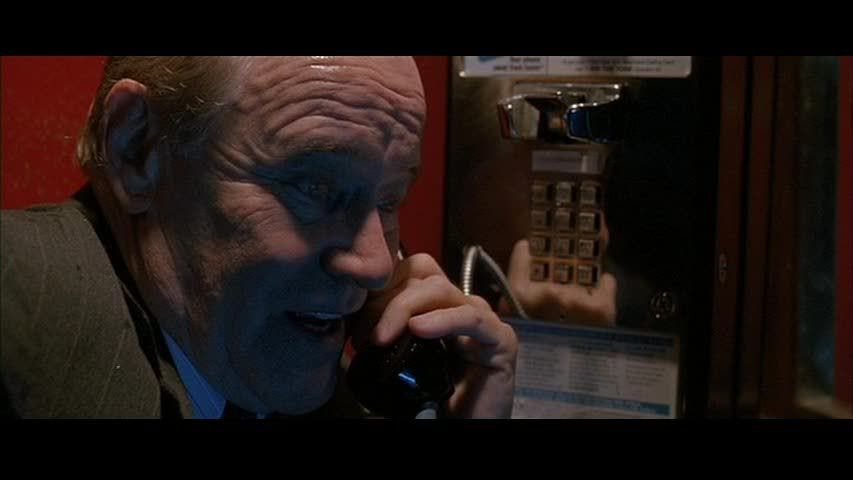
The film opens with a sequence that suggests a familiar Chabrol thriller in the offing. Betty is picked up by a twitchy, increasingly creepy man who claims he's a doctor, and goes with him to a club called Le Trou, a reference perhaps to the Jacques Becker classic as well as an indication that the people inhabiting this bar have reached the bottom, that they've sunk so low they're underground and desperately trying to tunnel out. As Betty swigs glass after glass of whiskey, the doctor begins exhibiting increasingly disturbing signs that he's no more stable than the woman he picked up. His patter becomes chilling, even vaguely threatening, as he talks about dead animals and gets noticeably sweaty, not that Betty, immersed in her drinks, seems to care about her companion's unhinged demeanor. The scene seems to be building to an apex of sinister violence, particularly when the doctor, his sweaty visage framed in profile against the cool blue of a fish tank in the background, tells Betty that she has worms underneath her skin, and that he'll dig them out for her with a needle he keeps handy.

Chabrol is offering up a red herring here, setting up what seems to be a thriller of predation and violence, when in fact this is a very different kind of movie, and the encounter with the doctor is soon defused by the arrival of the kindly bar owner Mario (Jean-François Garreaud) and his lover, Laure (Stéphane Audran), who explains that the doctor is a drug addict. Far from being a violent thriller, this is a quietly intense character study, an intimate portrait of a woman who, like everyone else in Le Trou, has sunk to her seeming low point, fallen as far as she can.
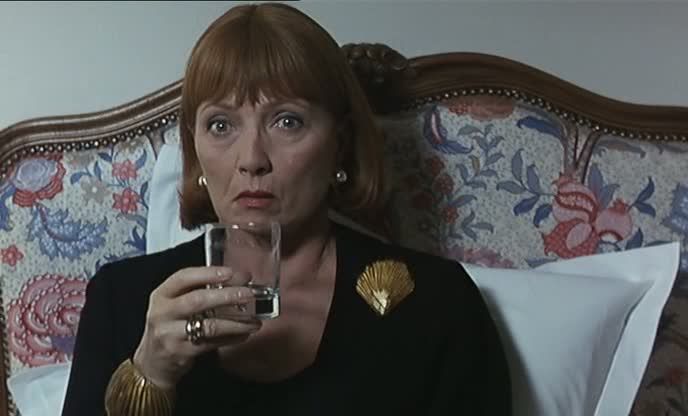

Betty is taken in by Laure, a woman of the upper-class who's rejected society after the death of her husband, retreating to a nice but isolated hotel and making nightly visits to Le Trou. As Laure helps Betty to recover from her desolation, Betty's story is doled out in fits and starts via flashbacks. She'd been married to Guy (Yves Lambrecht), the youngest son of a wealthy and prestigious bourgeois family, until Guy and his domineering mother (Christiane Minazzoli) had walked in on Betty having sex with one of the many lovers she'd taken to distract herself from a numbing, alienating existence. Betty was sleepwalking through life, and Chabrol, of course, is excellent at portraying the deadening effect of bourgeois home life. Betty felt detached even from her two daughters, who were so well-cared-for by a hired nurse that Betty was superfluous, a stranger to her own children, basically only interacting with them to give them a good-night kiss. She had a seemingly ideal life, on paper at least, but it never truly felt like her life, which is why she secretly drinks and arranges her constant affairs. When she gets caught, it seems like she wants to get caught, that she's secretly setting herself up for a confrontation, for something to shake her out of this dreadful nothingness.

Trintignant is exceptional here, plumbing the depths of this woman's misery and seemingly irresistible urge towards self-destruction. One of her lovers, a medical student (Thomas Chabrol) who loves to psychoanalyze her, asks her, "you know your problem?" Betty abruptly becomes serious, intent, flatly answering, "no, tell me," her desperate need to understand herself showing through what had otherwise been a somewhat casual conversation. The way she says it, it's obvious that she really wants to understand herself and her "problem," to pick apart why she is the way she is, even if this pretentious young man with his rote recitations of Freudian subtext doesn't actually have any of the answers. It's a small moment, the nuances of Trintignant's performance embodied in every little line like this, always communicating the submerged intensity of this sad woman.

Audran, in her last role in a Chabrol film, is equally remarkable, as a woman who is in her way every bit as damaged as Betty is, but has managed to recover, to carve out a small and comfortable life for herself as a balm for her loss and sadness. She is a glimpse of a possible future for Betty, and perhaps Betty herself also sees it, because in the film's devastating and unexpected finale, Betty, selfishly rejecting the possibility of growth or true healing, simply grasps for what her friend has and takes it. Betty, beneath her hurt and her victimhood, has a cold and calculating side to her as well, a darkness that prevents her from seeing a less destructive route out of her rut. The coda, which chronicles the minimal effect of all this emotion and self-destructiveness on the chilly, perpetually polite world of the bourgeois — the world that both Laure and Betty had fled for different reasons — adds a final ironic twist to the film's bleak picture. It's a powerful and intense film that is unsparing in its depiction of the central character's weaknesses, as well as her surprising and cruel strengths.

Monday, December 7, 2009

Bad Lieutenant


Abel Ferrara's Bad Lieutenant is a film entirely built around its central performance, Harvey Keitel's fearless, unfettered turn as a corrupt, unnamed New York City police lieutenant. Keitel delivers a performance of unrelenting power and intensity, a nasty, ugly portrayal of a man on a mission of self-destruction. He staggers through a filthy, dimly lit vision of New York, doing drugs in grimy apartments and even grimier hallways, pulling out his gun at a moment's provocation, engaging in sordid sexual exploits even though he actually seems barely interested, and must have so many drugs in his system that real sexuality is impossible anyway. It's a sloppy, crazy performance, and Keitel pours himself into it, breathing life into this bottom-dwelling man, this guy who, for no discernible reason, seems bent on bringing himself to the lowest possible place.

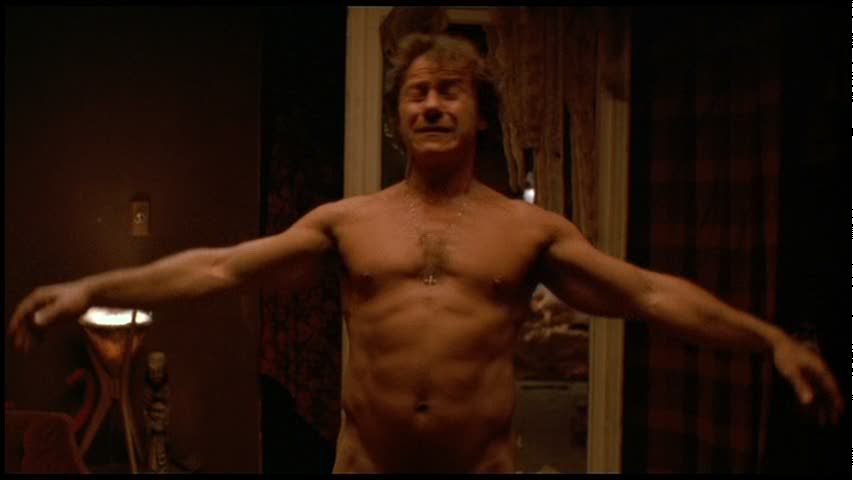
In order to document this everyman's descent into ruin, Ferrara smears the screen with brilliant, hallucinatory imagery, increasingly spiraling into a subjective vision of a truly horrifying world, a world where everything is stacked against this antihero, this shambling wreck of a man. It's apparent early on that the film is working on a symbolic level when, during an orgy with an unnamed young woman and a fey pretty boy, Keitel stumbles around naked, his arms outstretched like Jesus. It's the film's first Christ pose, but there will be many more: Keitel's journey through the New York underworld is explicitly defined as a religious experience, a struggle to come to terms with his spirituality in the context of his complete moral degradation. Jesus himself appears, as well, coming down from the cross still freshly bleeding, silently observing Keitel's plight.

Though there are obvious signs of degradation in everything Keitel does here, the true symbol of his self-destructive streak is contained in his masochistic fascination with the (entirely imaginary) World Series between the Mets and the Dodgers. Keitel is a compulsive gambler, of course; he has such a compulsive personality that there's seemingly no desire, no need, that he can resist. He spends the bulk of the film wheedling his fellow cops into putting their money on the underdog Mets, who had already lost the first three games of the series and were thus one loss away from throwing it all away. In the meantime, though, Keitel is rooting against his own home team, putting increasingly extravagant amounts of money on the Dodgers and getting deeper and deeper into debt as the Mets pull back from the brink of defeat, winning one game after another against all odds. Keitel is a born loser, basically, failing to see himself in his shaggy hometown team: as the Mets come back again and again, dramatically turning the tide of the series, Keitel only sinks deeper into his self-created abyss, masochistically letting his debt ride on each game until he is in so far over his head that he has to know he'll never get out. It's a rich irony, and Ferrara utilizes the patter of the games' sports announcers as a near-constant soundtrack, a low-level buzz in the background of many key scenes, steadily ticking towards Keitel's ruin as the announcers cheerfully document the Mets' improbable victory.


The film's plot, such as it is, focuses around Keitel's halfhearted attempts to investigate the vicious rape of a Catholic nun (Frankie Thorn) at a church. This scene is a brutal slap in the face, as visceral and horrifying as Keitel's performance. Two men strip the nun and beat her, holding her down on an altar as they defile her. Ferrara deliberately constructs the scene as a collage of religious desecration: a statue of the Virgin Mary toppling over, the chalice with the host being overturned, a crucifix being used as a weapon, and finally Jesus himself pierced on a cross, crying out in anguish in unison with the nun. This profound, violent insult to Catholicism seems to awaken something primal in Keitel's lieutenant, who is a Catholic but, obviously, a rather disconnected one, abstracted from his supposed faith. At one point, he watches his daughter receive communion and smiles with paternal pride, but not long after he can be seen snorting cocaine off of his daughter's communion picture.

His Catholicism actually seems to be tied up with his masochistic tendencies, his guilt and conflicted desire to achieve some kind of spiritual stasis from his tormented existence. As Keitel gets deeper and deeper into debt with his bookie, he's warned that he's going to get himself killed, and he simply responds, "I'm a Catholic, I can't be killed." It's this shallow understanding of religious feeling that drives him throughout the film, leading him at one point to go literally crawling on his knees towards a bleeding Jesus, kissing his savior's bloody, dirty feet. Ferrara is probing a kind of primal religious feeling, religion stripped to a raw essence, as represented not only by Keitel but by the nun as well. In a crucial scene, Keitel comes face to face with the nun — who he'd earlier observed voyeuristically at the hospital where she was recovering — and finds that she will not reveal the identities of her attackers because she forgives them. Keitel becomes like a devil on her shoulder, cajoling her, trying to get her to forsake her saintly pose, to wish for earthly justice instead of maintaining this attitude of stoic spiritual devotion. The conflict here is between Keitel, mired in the world, in the flesh, and the nun, who places herself above worldly concerns altogether, above even her own body, which means so little to her that she ultimately shrugs off its desecration. Keitel is unable to understand her forgiveness, unable to accept a worldview so at odds with his own, a way of thinking that is entirely distant from the physical world and its problems.


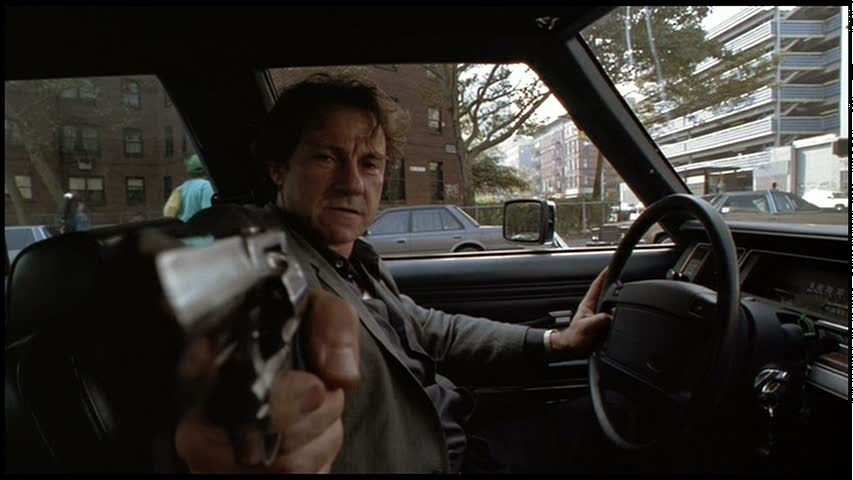
The film is thus seeped in Catholic guilt, in the simultaneous shame and primal attraction of sin, which Keitel's debased lieutenant wallows in throughout the film. In scene after scene, he pushes the boundaries of his performance into uncomfortable areas, such as the lengthy sequence where he threatens a pair of underage girls (who actually look like they're at least thirty, but nevermind) into baring themselves and simulating oral sex. Keitel's repetitive insistence that one girl should "show me how you suck a cock" verges from sinister to nearly comical to exhausting. His performance is frequently hard to watch, even embarrassing, and he projects a kind of emotional nakedness at every moment, as though his inner self is always right there on the surface, ready to explode outwards. His whiny, blubbering outbursts give way to sequences where he maintains more of a steely Dirty Harry-esque coldness; in one scene, Ferrara places his camera so it looks up the barrel of Keitel's gun as the cop threatens a pair of criminals.

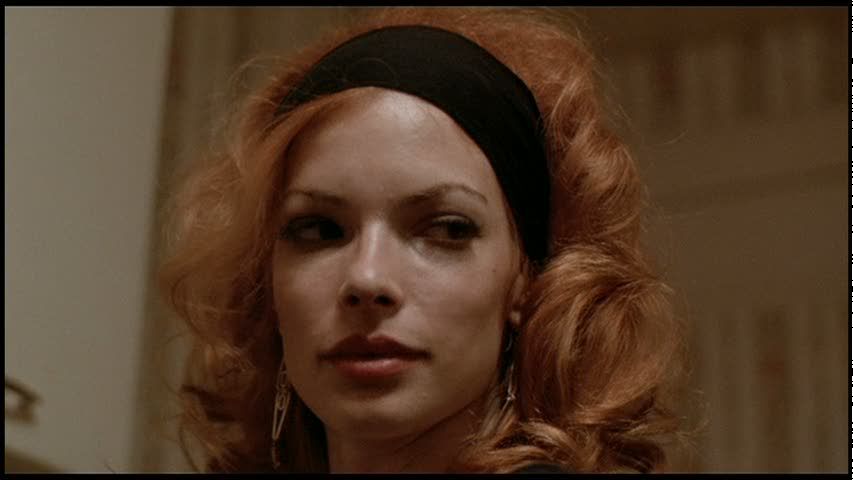
Some of the best sequences involve Keitel's visits to a waifish redhead (Zoë Lund) who gives him drugs. She's drifting and narcotized, seemingly living in her own world, disconnected from the messy corporeal reality of the lieutenant's existence. Drugs, perhaps, are another way of achieving the nun's beautific separation from the worldly, recasting Keitel's habitual drug use as another way of chasing spiritual enlightenment, another way of locating the divine in the mundane and filthy. Her introduction is darkly comic as she wanders around her apartment in a daze, always a step behind, muttering to herself and casting sly, bright-eyed gazes at Keitel as he shoots up. But in a moment of lucidity, she also delivers what might be the film's mantra, its central theme distilled to an essence: "Vampires are lucky; they get to feed on others. We've gotta eat away at ourselves."

Indeed, Keitel spends the entire film eating away at himself, wearing himself down to nothing until his eventual implosion. It's an astonishing performance, a performance with no sense of boundaries or limits, and Ferrara admirably supports his actor with a skeletal framework that defines Keitel's seemingly aimless quest as a search for spirituality and redemption. The film nearly implodes by the end, descending into confusion and mystery, but that's perhaps appropriate, since Keitel never really gets the answers he wants, never really achieves the higher state he's so desperate to attain. He never gets above his mire, instead sinking deeper and deeper until the inevitable denouement is an expected anticlimax, the sad last whimper of a sad man.

Sunday, August 30, 2009

Rock Hudson's Home Movies


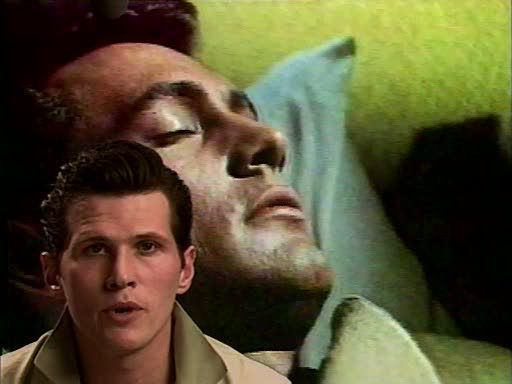
In Rock Hudson's Home Movies, filmmaker Mark Rappaport conducts a revisionist analysis of the famed Hollywood actor's cinematic career, with Hudson's films revisited with the hindsight knowledge that he was gay and would eventually die of AIDS. It's an essay-film that consists almost entirely of clips from Hudson's films, crudely recorded with videos, often from TV, giving them a raw, overexposed, desaturated appearance. This strips aesthetics out of the equation, shifting the focus entirely onto the dialogue, the situations, and the unspoken subtext underlying Hudson's screen persona. The film is, by turns, fascinating, provocative, amusing, and very often deeply silly and misguided, as Rappaport's quest to read gay subtext into seemingly everything Hudson did onscreen yields both clever insights and obvious stretching.

The film is on its strongest ground in the examination of the Doris Day/Rock Hudson comedies of the late 50s and 60s, films like Pillow Talk and Lover Come Back, where the plot would often center around Hudson assuming dual identities, one a sexually voracious macho man and the other a prancing wimp. Obviously, Rappaport finds these films rich in subtext about questions of gay identity, and it's not hard to see why. By deftly editing together scenes and chopping up the dialogue, he even manages to suggest that the "gay" onscreen Hudson found himself admiring the more "macho" Hudson. These films, under Rappaport's dissection, seem to toy with Hudson's sexuality, creating densely layered meta-situations where, as Rappaport's onscreen narrator Eric Farr points out, a gay man passing for straight is asked to play a straight man who pretends to be gay. It creates a twisted, hall of mirrors situation that the film compares to the funhouse conclusion of Welles' The Lady From Shanghai, with Hudson essentially having an onscreen affair with himself — or at least finding himself in situations where Doris Day suspects him of it.

Though Rappaport makes some interesting points along these lines, the film is continually mired down in the filmmaker's insistence on finding gay subtext everywhere he looks. At times, it's blatantly obvious that he's taking lines out of context even when one doesn't know the original films he's referencing. Two cowboys staring each other down for a shootout becomes gay cruising for Rappaport. Hudson's interrogation of his nervous son-in-law in Giant: likewise. Even the pronouncement that "Hamburg is the gayest city in Germany" gets edited into the film as though it's more evidence of Rappaport's thesis, even though he later somewhat sheepishly has to admit that the more innocent usage of the word was still the dominant one at the time of these films. Nothing escapes Rappaport's revisionism. When, in what is obviously a clip from early in Hudson's career, a man in a skeleton mask and black cloak bursts into the room as Hudson kisses a girl, Rappaport takes it as foreshadowing of the actor's eventual death from a sexually transmitted disease. It would be laughable if moments like this weren't in such outrageously poor taste, and of such dubious value as a form of film analysis. It's bad enough when Rappaport tries to read psychology into the characters Hudson played onscreen, characters who Hudson himself had no real hand in creating. Much worse are the moments when the film treats Hudson's cinematic legacy as a prediction of his eventual death, as though that revealed anything beyond Rappaport's own morbid fascinations.

In fact, much of what Rappaport reads in terms of gay subtext could be much more persuasively explained as more general expressions of sexual morality in the movies. One of the film's most tightly edited montages is a selection of Hudson's onscreen kisses with his leading ladies, and Rappaport points out that nearly every one is interrupted in some way, cut off by one partner or the other or else disrupted by some intrusion. For Rappaport, this is confirmation of Hudson's homosexuality written into his films — how, who knows, since as the narrator acknowledges, Hudson had nothing to do with any of the actual content of his movies. These kisses suggest a discomfort with heterosexuality, a perfunctory stab at playing an expected role by a man who must hide his true self. At least for Rappaport they do.

But such tropes are to be found everywhere in the cinema, particularly in the classic Hollywood era, and they're hardly restricted to gay actors. What Rappaport goofily calls "kisses interruptus" have always been a common device for both comedies and dramas — in the former, the break-off of the passionate moment is played for humor, while indecision about romance, characterized by moments of giving into passion and moments of regret, has always been a central theme in melodramatic works. One can easily imagine a montage of similar incomplete kisses with completely straight actors: it's such a common narrative element that reading it as having anything to say about Hudson's homosexuality is ludicrous. Rappaport is so intent on seeing gay meaning in everything that he often seems blind to alternative possibilities, to other readings, simply forcing everything to fit into his reductive schema. Many of the continuities he detects could be explored in terms of genre, or along auteurist lines, or as storytelling clichés, but Rappaport isn't interested in broader criticism, only in proving his pet theories.


In analyzing Howard Hawks' Man's Favorite Sport?, Rappaport emphasizes how Hudson's character is continually humiliated for not being a manly man, for not knowing "how to fish," which is an obvious euphemism for being sexually inexperienced — and, Rappaport believes, also a euphemism for Hudson's sexuality. In some ways, he's got a point, as there's a thin line between making a film about a man who's sexually inexperienced and one about a man who's simply sexually inexperienced with women. But Rappaport goes further, suggesting that Hawks (no stranger to homoerotic subtexts) and his screenwriters, like many others in Hollywood, had it in for Hudson, that they were purposefully mocking his sexuality in this film and others like it. This thesis quickly gets tied up in knots trying to justify itself when dealing with the question of Hawks' comparable films with Cary Grant, many of them comedies of humiliation like I Was a Male War Bride and Bringing Up Baby. The latter is cited for Grant's famous "I just went gay" exclamation, while the former becomes a prime example of how Grant, when cast in these films, somehow avoided being too humiliated or debased, while Hudson (who was literally replacing Grant in Man's Favorite Sport?, a film originally intended for the older man) looks like "a sissy."

Rappaport asserts, somewhat lamely, that Grant, despite persistent rumors about his own sexuality, came off better because he was married multiple times, while Hudson only married once. It's a weak justification, and in fact Hudson's character comes off no more ineffectual in his Hawks appearance than Grant did in most of his comedies with the director — except in the sense that Grant was a far better comedic actor. Rappaport seems blind to (or indifferent to) the continuities between these films and others not starring Hudson. Instead, looking at Hudson's oeuvre in isolation, he treats it as though the actor had any control over the lines he said and things he did, as though there were not more important considerations affecting these films than the sexuality of the actors, and as though the threads he identifies here as gay subtexts were not running through all sorts of unrelated movies regardless of the sexuality of individual stars.

The film is further dragged down by the amateurish, stilted performance of Eric Farr, supposedly playing Hudson speaking from beyond the grave, narrating his own life story through the movies he starred in. Farr's awkward line readings only distract from any point Rappaport's trying to make, as does the whole conceit of a younger version of Hudson supposedly speaking in the first person about his sexuality like this. Farr seems to be there primarily because he's handsome, not that he actually looks anything like Hudson or has any actual acting talent. In any event, Farr, though distracting, winds up being the least of the film's problems. Rappaport ultimately buries his most interesting points about gay identity and gay cinematic representation beneath a smug insistence on seeing every onscreen male friendship as a latent gay relationship. The film often adopts an insufferable wink-wink tone not far from adolescent toilet humor, delighting in the discovery of "naughty" interpretations for everything from two soldiers discussing traumatic wartime experiences to a deadbeat father reuniting with his son. Worse, there's a kind of barely restrained contempt for women flowing through this film's own subtext. Rappaport's text frequently treats the women in Hudson's movies as empty-headed predators, and cruelly gives Cyd Charisse the introduction that "she had seen better days," calling her "Ms. Dracula on a talent search" when she snares Hudson for a passionate kiss. It's this kind of catty commentary, along with the film's obliviousness to anything beyond its narrow interpretative rubric, that prevents Rock Hudson's Home Movies from being the truly incisive Godardian essay it aspires to be.

Sunday, March 1, 2009

Basic Instinct


Paul Verhoeven's Basic Instinct is a typically complex and ambiguous film from a director whose erotically charged work, at its best, explores and prods at the assumptions about sex, gender, violence and power that underlie various Hollywood genres, even as, on its surface, the film fulfills those genre conventions in every way. It's a delicate balancing act, and it opens Verhoeven's films up to multiple contradictory readings. Is he a skillful provocateur, looking to push buttons and provoke uncomfortable feelings in his audience? Is he probing for something deeper, a treatise on sexual power games and the ways they're presented in popular cinema? Or is he simply a purveyor of exploitative but well-crafted sleaze, reveling in the dirty fun of the trashy stories he's telling? Most likely, of course, it's a little bit of all three, and it's precisely this combination of high-brow deconstruction and low-brow junk cinema that makes Verhoeven such an interesting and slippery filmmaker. He is continually peeking beneath the surface of his films, letting all the interesting subtexts and sociopolitical commentary of the material bubble up, but he never lets his forays into the cinematic subconscious undermine the surface thrills he delivers.

This is certainly true of Basic Instinct, a sexual thriller that engages with received ideas about sexually aggressive women, the femme fatale archetype, and the power games and manipulation involved in male/female relationships. Catherine (Sharon Stone) is perhaps the ultimate femme fatale, and Verhoeven never flinches away from exactly what makes her so troubling to the men she encounters: her fearless sexual promiscuity, her calm demeanor and coolness about ideas like love and romance, the openly manipulative way she uses her sexuality. She's not just sexy and scary in equal measure; she's scary because she's sexy, and vice versa. She's a blatant confrontation to masculine ideas about what women are supposed to be like, and she flaunts this confrontational persona, which is both seductive and intimidating to men. And especially to the disgraced cop Nick Curran (Michael Douglas), who is recovering from the latest in a line of "accidental" shootings on the job. While undercover, he killed a pair of tourists, and seems to have barely made it through the resultant inquiries with his badge intact. This makes him especially vulnerable to the manipulations of Catherine, who he begins investigating after her club owner boyfriend shows up dead, riddled with bloody holes from an ice pick.

Catherine, of course, is the perfect suspect for the murder: she's got a shady past, shadier associates, has a fondness for ice picks, and, as a writer, has even written a trashy novel in which a former rock star is killed by his girlfriend in exactly the same way as her own lover. But Catherine is too clever, and neatly avoids the murder rap even as she begins sucking Nick into her clutches, researching his past and setting him up as the "inspiration" for her next novel. The bodies start piling up, but Nick is soon more of a suspect than Catherine, and even knowing that she's probably responsible for it all, he can't help being seduced by her. Verhoeven makes Catherine an iconic icy blonde, cool and deadly and always able to make things fall exactly her way. Stone's performance here is legendary for a reason, not just because she's great at projecting Catherine's quietly threatening sexual energy, but because she's embodying the cumulative image of decades of Hollywood genre fiction. She's the dangerous woman, the beautiful but treacherous blonde with an icy heart, just as likely to fuck you or put an ice pick in your throat — and if you give her half a chance, eventually she'll probably do both. Verhoeven delivers the expected story, the twisty neo-noir in which the sex-addled detective falls for "the wrong woman" (as Catherine herself describes the premise of her next mystery novel), but the undercurrents of the story, the inquiry into sexual roles and the battle of the sexes, is never far from the surface.


In this respect, the film's most famous scene is Catherine's interrogation, the cool blonde facing a roomful of tough detectives and calmly dominating them with the simple gesture of crossing and uncrossing her legs. It's a brilliant scene, tracing the way these men, supposedly in control of the situation, are actually undone just by that simple flash of Catherine's bare crotch under her short skirt. They're interrogating her, and the bright lights are directed on her, but they're the ones who are sweating, stuttering, breaking down and getting angry. She simply lights a cigarette, deftly brushing aside their protestations that she can't smoke, and soon turns the line of questioning around on Nick, interrogating him when she's supposed to be the one under examination. It's an especially clever reversal because it toys with various clichés about the male gaze and Hollywood cinema, the way that exploitative films treat women as objects to be looked at rather than active protagonists in their own right. Well, Catherine is there to be looked at, her body on display, but she's also never less than active, never less than in control, presenting herself for the gaze of others; you can say a lot about Catherine but she's certainly no object. Catherine reverses the typical balance of power by making the focus of the male gaze the one who's in control, the one who has all the power in the relationship. Among other things, she's the embodiment of male fears about women in the workplace, women who are not mere beautiful playthings but are smart and capable and in control.

The film also deals with this very notion of sex and gender relations as founded on power games. Once again, it's in one of the most sexually explicit scenes that Verhoeven locates some of his most trenchant observations. The first sex scene between Nick and Catherine is a study in sex as power, the couple rolling around and exchanging roles, first one on top, in control, then the other. It looks as much like a fight, a battle, as it does like sex. Verhoeven is also interested in the possible differences between "fucking" and "making love," terms that the people in this film never use interchangeably. Catherine is of course the first to make the distinction, emphatically insisting that her relationship with her murdered boyfriend consisted only of fucking, that there was nothing deeper to it, at least for her. It comes up again after Nick violently has his way with his occasional lover and therapist, Beth (Jeanne Tripplehorn), who angrily tells him afterward, "you weren't making love." Among the film's many concerns is the question of what sex actually means, whether it can or does constitute deeper connections between people or whether it's just fucking: manipulation, power games, who's on top, who's fucking and who's being fucked. Later, a visibly softened Catherine asks Nick to "make love to" her, but one of the film's many unresolved questions is whether Catherine's icy exterior is actually melted by Nick, or if she just decides he's an especially great fuck.

What's great about Verhoeven's film, like so many of his films, is that Basic Instinct raises all these questions about sexuality and power and the media image of women without even seeming to verbalize anything greater than a grisly whodunnit with a lot of T-and-A. The film can be read just as easily either way, as a surface-level exploitation or a complex satirical commentary, and one suspects that Verhoeven likes having it both ways. This is one of the most troublesome aspects about his films, the suspicion that he enjoys smirking at his audiences, enjoys the fact that most people walk out of the movie talking only about Sharon Stone's body or the lingering mystery of whether or not Catherine "did it." At the same time, though, Basic Instinct is simply too complex, too potent, to dismiss entirely as Verhoeven condescending to popcorn moviegoers. The film ultimately positions Catherine as a surrogate for the director, manipulating and seducing the audience even as she does with Nick. Verhoeven, like Catherine, seems to enjoy the audience's appreciative gaze, but he knows that he's always the one in control.

Monday, January 26, 2009

Glengarry Glen Ross


Adapted from one of David Mamet's plays by Mamet himself, Glengarry Glen Ross is severely constrained by the stagebound nature of its material, giving it a claustrophobic, airless quality that director James Foley does nothing to mitigate. The story of a group of real estate salesmen struggling to meet rigid sales goals with the threat of losing their jobs dangling over their heads, the script mainly consists of a set of repetitious, utterly circular conversations in which these angry, frustrated men rant and rave, spewing vulgarity and saying the same things over and over again. Their leads are no good. They can't close these leads. The leads are shit. The leads are fucking shit. The boss is a no-good cocksucker. They curse a lot: a lot. Mamet seems to think that realism means having his characters say "fuck" every other word and constantly repeat themselves, but the result is merely strained and, very quickly, exhausting. It doesn't help that Foley has only the most pedestrian solutions for directing most of these conversations. In a movie that consists of virtually nothing but one long, heavily stylized conversation or monologue after another, it is absolute cinematic torture when the director can think of nothing better to do than to cut, on the dialogue, back and forth from one closeup to another, occasionally varying things with a two-shot. In some of the more quickly paced conversations, it even becomes unintentionally kind of funny, as Foley cuts back and forth between actors exchanging quick words or bits of words, the syncopated rhythms of the editing completely disrupting the sense that the actors are even in the same room with one another, let alone sitting at the same table. It's maddeningly distracting.

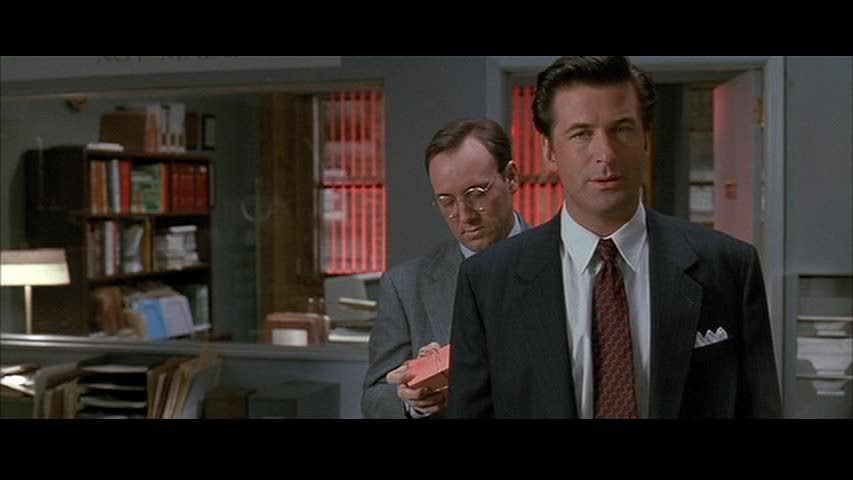
The film's basic idea certainly has some promise to it. A bunch of down-and-out salesmen are working on squeezing the last bits of life out of their mostly dead prospects. The best of them is Ricky Roma (Al Pacino), who's on a streak of luck. Meanwhile, neither the stuttery, awkward George (Alan Arkin) nor slick old-timer Shelley (Jack Lemmon) have done much of anything lately, and even the cocksure, abrasive Moss (Ed Harris) is struggling. They're all overseen by the smug, rigid office manager Williamson (Kevin Spacey), and they're given some fiery "motivation" by a representative of the uptown head office, the priggish Blake (Alec Baldwin), who gives the salesmen an ultimatum: make the top two slots this month or get out. There's some high-powered acting talent on display here, even if this stellar cast isn't given much to do besides bluster endlessly. The script has so much spit and venom that none of these great actors are really able to add much depth or nuance to their one-dimensional characters, with one very notable exception.

In a film mostly populated by soulless caricatures with no substance, Jack Lemmon's Shelley shines as the one decent, truly fleshed-out portrayal of the bunch. Other than Arkin's non-entity wallflower, Lemmon's is the only performance that consists of more than cursing at the top of his lungs. He takes the script's vulgarity and broad strokes and makes them his own, really sinking into this character, living it, writing it in the lines of his face and the earnest, pleading quality in his voice. There's more than a little Willy Loman in his over-the-hill salesman, still ready with lots of fast talk and slick double-dealing, but no longer having the numbers to back up his skill. He insists he's just hit a streak of bad luck, but nobody cares, focusing only on what he's done lately. Lemmon brings his quiet dignity and reserve to the film, adding much needed subtlety to a script that is otherwise inclined to use bigger and bigger hammers to hit its tiny nails. The film's apparent messages — about the uselessness of a life dedicated only to a soulless job — are most forcefully felt in the character of Shelley.


Foley also reserves his most potent directorial flourish for Shelley's pivotal moment, after he finally succeeds on an important sales call and is describing his victory to Roma. As Shelley describes his sale in hushed, quasi-spiritual tones, the camera drifts airily backward, forsaking the back-and-forth cutting on dialogue to take in the whole scene in the office, with a low angle shot that increasingly isolates the two salesmen in the center of this big empty space. It's a shame that Foley isn't able to expand upon the material like this more often. It's a lovely shot, commenting on the emptiness of Shelley's victory even as it captures his very real enthusiasm and nearly ecstatic joy. Elsewhere, the exterior shots, bathed in neon colors and pouring rain, are evocative but don't really add up to anything. And Foley's simplistic way of dealing with the vast majority of the dialogue scenes drags the life out of them, even if there are still some sparks in the best patches of Mamet's dialogue. There's a truly great sequence in which Roma delivers a lengthy, rambling monologue about absolutist morality, attitude, religion, and the importance of personal choice. It is a speech of astonishing amorality, and the scene's payoff comes when Roma climaxes this dazzling oration by whipping out a sales brochure and spreading it out on the table in front of his slack-jawed companion: all this eloquence and ranting for the sake of selling a parcel of Florida real estate.

At its best moments, like this, the film has the capacity to surprise with its dark wit and harsh insights; its mordant satire has some real sharp teeth. But its rambling structure, functional style and repetitive dialogue diminish the material's potential. Large chunks of the film are dedicated to hammering home the same points repeatedly, particularly anything involving Harris or Arkin, who play the same note throughout as though they're incapable of hitting any other. The scenes where the two of them are talking together are thus doubly exhausting, especially since they converse at length throughout the whole first half of the film. There's the foundation of an interesting film here somewhere, but the film that actually got made isn't it. Despite flashes of quality, and even sporadic brilliance, Glengarry Glen Ross is mostly monotonous and cinematically limited.

Wednesday, November 12, 2008

A Winter's Tale


A Winter's Tale is the second installment in Eric Rohmer's "Tales of the Four Seasons," and it is a small pleasure of a film from a director who excels at delivering smart, carefully constructed, meditative confections like this. It is, as its title indicates, mostly set within the space of a few weeks in December, but it is not a chilly film by any means. Indeed, the film opens in a very different atmosphere, with a few minutes spent on a summertime beach, one of the most erotic, sensual sequences in all of Rohmer's cinema. These opening minutes have a disjunctive, crisply edited style that evokes a series of vacation snapshots, brief moments captured that together add up to an impression of absolute bliss. A young man and woman, who we later learn are Félicie (Charlotte Véry) and Charles (Frédéric van der Driessche) but who remain unnamed in this mostly wordless opening, have a summer affair of intense passion. Rohmer's evocative images of this romance, spent on the beach, in bed, bicycling among the hills, are as sumptuous and romantic as any he's ever made. It's all too easy to forget that Rohmer, well-known as a director of talky, philosophical films about relationships, can be incredibly earthy and sensuous when he wants to be, and these searing images establish in a few quick, economical strokes just how intense, adoring, and serious this romance is. It is obviously a lasting love in the making. Then the summer ends, and the couple reluctantly parts, promising to stay in touch as she dictates her address to him.

And then it is five years later, in the winter. Félicie has had a daughter, the fruit of her summer with Charles, but due to a mix-up over her address the couple has been out of touch ever since they parted, unable to locate each other. Charles is absent from the rest of the film, his only presence a single photo from the beach that Félicie shows to their daughter as an icon of her missing father. But those opening minutes linger on; they are unforgettable, and Rohmer knows it. He trusts his storytelling implicitly enough to understand that these fleeting, speechless minutes are more than enough to carry the rest of the film. They are the bedrock upon which Félicie's character and the plot itself are built. As for Félicie, with Charles absent, she alternates between two men who essentially represent polar extremes, with Charles falling in the middle, the sweet spot between them. Maxence (Michael Voletti) is very physical and domineering, with strong feelings for Félicie; he is a bear of a man, husky and cheerful, who can swallow his petite lover in tremendous hugs. On the other end of the spectrum, Loic (Hervé Furic) is a bookish librarian, incredibly intelligent and articulate but very reserved, not very physically aggressive or affectionate, better suited to be a friend than a lover — Félicie tells him, without meaning to hurt him, that in a past life they might have been brother and sister.

In her way, she loves both of these men, who are mostly good to her and who undoubtedly have very strong feelings for her. But the reasons for her vacillations are obvious, as the perfection of her time with Charles, and the intensity of her still-burning passion for him, dwarfs her relationships with any other men. Throughout the film, she goes back and forth from Max to Loic, at various times committing to one or the other, settling into a comfortable situation only to decide that comfort is not enough, that she wants true, overwhelming love or nothing at all. It is a familiar template for Rohmer characters, who often live by obscurely defined moral codes and a stubborn insistence on perfection, qualities that can make them seem capricious and frustrating, both to their in-film associates and occasionally to the film audience as well. Félicie is no exception, a typically maddening Rohmer heroine who can at times exhaust the audience's patience with her. But Rohmer invariably respects her, and he has the patience to let her do what she wants or feels she needs to do, to follow her as she changes her mind and attempts to live up to her "intimate" convictions.


Rohmer has often drawn a connection between his characters' insistence on romantic perfection and his own deeply held but idiosyncratic Christianity. Nowhere is this more true than in this film, where Félicie's idealistic belief that someday Charles will return to her is explicitly compared to the Christian faith in the afterlife. At one point, Félicie and Loic, who is a devout Catholic, go to see a production of Shakespeare's play The Winter's Tale, in which after a separation of 16 years a king is reunited with his long-dead wife by a mysterious magical ritual. Félicie, for obvious reasons, becomes emotional at this scene that so movingly parallels her own desires, and the play is one of the film's most unexpectedly emotional moments. As the statue of the king's dead wife comes to life amidst flowery speeches, Rohmer cuts away to a shot of Félicie in the audience, her eyes damp with tears, fiercely clutching at Loic's hand.

After the play, Loic asks about a plot point that is deliberately left somewhat ambiguous by Shakespeare: whether the statue really is reanimated by magic, or if the queen had simply been in hiding for all those years, and the magic a sham to initiate her return. Félicie quickly brushes the question aside as irrelevant, telling him that it was faith that brought the woman back to life. The king, like Félicie herself, was willing to sacrifice his life and present happiness to the hope of a miracle, and as a result his desire comes true. This is both an answer to the play's unresolvable mystery and to the question of why Félicie will not settle down with either Loic or Max, and at this moment Loic says that she is, without realizing it, essentially articulating Pascal's wager. This scene directly connects back to the famous conversation in My Night at Maud's in which Jean-Louis Trintignant discusses the nature of faith, and especially Pascal's belief that trading an unfettered life for the possibility of an immortal soul is a wise wager to make. Félicie is making the same wager, trading away the certainty of mild happiness with either Max or Loic for the very slim possibility of an ecstatic happiness with Charles at some point in the future.

This moment is so potent, not only for its connections to past Rohmer films and his own personal faith, but because Rohmer has taken such pains to establish the stakes. The opening images of the film hang over everything that comes afterward, a vision of summertime pleasure lingering in the chilly air of December. It's obvious where things are going, towards Félicie's secular miracle — is it true magic or simply sleight of hand? — but the film itself is a joyous miracle despite its air of inevitability. It is a complex and fascinating masterpiece.

Friday, August 29, 2008

The Player


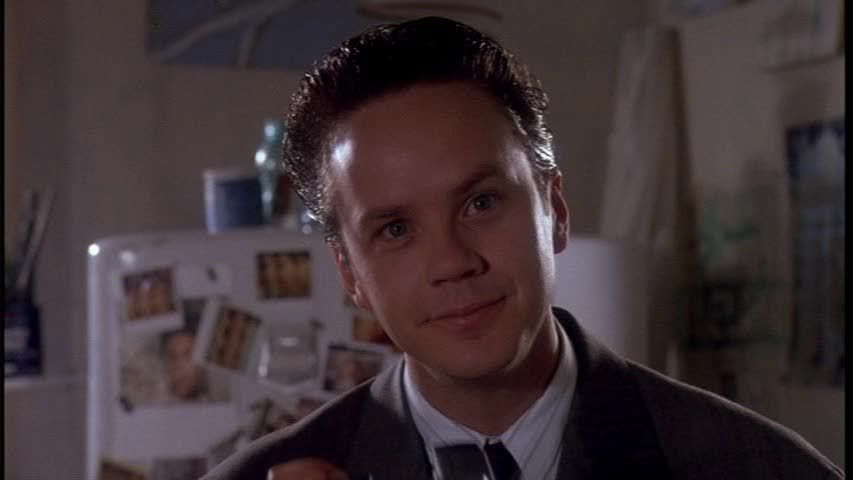
A lot has been said about the metafictional genius of Robert Altman's The Player, in which the Hollywood producer Griffin Mill (Tim Robbins) is unwittingly involved in a very Hollywood-style story of murder, sexual intrigue, and duplicity as his career disintegrates around him and he receives threatening postcards from a writer whose script he rejected. The film announces its intent with its opening, a virtuoso tracking shot that lasts several minutes, beginning within an office and slowly panning out and around the entire grounds of a studio lot. This is a stunning maneuver, introducing the large cast in walking cameos as they stroll by the camera's path, conversations drifting in and out of range at various points. Moreover, Altman has these characters discussing the use of just this kind of device in other films, from the opening of Orson Welles' Touch of Evil to Alfred Hitchcock's Rope with its unbroken ten-minute takes. As these characters themselves say, such devices introduce the entire movie in microcosm before the credits have even finished rolling, and Altman sets out to do just that, establishing not only the setting and characters but the way in which the constant flow of inane chatter and deal-making patter constitute the reality of behind-the-scenes Hollywood.

If this intro — and the non-stop flow of Hollywood stars flooding the film with cameos — telegraphs the metafictional, satirical intent of The Player, the soul of the film is contained in a single richly layered scene at a fundraising party where Mill gives a speech. Speaking to a room of stars and producers (including Cher, the only one dressed in red at a black and white affair), Mill praises the studio system for keeping alive the idea that movies are art by donating prints of a few dozen old classics to a film center. He lambastes the moviegoing public and the press alike for failing to understand art, for wanting only crass entertainment, while maintaining that it is up to Hollywood itself, and especially the producers, to deliver great art to the people. He ends on a passionate note, emphatically declaring: "Movies are art!" Altman cuts in for a closeup at this point, capturing the genuine sincerity of Mill (and the earnest glint in Robbins' pale, expressive blue eyes): he radiates an intense belief in what he's saying. It's a powerful, even moving speech for those who love movies and take it for granted that they are art, and one senses that for a moment, Mill is speaking Altman's mind; the director has momentarily taken over his character like a puppet and is ventriloquizing through him. It is also an extraordinarily complex and ironic scene, though, mainly because despite Mill's apparent sincerity and Altman's obvious underlining of his words, there is little evidence that Mill pays any more than lip service to what he's saying. If he truly believes what he says, he does so in the abstract, as a concept divorced from his actual practices in the movie business — in practice he does everything he can to smother the art in movies, to produce the generic entertainment he rails against, though in fairness he is not quite as mercenary as the young upstart Larry Levy (Peter Gallagher), who thinks that producers can replace writers altogether in the Hollywood assembly line.

This speech is also undercut by the fact that hardly anyone is listening to Mill. Altman cuts around the room from one table of celebs to another, showing the various actors and actresses chatting with one another, hobnobbing and ignoring the producer's words. One wonders if, when they agreed to these cameo appearances, the stars realized that they'd be depicted as ignoring a speech about the importance of cinematic artistry — or if they'd even understand if they did. The constant interplay between star personae and screen characters encourages these kinds of metafictional musings. One of the funniest things about Altman's decision to include so many cameos is that one is never sure, when a new star appears, if they're playing themselves or if they're meant to be an actual character in the film. OK, so Sydney Pollack and Whoopie Goldberg are characters (Mill's attorney and the detective investigating him, respectively), but Jeff Goldblum, Anjelica Huston and John Cusack are all going by their own names as Hollywood stars. The film's metafictional slippage creates and revels in this uncertainty, crafting a world in which some of these stars are playing parts, while others ostensibly represent who they really are. Altman encourages this star-spotting, peppering his crowd scenes with recognizable faces who he occasionally points out, enhancing the impression that this satire is sharply pointed at the real Hollywood apparatus these people are a part of.


Mill's speech also highlights one of the film's key themes, the gulf that exists between modern Hollywood and its vision of itself, a vision largely crafted in an era when its artistry and its commercialism were inextricably intertwined rather than in competition with one another. There are constant references to the past, both verbally and in the continuous use of images from Hollywood's past: posters for noirs like Laura hang on Mill's office walls, and the mysterious figure who threatens him sends him a postcard promotional still of Bogart pointing a gun. Mill has more of a connection to the past, and to the non-American cinema, than most of the film's characters; he admires Umberto De Sica's Bicycle Thieves and Tod Browning's Freaks, whereas other characters are oblivious to films outside of their immediate cultural sphere. In that long tracking shot opening, one producer keeps citing Touch of Evil as if it's the only film he ever saw, while he repeatedly says he has no idea about anything made outside of the US. Even Mill, though, is limited in his knowledge — he fails to recognize the name of Joe Gillis, the murdered writer played by William Holden in Sunset Boulevard — and his idealistic image of Hollywood's past is in direct contrast to the debased system he's a part of in the present. In mercilessly delving into the business of making movies, The Player makes it difficult for Hollywood types like Mill to rest on the laurels of the Hollywood Golden Age; Mill's contention that (Hollywood) movies are art holds some water for noirs and Bogie adventure flicks, but it's a lot harder to keep a straight face when he seems to be referring to his studio's endless stream of mass-marketed pablum, their plots massaged and reworked on the evidence of test screenings.

As these themes percolate and develop, Altman patiently weaves a thriller plot into the satire, as well as an increasingly steamy romance between Mill and the girlfriend (Greta Scacchi) of a writer (Vincent D'Onofrio) who had an antagonistic relationship with Mill. The whole thing is brilliantly concocted so that it's barely obvious, until the very end, just how neatly Mill's story reads like a Hollywood genre piece, with all the necessary sex, violence, and emotional mood swings required to punch it up. Even Mill himself doesn't realize it until he has the whole sordid story, in barely veiled form, read to him over the phone as a pitch, complete with the obligatory happy ending. The final act of the film, presented as a flash-forward set one year after the main events of the story, completes Mill's arc by tying up all loose ends and providing him with his promised — and utterly improbable — happy ending, an ending that rhymes off the similar last-minute turn-around in a movie Mill was producing, a death penalty drama that was meant to have a grim, "realistic" denouement, but is turned into a high-octane thrill ride in the final minutes due to the whims of a test audience. One wonders what that same audience would have made of Altman's finale, which on the surface makes use of the conventions of the happy ending only to draw attention to them and satirize them, and which externalizes the script itself by putting its too-tidy resolution and literary ironies right out there for anyone to see (and to second-guess). The most clever aspect of Altman's film is its auto-critique of its own cleverness.