Showing posts with label 2010. Show all posts

Monday, April 23, 2012

Certified Copy


There is a small, unobtrusive scene in Abbas Kiarostami's Certified Copy that provides a neat synecdoche for this puzzling, ambiguous, enthralling film. The writer James (William Shimell) is standing in an Italian plaza, watching an older French couple who seem to be arguing, the man yelling at the woman, who just stands there taking his abuse. Kiarostami shoots the scene from James' perspective, with the man facing away from him. From James' point of view, the woman is mostly obscured by the man's back, but when the man turns to present his profile to James instead, the scene changes, and it turns out that he's actually yelling into a phone, that he's not even angry, really, but is yelling to make himself heard over a noisy connection. From one perspective, the scene looks like one thing, but with nothing but a 90-degree turn, what had seemed like marital discord is transformed into a simple phone conversation. It's a very modern kind of joke — a public altercation between spouses becomes "can you hear me now?" — but it's also a wonderful encapsulation of the themes lurking at the core of this very slippery film.

This is not the film's only unhappy marriage that might not be what it seems. Certified Copy — the film, that is; it's also the title of James' book, an essay about how copies are as valid and important as originals — takes the form of a meeting between James and a woman, sometimes credited as Elle (a name or simply a nameless "she"), played by Juliette Binoche. In the opening scenes, she attends a talk James is giving about his book but, distracted by her son Julien (Adrian Moore), she walks out after a few minutes, leaving behind her number to arrange a meeting with James. They meet, and she gets James to sign some books, and they talk about and debate some of the ideas in his book — interestingly, he seems unconvinced by his own thesis, as though his reflex is to think that authenticity matters, and he's forced himself to think otherwise for intellectual reasons.

A funny thing happens midway through the movie, though, at a small café where James steps outside to take a phone call. While he's away, the café's proprietress mistakes him for Elle's husband, and Elle goes along with the mistake, and when James returns, so does he. This goes on for a while, and then, though the precise moment is hard to pin down, at some point the ruse stops being a ruse, and they no longer seem like strangers role-playing a married couple, but like an actual married couple, unhappy, possibly separated or considering divorce. The most telling clue to this transformation is the moment when the British James, previously described as speaking only English, seamlessly switches to French as though he's always spoken it, and for the remainder of the movie the couple switches languages without warning, sometimes both speaking English, sometimes both in French, sometimes talking past each other in different languages, a perfect symbol for their disconnection.

Some interpretations of the film have tried to argue for one possibility or the other, to determine if the couple are strangers role-playing a marriage, or spouses role-playing being strangers. In other words, which half of the movie is "fake" and which is "real"? Which relationship between these two people is authentic? Is the first half of the film when they're acting, or the second half? This is, perhaps, both central to the film's point and somewhat beside it, because of course both halves of the film are equally real and equally fake. Neither argument is entirely persuasive, or rather, both arguments are persuasive at different times. In the first half of the film, they genuinely seem like strangers, their interactions hesitant and slightly awkward, and in the second half of the film they perfectly inhabit the role of a bitter couple who's been together for fifteen years and has fifteen years worth of memories, recriminations and regrets. Both possibilities are thus convincing at one time or another, because Binoche and Shimell are excellent actors who are naturalistic and compelling whether they're portraying strangers meeting for the first time or a longtime couple. In that sense, none of this is "authentic" — it's acting, a performance — and yet all of it is, because when a viewer is watching a movie, he or she is always aware on some level that it's not "real," and yet movies are still capable of sweeping audiences up in emotional narratives, producing empathetic reactions from the fakery of actors.

This has often been a focus of Kiarostami's work, and though on its surface Certified Copy does not deal with the documentary/fiction dichotomy that has so often been playfully tweaked and subverted in the director's oeuvre, these concerns are still implicit in the film's thematic subtext. In Shirin, Kiarostami's previous feature, he'd filmed the faces of women (including Binoche) seemingly watching a movie — except it gradually becomes clear, partly cued by Binoche's very presence, that they're not ordinary theatergoers but actresses, and all their emotional reactions are in fact performative. In the same way, Certified Copy seems designed to call attention to its own status as art, as opposed to reality.

In a way, the film is a proof of James theorem, even if James himself doesn't entirely believe in the idea: what's authentic or original doesn't matter nearly as much as one's experience. One of the things the film is about is the nature of art's meaning for different spectators, and at several points Kiarostami breaks the fourth wall, or seems to break it, in order to invite the audience to consider the film and their reactions to it. In all cases, these moments are justified within the film by being shot from the perspective of another character, so that the fourth wall is not actually being broken — and yet the subjective feeling of these shots is as though the fourth wall really has been momentarily shattered. Early on, at James' talk, his Italian translator turns to the camera and winks; he's actually looking at Elle's son, who's restlessly waiting at the side of the room, but it seems like he's literally winking at the film's audience. Later, Binoche's character gestures at the camera, waving it forward, inviting the audience to come closer; it's a gesture of intimacy, an invitation to engage more intensely with the film, and after she gestures a few times, the camera does begin tracking forward, while James, who she was actually summoning, steps into the frame. The most obtrusive of these breaks is Binoche's actual closeup wave to the camera, intended for some acquaintances but again actually directed at the film's audience.


These metafictional-but-not-actually-metafictional moments are indicative of Kiarostami's playfulness, which extends as well to the puzzle-but-not-a-puzzle narrative. Kiarostami teases the viewer by having Julien act coy about his surname, which annoys Elle, suggesting some anxiety about paternity and fathers, and lending some credence to the idea that James and Elle are in fact married or at least somehow involved. But it's equally possible that Elle has been married to someone like James, and that their falling into the routine of an unhappy marriage is an echo, a copy, of an earlier relationship. There's an element of familiarity in much of their dialogue, but not necessarily the familiarity of their specific marriage so much as the familiar patterns of discontent and alienation that afflict many couples.

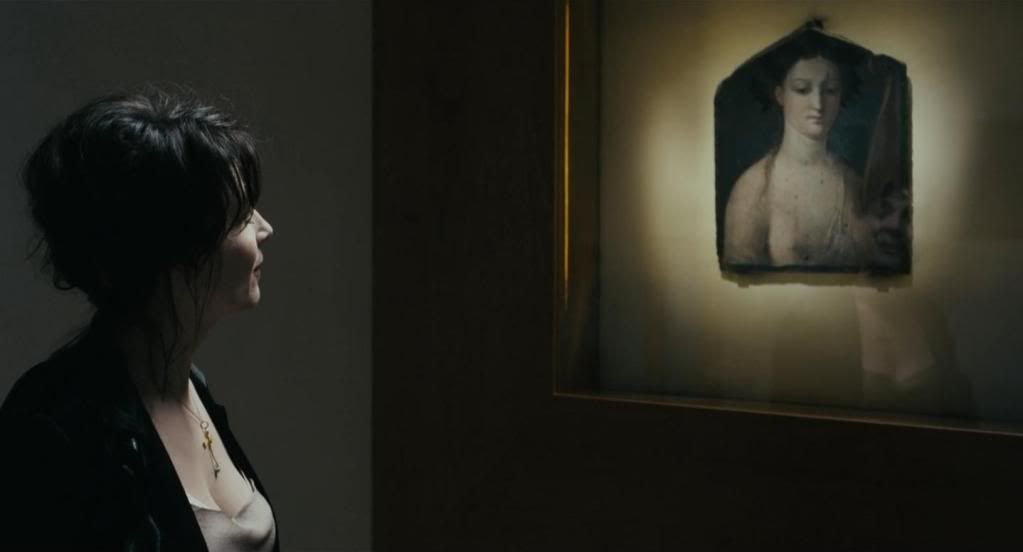
Certainly, the film is visually teeming with copies, reflections, echoes. As James and Elle begin acting like a married couple, they're walking through a town with a shrine that has particular resonance for newlyweds, so the streets are often packed with brides in wedding gowns and men in tuxedos. Weddings are everywhere, and so are mirrors, images in glass, visual copies, a further layer of reality and reflection, original and facsimile. At one point, Elle takes James to see a painting in a museum that had long been displayed as an authentic piece of ancient Roman art but was eventually revealed as a forgery. The museum chose to continue displaying it, though, claiming that the fake is as beautiful as the original; certainly, the painting had been genuinely admired for so long that it would have been a supreme hypocrisy to suddenly claim that it was without value simply because it wasn't painted when, or by whom, historians had originally thought it was. In one shot, Elle gazes up at the painting, her sensually low-cut dress echoing the bared breast of the woman in the painting, her face reflected in the glass display case like The Woman in the Window of Fritz Lang.

Lang's film — which is, after all, about an imagined, false narrative inspired by art — is just one of many cinematic references that come to mind here. Appropriately, given the obsession with originality, influence, and copies throughout Certified Copy, Kiarostami is drawing from the rich history of European art cinema. Resnais, Antonioni, Rossellini, and others reverberate through the subtext of Kiarostami's moving, ambiguous examination of marriage, art and spectatorship. In the end, it's a film about its own status as a film, its own artifice, its existence as a copy of a reality in which actors are pretending to be people who are themselves pretending. In that respect, the last shot is vitally important and extraordinarily clever: James, looking in a bathroom mirror, stares directly at the camera — seeing a reflection of himself in the audience? — and then walks out of the frame, leaving behind a view out the window at a church whose bells are chiming. The credits then begin to scroll, crucially, not across the entirety of the frame but only within the frame of the window. It's as though the bathroom has become a theater, and the window is a screen on which the world itself plays like a movie.

Thursday, April 19, 2012

The Sleeping Beauty


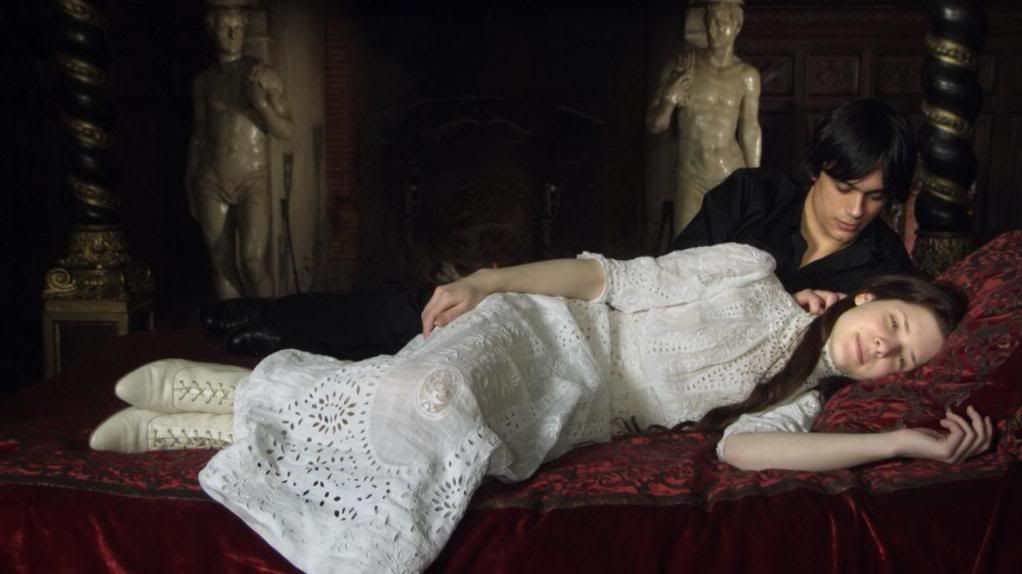
Catherine Breillat understands very well the appeal and the power of fairy tales and children's stories, their ability to reflect and create dreams and nightmares, to provide ideal images or give shape to primal fears. The Sleeping Beauty is her second film in a row, following Bluebeard, to deal with children's stories and fables, deconstructing these ancient tales and the lingering influence they have on children's ideas about the world, as well as what these stories can teach about growing up, love, sexuality and the differences between boys and girls. One senses that Breillat has found, in these sensual, magical films, the perfect form for expressing her provocative ideas about girlhood and womanhood.

The Sleeping Beauty is, if anything, even richer and stranger than its predecessor, following the little princess Anastasia (Carla Besnaïnou) into a dream world where she must stay for a hundred years, cursed by a witch to die but instead left in this in-between state by the intervention of three more benevolent witches. When she wakes up, they promise, she'll be 16 instead of 6, having passed through the troubling transition stage from girlhood to womanhood in her sleep. Like Bluebeard, the story is taken from one of Charles Perrault's folk tales, though here Breillat blends it with Hans Christian Andersen's The Snow Queen and renders it as a surrealist dream. Anastasia wanders from one strange scene to another, encountering a train station populated with mannequins, a wicked jailer covered in boils (who, strangely, forces her to bowl with skulls), and a band of pirates led by a little gypsy girl (Luna Charpentier). At one point, Anastasia is taken in by a farmer woman (Anne-Lise Kedvès) and her son Peter (Kérian Mayan), with whom she lives happily until Peter disappears. She spends the rest of her dream life chasing after him; in his absence, he has become her ideal man, her dream man who she'll always be chasing after.


For Breillat, childhood is an idyllic, pre-sexual Eden in which boys and girls can happily interact, and gender identity is fluid. Anastasia is a princess who wants to be a knight, and who reads about hermaphrodites in the dictionary as a bedtime story before going to sleep. When she stays with Peter and his mom, Peter and Anastasia are instantly happy together, rough-housing and playing, sleeping in one bed, curled up with their heads close together. It's the onset of sexual maturity that opens a gulf between them, as Peter enters puberty, symbolized by the sight of the lovely, chilly Snow Queen in a silvery gown like a wedding dress, followed by a snowflake drifting into his eye, changing his way of looking at the world. From that point on, he's cruel to Anastasia, and they now sleep in separate beds like a married couple in an old Hollywood movie, their perfect union and genderless play forever altered by the dawning of sexuality and the realization that childhood is moving towards its end.

The film's style is both magical and direct, with crisp cinematography that makes these glistening fairy tale locales seem quotidian and grounded, even when they're populated by albino princes and princesses who invite Anastasia for a tea party that's more Alice in Wonderland than Perrault. In one stunning sequence, Anastasia rides a reindeer into the arctic wilds to find an old crone who controls the winds, and the snowy landscapes stretch across the screen, the Northern Lights explosively filling the sky, with the princess a fuzzy little smear in her pink coat, lost and alone in this beautiful but deadly land. The film is richly symbolic, loaded with heavy psychosexual meanings encoded in every object, every image. When Peter shows Anastasia a queen bee, folded in his hand, he tells her that it's so weighted down that it can't move, causing Anastasia, a princess who may grow into a queen, to cry out that she doesn't ever want to be like that.


The film is all about the trauma of moving from childhood's dreams and fantasies into the much less fantastic reality of adulthood. The pivotal moment comes when Anastasia wakes up at the age of 16 (now played by Julia Artamonov) into the modern era. Before this, the film had been an anachronistic mash-up of all times and no time at all, with old-fashioned costumes side by side with more modern objects and decorations, giving the surreal dream the timeless quality of a fairy tale. When Anastasia wakes up, she's in the modern world, her dress and corset and princess' demeanor now the anachronisms in a world of cars and TV and boarding schools. And she finds waiting for her, not Peter, but his descendant Johan (David Chausse), who nevertheless bears enough resemblance to her dream man that she's instantly drawn to him.

Breillat cleverly deconstructs and subverts this "happily ever after" ending by daring to ask what comes next after the sleeping princess wakes up from her curse into the arms of the waiting prince. What comes next is disillusionment: he's too eager, she's shy and virginal, reluctant to give up her virtue so quickly to a man she's just met, while he keeps trying to get away with more and more in their playful flirting. Pushed away, he hangs out with another, more accessible girl, dressed in modern clothes, making out with her while an erotic movie plays on the TV. Meanwhile, Anastasia is reunited with the little gypsy bandit girl, now grown up (and played as a woman by Rhizlaine El Cohen), and she has an erotic encounter with her that's far more sensual and satisfying than her hesitant teenage games with Johan. When she finally does go to bed with Johan, it's painful for her — Breillat cuts to them in mid-act, with Anastasia screaming, seemingly not in pleasure — while Johan is confused and hurt to find that she doesn't want him for himself but as an echo of an ideal dream man whose image she'd had in her head since childhood.


Obviously, the fairy tales that kids learn only set them up for various forms of disappointment, creating impossible romantic ideals to which the reality can never live up. After she has sex with Johan, Anastasia finally sheds her white, lacy princess' dress and the corset that had left painful-looking pink stripes across her back, for a more modern black skirt and stockings, cutting her long hair as well. The dream is over, childhood is over, and she's shed the illusion that she's a special princess, accepting that she's just another girl, in just another complex, painful, confusing, up-and-down relationship with just another boy.

In the film's final image, Johan and Anastasia lay in bed together, their heads outside the frame, red claw marks across his bare torso and tears in her black stockings; they're hurting one another, settling into a familiar kind of damaging relationship. He asks her, "Do you love me as before?" "As before," she agrees, before adding, "but this is after." This is their happily ever after, an acceptance that childhood is over, that the dreams of youth were only dreams, that they are not special or unique, not princes and princesses but common lovers, damaged by their expectations about one another and the ways in which they've so quickly disappointed one another. The fairy tale is over, but its impact on the real waking world lingers.

Monday, August 15, 2011

Let Me In


Let Me In is Matt Reeves' remake of Tomas Alfredson's Swedish vampire movie Let the Right One In, which was itself based on John Ajvide Lindqvist's novel. Reeves' film is part of a not-so-honorable tradition of remaking foreign movies — particularly foreign horror movies, and particularly Japanese horror movies — in the English language in order to make them more palatable to American audiences. The main reason for the prominence of this trend in the last decade or so is fairly obvious, as well as regrettable: the original films, for the most part, are interesting, creepy, frightening, well-made horror fare, and they would be eagerly consumed by mass audiences if not for the fact that so much of that English-speaking mass audience, certainly in the United States, is very averse to reading subtitles. Reeves' film starts with one strike against it, then, in that its origins are so blatantly commercial, motivated not by the artistic necessity of remaking Let the Right One In a mere two years after the compelling original film, but the commercial necessity.

Reeves both lives up to those low expectations and, in some ways and more surprisingly, surpasses them. The film is almost slavishly faithful to Alfredson's film: it leaves out some of the subplots and scenes from the original, but what it includes is often copied from the Swedish film, if not in exact dialogue or exact shots then at least in close paraphrases and images that evoke the mood of the original very strongly. The relationship between the perpetually young vampire Abby (Chloe Moretz) and Owen (Kodi Smit-McPhee), the disturbed, violently simmering boy she befriends, plays out very similarly to the same relationship in Alfredson's film (where the characters were called Eli and Oskar, as in the book). What's missing is the full extent of the warped, ambiguous sexuality that wafts through the original — not surprising considering American audiences' skittishness about sex and especially the developing sexuality of children — and some of the warmth and tenderness of this vampire/human friendship. A few chopped shots aside (including the infamous closeup that explicitly called Abby's gender into question) Reeves includes most of the same scenes that Alfredson staged between Abby and Owen, but some crucial spark, some energy and intensity and mood, seems to have been lost in translation. The relationship goes through the same motions and winds up in the same place, but the strange chemistry between the leads is missing the vitality and dark humor of the original.

In another respect, however, Reeves expands upon and possibly improves the original, by subtly drawing more out of the character of the older man (Richard Jenkins) who accompanies Abby and kills for her, gathering blood for her to drink from his victims. Reeves perhaps suggests the heightened importance of this character by opening the film with him, pushing back the introduction of Owen; the young boy had the first lines of Alfredson's film, creepily intoning "squeal like a pig" as he imagined violent vengeance on the schoolboys who bully him. In Reeves' film, the killings of Abby's "father" play out very differently from the corresponding scenes in the original film. Where Alfredson made the old man seem like an incompetent killer, floundering and past his prime, the father in this film simply hits a run of bad luck that leads to his horrifying climax. Jenkins also delivers a deep, powerful performance that makes this character even more poignant: he seems weary, done, tired of a long life mostly spent killing for Abby. One of Reeves' cleverest changes is inserting a brief scene in which Owen finds an old photo of Abby with a young boy who doesn't look very different from Owen himself. It's obviously the "father," and by including this detail, Reeves makes explicit a subtext that haunted the earlier film: that Abby's friendship with Owen is the beginning of a relationship very like the one she once had with the old man. This more fully developed subtext gives special weight to the scene where the old man tells Abby to stop seeing Owen: it's not fatherly protectiveness that motivates him, but jealousy, and perhaps the hard-won knowledge that a friendship with Abby isn't a gift to the young boy who is obviously already falling in love with her.


In other respects, Reeves' film simply trims a lot from the original without adding much new material to counterbalance. Alfredson's focus on some of the characters around Abby and Owen — Owen's parents, the other inhabitants of the apartment complex — is mostly reduced to a few token scenes. That's a shame, because though Let the Right One In was also always focused on the young vampire and her new human friend, Alfredson also found time to develop other characters in surprising ways. Alfredson lingered much longer than expected with one victim of Abby's bloodlust, creating pathos and horror (and also some absurdist bleak humor) from this character's fate. The few disjointed scenes with that character that remain in Let Me In don't do justice to that tonal and emotional complexity at all. Similarly, Alfredson spent time hanging out with some of the men who lived in and around this apartment complex, listening to their casual banter and their political dialogues, many of which centered on the death penalty, an important theme in Alfredson's film. Reeves moves the time and setting of the story to 80s Reaganite New Mexico, but curiously not only drops the death penalty thread but fails to develop any political context. Reagan is purposefully evoked in a striking shot in which the president's face, on a TV, is reflected in the glass door of a hospital, but this political reference is just empty window-dressing, never mentioned again.

The development of the "father" aside, what Let Me In does well is more or less limited to effectively and faithfully repeating the central ideas of Let the Right One In: the burgeoning friendship between a vampire and a malcontent loser whose violent impulses are slowly building up. The film captures the confused emotions and simmering rage of a kid who is tormented at school and ignored at home (Reeves' decision to condense the roles of Owen's parents accomplishes something similar to the more fully fleshed out portrait of familial neglect in Alfredson's film). To a lesser extent, it captures the sexual confusion of adolescence, particularly in the scene where the sexless Abby slips into bed naked with Owen, who's obviously equal parts baffled and titillated as he asks her to "go steady."

Taken on its own merits, Let Me In is a fascinating twist on the vampire myth, exploring the vampiric condition as a metaphor for adolescent fantasies of violence and revenge. The film's snowbound atmosphere doesn't come close to matching the eerie beauty of the original, which got a lot of mileage out of the contrast between pitch-black night and the fluffy white snow on the ground, but it's still effective. If the film wasn't so closely related to its superior Swedish source, it could even be considered a very fine modern horror movie in its own right. But comparing the remake to its source is nearly unavoidable, as most of the time it follows the original film slavishly, and where it departs it's usually to simplify the subtext and peripheral plots of the original. Reeves makes some intelligent decisions in adapting Let the Right One In for English-speaking audiences, and he does a decent job of repeating some of what made the original film so memorable and powerful. What he doesn't do is establish Let Me In as its own film with its own reason for existing and its own set of concerns, which would've gone some way towards legitimizing this otherwise rote remake effort.

Monday, June 20, 2011

You Will Meet a Tall Dark Stranger


It's usually taken for granted, but it's a little amazing that Woody Allen, well over 40 years into his career as a writer-director, continues to be so prolific, to work at the fevered pace of a young man, delivering a film, almost without fail, every year. Granted, not every one of those films is any good — and there are plenty of people who will tell you (mistakenly, I believe) that most of them aren't — but Allen's inexhaustible desire to create, to tell his stories, remains impressive. In recent years, he's delivered at least one masterpiece (the melancholy, incisive Vicky Cristina Barcelona) and a string of variably successful tales about those characteristic Woody subjects: murder, infidelity, dissatisfaction, the desire to be creative and engage with culture. Last year's You Will Meet a Tall Dark Stranger — not even his most recent film, because as a I write this Midnight In Paris is in theaters and another film is already in the works — strikes me as an utterly typical Woody Allen film. It's not a great film, sometimes not even a good one, but rather an embodiment of the Woody ideal. It's what people think of when they think of his work: wry, cultured people cheating on one another in picturesquely filmed settings, eloquently expressing their disappointments. It feels, at times, like Woody by numbers, like even the director himself has internalized the popular conception of his sensibility and has turned out a film that diligently hits all the expected notes of a Woody Allen movie. For all that, the film is often emotionally compelling and, after a rather wan opening act, opens up into a film with some surprisingly intense emotions bubbling up beneath its familiar surface.

The film focuses on several troubled relationships, centering around the family of married couple Roy (Josh Brolin) and Sally (Naomi Watts). Roy's a once-successful, now struggling writer, and Sally is an assistant at an art gallery, both of them in characteristic Woody Allen professions. Sally's parents have gotten a divorce: Alfie (Anthony Hopkins) is possessed by a fear of getting old and becomes obsessed with appearing youthful and vigorous, an obsession that his wife Helena (Gemma Jones) can't share. The film follows these characters as their relationships splinter and new possibilities become apparent; this is Woody's essential subject, the follies of love and desire, intimately linked with the follies of how his characters view themselves, their ambitions and their dreams. The film's situations are familiar in every sense, all following similar romantic comedy templates: Roy becomes fascinated with the beautiful young woman, Dia (Freida Pinto), whose window faces his, Sally grows infatuated with her boss Greg (Antonio Banderas), Alfie falls for a trashy young prostitute (Lucy Punch) who he impulsively asks to marry him, and Helena begins visiting a psychic (Pauline Collins) who reassures her that her future is rosy. These various subplots are predictable, but Woody manages to extract some surprising depth from these old stereotypes.


The scenes between Naomi Watts' Sally and Antonio Banderas' Greg are the film's most emotionally compelling and indeed startling moments, largely because Woody gets such a powerful performance from Watts, who becomes the fiery emotional core of this film. At one point, Greg invites Sally to go to the opera with him, and Sally, who has been nursing increasingly strong feelings for her boss, is excited for the opportunity. There's a great shot of Sally looking obviously stirred by the music at the opera, her eyes slipping sideways to admire Greg with a slyly upturned smile on her lips, her eyes shining, moved by the music and by her attraction to her companion. It's a wonderful moment, wordlessly communicating the intense emotions she's feeling, and this shot's intensity is carried over into the duo's awkward but charming conversation in the car later, as Greg drops Sally off at her home. The romantic tension lingering between the pair is obvious, and the possibility that one or both might lean over at any moment for a kiss hangs between them, unfulfilled, as they stammer and banter.

This emotional subtext is carried over into the later moment when Sally at last hesitantly admits her feelings for Greg, while he awkwardly tries to steer the conversation away from the subject without hurting her feelings, without openly admitting that he does not reciprocate her desire. But Sally refuses to drop the subject until she's gotten some closure; she is obviously determined to follow this through to the end so she knows if what she wanted could ever have been possible. Woody inserts a closeup of Sally, her mouth straining with forced smiles, her eyes barely holding back tears, her face growing increasingly red as she realizes that she's opened up her heart while Greg has shunted her feelings aside, as gently as he could but still painfully. Woody cuts between the two to emphasize the distance between the suave, unmoved Greg, who doesn't seem to fully understand his employee's overwhelming emotions, and the frazzled, disintegrating Sally, who presses on even as she realizes that she's not getting through, that any connection she imagined only existed in her head. Sally's face is heartbreaking: there's such hope in her expression, mingled with despair and desperation and also the dawning understanding that she was wrong.


At the same time, Roy is developing a flirtatious friendship with Dia, their neighbor across the way, who he spies on from his window, watching her play guitar or strip out of her clothes to make love to her fiancé. The two begin spending afternoons together, walking in the park in scenes that recall the cinema of Woody's longtime influence Eric Rohmer, particularly The Aviator's Wife, in which an afternoon spent in a lakeside park similarly flirts with infidelity. The flowery natural beauty of these scenes, coupled with the somewhat eye-rolling romanticism of the fact that Dia always dresses in red, suggests that these scenes are more symbolic than actual. Roy speaks of Dia as his muse, his inspiration, and though he desires her strongly he hardly seems to think of her as a person. That's why it's so surprising when, late in the film, Woody suddenly confronts Roy's romanticism head-on, abruptly revealing that the character's romantic conception of this affair was not necessarily shared by the director or the film. In one scene, after Roy moves out of his home and into Dia's apartment, he looks across the way and sees Sally stripping out of her clothes into black underwear, looking sexy and desirable, just as earlier he'd watched Dia. The shot reinforces the truism that one always wants what one doesn't have, and suggests the first moment of self-awareness for Roy, the first suggestion that he was chasing after a dream and might come to regret it. It's a self-awareness he flinches away from, sadly closing the blinds on the view. In another scene, Dia is angrily and tearfully confronted by her fiancé and his family after calling the wedding off, another reminder that the romantic plot between Roy and Dia is not without its casualties, that what seems so wonderful for Roy is bitterly painful for other people.

You Will Meet a Tall Dark Stranger often seems light and cheerful, if not outright comic, so such moments of emotional catharsis are bracing and powerful when juxtaposed against the generally pleasant tone of the film. It's not often a full-on comedy, though Woody's wit does cut through in places, often wedded to the film's darker emotions. In one scene, Helena says about her new boyfriend, "He left me for another woman. A deceased one. They're often the stiffest competition." And then, as though realizing that in her grief she's accidentally told a joke, adds in the same shell-shocked monotone, "no pun intended." The joke itself is classic old-school Woody humor, somewhat corny even, but it's made funny — and also sad and true — by the way it's delivered, an offhanded acknowledgment of the accidental humor that resides in even the saddest stories, a nod to the kinship between tragedy and comedy.

In that regard, this film's navigation of those two dramatic extremes is much defter than the thematically similar Melinda and Melinda, in which Allen tried to separate the two impulses to explore their connections and disjunctions. The link between the funny and the pathetic is much more organic here, and the film knowingly climaxes with dual scenarios that hint at the murder plots of other recent Allen films, without quite heading in that direction. This isn't a great Allen film. It takes a while for the clichés of the film's various plots to resolve into something deeper, and as a result the early stretches of the film are often unsatisfying and awkward. The voiceover, a convention that Woody has increasingly embraced, seems especially tacked on here, and the pat way in which the narration frames the film with references to Shakespeare is just silly. But despite these flaws the film finds Woody investing these overly familiar situations with wit and emotional life, with sparks of energy that go far beyond the basic templates that he is drawing from. Even Alfie's story — by far the most clichéd with its male crisis jokes about Viagra and dumb blondes — climaxes with a moment of surprising emotion in which the hapless Alfie suddenly channels some of Hopkins' sinister intensity, projecting the deadly-serious emotions of a man who's been treated like a punchline for too long. Such moments of emotional revelation, in which Woody unexpectedly overturns and subverts the clichés of the romantic templates that drive the film, make You Will Meet a Tall Dark Stranger much more than it initially seems to be. In a way, that's the theme Woody is dealing with here: life may follow familiar patterns, but just because a story is familiar doesn't mean that it's not real and painful and exciting and full of surprises for those actually living it.

Tuesday, February 8, 2011

Inception


Christopher Nolan's Inception is a purposefully twisty film, a film that prides itself on its elaborate structure — a structure that exists on the meta-level of the narrative as well as constantly asserting itself within the film itself. Mirroring the film's plot about sci-fi thieves who enter people's dreams to steal (or plant) crucial bits of information, Nolan weaves through one layer of dreams/narrative after another, constantly sending his characters leaping from one false reality to another, and thrusting the audience through similarly discombobulating shifts. And yet, for all these dreams and dreams within dreams, and maybe dreams within dreams within dreams, the film telegraphs its supposedly most important revelations well ahead of time, and in the end all of its intricate structures and flashy surfaces seem designed to disguise the rather conventional story being told at its center.

Early on, after the dizzying, action-packed opening sequence, it becomes clear that Inception is at heart a heist picture. The ace dream "extractor" Cobb (Leonardo DiCaprio) and his partner Arthur (Joseph Gordon-Levitt) are hired to do a seemingly impossible job for the businessman Saito (Ken Watanabe): to plant an idea in the head of Saito's corporate rival, Fischer (Cillian Murphy). To do so, of course, Cobb and Arthur will need to gather a team, which triggers the obligatory extended sequence in which the pair goes around gathering together their fellow conspirators, including the "architect" Ariadne (Ellen Page), who will build the dreams, and the forger Eames (Tom Hardy), who will pose in other identities within the dreams. Once this team is assembled, the dream extractors enter the mind of Fischer, enacting an elaborate plan that involves putting the businessman to "sleep" multiple times, moving from one dream to another within his sleeping mind, constructing multiple layers of reality where the various characters are sleeping, dreaming within a dream, all while their "real" bodies are sleeping on a 747 bound for Los Angeles.

The bulk of the film is taken up by this complex web of dreams within dreams, and Nolan stages it all as an unrelenting action race against time. You see, Fischer had had training to protect against extraction, which means that his subconscious is "militarized," and that means that people are constantly shooting at the heroes. And if they die in the dream, they'll go into limbo, even though under normal circumstances they'd just wake up when "killed" in a dream. And... well, there's a lot more, but that's a big part of the problem. The film is awash in complex concepts and reversals, in intricate rules and exceptions to those rules. Mostly, though, it all just plays out as a big, thudding, deafening action extravaganza, like the wildest physics-defying action sequences from The Matrix stretched out to feature-length (kind of like The Matrix's sequels, come to think of it). When the extractors arrive in a dream layer that is, for some inexplicable reason, set in a snowy wilderness with a heavily defended fortress at the center, it seems less like a movie than a video game, maybe a level of a Call of Duty shoot-em-up. That's what the various dream layers start to feel like after a while, like levels in a game — and when you get right down to it, while it's lots of fun to play a video game, no one really likes watching someone else play a video game. Nolan is playing a very big, very expensive, very complicated video game here, and it's exhausting to watch him play it through to the last level.


All of Nolan's blaring action set pieces and dream levels would perhaps be more bearable if one sensed there was something of substance to be found by navigating this maze. But, much as in The Prestige, Nolan's last attempt at a "personal" interlude in between Batman films, all of the film's narrative shenanigans don't really add up to anything in the end. It seems like a superficial attempt to dazzle with complexity for its own sake, despite a conceit that's tailor-made for such narrative pyrotechnics. Comparing Inception or The Prestige to Nolan's breakthrough second film, Memento, it's obvious that what's really missing is a deeper emotional connection to the film's structural gimmicks. The reverse-time structure of Memento, so often wrongly derided as a shallow gimmick, was actually a clever and substantial way of reflecting not only the character's short-term memory loss, but the resulting disconnect between his morality, his actions, and his reasons for those actions. Cause and effect were reversed and disassociated for that film's protagonist, and the film's structure reflected that.

Inception is lacking in that kind of depth. Nolan's love of structural puzzles seems to have consumed him, to the extent that the gimmicks now drive the film, rather than allowing the narrative structure to be defined by the story's themes and characters. Cobb is driven by his relationship with his dead wife, Mal (Marion Cotillard), and their children, who he's been estranged from. His fixation on Mal and his desperation to get back to his children are his major motivating forces and, more or less, his only character traits. But there's no depth to these emotional foundations. The film slowly metes out pieces of information about Cobb's past with Mal, using this relationship as material for "twists" that are so broadly telegraphed they're never even the least bit surprising. What should be the film's emotional core winds up being used for shallow suspense, and it fails even at that. Mal is never fleshed out enough as a character to make her anything more than a plot device, despite Cotillard's best efforts to make the character interesting. That's typical of the film as a whole: the performances are fine and even effective, but the characters are largely non-entities, hurtling through the film's claptrap constructions without pausing to take a break. The characterization is so thin that it's refreshing when the actors do even something small to enliven their generally functional parts, like Ariadne's little satisfied smirk after Arthur uses a tired movie trick to steal a kiss. Any little scrap of emotion, anything that feels the least bit real, is to be cherished in a movie this empty.

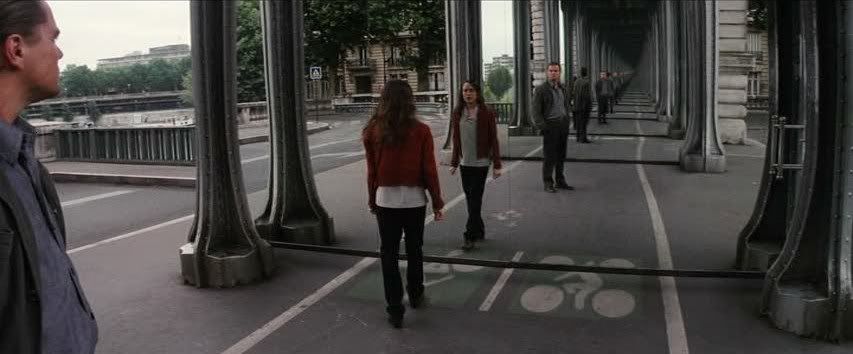
Within this oft-dazzling but ultimately insubstantial film, there are powerful moments, most of them early on, when the film's grandiose dream imagery still feels relatively fresh. Too often, Nolan signifies the unlimited imaginative potential of dreams by, well, blowing lots of things up, but there's no denying that certain sequences are viscerally thrilling, like the scene where Ariadne first explores the dream world, changing its architecture around her, creating steps to walk up and using mirrors to craft whole new landscapes. Nolan doesn't move much beyond this visually, though. His film's vision of dreams is surprisingly staid and unimaginative, rooted more in other movies — the weightless kickboxing cribbed from The Matrix, the crumbling dystopian cities of countless sci-fi movies, the frenetic action movie chase scenes of James Bond or Jason Bourne — than in a real feel for dream logic or the surreal imagery of our minds. For a film about dreaming and reality, Nolan is dreaming surprisingly small, content to deliver predictable heist movie beats dressed up in a flashy surface that he presumably hopes will be mistaken for the substance missing from the film.

Monday, January 31, 2011

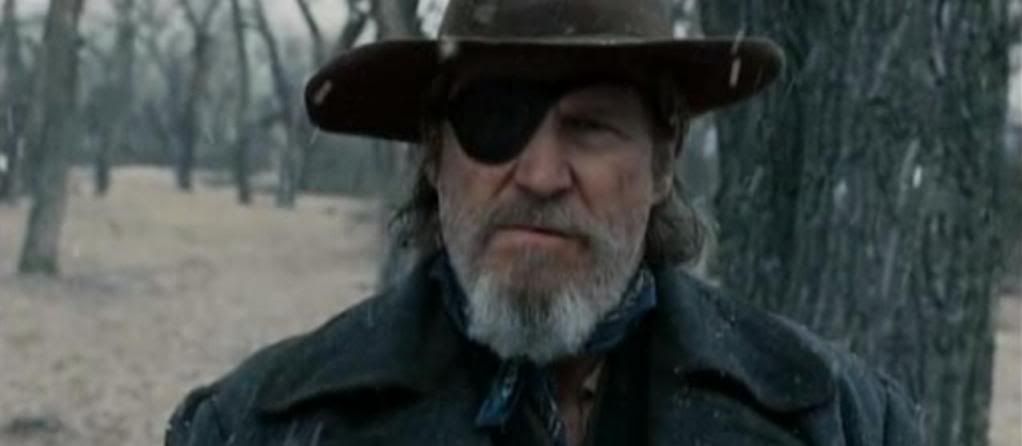
The Conversations #23: True Grit


The latest installment of The Conversations has now been posted at The House Next Door. This time around, Jason Bellamy and I discuss the Coen brothers' new adaptation of Charles Portis' True Grit, and compare their take on the material to Henry Hathaway's iconic John Wayne-starring version of the same story. We talk violence, revenge, Wayne, Westerns, the place of this film in the Coens' oeuvre, and much more. Join us at the House and be sure to comment to continue the conversation.

Continue reading at The House Next Door

Friday, January 28, 2011

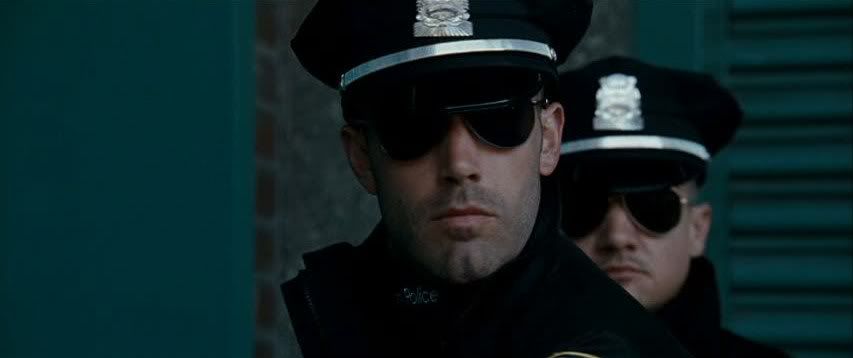
The Town


Ben Affleck really likes Michael Mann's Heat. Like, really, really loves it. Like, it's his favorite movie ever. How do I know this? Because Affleck's second directorial feature, The Town, follows the template of Heat so closely, is so deeply indebted to its example in every way, that it might as well be a remake. Affleck plays Doug MacRay, the brains behind a gang of Boston bank robbers who run briskly paced jobs that could be mistaken for professional robberies if you ignore all the idiotic things that the script has these supposed crack thieves do over the course of the film. Heat was driven by the grudging professional respect and mutual intelligence of Robert De Niro's ace thief and Al Pacino's dogged police detective, so Affleck tries to develop a similar rivalry/bond between MacRay and the FBI agent trying to catch him, Adam Frawley (Jon Hamm). In some ways this is doomed to failure — Affleck and Hamm is simply not De Niro and Pacino, and there's nothing anyone can do about that — but the problems run deeper than that. Affleck can't develop the same epic but intimate scale that Mann so effortlessly infuses into his films, where the canvas might be sprawling but the characters within it are sharply defined. The characters of The Town lack that definition, and the relationships between them are consequently shallow. When Frawley half-admiringly calls his adversaries "the not-fucking-around crew" — after an armored car robbery that went so spectacularly, laughably wrong that the crooks ultimately escape only because the script says they must — it doesn't feel earned, it doesn't feel organic.

That's the case with a lot of things here. The Town isn't as deep or as smart as it clearly thinks it is, but it does have its charms. Affleck has a good feel for action, and his robbery scenes have energy and vigor to spare. Taken as a lightweight heist flick — its obvious cribbing from Heat aside — it's at least mildly enjoyable, and does a good job of conveying the hopeless cycle of these poor Boston guys who seem to have crime passed down to them in their blood from their equally lowlife fathers. As the Irish gangster Fergie (Pete Postlethwaite) tells MacRay's gang at one point, he looks at them and sees their fathers; he's an old guy who's been in this racket long enough to see gangs of sons replace their fathers. That's probably the film's most compelling subtext, this emphasis on the continuity of crime from one generation to the next within this cramped part of Boston that no one ever really gets out of.

Less compelling is the budding romance between MacRay and the bank manager, Claire (Rebecca Hall), who his gang had briefly taken hostage during the robbery that opens the film. Affleck seems to be going for the unlikely but surprisingly tender romance between De Niro and Amy Brenneman in Heat, but Mann developed those characters so that they were disarmingly right together. The romance in The Town just consistently feels unlikely and silly, despite a warm and nuanced performance from Hall as her character deals with the stress of the bank robbery's fallout. The drama is, in general, rather generic, just stock bits of childhood trauma that provide the characters an opportunity for ponderous soul-baring speeches. MacRay's mother left him when he was a kid, and Claire had a brother who died when she was young, though this bit of information then becomes merely a source for the clever catch phrase that Claire uses to alert MacRay to the feds' presence in her apartment when Affleck decides to rip off the farewell scene between Val Kilmer and Ashley Judd in, you guessed it, Heat.


That's not all he rips off. The film frequently feels like a collection of scenes and scenarios from Mann's heist classic. The final robbery, at Boston's Fenway Park, degenerates into a street battle between cops and crooks, with assault rifles blaring. In the midst of this chaos, the final run of MacRay's best friend James (Jeremy Renner, giving an edgy, slightly sinister performance that deepens the character far more than the script does) feels more than a little like a recreation of the final moments of Tom Sizemore's character in Heat. In the film's final act, MacRay even develops a thirst for vengeance that drives him much as De Niro's Neil McCauley in Heat.

But this is precisely where the biggest difference between The Town and its source arises. It's obvious, from his film's denouement, that Affleck is more of a romantic than Mann. Virtually no one could watch the final act of Heat without desperately hoping that Neil makes it out alive, that's he's able to evade capture and find his private paradise with the woman he loves, away from the life of violence and crime he'd made for himself. And virtually no one could watch the final act of Heat without knowing that Neil is doomed anyway, that his mythical "one last gig" will not be his last because he's gone into hiding on some tropical island. Neil is such a compelling character, as defined by Mann and De Niro, that one always wants to see him make it, even knowing he won't, and even despite everything's he done in his life. Affleck obviously watches Heat with that same yearning for Neil's success, and this is doubtless why he decided to give his own film a kind of happy ending for his own character — as though he could vicariously live out the escape and rebirth denied to Neil. Neil's desire for vengeance undid him, but MacRay is able to get his vengeance, he's able to get his escape, he's able to get his redemption by using his stolen money for good, he's even implicitly able to get his girl, who may come join him in his exile someday. Affleck is ducking away from darkness and complexity, delivering a would-be heartwarming ending in which the longtime crook redeems himself and gets away clean. It's singularly unsatisfying, and not only because of the cheesy sunset shot of a bearded MacRay looking out over a lake from his remote cabin.

What's obvious is that Affleck wanted to remake Heat without dealing with the complicated morality or deep, contradictory characters of Mann's film. The Town still has its moments, like the way James takes a sip of soda from a discarded fast food drink before making his suicidal final run at the cops: the kind of small, surprising, humanizing detail that is sorely needed in this film. The performances are largely solid, particularly Renner's James, who has an at times creepy bond with his childhood friend, and Postlethwaite as the kind of sinister, subtly nasty hood who might have fit well in one of Guy Ritchie's first couple of films. The only real exception is Blake Lively, as James' sister Krista, delivering a mumbling, over-the-top performance of such spectacular awfulness that her big dramatic moments induce only giggles. The problem with the film is not the cast, however, but the generic unoriginality of its script and the lack of anything substantial or un-borrowed to flesh out these clichés.

Monday, January 17, 2011

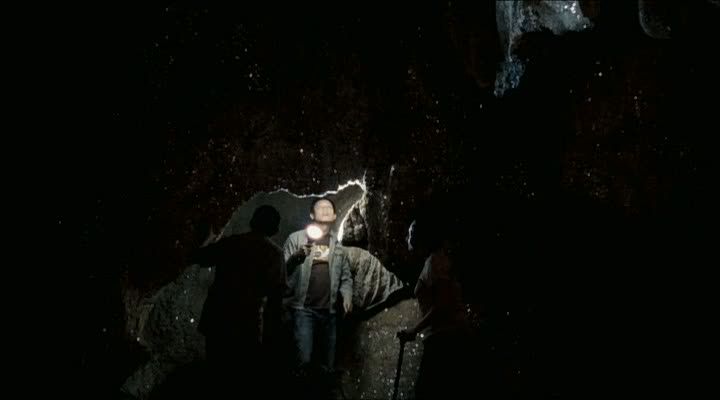
Uncle Boonmee Who Can Recall His Past Lives


Apichatpong Weerasethakul's latest feature, Uncle Boonmee Who Can Recall His Past Lives, is a ghost story told with the calm and patience of a prosaic tale of country living. The film concerns the final days of the titular protagonist, Boonmee (Thanapat Saisaymar), an old farmer suffering from a kidney disease. He's visited by his sister-in-law Jen (Jenjira Pongpas) and her son Tong (Sakda Kaewbuadee), and in his last days Boonmee's remote farm is haunted by ghosts of his own past, as well as visions of alternate lives both past and future. The film moves at the tranquil, languid pace of lazy afternoons with nothing to do, and this quiet grace allows the frequently outrageous and bizarre elements of the story to blend seamlessly into reality, to appear as natural as the background hum of insects or the gentle murmur of the wind.

The film is certainly awash in surreal elements, presented with that deadpan nonchalance that characterizes much of Weerasethakul's work. Boonmee is visited by both his dead wife, Jen's sister Huay (Natthakarn Aphaiwong), and their son Boongsong (Jeerasak Kulhong), the latter of whom reappears as an apeman, having long ago wandered off into the jungle to commune with the mysterious "monkey ghosts" that inhabit the dense forests surrounding Boonmee's home. Huay appears without fanfare, simply fading into existence in an empty seat while the family is eating dinner. At first she's a kind of cinematic ghost within the frame, a hovering reflection where there is no mirror, a faint photographic afterimage layered within the film stock. But as she fades in, she becomes tactile and physical, as real-looking as the non-ghost people sitting around her, and the scene loses its subtle air of unreality to become simply a prosaic family dinner again, a group of people sitting around talking and reminiscing. It's a subtle point: within the cinema, everyone is a ghost, an image, and no figure is any more "real" than any other. Weerasethakul allows the film's ghosts to be as physical, as concrete, as the living people, just as he allows past, present and future to coexist without separation.


The same slow adjustment to strangeness occurs with Boonsong arrives. The "monkey ghosts," from a distance, are haunting and creepy figures, pure black shadows with glowing red eyes set into their faces. Weerasethakul periodically inserts a shot of these creatures in the jungle, these inscrutable figures with piercing eyes, eerie ghosts or demons who never reveal more of themselves than this shadowy outline. Boonsong appears the same way, walking up the stairs towards the family, his red eyes the only visible sign of him, the rest of his body blending so totally into the darkness that the twin red orbs appear to be floating in midair, disconnected from any concrete figure. Once he steps into the light, however, his creepiness is diffused, and he's revealed as simply a man in somewhat ungainly ape makeup. As he talks with his father, describing the circumstances of his long-ago disappearance, it is both poignant and silly and strangely ordinary: the emotions of the reunion, a son revisiting his father after many years of absence, cut through the goofiness of the ape outfit.

Weerasethakul has a wry sense of humor in moments like this. The first thing Jen says, upon realizing who the apeman is, is to ask, "why did you grow your hair out?" It's a singularly strange and funny thing to say to a guy who's somehow been transformed into a talking gorilla, and it reflects just how accepted the surreal and the supernatural are in this film. Later in the dinner, when Boonmee's worker Jaai (Samud Kugasang) arrives, he looks in wonderment at the monkey and the dead woman sitting at the table, but then he breathlessly murmurs, "I feel like the strange one here." In Weerasethakul's casual presentation of the supernatural and the mythical, it's prosaic reality that begins to feel strange. And after all, Jaai is the only outsider here, the only one who's not a member of the family. His distinction from the family is ultimately more important than the separation between the dead and the living, or between the human and the once-human.


Jaai is also an outsider as a Laotian immigrant, possibly an illegal who'd entered the country without authorization. The film is set in a border region between Thailand and Laos, and towards the beginning of the film Boonmee and Jen talk about illegal immigrants. Jen evinces prejudice against the Laotian workers, saying that they're "smelly" and that they sometimes rob and kill their employers. It's the same kind of dynamic that seems to develop anywhere that poor foreign laborers enter a more affluent neighboring region for work: they're needed for the work they do, but also mistrusted and feared, thought of as inferior and filthy, looked down upon by those who rely upon them. Politics drift gently through Weerasethakul's film, never quite becoming the focus but lightly tugging at the corners of consciousness. This examination of the nature of illegal immigration is later expanded when Jen has a conversation with Jaai, in which he reveals that he is soon leaving, heading back home to marry a girl who he'd been courting from afar. He's maintained his connection to his native country, and he knows that even if Boonmee is okay to him — though it's implied that the workers aren't paid especially well — that this isn't really his home.

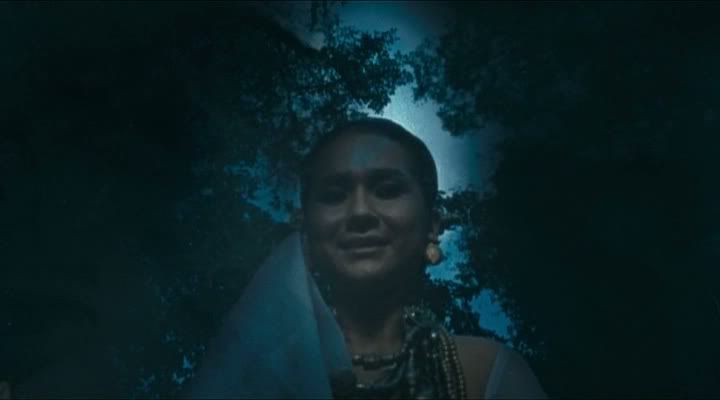
Jaai's lower-class position is subtly mirrored in the later interpolation of the story of a princess and her servant. This dreamlike sequence feels like a folk tale or myth subtly grafted into the film, perhaps as a visualization of one of Boonmee's past lives. The servant and the princess fall in love, and Weerasethakul gracefully captures the forbidden tenderness between them in a scene where a group of servants bear the princess' carriage through the jungle on their shoulders. The princess, encased in gossamer layers of gauzy fabric, the lower half of her face hidden beneath a veil, reaches out of her carriage to touch the hair and bicep of the closest servant, who turns to her and folds her hand into his own free hand as he continues to haul her on his shoulder. This simple moment of physical contact, stolen secretly, feels as powerful as a kiss or an embrace. Later, the aging princess doesn't believe that the servant wants her anymore now that her youthful beauty has faded, and she sends him away by the side of a small lake where she sees her younger self reflected in the water. Then, in another of Weerasethakul's bizarre touches, she's confronted by a talking catfish who praises her beauty and eventually flaps between her legs as she wades into the water, the fish bringing her to orgasm as she drifts towards a waterfall.

This whole sequence has the feel of an erotic folk tale, unreal and ghostly. The princess and her servant are both caked in blue paint that makes them glow eerily in the moonlight. Weerasethakul, as is his habit, never explicitly connects this tale to the rest of the film, but its implications are obvious. If it's a past life of Boonmee, we're meant to wonder what part he plays in this drama: is he the princess or the servant? Or even the catfish, since the film's opening scene seems to imply that one of his past lives was as a cow escaping from its owners and wandering off into the jungle. The themes of aging and loss reverberate throughout the film, as Boonmee thinks back on his life, regretting what he's lost and what he's done, lamenting his illness and weakness as compared to his youthful vibrancy. The princess, looking into the lake, sees herself as a younger woman and wishes she still looked like that — but then she pushes her lover away, accusing him of fantasizing about her younger self. She speaks of the woman in the reflection as though she was another person altogether, as though she wasn't simply an earlier image of herself, frozen in time at a particular moment. It's as though she's disconnected from the past, disassociated from her own memories. Maybe that's why photographs, mementos of the past, are so important, why at Boonmee's familial reunion with his wife and son, he pulls out photo albums to look at with them, poring over these images of particular moments of time from the past. When we look at photos, we remember ourselves in earlier times as though catching glimpses of someone else's story, some younger person we only vaguely remember being. It's as though our "past lives" are just earlier moments, earlier ages, from the same long life.


There is a political component to memory here, as well. One of Boonmee's regrets is his time spent as a soldier, violently suppressing communists for the government. He says that he believes his illness is the payback of karma for all the men he's killed. Jen shrugs off such concerns, saying that he was only serving his nation, but she does seem proud of her father, who had apparently resisted the violence to some extent. He'd been sent into the woods to hunt people, she says, but instead he hunted animals, communing with nature and avoiding the horrors of killing. The film is subtly haunted by this violent, military past, a mostly unspoken past of bloodshed and repression.

Towards the end of the film, Boonmee describes a dream or a future vision, his words accompanied by strange still images of soldiers capturing and leashing the monkey ghosts, and citizens apparently rioting angrily, throwing rocks. (At the soldiers or the apes?) Boonmee's vision describes an authoritarian future in which the past can be erased by the government, in which those who maintain a connection to the past are hunted and captured, then made to disappear. It's an obvious metaphor for the governmental whitewashing of various tragedies and atrocities: whole cultures and groups, like the Laotians, like the monkey ghosts who may represent primitive ethnicities or cultures, can be made to disappear by the inevitable onslaught of progress and modernity. That's why the film is set in a tranquil, largely untouched rural area, surrounded by dense jungles, a last bastion of connections to the past, to rural living and agrarianism. In the film's final scenes, the characters return to the city and are surrounded on every side by signs of modernity: television sets and air conditioning, rock music karaoke, neon lights that brighten not only urban restaurants but sacred temples. Weerasethakul cleverly shoots a funeral scene from three angles: first head-on, looking at the mourners, then from behind them, looking at the altar with its banners and candles, and then, jarringly, in a wide shot from the side, revealing the previously unseen gaudy tower of neon lights that fills up the side of the temple, next to the rows of mourners. This shot disrupts the somber, spiritual tone of the funeral, introducing the disjunctions of modernity, in which the cheap and the superficial rest side by side with the serious.


Weerasethakul further examines the changes of modernization in the scenes of Tong as a monk towards the end of the film. Tong seems too restless for the monk's life, too in love with modern conveniences and appliances. But such things are infiltrating the supposed calm of the monastery as well: he describes how many of the monks have stereos and computers to send e-mails, and wishes that he had such things, too. He seems thoroughly disconnected from a life of spirituality and stoicism, and one wonders what ever made him think to be a monk. It feels like Weerasethakul's subtle lament for a culture that has perhaps lost touch with such otherworldly, mystical things. The film is partly about the increasing emphasis on the worldly and the material, and in this context Weerasethakul's emphasis on reincarnation, ghosts, rural legends and romantic folk tales is a radical assertion of the resistance of these traditions against encroaching modernity.

Uncle Boonmee Who Can Recall His Past Lives is the culmination of Weerasethakul's "Primitive" project, which also included a pair of short films dealing with similar themes of memory, nostalgia, history and loss in this particular border region of Thailand. As the capping work of this project, this feature is one of Weerasethakul's richest films, weaving together the political, the spiritual, the fantastic and the deeply personal into a mysterious, moving, often funny account of facing mortality and confronting the sometimes uncomfortable truths of history. As such, the film looks both forward into the future and back into the past, and finds death in both directions, but even so it is not a bleak or dark work. It is instead warm and beautiful, evocative and sensual, flowing with the rhythms of daily life even as it examines the extraordinary and the shocking in both the real, violent history of the world and in the magical realms of myth, art and fantasy.

Wednesday, January 5, 2011

Film Socialisme (take 2)


Take 2, because take 1 was not enough. Because this latest film of Jean-Luc Godard defies interpretation at every step. Because Godard released Film Socialism with "Navajo English" subtitles in the English-speaking world, defying Americans to glean some meaning from the minimal, fragmented translations that reduce this film's at times complex texts to disconnected strings of verbs and nouns, at times run together into compound words. Not that seeing the film with more complete translations in the subtitles completes the picture: there are still gaps, still confusions, still whole sections where that signature Godard logic is fully comprehensible perhaps only to the filmmaker himself. The film, grandiosely titled as the document of (or monument to) an entire political philosophy, is a summation of Godard's relationship to commerce, quotation, politics and nationalism. As such, it can only be as gnomic and digressive as Godard's whole career has been. The document of a journey now lasting over 50 years, the journey of a filmmaker who's always been interested in questions of art, commerce, political action and inaction, history with its repetitions and echoes, and of course his own role as an artist in dealing with these subjects, and our role as the audience in watching him deal with them, trying to follow him. That's what the film is, a game of "follow me," with the implied dare being "if you can."

This intellectual gamesmanship is bracing and enthralling, even when the film remains baffling and unapproachable despite multiple viewings and multiple attempts to get closer to it. At one point, one of the characters, a young woman trying to trace the various losses of socialism like a detective of history, suggests that not everything is comparable (and thus comprehensible?), that sometimes "the incomparable can only be compared to the incomparable," a paradox that Godard applies to the machinations of history, the march from Hitler and Stalin to the current global capitalist status quo, where such flashy dictators have been replaced by the dominance of gold and money. That's why, perhaps, this woman is trying to discover the truth behind the various robberies that define the past: money stolen from Spain, from Palestine, by the West and by the supposed representatives of Communism alike. The gold funneled out of national banks by businessmen and capitalists: this, it is implied, is the foundation for the modern order, for the opulence of the cruise ship and the culture that revels in such luxuries.


Photographs are important in this film, as Godard examines the relationship between reality and the document of reality. A discourse about the imperialist history of the West's involvement in Palestine ends on the revelation of "the first photo of the Bay of Haifa," which segues into an image of the cruise ship photographer snapping pictures of partying tourists, then an image of an Arab woman looking at a photo, presumably the already mentioned imperialists' document of the West's arrival in the Middle East. The implication is that a photo is not just a document, not just a representation of what is seen. There is a story behind each photo. Just as a photo of a cruise ship passenger tells a story about luxury and privilege, a photo of a Middle Eastern location, from the vantage point of arriving imperialists, tells a story about a history of conquest and exploitation. That's why so many shots in this film show people using cameras, taking photos, documenting their surroundings and documenting, in the process and perhaps unconsciously, their relationship to those surroundings. The importance of the camera is asserted again in the film's second half with the presence of the TV journalists, whose cameras are never present during the intimate, private interior moments where the family discusses their ideas and their emotions. The TV cameras are only present outside the house, and mostly glimpse people rushing back and forth, trying to avoid the camera's gaze. Only Godard's camera, which exists outside the diegesis, can capture the more private moments that really count.

The second segment is Godard's return to the territory of his 1975 film Numéro deux, an examination of the political foundations of the family, dealing with the question of how ideas are passed from one generation to the next. The parents try to make a connection, to forge a mutual understanding, but they frequently falter, struggling to pass on their understanding of a world they don't really understand themselves. This is a near-constant undercurrent in Film Socialisme, this struggle to make sense of history and the present, which is the current endpoint of history, the situation that everything before had led towards and created. Politics and family life interweave, as the outside world unavoidably intrudes upon the domestic status quo, influencing the relationships that form between parents and their children, influencing business and daily life alike.


In the first scenes of this segment, first the family's father and then the mother are questioned from offscreen by their children, an interview technique that references Godard's frequent use of such dialogues dating back to Masculin féminin. In these unbalanced conversations, the children want to understand, while the parents just want to be loved and appreciated. Godard spaces out these dialogues amidst the quiet stasis of daily living. The pacing of these pastoral scenes of home life is exquisitely slow and meditative. Godard holds shots for a long time, watching as these people brush their teeth, or as the daughter rests her head on her father's shoulder in the dark, or the mother washes the dishes. There's a casual domesticity to such moments, and Godard purposefully infuses political dialogue and considerations of history and the image into this context. He's suggesting that such concerns are not — or should not be — separate from daily life or daily concerns. There is no disconnect between the home life and the political life, as the journalists hang around the family's home trying to create a political documentary, filming these domestic moments while shouting out questions that never get answered.


The film is, like many of Godard's films, about culture, though not in the obvious way of Passion, where he posed his characters like figures from classic paintings, nor of King Lear, where the search for Shakespeare provided the foundation for all manner of ruminations on culture and art and meaning. The young blonde son of the film's second segment is an avatar of culture, recreating the paintings of Renoir, moving with the rhythms of classical music and dreaming jazz. Godard's relationship to art has always been complex; he both loves beauty and is suspicious of it. He seems to be suggesting that art, rather than providing a commentary on reality and a way of expressing ideas about the world, has become an escape, a refuge from reality. A voiceover says, "We have only books to put into books. But what if we have to put reality into books?" Art feeds into art, creating a cultural conversation that is abstracted from the real world, from the experience of life as it is lived. That is why Godard subtly shifts the emphasis onto domestic routine, onto the peripheral tasks of the cruise ship's maids and waitresses as they do their work, onto brief scenes of Arab women talking and doing daily work.

In the final section of the film, culture becomes both a document and a warning, as Godard tries to develop an alternate understanding of art as essential, as intimately connected to life as it is lived. As Godard visits several European and Middle Eastern locales in turn, he finds the lessons of history in culture, and particularly the cycle of war and violence that has defined both world history and the depictions of it in art. The constant warring of Greek mythology and Greek tragedy, the emphasis on mortality in Egyptian art, the endurance of the Odessa Steps as a site of dramatized bloodshed: all of these markers are for Godard signs of the continuity between current situations and the grand tragedies of the past.

Monday, January 3, 2011

Film Socialisme (take 1)


Take 1, because Film Socialisme is not a film that offers up its ideas easily, because Jean-Luc Godard, in his latest film and first feature since 2004's Notre musique, is typically opaque and elusive. Take 1, also, because Godard, trickster that he is, released this latest opus to the English-speaking world in a way deliberately designed to make it even more difficult for those who don't speak the film's many languages. The film's dialogue and monologues are in French, Russian, German, Arabic, and other languages, but only an occasional isolated phrase of English. And Godard's chosen subtitles are in what the director has playfully dubbed "Navajo English," minimalist strings of disconnected words, not so much translating the dialogue as providing snippets of meaning, hints at the full meaning of what's being said. The subtitles are less translations than messages to the audience, enigmatic epitaphs that translate not speech but the deeper subtexts of Godard's cinema. The subtitles are a kind of passive-aggressive joke on American audiences, because America and its influence is the film's subtext — for the most part, Godard avoids explicitly mentioning America so assiduously that it becomes the unspoken ghost within the film, the driving force for everything that happens, the hidden target of so many of the film's satirical jabs.

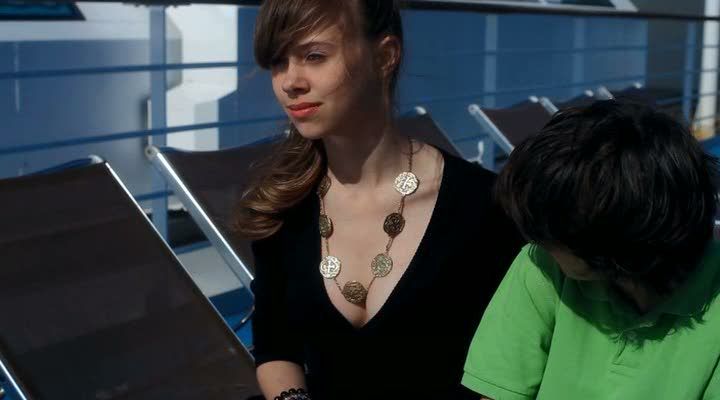
And what is this but a satire? A satire of America, of capitalism, and also of the whole idea of cinematic storytelling. The film is divided into three segments. The first is set on a cruise ship, visiting various locales that have resonance to Godard — Barcelona, Naples, Odessa, Hellas ("Hell As," and also hélas, as in "alas," as in Godard's Hélas pour moi), Egypt, Palestine ("Access Denied," the onscreen text simply reads at this last port of call) — and never venturing beyond the superficial surfaces of anything. The images are glossy and pristine, bright and beautiful, parodies of cinematic splendor that are both jaw-droppingly sublime and yet somehow empty, suggesting how little beauty counts for amidst all this silly opulence. The film is obsessed with gold, with money. The cruise passengers play slots, their mechanically pumping arms highlighted against a gorgeous seascape. A Christian mass is held in a dining room with a bar nearby and a crystal ball rotating overhead, projecting fragmented mirror images of the ceremony. Snatches of conversation, partially translated or not, are concerned with business deals, with history (Hitler, Stalin, Communism, wars civil or otherwise), with seeming plots and spy maneuvers.

This baffling, elliptical verbal chatter is juxtaposed against the images of the cruise ship's conspicuous consumption: dance clubs where the music is distorted into a noisy clamor, passengers watching workout videos and cinematic images of Arabs interchangeably, people lounging around, eating, staring out at the sea. What better place than a cruise ship for Godard to document the victory of capitalism and the death of socialism: it is a place where capitalism's virtue is assumed, where every image, every setting demonstrates the capitalist's ascendancy. To the extent that there are distinguishable characters in this section of the film, they are symbols and metaphors rather than actual individuals. So Godard pays special attention to the glowing glamor of this setting, but does so in ways that call attention to power relations and the subtexts of the capitalist system as it's incarnated here. One shot from early in the film shows a couple of passengers posing for a photo on a typically glitzy staircase, surrounded by bright lights. But the image is out-of-focus; only the photographer in the foreground, presumably a cruise ship employee, is in focus, while the rest of the image is deliberately blurred and indistinct, an abstract image of privilege and success rather than a concrete portrait of two particular people. The composition calls attention to the worker taking the picture rather than the photo's ostensible subjects.


The film's second section shifts to a rural setting and focuses more concretely on a single family. The fragmentary pacing and flashy aesthetics of the cruise ship segment give way to a slower, more patient pace and an emphasis on domesticity and routine. This family, the Martins, owns a gas station and is apparently involved in an important election. They are dogged by a pair of journalists with a movie camera, who hover around the gas station accosting anyone who walks by, trying to get interviews and images. The fragmentary dialogue of the film's first part is replaced by lengthier dialogues, which makes the incomplete "Navajo" translation more of an issue: during the cruise ship passage, the Navajo subtitles mirrored the jumpy editing and the collaging of hi-definition digital images with grainy video footage. Here, the subtitles really do feel like out-of-context fragments ripped out of a larger whole, and it becomes even more apparent that Godard intends for language-deficient Americans to understand only incompletely, to be denied the full meaning of the dialogues.

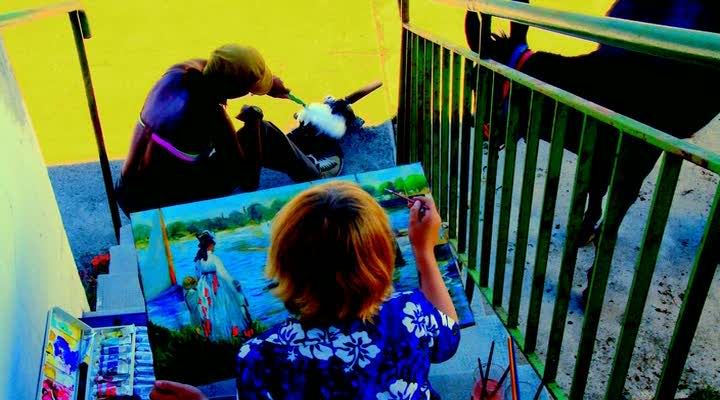
But this confrontational pose is balanced by moments of humor and playfulness, particularly in the form of the Martins' young blonde son, a sprite who incarnates Godard's still-youthful sense of humor. This boy, dressed in a red CCCP shirt decorated with the Soviet hammer and sickle, conducts the classical music of the soundtrack, wildly swinging a lead pipe through the air in response to the music. Later, in his sleep, the movements of his mouth and the twitch of his fingers respond to — or perhaps produce — the plucking bass of a jazz tune. This boy chases off the TV reporters with his pipe, swinging it like a sword, playing pirate. He feigns blindness and runs his hands along his mother's body, creating an image of her in his mind with his fingers. He paints a Renoir masterpiece, and Godard's camera looks over his shoulder, distorting the image with digital color manipulation, as the boy looks at the young black camerawoman in her bikini top but paints a Renoir scene of pastoral beauty. The manipulated, blown-out colors make the whole image look like a painting, artificial and distancing.


Godard seems to be suggesting that art distorts, art lies, art dodges reality: the disconnect between what the boy is looking at and what he's painting suggests that the art of the past, like Renoir's landscapes, is a way of avoiding engagement with the present, with what's directly in front of us. What we need is an art of the present, an art that engages with reality as it really is. Earlier, on the cruise ship, one of the wealthy passengers wound through a gallery crowded with paintings, all of them for sale, all of them representing a classical style from the past, and images from the past. The glorification of the past, the obsession with masterpieces and masters, is interwoven with commerce, with the value of art in terms of money. Godard's more interested in the present, in images that are aware of history but point towards people and things that are happening now. Thus the second section, with its emphasis on the slow rhythms of daily life — brushing one's teeth, reading a book, children playing, halting conversations between members of the family — locates Godard's ideas within the context of the family, the context of prosaic reality rather than the stylized confines of art.

In the film's final section, Godard adopts an essayistic style to return to the locales of the cruise ship's journey: Egypt, Palestine, Hellas, Naples, Barcelona. For the cruise ship, these were simply destinations, brief stopovers, their rich histories obscured by the tourist's gloss. Godard returns to them here by pulling images from newsreels and films, images of art and photographs of history mashed up alongside cinematic excerpts. He's examining the disjunctions between past and present, nowhere so obviously as when he cuts between the Odessa Steps sequence from Eisenstein and the modern-day Odessa Steps, a tourist attraction where groups of schoolchildren gather on the steps that were once the site of both a real massacre and its cinematic representation. It's during this section, especially, that Godard's insistence on denying meaning and translation render any understanding of the film conditional and ephemeral.


But, one suspects, that is the nature of the film in general, even for those rare individuals who "understand" all its many languages perfectly, who don't require any translation. Film Socialisme is dense and challenging, beautiful and provocative, allusive and elusive, bursting with so many ideas and suggestions that it defies the possibility of the kind of complete reading that one generally expects from a movie. In its very structure, the film is making a statement, more even than any Godard film before it, that the idea of complete understanding is an absurd joke.

Take 2, of perhaps many more, follows here. Understanding will come, if at all, much later.

Thursday, December 16, 2010

Carlos


Olivier Assayas' Carlos is a probing, fascinating epic, a sprawling, admittedly fictionalized biography of the Venezuelan-born socialist terrorist Ilich Ramírez Sánchez, who went by the nom de guerre of Carlos (Édgar Ramírez). The film's scope and breadth encompasses, in sharply drawn detail over a five-and-a-half-hour running time, nearly 20 years in the life of this self-described revolutionary fighter, who briefly became an internationally infamous face of terrorism for his violent actions and bold plots. The film is a profile of one man and his actions, but more than that, it is a sweeping portrayal of terrorism, diplomacy, the shifting alliances of convenience and ideology that define global relations, the back-door dealings and maneuvers in which state action and anti-state terrorism exist as part of a single, densely connected network. It is an epic in the true sense of the word, a film that attempts to present a coherent portrait of this single terrorist's actions and, in the process, to examine the struggles of the Cold War and the struggles that continue to define the world today.

Carlos is an idealist for a cause, at least at the beginning of this three-part saga. Assayas opens the film with Carlos as an eager young fighter, already with some background in insurrectionary struggle behind him, but still relatively inexperienced. He nevertheless becomes an important figure in the European arm of a Palestinian terrorist organization, based in London, carrying out actions against prominent Jewish leaders. His first, clumsy attack on a businessman to some extent establishes the pattern for what's to come: Carlos is fast and violent and effective, but his gun jams and he only wounds the man, forced to escape frantically. His second attack, a bombing of a café, goes smoother, and soon afterward Carlos, naked and solid — he will grow fat in his later years, and is already boxy — admires himself in a mirror, caressing between his legs. It is as though this success is a sexual conquest for him, a validation of his manhood and his valor. He finds glory in the slaughter of random innocents.

Sexuality, masculinity and glory are very important to this film. Carlos is a compulsive womanizer, a man who loves women as much as he loves weapons, as much as he loves his cause — or the idea of a cause, since an actual ideological commitment seems increasingly remote in relation to him throughout the course of the film. In one of the film's most telling scenes, early on, with one of his many lover/conspirators, he shows her a trunk full of weapons, reveling in her fearful reaction. He caresses her with the weapons in his hands, placing a grenade first between her legs, then rubbing it up her body to place the arming ring between her bared teeth. Sex and war and revolution are all tangled up for Carlos. His lover tells him that his love of women and his love of weapons are the same, and Carlos seems to agree: "my weapons are extensions of me, like my arms." One can't help but think of that earlier scene, where Carlos held his penis in the aftermath of a bombing, celebrating these "extensions" of himself.


Carlos celebrates because, more than an ideological revolution, it's personal glory and personal success that he seems to thirst for. He chafes against orders, declaring that he's working for the revolution, not for any leader or single government. But later, when he's independent, with control over his own cell, he demands absolute obedience; he only wants to be the one giving the orders. At one point, he tells a Saudi Arabian diplomat that he cherishes democracy, that he will discuss a crucial matter with his comrades — but when his comrades disagree with him, he explodes, making the decision unilaterally on his own. It's not democracy he wants, it's not revolution, and more and more what he seems to want is money.

The brilliance of the film's three-part structure is that it documents the increasing distance of Carlos from any kind of idealism or, towards the end, any kind of action at all. Throughout the film's first part, Carlos is, at least ostensibly, striking out in the name of a cause, though even then his cause seems poorly defined, a so-called "internationalist" movement that aims to fight imperialism everywhere. He rejects peaceful means, rejects strikes and protests and political channels, and one suspects, even this early, that he does so not so much because he doubts their effectiveness as because these methods lack opportunities for glory and grand gestures, for headlines and action. When he's first asked to join the Palestinian group, he's told to think of a code name, but he already has: he's obviously put a lot of thought into this, come up with a cool name to make famous before he had done anything to require such an alias.

The first part ends with a shot of Carlos and his cell on a train, headed towards what will turn out to be their most decisive and grandiose action, an assault on an OPEC meeting, aimed at both making a big statement and, in the process, killing the Saudi and Iranian oil ministers to advance the agenda of Iraq. The film breaks here because if the first part documents Carlos' introduction to terrorist action, the second part is about his acclimation to infamy, about his willingness to allow himself the illusion that he's an important actor on a global stage. The OPEC assault becomes a protracted and increasingly bizarre hostage negotiation, as Carlos' initial plans fall apart due to machinations within various foreign governments. He had been relying on Libyan support, but during the initial attack he killed a member of the Libyan delegation, burning that bridge almost immediately.

As a result, the terrorists wind up flying back and forth between Libya and Algeria with a DC-9 full of OPEC delegates. It would be almost comical if the stakes weren't so high, and Assayas emphasizes how ridiculous and petty it all is — the plane lands in Libya despite official refusal, but isn't allowed to leave the edge of a runway, and while they're bickering with flight control, an Austrian diplomat steps in to demand that the terrorists return the borrowed DC-9. All this while lives hang in the balance, and the terrorists begin to realize that they're facing a choice between carrying out their mission — slaughtering the Iranian and Saudi ministers — and getting killed, or letting everyone free in exchange for a large sum of money and political protection. Carlos' militant associates are in favor of killing the ministers, sacrificing themselves to complete the mission, but Carlos disagrees. He's "a soldier, not a martyr," he says, and tries to convince the others — and possibly himself — that the revolution needs the money, but it's hard to ignore the sense of a man coming to terms with political realities.


The political reality, for Carlos and his allies, is that they are simply pawns in a complex global game. Carlos began his struggle with grand goals. But what is he fighting against? Imperialism, capitalism, Zionism. He offers up abstract enemies, ideologies to combat, but there's seldom any evidence that his missions — carried out, as often as not, in service of shadowy political motivations in Baghdad or Moscow — do anything to advance his abstract revolutionary program. He fights for money, for ransoms, to gain support of one possibly sympathetic government or another.

Within the film, the German revolutionary Angie (Christoph Bach) provides the voice to these doubts, expressing his desire to fight capitalism, to make a difference, not simply to "spread terror." Angie, disillusioned with the struggle, is particularly appalled by the actions of some of his German comrades who, during a siege on an airplane, separate the Jewish passengers from the non-Jews, threatening to kill the Jews first. Angie sees it as a continuation of the horrors of Auschwitz, perpetrated in the name of a cause that is supposed to oppose tyranny and brutality but winds up simply duplicating it or worse. Angie sees a clear difference between anti-Zionism and anti-Semitism, and he also sees clearly that the actions he's taken part in have done little to advance the kind of cause he is interested in. Carlos sees the world in black and white, in terms of revolutionaries and anti-revolutionaries, but Angie understands that not all revolutions are equal, and that much of what is done in the name of revolution has little to do with advancing the fight against capitalism or opposing oppression.

To underscore this point, the film's second part, which encompasses the OPEC raid and its aftermath, ends with Carlos striking a deal with the Syrian government — formerly his enemies, who had once tried to killed him, but who now want his services in a changed world — to set up a new organization and work for them. In the film's third part, the bulk of the terrorists' time is spent shuttling from one place to another, establishing tenuous relationships with various socialist governments, getting an offer from the KGB to kill Egyptian president Anwar Sadat (Carlos dithers until someone beats him to the hit), forging alliances with Iraq, Syria and East Germany, even flirting with helping out Romanian dictator Ceausescu. Carlos' ideals, whatever they were, seem to have vanished, and when one German diplomat calls him a mercenary, it's essentially accurate. He plots mission after mission, most of which never happen, but which in any case all have as their only goal money, or weapons, or political support. The film's third act is a long decline into irrelevance, as Carlos gets old and fat, settles down with his wife Magdalena (Nora von Waldstätten) and their daughter, drinks, plays at the beach, poses as a businessman. It's an aging terrorist's idyll, and Assayas presents it as such, as a surreal interlude of domestic calm — at least relatively, since Carlos' philandering ways continue throughout — in a life of violence. Carlos' story doesn't end with a bang, it just peters out, until after the Cold War, after a montage shows the fall of the Berlin Wall and the destruction of the East Berlin Stasi offices where Carlos once cut so many deals, Carlos is simply a liability, welcome nowhere, kicked out of Syria and Libya, abandoned by the mistreated Magdalena, out of contact with his daughter. Even his vaunted penis fails him, throbbing with pain and requiring medical attention, while his vanity compels him to seek liposuction — "for his love handles," as an observing spy mocks him to a superior.


Carlos is forced to confront, then, the knowledge that he was not nearly as important as he had thought. With the Cold War over, there are no longer any friendly government embassies or spy headquarters where he is welcome, no longer any allies, no longer anyone who needs his services. He even tries to flatter himself by believing that someone is going to come after him and kill him, that the French or the Israelis or the CIA would want him dead, but the fact is that he's a small concern by this point, incidental, and he's finally only taken to France and tried for the long-ago murders of two policemen. He was a useful nuisance, an agitator in the long war between East and West, a gun-runner and a pawn. But despite his briefly famous name and his grandiose rhetoric, he accomplished nothing. He was never more than a tool passed around in the hands of various warring governments.

In documenting this harsh reality, Assayas' filmmaking crackles and vibrates with raw energy. The soundtrack buzzes with punk and post-punk songs by bands like Wire, New Order and the Dead Boys, music with a raw-nerve vitality that is perfectly suited to Assayas' globetrotting saga. His characteristic probing camera is equally well-suited to nuanced negotiations, fast-paced action, and the many slow, sensual scenes that establish the rhythms of Carlos' global lifestyle: his routine seductions of women, his constant traveling back and forth. The film leaps from place to place around the world, constantly introducing new cities and new power brokers with onscreen titles, conveying the sense of constant momentum that, in the early stretches of the film, establishes Carlos' rise to power, and is then used in similar ways later in the film to suggest that he is no longer welcome anywhere, that he's being forced from place to place.

The film's scope also allows Assayas to establish subtle rhymes and patterns, like the way that, during the OPEC hostage incident, the plane is turned away from Libya, and later, when Carlos is trying to find a safe asylum to settle in after being kicked out of Syria, his plane is again sent back from Libya, for very different reasons, but both times because of politics, alliances, appearances, diplomacy, all the things that Carlos likes to think he's involved in but that he really doesn't understand. There is a pattern, too, to Carlos' seductions of women, to the ways in which he draws women to him and uses them, always continuing to take other lovers, to see prostitutes, and to demand absolute obedience in matters both personal and political. He is a chauvinist who has little patience for feminism, who despite his supposed championing of the oppressed can see no role for women as equal partners.

This is just one of Carlos' limitations as limned here. Assayas, by necessity, invented much of this story, reading between the lines of his meticulous research, and he shapes the material into an examination of the ways in which ostensibly revolutionary programs again and again serve the interests of various states and governments, never doing anything to help the oppressed anywhere. Even when Carlos undertakes a campaign of bombing and terror with the intention of freeing Magdalena from prison, he only accomplishes the opposite, stiffening the sentence handed down against her in response to the attacks. In this respect, Assayas goes somewhat beyond Gillo Pontecorvo's famous The Battle of Algiers, to which he obliquely nods with his café bombing sequence. (Though Carlos, notably, never looks at the faces of his victims the way the terrorist in Pontecorvo's film so memorably did.) Pontecorvo's film was sensitive to the devastation wrought by terrorism while suggesting that sometimes such violent resistance was necessary in the face of oppression. Assayas suggests, instead, that if that were ever true, it's not anymore, in a constantly shifting world order where oppressive and unstable governments aim terrorism as a weapon at one another, using the terrorists themselves, and their ideals and ideologies, as pawns in this global game of high-stakes chess.