Thursday, February 10, 2011

On the Waterfront


Elia Kazan's On the Waterfront is driven by the strength of its iconic performances and its crisp, clear, direct imagery. It's a story of black-and-white morality, told with all the punchy aesthetics and acting fireworks it demands. Terry Malloy (Marlon Brando) is a dockworker in a city where the dock union is as corrupt as they come, presided over by mob boss Johnny Friendly (Lee J. Cobb) and his right-hand man, Terry's own brother Charley (Rod Steiger). Terry knows that they're corrupt, and that they've even killed a few workers who threatened to talk to the cops about the operation, but Terry, despite his reservations about what he's seen, knows enough to keep quiet. He lives his life by a simple code, that he comes first and he just has to look out for his own interests. This code is only challenged by Edie (Eva Marie Saint), the sister of a man who Terry helped lure to his death for squealing, and the local priest Father Barry (Karl Malden), who is inspired to aid in the fight against the mob-run union by Edie's principled words.

There's a reason this film is so iconic: it's packed with grand speeches, with opportunities for the actors to showboat, to emote to the rafters, not just Terry's justifiably famous "I coulda been a contenda" speech but several of Father Barry's impassioned oratories on standing up for what's right, and Edie's similarly intense pleas with Terry to live up to the goodness she sees in him. Even Johnny Friendly gets a chance to speak his mind, in an early scene where he defends his crooked business dealings by referring to his own tough childhood, and his lifetime of work, clawing his way up from the bottom of the heap as a dockworker to be the boss of his own gang. This is a real actor's movie, and Kazan is a real actor's director, building the film around these powerful monologues and wisely allowing the words to do much of the work. The cinematography is often striking, of course, as in the bird's eye views of the docks at night, shrouded in shadows, the streets lonely and empty except for the various thugs doing their shady work. More often, Kazan simply stands back and lets the actors deliver their potent words, and that's mostly enough.

One of the most striking scenes, though, is one in which the words are obscured. When Terry finally admits to Edie that he was the one who convinced her brother to go to the roof where he was pushed to his death by Johnny's thugs, the scene is staged on the rocks by the waterfront, and most of the words exchanged are blotted out by the loud whistling of a ship nearby. Kazan cuts back and forth between Edie, in tears, her hands over her mouth, and Terry, desperately trying to justify himself, his face scrunched up in psychological pain as he tries to explain to this woman he cares about why he got her brother killed. All the while, the ship's whistle makes it impossible to make out more than a few words of Terry's speech, though his words are familiar, just recycling the same justifications he's been using throughout the movie: he didn't know they'd kill him, he can't speak out about it, he needs to look out for himself. By obscuring the words, Kazan does two important things: he keeps the focus on the faces of the actors, wordlessly communicating their anguish and heartbreak, and he emphasizes how hollow Terry's words actually are, how meaningless they are in the face of Edie's wordless but eloquent grief. For a director of words and speeches to realize this is no small thing, and it's why, for all the film's eminently quotable dialogue, this scene where the words mostly aren't heard is the film's most powerful, its most cinematically beautiful and perfect moment.


There's a subtext to this story, of course, one that's hard to ignore. Kazan infamously testified before the House Un-American Activities Committee, naming names of some of his former associates who were or had been members of the Communist Party. Kazan made On the Waterfront just two years later, with a screenplay by his fellow "friendly witness" Budd Schulberg, and it's obvious that it's a work intended to defend Kazan's decision. The film's passionate defense of those who turn "stool pigeon" when they know something is wrong was Kazan's way of justifying his own actions. Terry Malloy, the man torn apart by his conscience, split between a desire to stick by the dockworkers' code and stand by his friends and the desire to do what's right, is an obvious stand-in for Kazan himself. It's not a perfect analogy, of course; it's not even really a good analogy, even if Kazan himself doesn't seem to realize it. Malloy's conscience demands that he testify against the mob, standing up to those who have killed people and bullied the rest of the dockworkers into silence. Kazan's situation, needless to say, was much different, since he wasn't testifying against killers or thugs but against ordinary people who had simply attended meetings of the Communist Party. In some ways, the situation in the film is even the reverse of Kazan's. The temptation not to testify, for Malloy, is rooted in the desire to keep his job, to maintain his cushy position as the brother of well-positioned mob man. If he testifies, he risks losing all that. It was exactly the opposite for Kazan, who testified largely so he could keep his job, so he could keep working. Kazan, convinced he was Terry Malloy, seemed somewhat blind to the ironies of this reversal.

The political subtext isn't the only hard-to-swallow aspect of the film. There's also the disturbing scene where Terry forces himself on Edie, grabbing her and kissing her, the two of them falling off camera behind a door, at which point her struggles stop and her body goes limp in his arms, and Kazan switches to a glossy closeup of the lovers kissing. The romance is arguably the most contrived aspect of the film, even more than the occasionally heavy-handed dialogue that feels ripped right out of Kazan's autobiography. Even without the unfortunate rape-like implications of that forced kiss, this love affair never really feels believable: the tension and anger between the pair hits a lot harder than the sappy clenches and declarations of love. Saint is much better in her righteous anger, her desire to earn justice for her brother, to fight the abuses and violence that ended his life. Brando, for his part, delivers a remarkably consistent performance, his brow always knotted, his eyes constantly threatening to disappear within his scrunched-up expression of worry and confusion. Playing a former boxer, he really seems as punch-drunk as everyone says he is, his head scrambled, not by too many blows but by the sudden development of ideas he'd never had before. The dockworkers live by a code of remaining "deaf and dumb" to the crime and violence around them, but Brando's Terry is a different kind of dumb, and in his earnestly dopey performance he conveys the struggle to come to grips with a morality that had previously been foreign to him.

The complications of its political subtext aside, On the Waterfront well deserves its classic status. Brando is in peak form, manically chewing gum and scowling, copping the tough guy attitude that defined his youthful screen presence. Kazan surrounds this performance with similarly showy, dramatic supporting roles, and even when the film threatens to become an over-the-top acting showcase, it's never less than enthralling in its wordy directness. Its political entanglements even arguably make it a more interesting film, as the numerous contradictions in Kazan's perspective on this material rub up against one another uncomfortably within the film. The film's perspective on the working class certainly flirts with condescension, especially to the extent that Terry — uneducated and slow, visibly struggling when he's forced to think something through, his confusion perpetually written on his face — represents the working class. It's a film about morality and conscience, from a director who had obviously dealt with these issues in a dramatic fashion in his own life, and translated these experiences into a potent screen drama.

Wednesday, February 9, 2011

Diary of a Country Priest


Robert Bresson's aesthetic is famously stark and austere, with a stripped-down approach to narrative and performance. In Diary of a Country Priest, his third feature, Bresson examines the daily life of a tormented young priest (Claude Laydu), the head of a country parish, who suffers both from a stomach ailment and from the doubt and insecurity that plague his ministry. Laydu's performance, like most performances in Bresson's ouevre, is drained of expressiveness. The priest, though often captured in closeup, only rarely betrays more than a hint of the turmoil afflicting him inside. His face is a blank mask, his mouth slightly downturned, his eyes often closed or looking down, hidden from the camera's gaze. This restraint is a hallmark of Bresson's cinema, and it is a big part of what makes his work so challenging: he resists conventional expressiveness, instead turning inward, and encouraging his actors to do the same. Curiously, the effect Bresson achieves through this restraint is often not blankness, not exactly, but more like sadness and disconnection. His characters, with their empty expressions, seem to be suffering quietly and internally, isolated from others, out of touch with their emotions. The general restraint also enhances the impact of those moments when the priest's quotidian suffering becomes too much to bear without expression, as when he's overwhelmed by a sudden attack of nausea and rolls his eyes in pain, his face contorting as he nearly faints from the pain. The film becomes locked into cycles of repression followed by momentary lapses in which the priest's carefully controlled emotions boil over; it is as close as Bresson ever gets to emotional catharsis, and a very modest and unshowy catharsis at that.

The priest's story is told through a series of diary entries that serve as divisions within the film: each incident or moment is separated from the subsequent one by an image of a journal page, with the pen scratching across the paper, writing the words that are then read aloud in voiceover. The diary provides an elliptical structure to the film, building the priest's story through what he himself chooses to recount, creating a sense of the daily rhythms of an isolated life. The priest is young and has been placed in charge of a small country parish, which proves to be a difficult task for him since the town's people are mostly hard peasants and farmers with little use for religion. Masses are sparsely attended; in fact, only one person in the film is ever seen attending a mass said by the priest. The priest finds his faith continually challenged by the people he's supposed to be serving. The children are uninterested in his lectures, and the one student who he at first thinks is attentive and spiritual turns out to be nearly as unreceptive as the others.


The core of the film's story concerns the priest's fraught relationship with the family of a local dignitary, a Count (Jean Riveyre). The count's wife (Rachel Bérendt) is deep in mourning for the couple's dead son, to the point where she's cut herself off from the world, including her still-living daughter Chantal (Nicole Ladmiral). Chantal, for her part, is miserable growing up in this troubled home, especially since her father is rather openly carrying on with Chantal's governess (Nicole Maurey). The film revolves, in a subtle way, around a conversation between the priest and the Countess, as the priest tries to pull her out of her self-imposed isolation, to convince her that she should re-engage with God and with the world despite the devastating loss of her son. This extended back-and-forth is, in its quiet way, the film's dramatic climax, a moment of profound significance for both participants.

When the priest gets home afterward, he writes in his journal that the conversation was a "struggle," and that's precisely what it was. The priest and the old woman were fighting over her soul, engaged in an invisible tug-of-war over her fate in the afterlife. Their words, harsh and direct, are like weapons aimed at one another, each one seeking to open a wound deep enough that the battle will end. The film makes spiritual struggle a kind of war, as violent and emotionally exhausting as any physical struggle, if not more so. The priest's mentor makes the same comparison, saying that they are at war, that they must face their enemy, though he never says who that enemy is. The Devil? Sinners? Hell itself? It hardly matters: it's the sense of never-ending struggle that defines these men of God, even if the struggle itself is vague and metaphysical, occurring on an invisible plane, its effects on Earth ambiguous and uncertain. The priest believes that he has triumphed with the Countess, that he has left her in peace and lifted a tremendous burden from her through the power of his words. But any effect of this transformation must by necessity be displaced from the material world. The priest goes to the woman's deathbed hoping to see some sign of his good work in her dead body, but there is no smile on her lips, no hint of the serenity that he believed she met death with, no evidence of his effect on her. She died like any other human, and her essence departed from her body.

Towards the end of the film, Bresson makes the war metaphor even more explicit by introducing the character of Olivier (Jean Danet), a soldier in the Foreign Legion and a cousin of Chantal. He arrives on a motorcycle, first heard but not seen, a buzz in the distance, until he picks up the priest one afternoon and gives him a ride. The scene where the priest rides on the motorcycle is remarkable, as the priest vacillates between moments of carefree joy and serious introspection. Bresson watches the priest's face in closeup, as he smiles, feeling the wind on his face, enjoying the sensual rush of this ride, and then the smile melts away and his expression again grows distant and blank, as his voiceover returns on the soundtrack, delivering a running interior monologue of his thoughts about God and death and faith. It's a wonderful portrait of a man who thinks too much, allowing his constant internal monitor to overshadow the immediacy of a present-tense experience. He feels the rush of the motorcycle ride only briefly, in flashes of an unworried, spontaneous smile, which is then erased by the return of his self-consciousness. Because this is Bresson, there is also a note of homoerotic tension between the priest and the young soldier, particularly when the soldier drops off the priest at his destination and speaks to him with a knowing leer as he tells him that they could be great friends. It's more than just a hint of illicit sexuality, though; the soldier sees in the priest a kindred spirit, someone made for battle. He tells the priest that he could easily trade in his priest's robes for a uniform of a very different kind, the uniform of the soldier, waging physical rather than spiritual battle.


In its simple, graceful way, Diary of a Country Priest deals candidly with the mysteries of faith and the nearly uncrossable divide between the material and spiritual worlds. As if to prove the point, the film itself is inextricably rooted in the material world: the details of the priest's limited diet, the lower-class mess and clutter of a former priest's urban apartment, the inky darkness of the night, as the priest sits inside staring at the sheets of rain streaming down his window. When the priest, walking home late one night, falls to the ground, the mud beneath him has a moonlight sheen as his fingers sink into the wet soil. The grounds of the Count's manor are mostly filmed in long shots that emphasize the scope and sprawl of the flat lawns, often with a crooked branch hanging down in the foreground, zigzagging across the frame. The film is about wrestling with the spiritual, with what happens after death, but physicality and materiality are its real métier.

Tuesday, February 8, 2011

Inception


Christopher Nolan's Inception is a purposefully twisty film, a film that prides itself on its elaborate structure — a structure that exists on the meta-level of the narrative as well as constantly asserting itself within the film itself. Mirroring the film's plot about sci-fi thieves who enter people's dreams to steal (or plant) crucial bits of information, Nolan weaves through one layer of dreams/narrative after another, constantly sending his characters leaping from one false reality to another, and thrusting the audience through similarly discombobulating shifts. And yet, for all these dreams and dreams within dreams, and maybe dreams within dreams within dreams, the film telegraphs its supposedly most important revelations well ahead of time, and in the end all of its intricate structures and flashy surfaces seem designed to disguise the rather conventional story being told at its center.

Early on, after the dizzying, action-packed opening sequence, it becomes clear that Inception is at heart a heist picture. The ace dream "extractor" Cobb (Leonardo DiCaprio) and his partner Arthur (Joseph Gordon-Levitt) are hired to do a seemingly impossible job for the businessman Saito (Ken Watanabe): to plant an idea in the head of Saito's corporate rival, Fischer (Cillian Murphy). To do so, of course, Cobb and Arthur will need to gather a team, which triggers the obligatory extended sequence in which the pair goes around gathering together their fellow conspirators, including the "architect" Ariadne (Ellen Page), who will build the dreams, and the forger Eames (Tom Hardy), who will pose in other identities within the dreams. Once this team is assembled, the dream extractors enter the mind of Fischer, enacting an elaborate plan that involves putting the businessman to "sleep" multiple times, moving from one dream to another within his sleeping mind, constructing multiple layers of reality where the various characters are sleeping, dreaming within a dream, all while their "real" bodies are sleeping on a 747 bound for Los Angeles.

The bulk of the film is taken up by this complex web of dreams within dreams, and Nolan stages it all as an unrelenting action race against time. You see, Fischer had had training to protect against extraction, which means that his subconscious is "militarized," and that means that people are constantly shooting at the heroes. And if they die in the dream, they'll go into limbo, even though under normal circumstances they'd just wake up when "killed" in a dream. And... well, there's a lot more, but that's a big part of the problem. The film is awash in complex concepts and reversals, in intricate rules and exceptions to those rules. Mostly, though, it all just plays out as a big, thudding, deafening action extravaganza, like the wildest physics-defying action sequences from The Matrix stretched out to feature-length (kind of like The Matrix's sequels, come to think of it). When the extractors arrive in a dream layer that is, for some inexplicable reason, set in a snowy wilderness with a heavily defended fortress at the center, it seems less like a movie than a video game, maybe a level of a Call of Duty shoot-em-up. That's what the various dream layers start to feel like after a while, like levels in a game — and when you get right down to it, while it's lots of fun to play a video game, no one really likes watching someone else play a video game. Nolan is playing a very big, very expensive, very complicated video game here, and it's exhausting to watch him play it through to the last level.


All of Nolan's blaring action set pieces and dream levels would perhaps be more bearable if one sensed there was something of substance to be found by navigating this maze. But, much as in The Prestige, Nolan's last attempt at a "personal" interlude in between Batman films, all of the film's narrative shenanigans don't really add up to anything in the end. It seems like a superficial attempt to dazzle with complexity for its own sake, despite a conceit that's tailor-made for such narrative pyrotechnics. Comparing Inception or The Prestige to Nolan's breakthrough second film, Memento, it's obvious that what's really missing is a deeper emotional connection to the film's structural gimmicks. The reverse-time structure of Memento, so often wrongly derided as a shallow gimmick, was actually a clever and substantial way of reflecting not only the character's short-term memory loss, but the resulting disconnect between his morality, his actions, and his reasons for those actions. Cause and effect were reversed and disassociated for that film's protagonist, and the film's structure reflected that.

Inception is lacking in that kind of depth. Nolan's love of structural puzzles seems to have consumed him, to the extent that the gimmicks now drive the film, rather than allowing the narrative structure to be defined by the story's themes and characters. Cobb is driven by his relationship with his dead wife, Mal (Marion Cotillard), and their children, who he's been estranged from. His fixation on Mal and his desperation to get back to his children are his major motivating forces and, more or less, his only character traits. But there's no depth to these emotional foundations. The film slowly metes out pieces of information about Cobb's past with Mal, using this relationship as material for "twists" that are so broadly telegraphed they're never even the least bit surprising. What should be the film's emotional core winds up being used for shallow suspense, and it fails even at that. Mal is never fleshed out enough as a character to make her anything more than a plot device, despite Cotillard's best efforts to make the character interesting. That's typical of the film as a whole: the performances are fine and even effective, but the characters are largely non-entities, hurtling through the film's claptrap constructions without pausing to take a break. The characterization is so thin that it's refreshing when the actors do even something small to enliven their generally functional parts, like Ariadne's little satisfied smirk after Arthur uses a tired movie trick to steal a kiss. Any little scrap of emotion, anything that feels the least bit real, is to be cherished in a movie this empty.

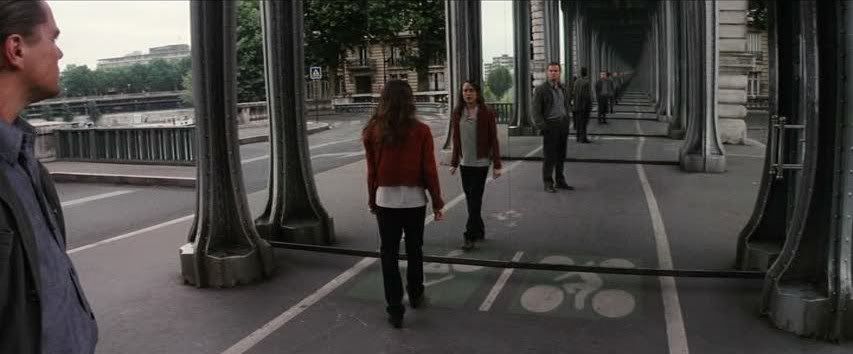
Within this oft-dazzling but ultimately insubstantial film, there are powerful moments, most of them early on, when the film's grandiose dream imagery still feels relatively fresh. Too often, Nolan signifies the unlimited imaginative potential of dreams by, well, blowing lots of things up, but there's no denying that certain sequences are viscerally thrilling, like the scene where Ariadne first explores the dream world, changing its architecture around her, creating steps to walk up and using mirrors to craft whole new landscapes. Nolan doesn't move much beyond this visually, though. His film's vision of dreams is surprisingly staid and unimaginative, rooted more in other movies — the weightless kickboxing cribbed from The Matrix, the crumbling dystopian cities of countless sci-fi movies, the frenetic action movie chase scenes of James Bond or Jason Bourne — than in a real feel for dream logic or the surreal imagery of our minds. For a film about dreaming and reality, Nolan is dreaming surprisingly small, content to deliver predictable heist movie beats dressed up in a flashy surface that he presumably hopes will be mistaken for the substance missing from the film.

Monday, February 7, 2011

36 Vues du Pic St. Loup


Jacques Rivette has always been fascinated by performance, so it's appropriate that his latest film — and possibly, though it hurts to think so, his last? — 36 vues du Pic St. Loup, is a gentle, low-key work in which various long-lingering dramas and pains are resolved through performance and play. The film focuses on a small traveling circus, the last vestige of a dying form, setting up in one small town after another, performing in near-empty tents, with a few scattered families sitting stoically watching in the stands. The circus represents a fading grandeur, an old tradition of public performance that now seems outdated. The circus' bright colors are faded with age, its routines are built on old vaudeville-style humor and spectacle, and there's something quaint about it all, as though the whole troupe was composed of time travelers from another era.

The film opens with a silent interlude by the side of the road, where Kate (Jane Birkin) is frustrated by her stalled jeep. A passerby in a flashy convertible, Vittorio (Sergio Castellitto), helps her get the jeep started without saying a word, then drives off, but the pair will meet again in a nearby town, where it turns out that Kate is with the circus, and Vittorio begins following the troupe around on their tour, seeing each of their performances and hanging around them during the day. Over the course of the film, Vittorio remains an enigma, an aimless wanderer who puts the rest of his life on hold to travel with the circus for a few weeks, but Kate similarly begins as an enigma only to have her mysteries gradually revealed throughout the film. Kate had been with the circus — which was founded by her now-deceased father — many years ago, but had left after a tragedy, and only recently returned. Her traumatic past continues to haunt her, even fifteen years later, and though she seems to think that revisiting the circus on what seems to be its final tour would bring her some closure, she's as confused and lost as ever while hovering around the site of her sad past.


Vittorio, who becomes embroiled in the circus' dramas, is fascinated by Kate and takes it upon himself to resolve her issues, to discover the root of what's bothering her and to help her overcome it. As he says dramatically at one point, he wants to "save" her. The film's approach to drama is both low-key and theatrical. The film is circumspect about its melodramatic components, slowly meting out little bits of detail about Kate's past or creating miniature dramas with the other members of the circus. The clown Alexandre (André Marcon) is in love with Barbara (Vimala Pons), the acrobat girlfriend of another cast member, Wilfred (Tintin Orsoni). Kate's niece Clémence (Julie-Marie Parmentier) lightly dodges an admirer, while flirting innocently with Vittorio, letting him pump her for information about Kate. These stories are developed through the most minimal whiffs of suggestion, as Rivette's characteristic probing camera slowly wheels around, coasting in graceful arcs that mirror the curve of the circus' ring, inching in towards closeups as these characters enact their little stories with the same stoical reserve that they apply to their performances. At one point, Alexandre and Wilfred act out a theatrical show of jealousy on an ad-hoc stage that is alternately bathed in light or encased in darkness, while Barbara and Clémence look on. The theatricality of it, the self-conscious presentation of this drama of jealousy, enforces the sense that this is, beneath its serious themes and dark secrets, a very playful film for Rivette, a light film dealing with serious ideas.

Certainly, the recurring sequences of the actual circus performances betray Rivette's interest in play and acting and entertainment, which ultimately trump emotionally exhausting melodrama. Vittorio initially ingratiates himself to the troupe by being the only one to laugh during the circus' opening routine, by the clowns Alexandre and Marlo (Jacques Bonnaffé). The clowns have a bit involving a chair, a stack of dinner plates, and a revolver, and throughout the film Rivette returns to this number again and again, each time revealing more and more of the bit. He obviously appreciates these clowns, who maybe aren't especially funny — indeed, the arena is always silent during their performances with the one exception of Vittorio's loudly appreciative laugh — but who have a certain dignity in enacting this old form of humor, this old form of entertainment, for modern audiences who largely don't show up and don't get it when they do.

Rivette treats the occasional performances by Wilfred similarly. The performer juggles torches or dances in the air, suspended by wires, and by modern standards these are not especially grand or impressive feats. They are small acts, acts that might have seemed extraordinary long ago, but to modern stimulus-overloaded senses, they seem humble. But Rivette still makes them seem, in their small way, magical and graceful, and more than that he makes them seem real. He stresses that these are very physical acts. His precise soundtrack captures not only the woosh of the fire as Wilfred juggles his torches, but the fleshy slap of the torch's handle hitting his hand. When Wilfred is twirling in the air, the grace and beauty of his movements are contrasted against the metallic clinking of the wires, which stretch and clang together with every movement. The sounds root these performances in physicality, in the material, and paradoxically that's what makes them so magical: they are little bursts of creativity and expression emerging from the routine of everyday existence, which is why even the quarrels and jealousies between these performers are enacted theatrically, as performances.


It's appropriate, then, that the film's climax takes place in the ring, with Vittorio taking the place of Marlo as one of the clowns in the opening bit. Here it becomes clear why Rivette spent so much time setting up this act, because Vittorio and Alexandre here divert from the script, improvising awkwardly in response to the shattering of the plates that had previously formed the basis for the whole gag. It's a celebration of improvisation from a director who has always appreciated the power of spontaneous acting, who has always left room for his actors to bring their own ideas and their own ad-libbed words into his films. As a result of the improvisation, the performance becomes both more and less real, constantly shifting between even more over-the-top theatricality than ever and bursts of emotional nakedness that eventually lead Vittorio to, as it were, break the fourth wall of the performance and address the offstage Kate directly. It's funny, and loose, and leads towards Vittorio's delivery of a speech that might as well have come directly from Rivette's mouth.

"This ring is the most dangerous place in the world," he says. "And also the place where everything is possible." As a summation of Rivette's career, and of his view of the cinema and art in general, it would be hard to find a more perfect epigram. The circus, the theater, the cinema: these are venues where it is possible, through play and pretend, to get as close as possible to the real heart of things, to use artifice to explore the deepest emotions. And it is also possible in these creative realms to be totally free, to enact magic, to invent, to delight through outrageous feats and stunning images. Rivette has always thought this way: art is a game, an act of pleasure, and yet it also has the ability to cut deeply, in some ways even more deeply than life itself. This metaphor isn't so metaphorical here — Kate's sad past involves art cutting very deeply, and literally, indeed — but in the end it's through art and performance that these characters can heal the wounds opened, long ago, by art and performance.

This is a modest film of small-scale pleasures, its proportions trimmed to accommodate the fading majesty of the circus. It is, indeed, the shortest proper feature Rivette has ever made, an oddity from a director who has always worked in extended duration. He's still dealing with time here, though, just in a different way. Like many late films by old masters, 36 Vues du Pic St. Loup is about the passage of time, about age, about how events resonate through the years for such a long time after their initial impact. The circus lingers on, an increasingly irrelevant souvenir from another time, just as Kate is haunted by memories of the past. But the circus performers are movingly aware of their own irrelevance, and they soldier on anyway, and it's through this connection to the past that Kate, late in life, is given an opportunity to finally move on and try something new, whatever that may turn out to be. This is Rivette's quiet but heartfelt ode to the things he loves — performance, artifice, the old-fashioned, the irrelevant, the out-of-touch, the quaint. It is a simple film, and a surprisingly direct one from this often circuitous artist, and as such it feels like a rather self-conscious statement of principles from the aging director. When, in one scene towards the end, Vittorio, Alexandre and Clémence take turns approaching the camera head-on, delivering bits of exposition and morals to be taken away from the film, it reinforces the sensation of the director taking an opportunity to speak to an audience that perhaps he feels has been as remote as the sparse, mostly unseen audiences at the circus' performances. It's a touching, affecting film, though more so for what it says about its director and his pet themes than for its intentionally spartan story.