Tuesday, February 15, 2011

Nightmare Alley


[This is a contribution to For the Love of Film (Noir), the second Film Preservation Blogathon hosted by Ferdy on Films and Self-Styled Siren. The blogathon has been organized for the benefit of the Film Noir Foundation, who do important work to restore and preserve the noir heritage. Please consider donating to the Foundation during this week. The blogathon will run from February 14-21, and during this time I'll be posting about some noirs to raise awareness of the blogathon and its worthy cause.]

Edmund Goulding's Nightmare Alley is a bleak, fatalistic noir, a rich and unusual examination of ambition, hypocrisy and ruin. The film is set in the world of the carnival and show business glitz, as the young carnival barker Stan (Tyrone Power) dreams of developing an act that will get him out of the low-rent carnival; he wants money and fame as a high-class night club attraction, wowing audiences with displays of psychic power and mind-reading. He sees his chance in the washed-up psychic Zeena (Joan Blondell), who had once been a famed night club performer with a flawless code system that had allowed her to stun audiences, until her partner and husband Pete (Ian Keith) was driven by her infidelities to become a drunk, no longer able to maintain the precision necessary for their act. The pair continue performing, in hobbled form, at a low-budget carnival, as Pete is kept barely stable by Zeena, even as she continues to stray. Stan — who openly admits that he thinks only of himself — worms his way in and sees Zeena on the side. Once he learns about the secret code she's guarding, of course he tries to get her to give it up to him, even as he lusts after the much younger Molly (Coleen Gray).

The film is built on a subtle structure of parallels and mirrors, as the film's first half carefully sets up the path of Stan's fated rise and fall. Stan's conversations with the drunken, no good Pete are so pointed that one senses it's only a matter of time before he winds up in the same situation. "How does a man sink so low?" someone asks early on, and the question — which will be repeated as some of the last words in the film — is the hidden driving force behind much of the action. How does a man sink so low? Through greed and cold ambition, through pushing away friends and using people for what he thinks he can get out of them. In the opening scenes of the film, Stan observes a performance by "the Geek," a carnival attraction of the basest sort, a man who degrades himself by pretending to be a subhuman brute, a monster with no thoughts who eats live chickens for the amusement and horror of the audience. Goulding stages this sequence brilliantly: the Geek is positioned at the front of the stage, hidden from view by the crowds gathered around him, and as Stan walks away, disgusted by the spectacle, a man on stage throws a pair of chickens to the brute. As the chickens squawk and squeal, the camera pans away with Stan, towards a fire-eater who blows turrets of flame into the air from his mouth. The audience begins to turn away from the Geek as well, to watch the fire-eater instead, and the moment underscores the insignificance of the degraded, unseen man. He lowers himself to the level of an animal for the momentary entertainment of a fickle crowd, and when they're satisfied with his degradation, they turn to the next spectacle, seeking the next stimulus.

That's why it's so heartbreaking when Pete and Stan discuss the Geek later, watching the man go crazy, pursued by carnival workers. Pete admits that if not for Zeena, that would be him: the Geek is just an ordinary man, a drunk who's sunk so low that he's willing to do anything for a bottle of booze, even if it means utterly debasing himself in the most humiliating and public ways. The Geek pretends to be without thoughts, without a human brain, but Pete's awareness of his own degradation, his own uselessness as a sloppy drunk, suggests that beneath his brutish surface the Geek is very much aware of what he's doing, very much aware of how low he's fallen. That only makes it all the more horrible, and Stan in particular is horrified by the Geek, as though he were seeing a creeping premonition of his own future in this debased man, a former carnival performer himself.
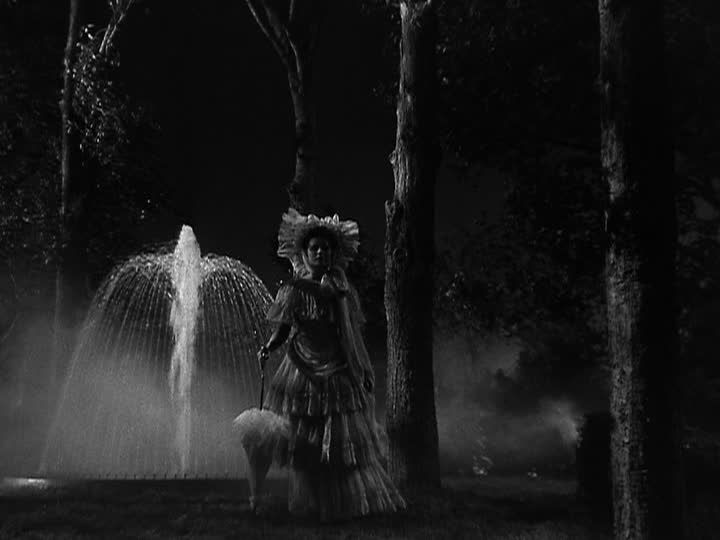

Stan's rise to fame occurs when he gets away from the carnival, at first not of his own free will, though he eventually realizes that he's actually gotten his big break. He brings Molly with him, and one of the film's cleverest scenes is the one where Stan concocts his newest scheme. He's thought of the idea to create a new psychic act with Molly as his partner, and a grin spreads over his face as he thinks of all the money and fame they can earn. But Molly obviously misunderstands, thinking he's happy to be with her, starting a new life with her. "Do you really mean it?" she asks breathlessly, looking at him with wide, happy eyes, and he excitedly exclaims, "yes," but there's some obvious miscommunication here. Molly's happy to be married, to be in love, but Stan is just happy to finally be on the verge of major success. He's happy he's got the girl, but only because he knows he can use her in the act, because she'll be very useful to him. The scene is staged like a conventional romantic climax, a moment of togetherness and union, but the lovers are talking past one another, seeming to say the same things but meaning something very different. The way the different meanings criss-cross in the subtext makes the scene heartrending rather than uplifting, even as the strings soar and Molly proclaims, with sappy earnestness, that she'll be a good and loyal wife to her man. It's as though the film is mocking Molly for being just another mark, just another sucker for Stan's clever patter.

It's fascinating to watch the sweet, innocent Molly hoodwinked by Stan, even as he himself gets tangled up with a calculating psychiatrist, Lilith Ritter (Helen Walker), who sees one of his acts and gets interested in him. The interplay between Stan and Lilith is a study in power struggles and mutual manipulation, as Stan thinks he's using the psychiatrist for her connections to wealthy society people. But, in a potent scene late in the film, the rug gets pulled out from under Stan, to the point that he begins questioning his own sanity, unsure of what's been real and what's been a con, not knowing if he's losing his mind or being brilliantly played. Goulding, ingeniously, allows the audience to wonder as well. Walker plays this scene with a hint of menace, an undercurrent of knowing manipulation, wrapped up in sincerity and bursts of seemingly genuine confusion. As the psychiatrist winds around her patient in the dark, the shadows making a cruel mask of her face, the audience is left to wonder what's truth and what's lies — to think back on what had already happened and wonder if there had been an elaborate long con running, and if so where the deceit had begun, how far back the web of lies stretched. The uncertainty places the viewer into Stan's position, concocting paranoid conspiracy theories, lost in the dark, feeling used and betrayed.

This is Stan's comeuppance, one explanation for how a man can get so low, how a man becomes the Geek. It is, in some ways, a divine justice, a form of destiny or punishment from above: the film's script is full of allusions to destiny, to the magic of the Tarot deck, and to God and the Christian Bible. There is an increasingly religious fervor to Stan's psychic performances, as he puts his audiences in touch with dead relatives and uses the rhetoric of the church pulpit as fodder for entertainment and spectacle. To him, religion is just another con, and Molly, growing afraid as he crosses the blurry line from entertainer to con artist, begs him not to invoke the wrath of God by playing the role of a spiritualist. But Stan has a literalist's understanding of religion; he believes, or tries to convince Molly that he believes, that because he never explicitly mentions God, then he is free of blasphemy. It's as though he's even trying to con God, to sneak by on a technicality. In the end, though, as Stan semi-consciously falls lower and lower until he's mirroring first Pete and then the lowly Geek, the film suggests that there's no way to con destiny, no way to avoid the inevitable and awful descent into pathetic ruin.

Monday, February 14, 2011

The Big Heat


[This is a contribution to For the Love of Film (Noir), the second Film Preservation Blogathon hosted by Ferdy on Films and Self-Styled Siren. The blogathon has been organized for the benefit of the Film Noir Foundation, who do important work to restore and preserve the noir heritage. Please consider donating to the Foundation during this week. The blogathon will run from February 14-21, and during this time I'll be posting about some noirs to raise awareness of the blogathon and its worthy cause.]

Fritz Lang's The Big Heat is a dark, tough noir, an intense crime thriller that moves at an unrelentingly brisk pace as it delves fearlessly into the darkness of its story. It is a remarkably adult film, never wincing away from the seedy truths at its core, and for the Hollywood of its era — even in the gritty world of the noir — it especially stands out. Its dialogue is taut and punchy, dealing candidly with this world of corruption, adultery, death and disfigurement, and the sad fate of "that kind of girl." The film focuses on the scrupulously honest cop Dave Bannion (Glenn Ford), a guy with such a highly developed sense of morality that he never thinks twice about doing the right thing. When the suicide of a highly positioned police officer starts stirring up some ugly suspicions, Bannion charges into the middle of the case, even when it becomes apparent that there are some very powerful people above him who would like the whole matter to be put to rest as quickly and cleanly as possible. Bannion can't go along with that. He's got a kind of brute force morality that drives him forward, pushing at the people who'd like him to simply go away — including the dead cop's widow, Mrs. Duncan (Jeanette Nolan) and the gangster Lagana (Alexander Scourby), a powerful man with connections that run deep into the police force. Bannion doesn't have the smarts to conduct his investigation quietly or subtly, so he just keeps forcing himself on underworld contacts and on Lagana himself until someone decides he needs to be dealt with.

Bannion is setting himself up for tragedy, and of course he gets it. The film goes to some very dark places, but before it does, Lang takes pains to establish the stakes for Bannion: a very happy home life with a lovely wife, Katie (Jocelyn Brando), and a daughter. The early scenes of Bannion and his wife at home create a contrast against the darkness and corruption he encounters at work. Bannion is scraping by on a cop's salary, always conscious of the tight budget his family has to maintain, and his conversations with his wife about money set him apart from the dead Duncan, who'd transcended his cop's salary by serving on a criminal's payroll, at least until his conscience caught up with him. Moreover, the scenes between Bannion and Katie serve as a tonal contrast; these scenes are syrupy and romantic, dripping with pathos and big goopy closeups, and the bright, clean light of the Bannions' home makes it look like a cheery sitcom set as opposed to all the shadowy hotel rooms and seedy bars where the corrupt and the crooked do their deals. The couple has a light, flirtatious relationship, rooted in concrete details like Katie's habit of taking a sip of her husband's beer or polishing off his whiskey, or their gentle sparring and coded sexual banter as she prepares dinner. Their romance is pure and good, but it's obvious from the beginning that Lang is establishing this foundation for Bannion only in order to disrupt it in some way.

When the disruption finally comes, it's one of the film's most chilling scenes, a shattering break in this domestic bliss that comes just as Bannion is telling a story to his daughter. The remainder of the film ventures even further into darkness, as Bannion becomes obsessed with breaking up the ring of corruption in his city, following the chain of crime towards the men who pull the strings from behind the scenes. He particularly becomes concerned with Lagana's right-hand man, Vince (Lee Marvin), a sociopathic tough guy who takes his anger out on women more often than not. Vince has a bouncy, cheery good-time girl, Debby (Gloria Grahame), who drunkenly mocks Vince's eager obedience to Lagana, but is still happy to profit off the illegal gains from her man's shady activities.


Like so many of the best noirs, The Big Heat is about pain and rage, about revenge and justice. Lang focuses intently on both the violence and its ugly consequences, particularly when the psychopathic Vince goes too far with Debby. Vince is a brutish character, played with chilly intensity by Marvin, whose tight-lipped, stony expression perfectly captures the casually sociopathic violence of this killer. In one crucial scene, Vince utterly loses his cool and assaults Debby with a coffee pot, perhaps a nod to Raymond Burr in a similarly unhinged performance in Anthony Mann's Raw Deal.

Grahame is even better as the hard-drinking party girl who's eventually forced to sober up and face the ugly reality of the life she'd been living. As with the use of Bannion's relationship with his wife, Lang develops a contrast between the playfulness of Debby and the crude nastiness of Vince. There's also a contrast between Debby in the first half of the film and the increasingly pained, pathetic Debby in the second half of the film. Debby goes from a character of light — dancing around in Vince's well-lit apartment, cracking jokes and admiring herself in a mirror — to a woman who's afraid of the light, who wants to hide in the shadows instead. The film cleverly exploits these dichotomies between dark and light, and it's especially interesting that Lang reverses the motif for Debby. When she's in the light, she's living a corrupt life as a thug's moll, enjoying her decadent ease with dirty money paying for her shopping trips and keeping her supplied with liquor. It's only when she's swallowed up in shadows that she sees things with some clarity. It's fitting, then, that she spends the second half of the film divided in half, her face half-covered with a white bandage, the other half of her face often bathed in the richly textured shadows of Lang's images. Debby is divided between a fun, mostly carefree past that now seems lost forever, and the knowledge of the ugliness on which that life had been built.

The Big Heat is a powerful film, a stark examination of the tremendous difficulty of maintaining honor and morality in a corrupt world — an examination of the risks of speaking truth to power, and the slim rewards. In the film's final scene, Bannion has returned to the daily routine of police investigation. There is no glory, no real reward, only the resumption of relative normality, minus the horrible costs he'd already paid. That's part of what makes the film so bracing and affecting and even, despite its glossy aesthetics, somewhat realistic in its portrayal of corruption and the cost of honesty.

Saturday, February 12, 2011

Two Upcoming Blogathons


In the next two weeks, there are two exciting and worthy blogathons that everyone should definitely check out, and participate if you can.

The first is For the Love of Film (Noir), a sequel to the highly successful original For the Love of Film blogathon which took place last year. The blogathon is once again organized by the fine ladies at Ferdy on Films and Self-Styled Siren. This blogathon will be running from February 14-21, and as with the last one, it is a fund-raising blogathon, intended to raise money for the Film Noir Foundation. Any money raised during the blogathon will go towards the great work being done in film preservation by this Foundation — and will be specifically targeted to save and restore Cy Endfield's 1950 film The Sound of Fury. So be sure to visit both of the host blogs this week, and to donate to the Foundation using the special link that's specific to the blogathon. Also check out the promotional video above, created by Greg Ferrara of Cinema Styles. I'll be posting about film noir all week long as well, in order to help promote this great event.

The second film blogathon I'd like to call attention to is the Iranian Film Blogathon hosted by The Sheila Variations. This blogathon is prompted by the imprisonment of Iranian director Jafar Panahi by the Iranian government, and is dedicated to both Panahi's work and the work of other directors from his country. If you're interested in Iranian cinema, or if like me you'd like to learn more, you should definitely check out all the activity going on at Sheila's blog from February 21-27. I'm going to try to write about Panahi's 1997 film The Mirror at some point during the week.

Friday, February 11, 2011

Four 1960s avant-garde shorts (Jacobs, Levine, Mekas, Jordan)


Ken Jacobs' Little Stabs at Happiness is an aimless collection of vignettes featuring various friends and associates of Jacobs lounging around, playing goofy games or simply hanging out in various urban locales. Its aimlessness, one guesses, is part of the point, as the title suggests people just trying to live their lives, maybe find a little happiness along the way. The film is divided into about six rough sections, some of which are preceded by chapter titles and some of which aren't. In the first scene, Jacobs' fellow filmmaker Jack Smith plays in a bathtub with a woman, both of them dressed up in goofy homemade costumes of foil and thrift store clothes and paint, Smith with a blue line running down his nose and a hood wrapped around his head. They play with dolls, and Smith enacts both violent and sexual acts on the dolls, stubbing out a cigarette in the eye of one doll and enacting oral sex on the blank, molded plastic crotch of another, which he nearly shoves all the way into his mouth. It's a vision of childlike "innocent" play as destructive and outrageous, not so much innocent as morally undeveloped.

In the subsequent scenes, Jacobs adopts a more realistic, observational aesthetic, observing in turn two women sitting around an empty yard, a man and a woman hanging out by a dock, a man and woman talking in an alley, and a group of kids and adults drawing on the ground with chalk. In the final scene, Jacobs returns to Smith as a portrait of "listlessness," hanging out on a rooftop as a sad clown in a puffy outfit, throwing around balloons and looking discontented and sluggish.

The most interesting aspect of the film, however, is the second section, in which Jacobs delivers a voiceover that describes the structure of the film, self-consciously talking about how this section will be three minutes long, and how he is using music and other sounds to disrupt the potential for connection or conversation between the two women onscreen in this section. Most interesting of all is his admission that the people onscreen in this film are almost all people who he doesn't get along with or see anymore. He hints at an argument and falling-out with Smith, and describes all the other people as former friends who have moved away, or disappeared, or who just don't come around much anymore except if they want something. It's sad, and places the rest of the film in context as a nostalgic memoir for lost friends and broken friendships. Maybe that's why we see people talking here but can't hear them. Without this voiceover, the film risks seeming like a pointless, disconnected series of images of people hanging out, acting out typically abstract or surreal avant-garde film scenes or simply doing not much at all. But this simple, direct voiceover recontextualizes everything, and makes the film a scrapbook of happy or memorable moments from the past, rough portraits of people the filmmaker wishes to remember as they were when they were a part of his life.


Saul Levine's Note to Patti is a touching, evocative short film made for the absent friend of the title. Made during a snowy winter, featuring the friends and family of Levine's friend Patti, who was away from home, the film is an ode to the simple pleasures of the home life, a nostalgic portrait of loved ones having fun in the snow, playing, shoveling, observing the beauty of the natural world around them. The film is briskly edited, full of washed-out images that evoke a kind of nostalgic fading: kids in pale red snowsuits frolicking amidst the snowy whiteness all around; birds flitting from branch to branch in a bare tree, framed against a dull gray sky; adults trudging through several feet of heaped-up snow, digging out and watching the children have fun. Levine's cinema is irrevocably tied to the aesthetic and content of home movies. It is a personal cinema, assembled from tiny everyday moments, full of casual image captured on the fly, with a sentimental eye for the activities of the friends and family surrounding the filmmaker. The film's washed-out images evoke the past, despite being captured in the present: it is as though the film is already preparing for its future status as nostalgia, as a reminder of youthful fun.

The snow in the film provides a kind of blank canvas on which Levine draws his images in blots of color framed against the broad white stretches. The children running through the snow form streaks of rapidly moving color as they play. One boy's red hat provides a shock of bright color every time he appears. Levine is playing with the rhythms of the colors, editing so that flashes of bright color — sometimes an object within the frame, sometimes provided by filters that turn the image bright blue or yellow — alternate with pale snowy landscapes or stretches of pregnant, cloudy sky. At one point, Levine flickers back and forth between an image of a bird in a tree and a human figure walking along in the snow, so that the bird and the person continuously morph into one another, both dark blots framed against an expanse of blank nothingness, both living beings flitting around in the snow's cold solemnity. Levine is contrasting the stillness and quiet of the snowy landscape — embodied in his characteristic lack of a soundtrack — with the liveliness and activity of the people who interact with this snow, clearing it away or making games of running through it.

In its brief seven-minute span, Note To Patti communicates much, evoking warm, slightly melancholy emotional resonances from its simple images of a snow day. Levine is tapping into what's best and most noble about the home movie: the concrete capturing of a moment in time, the built-in nostalgia for this moment that will soon be over, the rich emotions of family life. But his film is far from a simple home movie, and it's his intuitive, agile aesthetic sensibility that allows him to swirl up all these feelings and ideas from this rapidly edited flow of winter images.


Notes on the Circus is one part of Jonas Mekas' long series of diary films, his records of events both prosaic and exceptional, which were eventually edited together into his diary epic Walden. The film was shot at the Ringling Brothers circus and attempts to capture the thrills of the circus through fragmentary images and fast-paced, elliptical editing. Mekas is not after a conventional documentary record of a trip to the circus: instead of chronicling the concrete events that happen during a performance, Mekas is after the feel and the atmosphere of the circus. It's a sensory record of what the circus feels like to an observer, capturing the dizzying array of sights that overload the senses. The opening section of the film seems to focus especially on the circularity of the circus, as animals are led in speedy circles around tight rings, while acrobats twirl in the air, hoops are lit on fire and spin around, and jugglers toss round balls in circular orbits above their heads. Everything seems to be spinning in constant motion, turning circles, creating a sensation of dizzy confusion, mirroring the circus patron's uncertainty about where to look, which sight to take in next.

What makes the film so charming and enjoyable is that Mekas obviously shares in this sense of wonder. One senses that the film's perspective is that of the dazzled patron, Mekas himself, gawking happily as the circus performers go flying and leaping by, their bright costumes blurred by their speed. The film often becomes nearly abstract, a stream of unclear images and fragments of discernible figures. Every so often, the frantic pace slows down in order to focus on a single image, like a tiger riding on the back of a horse or a group of acrobats tossing each other through the air and then precariously grabbing hold again. Such moments mimic the observer's temporary fascination with a particular sight amidst the chaos, before being distracted again by the overall spectacle.

Mekas is in particular fascinated with a solitary female acrobat who swings back and forth on a trapeze bar, hanging upside down by her feet, arching her back across the bar, pulling herself up and then letting loose to hang in the air again. Mekas stays with her longer than with any other individual performer, admiring her graceful back-and-forth swings, and the way she casually lets her body dangle upside down in the air, framed against a black backdrop so that she seems to be suspended above the void, holding herself aloft by barely a toe. Mekas then superimposes her gyrations over the general chaos of the rest of the circus, allowing this graceful individual performance to be absorbed back into the larger extravaganza. All the moments of grace, of humor, of absurdity, of death-defying bravado, are allowed to coexist as they do in the circus, emphasizing the emotional experience of witnessing so many different forms of wonder and magic. The soundtrack, consisting of old-timey jugband tunes, further emphasizes the childlike, slightly old-fashioned appeal of the circus. Mekas, with his Old World sensibility and wide-eyed love for the ephemera of life, is perhaps the perfect filmmaker to craft this unrepentant ode to the circus.


Larry Jordan's Hamfat Asar is a crudely animated short that uses cutout etchings and drawings as a foundation for a goofy surrealist pastiche. Against a static backdrop of a seaside scene, with a line drawn across the center of the frame like a tightrope, Jordan assembles weird collages of fish, butterflies, anatomy diagrams, naked women, various mechanical devices and pieces of scientific equipment, and other ephemera. The images are formed from collages of old illustrations, meticulously assembled into new hybrid forms that dance across the screen, coming together and then fading away or splitting apart. Jordan was clearly inspired by the wonderfully inventive collage novels of Max Ernst, like the 1934 masterpiece Une semaine de bonté. As in Ernst, there is no clear meaning to these absurdist, surrealist juxtapositions, with the emphasis on odd conjunctions of unrelated images, married into hybrid forms that improbably come to life and interact.

However, Jordan's approximations of Ernst's inventive visual sensibility rarely go beyond the level of homage. It can be fun to see these very Ernst-like creations in motion: a microscope hobbling across the screen, propelled by its hind "leg," or a butterfly with a mushroom sprouting out of the junction point of its wings as it flits across the screen. But too often the film seems to be offering up a simple stream of weird images without really digging deeper into the substance of the images. Ernst's images, though they too defy conventional interpretation, are packed with resonances and suggestions, intimations of psychosexual probing, hints of darkness and menace, submerged satirical jabs encoded in his weird constructions. Jordan's images, in comparison, seem shallow and superficial, their resonance limited to the surface, only rarely suggesting anything deeper beyond the playful impulses of combination and juxtaposition that drive the film.

Hamfat Asar is thus most satisfying in its flashes of humor and playfulness. At one point, a fish and a lightbulb dance to the beat of the hand-drumming soundtrack, traipsing along the tightrope at the center of the frame, giving playful little kicks to accentuate the beat. Towards the end of the film, a woman is chased across the frame by a hummingbird, hiking up her skirt as she runs, the bird's long, sharp nose pointed with obvious sexual intent at her hindquarters. The image mirrors an earlier and equally playful assemblage where a woman had been pursuing a fleeing piece of machinery, wagging her finger at it as though chasing down an unruly child or a misbehaving pet. In these moments of humor, Jordan's film is witty and entertaining, but he never really attains the richness of visual language that would allow the film to tap into anything deeper than a few chuckles.