Thursday, May 12, 2011

The Dreamers


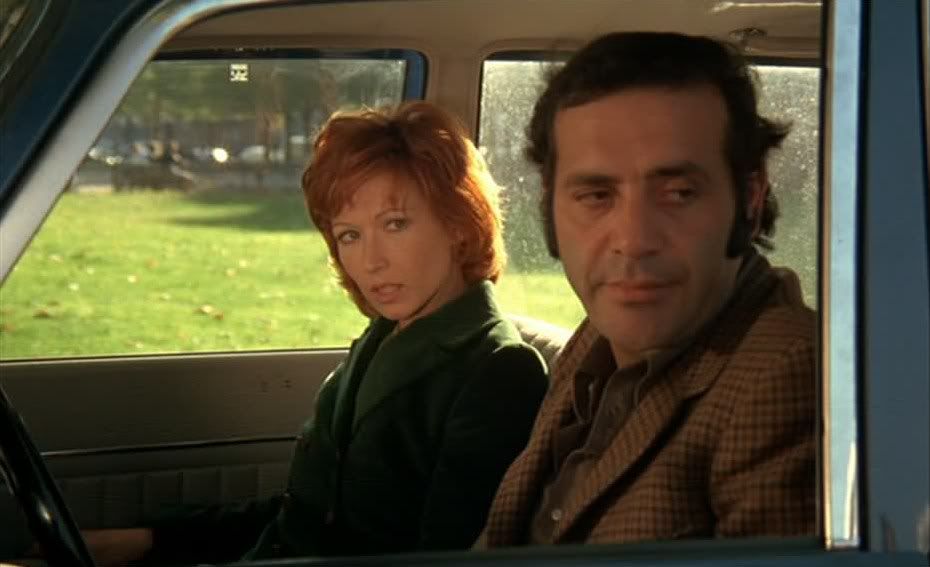
It's appropriate that Bernardo Bertolucci, late in his life, should make a film like The Dreamers, which at this point, eight years after its release, remains his final film to date. If he never makes another, this will be a fitting and beautiful swan song, a love poem to the cinema that's as aware of the limitations of film as it is enraptured with the artform's possibilities. This cineaste's dream, a vision of Paris at the height of the passions of May 1968, is essentially Bertolucci's return, in highly symbolic and stylized fashion, to his own youth, to his own introduction to the cinema. The film opens with Matthew (Michael Pitt), saying that the Cinémathèque Française is like a palace, and in the opening scenes of the film he goes religiously to see films there, staring raptly at the screen, alone but together with a crowd of people all seemingly hypnotized by those flickering images. That word, "religiously," is not chosen lightly. The film is about a generation of people, born with the French New Wave, for whom the cinema was a religion, for whom those flickering images were the Stations of the Cross, carved in film stock rather than stained glass. Later, after Matthew meets the brother and sister cinephiles Isabelle (Eva Green) and Theo (Louis Garrel), Isabelle says that she was born in 1959, an impossibility except that she's not referring to her literal birth but her birth through cinema: she came into this world, figuratively, in the year of Godard's Breathless, the film that ignited the New Wave and served as a symbol for everything that would change in the cinema, and maybe even in the world outside the theater, with the coming of this new movement.

The film is also, of course, about disappointment. Bertolucci has precisely captured a particular moment in time when anything, seemingly, could happen — and when, in fact, almost nothing actually did. The cinephilia of Matthew, Theo and Isabelle briefly flows out into the streets, into the world beyond the frame, with the Langlois affair, the series of protests aimed at reinstating the Cinémathèque's director Henri Langlois. New Wave icon Jean-Pierre Léaud appears, reprising his own role in those protests, juxtaposed alongside his own black-and-white image from 1968, that much younger man shouting out speeches to crowds of young cinema fans who had been galvanized by this situation. Later, Matthew and Isabelle will go to see Frank Tashlin's The Girl Can't Help It, with its opening in which Tom Ewell playfully expands the borders of the cinematic frame, kicking the constricting Academy ratio frame out to widescreen: a perfect metaphor for the expansion of boundaries, for the possibility of expanding, eventually, not just from 4:3 to Cinemascope, but from Cinemascope to reality, to the world pushing in on the corners of the screen, or conversely to allow the film to bleed out, past the black border into the world outside.

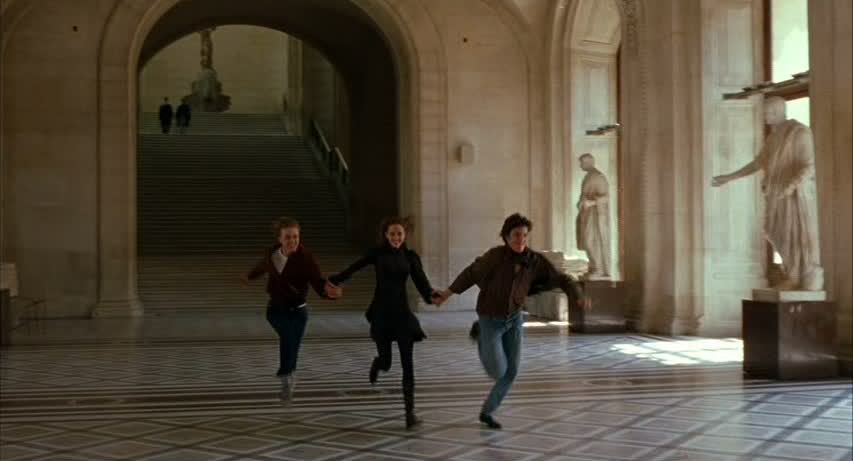
Instead, Matthew, Theo and Isabelle cut themselves off from the world in the beautiful apartment of Theo and Isabelle's bourgeois parents. The brother and sister — Siamese twins, they insist, and they have matching scars on their shoulders to suggest it's true — have a passionate, near-incestuous attachment to one another, and they essentially invite Matthew to join them as the third point of a triangle, to be absorbed, if he can be, into their perfect unity. When their parents go on vacation, leaving the apartment to the young people, the trio hole up there for an indeterminate amount of time, playing games of sex and cinema. They challenge one another to re-enact the famous fast-paced run through the Louvre of Godard's Band of Outsiders — a sign, in the original film, of how little those characters cared or knew of culture, and a sign of this trio's repetition of those same mistakes, taking the film as a guide for living without thinking about the meanings behind it. They challenge one another to identify scenes from films: Isabelle apes Garbo while Theo performs death scenes where X marks the spot, as in Hawks' Scarface. And the penalties for losing in these guessing games are sexual penances that only draw the trio tighter together into a sexual-cinematic union. Matthew falls in love with brother and sister together, and his love for them is mashed up with his love for the cinema, with his excitement over what he'd seen on the screen in darkened theaters. When the Cinémathèque closes during the Langlois affair, the apartment becomes a substitute theater, a place where these young people can create their own films, their own fantasies, using the films they love as raw material.

Bertolucci is revisiting, in a way, the theme of his infamous Last Tango In Paris. Like Marlon Brando and Maria Schneider in that film, this trio of cinephiles attempt to close themselves off from the world, to blot out everything outside their apartment. It's no coincidence that when Theo and Isabelle invite Matthew over for the first time, the scene is staged with Matthew in an elevator that's very reminiscent of the one leading to Brando and Schneider's apartment in Last Tango, while the twins run up the stairs, recalling the sequence where Brando stalks a frightened Schneider as she tries to escape him. Later, the apartment becomes their whole world, and their games of sex and movie trivia become their only activity, while outside the student riots boil over in earnest, this time with a real political agenda far broader than the cinephiliac demands of the Langlois affair.

When Matthew, finally growing frustrated with the twins' isolation and infatuation with one another, brings Isabelle out on a date, it shatters that boundary between the apartment and the outside world. The lovers go to a movie together, of course, but afterward, kissing by a shop window, they see news of the protests on a TV screen, and it's as though these images snap them out of their selfishness and monomania. When they turn around, away from the TV in the window, the camera pans with their gaze towards a massive heap of trash, the wreckage left behind by that day's demonstration. The streets look like they've been hit by the messy apocalypse of Godard's era-defining Week-end, and the only way this pair could possibly not have seen all this evidence before was that they were still locked into their isolation, as though they were still inside that apartment even while walking through the streets of Paris. Bertolucci carefully shields the audience from these signs as well, right up until the point when Isabelle and Theo see the trash and the wreckage all around them. If Last Tango was about trying to ignore the world in order to extinguish the pain of personal tragedy, The Dreamers is more political than personal; it's about trying to ignore the turmoil of the world, trying to pretend that nothing will or could ever change, so the only thing to do is engage in bacchanalian rites of pleasure, whether in a bed or in the dark of a cinema.

Later, when even this wake-up call proves insufficient to jolt the trio out of their solipsism, Bertolucci intervenes more stridently. The trio barricade themselves in a tent of sheets that, Theo says, dates back to their childhood, when they used to play like this in, one presumes, a more innocent way. The twins' parents, having briefly returned, simply tiptoe in and out, providing no guidance, no direction, for these youths, only some further enabling behavior. It takes Bertolucci himself to shatter the isolation, in a somewhat literal and cute way, as his camera pans away from the tent towards a window, which is then broken by a rock flying through it. As soon as this happens, the tranquility and quiet of the apartment is revealed to be false, as the clamor of street protests rushes in from outside. It's utterly artificial, as no pane of glass could have blocked out all this noise so completely; it's a symbolic rupture, the shattering of the boundaries between the bourgeois apartment and the streets outside. When Theo and Matthew ask what happened, Isabelle calmly replies, "the street came flying into the room," a wonderfully poetic way of saying that it's become impossible to ignore that this is a moment pregnant with possibility for all sorts of changes and ruptures.

Back in 1968, many of the New Wave's filmmakers and artists had realized the same thing, taking to the streets and engaging with the world beyond the cinema, hoping to effect some kind of lasting change. That nothing of the sort ever materialized is well known now, but Bertolucci seemed to have realized it even at the time; his second feature, Before the Revolution, made four years before May '68, is a kind of preparation for the disillusionment and disappointment of that would-be revolution. Matthew, Theo and Isabelle are very much like the aimless revolutionary idealists of that film, unsure of where their lives are heading, momentarily energized by political fervor or the love of cinema or the love of one another, but with a sense of the temporary, the ephemeral, drifting through everything they do, everything they desire. When the "revolution" breaks down into either pointless violence and destruction or disgust with all this squandered potential, it's predictable but no less sad for it.

All of this makes The Dreamers a very personal film, and a very poignant one. It's an elegy, not only for the generation of 1968, but for a whole way of looking at and thinking about the movies. It's an ode to Cahiers du cinema, to a time when all this felt so very important and so very vital. It's a loving if clear-eyed tribute to the filmmakers, and the ideas, that initially inspired Bertolucci and set him off on his own life and career.

Wednesday, May 11, 2011

We Won't Grow Old Together


We Won't Grow Old Together, as its title suggests, is about a tormented relationship. Jean (Jean Yanne), has been married to Françoise (Macha Meril) for years, but his relationship with his wife has been all but over for a long time — she's hardly ever around, always traveling to Russia for work, and she drifts in and out of the film as well, reflecting the ephemeral nature of their marriage. This is not the relationship to which the title refers. Jean's relationship with his mistress Catherine (Marlène Jobert) has lasted for about half as long as his marriage, and their relationship is much stormier, more potent and intense, than Jean and Françoise's chilly, civil non-communication. Jean and Catherine are constantly fighting, constantly breaking up, one or the other of them angrily calling it all off only to go crawling back to the other very soon after. This was the second feature of Maurice Pialat, adapted from one of his own novels, and it's obviously autobiographical in its depiction of a doomed relationship between the brutish, nasty Jean — a documentary filmmaker like Pialat was before venturing into fictional features — and the insecure Catherine.

If this is a self-portrait, it's an unflinchingly negative one. Jean is a monster, a brute, a boor, and he absolutely terrorizes and torments Catherine. His behavior is despicable: he's constantly berating her, calling her stupid, and when they meet her parents during a vacation, she's got a small bruise above her eye, a sign of his often physical violence against her. At one point, when she refuses to have sex with him, pleading exhaustion, he violently leaps onto her and tears her shirt, then storms angrily out of the room (though she later finds him petulantly waiting downstairs, like a little kid waiting for her to come fetch him). Every time she shows some sign of independence, he tries to wear her down, insulting her, calling her ugly, mocking her ambition to become a model, telling her she's good for nothing. He wants her to be weak and meek, to lack self-esteem, because it's clear that he can't handle a woman who can think for herself — because what woman with any sense of self-respect would tolerate his bullshit? He's an utterly rotten character, and yet it's obvious that Pialat sees himself in this man, just as later he'd see himself in the role of the domineering, manipulative patriarch of A nos amours, a role where he'd dispense with the stand-ins and simply cast himself.

Here, though, Pialat is filtering himself through the brooding, aggressive performance of Jean Yanne, who excels at playing these kinds of brutes, who had in fact recently played similarly despicable sad-sack monsters for Claude Chabrol in Le boucher and Que la bête meure. Pialat is unflinching in his depiction of Jean's nastiness, and yet he's clearly also sympathetic to this character, this man who torments the women who love him, relentlessly driving them away and then feeling remorse and nostalgia when they finally decide they've had enough of him. His fractious relationship with Catherine has gone on a long time, but it's only when she starts hesitantly pulling away, trying to detach herself from Jean, that he realizes he loves her and wants her to stay. The film is structured around the repetition, over and over and over again, of the basic scenario that arises from this situation: the couple quarrels, they break up, they storm off alone, and shortly thereafter they're back together as if nothing had happened, and the cycle repeats itself. Pialat's brisk editing emphasizes the cyclical nature of this relationship, with scenes of breakup and finality immediately followed, jarringly, with scenes in which the couple meets up, smiling, for a day together. A closeup of Catherine, a single tear poised on her cheek but never quite rolling off — a perfect metaphor for the static, frozen-in-place turmoil of this relationship — immediately segues into a scene of the couple meeting for lunch, smiling and chatting. And then the conversation takes on a darker tone almost immediately and they part in anger again. Pialat understands this pain, understands this kind of love/hate, push/pull relationship that's clearly dying even though neither of the lovers will quite admit it.


Pialat relentlessly examines the disintegration of this relationship, looking with pity at the spectacle of the hard-edged Jean falling apart as he realizes that Catherine is leaving him. He brought it on himself, and he knows it, and he talks candidly about how badly he mistreated Catherine, even though he still seems to think that it's possible to fix things. It's obvious that he won't change, though, no matter how much he mopes and whines, and in the film's long denouement, Catherine disappears for a long time, leaving Jean as the lonely center of the film, commiserating with his wife of all people, who seems to pity him, to feel bad for his heartache. She's got a life of her own, with friends and lovers and an active career outside the home, and she doesn't need Jean although she remains tied to him by marriage. Jean has nothing, just a stalling career as a failed filmmaker, barely working, with no friends and now no lover either. A brief visit with Jean's drunken, lonely father (Harry-Max) provides a premonition of the pathetic future awaiting men like Jean, who from François' description very much takes after his notoriously hellraising father.

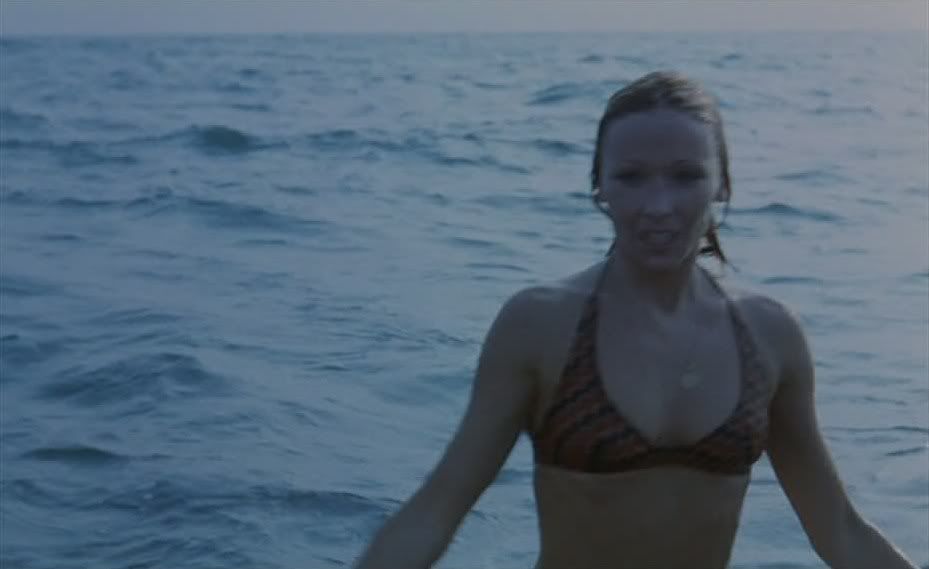
The film's ending provides another vision of the future, a future informed by nostalgia and memory. In the final scenes, Jean and Catherine meet up one last time, after she's left him for good, and they talk about the future and about her new life without him, and Jean still clings pathetically to the hope that he'll somehow, someday get her back, that she still needs him. She doesn't crush his hopes, but she remains tellingly aloof throughout their conversation, communicating the sense that she's done with him, that he's now a part of her past. The film's final shots tell the same story more poetically. After this meeting, Pialat cuts to an image of Catherine swimming in the ocean, alone, an image from the the couple's vacation earlier in the film. As she swims, the waves crash against her head, which remains barely above the water, and she struggles against the violent sea, swimming hard as the the gray-blue water stretches out toward the horizon all around her. Finally, she enters shallower waters, steps up out of the water in her bikini, stretching and pushing her wet hair away from her face, and she walks off toward the side of the frame, pausing for just a second before vanishing at the right side of the frame, leaving behind the empty and turbulent ocean.

Pialat then cuts to grainy, black-and-white footage of Catherine running and posing in the shallow surf at the edge of the beach, images that, with their home movie quality, might have been captured by Jean the filmmaker. These are his memories of Catherine, captured in film, just as We Won't Grow Old Together represents Pialat's own memories of his own difficult relationships. Through memory, through the filters of film and art, the past becomes distant, tinged with nostalgia, faded into black and white in contrast to the crisp, colorful clarity of a present-tense moment. Even in the color shot of Catherine in the water, there's a brief glimpse of some object at the corner of the frame, a piece of filmmaking equipment or the prow of the boat the camera is drifting on, a sign of the artifice constructed around this heartbreaking story. Pialat leaves this trace of the filmmaking process intact, perhaps because he wants to acknowledge that this is filmed memory, that the film, like the novel before it, is a way of transmuting painful life into art, placing these incidents irrevocably in the past.

Tuesday, May 10, 2011

Gente del Po/N.U.


Michelangelo Antonioni, like many directors who later became known for their fictional features, started his career making documentary short films. His first was Gente del Po, shot in 1943 but not finished and released until 1947, its production hampered by problems with damaged and partially destroyed negatives. Despite this troubled history, the film is a beautifully shot document of the people who live their lives along — and on — the Po river, working as farmers or living on floating barges. The film's stark black-and-white images capture the physicality of this land, of the lives that are set within this often tumultuous landscape. The voiceover, spoken by a female narrator, is generic and banal, and doesn't have much to say beyond the most prosaic descriptions of these people's lives and occupations, as farmers or barge-dwelling laborers. It's the images that tell the real story, expressing the beauty and the harshness of this land and the work that's done in it.

Antonioni's visual sensibility is obviously already striking even in this first documentary. In one shot, he captures a woman walking home and frames her as a small figure against a massive, empty sky, with a tall, thin tree stretching up towards the sky above her. The shot, framed from below, looking up towards the woman and that blank gray sky, prefigures the distinctive compositions of Antonioni's later features, in which he also often framed his characters within landscapes that seem to tower over them, as expressions of their alienation and isolation. In another shot, he shows a young man going to court a girl by the riverbank, and he shoots the girl from behind, looking out at the water, only to turn around as the guy steps into the shot and sits down beside her. These little bursts of narrative suggestion belie the film's documentary construction; it's apparent that Antonioni, already possessed by the urge to tell stories and explore his characters' psychologies, was forming little narrative vignettes around the lives of these real people.

As a result, Gente del Po is an interesting debut, a rough but potent first short from a director who would later explore similar themes — like the effect of environment and occupation on people — in more depth. The film is ragged, with its routine narration, generic music and the abrupt ending necessitated by Antonioni's problems with his footage, but in its brief span it points the way forward to the ideas and aesthetics of the director's subsequent career.


N.U. is a more modest and simple documentary from Michelangelo Antonioni, a film about the workers of the Netezza Urbana, the department of sanitation: the street-sweepers of Rome. The film has very minimal narration, just a short blurb announcing its purpose at the very beginning of the film, describing the work of the street-sweepers and making the banal point that, though nobody pays attention to them, they are in fact integral to the city's activity. Antonioni then stages a series of quasi-documentary scenes of the street-sweepers at work. As in Gentle del Po, there is, already in this commissioned documentary work, a hint of narrative structure, a suggestion that Antonioni likes to look at the world and tell stories about what he sees. These scenes have the feel of a childlike imagination playing a game: watching ordinary people and imagining what private dramas they might be experiencing. A man and a woman, obviously a bourgeois couple of the type that Antonioni would later probe and psychoanalyze so incisively, walk down the street, arguing with each other, and as the woman walks away the man stops to angrily tear up a piece of paper and throw it on the street. As he runs to catch up to the woman, grabbing her arm and continuing their argument, a street-sweeper stoically sweeps up the shreds of paper into his shovel, dumping them into his garbage can. As the couple walk away in the background, taking their story elsewhere, a bum walks up and talks to the street-sweeper.

The staging of scenes like this in no way feels like a documentary; there's no looseness in Antonioni's compositions, nothing that suggests that this is unscripted reality. He may be shooting on the streets, capturing real people at work, but already his urge to impose his own will, his own vision on these images is apparent. He was never cut out to be a true documentary filmmaker. In one shot, his camera pans towards a small wooden shed, the door of which swings open as though in the breeze precisely at the moment that the tracking shot ends; a newspaper rustles inside, and eventually it's revealed that it's not the wind producing this motion but a homeless man who had been spending the night in this shelter with blankets of paper. Such images, so obviously arranged and choreographed, wind up working against the sense of ordinary reality that the voiceover pays tribute to: this is not a straightforward document of street-cleaners and bums but a carefully arranged series of images and stories.

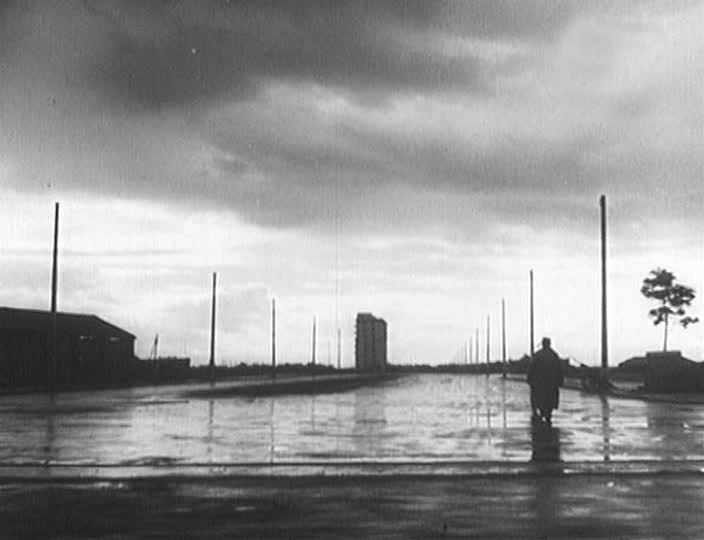
The film ends with a sweepingly romantic image of a solitary street-cleaner walking home after work, a black silhouette in the darkening evening, the city stretched out around him in a long shot that perfectly captures the urban romanticism of this image, very unlike later Antonioni but not unlike his noir-influenced feature debut Story of a Love Affair, which he would make two years later. The image also recalls Charlie Chaplin's Tramp figure, a suggestion that the romanticized homeless people and laborers of this film are derived from the example of the movies as much as from real life. Antonioni, making these small documentaries to observe the lives of ordinary people, was already crafting the foundation for the films he'd make as a mature filmmaker, already laying the groundwork for a cinema dealing with people and their surroundings, with the importance of work in modern society, and with the isolation and alienation of the individual in a society where individual lives are increasingly marginalized, like the ignored street-sweepers and bums of this short.

Monday, May 9, 2011

Red Desert


Michelangelo Antonioni is the cinema's greatest chronicler of the modern era's disconnection and dehumanization, of the existential dilemmas created by the modern way of life. His first color film, Red Desert, is yet another entry in his peak period's run of intense, stylistically profound variations on that signature theme. The film is set in a modern industrial zone, not an urban center but a desolate country harbor colonized by smoke-spewing factories, massive ships that drift by in the omnipresent fog, oil drilling platforms out in the ocean, barely visible from shore. The landscape of the region is a cold, foggy, smoke-filled wasteland, a bleak territory of small mud-puddle lakes with sleek black surfaces, chemicals glistening in multiple colors, green scum leaving behind a thick crust on the shore. It's always overcast. There's always a thick fog hanging in the air, making everything fuzzy and gray. The credits roll over a series of out-of-focus shots of the region, of smokestacks and gray factory buildings and grim landscapes that nearly look post-apocalyptic in their indistinct desolation. The first in-focus shot, after the credits, is a closeup of a plume of fire erupting from a factory smokestack. The symbolism could not be more obvious: this is Hell, a strange Hell where the air is cold and the only heat comes from the factories' never-ending industrial processes, from the burning of chemicals.

Wandering through this landscape is Giuliana (Monica Vitti), her crisp green coat a striking contrast against the colorlessness of the land around her. She seems to be dazed, utterly lost, acting in inexplicable ways. She's walking with her son, but seems to keep forgetting about him and leaving him behind, letting him wander off by himself, then belatedly remembering that he's with her. As the film progresses, it becomes apparent that she's losing her mind, a not so surprising state of affairs in a place like this. Giuliana's husband, Ugo (Carlo Chionetti), is an industrialist himself, a manager at one of the local factories, so in a sense the environment that's poisoning Giuliana is in part created by her own husband, who doesn't seem to understand his wife at all. Ugo seems to think of his wife's odd behavior and increasingly obvious depression as inconveniences, minor female hysteria that would go away if only she'd stop thinking about it. He is constantly away on business, leaving her alone, and when he hears that she's been in a car accident and is in the hospital (an event that happens before the start of the movie but lingers over everything that happens subsequently), he doesn't even return from a business trip once he learns that she's going to be alright.

Initially, it seems like Ugo's friend Corrado (Richard Harris) might be able to wake Giuliana out of her misery and aimlessness. He takes an immediate interest in her, really looking at her and trying to engage with her in a way her husband doesn't. They begin to seem like a couple, as wherever they go, Corrado walks with her at her meandering, dawdling pace while her husband impatiently strides ahead, all business. Corrado is also involved in industry, but unlike Ugo he seems conflicted by his work; he's been in many different businesses, always moving from place to place, simply abandoning his life and starting anew somewhere else. In one early scene, Ugo makes calls around to several factory managers he knows, trying to find workers for Corrado's newest project. Antonioni cuts to each place Ugo calls in turn, emphasizing the similarities between them: wherever he calls, smoke spews in the background, the clatter of industrial machinery nearly drowns out the conversations, huge pipes and banks of electronic devices with blinking lights and gauges dwarf the human workers. This is industry, this is progress, making every place the same, erasing the distinctions between places to install a uniformly sleek and gray modern façade that covers up one place after another. Maybe that's why Corrado is never satisfied no matter where he moves; each new home, each new city, is modeled on the old one.


If Ugo is indifferent to the costs of modernization — even laughing at a story of a restaurant customer who complained about fish that taste like petroleum — Corrado seems to feel a small measure of the discontentment that affects Giuliana so dramatically. In a meeting with his new workers, towards the end of the film, Corrado's gaze wanders over the workers' faces but drifts away from them towards the stacked crates behind them, towards the cracked paint on the walls of the warehouse. Antonioni's images create the impression that in this environment, the faces of the men, often filmed out-of-focus, are simply another part of this inhuman landscape, and the gaze inevitably glosses over them to look at the surroundings instead. It is a glimpse of how Giuliana sees her world, as a place where humanity itself is being effaced by its own creations, by its piles of consumer goods and the massive factories dedicated to their production.

Antonioni's aesthetic constantly reflects this dehumanization and destabilization. The ugly gray surroundings of the area are reflected in Antonioni's bleak, strikingly composed images, in which the color seems to have been drained out of almost everything, leaving behind pale, washed-out hues. Often, the background is made blurry and abstract, isolating Giuliana from her surroundings, so that her crisply focused face is contrasted against the out-of-focus haze of factories and industrial parks. The omnipresent fog adds to that hazy feeling, especially in a scene by the docks when Giuliana, Ugo and their friends run through the fog, disappearing into the gray tendrils that wrap around them. Standing in the fog, the people seem to be fading in and out of view, partially obscured, their expressions unreadable due to the filtering overlay of the fog. Giuliana faces her friends and her husband and sees only the uncomprehending blankness of their faces; they seem separated from her by an uncrossable gulf.

This is a potent depiction of a world in which human connection seems impossible. At best, there are cheap and tawdry facsimiles of connection, like a party that Giuliana, Ugo and Corrado go to with some friends, where everyone talks incessantly about sex and the whole thing seems constantly on the verge of breaking out into an orgy. The orgy never happens, though, in part because all these upper-class blank slates seem too lazy, too bored, even to really have sex — their lascivious but empty chatter is contrasted against a young working class girl who says she'd "rather do certain things than talk about them." But talk is all these bored bourgeois can muster. Even Giuliana's interactions with the men who love or want her seem oddly impersonal. Her husband, who ignores all her concerns and doesn't seem to know what to make of her depressed manner, paws at her and kisses her while she sobs and moans; unable to understand her pain, he tries to smother it with sex, not getting — or not caring — that she isn't likely to be soothed in this way. Ultimately, Corrado can only resort to the same solutions; when Giuliana comes running to Corrado for help late in the film, he takes advantage of her confusion and sorrow by taking her to bed, caressing her and stripping her while she cries, alternately pushing him away and seeming to pull him closer. Her isolation and anguish is so intense that she needs some companionship, some comfort, but none of these men can offer it to her in any real and lasting way.


After Giuliana and Corrado make love, the hotel room, which had previously had white walls, is suddenly painted a pale pink, and even the coffee cups on the bedside table are pink, as though the whole room had become a womb of flesh, encompassing the lovers, as though their skin-on-skin contact had begun to spread to the objects and constructions around them. This is a film about how environments and surroundings affect human relations and psychology, but the reverse is also true: modern people create the environments in which they live. Just as it's humanity's obsession with progress that leads to industrial expansion and pollution, this scene reflects the wish that human connection, however fleeting, could counteract the suffocating and alienating effects of the world. Instead, sex and "love" only offer up more pain and disappointment. Even motherhood is unsatisfying to Giuliana, whose son is virtually a mute prop, as disconnected as his mother, and who already shows signs of his mother's unpredictable responses to this alienating environment.

There is at least one beacon of light in this desolate world: the human imagination and the capacity for hope, the capacity to dream of a better world. At one point, trying to keep her son entertained while he's ill, Giuliana tells him a story, but it's no light bedtime story. It's a haunting parable of unspoiled natural peace and the constant threat of disruption that arises from human presence. In this story, there's a beautiful beach with pink sand and clear, blue water, and the only person around is a young girl with darkly tanned skin who swims in that bright blue water and lounges on the beach all day, as long as the sun is out. The style of this sequence differs drastically from the rest of the film, as the bright colors and clean, bold images contrast against the drab tones and fog that persist outside of this dream world. As Giuliana's voiceover describes the beauty of this place, the images present an idyllic paradise, totally unspoiled, no human activity except for the girl's unhurried, isolated enjoyment of the place's beauty. The only sound is the water lapping up on the shore, a hushed whisper accompanied by Antonioni's remarkably sensual closeup of the tiny waves lapping up against the shore, kicking up swirls of pink sand that turn the crests of these wavelets a pinkish hue.

This idyll is interrupted by the appearance of a mysterious boat, unpopulated by any visible human crew, which simply turns into the inlet, seems to look around, then sails away. It is an obvious indication that this isolated place could be spoiled at any time, that the big ships of industry, so inhuman and strange, could pull in at any time, muddying up that crystal-clear water, spewing filth to cover up the delicate pink of the sand. After the ship leaves, the story goes, the whole cove sings as a kind of beautifully sad warning, or a protest, a song of heartache and fear. As Giuliana's voiceover says that the cove was like a living being, Antonioni films the curved pink rocks surrounding the water like a woman's body, admiring the glistening accretions of sand and crystal in these rocks, admiring their graceful curves that at times look like a woman's breasts or the curve of her hips. In this deeply affecting parable, this place of natural beauty becomes a woman, welcoming and pure, whose beauty is threatened by the rape of industry.


That story is a vision of the world's beauty that seems far removed from reality as Giuliana knows it — but not from reality altogether. It's the world as it could be, and the world as it still is in some places. The mere possibility of this fantastic beauty, of this total communion between humanity and nature, is enough to soften the hard edges of industrial existence. Another scene, earlier in the film, seems like a slightly surreal dream but with a much less optimistic message. Giuliana wakes up in the middle of the night and finds, in her son's room, a grinning robot running back and forth on autopilot, crashing backwards into the wall and then running up against her son's bed, grinning all the while. Giuliana turns off the robot, which remains in the lower left corner of the frame, staring at the camera with glowing eyes, as she checks on her son. When she leaves and shuts the door, restoring the room to darkness, those glowing eyes are all that remain, two yellow orbs floating in the dark, an eerie mechanical stare watching over the sleeping boy.

That image is indicative of the film's general tone of industrial malaise. The soundtrack buzzes and hums with the sounds of machinery, the high-pitched subliminal whine of power transformers, these real sounds matched in the low-key electronic score of Vittorio Gelmetti, which burbles up every so often to further deepen the sense of anxiety. Antonioni carefully calibrates every aspect of the film so that each image becomes an expression of the characters' isolation, and the weight of the world that they feel so acutely. The scenery is almost studiously bland and gray, sometimes literally, as when Giuliana sees a fruit vendor whose wares are all painted gray, as though covered in a layer of ash. In Corrado's hotel, the whole lobby is a clean, clinical white, even the plants, their white stalks emerging from white soil and white pots. Antonioni has crafted a precise and deeply affecting portrait of the destruction of the human soul in the metal jaws of industry — and the nature of the continuing psychological and physical struggle against the oppressive environs we've created for ourselves as a society.