Monday, September 10, 2012

Intolerance


Boldly ambitious, staggeringly epic, and, for its time, remarkably experimental in its approach to narrative and themes, D.W. Griffith's Intolerance is justifiably a landmark of the silent cinema, perhaps even more so than its more famous (and infamous) predecessor in his oeuvre, The Birth of a Nation. This three-hour epic tells four stories set in four different eras, weaving the thematically related tales together throughout the film, cutting between eras to draw connections between them. In the most prominent story, set in the modern day, the lives of a young couple are torn apart by capitalist exploitation, self-righteous social reformers, and injustice. This intensely melodramatic romance is buttressed by three historical tales: the crucifixion of Jesus, the violence between Catholics and Huguenot Protestants in 1500s France, and the ancient war between Babylon and Persia, also rooted in religious strife. Of those three historical segments, only the Babylonian epic is really developed into its own story, nearly the equal of the modern story in terms of detail and screen time; the other two stories simply provide short sequences that serve as illustrations or parallels to the action in the modern and Babylonian stories.

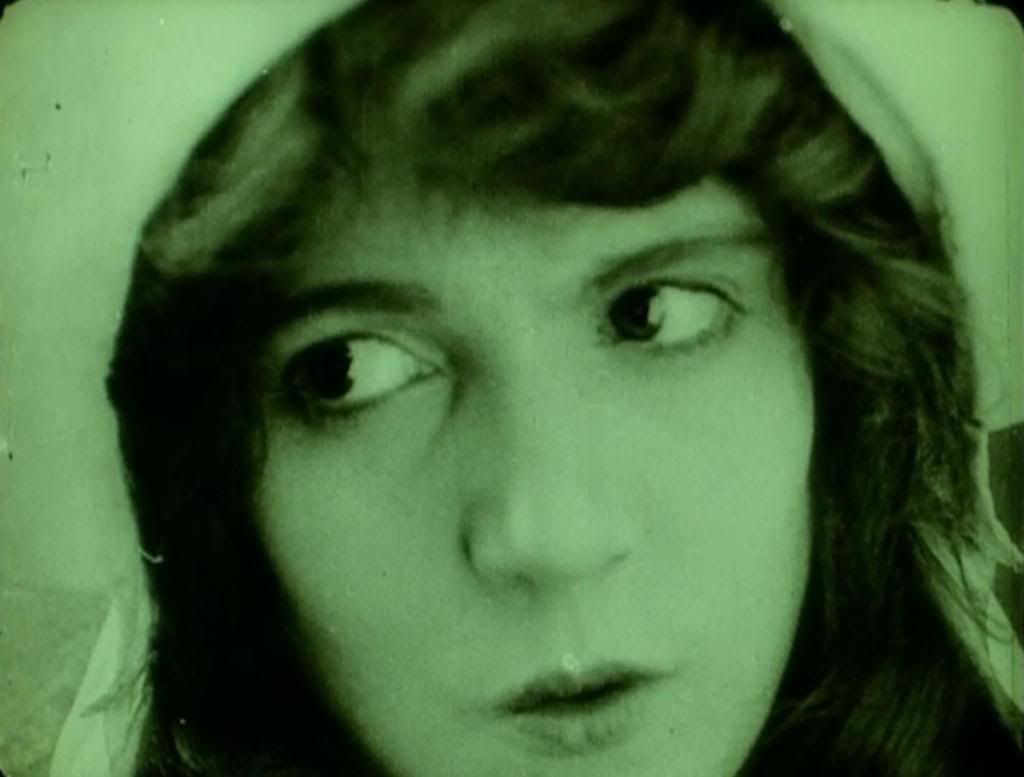
The film's sweeping scope and ambition are as dazzling as they are exhausting. Griffith hammers home his simple themes relentlessly, and everything is broad and lurid, the emotions rendered with big, sloppy outbursts of feeling. The emotions range from innocent love to craven jealousy or pettiness, and there's no middle ground, only these extremes of intense emotionality, delivered with grand gestures and shameless mugging. The acting is locked into this heightened register, especially the cutesy, girlish overemoting of both Constance Talmadge as the Mountain Girl of the Babylonian story and Mae Marsh as the cloyingly named Dear One in the modern romance. (Although Talmadge does provide one of the film's most endearing little moments, in a throwaway sequence in which, playing with a goat, she bites the animal's ear.)

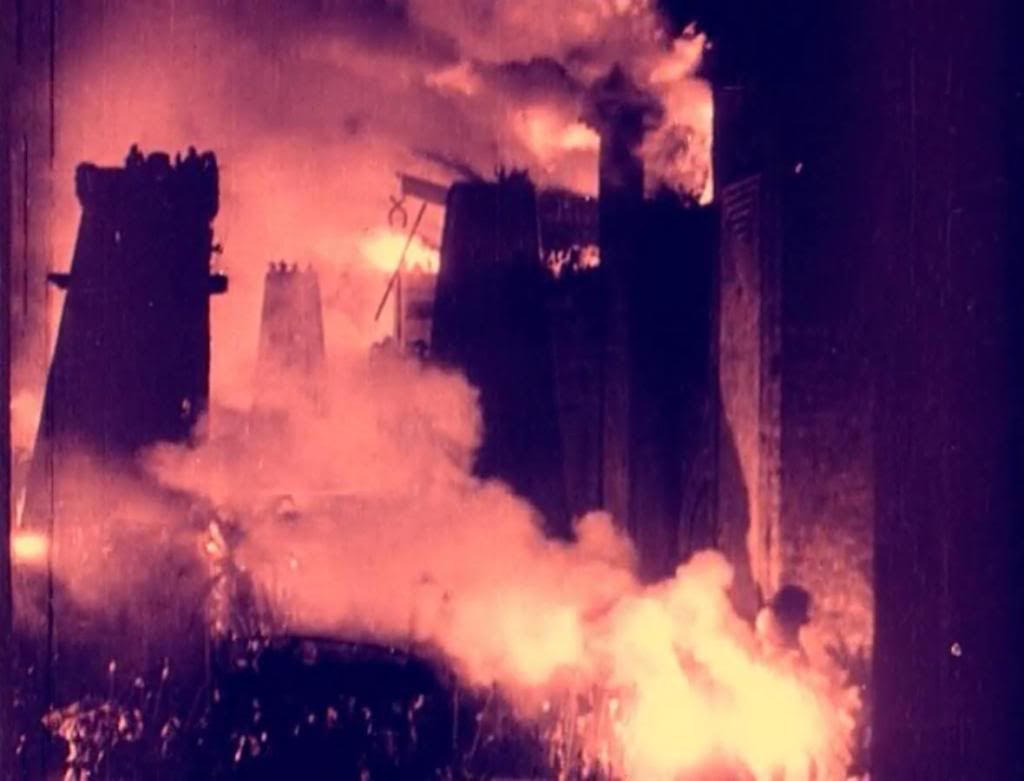
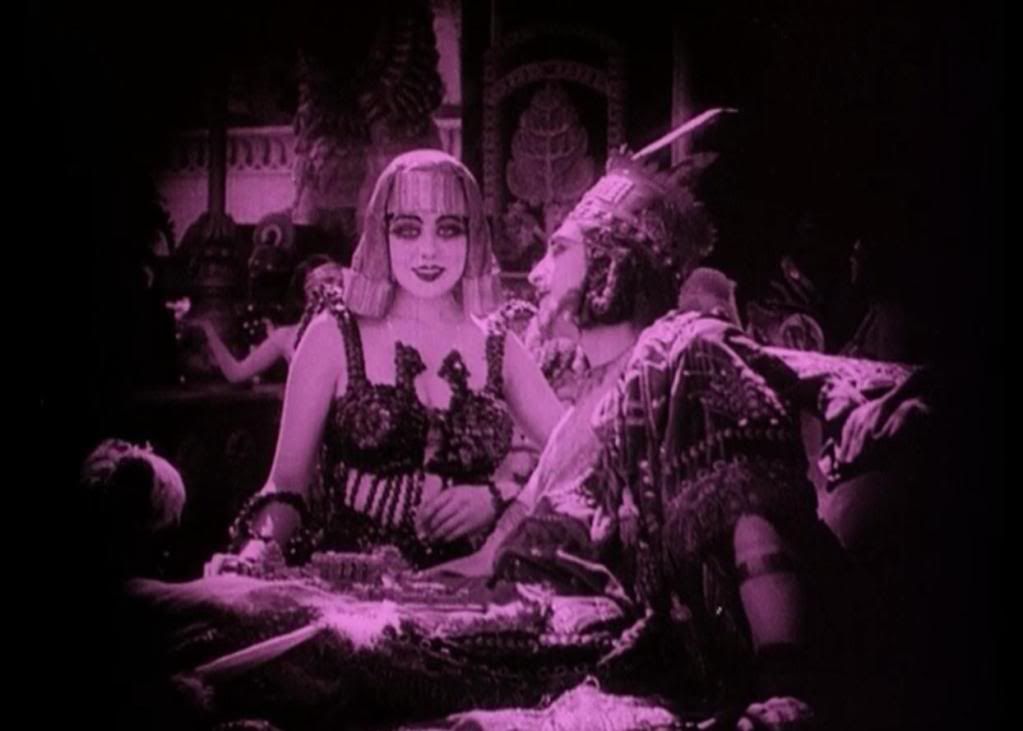
The Babylonian story fares best here, because it's naturally suited to the grandness and exaggeration that infuses the aesthetic and performative style dominating the movie. Everything about the Babylonian story is big and excessive, from its famous massive sets to its swarms of extras to its lavish feasts and battle scenes. The Babylonian story is an expression of pure sensual excess, filmed mostly in wide shots in which the frame seems to be packed with hordes of people, scurrying around the city like ants, dwarfed by the massive statues of rival gods and the towering walls of Babylon itself. The Mountain Girl's story exists at the fringes of the historical drama: her life is briefly touched by the Babylonian king Belshazzar (Alfred Paget), and she dedicates herself to him thereafter, doting on him from afar while he romances his beautiful Princess Beloved (Seena Owen) and wars with the advancing Persian armies. Whereas the modern story is a melodrama of individual romance and separation, the Babylonian part of the film is more abstract, its action occurring at a level where individuals are often mere specks in the corner of the frame. It's exhilarating and mad and frenzied, and packed with unforgettable images: most memorably, a tiny chariot pulled by white doves, carrying a flower between lovers, a concept that's poignant and hilarious at once.
Intolerance is kind of like that Alanis Morissette song about irony in which most of the verses aren't actually ironic; although Griffith keeps hammering home that his film is about the opposition between intolerance and love, most of the film's situations don't really chronicle intolerance as it's usually understood, so much as hypocrisy and injustice. At the core of the film is an opposition between carnality, physicality and freedom on the one hand, and repression, meddling and asceticism on the other. There's no question which side is favored by Griffith, who makes the film's celebrations of excess and bombast truly overwhelming — especially in the ecstatically sensual Babylonian thread, with its half-naked dancing girls and massive citywide parties — while viciously mocking the hypocritical champions of "reform" and restraint. Even Griffith's Jesus gets in on the act; it's no coincidence that Griffith makes sure to highlight, in his otherwise very abbreviated account of the New Testament, the miracle of turning water into wine, showing Jesus proudly presiding over a raucous party that can resume its boisterous course once the wine supply has been replenished.

Griffith makes the Pharisees' primary complaint about Jesus that he's "a winebibber" and a friend to lower-class rabble and sinners, thus paralleling the crusade against Jesus to the modern-day advocates of Prohibition, who ironically work in Jesus' name to prohibit fun and partying and pleasure. These no-fun old biddies are the real villains of the film, social reformers who are "intolerant" of anyone having fun. They're meddling hypocrites who use money taken from their connections with exploitative industrialist kingpins to restrict the activities of the very working class employees who are exploited by the reformers' capitalist supporters. There's also an obvious sexist undercurrent to Griffith's depiction of these crusaders, whose actions are explained in terms of their age and homeliness in a particularly egregious title card: "when women cease to attract men they often turn to Reform."

Beyond that nasty thread of sexism, there's an even more telling subtext to these denunciations of meddling reformers who couch their interference in terms of moral outrage. Griffith's previous feature, The Birth of a Nation, had been the subject of much protest and criticism for its infamously despicable depiction of black predation on white women and its lionization of the Ku Klux Klan. It's tempting to think that Griffith built his next film around the concept of "intolerance" by way of atonement, but the film itself is not an apology but an indignant rebuttal directed at the "intolerance" of his critics for the views expressed in his earlier film. Racial intolerance is not part of the brief here; rather, he's condemning the intolerance of those who try to reform society, imposing their ideas on others, and thus drawing parallels between social reformers decrying the treatment of blacks and those calling for the Prohibition of alcohol and other so-called social ills. At the heart of the film's concept of "tolerance" is the espousal of a live-and-let-live philosophy that's actually really objectionable when one realizes that Griffith seems to have in mind "tolerance" for bigots. Ironically, in Griffith's formulation, those protesting and pointing out intolerance are themselves the ones who are intolerant, presumably because they don't respect the ideas of bigots.

The film is curiously twisted in its themes and its subtexts, and when it's not offering backhanded stabs at the director's "intolerant" critics, it's delivering simplistic pleas to end all war and replace fighting with love. The film ends with a dazzlingly saccharine vision of a future without war, complete with heavenly hosts floating above a battlefield and a prison being replaced with a field of flowers. But if the film is ideologically suspect, historically inaccurate, and melodramatically overwrought, it's also undeniably exciting and finely crafted in terms of its aesthetics and the mechanical precision of Griffith's cross-cutting, here ratcheting up suspense and creating connections not just within the same story but between stories.

The apex of this approach is the thrilling climax, in which the Dear One's husband (Robert Harron), wrongly convicted of a crime, is set to be hanged. Griffith builds the suspense over the course of a solid half-hour, as the girl struggles to get the evidence to clear her man's name, then races to catch the governor, then races to the jail for a last-second rescue attempt. Griffith employs the signature cross-cutting that by this time he'd developed into a well-honed art, cutting between the condemned man's last rites and his long walk to the gallows, and the frantic activities of his wife as she pursues a train and speeds through the streets towards the jail. Griffith also elongates the suspenseful moment by cutting away to the other stories, in which there is no such suspense, but the predictably tragic climaxes of those tales — Babylon is sacked, Jesus is crucified, and the Catholics slaughter the Huguenots — provide a grim parallel to the likely outcome of the modern-day romance.

Griffith's command of cinematic language is what's most impressive today, looking beyond the film's many problems. The director's ability to use form to heighten the effect of narrative was unparalleled in the early cinema, particularly in his feel for grand action set pieces and endlessly building suspense. The Babylonian sequences also confirm the director's penchant for spectacle, with his camera sometimes even breaking free of the mostly static set-ups to drift gracefully closer to the action, tracking in from the epic wide shots to focus on some details within the sprawling chaos. It's no wonder that Erich von Stroheim, working as an assistant on the Babylonian parts of the film, was inspired by Griffith's dazzling spectacles. Intolerance as a whole is an uneven and contradictory experience, but the wild ambition and inventiveness of its director always show through, and partially redeem, even its worst failings.

Friday, September 7, 2012

Small Change


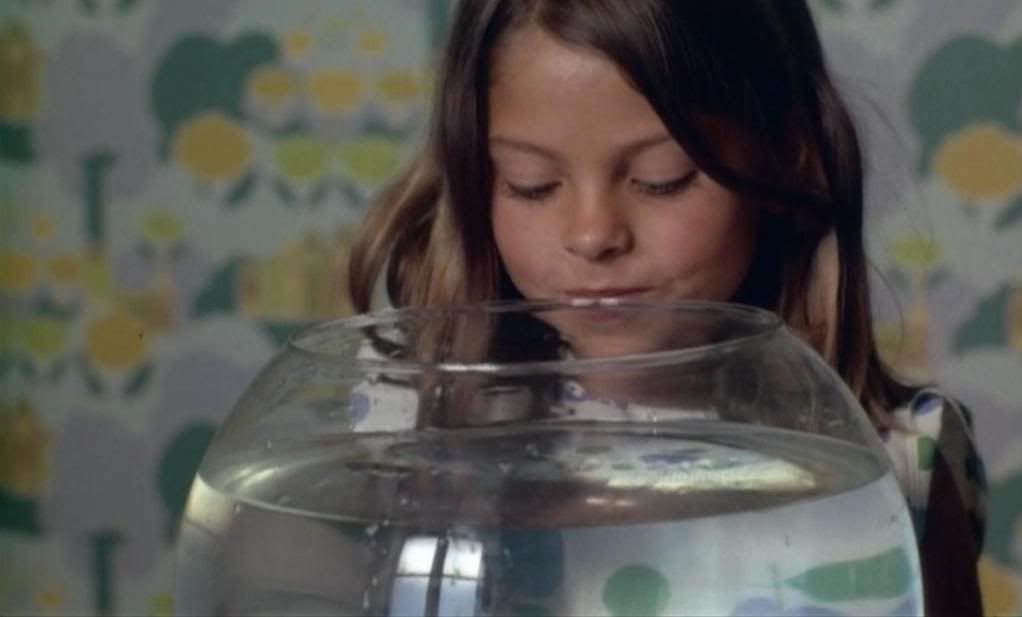
With Small Change, François Truffaut returns again to the topic of childhood, one of the recurring thematic focuses of his films ever since his famous debut feature The 400 Blows. It's a loose, anecdotal film, charming and sweet if perhaps also a little lightweight. There's little structure here, simply a series of vignettes involving various children living in a small town, as well as their teachers, particularly Richet (Jean-François Stévenin), whose wife is expecting a child of their own.

The film meanders along at an easy pace, bouncing lightly from one gently comic anecdote to another. One continuing subtext throughout the film is Truffaut's focus on the dawning of sexuality, the first stirrings of feelings about the opposite sex. The boys are always spying on girls, catching glimpses of one woman's skirt riding up as she bends over or another girl bathing herself, naked, in her window. These flashes of nudity and sensuality have the illicit erotic charge of something not fully understood but powerfully felt regardless. Similarly, Truffaut captures the infatuation of one boy, Patrick (Georges Desmouceaux), with his friend's mother (Tania Torrens), gazing rapturously at her and associating her with a poster he sees of a man and a woman on vacation in a train car, locked in a pose that, for the young boy, seems replete with sexual promise: Truffaut cuts rapidly back and forth between closeups of the man and the woman in the poster, as though visualizing the way that the boy tries to make sense of the obvious attraction between the poster's couple.

Truffaut also drops a few subtle movie references into the film, in particular to Hitchcock's Rear Window. Patrick's father is confined to a wheelchair, paralyzed, and at one point he looks out his window and sees a man in the opposite flat stringing film through reels for a projector. But the Rear Window references are most potently realized in a clever sequence where Sylvie (Sylvie Grezel) is left at home by her parents because she's being stubborn, so she appeals to her neighbors in the adjoining buildings by using a bullhorn to announce that she's hungry. Truffaut's camera pans around the courtyard, where all the residents gather at the windows, and finally conspire to use a basket and a pulley system — like the basket used to raise and lower a dog in Hitchcock's film — to deliver some food to Sylvie for her lunch.


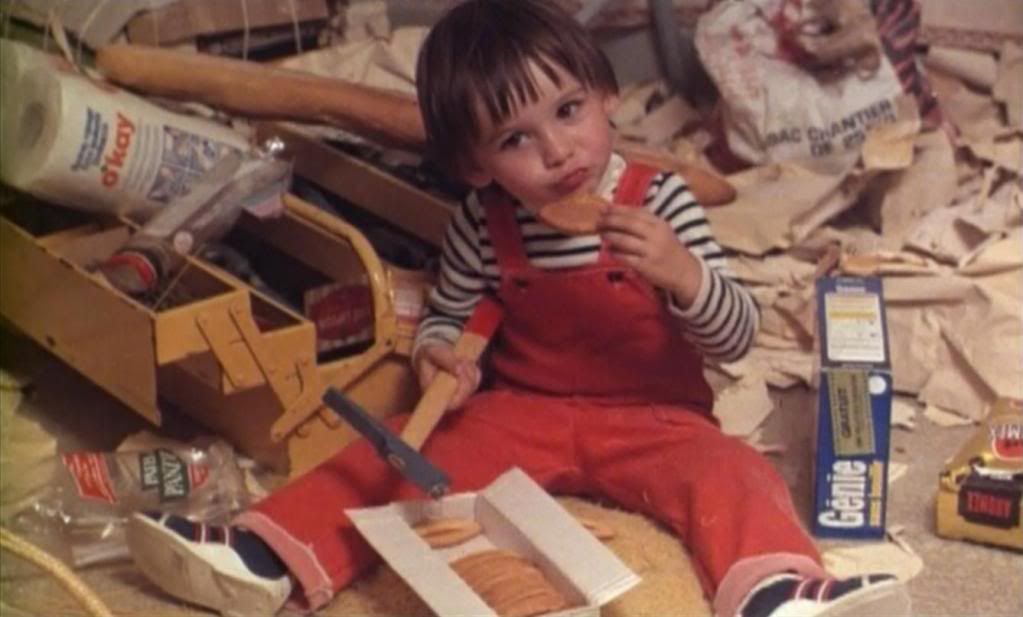
One curious scene is the one where the toddler Grégory plays with his cat by a window and hangs off the ledge when the cat falls to a lower balcony. Truffaut builds the obvious tension of this scene, in which the boy's mother has gone out and he's been left home alone, getting into a dangerous situation, edging into ever more precarious positions as he clambers clumsily along the balcony, hanging off the small rail that's the only protection between him and a fall of several stories. Down below, people start noticing and can only watch helplessly as the boy hangs off the rail and finally falls to the ground. At this point, Truffaut abruptly breaks the suspense by having the kid land on his butt and simply giggle, unfazed and unharmed by the fall, which in reality would certainly have injured him severely at the least. It's a totally puzzling scene, followed up by a conversation between Richet and his wife in which they conclude that kids are tougher than one thinks, which must be the trite moral that Truffaut wants to communicate here. But it comes off as a bizarre piece of fantasy, a surreal fracture in a film that is otherwise committed to low-key realism, really offputting in its casual dismissal of the danger of this scenario.

It's especially jarring because, while the film generally has a pretty light and rosy outlook on childhood, Truffaut doesn't flinch away from the story of Julien (Philippe Goldmann), a poor kid whose family is abusing and beating the boy, a discovery that only comes out during a school physical. This plotline is treated with real honesty and directness, and it provides the opportunity for a speech from Richet that sums up the movie's treatment of childhood: "life is hard, but it's wonderful."

For the most part, Truffaut leans more towards the "wonderful" here, and the film is charming and pleasant from beginning to end, with nicely naturalistic performances from all the amateur child actors. It's a low-key film, with only sporadic traces of the more emotionally intense approach to childhood that Truffaut had explored in The 400 Blows. For the most part, he gracefully and tastefully covers sexual awakening, friendship and teasing, petty stealing and pranks, with a light touch and a warm, affectionate sensibility. A sweet, unassuming film, Small Change is a slight trifle that's nevertheless often moving and quietly funny.

Wednesday, September 5, 2012

Madame Bovary


Claude Chabrol is so thoroughly associated with the genre of the thriller that it's always a surprise when he ventures outside its confines. Certainly, Flaubert's novel Madame Bovary is not what one expects of Chabrol; a period piece literary adaptation is very far from the director's familiar territory, even if this novel of a bourgeois woman's boredom and rebellion resonates thematically with Chabrol's usual topics. Chabrol plays it mostly straight, sticking faithfully to the source novel and delivering a dry, somewhat cool costume drama that doesn't really play to the director's strengths.

It's the story of Emma Bovary (Isabelle Huppert), married to the doctor Charles (Jean-François Balmer), who she soon realizes is a total bore, unable to provide her with the glamorous, exciting life that she dreams about. Dissatisfied with this dull marriage and her stultifying life as a homemaker, Emma alternates between periods of passionate affairs and wild spending, and periods of recommitment to the virtues of family and home. She has two torrid affairs, first with the sly playboy Rodolphe (Christophe Malavoy) and then with the sensitive young Leon (Lucas Belvaux), but neither of these loves can ultimately save her from the self-destructive streak that leads her closer and closer to oblivion.

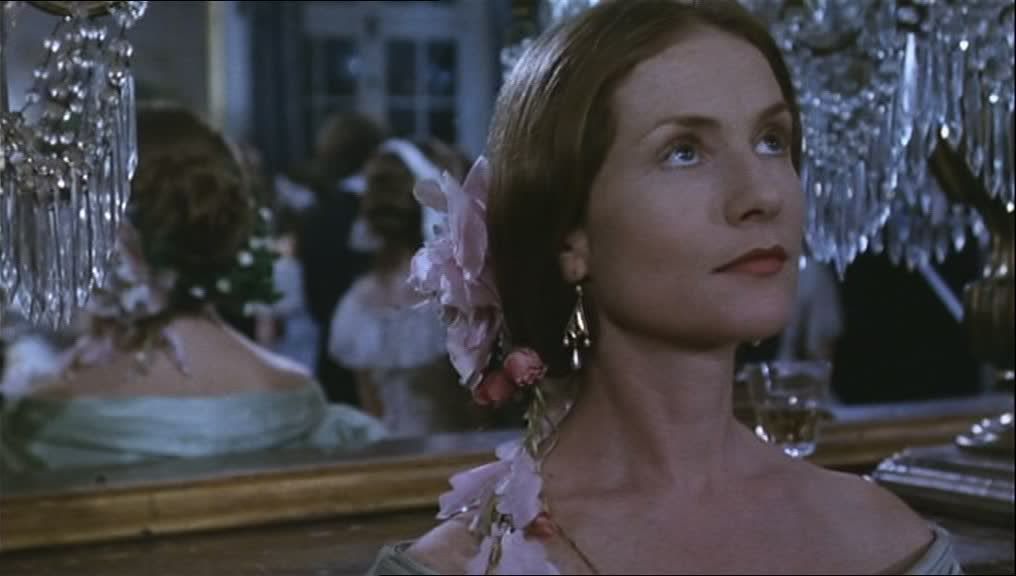
Emma is a romantic who's filled with dreams by the novels she reads as an escape from her dull, passionless husband, whose intellect she finds so wanting. Under the influence of her desire for Leon, she walks around her garden, practicing swooning declarations of love with a theatricality that obviously indicates she's acting out scenes, imagining her own life as a novel, playing herself as a character in a romantic book. She's filled with grand dreams that are very distinct from the unfulfilling life she actually leads. In one of her happiest moments, she and her husband are invited to a fancy ball by a local dignitary, and Emma is so overwhelmed by the glamour and finery on display that she nearly swoons with pleasure, drifting around the hall listening to the stimulating conversations that she'll never have at home with her husband.


Chabrol wittily stages the big seduction scene between Emma and Rodolphe by cutting back and forth between the couple and the agricultural fair going on outside. He alternates between Rodolphe's passionate come-ons to Emma and the awarding of prizes for best manure and best pigs and so on, cleverly subverting the romance of the scene with these earthy rural details. After all, for Rodolphe this is just a game, a conquest, while for Emma it's like a scene out of one of her beloved novels, the fulfillment of her dreams and secret desires — the romance is a sham, stained by baseness. When Emma rides with Rodolphe into the woods and finally gives in to her passions, it's obvious that she's acting, performing a role. She's more excited by the idea of this secret affair than she is by its reality, which is perhaps why Chabrol discreetly cuts away from the actual lovemaking. The real pleasure for Emma is not the actual sex but the romance and melodrama of it; she gets shivers of pleasure by looking in the mirror and saying, "I have a lover," pronouncing it with the wonder of a woman living out her literary fantasy.

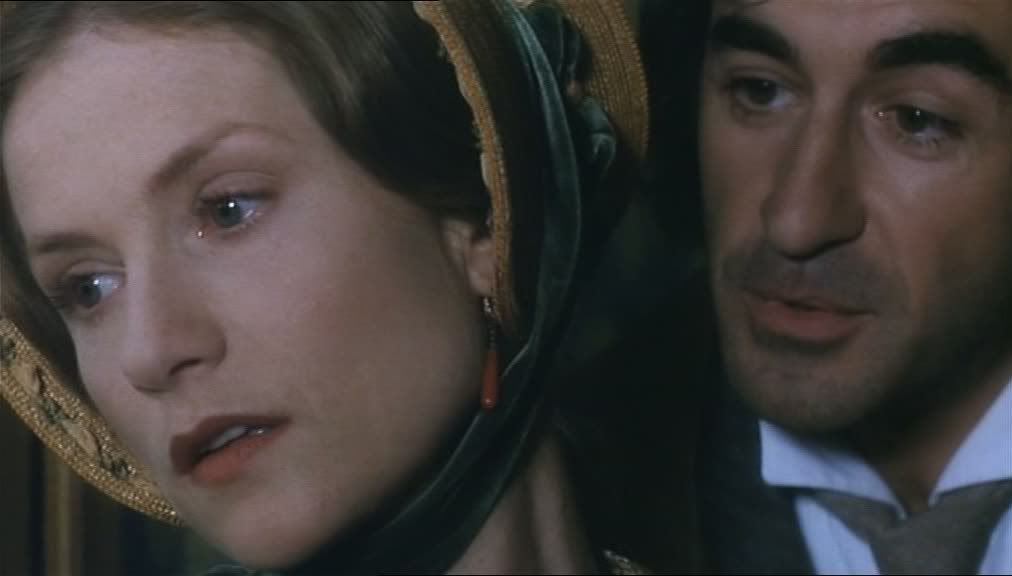
Emma is constantly searching for something, though she's not sure what it is, and one institution that the film repeatedly holds up as inconsequential is religion and the church, which offer scant comfort. She goes to see the village priest, but he just talks past her without really hearing her; submerged in the physical problems and poverty of his flock, he's unable, or unwilling, to appreciate the more metaphysical, less tangible problems that Emma wants to tell him about. The frustration of the shot is sublimely realized: while Emma stares straight ahead, her eyes wet, struggling to express her thoughts, the priest prattles on about the problems of his parishioners, oblivious to Emma's troubles — or, perhaps, deliberately stomping over them, trying to shame her out of her misery by pointing out how many worse problems are experienced by people of lower social classes.

The film is generally well-realized and well-acted, and moments like this are staged by Chabrol to maximize the emotional and thematic subtext of Emma's various encounters. The film as a whole, however, doesn't quite connect: it lacks the satirical bite of Chabrol's best work, despite the thematic continuity with his more personal works, and too much of it feels like a scrupulously faithful condensation of the source novel rather than the work of a director applying his own voice to this material.

Monday, September 3, 2012

Die Puppe


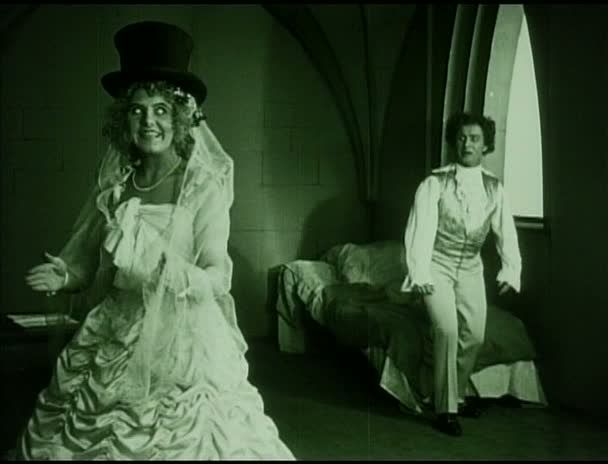
Ernst Lubitsch's Die Puppe is a delightfully kinky and absurd silent fantasia, a charming artifact of the master director's tenure in the German film industry before his emigration to Hollywood. Fast-paced and funny, it's a brilliant farce, a madcap and surreal confection that's a pleasure from start to finish. It's a celebration of artificiality and theatricality that opens with Lubitsch himself introducing the film by setting up a cardboard diorama, suggesting that he's about to act out a kind of cinematic puppet show.

Indeed, that's an appropriate reference point for a film that consistently deals with the slipping boundaries between the real and the artificial. This story of a girl mistaken for a doll takes place against a backdrop of blatantly cardboard sets, these flimsy-looking surroundings adding to the atmosphere of a strange fantasy, a children's puppet show with an adult theme. Lancelot (Hermann Thimig) is a fey and painfully shy young man who happens to be the only heir of his uncle, a wealthy baron (Max Kronert) who wants Lancelot to get married so that their line will carry on. The problem is that Lancelot is terrified of women, as evidenced by the comic chase sequence that results when a crowd of forty women come looking for the heir, pursuing him in their fever for such a prestigious marriage. Lancelot manages to escape to a monastery where he hides out, until his uncle puts out a newspaper ad promising a big dowry for Lancelot if he returns and gets married.

The greedy, corrupt monks concoct a clever and ridiculous plan: Lancelot will pretend to marry a life-like doll, get the money, and bring it back to the monastery. The only problem is that the doll, a perfect likeness of the dollmaker's daughter Ossi (Ossi Oswalda), is broken and replaced by the real girl, who pretends to be a doll while Lancelot carts her off for the fake wedding. What ensues is an utterly lunatic farce packed with naughty gags and innuendos. Oswalda delivers a delightful performance as the girl playing a doll, her face agilely contorting into gleeful grins and eye-rolling expressions of disdain whenever her hapless new husband isn't looking. She's clearly enjoying her ruse, and the wedding scene especially is packed with charming moments, as whenever Lancelot's back is turned, Ossi — who as a doll isn't getting any food or drink — grabs glasses of champagne to swig and gobbles down any food on the plates he leaves unattended.


There's also plenty of sexual subtext here. Lancelot's fear of women is absurd and caricatured, as he runs in terror from the hordes of women who desire him. He's so skittish that he even flinches away from the chorus line of dolls who dance and pose for him in the dollmaker's shop; when the dolls kick up their legs, he buries his head in his arms, crying that it's too risque. He's assiduously proper to the point of repression, and it's only with what he thinks is a fake woman — and a better-behaved one than those bold dancers — that he can get used to the idea of spending time with a woman. Lubitsch plays up the naughty subtext of this "doll" seducing and toying with the man: he starts to undress her and she resists, miming that she can dress herself, and later he undresses in front of her, using her extended arms as a coat rack, much to her annoyance. For Lancelot, marriage makes him quake in terror, and he enters into it in the most unromantic fashion. He buys his wife — with the understanding that he'll be paid back and then some for marrying her, making marriage a transaction twice over.

Lubitsch surrounds this sexual farce with a toy box aesthetic that enforces the essential unreality of the whole affair. A paper moon hangs in the sky at night, its frown turning to a grin when it sees the doll kiss the man. Lancelot rides his bride to their wedding in a carriage drawn, hilariously, by some of the most unconvincing fake horses ever imagined, obviously consisting of a pair of men inside a costume, with their legs sticking out of the cloth. As the coach driver prepares to depart, he notices that one of these "horses" has lost its tail, and without fuss he stoops down, picks it up, and reattaches it. It's a wonderful little moment that would break the film's fourth wall if there were really any to break in the first place, and it's also a sign of the lightness and playfulness of Lubitsch's approach. He lets all of the film's seams show, especially in its elaborate painted sets — every bit as stylized and expressionist as the next year's The Cabinet of Dr. Caligari, albeit in a very different way.

Die Puppe suggests just how early in Lubitsch's career the director's brilliant comedic sensibility was developed. Clever, witty, and sophisticated, this is pure Lubitsch, a delightfully fluffy and fun comedy with a bit of a wicked edge to its sugary aesthetic.