Friday, November 30, 2012

The Black Pirate


The Black Pirate is a swashbuckling pirate adventure, a showcase for the daring stunts and swordplay of silent action star Douglas Fairbanks. Made in 1926 and directed by Albert Parker, it was one of the first films shot entirely with the two-strip Technicolor process, which makes it one of the rare surviving silents shot in color. Fairbanks plays a nobleman, the sole survivor of a pirate attack that kills his father. He vows revenge on the pirates, though his plan to achieve that revenge is anything but logical, since it consists of joining the pirate band, becoming their leader, and teaching them to be better, more effective pirates, even helping them to hijack a ship while plotting against them.

It never makes much sense, but the silly plot (from a story by Fairbanks himself) provides ample excuse for Fairbanks to show off his exhilarating stuntwork and obvious love of physical feats of daring. He makes a much more convincing pirate than a nobleman, and he seems to enjoy inhabiting this role altogether too much for a man supposedly seeking revenge. To prove his worth to the band of pirates, he hijacks a ship singlehandedly, pulling up alongside it in disguise as a fisherman and swinging around all over the ship, cutting ropes and sails, sending watchmen flying up into the rigging and finally holding the whole crew hostage with a pair of imposing cannons. He does it all with a big, infectious grin on his face, his teeth shining as he leaps and soars through the ship's rigging and swings from one perch to another, clambering around with the agility of a monkey, gliding down the sail with his knife thrust into its fabric or swinging on ropes. Fairbanks always seems to be having a blast when pulling off these stunts, and his enthusiasm is what makes him so fun to watch.

In between the action scenes, the film flounders a bit, and Parker's direction is mostly static and workmanlike. One exception is a great celebratory shot towards the end of the film, after the action-packed battle scene climax — which itself mostly consists of Fairbanks' allies comically jumping on the pirates en masse as if they're playing football — in which Fairbanks is hoisted aloft by his soldiers. He's in the bottom of the ship's hold and is handed up from one set of hands to the next at each level of the ship, the camera tracking up with him while he simply poses heroically, flexing his muscles and grinning proudly, passively letting himself be carried up to the top deck. It's a gloriously silly and self-conscious affirmation of the hero's potency.


Despite Fairbanks' grinning bravado and the flimsy scenario, some grit is provided by making the pirates — with the exception of Fairbanks' one-armed sidekick (Donald Crisp) — credibly sinister. The film is fairly direct about the brutality of the pirates, particularly with regards to their leering intentions towards a princess (Billie Dove) who the crew takes captive. A few of the pirates fight over her and draw straws to see who takes possession of her, just as earlier they'd drawn straws to settle a struggle over a monkey they'd found. The parallel between the two scenes suggests that these bloodthirsty pirates look at women as property, and it's all too obvious what they want to do with this particular piece of property. Of course, Fairbanks protects her from the pirates' lust, and of course the pair falls in love with one another, though it's funny that the princess is visibly relieved, at the end of the film, when she learns that her paramour is not actually a good-hearted pirate but a duke — a potential class crisis averted!

Early on, there's an offhandedly shocking grisly moment in which one of the pirates' captives, trying to keep them from getting a cherished ring, swallows it. But the pirate captain (Anders Randolf) sees this and gestures towards the man. One of the pirates then strolls offscreen with a knife, and moments later wanders back into the frame, the knife and the front of his clothes coated in bright, sticky red, holding out the ring for his captain.

The color is what makes it so startling, and it's one of the best uses of the film's primitive Technicolor. The clunky, unreliable two-strip process results in a restricted palette of mainly reds and blues, sometimes mixed with queasy greens or purples. There's no potential here for subtle color effects, which might be why color film didn't really catch on in a big way until the later three-strip process. Even so, the novelty of a true color silent film, no matter how basic the color scheme, helps to set this film apart as more than the routine pirate adventure it otherwise is.

Wednesday, November 28, 2012

The Grapes of Death


The Grapes of Death marked a return to form for the idiosyncratic horror auteur Jean Rollin. After 1974's remarkable but commercially unsuccessful Lips of Blood, Rollin, unable to get even the typically miniscule budgets his particular brand of surreal, dreamlike horror required, began churning out straight-up softcore porn under the aliases Michael Gentil and Robert Xavier. The Grapes of Death, produced in 1978, four years after his last horror project, was Rollin's retreat from the adult film ghetto. It's a fantastic return, too, with Rollin tackling the zombie genre and adapting his sensual, hypnotic aesthetic to this creepy tale of a rural wine-producing region overrun by shambling, rotting, diseased and insane farmers.

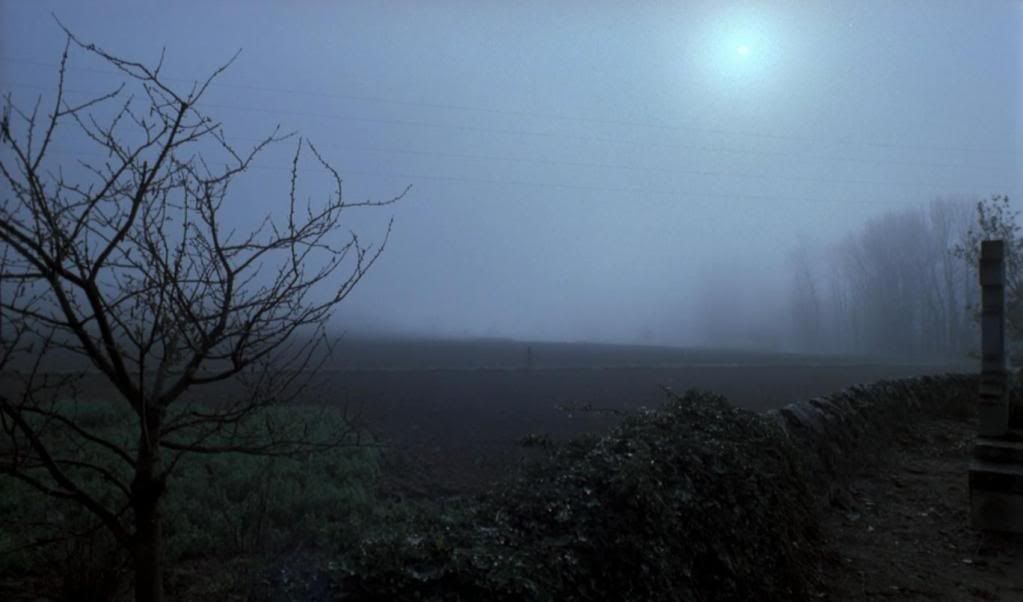
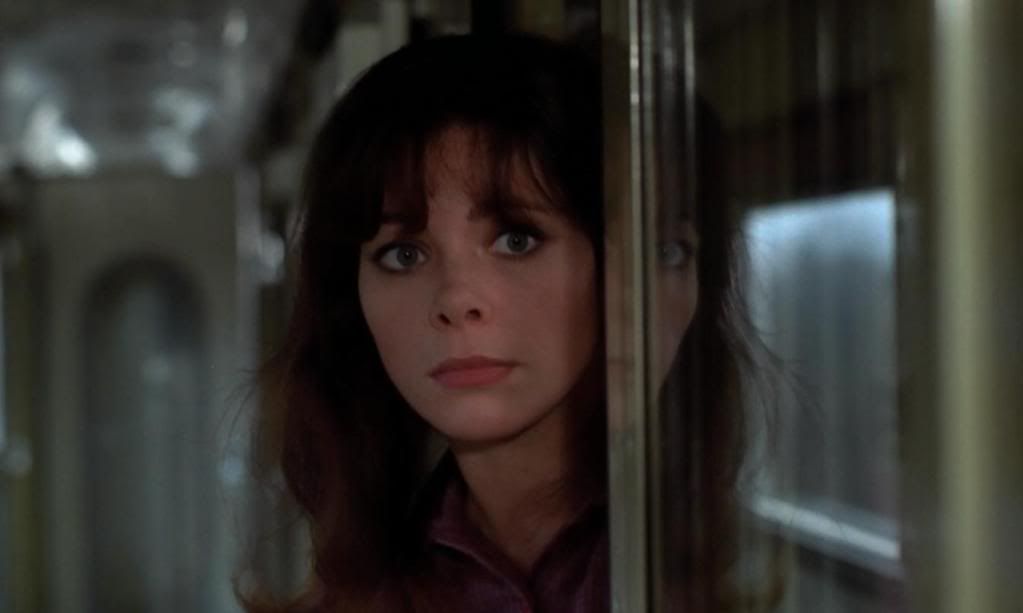
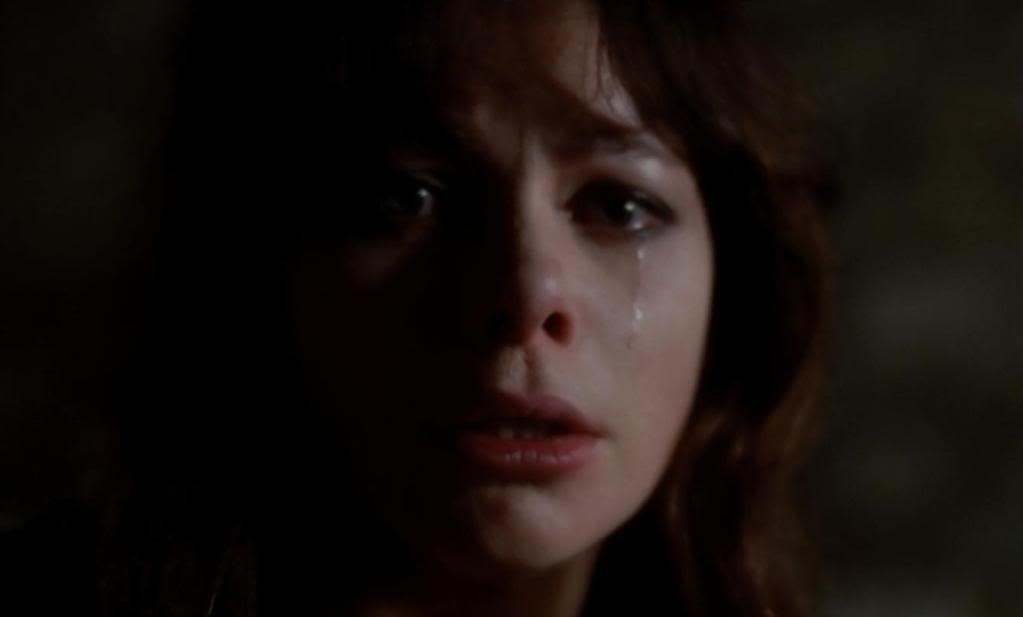
This decay of civilization is seen through the eyes of Élisabeth (Marie-Georges Pascal), a young woman who's planning to visit her fiancé at the winery he manages. Instead, her train journey is interrupted by a zombified man who kills her friend and chases her off the train into a typically desolate Rollinesque countryside. This rural landscape is alternately brightly sunny and shrouded in fog, utterly without logic or concern for continuity. The film has a strangely gorgeous, pastoral atmosphere that clashes against the periodic outbursts of sloppy gore and disgusting, smeary makeup effects. Fleeing from her zombie pursuer, Élisabeth runs across a foggy bridge, surrounded in fluffy white clouds, then runs into a large open meadow that Rollin films in a stunning wide shot, the sun a glowing blue pinprick just barely cutting through the thick soup of the fog. Élisabeth arrives at a cemetery, looming out of the fog with massive stone crosses atop its locked gate, but soon after, the fog disappears in between shots, and the heroine is running across a rocky, barren hillside, bathed in gorgeous summery sun.

Weather and landscape are both prone to this kind of slippage in Rollin's films, with their uneven regard for the niceties of continuity. The countryside itself provides many of the chills here, with this terrified young woman stumbling across this desolate, unwelcoming land, coming across crumbling stone buildings in various states of decay and destruction, as though the land was already abandoned and falling apart long before this zombie plague further decimated the region. Rollin has always loved the gothic ruin of collapsing castles and old buildings situated in bleakly beautiful, unpopulated surroundings. He makes these scenes both sinister and oddly appealing, because he's obvious fascinated by the poetic ruin of these landscapes even as he uses them as foreboding settings for tales of death and terror.


Rollin is adept at finding a languid, melancholy form of poetry in the trashy, violent, sexually charged B-movie material that drives the often fragmented narratives of his films. Here, he makes his zombies more sad than terrifying, as they stumble around, their faces melting with oozing open sores that pour multicolored liquids down their cheeks and over their foreheads. The effects are primitive and ugly, and also somewhat disgusting — especially in the disturbing scene where one zombie repeatedly smashes his head against a car's window, leaving pus-yellow streaks on the glass until he finally manages to shatter it. Rollin makes this zombie plague explicitly a kind of disease, caused by pesticides used on wine grapes, and the sufferers of the plague are in various states of mental and physical decay, some of them utterly blank, their minds erased, and others tragically seeming to understand that they're losing their minds and being possessed by violent urges.

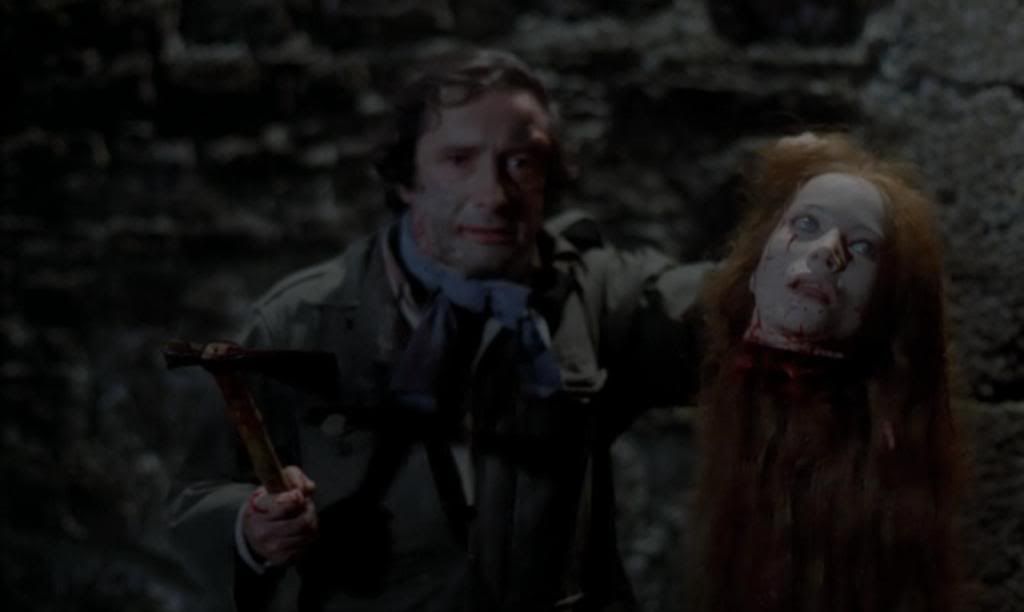
There's a strange poignancy to these zombies. When the initial zombie is first chasing Élisabeth, he abruptly gets tired and slumps down to a seat on the railroad tracks, cradling his head in his hands, exhausted and frustrated; Rollin, interestingly, pauses to consider the emotions of the zombie, too tired to continue chasing his prey. Later, Rollin gives one of the zombies a surprisingly affecting (and creepy) death scene, using the last of his energy to bloodily kiss the severed head of the woman he'd loved and killed, whose head he'd been carrying around in front of him like a talisman ever since.


Élisabeth's journey across the countryside is structured around her encounters with various people affected in various ways by the plague. She leads the blind woman Lucie (Mirella Rancelot) through the wasteland of a ruined, burning village with dead bodies strewn everywhere, the blind woman unable to see the wreckage all around her — and later, unable to see the zombies, her former neighbors, gathering around her and slowly closing in. Towards the end of the film, Élisabeth falls in with a pair of farmers, unaffected by the disease because they drink beer instead of wine, who provide an opportunity for a sudden diversion into political commentary. The action suddenly halts for these two to briefly discuss politics, improbably connecting the zombie outbreak to the French Resistance and modern anti-militarism. It's such a clumsy and truncated bit of forced commentary that it almost feels like a parody of the kind of social issue messages that, following George Romero, have become de rigeur for zombie movies.

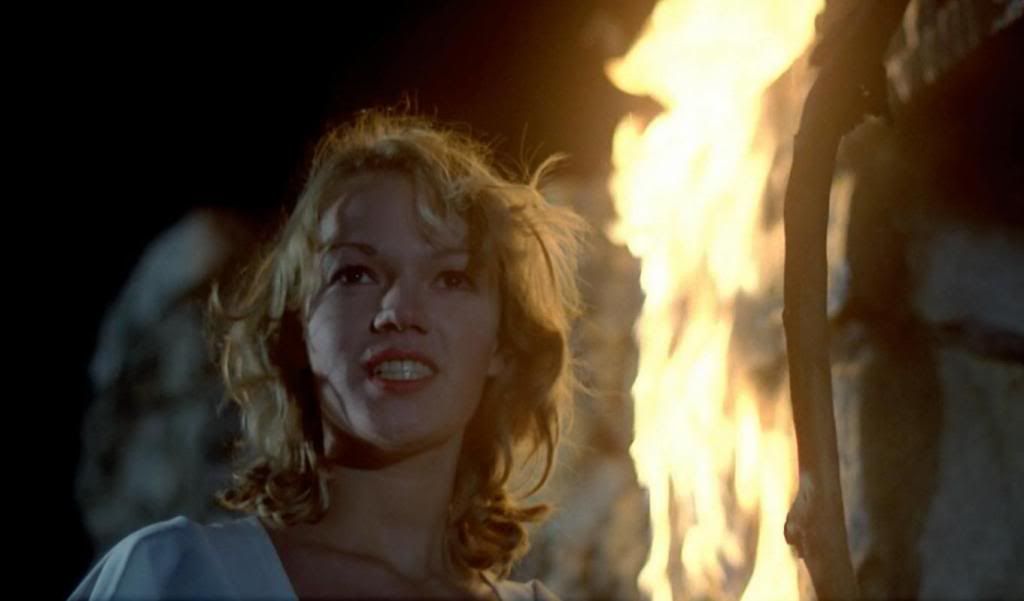
The film's most memorable cameo appearance comes from Brigitte Lahaie, an adult film actress who had appeared in one of Rollin's earlier porn ventures, and had apparently impressed the director: she'd go on to be an important muse in his next few features, and is here already a formidable screen presence. Her unnamed character (appropriately credited only as "la grande femme blonde") is a mysterious woman who Élisabeth encounters while fleeing from the zombies. Seemingly unaffected by the plague — in a typical Rollin flourish, she eagerly shows off her naked body to reveal the lack of rotting wounds — she nevertheless projects a curious, magnetic menace in her ferocious, teeth-baring smile. Her teeth permanently clenched, she looks like she's either holding back some intense inner turmoil or preparing to devour anyone in her path. She makes only a brief appearance here, but her unhinged, terrifying performance is unforgettable, especially since she also strikes some unexpected notes of poignancy within this portrayal of a deranged psychopath.

Moody, chilling, poetic and strangely moving, The Grapes of Wrath is another fantastic, utterly original horror piece from Rollin. It's slightly more straightforward and conventionally horrific than many of his earlier films, with more gore and action, but it's still primarily reliant on its dreamlike atmosphere, on the sense of an eerie journey across a haunted wasteland where the terror arises as much from the abstract aesthetics as from the actual supernatural or monstrous threat.

Monday, November 26, 2012

Pandora's Box


Pandora's Box was director Georg Wilhelm Pabst's first collaboration with actress Louise Brooks, who the director had discovered in Howard Hawks' A Girl in Every Port. As in that film, Brooks is a template for the femme fatale, a seductress who leads men into temptation and self-destruction while, strangely enough, retaining her own almost childlike innocence. Her character in Pabst's film, Lulu, was Brooks' most enduring and iconic creation, the part for which she will always be remembered. Pabst's film is built around her, and it succeeds almost entirely because Pabst is so adept at highlighting and channeling the actress' magnetic charm, her absolutely unparalleled ability to light up a screen with the sheer beauty and poignancy of her face.

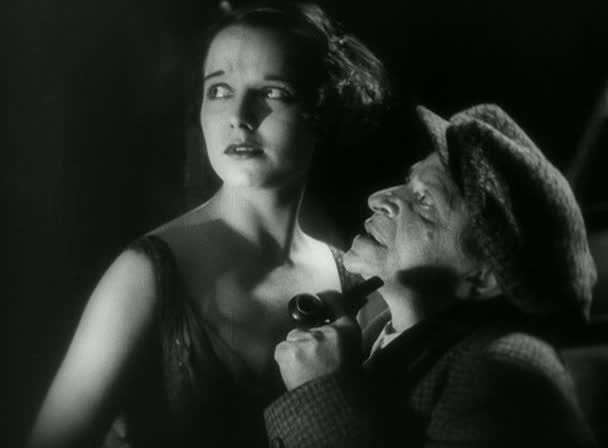
Brooks' charisma is so vital to the film because Lulu could have been a very unappealing character if embodied by a less iconic actress. Lulu is a prostitute and aspiring dancer, a frivolous and cheery woman who's totally unconcerned with morals. When her latest wealthy lover, Dr. Schön (Fritz Kortner), tells her at the beginning of the film that he's getting married to someone else, she shrugs and tells him that's no reason not to kiss her. Lulu's all about pleasure, and about living in the moment: when she's with a man, her casual intimacy and ready smiles convey the impression that he's the only man in the world, but she's able to easily skip from one man to the next, turning that radiant charm on each in turn, without any compunctions about her amoral behavior. The film's opening scenes quickly convey what this woman is about, as she cheerfully parts with one of her clients, acting tender and accommodating with him until the moment that her beloved old "patron" Schigolch (Carl Goetz) shows up, at which point the client is forgotten as Lulu pours her affection onto her former pimp instead. And then, when Schön arrives, Lulu just tucks Schigolch in a corner and devotes herself to the doctor. The whole sequence is like seeing a microcosm of Lulu's serial bed-hopping, her whole life condensed into a few minutes.

Schön is a respectable upper-class man who knows all too well that his affair with Lulu is tainting his reputation, but he can't quite manage to disengage himself; even when he finally breaks off his affair with Lulu to marry a woman of his own class, he remains involved with Lulu's life, managing the variety show that marks Lulu's debut as a dancer. Schön repeatedly says that his affair with Lulu will lead to his death, driving home the foreshadowing of his end, and the knowledge of it weighs heavy on him, making him a lugubrious counterpoint to the sprightly and carefree Lulu.

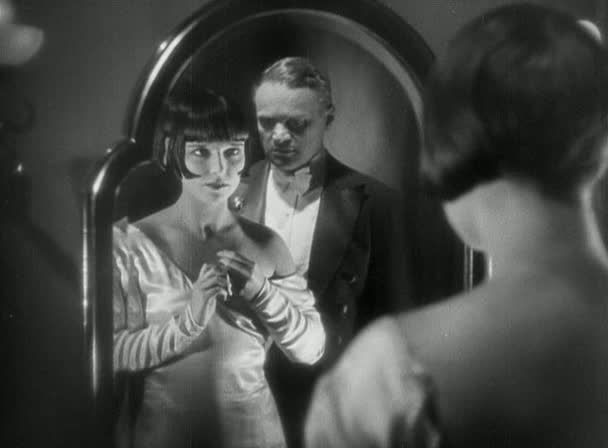
Indeed, Lulu can seem downright cold-hearted in her selfishness. After the film's central tragedy, Lulu returns to the house Schön had kept for her, and far from seeming distraught by what had happened, she's delighted to be reunited with her clothes and possessions, happily rifling through her closet and posing in front of a mirror. While she ignores the meaning of this place and what had happened here, Pabst keeps highlighting the tragedy by calling attention to a striking sculpture of a woman twisted into a pose of suffering and prayer, a piece of art that had hovered portentously in the background of the earlier scenes of tragic violence. The woman, with her short hair echoing Lulu's distinctive bob-cut, seems like a foreboding sign of what's in store for the film's heroine, though Lulu, despite being a victim as often as an instigator, rarely seems to suffer, not truly — most of the time, she uses her tears and her tantrums as a tool, a way to sway men to her cause.


Despite that calculating streak, Lulu never seems really evil, just self-absorbed, and at times genuinely unaware of the volcanic effect that she can have on men. When she's placed on trial halfway through the film, the prosecuting lawyer compares her to Pandora, beautiful and irresistible but possessing a box full of evil that she somewhat haplessly unleashes upon the world. It's an apt comparison, because Lulu doesn't fully understand what she's doing to those around her, in part because she's not thinking about them — she only cares about her own comfort and happiness. Because she laughs it off every time she's caught in an indiscretion, she expects everyone else to be similarly accommodating.

And yet there's also an undercurrent of deeper emotion within Lulu, whose childlike emphasis on constant pleasure seems to stem from a fear of what might have happened if she stopped having fun for a moment. There's a definite desperation to Lulu's constant pleasure-seeking, which is explained several times in terms of her difficult childhood. Her most poignant scene is probably her trial, in which Pabst and Brooks cleverly suggest everything about Lulu's mental state through her manipulations of the thin veil she wears. Lulu feels the eyes of the crowd on her and instinctively pulls her veil down over her face, hiding from them, for once unhappy to be the center of attention. Mere moments later, though, she stands and holds the veil away from her face to deliver an impassioned plea for her innocence, and then, in a remarkable shot, she lets the veil fall back over her face as she sits down, the veil fluttering around her face as she gracefully descends. This simple moment is utterly poetic and beautiful, abstractly suggesting the effect of this situation on Lulu. Pabst also locates a strangely melancholy, even almost romantic, vibe in the film's closing scenes, when Lulu encounters the sinister but handsome Jack the Ripper (Gustav Diessl) prowling the London streets. Lulu's appeal is so enticing that she even, for a time at least, calms the bloodlust of the notorious killer, and these scenes are infused with an unsettling tenderness, as though there's a deep and surprising connection between the notorious killer and the sweet, smiling prostitute who now seems sadder than ever behind her smile.

Pandora's Box is justifiably known as the defining role of Brooks' career. Pabst and Brooks would follow up this success with the equally great Diary of a Lost Girl, in which Brooks would play a more purely innocent suffering woman rather than the complicated mix of naïveté and conniving that she embodies here. Brooks' Lulu is a woman in trouble, a troubled woman, or maybe just trouble, but there's no question that she's utterly mesmerizing to watch, and Pabst perfectly captures her luminous qualities. The film's melodramatic narrative, which puts Lulu through a series of increasingly demeaning tragedies, is balanced by the combination of realism and stylized glamour in Pabst's aesthetic, making this one of the great collaborations between a director and an actress.

Friday, November 23, 2012

Lightnin'


John Ford's Lightnin' is a modest, low-key little silent comedy that concentrates entirely on the folksy humor that often populates the fringes of Ford's films. The prospect of an entire film that focuses on what serves as not-always-welcome cornpone comic relief in Ford's more serious works isn't necessarily appealing, but there's some modest enjoyment to be found in Lightnin' anyway, at least before it gets bogged down in sentiment and turgid courtroom drama in its second half.

The film opens with an extended introduction for the old-timer "Lightnin' Bill" Jones (Jay Hunt) and his pal Zeb (Otis Harlan), two amiable drunks who will go to any lengths to get a drink. Bill and his shrewish wife (Edythe Chapman) run a curious hotel that straddles the Nevada/California border, so that married women can stay in Nevada while awaiting a divorce but still get their mail sent to California to avoid the shame of staying at a Nevada hotel. Ford sets a meandering, somewhat ramshackle pace, focusing on the shenanigans of Bill and Zeb as they dig up various buried booze bottles while trying to avoid the disapproving eye of Mrs. Jones. There are some decent running gags here, especially involving Bill's dog, who dutifully tracks down hidden bottles of alcohol and fetches them for Bill.

Eventually, the film ambles along into an actual plot, involving a band of corrupt land barons who are trying to swindle the Joneses out of their property, with Bill resisting at the advice of his young friend John Marvin (Wallace MacDonald), who knows all too well that this deal isn't on the level, since the same gang swindled his family. Marvin's also wanted by the police, since he took his land back by force from the crooks. This provides an opportunity for Ford to establish a comic situation similar to that of Buster Keaton's Our Hospitality, with the local sheriff unable to issue his Nevada warrant on Marvin as long as he remains on the California side of the Jones hotel. Ford never really takes advantage of the comic potential of these situations; he's not a really great comic director, though he has an undeniable feel for this kind of folksy rural milieu, including the corny humor and stock types that come with the territory.


The film's sentimental plot and old-fashioned humor mean that its appeal is fairly limited, and its deliberate pacing doesn't help. In the second half of the film, the plot leads to a courtroom drama with Mrs. Jones requesting a divorce from Bill, talked into it by the crooked men trying to take her land. At this point, the film slows to a crawl and, at the finale, gets totally overwhelmed by predictably sentimental hokum, culminating with Bill's earnest speech in which he wins back his wife. Despite the lame plot and down-home humor, Ford provides some occasional visual interest and poignancy to the film, much of it focusing on the relationship between John Marvin and the Joneses' daughter Millie (Madge Bellamy).

At one point, Millie, playing up her anger at John, prepares a meal for him anyway, leaving a note beside it to remind him that she's still angry at him despite her gesture. While he eats at the table in the foreground, she's in the doorway in the background, facing away from him and from the camera. The composition dramatizes the conflict between the young lovers while also emphasizing that the girl's anger is to some degree theatrical, a pose, and that despite her turned back she's still connected to John. The doorway also adds to the tension of the shot; it's not the typical Fordian doorway shot with an outsider isolated from the home, but as always in Ford the threshold of the house is made to seem like a site of great import. Here, perhaps, because the girl is still inside the house, not separated from her lover by the doorway, it's a way of confirming that the break between them is not decisive. Soon after, she does lock him out so that he's on one side of the door and she's on the other — after he has the nerve to kiss her — but the way that she caresses the door in his absence once again confirms her longing for him. The staging of these scenes is consistently clever, delving into the contradictions between surface separation and subterranean connection.

Such moments reveal Ford's sensibility even when working with some rather weak material. Lightnin' isn't one of Ford's better or more revealing silents, but with its sporadically striking images and an early example of Ford's love of folksy comic archetypes, it's well worth seeing for devotees of the director.