Tuesday, February 9, 2010

Four Marie Menken shorts

[This is part of a series of posts in which I explore the work of the Austrian DVD label Index DVD. This company has released a great deal of valuable European experimental cinema onto DVD, naturally focusing on the Austrian underground but occasionally branching out as well. Index's DVDs are distributed in the US by Erstwhile Records, so anyone intrigued by Index's catalog should take a look and support the fine work both these companies are doing for obscure and avant-garde cinema. The short films below, with the exception of Go! Go! Go!, are included on Index's DVD of the documentary Notes on Marie Menken; that film is reviewed here and Menken's other short Lights is reviewed here.]


Marie Menken was an influential early pioneer in experimental film, a key figure in the development of the American avant-garde. Visual Variations on Noguchi, originally made in 1945, was her first film, a study of a set of sculptures by Isamu Noguchi. These sculptures are smooth, rounded abstract forms, and Menken impressionistically runs her camera along the curved surfaces of these sculptures, infusing movement into the static forms through her explorations. She examines the surfaces and shapes of these sculptures in patient pans across their surfaces, occasionally honing in on the detail of a textured curve, and montaging everything together with a loose, ragged aesthetic that contrasts against the fluidity of the forms. The jump-cuts and quick montage of Menken's aesthetic creates a jagged impression that works against Noguchi's amorphous blobs and graceful limb-like extensions.

Menken also added, for a 1955 re-envisioning of this film, a bold soundtrack created by Lucia Dlugoszewski. This clanging, clattering free improv is composed of pounding piano, trashy drums, scraped string feedback and occasional outbursts of talking, listing off names. The jittery, abrasive music clashes against the smoothness of the sculptures, further adding to the film's sense of opposites careening off one another. Menken made this new soundtrack version the definitive cut of her film, and with good reason. The music is one more contrasting element in a film where everything clashes against everything else: Menken is bringing together different aesthetics and sensibilities into a single space, allowing diverse artistic ideas to collide and enrich one another. Thus the simple, graceful forms of Noguchi's sculptures ricochet against Menken's rapid editing and the cacophony of the score. It is this sense of opposition, of contrast, that lends weight to Menken's precise, intimate examination of the sculptures.


Glimpse of the Garden is a simple, unassuming observational film. In this brief film, Marie Menken carefully probes the layers of a lush garden, shifting from the macro to the micro and then back again. She collages together images that nudge into the hidden details within the greenery that surrounds her. Extreme closeups of garden plants and insects alike reveal details and textures, thin hairs, protrusions, ridges and stalks that transform this hidden micro world into a whole universe. She accompanies these images with a soundtrack consisting of processed bird and insect noises: reedy trills vibrating in clustered rhythmic pulsations. The slightly off-kilter bird calls resonate with the imagery, in which natural elements are made to seem strange and alien, as Menken peers into the center of a flower or pans her camera up a stem, examining the bumps and grooves in the plant's flesh.

As always in Menken's cinema, the editing is crucial to the effect. Her sense of pacing is intuitive, as she delivers a constant barrage of colorful, sensuous imagery, shifting from streams of foliage that rush by so fast that individual images can hardly be grasped, to moments when she slows down to observe the flowers more closely. She also delivers a gorgeously dark, haunting final shot of what appears to be a watery midnight-blue sky rippling above a black filigree of tree branches. It's a mysterious, beautiful image, a fitting capper to a film that unexpectedly locates the mystery and strangeness within the ordinary. The film has the air of a home movie, a stripped-down and simple work, and this casual, amateur mood lends it a certain laidback charm that makes its more abstract imagery all the more striking.


Arabesque for Kenneth Anger is Marie Menken's tribute to her fellow avant-garde filmmaker, Kenneth Anger, whose influence obviously looms large over this expressive, evocative short. The film, shot in a Moorish palace in Spain over the course of an afternoon, is concerned, as Anger always was, with light and color, and especially with the ways in which forms could be made to interact with the tempos of music and cutting. The film is set to a lively score by composer Teiji Ito, who combines Spanish guitar and castanet motifs with Japanese-influenced reeds, resulting in a driving, vivacious score that's perfectly suited to Menken's imagery. Although the score was made later, to fit the short, the film sometimes seems to move with the tempo of the music, as when the circular ripples in a puddle dance to the beat of the snapping castanets. Even better is a wonderful section where the film takes on the stuttery rhythm of the percussion as the frame seems to jump and skip, giving the illusion of a sideways motion through a courtyard but in fact repeatedly returning to the same spot again and again. The black edges of the frame take on the function of cutaway walls, so that the viewer is faked out into believing that the camera is moving from one room to the next. It's a compelling image of being in constant motion while never quite going anywhere; the camera is essentially running in place.

With its driving rhythms and free-associative editing, the film is a fitting tribute to Anger, who Menken also nods to with repeated shots of fountains, the streams of water glistening and letting off a crystalline spray of droplets. It's an obvious visual homage to Anger's gorgeous Eaux d'artifice, in which blue-tinted images of a garden and its fountains create a sumptuous tribute to light reflecting off of water. Elsewhere, Menken intersperses a rapid time-lapse montage of gargoyle heads, and picks out random architectural features, lingering over the curves and textures of the concrete. Menken loves these details; she seems to think of "detail" in the artistic sense of the word, presenting a fragment of an arch or a roof's peak as a detail selected from a larger canvas. She explores these fragments as representative of larger forms and as textural, aesthetic forms to be admired in their own right as well.

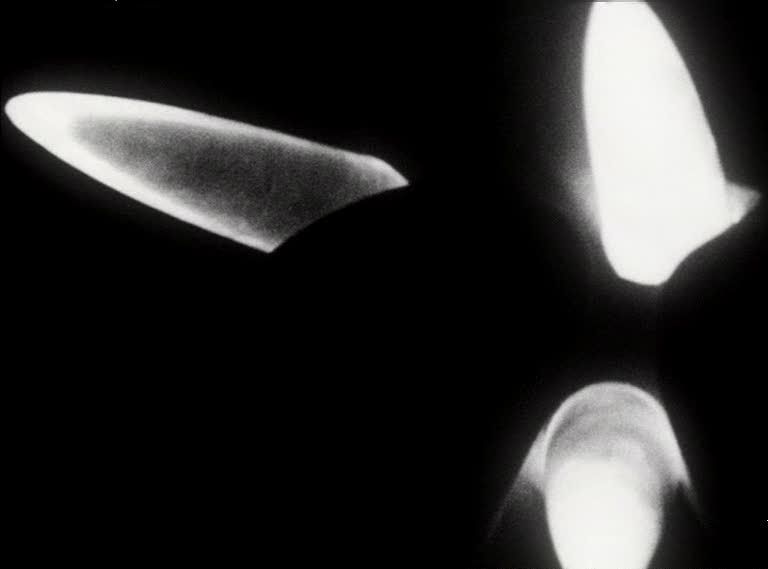
Menken's talent lies in her mastery of editing, of pacing. Her images move and breathe, achieving a delicate balance between static observation and visceral kinetic flow. At one point, she lingers on an image of star-like lights floating in a field of black, swirling with that swoony, choreographed quality that infuses Anger's short experiments like Puce Moment. It's an abstractly beautiful shot, and a fitting tribute to Anger.


Go! Go! Go! is a time-lapse film shot in New York City, a familiar subject that Marie Menken infuses with enough energy and vitality to make it somehow feel fresh. Her camera races along through the city streets, in tracking shots that seem to have been taken from out the window of a moving car. So it's all about travel, about motion, and in terms of subtext, about how fast it all goes by, how fleeting everything in life is, how ephemeral each moment, each sensation, can be. She shows an entire graduation ceremony massively sped-up, with endless processions of black-robed students marching across the frame like lemmings, disappearing at the edge. This manic parade becomes poignant as the students stutter across the frame and seem to vanish at the edge, fading out of existence as though a life lasts only the width of a film cel; blink and you'll miss it.

Some of the film's best scenes show sped-up processes from a distance so they take on qualities of abstract design: cars and pedestrians locked into traffic patterns at a city intersection, industrial vehicles moving crates across a shipping yard, boats tracing semicircular paths on a roiling sea. Shot from above, with everything moving so fast, the cars and boats are geometric forms rather than tangible objects. As Menken continues to explore the city at hyper-speed, her frantically edited montages acquire an odd poignancy, as she accentuates the rapid pace of life. In a way, her time-lapse film mimics the form of memory, the way the past is just this indistinct blur with certain moments sticking out with utter clarity. To that end, Menken captures a beach scene where the shake and jitter of her camera eliminates individual personalities and faces, leaving only the sensual impression of youth, lust, vibrancy, play, desire: the essence of a summer day distilled in blurred images of bare limbs and bright skies and sand.

Monday, February 8, 2010

Notes On Marie Menken

[This is part of a series of posts in which I explore the work of the Austrian DVD label Index DVD. This company has released a great deal of valuable European experimental cinema onto DVD, naturally focusing on the Austrian underground but occasionally branching out as well. Index's DVDs are distributed in the US by Erstwhile Records, so anyone intrigued by Index's catalog should take a look and support the fine work both these companies are doing for obscure and avant-garde cinema. I have also reviewed some of the short films included as extras on this disc, here and here.]


Marie Menken's importance to the early American cinematic avant-garde is often forgotten today. She was an abstract painter, a filmmaker, an inspiration to Jonas Mekas and Stan Brakhage, an important figure on the fringes of Andy Warhol's large entourage, appearing in his films and documenting some of the Warhol group's activities. Martina Kudlácek's documentary Notes on Marie Menken probes this rich legacy, examining Menken's life and art through her films and the memories of those who knew her. Menken was a very diaristic filmmaker, crafting small, nearly incidental works of observation and prosaic activity, chronicling the day-to-day and the ordinary with a sensibility that discovered surprise and beauty in such conventional sights as a flower garden, a sparkle of light off a shiny object, a person's face. Kudlácek pays tribute to this sensibility by making her own film a reflection of, a response to, Menken's own methods. In sensuous black and white images, Kudlácek interviews those who knew Menken: Mekas, Kenneth Anger, to whom Menken dedicated a film, Warhol assistant and filmmaker Gerard Malanga, Warhol Factory designer Billy Name, underground actress Mary Woronov, filmmaker Peter Kubelka and painter Alfred Leslie. These people weave a complex web of anecdotes and impressions, contributing to a portrait of a woman who was crucial to the development of the American avant-garde, and whose corpus of unassuming little films endures as an unshowy, private oeuvre. Menken's films, originally not meant for public consumption, were intended as documents of her observations and impressions, chronicles of the way she perceived certain moments in time. They are deeply personal, and Kudlácek's documentary maintains that sense of peeking into a private life, seeing the art and beauty in this woman's everyday life.

Kudlácek weaves together the interviews and reminiscences with excerpts from Menken's own films, as well as interludes in which Kudlácek follows her subject in capturing ephemeral moments on camera. At one point, while interviewing Mekas, her camera peers out a window, down at the street two stories below, where a group of kids are exchanging greetings and eager chatter, making plans and saying goodbye before they split up for the evening. Kudlácek watches them for a few moments before panning back inside onto the documents and film canisters on Mekas' desk. Such moments — like similar ones where Kudlácek lingers on the spray of water from a fountain or the skeleton-like designs on the backs of some fish in a pond or the twirling kaleidoscope of lights from a carnival ride — are the documentarian's way of paying tribute to Menken, who made such small and poetic details the substance of her oeuvre.

Kudlácek gathers a great deal of stories and information about Menken, who seems to inspire an almost aching nostalgia in many of these interviewees. When Kudlácek interviews Mekas and, especially, Malanga, one can see the warmth and love that these men felt for Menken, whose art and personality meant so much to them. Throughout the course of the film, Kudlácek deals with Menken's passionate but often troubled relationship with her husband Willard Maas (the couple were the inspiration for Edward Albee's Who's Afraid of Virginia Woolf?) and her interactions with the New York art scene of the time. But the real meat of the film, the real way in which Menken's essence is captured, is in the excerpts from her work. Kudlácek includes the full film Arabesque for Kenneth Anger, Menken's film made in Spain, set to a new score composed by John Zorn. Zorn contributes lyrical, low-key jazz throughout the film and here provides a lively, propulsive piece, derived from the ethnic melodies of his Masada group, to accompany Menken's fast-moving snatches of Spanish architecture and fountains. The film is contextualized by Anger himself, who accompanied Menken on the trip that produced this film and indeed was apparently standing right behind her while she made it. He describes how he was guiding her while she moved through the gardens and courtyards documented in the film, making sure she wouldn't fall. For Anger, and for many others who describe Menken's working methods here, she was dancing with her camera, fluidly moving so that the images she captured were an extension of her body, of her senses. Hers was a very physical cinema, but also a graceful one, and Anger's story, of the two of them dancing in tandem as she made this film in tribute to him, is moving and evocative of Menken's art.


Perhaps even more so than in her excellent, informative documentary on Maya Deren, Kudlácek really makes this material her own, finding her own way into Menken's life and art. Increasingly, in the second half of the film, Kudlácek seems to have discovered a peripheral story that she finds as interesting as Menken herself: Gerard Malanga, Warhol's assistant for so long, star of some of Warhol's most iconic films, a poet and photographer and filmmaker in his own right. The scenes with him, which form a substantial part of this film, are poignant and almost startlingly emotional, as the prospect of talking about Menken brings forth in Malanga a virtual torrent of nostalgic feelings and potent memories. This is especially true during a wonderful scene in which Malanga unearths a crusty old film strip that contains footage of Menken and Warhol. On his own small reel-to-reel machine, he begins playing the film, letting it pass slowly across an editing stage, excitedly picking out frames of interest that seem to trigger deep-seated emotional reactions in him. The film contains a "duel" between Menken and Warhol in which the two artists essentially danced around each other on a rooftop at sunset, the sky bright red behind them, as they filmed one another on handheld Bolex cameras. It is a fantastic scene, and the degraded quality of the filmstrip only adds to the poignancy of it all: the rot and decay of the years at times threaten to swallow the image whole, and then a few frames of Menken or Warhol with their cameras will abruptly emerge from the morass. As Malanga says, the film seems to be "resisting extinction." This is followed by some footage Menken shot, in her jumpy time-lapse style, of Warhol and Malanga walking through the city, creating some screenprints in a small apartment studio, and then returning home. It's the kind of time capsule moment that's invaluable, one great artist documenting another at work, and Kudlácek and Malanga both seem very aware of the historical import and beauty of these documents.

Kudlácek returns again and again to Malanga throughout this film, fascinated by his obviously emotional reaction to being reminded of Menken and Warhol and this whole scene that he was a part of. Menken, he says, was like a mother to him, and she thought of him as a son. His nostalgic recounting of private moments with her — going to visit her at her late-night shift at Time magazine, where they used the magazine's photocopiers and facilities to assist in their personal work — provides the film with an emotional heft that contextualizes Menken beyond her art, beyond her influence and importance, in the personal relationships she formed with those around her. It seems, for those who knew her, Menken herself loomed as large as the art she made. The pinnacle of this approach comes when Kudlácek goes with Malanga to the cemetery where Menken is buried. He goes first to visit his father, who he'd never really known but who happened to be buried in the same place, and then he goes to visit the woman who became virtually his surrogate mother. It could've been an exploitative, tear-jerking moment, but Kudlácek films it with a quiet, unassuming observational quality, so that Malanga's graveside visits with his real father and his spiritual mother are poignant rather than manipulative.

The way that Malanga's reminiscences merge his personal affection for Menken with the artistic inspiration he and so many others took from her provides the template for Kudlácek's own multifaceted tribute to the filmmaker. She excerpts liberally from Menken's rich oeuvre: the stop-motion animated paintings of Dwightiana, the lush light studies of Lights and Eye Music in Red Major (the latter introduced by Brakhage's blend of the mystical and the pseudo-scientific from one of his lectures), the diaristic observation of Andy Warhol or her portrait of Spanish monk gravediggers, the blurry rapidity of her New York fantasia Go! Go! Go!, the blend of home movies and theatricality in Midnight Maases. But Kudlácek goes beyond Menken's own images, her own films, to probe the artist's broader sensibility, and the image of Menken herself that endures in memory. Kudlácek's documentary includes the kind of moments that Menken herself would have loved to capture, like a wonderfully funny visual diversion while interviewing Billy Name, in which Kudlácek indulges in a close-up of Name's bushy beard, exploring its textures, bristly white like steel wool, as he talks about Menken and strokes the long beard's tip. Menken, one suspects, would have loved this image, simultaneously absurd and sublime, utterly prosaic and somehow also lyrically beautiful.

Friday, February 5, 2010

They Live By Night


Nicholas Ray's first film They Live By Night, based on the same story as Robert Altman's later Thieves Like Us, is a tale of doomed romance between a desperate criminal and a simple, inexperienced country girl. It's a story as old as crime fiction, or even as old as time itself: the bad man who wants something better, who dreams of a "normal" life, and the girl who loves him even though she knows they'll never have the life they want. Bowie (Farley Granger) was in prison for hanging out with the wrong gang as a sixteen year-old orphan, until he breaks out and goes on the run with two older, hardened criminals, T-Dub (Jay Flippen) and Chickamaw (Howard da Silva) — another bad gang, because Bowie's a guy who always seems to be in the wrong place, with the worst friends. Keechie (Cathy O'Donnell) is Chickamaw's niece, who grudgingly ministers to the gang after a failed job on which Bowie was injured. These two young, confused people are unlikely lovers, but there's nevertheless a magnetic, seemingly irresistible connection between them, the bond of a desperate and slowly developing love. Neither of them has ever had much happiness from life, from their families or the situations in which they find themselves. They share absent parents: both their mothers ran away with other men, and Bowie's father was killed before his eyes while Keechie is saddled with a drunken, no-good old man.

Ray treats this young love with grace and shadowy romance, capturing the brooding quality of this slow-burning desire between two inexperienced youths. "I don't know much about kissing," Keechie admits after the couple are married, and Bowie shyly agrees that neither does he. He's billed, on the radio and in the newspapers, as the leader of a vicious gang of bank robbers, but his infamy is almost accidental, entirely out of proportion to his simple ways, his country boy decency and good manners, his humble ambitions. He actually convinces himself that if he can just raise enough money for a good lawyer, he can show everyone that it's all just been a mistake, that he's actually not a bad man, and they'll let him go. Keechie has the same fantasies: they'll settle down, live a good life like ordinary people, and then the authorities will let him be since he's proven he can lead an honest life. They have to know it doesn't work that way, that their story is predestined to have a darker ending, but Ray portrays their insular romance so convincingly, so romantically and beautifully, that one is swept along in their fantasies, momentarily blinded to the unrealistic foundations upon which they're attempting to build this love.

The pair go on the run together, splitting away from T-Dub and Chickamaw, and manage to craft a haphazard domesticity in an out-of-the-way vacation lodge. Nothing is perfect for them, everything's a ramshackle parody of respectable life, but they don't mind. Their marriage — telegraphed by a great shot where, as the bus the couple is on pulls to a stop, a blinking neon sign advertising all-hours weddings is framed by the front window — is an expression of their deep, intuitive connection with one another. They get married at a small chapel where a weary minister marries eager couples for $20, charging an extra $10 for the full deal with music and photographs and recordings of the rushed service. Keechie and Bowie skip the frills, getting the stripped-down essence of a wedding, with sour-faced witnesses who only provide the expected good wishes and blessings after they've received their tips. Later, the couple's honeymoon lodge is rundown and dusty, though the place is overseen by a cheerfully eccentric proprietor who keeps passing on business tips to his young son. The film is packed with eccentricities like this, bit characters who get some compelling business to do around the fringes of this lovers' story.


The core of the film, though, is the romance between Keechie and Bowie, and Ray is well-suited to portraying their unconventional love. Their relationship seems like a nascent indication of the makeshift family formed by a group of outcast, neglected teens in Ray's famous Rebel Without a Cause; Keechie and Bowie don't seem much more mature or adjusted to life's cruelty than James Dean and Natalie Wood do in the later film. Ray's images are meticulously framed and intimate, bathing the doomed lovers in lushly romantic light and shadow. He frequently places his camera in close proximity to them as they kiss and clench, enforcing the intimacy and exclusiveness of their love. As their romance develops, other characters and dramas increasingly drop out of the film; Bowie's gang disappears, as does Keechie's father and various other supporting characters. It's as though the whole plot is put on hold by the sheer force of their love, their determination to create a new life away from the violence and criminality of their pasts. There's a lengthy interlude at the film's center that feels more like a romance than a crime film or a noir, but the intensity of this focus only makes it all the more devastating when the sinister Chickamaw's return heralds the couple's true tragic destiny.

Although this was only Ray's first film, his sensibility is already tough and his command of storytelling surefooted. The film has a raw energy that elevates it above many similar stories. The early encounters between Keechie and Bowie are fantastic, seething with barely contained stormclouds of hostility and attraction, which Ray captures by dwelling on Keechie's sullen, heavy-browed glares and Bowie's hesitant attempts to maintain his gangster composure. Ray's equally assured with their brighter moments, like the dawning grin on Keechie's face as she awakes one morning, stretching and mewling in a way that Bowie quite accurately describes as kittenish. Ray is undoubtedly better when dealing with the darker shadings of this story, however, and nowhere is this more apparent than when the couple has a brisk, pointed exchange about Keechie's unexpected, unwanted pregnancy. Bowie expresses his frustration and unhappiness with the situation, and Keechie responds with an absolutely harrowing line: "you don't see me knittin' nothing, do you?" It's such a direct and heartfelt response to her pregnancy, completely overshadowing Bowie's reaction with an implicit suggestion that she's the one who's really affected by this, that she's the one who's going to actually have the baby.

As forceful as Keechie is here, she can also be almost painfully subservient and pathetic elsewhere in the film. In one of the most nauseating scenes, she actually compares her loyalty to Bowie to that of a dog, telling him that a bad dog will take anyone for a master, while a good dog will remain true to the one person it loves. She tells him about one dog who, after its master died, wouldn't take food from anyone else and died not long after, and the obvious implication is that she's like the dog. It's a pretty horrifying analogy, and once Keechie drops her antagonistic initial response to Bowie and the other robbers, the film does little to make Keechie into a more developed character: her only desire is simply to be by Bowie's side, eagerly leaping into his arms at every moment. The limitations in the portrayal of Keechie hold the film back from being completely satisfying, but in other ways it's a worthy noir romance, replete with dark undertones and a poignant depiction of the gap between reality and impossible fantasies.

Wednesday, February 3, 2010

Gosford Park


In Gosford Park, Robert Altman revisits the territory of Jean Renoir's The Rules of the Game, examining the separate worlds — "upstairs" and "downstairs" — of rich society people and their servants at a country mansion. Altman takes an even more systematic approach than Renoir, designing the film in terms of alternations between masters and servants, cutting back and forth between the two worlds to reflect the yawning gap in class and privilege between these two sets of people. His camera, almost constantly in motion, seems to flow easily from one world to the other, its movements fluidly continuing even as he cuts from upstairs to downstairs or vice versa.

The film is set in 1932 at a hunting party, just as in The Rules of the Game, and like Renoir's film the dual centerpiece is a bird-hunting expedition and a murder. The party is hosted by Sir William (Michael Gambon) and his young wife Lady Sylvia (Kristin Scott Thomas), gathering together their family and friends. Right from the beginning, it's obvious that this is a complicated situation, with mutual resentments, suspicions and intrigues floating around between these nasty, corrupt society people. Altman's camera drifts through the estate's corridors, lingering to capture secretive conversations and exchanges of bitchy gossip. As usual, his dialogue is densely layered, different conversations overlapping to create aural pile-ups where key facts and snippets of talk rise out of the general morass. Various stories and histories are buried beneath the thin veneer of society, and Altman allows these complex plots to emerge gradually from the characters' chatter, their oblique hints and threats. Everyone here is plotting at something, involved in some ugly secret that everyone seems to know about anyway in a place where no gossip remains submerged for long.

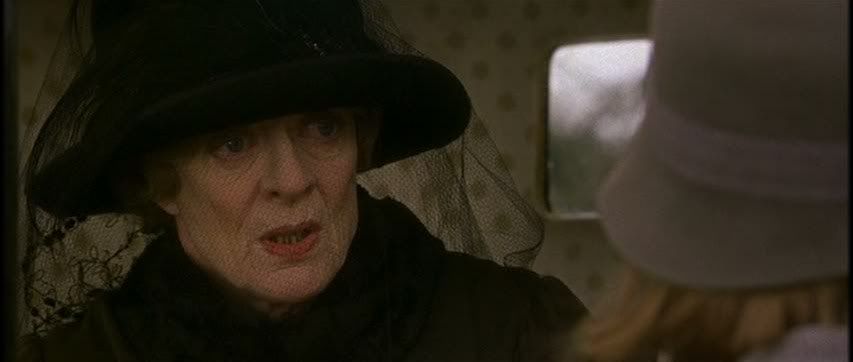
Some of those gathered here are looking to get something from the notoriously tight-fisted Sir William, as some among the family struggle to maintain the illusion of their status even as they're failing in business. In this context, class is actually divorced to some extent from money: what's more important than wealth is a good name, a family history, a status as one of the upper-class people. In fact, Sir William is supporting many of his supposedly high-society relations, including the elegant, self-possessed Constance Trentham (Maggie Smith), to whom he gives an allowance that he's now threatening to cut off. Sir William seemingly makes enemies with ease. His staff almost uniformly hates him. His daughter Isobel (Camilla Rutherford) resents his interference in her prospective marriage to Rupert (Laurence Fox), who's equally peeved that his attempts to marry into money and status are being foiled by William's resistance. Anthony Meredith (Tom Hollander) is enraged by William backing out of an important business deal — selling boots to shoeless Nigerians, an absurd touch that reveals Altman's wry sense of humor — that could have salvaged the ruined Meredith's livelihood. Meanwhile, Freddie Nesbitt (James Wilby) is bitter because he thought he was marrying into wealth, if beneath his station, by wedding dowdy, hapless Mabel (Claudie Blakley), who it turns out didn't have nearly enough money to balance out the embarrassment of having her for a wife.

These intrigues emerge organically as Altman's camera weaves through the estate. With such a large cast, a great weight falls on the actors to convey the essence of their characters economically, in small gestures and details, like the way Mabel, easily the most sympathetic character among the "upstairs" crowd, yearns for some genuine love and affectionate from her verbally abusive husband. Her face dawns with childlike excitement when the singer and actor Ivor Novello (Jeremy Northam) asks her to join him at the piano, and she looks both ways first, as though to say, "who me?" Small touches like this, conveying a sad woman's disbelief that someone's actually paying attention to her for some reason other than spewing insults, are everywhere in Altman's dense, cluttered mise en scène. Even throwaway details, like the usually dour, snooty Lady Trentham's disarming habit of saying "yummy yummy" when she enjoys a meal, add to the richness of Altman's portrayal.


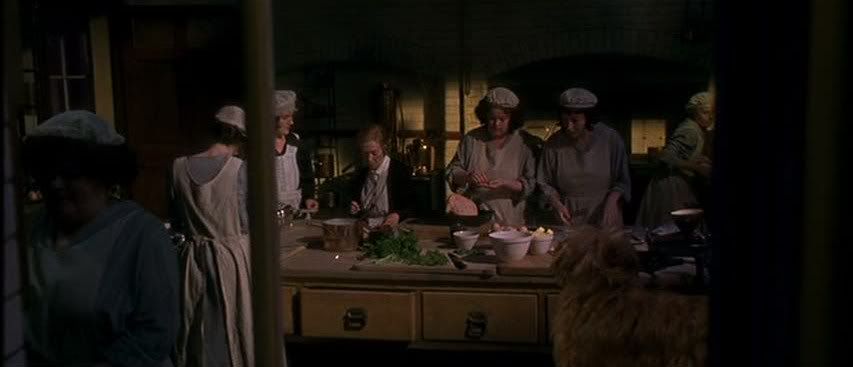
This is equally true of the "downstairs" servants, who have their own complex and richly developed world, entirely separate from that of the masters even though the two groups inhabit more or less the same space. Altman's handling of this division is brilliant, keeping the two worlds entirely distinct and yet subtly intermingled; his cross-cutting neatly separates the bustle of the kitchen from the stately low-key drone of the drawing room. And yet, in every scene "upstairs," the servants are present, quietly lingering in the background, unseen and ignored by the party's guests and thus only occasionally glimpsed by Altman's camera as it darts around the room. This separation, and the impression, constantly reinforced, that the servants are not to be noticed, makes the moments when a servant does break the barrier all the more startling. At one point, the maid Elsie (Emily Watson), who has a genuine affection for her employer (and lover) Sir William, speaks up indignantly to defend him against the insults of his family, blurting out a retort before realizing what she is saying and running away. It is an unthinkable breach, and Altman makes it as shocking for the audience as for the assembled guests. He had so thoroughly established the guidelines and boundaries separating these two worlds that Elsie's mistake feels absolutely devastating, as it must have for her and for the guests so used to unobtrusive, unobjectionable domestic help.

Lady Trentham's maid Mary (Kelly MacDonald) is the audience's surrogate in exploring the "downstairs" world of the film. She is an inexperienced young girl, nervous and shy, just becoming used to her profession and overwhelmed by the complex etiquette and rules governing special occasions like this one. She is thrown off, especially, by the insistence that, while she's here, she will be known as Trentham, thus entirely losing her identity to her employer even while among her own class equals. The servants are known, among themselves, only by the names of their masters, the ultimate submersion of their identities into their occupation. As the housekeeper Mrs. Wilson (Helen Mirren) says late in the film, as a good servant she has no life of her own, and it genuinely seems to be true. The other outsider amongst the servants here is Henry Denton (Ryan Phillippe), supposedly the servant of American film producer Morris Weissman (Bob Balaban, who is also co-credited with Altman for the film's idea). As the film goes on, Denton's cocky attitude and unsubtle curiosity about the estate's workings are revealed to be the symptoms of a ruse: he's not actually a butler, he's an actor studying for a part and, it's heavily hinted, also Weissman's gay lover (a situation presumably not permitted in this judgmental high-society context). His subterfuge thus allows him to be the only character in the film who traverses both worlds, though a maid tells him, after the deceit is revealed, that he "can't be on both teams at once," and once he's no longer a servant he's treated with the same aloof subservience as the other guests.

Altman's most sustained attempt to bring the two worlds together, however, comes during the pivotal scene where Novello sits at the piano to play and sing one night, while the various upper-crust guests scheme and bicker around him, and a murderer sneaks around the house in the dark implementing a violent crime. As Novello sings, the servants gather around the house, in darkened corridors, listening with expressions of satisfied awe on their faces; they are deeply moved by this music, by the beauty and humor of Novello's singing. Novello, too, is a bit of an outcast among these upper-class people; his status in the entertainment business makes him an object of scorn. At dinner one night, the guests had asked Weissman to describe the movie he was making, urging him even to give away the ending, since none of them will go see it anyway. Such things are beneath them, and though they had urged Novello to play the piano, to entertain them, they aren't happy with the entertainment they get, grumbling that they'd expected background music, easy to ignore, instead of these lively, emotional songs. Only the servants seem touched by the music, happy to have this rare opportunity to experience a great entertainer's work firsthand. These are some of the film's most beautiful scenes, capturing the servants standing in the dark, their faces illuminated by thin slivers of light emanating from the lit-up drawing room, dancing silently in back rooms out of sight. Nowhere else in the film is the concept of two separate worlds more poignantly expressed than here, as the "upstairs" people ignore and snicker about Novello's music while the "downstairs" folk, hidden away everywhere around the house, respond deeply to what they hear. Novello's true audience is the one he can't see, and his music has far-ranging effects he probably doesn't even suspect — it's a wonderful expression of the way art flows away from its maker to affect and touch the lives of others in ways the artist can't control or predict.

Such subtle subtexts flow through the film, especially once the central murder occurs and its aftermath stirs up all sorts of secrets about Sir William and his exploitation of his privilege and status, as well as his surprising connections to the servant Robert Parks (Clive Owen). The murder also occasions some of Altman's blackest dark humor, in the form of the inept investigator Thompson (Stephen Fry), who haplessly puts his fingers on everything at the crime scene and seems utterly disinterested when his deputy keeps bringing up all sorts of potential evidence. He's complicit in the upper-class insistence on keeping secrets, on not stirring up trouble; he puts on a show of being a hard-nosed interrogator, but his questions never lead anywhere. He must be utterly conscious, too, of the pressure on him to not cause trouble; he questions Mary in front of Lady Trentham, asking the girl questions about her employer that he has to know she can't possibly answer truthfully with the lady sitting right there. Status and class are ultimate barriers, keeping these people apart and preserving the status quo even through the most devastating of breaks; life resumes its normal course almost instantly for these people, who won't break from their routines and pretenses even for the sake of a murder. They are unruffled, and perhaps unruffleable, comfortable in their tradition and their empty decorum.