Wednesday, September 19, 2012

Demoniacs


Jean Rollin walks a very fine line in his trashy B-movie exploitation flicks. So much is "bad" and amateurish in his movies, from the wooden acting to the flimsy props to the ridiculous scripts, that it's sometimes difficult to determine just why the resulting films aren't bad, but in fact create a kind of budget poetry and eerie beauty from these minimal building blocks. Demoniacs perhaps proves just how easy it is for a Rollin film to tip over from that atmospheric minimalism into more typical sub-B-movie horror tripe. Demoniacs feels very much like a Rollin film in most ways; he's taking a brief detour from his obsession with lesbian vampires, but otherwise the film provides plenty of eerie beaches, ruined castles, sinister clowns, and languid softcore sex scenes. The usual shoddy production values and amateur acting are very much in place here. All the elements are there, but for whatever reason the ineffable magic that allowed Rollin's earlier films to transcend their trashy premises is missing here.

The story concerns a band of pirates who wreck ships by guiding them into the rocks with false light signals. After one of these shipwrecks, while the pirates are gathering their loot, two sisters (Lieva Lone and Patricia Hermenier) stumble to shore, the sole survivors of the wreck. The pirates attack and rape the girls — in a sequence staged so incompetently that it's laughable and discomfiting rather than harrowing — and leave them for dead on the shore. The girls aren't dead, though, and they eventually make their way to a ruined castle where the devil (Miletic Zivomir) is trapped along with two strange retainers, a clown (Mireille Dargent, donning clown makeup again after Requiem for a Vampire) and a bearded man who looks like Rasputin (Ben Zimet). The devil gives the girls his power through a sexual ritual, sending them off to get their revenge against the pirates.
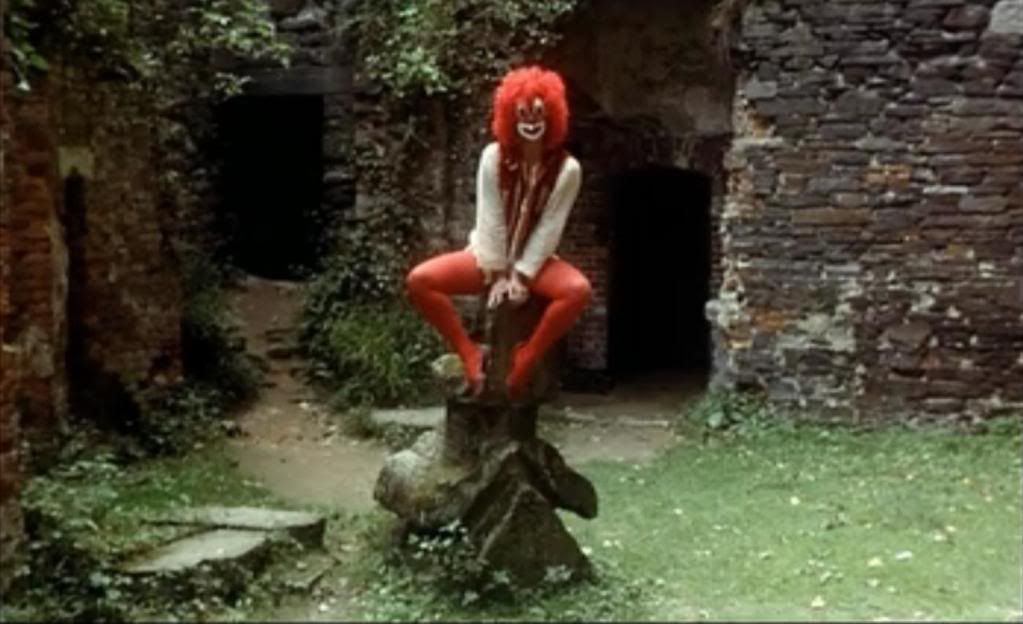
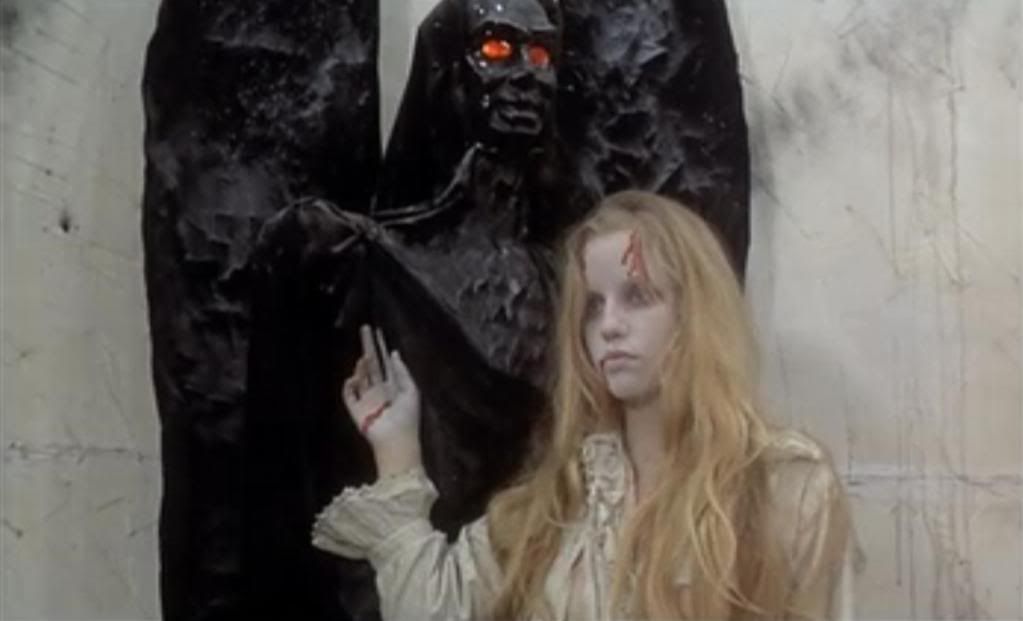
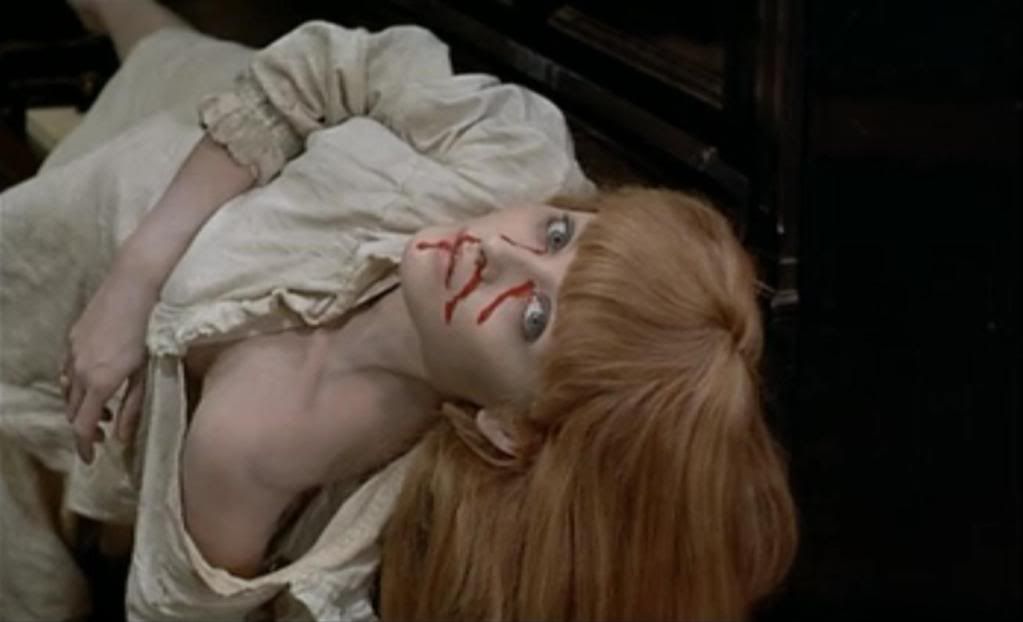
It's a compelling enough story in its broad strokes, but Rollin, typically, isn't that interested in telling it. Instead, there are endless scenes of the pirates loitering around a bar where a psychic barmaid (Louise Dhour) stares into space and issues dire pronouncements about spirits, demons and violence. The pirate captain (John Rico) is occasionally plagued by a guilty conscience, which provides opportunities for some striking visions, as he sees the two girls from the shipwreck, dripping with blood, posing with skeletons and a creepy black stone angel with glowing red jewels for eyes. Mostly, though, the film feels slack and empty; it's just over an hour and a half long but feels much longer, its slowness not hypnotic as in Rollin's best films but draggy and numbing.

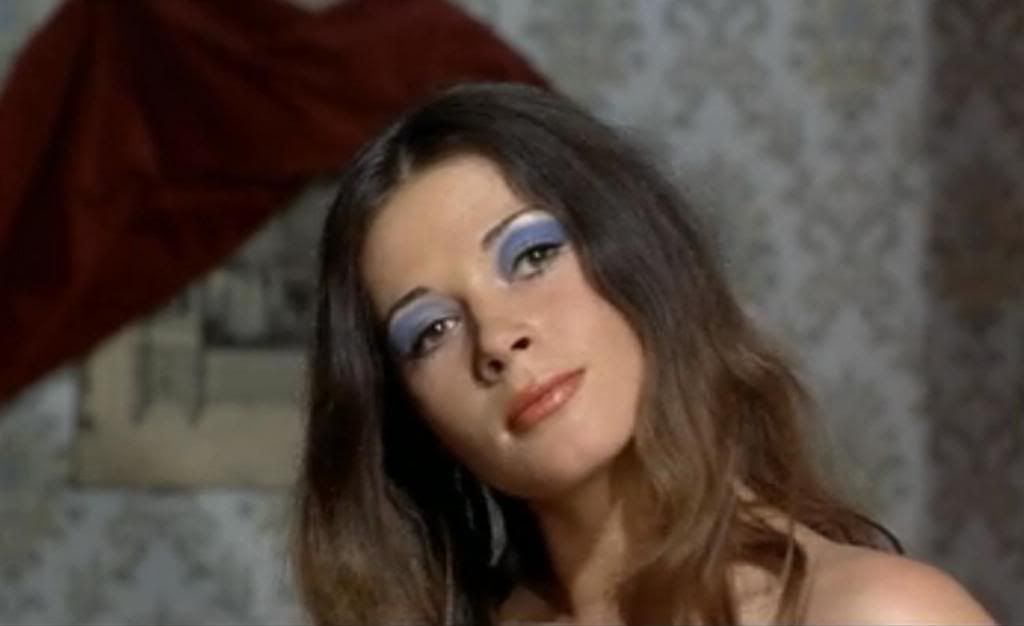
The highlight of the film is undoubtedly the presence of Joëlle Coeur's vicious nymphomaniac pirate Tina. Coeur isn't really any better an actress than the average Rollin star, but she does project a savage form of sexual menace that makes her an especially magnetic, memorable screen presence. Tina's a deadly femme fatale who's turned on by evil: in the opening scenes, she watches with a wicked smirk as her fellow pirates attack and rape the two survivors of the shipwreck, and all the violence moves her to strip down and seduce the pirate captain into her arms. Rollin treats her to multiple closeups in which she smiles that sinister, lusty smile, sensually shaking her long hair away from her face, throwing her head back, overcome with arousal at the prospect of violence and pillaging. Her performance is totally unmodulated, violently sexy, awkward and erotic in equal measures, and she brings a level of energy and enthusiasm to the film that's otherwise totally missing. Her constant posing — putting her hands on her hips and thrusting to and fro in a sexually charged celebration of death and destruction — is blatantly theatrical, making her a caricature of erotic evil, a nasty cartoon character come to fleshy life.

If only Rollin had built a worthier movie around this devilishly unrepressed villainess. The credits sequence introduces this as "un film expressioniste de Jean Rollin," but that description is far more apt for the director's earlier movies, which truly did create expressionist beauty from low-grade horror schlock. This film just meanders aimlessly without ever taking advantage of its most promising elements; even the revenge quest of the two girls is disappointing. With all the power of the devil at their fingertips, the best the sisters can do for vengeance is to make some statues fall from pillars while Tina runs around screaming, in what must be the silliest and least convincing sequence in a movie with some very stiff competition for that title. A few compelling moments aside, Demoniacs is one of Rollin's weaker efforts, where the unique alchemy of his approach fails to come together, leaving only the multiple failings of performance and plotting that are usually glossed over by the director's idiosyncratic aesthetic.

Monday, September 17, 2012

The Iron Horse


John Ford's epic silent Western The Iron Horse was the director's first major statement in the genre that, more than any other, would become synonymous with his career. He'd made many Westerns before, churning out low-budget B-movie oaters throughout the silent era, but this was his first large-scale statement in the genre. His ambition seems obvious in the title cards that introduce the film, paying tribute to Ford's hero Abraham Lincoln and announcing that the film's chronicle of the construction of America's "first transcontinental railroad" would be "accurate and faithful in every particular of fact and atmosphere." This isn't just a film, he seems to be announcing, it's history.

That's bunk, of course, and as history the film is utterly suspect from virtually the moment it begins. Typically of the Hollywood Western, this is a mythological, romanticized depiction of the westward expansion, one in which the white heroes must struggle against the odds, fending off Indian attacks and the cruel assaults of the elements in order to fulfill their destiny of pushing into the unpopulated wilds of the west. The film's tone towards the Native Americans who are actually in those lands is obvious in the way the title cards keep announcing how "inevitable" it is that the white man should take over the entire country. The Native Americans who resist this expansion, the film suggests, are merely standing in the way of destiny, which means they're destined to be crushed. How dare they oppose "the inevitable"? How dare they oppose progress?

The film's ahistorical steamrolling of the non-white is obvious throughout. The title cards casually announce at one point that "there is no white labor" for the building of the railroad, so "it is necessary to bring in Chinese for the task." There's no mention, of course, of the fact that the Chinese laborers were paid less than white counterparts, and despite the acknowledgment that most of the laborers were Chinese, most of the onscreen work actually shown within the film is performed by white Irish and Italians. The discriminatory laws that applied to the Chinese are made into a joke in a courtroom scene where Ford makes light of the fact that shooting a Chinaman is a lesser offense than shooting a white man. The mass killing of buffalo to feed the railway employees — one major source of Native American anger at the rail's invasion of their lands — is also glossed over.


Ahistorical and ideologically suspect as it is, The Iron Horse is also often a grand piece of entertainment. Its scope is truly epic, and Ford's images have a real grandeur to them, a feel for landscape and crowded scenes. The hard work of the railroad workers is viscerally felt, and there's a sense of realism in Ford's recreations of their struggles. Horses trudge through deep snows, pulling locomotives. Men hammer rhythmically at large spikes. One sequence documents the process by which the movable railroad towns settle in one place for a while before leaving it behind as a ghost town, always moving with the forward advance of the tracks. As the town moves, Ford shoots a wagon train running side-by-side with an actual train, the soon-to-be obsolete form of cross-country travel helping to build its own replacement.

The film is dominated by sequences like this, which focus on the big picture at the expense of individual characters. There is an individual story here, built around Davy Brandon (George O'Brien), a Pony Express rider whose father had dreamed of building a transcontinental railroad before being killed by Cheyenne, led by the sinister white outlaw Deroux (Fred Kohler). After a prologue in which Davy appears as a boy before his father's death, the character doesn't return as an adult until almost an hour into the film, confirming the dominance of large-scale historical storytelling over character-based drama. Davy's presence provides at least a hint of the usual Hollywood hero-centric drama, but the film is about historical processes and feats accomplished by groups and societies rather than individuals. Even Davy's romance with Miriam (Madge Bellamy), the childhood sweetheart he was separated from, is eventually paralleled with the building of the railroad. Only when the tracks are completed can their love be consummated, the two lovers coming together from opposite ends of the country at precisely the moment the tracks are joined.


At its best, the film's epic storytelling is very satisfying. There's a sense of scale here that's truly exhilarating, particularly in the inventively staged battle scenes — one Indian attack is staged with the shadows of the attackers projected onto the side of a train, while the climactic battle is all dust clouds and sweeping overhead shots that take in the whole battlefield. Ford similarly pulls back for a grand cattle cattle drive sequence, whereas the countless images of men at work on the rails are invariably captured in densely packed frames that emphasize the sweaty, choreographed simultaneity of their labors. Indeed, the film is at its best when it's abstract like this, since the usual Fordian diversions into ethnic comic relief are especially grating here, and the characters, mostly treated as cogs in a massive machine, aren't well-developed enough for the sporadic shifts to dramatic narrative.

What the film is really celebrating is the moment that the United States became truly united, when it began to take on something like its modern form — pushing further and further into the so-called "wild" lands populated by non-whites, slowly absorbing the entire expanse from east coast to west, linking it all via technology. It's no coincidence that Ford makes sure to note that, when the rails are finally connected in the middle of the country at the end of the film, the news is rapidly spread around the country via telegraph, instantaneously alerting people way back on the east coast to the news. The modern America is forming here. Within the course of the film, which spans years, the Pony Express and the wagon train are made largely obsolete by the telegraph and the locomotive. In the last shot, Ford has people posing for a photograph by the side of a train, a precursor of the cinema, which would be another of those world-shaking, transformative technological leaps forward. This is, after all, a film about technology more than anything else, about the way in which a country was built through a unique combination of rapid technological advances, hard work, and, buried in the film's subtext but rarely acknowledged, exploitation and genocide.

Friday, September 14, 2012

Four Agnès Varda shorts, 1957-1968


In Ô Saisons, Ô Châteaux, Agnès Varda sets out to document and discourse upon the architecture of various Renaissance-era castles, but her playful sensibility and constant digressions make this anything but a conventional documentary. This is apparent right from the opening credits, which whimsically sync up the movements of a trio of gardeners with the jazzy score by André Hodeir, pairing sweeping rakes with brushed cymbals. The voiceover mostly recounts facts about the reigns of various French kings and the castles they built, the renovations that were added to them over the generations by subsequent rulers. Often, though, this narration is interrupted by excerpts from poems, since the narrator is easily distracted from the succession of kings and castles by the stories of the poets who wrote within these walls or served these kings, and Varda's camera frequently wanders off the beaten track into the surrounding woods and gardens to admire the cool orange light of an autumnal glade or the geometric maze of an elaborately laid out garden, still immaculately maintained by the gardeners who seem to excite much of Varda's visual interest. It's as though the film keeps subverting its royalist history with anecdotes about artists and laborers, taking the focus off the upper-class, the big names of history, to focus on ordinary people and obscure poets.

The images are idyllic and pretty, capturing the charm of rural France surrounding all the photogenic ruins of the past. The film was commissioned by the French Tourist Bureau, and those origins are apparent in the scenic imagery of the countryside and the informative narration, but Varda can't play it straight. The narration relates the facts but has a flippant tone that suggests it's all read with a sly, skeptical smile, and the constant digressions suggest that Varda's wide-ranging interests can't be contained by her ostensible subject.

She finds an old man painting the castles and for a while focuses on his charming, rough canvases more than the actual scenes he's painting. At the site where Joan of Arc gave her famous prophecy to the Dauphin, Varda's camera dramatically pans upward at a key moment in the voiceover, a visual punctuation to the narrative. Gardeners occasionally stroll through the frame, making gnomic comments about trees or architecture. Fashion models in glamorous gowns, carrying shopping bags full of expensive clothes, wander through the ancient grounds, evoking the fashionable, idle women who once inhabited these lavish palaces. It's sensual and eclectic more than factual, anything but a dry tourist guide to the region.


Du côté de la côte is a satirical, mocking documentary about tourist season on the French Riviera. Agnès Varda's examination of the coast, packed with tourists from all over, emphasizes the absurdity of it all, poking gentle fun at the trendiness and crowdedness of the region, the superficial qualities of tourism. A bright, colorful, lively short, it provides a vibrant overview of the charms of the Riviera, both its genuine beauty and its kitschy tourist trap nonsense, the real historical foundations sitting side by side with imported, readymade exoticism, buildings made up to look like Asian temples or Russian palaces, all coexisting along the same sun-swept coastline.

Varda finds plenty of delightful, silly, striking images in her tour along the coast. The narrator opens the film by saying that they're not going to focus on the natives — "we'll leave them to the ass and the ox," he says, as some old peasants stroll by with farm animals — but rather on the tourists, and the camera immediately begins panning across a line of sunbathers in tiny bathing suits, before pulling back to show a whole beach crowded full of reclining bodies, with hardly an inch left to move or walk around. Varda finds some photogenic sunburns, peeling skin, demarcation lines with lobster-red flesh above and pale white below. At one point, she holds a deadpan funny shot of a little boy staring intently at his middle-aged mother's butt crack as she lays on her stomach to sun-bathe.

Spliced-in images of Sophia Loren and Brigitte Bardot suggest that all these tourists are searching for glamour, trying to fulfill movie dreams of high-class luxury that are otherwise unattainable, acting like movie stars relaxing at the shore. Varda also subtly undercuts the touristic impulse and its superficial approach to the real, rich history of the region, which has hosted great names of art and culture throughout the centuries. Even museums are ripe for mockery: the narrator says that "Cro-Magnon man received homage," and Varda accompanies the words with an image of a dog rooting in a museum display of a skeleton, pushing the skull around with its nose. Ultimately, Varda finds the real essence of the Riviera in a deserted rocky island, an Eden, devoid of people except for a pair of naked sunbathers, quiet and truly blissful in comparison to the manufactured, commercialized bliss peddled all along the more populated areas of the tourist coast. The camera's sensuous gliding in this final section says it all, evoking the peace and tranquility of this natural beauty without all the people around to screw it up.


Elsa la rose is Agnès Varda's affectionate chronicle of the love between the writers Louis Aragon and Elsa Triolet. The couple had met in 1928 and married in 1939, and they were old and contented when Varda filmed them together in 1965 — five years, as it turned out, before Elsa's death. It's a very sweet film, a tribute to a love that had lasted a long time and been immortalized in many of Aragon's poems. In striking black-and-white cinematography, Varda captures the couple at their home, talking about their lives together and their shared memories. Varda weaves in Aragon's poetry as well, narrated by Michel Piccoli, to bring together these images of enduring love with the art that had so often arisen from that lifelong partnership.

Varda's loving portrait of these two aging writers includes an interesting examination of the relationship between life and art. Elsa discusses how she feels about being the subject of so many poems, what she thinks about so many people reading her husband's descriptions of her youth and beauty, so that in many readers' minds she is forever frozen at the age of 20, young and pretty. Varda keeps cutting back and forth from images of the writers the way they look now and images of them from old, faded photographs, their pasts and their youths jutting up against the present as they tell their stories.


In 1968, Agnès Varda traveled to California to make a documentary about the Black Panther Party, focusing especially on a rally to free Huey P. Newton, who'd been arrested for killing a policeman. In the resulting film, called simply Black Panthers, Varda and her crew interview the Panthers and their supporters at the rally and surrounding events, trying to present a portrait of the group's ideas and politics. Most eloquent and interesting is Eldridge Cleaver's wife, Kathleen, a high-ranking communications officer in the party, who speaks to Varda's crew about the importance of embracing black ideals of beauty rather than trying to straighten one's hair or lighten one's skin in deference to white ideals of beauty. Varda seems especially fascinated by the seeming gender equality within the party, the opportunity for women to take on important roles in this political struggle, though a jailhouse interview with Newton himself reveals some strange remnants of old attitudes, as he says that women have "duties" within the party and then hastens to add that he doesn't mean sexual duties.

Interestingly, though Varda is obviously sympathetic to the Black Panther cause and the radical politics of the movement in general, the film maintains some skepticism regarding the way in which the drive to free Newton seems to skirt around the issue of whether or not he actually did what he's accused of. The film crew asks many of the rally attendees some pointed questions about Newton's guilt or innocence, about what kind of defense is being mounted to prove his innocence, and the narration points out that no one seems to care, that whether or not he actually killed someone or not seems to be immaterial. His prosecution is considered solely in political terms, with no attention paid to the facts of the case, and it's to Varda's credit that she doesn't just accept this at face value but continually questions it within the film.

The film's coda recounts the verdict that Newton was found guilty of manslaughter, but given a lighter sentence than expected as a compromise between those who wanted him freed and those who wanted him to get the death penalty — a compromise that satisfies no one, the voiceover points out. Varda then describes how two angry policemen responded to the verdict by shooting out the windows of a Black Panther headquarters, shooting the photographs of the party's leaders in the windows of the office. This is an expression, the voiceover says, of "the magical act of killing the image, usually attributed to so-called primitive and non-white people," a strange irony in which these enraged white policemen enact a superstitious, almost voodoo-like ritual as a symbolic revenge, a symbol of their hate and anger. That's a fascinating analysis, one that, typically of Varda, gravitates towards the symbolic power of images and the importance of the image in defining politics. Thus her images of the shattered glass windows and the photos riddled with bullets are crucially important as reminders of the systemic violence and atmosphere of hate which surrounded the Panthers and created the necessity for their struggle in the first place.

Wednesday, September 12, 2012

Romance


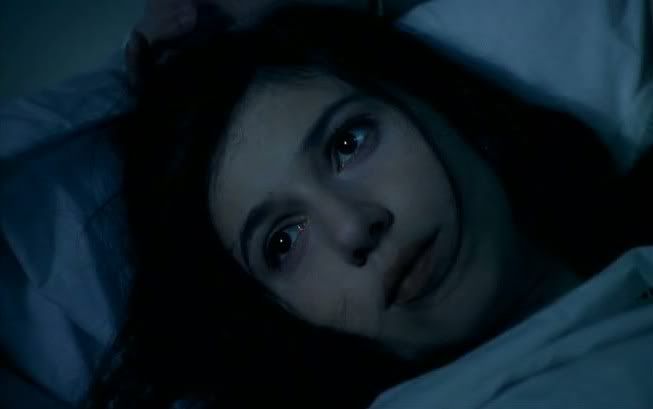
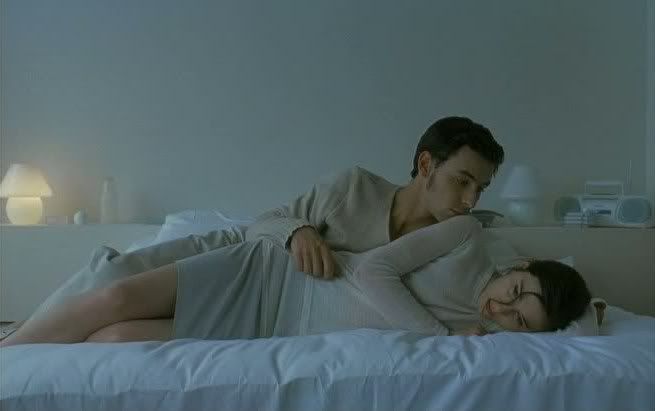
"Love between men and women is not possible." So says Marie (Caroline Ducey) towards the end of Catherine Breillat's ironically titled Romance, and the film goes about methodically proving this thesis by examining Marie's feelings about sex and her relationships with various men. Marie is in a long-term relationship, a conventionally "romantic" relationship, with Paul (Sagamore Stévenin), a handsome but passionless model who no longer has sex with her, who doesn't even want her to touch him. His apartment, where they sleep together sexlessly every night, is pure white, and they both dress all in white, virginal, unstained, totally clean and tranquil. The walls are white, the bedsheets are white, the lights are bright fluorescent white, the furniture is white. Everything is clean, clinical, untouched, and it's no wonder that there's no sex within these spotless walls, no hint of passion or tenderness. Paul is reluctant to even take his (clean, white) shirt off in bed, and Marie says she feels like she's sleeping next to a ball of cotton.

This spartan cleanliness is contrasted against the dirtiness and messiness of the sex that the increasingly dissatisfied Marie seeks out with other men, first with the muscular, sexually voracious Paolo (Rocco Siffredi), his name so similar to Paul's that Marie starts forming an almost romantic attachment to him too, and then with her boss at her teaching job, Robert (François Berléand), with whom she engages in sadomasochistic games of bondage and restraint that wind up getting her more excited than actual intercourse. Notably, Robert's apartment is decorated in red, and when he first ties her up, his red shirt against her white dress seems like a stain, as though he's going to leave bloody smears all over her from the bright red of his home, with red curtains framing her like she's on stage as she's being bound and gagged. The second time she goes to see him, she's wearing a bright red dress with black underwear, the first time she's ever worn anything but shades of white and gray, and the effect is shocking — even more so when she returns in this red dress to Paul's white apartment, her presence there suddenly standing out from the surroundings rather than fading amiably into the walls.

Breillat is dealing with sex and desire, control and submission, but it's all so schematic, so deathly dull in its rote plodding towards foregone conclusions. Towards the end of the film, Marie imagines sex as a mechanistic whorehouse where her upper and lower body are separated from one another by a wall with a hole. On one side of the wall, Paul sits beside her, holding her hand and smiling lovingly at her, while on the other side of the wall "ape-like" naked men approach her spread legs with simian lust, waiting in line and taking turns to fuck her. The symbolism is so crushingly obvious as to barely qualify as symbolism: lust and love are separated from one another, the ideal of the monogamous romantic relationship clashing against the animalistic desires of men. It's a treatise delivered with all the finesse of the porn movies whose passionless imagery of sex Breillat is drawing on here. Men are either fey automatons like Paul — whose woman-chasing seems to emerge only from a sense of duty, a sense of what he's supposed to do as a man, and who's actually implied to be gay — or big dumb studs like Paolo or remorseless ladykillers like Robert, who boasts about having had 10,000 women, including Grace Kelly.


Breillat is depicting Marie as someone who's seeking pleasure for herself, trying to break free of the idea that women don't desire sex, that women don't have the same strong lusts as men — but at the same time so much of Marie's behavior dovetails with male desires, with male fantasies of female submission and degradation. Marie is trapped, but it's not always clear by what; in any event, she's always staring at the world through the prison bars of the few stray strands of hair that break free of her pulled back hair to lay across her face. Notably, in the scene where she goes to see Robert for a bondage session, dressed in red, she lets her hair down for the first time, but is she really free, being manipulated into position by this lothario who has such naked contempt for women?

Part of the problem is that Breillat depicts all the sex as equally unappetizing and passionless, whether Marie is supposedly getting off on it or not. Towards the end of the film, she goes for a gynecological exam and is felt up by a succession of medical students, each waiting a turn like the men in her pornish whorehouse fantasy, and this clinical examination is filmed with exactly the same slightly bored detachment as the scenes in which Marie is supposed to be enjoying herself. Maybe that too is part of Breillat's thesis, that all sex is unavoidably compromised and fucked up by these weird societal ideas about men, women, relationships, desire, and love. At one point, in a rare flash of humor from this mostly humorless film, Breillat cuts from a splash of semen spurting onto Marie's stomach to a shot of a doctor spreading gel on her stomach for an ultrasound examination. That about sums it up: all sex is clinical and emotionless, and one might as well visit a doctor as get into bondage.