Showing posts with label '1910s. Show all posts

Monday, March 18, 2013

Hell Bent


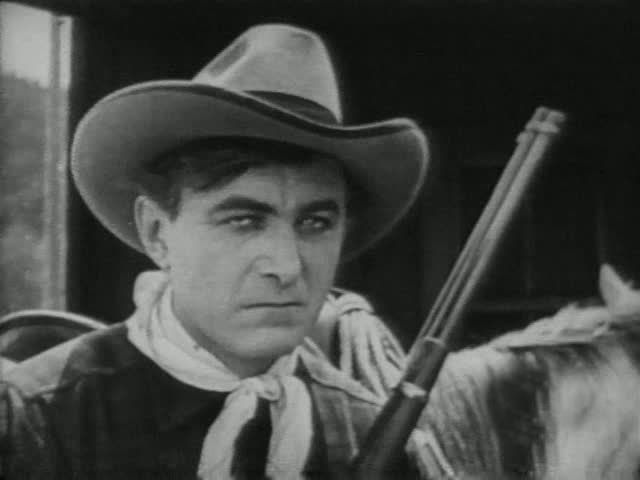
Hell Bent is a rare early John Ford Western, once thought lost, one of the director's many collaborations with the actor Harry Carey, with whom Ford made a total of 25 Westerns in the early part of his career. Carey plays a signature character called Cheyenne Harry, inevitably a no-good, low-level crook who's redeemed by the love of a good woman; that general narrative runs through both this film and the earlier Straight Shooting from the previous year. Carey is simultaneously anti-hero, hero, and comic buffoon, balancing his heroism with the rougher aspects of his persona, which often play out in comic drunkenness and general shiftlessness.

Even early in his career, Ford was already interested in combining comedy and drama in his films. Harry is introduced, in a way, while he's offscreen: the first evidence Ford shows of his presence is a saloon in shambles from a raucous fight over a card game, with Harry, accused of cheating, already having fled the scene. When the film finally catches up to him, he's manically pulling cards out of his sleeves and pockets, throwing away the evidence of his misbehavior. He's no good, a cheat and a brawler, and he promptly spends his winnings on alcohol, stumbling drunkenly through a series of comic showdowns with Cimmaron Bill (Duke R. Lee), which eventually lead to the two men bonding and becoming friends over a drunken singalong.

Naturally, Harry has to be tamed by the moderating influence of a woman, in this case Bess (Neva Gerber), who tames Harry so thoroughly that he's soon giving her a cuddly little puppy as a present. When Bess' brother Jack (Vester Pegg) gets mixed up with the outlaw Beau Ross (Joseph Harris), of course it's Harry who has to defend the girl and defeat the crooks, redeeming himself from his own less-than-legal ways and becoming the hero that, as the lead, he had to become. Interestingly, the film's framing device acknowledges Harry's status as a fictional archetype, opening with an author receiving a letter requesting a hero who's an ordinary man, "as bad as he is good." The novelist, musing on this request, walks over to Frederic Remington's painting A Misdeal, which Ford then restages as the aftermath of Harry's violent card game.


Also already apparent at this early stage of Ford's career is the director's penchant for striking natural vistas. The scenes of outlaws and posses scrambling through the rocky terrain have a casual splendor, with the emphasis always placed on the landscapes rather than the men and horses racing through this rugged territory. Criminals ride up into the foreground and raise rifles over their heads, signaling to the rest of their gang, while the hills stretch off into the distance behind them. Ford has a real feel for the landscapes of the West, and the exterior scenes here are uniformly stunning in composition and natural beauty: narrow canyons running down the center of the frame, tall hills that push the riding figures all the way to the top of the frame, big empty skies that tower above the land, pregnant with clouds.

Especially striking is the climactic sequence in which Harry chases Ross into the desert, a bleak expanse of nothingness where the hero and the villain are reduced to black specks against the large swaths of white sand. Their shootout is staged in a long shot, the two men stumbling towards one another in the wasteland, firing their guns and falling to their knees in the sand. The subsequent sequence in which they struggle to make it back to civilization without a horse similarly makes compelling use of the sparse surroundings, capturing the emptiness and desperation of this journey across the desert, culminating in mirages shimmering into view in the wastes and a sand storm that buries the two rivals.

Hell Bent isn't Ford's best collaboration with Carey, nor is it among the best of his early Westerns, but like the other surviving Ford/Carey movies, it's a spirited and well-crafted Western. Ford's visual sensibility, though still mostly static here, is already striking and promising.

Monday, September 10, 2012

Intolerance


Boldly ambitious, staggeringly epic, and, for its time, remarkably experimental in its approach to narrative and themes, D.W. Griffith's Intolerance is justifiably a landmark of the silent cinema, perhaps even more so than its more famous (and infamous) predecessor in his oeuvre, The Birth of a Nation. This three-hour epic tells four stories set in four different eras, weaving the thematically related tales together throughout the film, cutting between eras to draw connections between them. In the most prominent story, set in the modern day, the lives of a young couple are torn apart by capitalist exploitation, self-righteous social reformers, and injustice. This intensely melodramatic romance is buttressed by three historical tales: the crucifixion of Jesus, the violence between Catholics and Huguenot Protestants in 1500s France, and the ancient war between Babylon and Persia, also rooted in religious strife. Of those three historical segments, only the Babylonian epic is really developed into its own story, nearly the equal of the modern story in terms of detail and screen time; the other two stories simply provide short sequences that serve as illustrations or parallels to the action in the modern and Babylonian stories.

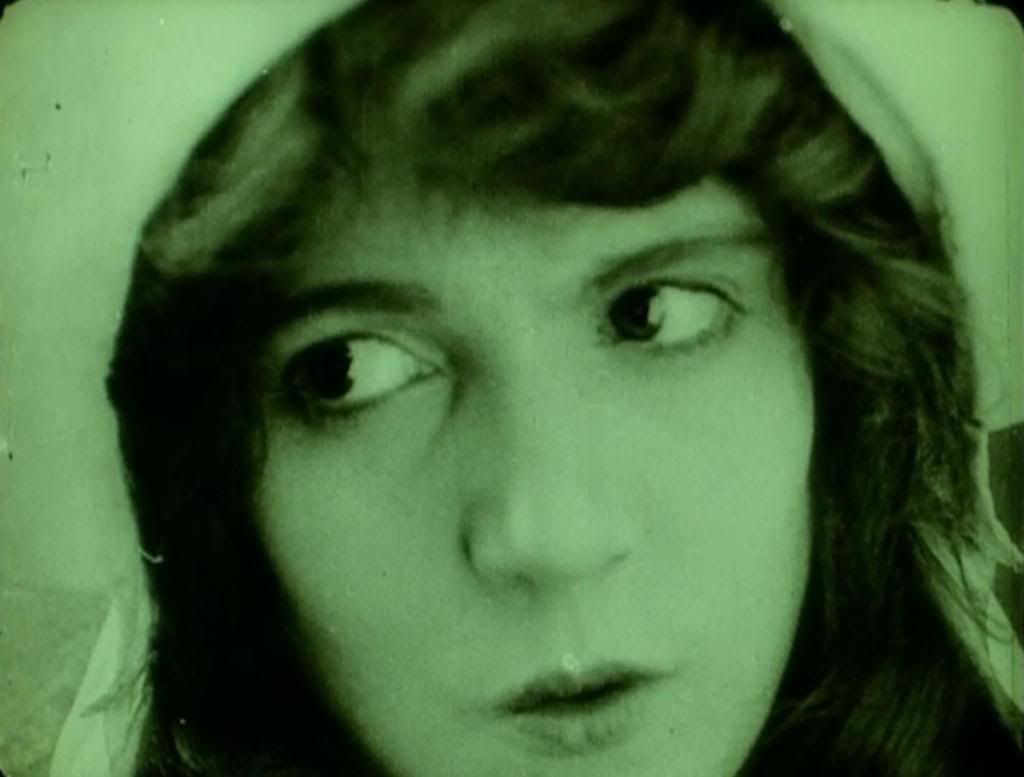
The film's sweeping scope and ambition are as dazzling as they are exhausting. Griffith hammers home his simple themes relentlessly, and everything is broad and lurid, the emotions rendered with big, sloppy outbursts of feeling. The emotions range from innocent love to craven jealousy or pettiness, and there's no middle ground, only these extremes of intense emotionality, delivered with grand gestures and shameless mugging. The acting is locked into this heightened register, especially the cutesy, girlish overemoting of both Constance Talmadge as the Mountain Girl of the Babylonian story and Mae Marsh as the cloyingly named Dear One in the modern romance. (Although Talmadge does provide one of the film's most endearing little moments, in a throwaway sequence in which, playing with a goat, she bites the animal's ear.)

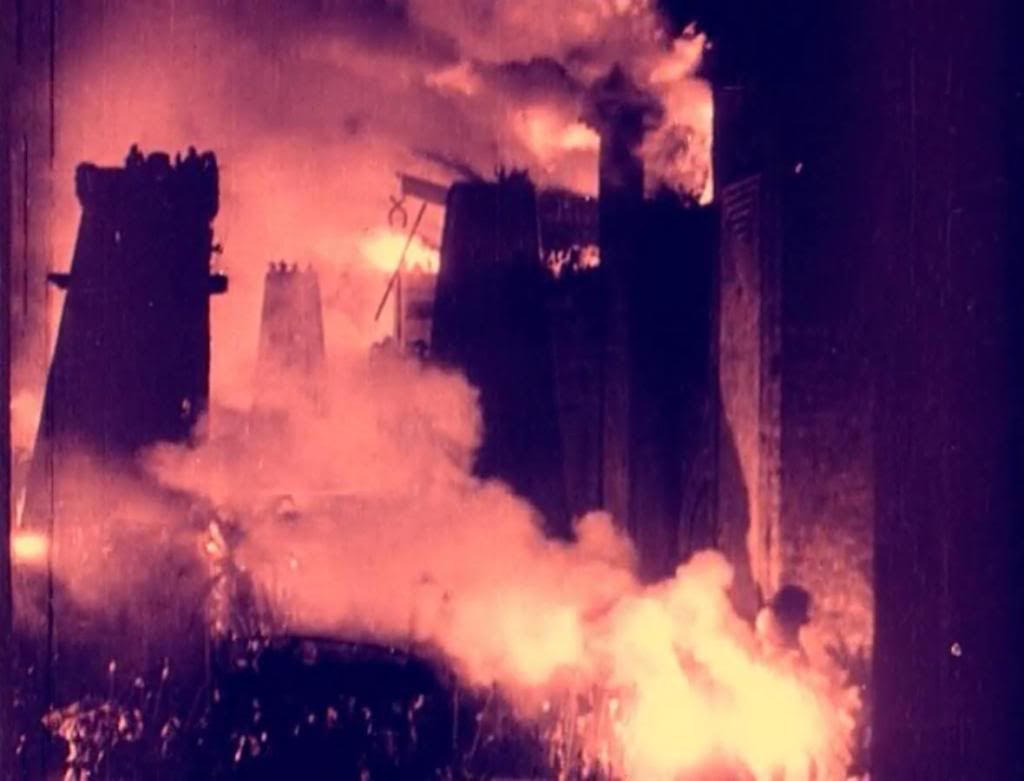
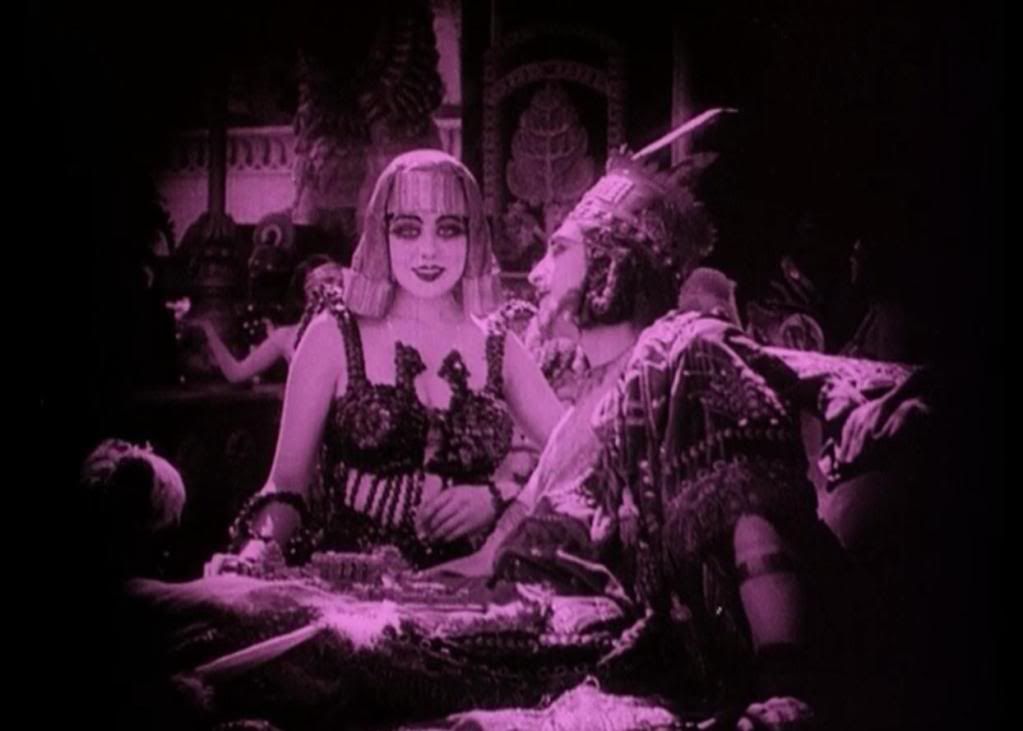
The Babylonian story fares best here, because it's naturally suited to the grandness and exaggeration that infuses the aesthetic and performative style dominating the movie. Everything about the Babylonian story is big and excessive, from its famous massive sets to its swarms of extras to its lavish feasts and battle scenes. The Babylonian story is an expression of pure sensual excess, filmed mostly in wide shots in which the frame seems to be packed with hordes of people, scurrying around the city like ants, dwarfed by the massive statues of rival gods and the towering walls of Babylon itself. The Mountain Girl's story exists at the fringes of the historical drama: her life is briefly touched by the Babylonian king Belshazzar (Alfred Paget), and she dedicates herself to him thereafter, doting on him from afar while he romances his beautiful Princess Beloved (Seena Owen) and wars with the advancing Persian armies. Whereas the modern story is a melodrama of individual romance and separation, the Babylonian part of the film is more abstract, its action occurring at a level where individuals are often mere specks in the corner of the frame. It's exhilarating and mad and frenzied, and packed with unforgettable images: most memorably, a tiny chariot pulled by white doves, carrying a flower between lovers, a concept that's poignant and hilarious at once.
Intolerance is kind of like that Alanis Morissette song about irony in which most of the verses aren't actually ironic; although Griffith keeps hammering home that his film is about the opposition between intolerance and love, most of the film's situations don't really chronicle intolerance as it's usually understood, so much as hypocrisy and injustice. At the core of the film is an opposition between carnality, physicality and freedom on the one hand, and repression, meddling and asceticism on the other. There's no question which side is favored by Griffith, who makes the film's celebrations of excess and bombast truly overwhelming — especially in the ecstatically sensual Babylonian thread, with its half-naked dancing girls and massive citywide parties — while viciously mocking the hypocritical champions of "reform" and restraint. Even Griffith's Jesus gets in on the act; it's no coincidence that Griffith makes sure to highlight, in his otherwise very abbreviated account of the New Testament, the miracle of turning water into wine, showing Jesus proudly presiding over a raucous party that can resume its boisterous course once the wine supply has been replenished.

Griffith makes the Pharisees' primary complaint about Jesus that he's "a winebibber" and a friend to lower-class rabble and sinners, thus paralleling the crusade against Jesus to the modern-day advocates of Prohibition, who ironically work in Jesus' name to prohibit fun and partying and pleasure. These no-fun old biddies are the real villains of the film, social reformers who are "intolerant" of anyone having fun. They're meddling hypocrites who use money taken from their connections with exploitative industrialist kingpins to restrict the activities of the very working class employees who are exploited by the reformers' capitalist supporters. There's also an obvious sexist undercurrent to Griffith's depiction of these crusaders, whose actions are explained in terms of their age and homeliness in a particularly egregious title card: "when women cease to attract men they often turn to Reform."

Beyond that nasty thread of sexism, there's an even more telling subtext to these denunciations of meddling reformers who couch their interference in terms of moral outrage. Griffith's previous feature, The Birth of a Nation, had been the subject of much protest and criticism for its infamously despicable depiction of black predation on white women and its lionization of the Ku Klux Klan. It's tempting to think that Griffith built his next film around the concept of "intolerance" by way of atonement, but the film itself is not an apology but an indignant rebuttal directed at the "intolerance" of his critics for the views expressed in his earlier film. Racial intolerance is not part of the brief here; rather, he's condemning the intolerance of those who try to reform society, imposing their ideas on others, and thus drawing parallels between social reformers decrying the treatment of blacks and those calling for the Prohibition of alcohol and other so-called social ills. At the heart of the film's concept of "tolerance" is the espousal of a live-and-let-live philosophy that's actually really objectionable when one realizes that Griffith seems to have in mind "tolerance" for bigots. Ironically, in Griffith's formulation, those protesting and pointing out intolerance are themselves the ones who are intolerant, presumably because they don't respect the ideas of bigots.

The film is curiously twisted in its themes and its subtexts, and when it's not offering backhanded stabs at the director's "intolerant" critics, it's delivering simplistic pleas to end all war and replace fighting with love. The film ends with a dazzlingly saccharine vision of a future without war, complete with heavenly hosts floating above a battlefield and a prison being replaced with a field of flowers. But if the film is ideologically suspect, historically inaccurate, and melodramatically overwrought, it's also undeniably exciting and finely crafted in terms of its aesthetics and the mechanical precision of Griffith's cross-cutting, here ratcheting up suspense and creating connections not just within the same story but between stories.

The apex of this approach is the thrilling climax, in which the Dear One's husband (Robert Harron), wrongly convicted of a crime, is set to be hanged. Griffith builds the suspense over the course of a solid half-hour, as the girl struggles to get the evidence to clear her man's name, then races to catch the governor, then races to the jail for a last-second rescue attempt. Griffith employs the signature cross-cutting that by this time he'd developed into a well-honed art, cutting between the condemned man's last rites and his long walk to the gallows, and the frantic activities of his wife as she pursues a train and speeds through the streets towards the jail. Griffith also elongates the suspenseful moment by cutting away to the other stories, in which there is no such suspense, but the predictably tragic climaxes of those tales — Babylon is sacked, Jesus is crucified, and the Catholics slaughter the Huguenots — provide a grim parallel to the likely outcome of the modern-day romance.

Griffith's command of cinematic language is what's most impressive today, looking beyond the film's many problems. The director's ability to use form to heighten the effect of narrative was unparalleled in the early cinema, particularly in his feel for grand action set pieces and endlessly building suspense. The Babylonian sequences also confirm the director's penchant for spectacle, with his camera sometimes even breaking free of the mostly static set-ups to drift gracefully closer to the action, tracking in from the epic wide shots to focus on some details within the sprawling chaos. It's no wonder that Erich von Stroheim, working as an assistant on the Babylonian parts of the film, was inspired by Griffith's dazzling spectacles. Intolerance as a whole is an uneven and contradictory experience, but the wild ambition and inventiveness of its director always show through, and partially redeem, even its worst failings.
Monday, September 3, 2012

Die Puppe


Ernst Lubitsch's Die Puppe is a delightfully kinky and absurd silent fantasia, a charming artifact of the master director's tenure in the German film industry before his emigration to Hollywood. Fast-paced and funny, it's a brilliant farce, a madcap and surreal confection that's a pleasure from start to finish. It's a celebration of artificiality and theatricality that opens with Lubitsch himself introducing the film by setting up a cardboard diorama, suggesting that he's about to act out a kind of cinematic puppet show.

Indeed, that's an appropriate reference point for a film that consistently deals with the slipping boundaries between the real and the artificial. This story of a girl mistaken for a doll takes place against a backdrop of blatantly cardboard sets, these flimsy-looking surroundings adding to the atmosphere of a strange fantasy, a children's puppet show with an adult theme. Lancelot (Hermann Thimig) is a fey and painfully shy young man who happens to be the only heir of his uncle, a wealthy baron (Max Kronert) who wants Lancelot to get married so that their line will carry on. The problem is that Lancelot is terrified of women, as evidenced by the comic chase sequence that results when a crowd of forty women come looking for the heir, pursuing him in their fever for such a prestigious marriage. Lancelot manages to escape to a monastery where he hides out, until his uncle puts out a newspaper ad promising a big dowry for Lancelot if he returns and gets married.

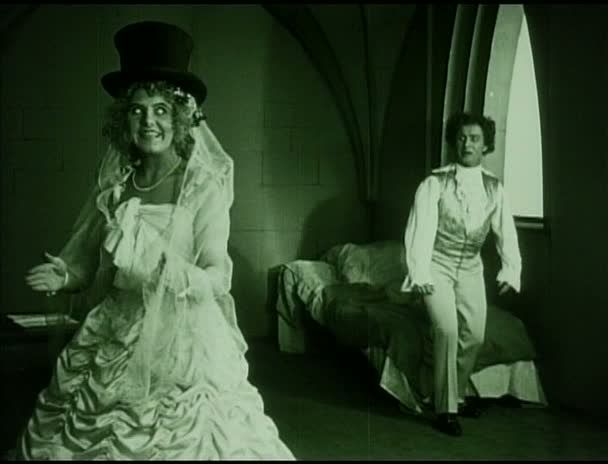
The greedy, corrupt monks concoct a clever and ridiculous plan: Lancelot will pretend to marry a life-like doll, get the money, and bring it back to the monastery. The only problem is that the doll, a perfect likeness of the dollmaker's daughter Ossi (Ossi Oswalda), is broken and replaced by the real girl, who pretends to be a doll while Lancelot carts her off for the fake wedding. What ensues is an utterly lunatic farce packed with naughty gags and innuendos. Oswalda delivers a delightful performance as the girl playing a doll, her face agilely contorting into gleeful grins and eye-rolling expressions of disdain whenever her hapless new husband isn't looking. She's clearly enjoying her ruse, and the wedding scene especially is packed with charming moments, as whenever Lancelot's back is turned, Ossi — who as a doll isn't getting any food or drink — grabs glasses of champagne to swig and gobbles down any food on the plates he leaves unattended.


There's also plenty of sexual subtext here. Lancelot's fear of women is absurd and caricatured, as he runs in terror from the hordes of women who desire him. He's so skittish that he even flinches away from the chorus line of dolls who dance and pose for him in the dollmaker's shop; when the dolls kick up their legs, he buries his head in his arms, crying that it's too risque. He's assiduously proper to the point of repression, and it's only with what he thinks is a fake woman — and a better-behaved one than those bold dancers — that he can get used to the idea of spending time with a woman. Lubitsch plays up the naughty subtext of this "doll" seducing and toying with the man: he starts to undress her and she resists, miming that she can dress herself, and later he undresses in front of her, using her extended arms as a coat rack, much to her annoyance. For Lancelot, marriage makes him quake in terror, and he enters into it in the most unromantic fashion. He buys his wife — with the understanding that he'll be paid back and then some for marrying her, making marriage a transaction twice over.

Lubitsch surrounds this sexual farce with a toy box aesthetic that enforces the essential unreality of the whole affair. A paper moon hangs in the sky at night, its frown turning to a grin when it sees the doll kiss the man. Lancelot rides his bride to their wedding in a carriage drawn, hilariously, by some of the most unconvincing fake horses ever imagined, obviously consisting of a pair of men inside a costume, with their legs sticking out of the cloth. As the coach driver prepares to depart, he notices that one of these "horses" has lost its tail, and without fuss he stoops down, picks it up, and reattaches it. It's a wonderful little moment that would break the film's fourth wall if there were really any to break in the first place, and it's also a sign of the lightness and playfulness of Lubitsch's approach. He lets all of the film's seams show, especially in its elaborate painted sets — every bit as stylized and expressionist as the next year's The Cabinet of Dr. Caligari, albeit in a very different way.

Die Puppe suggests just how early in Lubitsch's career the director's brilliant comedic sensibility was developed. Clever, witty, and sophisticated, this is pure Lubitsch, a delightfully fluffy and fun comedy with a bit of a wicked edge to its sugary aesthetic.

Thursday, June 21, 2012

Straight Shooting


Straight Shooting was John Ford's first feature, and that's the primary reason this straightforward, even prosaic Western is still worth seeing. It's a solid, if rather unoriginal, hour-long Western actioner in which the villainous outlaw Thunder Flint (Duke Lee) steals the water rights to an area, trying to scare off the local farmers. When the stubborn old farmer Sweet Water Sims (George Berrell) refuses to give in to Flint, the outlaws kill Sims' son and send the vicious killer Cheyenne Harry (Harry Carey) to kill Sims as well. Instead, Harry, witnessing Sims and his daughter Joan (Molly Malone) grieving by the dead boy's fresh grave, abruptly decides to go straight and fight for the farmers.

This was one of many films Ford would make in his early years with Harry Carey, who with his craggy, eagle-like face and hooded, deep-set eyes, brings an intense, glowering presence to this film as the outlaw who redeems himself for the sake of a woman. Ford obviously recognizes these qualities in the actor — who fills the place John Wayne would someday come to occupy in the director's work — and gives Carey many striking closeups. Carey's at his best projecting raw anger, but he also gets some nice low-key comic moments here, like a scene in which he drunkenly lounges around a bar with some other outlaws, staggering and swaying as he shows off his toughness and his quickness with a gun.

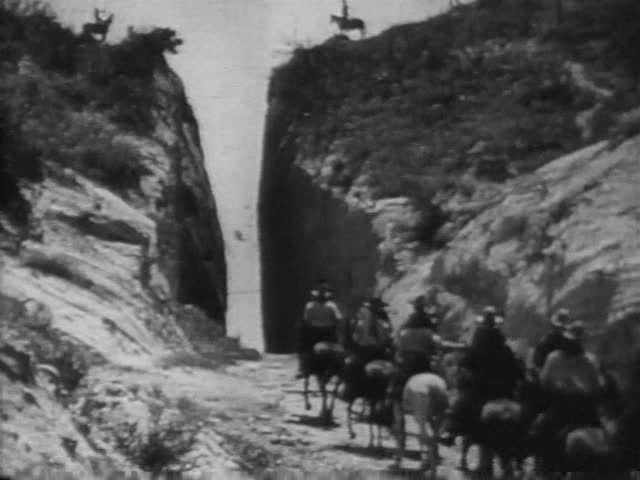
There are some nice action set pieces here, notably a tense showdown on a deserted, dusty street, with Harry facing off against another man, both of them carrying rifles. The staging is inventive, drawing out the tension as the two men approach each other from opposite sides of the street, and then suddenly defusing the showdown for a moment as the men pass each other and face off from around the corners of a nearby shack instead. There are also some typically nice Fordian landscape shots, particularly of a location that appears several times, a narrow valley between two cliffs, often with riders standing watch atop the rocky outcroppings at the top of the frame.


The young Ford also does a good job with some scenes set on a rainy night in a small Western town, a dense downpour soaking the cowboys who wander into town and race immediately for the tavern. The film's plot is predictable and typical of countless Westerns from the same era, but even here, in this very basic and pedestrian Western, his first feature, Ford provides some interest. The action sequences towards the end of the film are satisfying, certainly, with a ragged quality to the scenes of the farmstead being besieged by outlaw riders, kicking up dust, framed between low-hanging trees and arcs of foliage that provide a proscenium for the action.

Throughout the film, there are several occurrences of the through-the-doorway shot that would become a Fordian trademark, made especially famous by its use in The Searchers. Notably, Ford uses the shots in similar ways even here, at the beginning of his career: the doorway's passageway between inside and outside becomes a resonant symbol for the transition from domesticity to wilderness, from the comforts of home and hearth to the dusty, lonely trails. It's always the family that's inside, while the outlaw or cowboy is outside, separated from them, and when the door closes on Ethan Edwards at the end of The Searchers, it's closing on any possibility of familial happiness for that irredeemable outcast. In Straight Shooting, Ford's hero still hadn't fallen that low, hadn't quite lost all hope of being able to step inside. This film hints at a similar ending to The Searchers, with the outlaw leaving the family behind after having done his work to save them, but ultimately there's a far more romantic resolution in store for him here. The Fordian hero, still young, not yet so set in his ways, could still be redeemed and step across the threshold.

Friday, March 16, 2012

Four National Film Preservation Foundation shorts

[This post is a teaser for the third annual For the Love of Film blogathon and fundraiser, which will be running from May 13-18. This year, hosts Marilyn Ferdinand, Farran Smith Nehme and Roderick Heath have dedicated the week to Alfred Hitchcock, whose early (non-directorial) work "The White Shadow" will be the beneficiary of any money earned during the event. The following post provides capsules for some of the films currently screening at the National Film Preservation Foundation website's Screening Room. Be sure to donate!]

Ramona is an early D.W. Griffith one-reel short, an adaptation of a novel by Helen Hunt Jackson that dramatized the mistreatment of Native Americans throughout history via an inter-racial love story, not the kind of message movie that one would associate with the future director of Birth of a Nation. A young Spanish girl named Ramona (Mary Pickford) falls in love with a Native American improbably named Alessandro (Henry B. Walthall), with predictably tragic results. The young couple elopes, fleeing her disapproving family, but everywhere they turn, they only encounter "the whites" who keep pushing the Native Americans aside, claiming, "this is our land!" wherever Alessandro and Ramona show up.

The acting is extremely over-the-top: when Ramona is trying to resist her attraction for Alessandro, she sees him playing a guitar, listens briefly, and then recoils in terror, running away with her arms in the air, and throws herself down at an altar to pray. If a title card hadn't already prepared viewers for the fact that she was going to fight against her growing love for the young man, one would be hard-pressed to guess just why she was so suddenly hysterical. There are horror movie heroines who react more sedately to the sight of invading alien monsters. There's lots of hand-waving and dramatic gesticulating here; Ramona's mother (Kate Bruce), reacting with horror to her daughter's dalliance with a Native American, seems to have abruptly contracted epilepsy, her hands shaking and flailing about, locked into claws as she points in random directions all around her head. Most of the cast just runs around through every scene with hands raised, pointing dramatically off towards some unseen point beyond the camera.

This histrionic acting style aside, the film is well-directed, and Griffith's staging within the static frame is impeccable. He frequently frames some foreground action against a dramatic natural backdrop of hills and mountains stretching off into the distance, contrasting the human-scale romantic story against the imposing grandeur of the landscape, as though suggesting that this one little story is part of a grander historical struggle. One scene that suggests this especially well is the one where Alessandro's village is destroyed by white settlers who are driving off the natives. Griffith's camera is angled down from a high cliff, looking down at the village in the valley, mostly obscured by clouds of smoke as wagons rush by and the slaughter commences. In the foreground, Alessandro throws his arms around in despair and tears at his hair as a few white cowboys run past with guns drawn, casually killing another Native American man as they pass. These striking compositions provide some interest in an otherwise rather slight film that rushes through its narrative as a series of clipped moments, seemingly under the assumption, very reasonable at the time, that virtually everyone in the audience would have been familiar with the story already.


The Lonedale Operator is a one-reel Western actioner directed by D.W. Griffith and written by future Keystone mastermind Mack Sennett. The film demonstrates Griffith's famous development of suspense-building, cross-cutting action montages, in this case built around a simple scenario of a train station payroll robbery. A young girl (Blanche Sweet) takes over telegraph duties for her sick father, while a pair of criminals plan to steal the payroll bag that's been dropped off into her care. The first half of the very short film builds a little character through some flirtatious sparring between the girl and a train engineer who's courting her, and then the second half settles into a propulsive editing rhythm as the crooks try to break into the telegraph office.

Griffith cuts quickly back and forth from the girl in the office, sending out a message for help, to the criminals trying to break down the door outside, to the engineer rushing to her rescue on his train. The rhythm of the editing gradually speeds up as the criminals get closer to breaking in and the train gets closer to the station. It's a simple but effective way of ratcheting up the tension. The payoff is a nice last-minute gag in which the crooks break in before the rescue party has arrived, but the clever girl manages to outwit the robbers by making them think she has a gun. The ending defuses all the tension with some low-key humor, having the robbers exaggeratedly bow to the girl once they realize they've been outsmarted, and this resolution hints at Sennett's comedic sensibility, abruptly replacing the sense of impending danger with a witty sight gag.


Robert C. Bruce was a premiere director of what were known in the early cinema as "scenics," short documentary travelogues from exotic locales. Bruce's Tropical Nights is a prime example of the genre, the first film released from a 1920 expedition to the Caribbean, where he traveled through the islands and shot numerous brief, poetic, beautifully photographed little slices of reality.

The film is purely about the sensory experience of a locale, presenting one gorgeous, blue-tinted image after another of this tropical island paradise. The photography is lovely: trees swaying in the wind, scenic vistas looking out over the ocean, moonglow rippling on the water, dramatic storm clouds gathering on the horizon, but never any rain. The prosaic title cards only interrupt the poetic flow of these images with bland objective descriptions. Bruce's images hardly require the accompaniment, because there's obviously a keen photographic sensibility to these static views of beautiful natural scenes. People only occasionally enter the shot, but when they do they're often looking off in the same direction as the camera, as awed as the photographer by these lovely views. The presence of these spectators within the film merely confirms the "hey look" attitude of the film, which builds a contemplative mood as it chronicles the progress of the moon across the sky, the gentle flow from sunset to sunrise, with nothing but moody blue beauty in between.


Keystone comedienne Mabel Normand was a prolific comic actress in the silent era, and in 1914-15 she made the transition to director as well, making her one of the earliest female directors in Hollywood. Won In a Closet was her second directorial film (her first is presumed lost) and it's a madcap, silly farce that displays the fledgling director's likeably goofy screen presence and her feel for slapstick. The fluffy little story of Mabel's romance with a dopey-looking neighbor (Charles Avery) is just set-up for the extended sequence where her father and his mother get trapped in a closet together, prompting a ridiculous series of misunderstandings and slapstick pile-ups.

The slapstick is all but completely unmotivated here, with little connection to reality: everyone's just constantly running around, falling on their asses, colliding into each other for no apparent reason, and Normand herself switches on a dime from a sweet, coy young lover to a manic hysteria case. It's all pretty silly, of course, but there is one nice shot along the way, an inventive split-screen in which Mabel and her boyfriend walk towards one another, the two sides of the screen eventually coming together when they wind up on opposite sides of the same tree. That shot suggests a witty visual sensibility that matches Normand's charming screen persona.

Wednesday, March 7, 2012

Bucking Broadway


Bucking Broadway is a very early Western from John Ford, one of his earliest surviving works; it was once lost before being rediscovered in France in 2002. It's an hour-long Western melodrama about the ranch-hand Cheyenne Harry (Harry Carey), whose romance with the farm owner's daughter Helen (Molly Malone) is interrupted when the wealthy urban businessman Thornton (Vester Pegg) steals her away and takes her to New York. Harry, heartbroken, follows her to the city in order to get her back. It's a potent examination of the opposition between the folksy, noble West and the decadent, sleazy urbanity of the East.

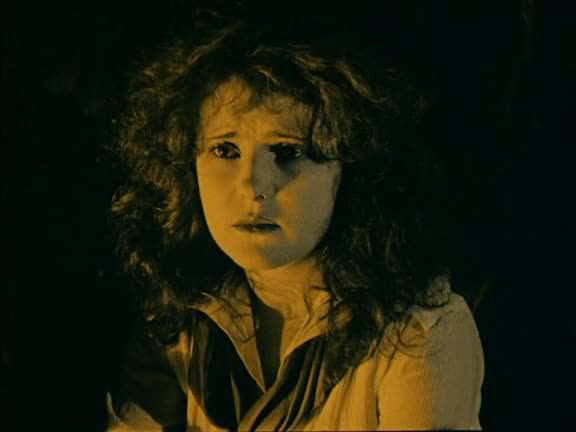
The story is very simple, almost iconic in its application of broad archetypes, but Ford's presentation of this elemental tale is extraordinarily poetic and sensuous. It's a gorgeously shot, moody and melancholy Western; one title card, appearing as Harry moons around the ranch in Helen's absence, economically read, "Loneliness, dreams and memories." Ford uses a lot of closeups here, probing the intense emotions of this story through the actors' faces. The closeups have a raw, shadowy beauty that sears away any trace of melodrama in this story, leaving behind only the very real underlying emotions. When Harry proposes to Helen, in the cabin that he's built for them to live in, the flickering candlelight sculpts her face, alternately serious and delighted, into a sweetly pretty icon of youth and innocence, moved by Harry's proposal and only a little worried about what her stern father (L.M. Wells) will think. This scene, so sweet and sensual, makes it a little puzzling why Helen would then so quickly be swayed away from Harry by the smooth-talking man from the city. The portion of the film dealing with his seduction of her seems more than a little clipped and rushed, and Helen's change of heart is unconvincing, beyond a rather offensive insinuation that all women are weak-willed and susceptible to flashy manners.

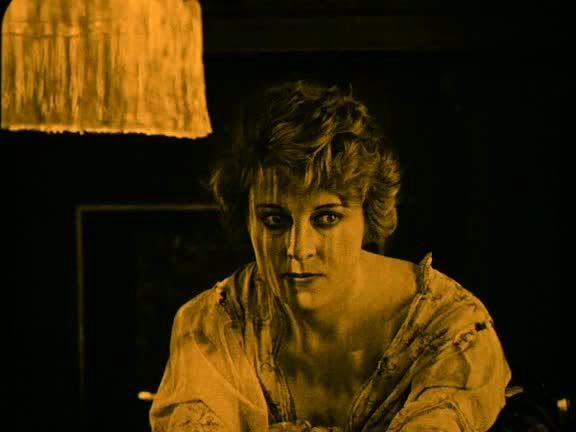
Indeed, the closeups of Helen on her trip to New York suggest that she's already realized what a mistake she's made, as Ford captures the haunted expression in her eyes, glaring up at the camera. In one affecting scene, Ford juxtaposes Helen's face, half-shaded with deep black shadow, against an image of a woman (Gertrude Astor) who a title says that Thornton "introduces as" his sister (which of course suggests that she's anything but). Ford shoots this other woman in a way that, oddly enough, seems to anticipate film noir all the way back in 1917: she's sitting by a lampshade, which casts a gauzy, striped shadow across her face as she looks at the new girl. The suggestion is that this is an old lover of Thornton's, used up and imprisoned by her decadent lifestyle, a hint of the future for Helen should she stay with this no-good man.


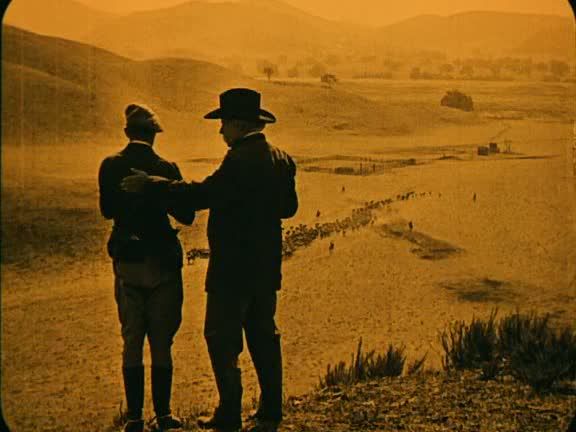
Ford is making the city a place of corruption and sexual iniquity, all dark interiors in contrast to the hilly fields of Wyoming from the first half of the film, with animals spread out across the plains and cowboys making photogenic silhouettes in the foreground, smoking and squinting out at the horizon from horseback. When Harry arrives in the city, Ford makes much of the fish-out-of-water comedy of the cowboy in the city: he mistakes a steaming water heater, which he's obviously never seen before, for a rattlesnake, and pulls a revolver, frightening the bellboy as he searches for the snake. Later, continuing the parallels between West and East, he finds "a seasoned guide" to the city in a prostitute and her pimp, who attempt to rob him before the city woman is moved by his down-home tale of love and loss.

Ford's feel for comic relief, always a prominent characteristic of his work, is also apparent in the earlier part of the film, when Harry tries to win Helen back from Thornton by buying some fancy clothes, so he can dress like the city slicker. Harry gets behind the counter at the store to try on his new pants, glancing anxiously out towards the front of the store hoping that no one will come in — although the way Ford cleverly stages the shot, it looks as though Harry is glancing at the camera, breaking the fourth wall, as though wondering if the audience will see him undressing like this. (Ford unfortunately follows this scene with a wince-inducing racist gag, when Harry sees a black man wearing the same outfit as him and grows angry with the store owner.)

The film climaxes when Harry and his cowboy pals get into a frenetic brawl with Thornton and his friends at a hotel, after the sequence that gave the film its name, a few blue-tinted shots of the cowboys roaring through the center of New York on horseback, weaving through traffic and waving their hats in the air, Wyoming having truly come to the big city. The brawl itself is frenzied and fast-paced, utterly chaotic, a flurry of half-comic action to cap off the film's conflict between East and West.

This was an early, budget Western for Ford, from a period in his career when he was cranking out economical little Westerns like this in a few days of shooting. With that in mind, it's surprising that the resulting film, despite its clichéd story, is anything but inconsequential. Bucking Broadway is an emotionally compelling, beautifully shot film that proves the director was already a supreme visual talent even this early in his career.

Sunday, April 26, 2009

Fantômas: In the Shadow of the Guillotine/Juve Versus Fantômas


The pulp fiction villain Fantômas was one of the early cinema's first great criminal figures, as depicted in the famed five-film serial directed by Louis Feuillade. The first film in the series was Fantômas: In the Shadow of the Guillotine, which established the titular bandit and criminal (played in all five films by René Navarre) as well as his adversary, Inspector Juve (Edmund Breon), both of them taken from a popular series of novels of the time. Fantômas is a master of disguise, as hinted at in the opening montage, which fades between several different mugshot-like portraits of the villain in various guises and false beards. This hour-long opening chapter of the serial depicts Fantômas robbing and murdering, scheming with the Lady Beltham (Renée Carl) to kill her husband, and presumably take his money, too, though this is never spelled out. The interesting thing about Fantômas is that his crimes rarely seem to have any overriding motive; he's in it for the money, yes, but more than that he just seems to get a kick out of doing evil things for their own sake. But the clever Juve is on the trail, and with the help of his friend, the reporter Jérôme Fandor (Georges Melchior), he is soon able to apprehend Fantômas, sending him to prison to await execution.

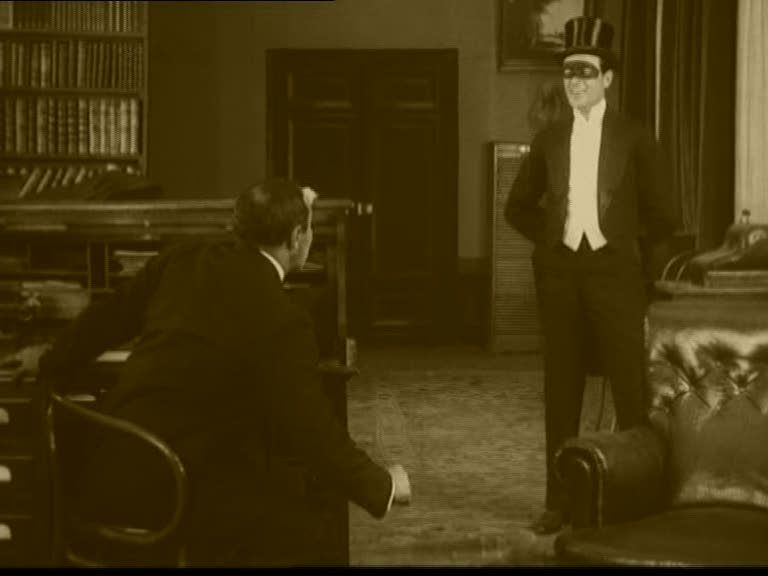
The second half of the film is thus dedicated to Fantômas' plan to escape from prison and his deadly fate. Interestingly, Feuillade more or less places the audience in a position of identification, not with Juve, but with Fantômas himself. With the criminal caught and sent to jail halfway through the picture, this can't be a typical police mystery where the audience is rooting for the detective to catch the criminal and solve the case. Once the case is solved, the big question becomes: how is Fantômas going to escape? It's a foregone conclusion that he will escape, that he'll live to rob and kill again another day, so the suspense is simply all about seeing how he'll do it, what clever plan he'll come up with. The plan turns out to be a good one, not necessarily in terms of its logic (which is non-existent), but in terms of the way its convoluted mechanics play out on screen. With the help of his accomplice Lady Beltham, Fantômas lures the actor Valgrand (Volbert), who is playing Fantômas in a stage re-enactment of his crimes and punishment, to appear at a house near the prison in his performance costume. Once there, he is substituted for Fantômas and sent to a rendezvous with the guillotine while the master criminal makes his escape. Juve saves the man at the last minute and vows to pursue Fantômas from then on. The film's final scene is its best: Juve, in his study, has a vision of his adversary, fading into view in the corner of the room, dressed in a top hat with a domino mask across his eyes, taunting the inspector to chase him down.

Feuillade's aesthetic is simple and direct, very much of its time. His camera set-ups are of course static, and even stagey. With the exception of a few, rare closeups to highlight an object (like Fantômas' clever calling cards, which appear blank at first before his name fades into view), the film is staged entirely in tableau-like medium shots, with all the action playing out for each scene within a single room, from a steady, head-on angle. Given the limitations of the cameras of the time, Feuillade often composed in depth, using his static shots to his advantage. An automobile parked alongside the curb is shot from a skewed angle that accentuates the sidewalk stretching away into the distance, calling attention to the man walking towards the car, who will prove to be important. Later, when Lady Beltham goes to watch Valgrand's performance as Fantômas, the scene is shot from her booth in the back of the theater, with the stage itself framed, like a cinema screen within the screen, by the boundaries of her booth. The multiple levels achieved within this shot are striking: the cinema audience watches someone else, who's watching another audience that's watching a play.

These layered, deep-focus compositions are the most interesting aspect of this first chapter in the Fantômas serial. The action here is slow and drawn-out, and the staging of some scenes — like Fantômas' first robbery, at a hotel — are awkward and clumsy, making the dashing villain seem very amateurish indeed. This installment mainly just sets up the characters and situations that would be exploited throughout the remainder of the series.


Already with the serial's second chapter, Juve Versus Fantômas, the pieces seem to be more firmly in place, and the action more elaborate and thrilling. Curiously enough, the story here is also more rambling and incoherent, often threatening to fall apart completely, as though Fantômas himself had forgotten what his plot was all about. A dead body appears, supposed to be Lady Beltham, but apparently not since she is alive later; in any event, the corpse is quickly forgotten. Instead, Fantômas plots to get a large sum of money from a businessman, although this too is unceremoniously dropped in the latter half of the film. Basically, this hour-long film is a string of inventive set pieces, in which Fantômas engages in a duel of wits and brawn against the combined forces of Juve and Fandor.

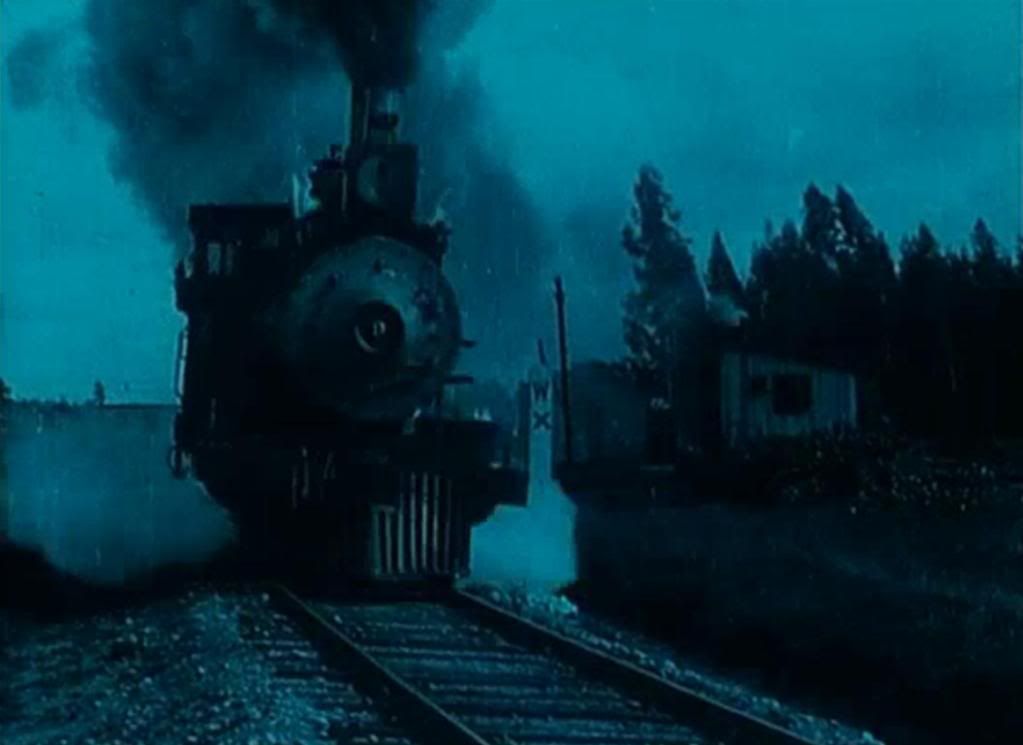
There's an exciting action sequence in which Fantômas and his gang of thieves hold up a train, uncoupling the last car in order to facilitate their getaway and trigger a horrible collision to eliminate any witnesses. Feuillade stages this by fluidly blending together model shots and images taken aboard a real moving train, and there's a propulsive rhythm to the editing during this scene that belies the static nature of the individual shots. Feuillade manages to convey the motion and energy of the trains without even moving the camera once. Even better is a shootout at a wine barreling plant, where Fantômas' hoods are hiding out in a large field of wine barrels, popping up sporadically between the rows to trade shots with Juve and Fandor. The whole thing is set up like a carnival shooting game, and Feuillade plays it for near-slapstick humor without ever dissipating the sense of danger. Feuillade likes to play with the entirety of the frame, often enlivening his static shots with bits of business tucked away in all the layers from foreground to background. In a scene at a nightclub where Juve and Fandor confront Fantômas' girl Josephine (Yvette Andréyor), the frame is packed with activity and small jokes, distractions at the edges or in the extreme foreground, like the drunk guy who keeps nodding off to sleep in the corner of the frame. Finally, there's a rousing concluding set piece at Lady Beltham's abandoned mansion, where the police track down Fantômas, who avoids them through some clever hiding spots. The whole thing closes with a fiery cliffhanger, a teaser for the next episode.

With this second film, the pace of Feuillade's storytelling picks up a bit — though it's still often plodding by modern standards — and there's a lot of fun in watching Fantômas and Juve match wits. This installment places the inspector on an equal footing with his adversary, as indicated by both the title and the opening montage, in which Fantômas' line-up of disguises is followed by a similar introduction for Juve. This film solidifies the series' mania for dressing up and switching identities. Now even the cops get in on the fun, putting on fake beards and disguises in an effort to keep up with their enemy. Identities become fluid and temporary. Fantômas' favorite trick is changing while he's out of view, either in an elevator or in the back of a motor car, becoming a different person in the time it takes him to get from one place to another. And in the finale, he very nearly becomes nobody, donning a form-fitting black costume and mask that turns him into an iconic, mysterious phantom.

Monday, December 8, 2008

The Mystery of the Leaping Fish


The Mystery of the Leaping Fish is an absurd, utterly bizarre farce, an unlikely silent film whose hero is the drug-addicted and wildly incompetent detective Coke Ennyday (Douglas Fairbanks). This weird little short has an impressive pedigree, featuring the writing talents of none other than Tod Browning (!), an uncredited D.W. Griffith (!!), and prolific intertitle scribe Anita Loos, whose soon-to-be husband John Emerson directs. It's hard to know why all this talent needed to be concentrated in one place, though, since the film is basically a really silly, hilarious one-man show with a succession of physical gags designed to suit its star's strengths. Fairbanks drives the action singlehandedly; his exuberant physicality and goofy facial expressions are continually at center stage, and when there's something he can't do outright, a bit of subtle backwards-running film is sufficient to pull off some of the wilder gags, where he seems to go leaping impossibly into the air.

The film is an unabashedly pro-drug comedy, presumably made in an era before widespread anti-drug regulation. The hero is a "scientific detective" who propels himself through his cases by ingesting prodigious quantities of drugs, which give him the pep and vigor he needs to defeat any adversaries. He has a bandolier of syringes strapped to his chest and a huge tub on his desk labeled "cocaine" in big block letters, from which he grabs handfuls of white powder to rub all over his face. The clock on his wall has only four labels, to indicate the four states of Coke Ennyday's life: sleep, eats, drinks, and of course dope. When Coke is enlisted to find the source of the wealth of a mysteriously rich stranger (Allan Sears), he doesn't so much conduct an investigation as simply hurl himself, bopping and jiving, into the vicinity of his target, letting the chaos that inevitably breaks loose lead him through the mystery. Fairbanks is a fount of energy, literally bouncing and shaking with every step whenever he's just taken some drugs. And after a certain point, when Coke gobbles down a few heaping handfuls of opium (stolen from the smuggling ring he's supposed to be busting), he just never stops bouncing. It's like he can't walk a step without adding some extraneous movement into the simple motion. He hops around like a bunny, crashing obliviously into walls, turning in circles, a goofy grin on his face and his eyes popping out of his head. It's so much mad fun that everyone else in the film — especially token love interest cutie Bessie Love — looks like they're going to bust out laughing every time they're onscreen with Fairbanks.


Beyond its over-the-top slapstick humor, the film doesn't really have much else to offer. Its construction is as fast-paced as Fairbanks himself, and at times it seems like the editing is trying desperately to keep up with the antics of the super-charged star. The intertitles fly by so briskly that some of them are gone before anyone save an unblinking speed-reader could catch more than a word. The whole thing seems to have been filmed, acted, and edited while under the influence of some serious uppers, and one wonders if some of those tubs of white powder were filled with the real thing. The film is ostensibly a parody of Sherlock Holmes — who in the original Arthur Conan Doyle novels was a prolific opium user — but the only real nod to Holmes is the outrageous checkered coat and hat that Ennyday wears, pulling it from a big valise conspicuously lettered "disguises." Really, the film's only real reason for existence is to give Fairbanks an excuse to act his nuttiest, and the scenario supplies plenty of gags tailored to the actor's boundless enthusiasm. But even if Fairbanks is the indisputable center of the action, there's also a great deal happening around him, and the frame is often littered with sight gags, especially in his cluttered laboratory, where clearly marked signs point out the objects of interest. This is a fun, shamelessly silly farce, a drug-fueled burst of slapstick energy.