Showing posts with label Chantal Akerman. Show all posts

Friday, February 24, 2012

Hôtel Monterey


Hôtel Monterey was one of Chantal Akerman's very first films, a completely soundless documentary about a New York City residence hotel populated mostly by old people. The film is formally minimal and even simple: one silent, (mostly) static shot after another of scenes from around the hotel, images of lobbies, elevators, corridors and rooms, sometimes with people moving about, sometimes entirely unpopulated. Akerman maintains a somewhat remote and aloof perspective, shooting people mostly from a distance, often in static poses where they sit facing the camera, sometimes even staring into the lens. At other times, Akerman seems to be eavesdropping, watching a woman's sleeping form from a discreet angle through a door that slowly swings closed as the camera sits still, stoically observing. In another shot, a pregnant woman sits in a chair, holding her large belly, and Akerman shoots her through a doorway, framed through the telescope of the narrow hallway and the door.

There's something faintly surreal about the film, despite Akerman's simple observational stance. The colors are bright and garish, from the sickly yellow of the walls in the corridors to the rusty red of the bedspreads in the rooms to the floral print curtains that hang from the windows. Akerman shoots these images so that light sources become hot and blindingly white, casting streaks and halos of pure white light along the walls, while the shadows are thick and black, grainy empty zones in which anything might be lurking. This high-contrast style renders the hotel ineffably spooky — eight years before The Shining, Akerman uses formally rigid compositions and lurid color schemes to render a hotel as a site of unsettling strangeness and vague mystery.

Often, Akerman holds her shots for a long period of time without anything happening or changing. The camera gazes at a forked corridor as, to one side, an elevator occasionally flickers to life in the darkness with a shadowy form entering or exiting, while the other hallway is mostly cut off from view by the angle of the shot, subtly and unnervingly suggesting that anything might be happening just out of view, just around that corner. The camera only starts moving towards the end of the film, but once it does, its slow tracking only adds to the impression of a silent, abstract horror movie that has no monster, no villain, only one creepy hallway and dark corner after another. At one point, the camera plods slowly down a shadowy corridor, tracking until it reaches a dark and grimy cul-de-sac by an exit sign, briefly pausing in the near-darkness against the wall, then backing away, slightly faster than it had approached, as though the camera was retreating, spooked. Akerman then repeats the movement, though this time a window is identifiable in the darkness at the end of the corridor, revealing a glimpse of the city lights and traffic outside, a hint of the outside world that otherwise barely touches this hermetic interior.


Akerman's style suggests not only the rigidity of Kubrick but also David Lynch's love of edging around dark corners, revealing the strangeness of ordinary reality. This film certainly prefigures the casual oddity of Lynch's work, the habit of taking prosaic locations and using the camera's probing gaze to make them portals into weirdness and unreality. Akerman's camera insistently tracks down the hotel's corridors, and statically examines its walls, its elevators with their blinking lights, its minimally decorated rooms and its wizened occupants. The people barely figure into the film, though, only occasionally serving as the focus of a shot or drifting through the shadows, hardly even visible. The hotel often seems eerily unpopulated, and it's the building that Akerman is really documenting rather than the people in it. The film is structured as a trip upwards through the hotel, starting in the lobby and then progressing upwards, floor by floor. It ends on the roof, where Akerman's camera drifts in a slow pan around the surrounding skyline or looks up at a sky so cloudy white that she's able to insert a few frames of white leader to partially obscure a cut.

Hôtel Monterey is an enthralling and original documentary, with no commentary, no sound at all, relying entirely on its evocative and mysterious images to communicate the sense of life in this hotel. The effect is disarmingly hypnotic and powerful.

Monday, December 19, 2011

Je, tu, il, elle


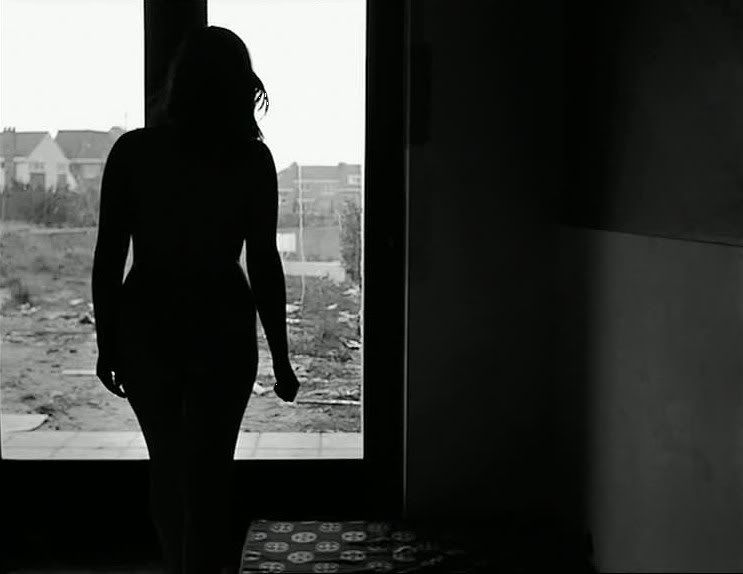
Chantal Akerman's first feature-length film is a striking, minimalist work about love, loneliness, desire and gender. Actually, "minimalist" doesn't begin to do justice to the film's narcoleptic pacing and sparseness of action. The film opens with a young woman played by Akerman herself (named as Julie only in the post-film credits) alone in her room. In a series of long, mostly static shots, this woman sits on the floor in a corner, eats sugar from a paper bag, moves her furniture around, writes letters, strips naked and walks around, looking out the window or examining her body in a mirror. The camera occasionally tracks to follow her, when she's actually moving, but more often the camera sits as patiently still as the protagonist herself, locked into stasis and repetition. It gradually becomes apparent that she's recovering from a breakup, missing her lover and writing letters that she'll never mail.

This portion of the film, which last around a half hour, is a powerful and suffocating depiction of loneliness and depression. Akerman perfectly captures the sense of being locked into stasis, alternately numbed and pained, unable to break free of a series of repetitive, minimal tasks. She writes the same letter over and over again, crossing out most of it and then starting again, periodically laying all the pages out on the floor in front of her. She unthinkingly spoons sugar into her mouth as her only sustenance, then spills it on the floor and methodically spoons it back into the bag. The black-and-white photography is high contrast and alternates between crisply defined daytime sequences and shadowy scenes where Julie/Akerman is just a silhouette, her face hidden by her long dark hair. The pacing of this sequence is slow and patience-testing; it is quite deliberately empty of incident, and as a consequence the smallest movements, the smallest shifts in the familiar patterns of nothingness, have great impact. These scenes are accompanied by a voiceover in which the protagonist describes her time alone in her room. Tellingly, the action onscreen often lags behind the narration by a good amount of time, as though the narrator is anticipating what she'll do next — and it then takes a supreme act of willpower to actually go through with these tiny, insignificant actions. This disconnect between narration and visuals thus enhances the impression of a woman struggling to force herself into action, to break free of this self-imposed black hole.


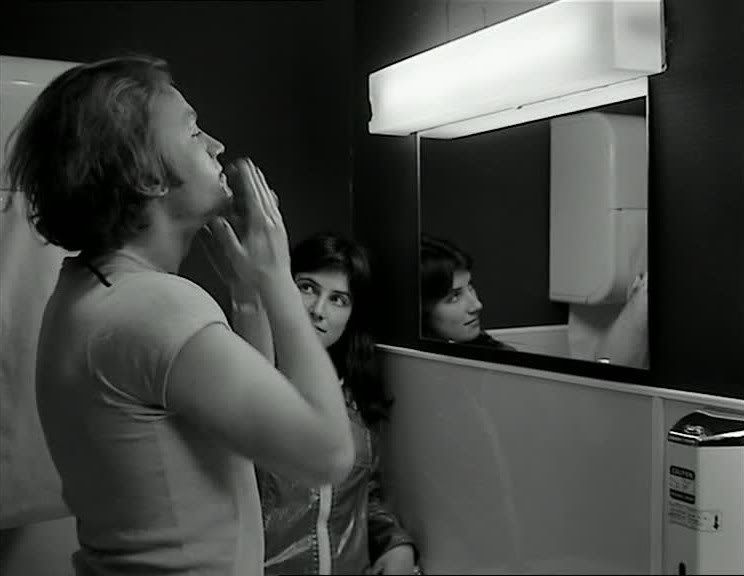
In the second segment of the film, Julie abruptly decides to leave the apartment, flagging down a passing truck on the highway and hitching a ride with the driver (Niels Arestrup). This sequence is initially as static and tranquil as the scenes in the apartment, as though the woman has still not fully emerged from her exile into the world. But soon the driver asks Julie to give him a handjob, and after this extended and strangely compelling scene — in which Akerman films the man's profile while he dispassionately narrates the experience from start to climax — the driver becomes more talkative. In an intense and rambling monologue, he talks about his wife, his children, his jobs, his brother and his cousin who are both more successful than he, his thoughts while driving late at night on his cross-country truck runs. It's a great piece of writing, all the more startling because it's the first extended verbal sequence in the entire film, coming well after the halfway mark. Throughout this sequence, Akerman holds a static shot on the driver, smoking a cigarette and occasionally looking away from the road, bathed in the grainy, shadowy quality of the image, which is packed with dancing, shimmering film artifacts that counteract the static shot.

The subtext of the driver's monologue is male discontentment and the impersonal nature of sexuality. The driver has been married a long time and long ago began to see sex with his wife as an unexciting duty; he is more excited, he says, by random hook-ups with hitchhikers in his truck, and also by the simple experience of driving, alone, at night, getting an erection for no reason as his truck drifts through the night and his mind wanders. His descriptions of his sexuality are all tangled up with his boredom with his marriage, his ambivalent thoughts about his kids, his jealousy of other men who have gotten better arrangements for themselves, and his feelings of duty as a man with a family. It's a remarkable speech, and the dysfunctional view of sex presented here, in which sex is simply a needed release found outside of any emotional bond, sets up a contrast against the much different view of sexuality found in the film's final act.


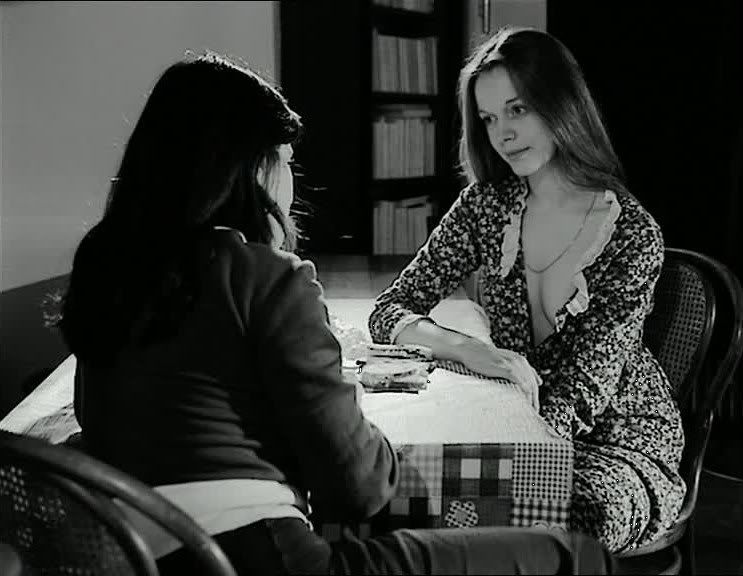
Julie takes her leave of the truck driver shortly after this scene, arriving at the apartment of the lover (Claire Wauthion) who she had missed so profoundly during the film's first half hour. Julie's girlfriend tells her immediately that she doesn't want her staying the night, and the subsequent scenes are full of awkward, hesitant interaction: they embrace, the girlfriend makes Julie a sandwich and serves her some wine, and they stare at one another while Julie chomps on the sandwich. Then Julie reaches across and unbuttons the other woman's dress, while her girlfriend smiles and shakes her head, not as though saying "no" but with a faint air of admonishment and disbelief that they're going to go through this again. Akerman then cuts to the two women naked in bed, caressing and kissing one another, rubbing their bodies together and rolling around so that sometimes one is on top, sometimes the other.

Sensuous and sensual, passionate and joyful, tender and desperate, it's a forceful answer to the mechanized orgasms of the truck driver, a vision of a much more beautiful kind of sex built on real emotions. Those emotions can sometimes hurt and wound those who give themselves up to them, as they did to Julie during the film's opening, but that's just because the stakes are so high, and the rewards so transcendent. This lovingly filmed and lengthy sex scene can be read as a feminist/lesbian rejection of heterosexuality and marriage, but it can also be read as simply an ode to the beauty of real loving sex, no matter who's involved, as contrasted against sex as duty and sex as simple biological imperative. All of the film's patient minimalism was building towards this sequence, and when it's finally over, the next morning, Julie simply gathers her clothes and sneaks out, leaving the other woman sleeping peacefully, and the film ends. Je, tu, il, elle is a simple film in many ways, as symbolic and schematic as its title suggests. But for such a small, quiet film, it has a lot to say in its silences and its stark, still images.