Showing posts with label '1930s. Show all posts

Wednesday, October 24, 2012

City Girl


F.W. Murnau's City Girl is something of a response to and a reconfiguration of the director's earlier Sunrise, returning to that film's theme of the opposition of rural and urban values. Lem (Charles Farrell) is a farmer's son, heading to the big city to make a deal for his family's impending wheat harvest. While he's there, he isn't able to make quite the deal that his stern father (David Torrence) had been counting on, but he does meet the waitress Kate (Mary Duncan), so when he returns to the family farm, it's with a girl from the big city as his new wife. Naturally, this sets up a country/city divide, but not in the expected ways, and Murnau purposefully hints at his earlier film as a way of contrasting it against this one. At the beginning of the film, while Lem is taking the train to the city, he's sized up by a gold-digging woman who takes interest once she notices the wad of bills he's carrying. She's a callback to the vile city vamp of Sunrise, but Murnau swiftly foils her plans; thankfully, this isn't a story about the city girl corrupting the wholesome and innocent country boy, but something much more complex.

In fact, this is a film about love transcending that kind of shallow distinction between city and country. It's also about replacing romantic and artificial notions about rural purity and urban corruption with a more pragmatic and balanced view of humanity as a whole. Kate herself, unhappy in the city, romanticizes the country, looking longingly at posters of a wheat field and a pond with a couple rowing across it — an image that's not nearly as romantic as it seems to her, with Sunrise's iconic and rather grim boat ride in mind. Murnau sets the film up as though it is going to be steeped in romantic pastoralism, in shallow contrasts between city and country. "Give us this day our daily bread," the farmer says as he prepares to eat, and Murnau cuts from him slicing off a large slice of bread from a loaf to a diner in the city, where tiny slices of processed white bread roll off a conveyer belt for a waitress to serve. Lem is also something of a caricatured rural good boy, which is partly what attracts Kate to him in the first place. In a crowded, fast-paced urban restaurant where most of the guys just want to leer at her, Lem stands out as the guy who prays before he eats and writes out postcards expressing his love for his kindly mother (Edith Yorke).

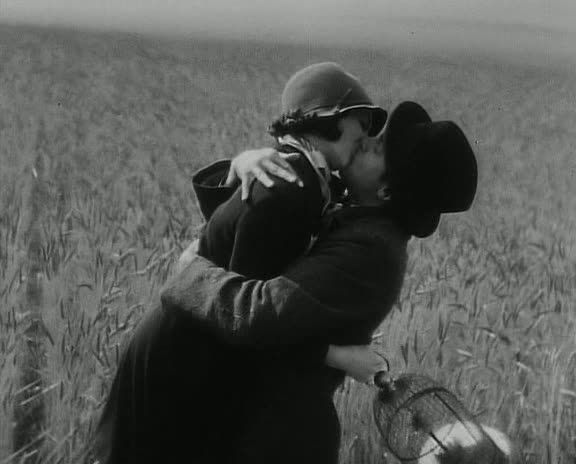
It's when the couple arrives in the country that the trouble starts, though not quite immediately. Their arrival at Lem's family farm is exuberant and kinetic, Murnau's camera tracking along with the couple as they run and twirl through the fields of wheat, pausing to hold and kiss one another, excited and in love. The farmhouse in the distance, its chimney billowing smoke, promises the welcoming comfort of home and hearth. The reality, of course, is not quite as idyllic: Lem's father, with his own received ideas about the differences between city and country, views this woman as an interloper, a bad girl, a vamp who's just using his son in some way.

Once she moves to the country, Kate soon learns that it's not what she thought it would be, and that there's cruelty and nastiness everywhere, that there are even men here just as mean and manipulative as her grabby diner customers, like the harvest foreman Mac (Richard Alexander), who tries to exploit the tension between her and Lem to break them apart. Kate had gone to the country thinking that she'd be escaping the urban grind and the soul-numbing artificiality of the city. In her cramped city apartment, billboards had provided her only window into natural vistas, and she tried to approximate the allure of the natural world with a wind-up mechanical bird kept in a cage, a toy that she then brings with her to the country, where it in turn provides a connection back to the city.

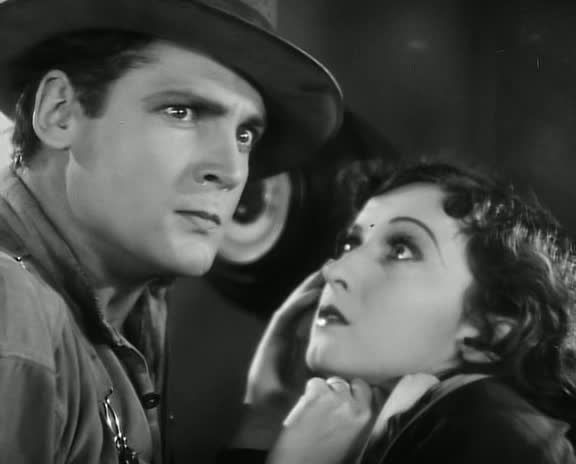
Murnau, even while critiquing simplistic dichotomies between city and country, still captures the moody beauty of the countryside, the lure of the open fields, the sensuous gloom of a dark night with a pale moon hanging low in the sky above the farmhouse. The film's gorgeous imagery is especially mesmerizing during the stunning, incredibly tense climax, in which the family and their hired hands must rush to bring in the harvest before a threatening hailstorm blows in and destroys the crops. While the wind kicks into a frenzy and the men labor outside, the brewing trouble between Lem and Kate comes to a head as Mac stirs up a confrontation with Lem's father. The stormy, foreboding atmosphere constantly threatens to explode in various ways, and the tension builds with the increasingly intense wind outside. Murnau's images are loaded with drama, particularly in the way in which he frames taut two-shots in which the characters' poses are infused with their conflicted emotions. The images of Kate and Lem together, especially, are charged with their new, passionate, but fractured relationship — their postures simultaneously suggest intimacy and disconnection, as though they're both desperately pushing towards each other and pulling away, their intimacy polluted by the differences in their backgrounds and origins.

This is one of Murnau's very best films, a deeply moving and passionate film, a poignant romance that's tested but ultimately strengthened by the film's clearheaded skewering of the idealization that often goes along with such romances.

Thursday, June 7, 2012

Vampyr


Vampyr was Carl Theodor Dreyer's first sound film, a hypnotic and dreamlike horror movie, a chilling masterpiece whose hazy, fuzzy beauty has only been enhanced by decades of wear and tear, by the degraded, scratchy quality of the surviving prints. A film that started out vague and blurry — much of it was shot with a filter in front of the camera lens to give it a distant, gauzy look — has only become more faded, more eerily unclear, over the years, its beauty and strangeness enhanced rather than hurt by its imperfections. It's a surreal and haunting experience, a rather indirect horror movie in which its atmosphere of fear arises from what's not seen rather than what's seen.

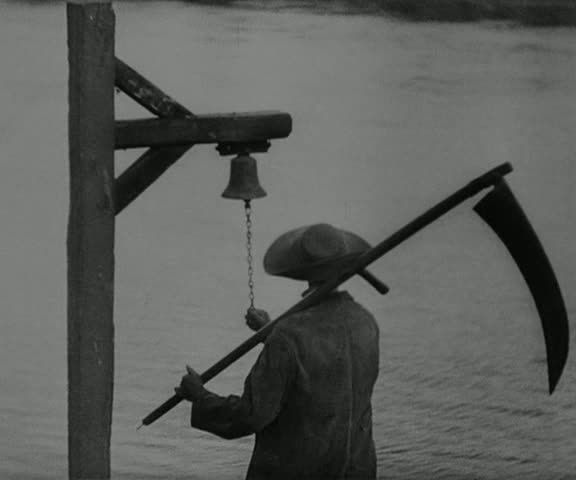
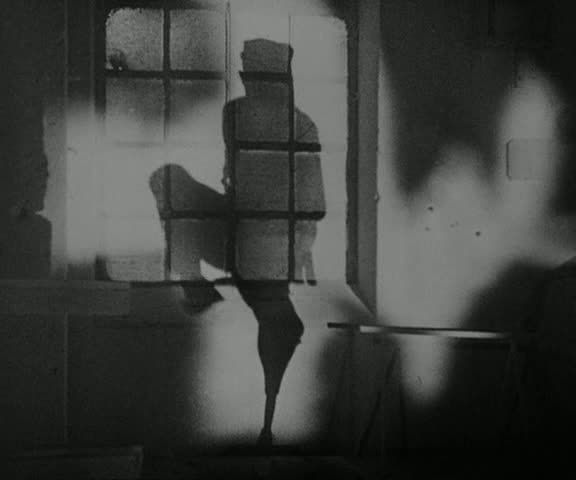
The handsome but abstracted everyman hero, Allan Grey (Julien West), is pursuing evidence of the supernatural for vaguely defined reasons, and he finds what he's been seeking in a sparsely populated small town. Grey's wanderings through the town have a feeling of surreal disconnection as he seems to be passing from the material world into a place of shadows and illusions, a world where the concrete fades into the immaterial. A farmer with a scythe rings a bell, an ominous tolling that seems to forebode grave events in the offing. Shadows are disconnected from any physical bodies, passing along walls without any sign of who might be casting the shadow. A reflection of a child runs, upside-down, along the surface of a pond, with no corresponding figure upon the shore who could be creating this reflection. A man's shadow shovels in reverse, the dirt seeming to leap from a pile on the ground to his shovel. Other shadows dance upon the walls to a sprightly tune, echoes or memories of previous eras, ghosts haunting a place where they'd once danced and played.

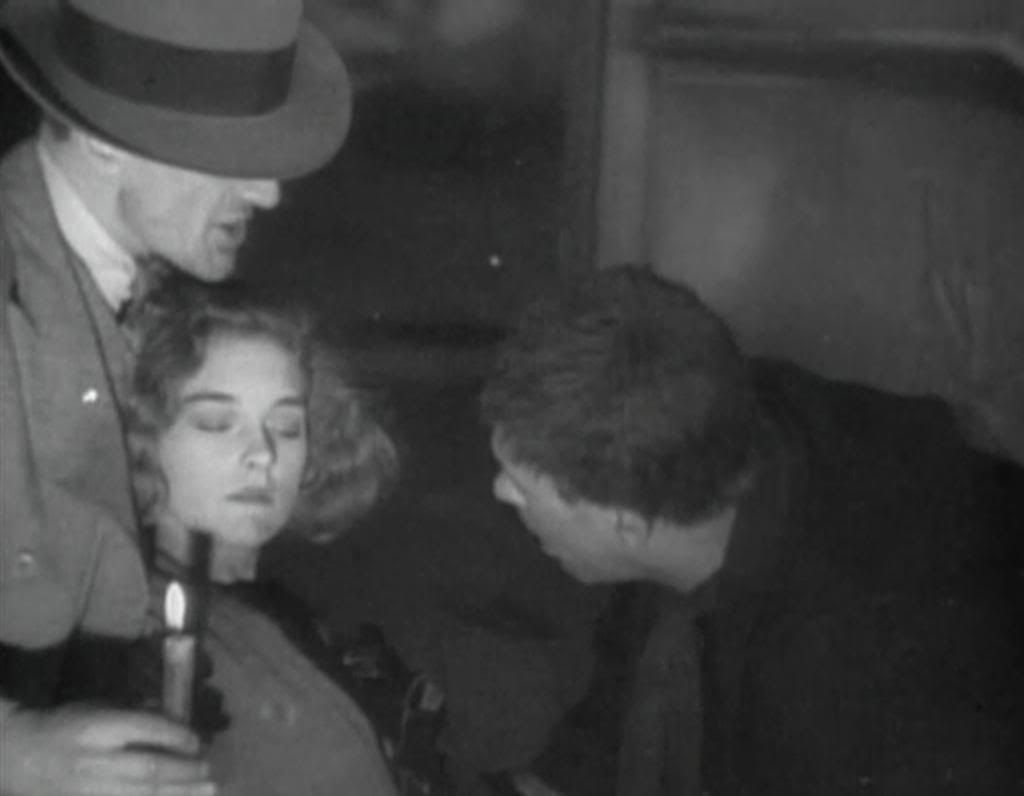
This imagery is creepy and somberly beautiful, and Grey is getting sucked into this strange dreamworld along with the audience. Dreyer's camera drifts and tracks behind the protagonist, following him on his wanderings, suggesting that the audience is his unseen companion on his quest. Indeed, Grey himself is mostly an observer, stumbling into the middle of a haunting horror tale that he watches play out around him like an audience member wandering in a daze through the middle of a supernatural play. Grey follows the shadows to a country estate where an old man (Maurice Schutz) and his daughters (Rena Mandel and Sybille Schmitz) are plagued by the vampire's curse. The old man is killed by a shadow soon after Grey's arrival, and then one of the daughters is attacked as well, infected with the vampire's bloodlust, grinning madly at her sister with a thirst for blood.


While all this is going on, Grey observes with mild detachment, and after each incident he returns to reading a book about vampires given to him by the old man, reading passages that both explain the action and foreshadow future developments. Interestingly, although this was a sound movie, it still feels like a silent film most of the time, and the extensive use of text contributes to that impression. There are poetic intertitles that punctuate the film early on, describing Grey's journey and mental state, eliminating the need for any expository dialogue whatsoever. As a result, Dreyer can reduce the spoken dialogue to a bare minimum, allowing most scenes to play out wordlessly, accompanied only by the expressive orchestral score. At times, even the score drops out or is reduced to a minimal murmur, exposing the hollowed-out silence of this village that seems to be populated almost entirely by shadows and ghosts. When there is sound, it's often strange and disconnected, due to the movie's post-dubbed soundtrack: people wander through the fog, their calls for their missing loved ones muted and echoey, and occasionally the silence is pierced by the clatter of horse's hooves or the somber chiming of church bells.

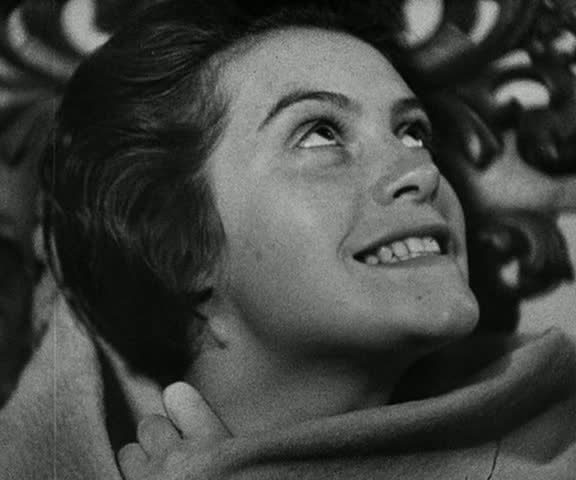
Dreyer also uses the vampire book similarly to silent movie title cards, interspersing excerpts from the book throughout the scenes at the mansion. The way in which Grey keeps returning to the book, as though he's more drawn to its text than to the very strange happenings all around him, contributes to the film's eerily affectless tone. Even the protagonist seems disconnected from what's going on, easily distracted by this text, immersed in reading rather than truly interacting with the sinister goings-on. Soon after, Grey becomes disembodied, his self splitting apart as his non-corporeal form has an out-of-body experience, wandering into the lair of the vampire's creepy associates, and the film's dreamlike atmosphere is especially pronounced here. Dreyer again toys with the audience's point-of-view, this time by shooting from the perspective of a body laying in a coffin, staring up at the sky and the looming buildings of the town as this coffin is carried away.

Vampyr is an unforgettably haunting experience, unsettling more for its shadowy, foggy atmosphere than for anything that happens in its minimalist narrative. Dreyer makes the vampire legend an abstracted nightmare, a journey into a strange, unstable world of shades and spirits that might just be the mind itself.

Tuesday, May 22, 2012

Modern Times


Modern Times was the last of Charles Chaplin's "silent" movies, made after the silent era was over for everyone else, with pretty much only Chaplin hanging on — and Chaplin only able to hang on because of his special clout and fame. Like its predecessor City Lights, this isn't a true silent film, since it has a synchronized musical score (written by Chaplin himself) with sound effects and even, in this case, some actual speech. This is Chaplin's affectionate goodbye to the silent era, one last great masterpiece of silent aesthetics, with only a few small concessions to the sound pictures that had taken over the rest of Hollywood. Virtually all of the actual intelligible dialogue in the film is delivered through machines: the boss' voice barking orders over the intercom, a radio news report, a robot voice that delivers a sales pitch even as the salesmen stand silently nearby, miming along with the recorded voice. This suggests Chaplin's suspicion about the coming of sound in the movies, treating the voice as disconnected from the speaker, always with a mechanical layer between the source and the sound.

That suspicion of the modern and the mechanical runs through the film, which is a brilliant satire of modernity, with a jaundiced eye cast on the unemployment and misery of the Depression, as well as the supposed improvements of modern factories and technology. Chaplin plays a factory worker on an assembly line, unable to pause in his repetitive tasks for a moment without falling behind. This is a society that seeks to mechanize and automate everything, including even eating, thus eliminating one of the only breaks the workers get and turning it into just another step in the assembly line process. It's no wonder that this poor worker suffers a mental breakdown, unable to tolerate these oppressive conditions any longer. Chaplin, wrenches in hand, sees nuts everywhere, including in the buttons on the back of a secretary's skirt or across the breast of an older woman's suit; he's so compulsively locked into the rhythms of the assembly line that even his sexual responses are mechanical, a woman's body reduced to a series of machine parts to tighten and manipulate.

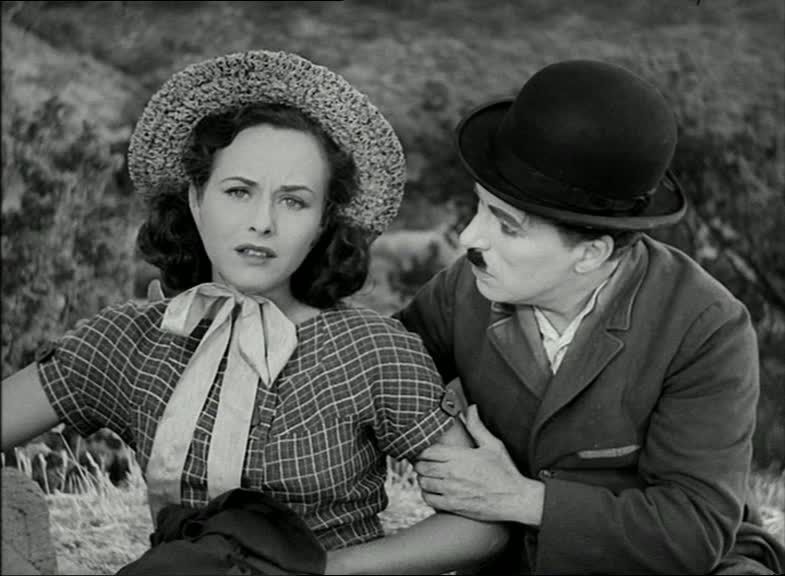
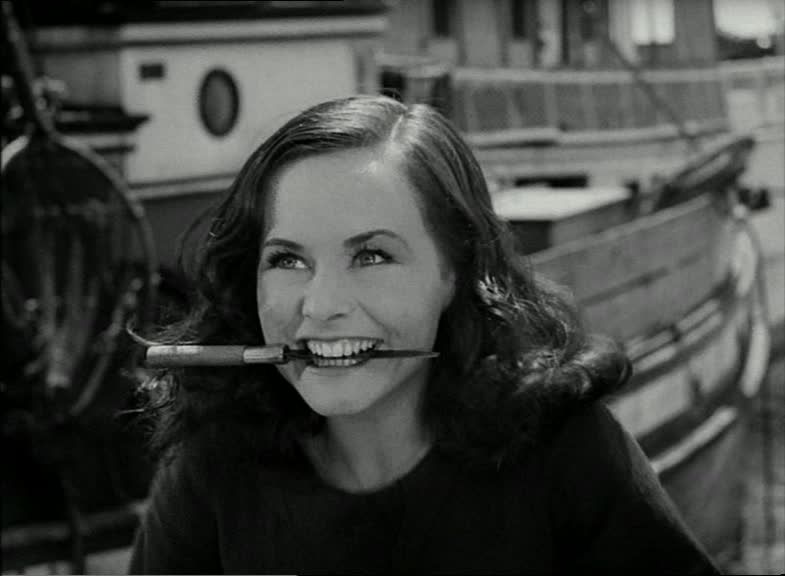
Now out of work, Chaplin's happier in jail, where he at least gets a comfortable place to sleep and some food — laced, in one outrageous scene, with cocaine from a drug dealer — than on the streets, where he's simply a poor bum. Once he gets out of jail, he's joined by Paulette Goddard's "gamin," a young orphan girl who remains a sprightly free spirit despite her life of poverty and deprivation. She is positively feral and ferocious from the moment she first appears on the screen, baring her teeth in a wild grin, a knife clamped between her jaws like a pirate as she steals bundles of bananas for the other poor kids of the waterfront. She's a magnetic and vivacious presence, with an electric smile that lights up the screen, and she's every bit Chaplin's equal, perhaps the only one of his leading ladies about whom that could be said.


Together, Chaplin and Goddard embody the determined spirit of the Depression's poor, locked out of jobs, unable to provide for themselves, living on the streets and scratching together whatever scant food and shelter they can get. And yet they never give up, and their spirit is infectious, their enthusiasm and boundless optimism propelling the film forward into one inspired comic set piece after another, the humor always tinged with the harsh truths of poverty and struggle. Chaplin is continually bouncing in and out of jail and getting fired from one job after another despite his well-intentioned but bumbling attempts to get by. He stumbles into countless comic situations, at one point accidentally leading a Communist rally by picking up a red flag from a passing truck. The rally's quickly broken up by cops, as is a later strike by factory workers — in fact, there's very little that the cops don't break up, and the film is rather contemptuous of these authority figures who can only endlessly arrest and chase those who are just trying to ease their hunger in any way they can.

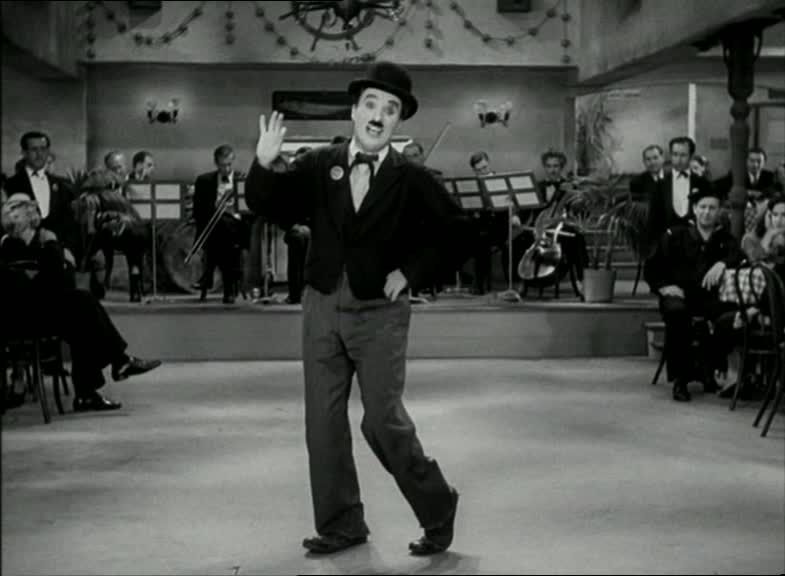
Towards the end of the film, Chaplin returns to tweaking the new talking pictures, with a sequence in which Goddard gets Chaplin a job as a singing waiter. Chaplin seems to be preparing for his entry into the sound era, teasing the audience with the prospect, at long last, of his voice being heard on film. He rehearses a number, having Goddard write out song lyrics on his cuffs, but he rehearses silently, mouthing the words and dancing, and when he finally does sing, he's forgotten the words, so he just makes up a nonsense song that's mostly pseudo-Italian dialect, gibberish and an occasional recognizable English phrase. It's a wonderful way of ushering Chaplin into the sound era without having him actually communicate anything intelligible, and the film as a whole provides one last visually, viscerally eloquent expression of Chaplin's privileging of image over sound.

The film's conclusion is justly famous, with a stunning final shot of Chaplin and Goddard walking off down a long road into the future, arm-in-arm, Chaplin duck-walking besides his beautiful partner. It's optimistic and exhilarating and utterly gorgeous, a perfect ending to a film that is often cynical about the mechanization of the modern age but is celebratory of the human ability to resist this dehumanization, to fight back with song and dance and silliness and determination and, perhaps most importantly, love. After all, this is undoubtedly a love story, one of the rare Chaplin films where the tramp doesn't give up his great love at the end; when he strolls away into the distance this time, for once he's not doing so by himself. Chaplin was in an off-screen relationship with Goddard at the time he was shooting this, and it's easy to see that romance in her onscreen radiance and the absolute adoration that's implicit every time Chaplin turns a camera on her. He's in love, and seems determined to communicate that love in every image of his costar; the result is that it's nearly impossible to watch the film without falling in love with her along with Chaplin. Romantic, hilarious, beautiful, and endlessly inventive, Modern Times is one of Chaplin's greatest works, an ode to the irrepressible human spirit and its capacity for love and invention.

Monday, May 21, 2012

The Blue Angel


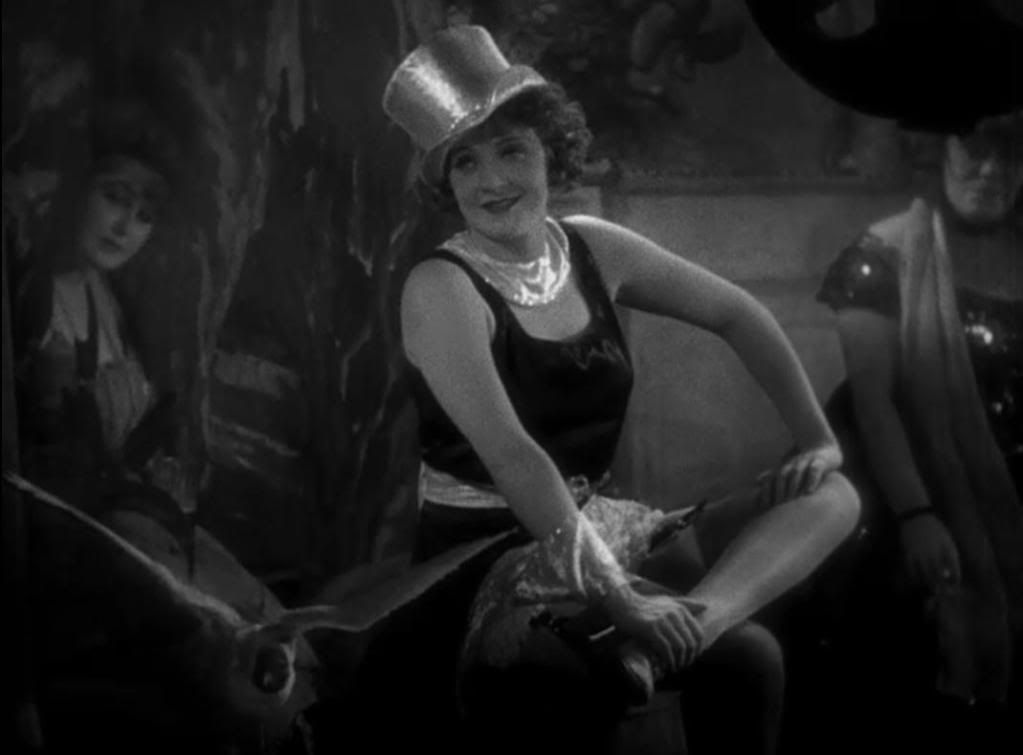
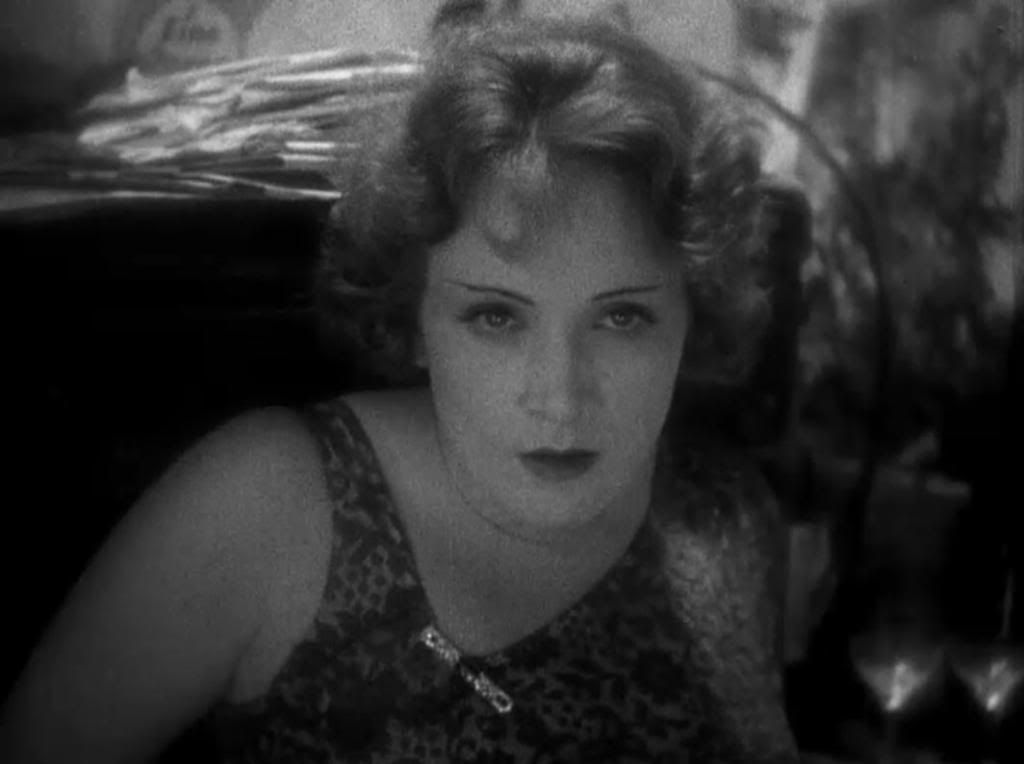
Marlene Dietrich's performance as the burlesque singer Lola Lola is one of the most iconic screen incarnations of the dangerous woman who lures a man to his destruction. This role in The Blue Angel was Dietrich's breakthrough; director Josef von Sternberg discovered her here and would make her his muse in many subsequent films. She radiates sex as the singer who wins the heart of the stuffy, sexless Professor Rath (Emil Jannings), an aging bachelor whose sheltered existence makes him especially susceptible to Lola's womanly charms. Rath initially only goes to the club the Blue Angel because he's outraged to learn that his students have been going there at night, but he keeps returning because of Lola.

The professor's fascination with the singer is charming and almost childlike; he becomes flustered and foolish in her presence, very unlike the stern disciplinarian he is with his students. This was an early venture in sound filmmaking for everyone involved, and it shows in the broad, physical performances, especially Jannings' turn as the professor. He blushes — it's obvious even in black-and-white — and sputters, his eloquence totally gone. Sternberg stages numerous deliciously naughty scenes that play up the professor's total helplessness before the spectacle of Lola. She drops her cigarette case and he goes scurrying under the table, fumbling around to recover the spilled cigarettes, but getting distracted by her long stockinged legs splayed out next to his head. "Send me a postcard," she says, her voice dripping with insinuation. Later, Rath gets drunk and wakes up in Lola's bed, clutching a doll, which he examines quizzically, like a child with a new toy. That's how he is with Lola in general, as though he's discovering women and sex for the first time, which of course he is.


The film then relentlessly, pitilessly follows Rath's downfall, his sad descent from respected professor to pathetic clown. Rath's boyish pursuit of a notorious woman like Lola causes him to lose the respect of his students and his colleagues, and he's soon drummed out of the college. In the scene where he loses his job, he sits at the front of the class, toying with a flower that Lola had given him, surrounded by mocking chalk drawings that his students had drawn on the blackboards behind him. The camera tracks back, leaving him isolated there, receding into the distance, and Sternberg repeats this unforgettable, simple but effective shot at the very end of the film. Rath then marries Lola and joins the traveling revue run by the magician Kiepert (Kurt Gerron). When Rath discovers, on his wedding night, a pile of risque pictures of his new wife, he demands that she stop selling these souvenirs. Her deadpan response is telling, and chilling, as she tells him they better hold onto them in case he's ever poor. Sure enough, Sternberg immediately cuts to a shot of Rath, some time later, shuffling through the postcards, waiting for Lola's performance to end so he can walk around from table to table, selling them to the club patrons.

The film reaches a heartbreaking, absolutely shattering climax when the revue returns, after five years away, to the Blue Angel in Rath's hometown, the first time he's been back since his disgrace. In the meantime, his relationship with Lola has deteriorated, and the childlike bliss he once felt with her has long since vanished, along with his dignity. The man who once virulently defended her virtue, calling Kiepert "a pimp" for convincing Lola to drink with club patrons, now finds himself in the same position, living off of her beauty and seductiveness, living off of her appeal to other men. Worse, Kiepert sells the Blue Angel show on Rath's name, knowing that his former friends and students and neighbors will flock to the club in order to see the disgraced old man perform as a clown alongside his sexy, provocative wife. This is the final assault on Rath's dignity, though he's perhaps even more shaken up by Lola's blatant infidelity, her flaunting of her new dalliance with a strongman who's also performing at the club.

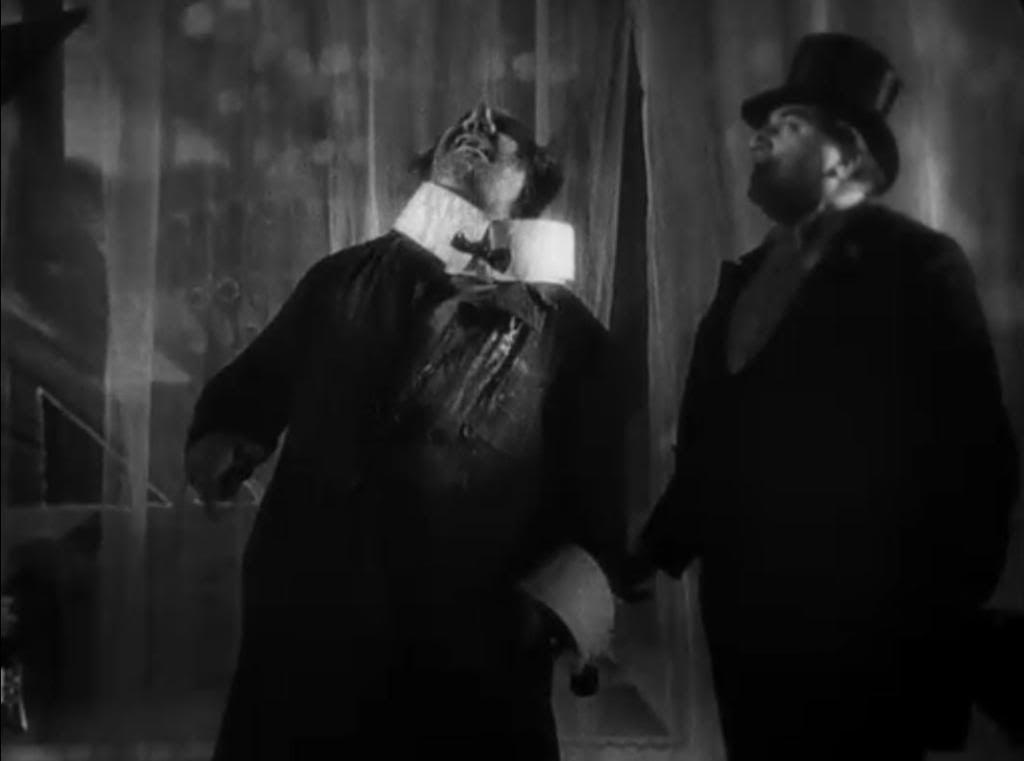
Rath's stage act is harrowing to watch: he stumbles onstage in a daze, pulled along by Kiepert, standing utterly still, his posture slumped and his face frozen, while the magician performs his tricks and gets laughs by smashing eggs on Rath's head. The show, it's clear, is only successful to the extent that it humiliates the professor: that's what everyone is there to see, and they laugh uproariously at anything at Rath's expense, while remaining silent for Kiepert's magic tricks. At a key moment, Rath is supposed to crow like a chicken while Kiepert makes eggs appear from thin air in front of the professor's face, but Rath stays silent until he sees Lola, backstage, kissing and embracing another man. Kiepert pulls him back onstage, telling him to crow, and he does, letting out an anguished, horrifying sound, a sob of fury and despair ripped from his very soul. He cries like a chicken, for the delight of the audience, but it's a heartrending sound, a sound of such raw emotion that it provides all the justification that could ever be needed for the switch from silents to talkies.


Dietrich's songs are also unforgettable, and another big reason why this was one of the very first major sound pictures. Her dry, deep delivery makes her ribald songs seem offhanded, as though she's so blasé about her own sexiness that she can simply drawl out these naughty come-on tunes. She stalks about the stage as she sings, not wiggling or dancing; there's something almost mannish and unfeminine about her stage manner, but only because she knows damn well that she doesn't have to oversell. She just has to stand there, stretching those long legs, singing those songs, and the men will helplessly fall all over her. That's why her signature song includes the oft-repeated phrase, "I can't help it," because she really can't. There's just something naturally seductive about her, a force of nature that's beyond her power to control. She really does have some feelings for Rath, it seems, and she thinks he's sweet and charming when he defends her from the caresses of other men. But everything she liked about him is worn away by the reality of living with her lifestyle, so their relationship is doomed to failure.

The Blue Angel is a tremendous film, a classic that endures for far more reasons than its undeniable historical relevance. It was the film that made Dietrich a star, and that forged the Dietrich/Sternberg partnership that would yield six more collaborations in the next five years. It also helped Sternberg transition from silents to talkies. The Blue Angel occasionally betrays its transitional nature, especially in the way sound from outside is abruptly cut off whenever a door shuts, a device Sternberg makes a bit of a gag out of during the backstage scenes. It's also notable that much of the action, particularly Jannings' comedic bits, plays out without dialogue, getting across the substance of a scene through the actors' body language and facial expressions. It's a film with one foot still in the silent era, and yet its use of sound can also be explosive and powerful, which is a big part of what makes the film so dazzling. It's the best of both worlds, straddling two very different modes of filmmaking, ushering in the new era while reaching back for some choice tricks from the old. The Blue Angel has it all: it's sexy, funny, gorgeously shot, and above all, deeply tragic.

Saturday, May 19, 2012

Jamaica Inn

[This post is one last late contribution to the third annual For the Love of Film blogathon and fundraiser, which ran from May 13-18. This year, hosts Marilyn Ferdinand, Farran Smith Nehme and Roderick Heath have dedicated the week to Alfred Hitchcock, whose early (non-directorial) work "The White Shadow" will be the beneficiary of any money earned during the event. Be sure to donate!]

Jamaica Inn was the final film of Alfred Hitchcock's British period, made just before the director emigrated to Hollywood. Hitchcock was purportedly not very happy with the film, which he made quickly and cheaply, in a hurry to get to America. It's certainly not one of the director's most characteristic works, a period pirate drama based on a Daphne Du Maurier novel. It's obvious the director is distracted and not fully engaged, and the film is pretty much as dire as its reputation suggests, mostly lacking in Hitchcock's characteristic visual rigor. Instead, it's talky and plodding, with little to recommend it beyond some showy performances and the occasional nice visual flourish.

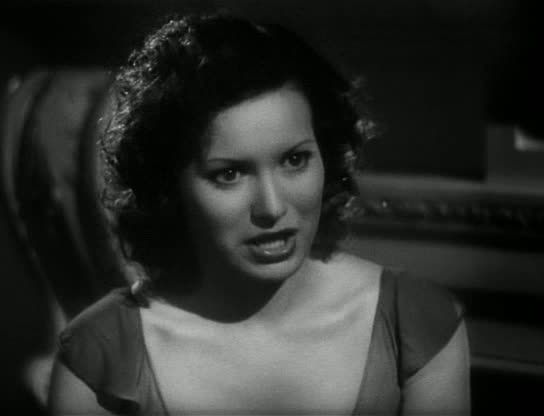
Maureen O'Hara, fresh-faced and beautiful, is "introduced" in the opening credits, since this was her very first starring role. As Mary, she's playing an avatar of innocence and goodness, stumbling into the center of a den of thieves when she goes to stay with her Aunt Patience (Marie Ney) and Uncle Joss (Leslie Banks). Joss, it turns out, is the leader of a group of pirates based at the Jamaica Inn, a base of operations from which they lure unsuspecting ships to crash on the rocks, plundering the shipwrecks and killing any survivors to coldbloodedly eliminate any witnesses. Joss, unbeknownst to Mary or anybody else, gets his orders from Sir Humphrey (Charles Laughton), a local dignitary who Mary has met and thinks of as an ally. When Mary arrives at the Jamaica Inn, she quickly disturbs the pirate gang's plans, freeing the pirate Trehearne (Robert Newton), who is being hanged as a traitor by the rest of the gang.


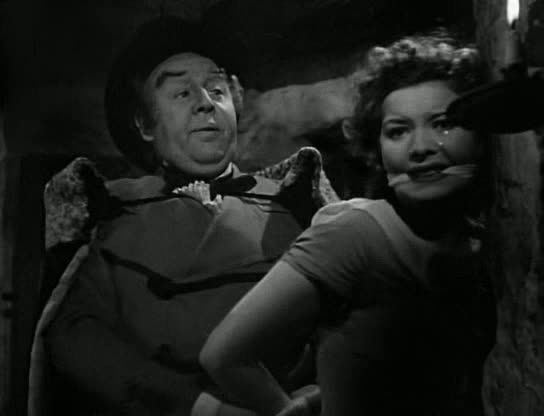
The film is primarily an acting showcase for Charles Laughton, shamelessly hamming it up as Sir Humphrey, a role substantially expanded and changed from the Du Maurier novel especially for Laughton to sink his teeth into. He seems to be having a blast playing this man living a double life as a well-respected lord and a smuggler boss. When he's not bellowing enthusiastically for his servants, he's pattering in a rapid stream of pretentious wordplay and speechifying, all bluster and stilted mannerisms. It's an over-the-top performance, though Laughton modulates his hysterics towards the end of the film, when he finally reveals his villainy to Mary, dropping all pretense and affecting more of a quietly sinister demeanor, projecting menace in silky tones. At this point, he becomes something of a memorably Hitchcockian villain, binding Mary and taking her away as he unleashes a mad stream of vitriol.

Hitchcock shows only sporadic signs of being visually engaged by this material. In one scene, as Trehearne tries to convince Patience to let him go, Hitchcock's camera whips rapidly back and forth again and again from one of them to the other as they exchange lines, arguing over the man's fate. Hitchcock also makes the scenes out in the countryside very stark and dark, set in a bleak rocky wasteland with perpetually gray and cloudy skies hanging above the hideously warped landscape. The exterior scenes have an eerie, minimalist artificiality that's bracing and potent, creating an evocative atmosphere. In one scene, as Trehearne and Mary hide from the pursuing pirate gang, Hitchcock places them in the foreground of the shot, in front of a jagged rocky wall that obscures them from the villains scurrying around in the background of the shot. The docks where Humphrey takes Mary at the end of the film are also moodily shot, covered in shadows, betraying the influence of German expressionism, though Hitchcock doesn't linger long in this foggy locale.

On the whole, though, such evocative moments are rare, and Jamaica Inn winds up being one of Hitchcock's very worst films. Hitchcock was on his way to Hollywood, and his first film there would be another Du Maurier adaptation, Rebecca, the sensuous style and psychological depth of which only confirms how slapdash and uncharacteristic this final British film was.

Friday, May 18, 2012

The Man Who Knew Too Much (1934)

[This post is a contribution to the third annual For the Love of Film blogathon and fundraiser, which will be running from May 13-18. This year, hosts Marilyn Ferdinand, Farran Smith Nehme and Roderick Heath have dedicated the week to Alfred Hitchcock, whose early (non-directorial) work "The White Shadow" will be the beneficiary of any money earned during the event. Be sure to donate!]

The 1934 version of Alfred Hitchcock's The Man Who Knew Too Much is very different from the 1956 Hollywood remake he made with James Stewart and Doris Day. The original film is a punchy, economical little thriller that deftly juggles its conflicting tones, with a generally lighter, more comedic tone than the later film. Bob Lawrence (Leslie Banks) and his wife Jill (Edna Best) go vacationing in the Alps with their daughter Betty (Nova Pilbeam), and get accidentally tied up in an international incident when their friend, who turns out to be a spy, is killed. Before he dies, though, he points the couple towards a clue that leads to a plot to assassinate a diplomat, and as a result Betty is kidnapped to prevent the Lawrences from giving their information to the British Foreign Office.

The early scenes of the film strike a jaunty tone, and strangely for a film that centers around a child kidnapping, it starts with a pretty cynical attitude about kids. In her first few scenes, Betty blithely skips onto the ski slope to scoop up her puppy, tripping up the skier coming down the hill and nearly injuring him badly, then snottily interrupts her mother at a skeet-shooting competition, prompting Jill to remark, as she misses her shot, "this is what happens when you have kids." It's all pitched in a ha-ha-just-kidding ironic tone that seems to hide at least a little genuine bitterness — which might be understandable, since after all this is a kid who obliviously blunders onto a ski slope, nearly kills a guy, and then laughs about it afterwards. The Lawrences are blithely ironic with one another as well, jesting and flirting — though mostly not with each other. As Jill dances with another man, Bob mischievously ties a piece of knitting thread to the back of the man's coat, so that as they dance the string winds around the legs of all the dancers. The climax of this comic set piece, when the man discovers the thread, cleverly dovetails with the introduction of the film's serious plot, as Hitchcock chooses this exact moment to have the man get shot.

Throughout the film, the comic is tightly interwoven with the dramatic, especially when Bob and his friend Clive (Hugh Wakefield) go hunting for Betty, trying to track down the kidnappers. The unfortunate Clive keeps getting a raw deal, serving as a guinea pig for an underworld dentist, then getting arrested himself when he tries to inform the police about the kidnappers' plot. Best of all is the strangely goofy scene when Bob discovers the kidnappers hiding in a church and confronts them: the villains can't simply shoot Bob or risk attracting police attention, so the showdown devolves into a wonderfully sloppy battle of throwing wooden chairs, Bob facing off against the bad guys as they hurl chairs at one another, all while a nun plays the organ to mask the racket they're making. It's almost childlike, a game with deadly serious stakes.


Of course, on a more serious note, there's the famous Albert Hall sequence, in which Jill sits in the audience, knowing that an assassin is going to shoot a diplomat when the music gets loud enough, but vacillating about what she should do. Hitchcock drastically expanded and refined this sequence for the 1956 remake, and it plays out much better in the later film, but here the essence of the suspense is already apparent, slowly building as the gun edges out from behind a curtain. Less successful is the protracted and lackluster shootout between the cops and the bad guys that concludes the film, with Hitchcock's usually precise sense of staging and action here degenerating into a flat, static mise en scène with constant pop-pop gun sounds coming from everywhere.

This extended sequence stands out as plodding because so much of the rest of the film rushes by at a clipped, no-nonsense pace, communicating everything in shorthand. When Jill first finds out that her daughter has been kidnapped, she stares off into space, walks a few zombie-like steps, and promptly collapses, and this is virtually the entirety of the film's depiction of parental grief. Everything is compressed and moves with a choppy, jittery rhythm that leaps from one scene to another. As a result, there's very little fat, but also very little characterization, and neither of the two lead performances stand out. Thankfully Hitchcock at least got a scenery-chewing villain in Peter Lorre, who plays the creepy kidnapper Abbott. He's a sleazy, slimy character, defined by the oddly skunk-like white streak running down the center of his hair. Curiously, Hitchcock gives Abbott some of the film's most subtle emotional beats, like the closeup of him looking down — with guilt? sadness? — while thinking about what he'll eventually have to do to Betty when this plot is over. Later, during the final shootout, when Abbott's female partner is shot by a stray bullet, he pulls her close to him, genuinely upset that she's dying. The film rarely pauses for such sentimental moments, so it's striking that the villainous Abbott is the focus of these brief diversions.

The Man Who Knew Too Much mostly speeds by, giving it a jumpy feel; it's bursting with the nervous energy of a rough, low-budget work. The film suffers at times from this economy, mostly in the clipped emotional subtext that the director would build upon when he remade the film, but it's still a fine early Hitchcock thriller with some enjoyable quirks.

Thursday, May 17, 2012

Number Seventeen

[This post is a contribution to the third annual For the Love of Film blogathon and fundraiser, which will be running from May 13-18. This year, hosts Marilyn Ferdinand, Farran Smith Nehme and Roderick Heath have dedicated the week to Alfred Hitchcock, whose early (non-directorial) work "The White Shadow" will be the beneficiary of any money earned during the event. Be sure to donate!]

For a film that its director didn't even want to make and later dismissed as terrible, Number Seventeen is a surprisingly entertaining, if more than a little ridiculous, minor thriller. The film was forced upon Alfred Hitchcock, then still very early in his career and coming off a box office flop that limited his options, so it's no wonder that he thought so little of it. In fact, it's a convoluted, frantically paced comic thriller that's devilishly difficult to follow, and doesn't even attempt to develop its narrative in the least until the hour-long movie's almost half over already, but is incredibly enjoyable anyway.

The plot involves a stolen diamond necklace, a bunch of crooks meeting up with their fence to split the take, a detective, the daughter (Ann Casson) of the man the necklace was stolen from, and an innocent bum (Leon M. Lion) caught up in this whole mess because he'd stumbled into the wrong building. Of course, none of these things are explained in the least until most of the movie's over already. To make things even more confusing, even when this basic scenario becomes clear, it's still not at all clear who's a crook and who's a detective. The film has a breakneck pace and hardly ever pauses to explain anything, which makes it not very satisfying narratively, but kind of fun in a baffling, manic way. It's the kind of film where a woman (Anne Grey) previously described as deaf-mute suddenly begins talking halfway through the movie, and it's never explained why, and where identities seem to switch every few minutes.

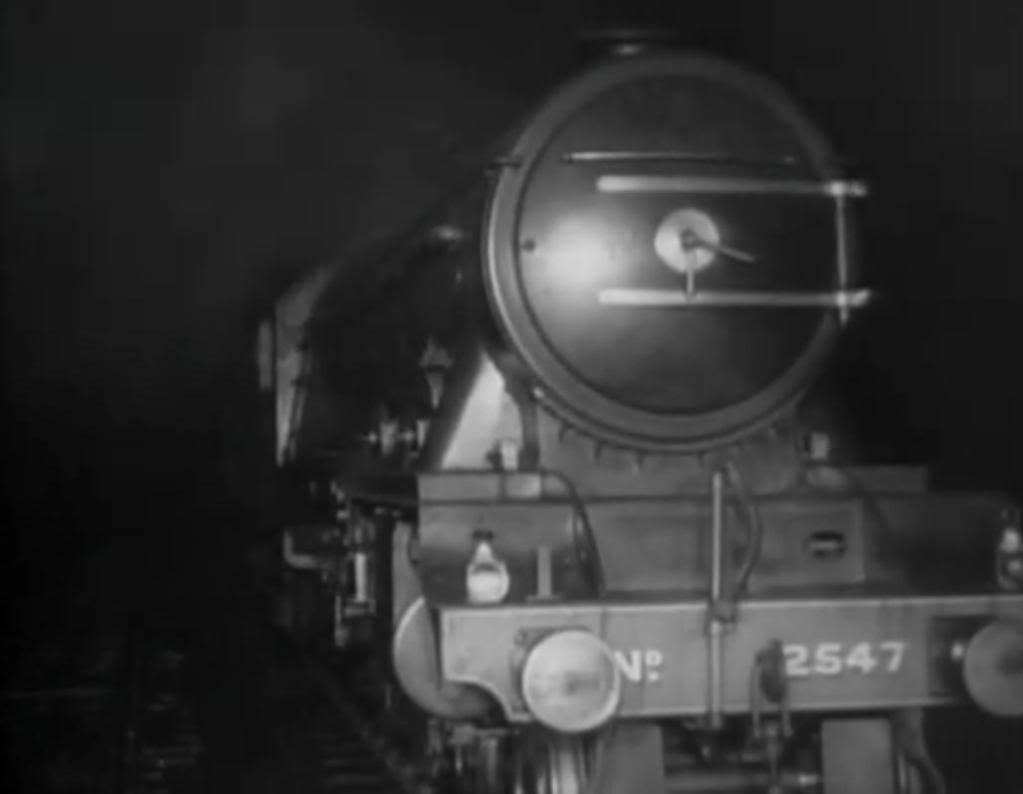
In the wordless, noirish opening sequence, the camera tracks rapidly along the sidewalk as fallen leaves and a man's hat are blown across the ground, stopping in front of a building where a man (John Stuart) runs into the frame to retrieve his hat. He stops outside the building, watching as lights mysteriously play off the walls inside, then he walks up to the door, which opens on its own like the entrance to the monster's lair in old horror movies. Inside, Hitchcock plays with expressionist shadows as the man prowls around, tracking someone else who's inside: there's a loud noise, a man collapses, his hand hanging over the upper railing and casting a tremendous shadow on the wall, and then the man from outside meets someone else wandering the abandoned building, who turns out to be the bum, Ben. They both find the body at the same moment, and Hitchcock finally deflates the tension with a jagged montage of a train roaring by, casting flickering lights over the two men — a forerunner of future Hitchcockian trains — and then cuts to brief, distorted closeups of both men comically screaming in terror.


More and more people begin converging on the abandoned building for mysterious reasons, and though nothing ever makes much sense, Hitchcock builds a compellingly eerie atmosphere as these people cluster in the darkness, listening for strange noises as shadows dance across the walls. At one point, the original man goes downstairs to check on noises at the front door, and he looks out the window to see smoke wafting up from the man on the other side of the door. Much else is conveyed with shadows and loud noises, and as more and more people show up, seemingly all of them toting guns and mysterious appointment cards, it increasingly begins to seem like Hitchcock's going for the atmosphere of a mystery/thriller with a plot that keeps getting more and more complicated without ever fully resolving itself. The film's pretty much a mess, but Hitchcock handles the narrative pile-up so deftly that it's easy to overlook the shambles of the script and simply enjoy the moody visuals and goofy comic asides.

Ben's a very comic character, a tramp who's stumbled into a mystery and just wants out. Hitchcock gives him some fun business to do, further distracting from the plot, like the scene where he checks to see if a gun's loaded by peering into and blowing into its barrel. He then tries to stalk his own shadow before realizing what it is, and playfully waves his arms about, watching as his stretched-out shadow mimics him.

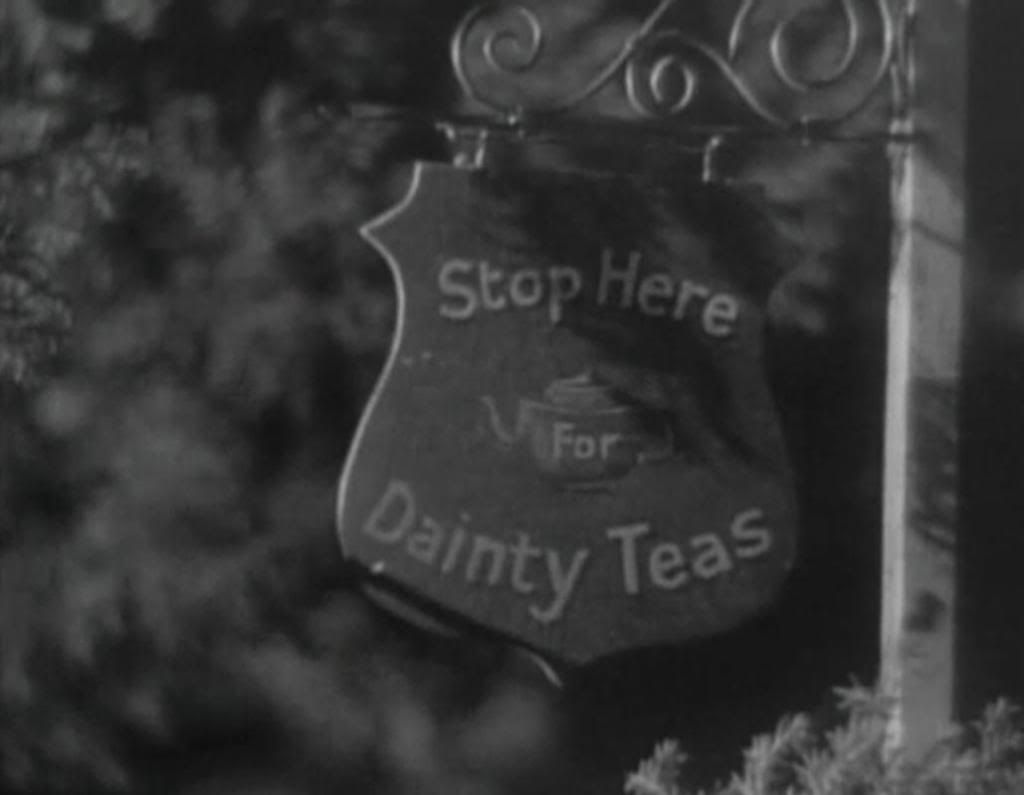
The film finally accelerates to a manic, chaotic climax with a chase between a speeding train and a commandeered bus, much of the chase achieved with some nicely done scale models. Hitchcock keeps cutting back and forth between the bus and the train, conveying the rapid pace of it all and also emphasizing the humor, showing the bus passengers bouncing in their seats as it careens along, flying by a sign that reads, "stop here for dainty teas." It all ends with an epic crash, the detective's identity changes a few more times, and in the final shot, Ben gets his moment of glory, grinning heroically for the camera. It's an extremely absurd and sloppy movie, but its lighthearted tone and Hitchcock's shadowy expressionist approach to it make it nearly irresistible.

Wednesday, May 16, 2012

Murder!

[This post is a contribution to the third annual For the Love of Film blogathon and fundraiser, which will be running from May 13-18. This year, hosts Marilyn Ferdinand, Farran Smith Nehme and Roderick Heath have dedicated the week to Alfred Hitchcock, whose early (non-directorial) work "The White Shadow" will be the beneficiary of any money earned during the event. Be sure to donate!]

Murder! was Alfred Hitchcock's third sound film, and it bears plentiful evidence of the young director experimenting with form and style, livening up what's otherwise a routine and glacially paced murder mystery. The theater actress Diana Baring (Norah Baring) is found one night sitting beside the corpse of one of her fellow actresses, swearing that she doesn't remember killing the girl. Nevertheless, it seems to be an open-and-shut case, and she's promptly convicted and placed on death row. Only after the trial is over does one of the jurors, Sir John Menier (Herbert Marshall), have second thoughts about letting himself get talked into going along with the guilty verdict. He begins investigating the case himself, hoping to uncover evidence of Diana's innocence. The film's plot is simple and schematic, and the pace is almost painfully plodding, with one inert scene after another walking Sir John closer to the solution. The performances are mostly not bad, but it's Hitchcock's budding visual imagination and subtle sense of humor that really elevates this pedestrian material.

The film opens in a quaint, patently artificial village that looks like it belongs in a German Expressionist silent: an appropriate place for a murder. In the opening scenes, Hitchcock cleverly builds tension sonically, starting with a scream that wakes up the neighborhood, sends birds fluttering away, and sets the dogs to howling. The soundtrack becomes noisy and cluttered: barking, people chattering, the banging noises of the police knocking on the door of the house that's causing all this disturbance. Hitchcock defuses the suspense slightly with the humor of one couple who stick their heads out their window, the wooden frame continually sliding down on their necks, but they're so intent on seeing what's happening that they let it push them down into the flower bed, craning their necks to see. At the site of all the clamor, Hitchcock further elongates the tension by focusing on the reactions of the people at the scene, shooting the backs of the heads of the people crowding around the door.

By this point, it's obvious that there's been a murder, but rather than just unveiling the body, Hitchcock employs a precise, elegant, slow camera move that retains the influence of the silent cinema in its ability to trace a whole narrative in the angle of the camera' arc. The camera moves from Diana's haunted, staring profile, down her arm, to the splatter of blood on the hem of her dress and her hand dangling just above the floor, then moving perpendicularly along the floor, parallel to a fire poker, the murder weapon, which lays pointing directly at the head of the dead woman who now, finally, appears within the frame.

Diana doesn't appear much in the film, but she still instantly makes an impression with her intense stare and shell-shocked demeanor. She barely even says much, mostly just staring blankly off into the distance, haunted by the secrets she's hiding and won't reveal even to save her own life or help her case. Her expressive silent movie actress face carries a lot of weight for what is otherwise an underwritten character; she serves as the trigger for the plot but is only vaguely defined even though the whole story revolves around her. Her most compelling moment is a wordless montage in which Hitchcock alternates overhead shots of her pacing around her cell with a foreboding image of the shadow of a noose reflected on a wall, creeping slowly up the wall as the sun changes position, a cleverly grim way of suggesting the passage of time.


Hitchcock also has some fun with a quirky little scene in which two gossipy women prepare tea while talking about the murder. This long scene plays out in a single shot that repeatedly tracks back and forth between two adjacent rooms as one of the women putters around, preparing the tea and laying out cups. Each time she walks from one room to the next, the camera tracks with her, and her friend scurries after her, sitting down, then almost immediately getting up again to return to the other room. The back-and-forth tracking of the camera brings out the deadpan comedy of this otherwise mundane scene, building an entirely cinematic and formal humor that's distinct from the banal content of the scene.

Hitchcock puts a little verve into moments like that whenever he can, because he doesn't have a whole lot to work with here. Once the trial is over and Sir John begins his investigation, the film is dominated by a series of stagey dialogues with witnesses and suspects, and there's not much Hitchcock can do to make these lifelessly written scenes pop. There are hints, here and there, of a buried homosexual subtext that was more explicit in the Clemence Dane novel the film is based on, but here it's mostly replaced by an undercooked racial theme. The film's theater milieu is full of crossdressing actors, and gradually the investigation begins to focus on the trapeze artist Handel Fane (Esme Percy), who dresses up as a glamorous woman and flies through the air, wowing the crowds with his grace. Fane's feminine artistry plays into the shocking circus climax, which Hitchcock stages by putting the focus on the horrified reactions of the crowd, just as he had during the opening scenes.

He then follows this, almost perfunctorily, with a letter that explains the film's whole plot, because after a climax like that, there's not much to do but quickly wrap things up and call it a day. As Sir John reads this letter, the shadows of the circus crowd flit by on the wall behind him, giving the scene a weird, disconnected feeling, as though the hero has quietly tucked himself off in a corner, isolated from the chaos, to resolve the plot. It's fitting, too, that the film then ends with a curtain coming down on a theater's stage, a last playful touch that accentuates the artificiality of these dramatics.

Friday, May 4, 2012

City Lights


City Lights was an anachronism when it first appeared, a new silent production from Charles Chaplin, one of the masters of silent comedy, at a time when the rest of Hollywood was eagerly embracing the arrival of sound. Released in 1931, when silent film was all but dying out, the film opens by immediately mocking the talking pictures, with a scene where a group of local dignitaries deliver speeches commemorating the unveiling of a statue. As they speak, the synchronized soundtrack (Chaplin's one modest concession to the new technology) features muffled nonsense noises, as though Chaplin is making a point, up front, of how irrelevant and silly so much dialogue is — as Norma Desmond would say in Sunset Blvd., it's all just "talk, talk, talk," and Chaplin for one doesn't need it.

In fact, City Lights has only what is absolutely necessary; it's a tightly constructed and incessantly funny flick that's also a moving love story between Chaplin's Tramp and the blind flower seller (Virginia Cherrill) with whom he falls in love. Though the Tramp, as ever, is broke and destitute — in the opening scenes he's sleeping curled up in the arms of a statue — he is determined to help the struggling blind girl and her grandmother (Florence Lee), who face eviction from their apartment while dealing with the girl's poor health. Obviously, this is a story about class, as with many of Chaplin's greatest works, and underneath the film's gentle humor and its romantic warmth lies a bittersweet awareness of the struggles of the working class. In the very first scene between the Tramp and the flower seller, he buys a flower from her, scrounging around in his pockets for the money to give her, and not accepting any change back. As they're talking, an obviously wealthy gentleman runs by, not even glancing at the Tramp or the flower girl, as though they're invisible to him, with no possibility of registering in his mind as he gets into his fancy car. Though he could certainly afford a flower, it would never occur to him to pause and buy one.

Chaplin develops a similar dynamic with the character of the millionaire (Harry Myers) who the Tramp befriends by saving the distraught rich man from killing himself over his divorce, in a very funny and fluidly paced slapstick scene in which the two men not only repeatedly fall into the water, but more importantly, continually teeter on the edge of falling in. (Chaplin knows well that so much of comedy is about restraint and teasing, as when he has the Tramp continually stepping just to the edge of a hole that opens up in the sidewalk, unseen, behind him. We expect the Tramp to fall in but somehow it's even funnier that he doesn't, at least not right away.) The Tramp and the rich man provide another of the film's allegories on wealth, because when the rich man is drunk, he considers the Tramp his best friend for saving him, but whenever he sobers up, he completely forgets about the homeless wanderer who'd rescued him. Thus he alternates between embracing the Tramp as a friend and ordering his servants to kick Chaplin out of his mansion, which the snooty servants very eagerly do.


This commentary on class awareness runs all through the film. The flower girl mistakenly believes the Tramp to be a rich gentleman, and when, in the film's justly legendary final scene, she learns his true identity, Chaplin simply inserts a laconic title card with a rich double meaning — "yes, I can see now" — before Chaplin's endearing final grin. That scene is all about the closeups, the faces, Chaplin hiding his mouth with a flower before finally showing his toothy smile for the final image, the flower girl letting so many emotions ripple across her face as the full import of the Tramp's charity towards her really hits home. Cherrill delivers a wonderful, charming, moving performance, and Chaplin's closeups of her, throughout the film, never fail to be tinged with an element of rapturous awe, something spiritual in the way he idealizes her as an avatar of goodness and purity and feminine beauty — which of course is the way the besotted Tramp sees her.

Of course, the film is also stacked with one delightful comic set piece after another, delivered with the sure hand of a director and performer at the very peak of his talent. Especially marvelous is the boxing match, which has a fluidity and grace to it that couldn't be more different from the crude slapstick violence with which Chaplin started his career at Keystone Studios; here, the boxers really seem to be dancing, a three-way dance that involves a referee who insists on sticking himself right in between the fighters, who trade blows by craning their arms around the other man. The sense of movement here is exhilarating, as the boxers twirl around, sometimes changing "partners" so that one of them is actually squaring off against the referee instead of one another.

City Lights is a marvel of the cinema, a warm and funny classic bursting with the simple humanity of Chaplin's Tramp. Its ending, with its rich emotional complexity and ambiguity, provides one of the most eloquent proofs of the enduring power and beauty of silent film, because with just a few words and those glorious closeups of the leads, Chaplin says so much without actually saying a word aloud.

Wednesday, April 11, 2012

M (1931)


Fritz Lang's M was the director's first sound film, and the penultimate film he made in Germany before emigrating to the USA, fleeing the encroaching takeover of the Nazi party. It is, even today, a strikingly modern film, tackling a very sensitive subject from a surprising angle. Lang's classic tells the story of the search for a child killer who's terrorizing a German city, eluding capture while kidnapping and murdering children that he meets on the streets, luring them with candy and toys. And yet the film is not concerned with the mystery of these killings — the murderer is identified very early on as Hans Beckert (Peter Lorre) — nor is it a thriller focusing on the fear of the victims, which is the conventional approach to films about psychopathic serial killers. Instead, Lang focuses on the paranoia and other effects that these killings have on the city, as well as the killer's own feelings of terror and confusion.

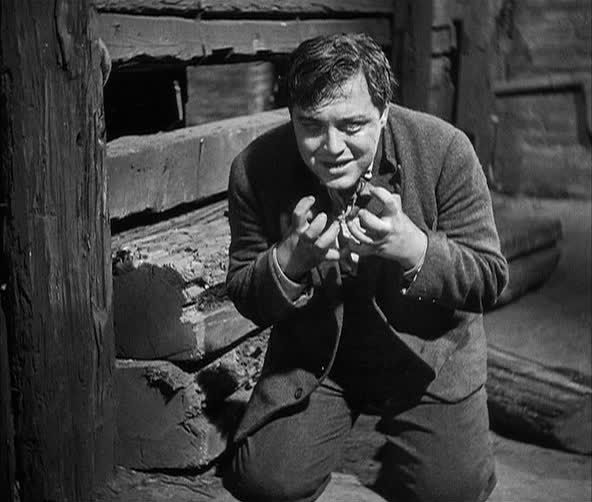
Indeed, Lang accomplishes the miraculous feat of making the killer an almost sympathetic figure in some ways, a figure to be pitied as much as despised or feared. Beckert is portrayed by Lorre as a weak, pathetic, fearful man overcome by compulsions and desires that he can't control. He's pathetic and vile, but his actions are portrayed unambiguously as the product of a mental disfigurement that he is hopeless to resist, and that apparently a stay in a mental hospital could not cure. The film does a remarkable job of portraying Beckert's crimes as a sickness, very different from the usual sort of crime, a product of a diseased mind that, as Beckert exclaims at the film's climax, "really can't help it." He is a desperate man, writing letters to the police and the newspapers that all but beg for them to catch him and stop him, and Lorre's bug-eyed, sweaty performance is incredibly powerful. After one of his crimes, Lang inserts a shot of Beckert looking in the mirror, pulling down the corners of his mouth with his extended middle fingers, stretching his face into a scowl of misery. Later, echoing this shot, he is innocently window-shopping and happens to catch a reflection of a little girl standing behind him; his face becomes deformed, his idle chores forgotten, and he begins whistling "The Hall of the Mountain King," the signature tune that stands for his compulsions.

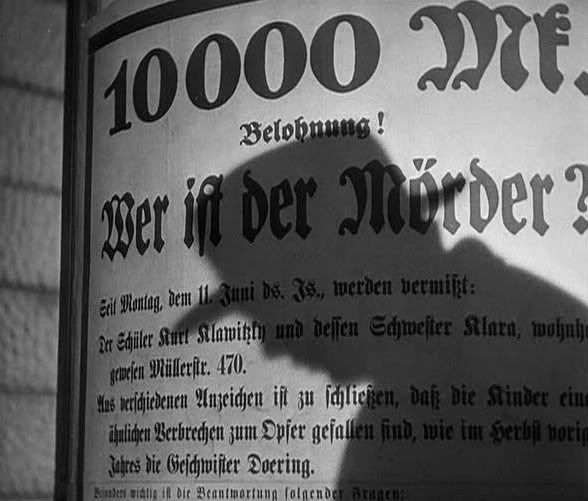
That song is virtually the only music in the film, which has no proper score and only uses whatever scant music appears within the diegesis. Towards the beginning of the film, Beckert's whistling precedes his first visual appearance, as he approaches a young girl, whistling, his shadow cast onto a poster announcing a reward for the killer's capture. It's a sinister image, and the whole scene is chilling for the suggestive way that it chronicles Beckert's predation without any overt violence. The girl's death is signaled with an evocative pair of shots: her ball rolling out of the bushes in a remote, overgrown area, followed by a shot of the smiling, human-shaped balloon that Beckert had bought for her, now drifting freely, getting tangled up in power lines. Meanwhile, at home the girl's mother fruitlessly calls out for her, expecting her home from school, and Lang cuts from the mother at the window, yelling the girl's name, to a series of static, empty, eerily silent shots of the apartment building's staircase and basement, devoid of life or movement. Lang elegantly uses such minimalist aural and visual symbols to tell his story, often replacing images of people talking with images of their shadows reflected on walls.


Lang is also concerned with depicting the killer's effect on the city. People are riled up and paranoid, and they begin responding with suspicion and violence at the least provocation: innocent men are accosted by mobs on the streets, friends accuse one another, anonymous letters point fingers at various random men, whose houses are searched and ransacked for clues by the police. The criminal underworld is also stirred up, as the police conduct raids of red light districts and bars, trying to uncover anyone the least bit suspicious, working on the assumption that the killer must be a shady character in general. These raids cause the criminal gangs, eager to catch the killer and end this intensified police activity, to start pursuing the killer themselves, aided by a network of beggars keeping an eye out for any sign of the murderer.

The general atmosphere of suspicion and persecution suggests a social and political response to this crime that is, in fact, disconnected from its origin. The cops raid bars without discrimination, arresting anyone whose papers are not in order, an eerie premonition of the ways in which the Nazis would shortly begin treating citizens. Lang was at this time growing increasingly concerned about the Nazis' ascent to power, even as his own wife Thea von Harbou, who co-wrote M with him, joined the party, alienating her from the partly Jewish Lang. Thus the film depicts a multifaceted nightmare where fear waits in every direction: a mother's fear for her child's safety, a criminal's fear of being apprehended, but also the more general fear of the innocent being sucked into the vicious whirlwind of a society riven by hysteria, as in the scenes where innocent men suffer in various ways for Beckert's crimes.


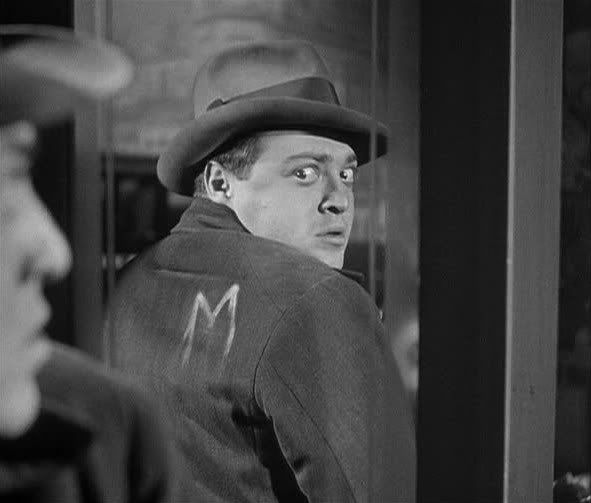
What's most interesting about M is the degree to which Lang lets all these different currents run together without emphasizing one over the other. Lang cuts between different segments of society — at one point blending together a meeting of the police and a meeting of some gangster bosses to ironically point out the similarities between cops and crooks — and different characters, never building a real solid central presence. Lorre's Beckert comes closest to fulfilling that role, though he's almost entirely absent for the first half of the film, only occasionally appearing as a reminder of the one man who's generating all the chaos in the city. Much of the film's second half, though, seems to stick closest to Beckert's perspective, particularly in the harrowing sequences where the killer is pursued through the streets by beggars, eventually cornered in the attic of a building, where the criminals track him down. The beggars even mark him with an "M" drawn in chalk on his jacket — another striking bit of Nazi foreshadowing — and the scene where he discovers this mark in a mirror recalls all the earlier mirror shots involving Beckert. Lang, interestingly, has crafted a suspense sequence in which nobody could possibly be rooting for Beckert to get away, and yet his terror, his increasing desperation, is nevertheless potently communicated by Lorre's performance and the shadowy, expressionistic mise en scène. Further enhancing the tense atmosphere is the fact that Lang shot many scenes entirely silent, only occasionally piercing the hush with bursts of clamoring police sirens or the shouts of the killer's pursuers.

M is many things: a powerful depiction of violent malaise, a searing critique of the death penalty and vigilante justice, a psychological study of fear and guilt, a vision of societal violence and fear that serves as a prelude to the rise of the Nazi Party. It remains such an affecting film in large measure because of how deftly Lang weaves together all these ideas, destabilizing audience expectations at every turn. Even today, so long after it was made, the bravery and modernity of Lang's ideas and his cinematic approach to this material is bracing and impressive.

Monday, April 2, 2012

La Chienne


Bleak, tragic, affecting, and at times surprisingly humorous, Jean Renoir's La Chienne is the melancholy tale of a poor schlub who gets in way over his head. Maurice Legrand (Michel Simon) is a low-level cashier, a reserved, quiet guy who's the butt of everyone's jokes because of his social awkwardness and his notoriously nasty wife Adèle (Magdeleine Bérubet). She shrilly browbeats him over the most insignificant things and is constantly comparing him, unfavorably, to her dead first husband, a war hero whose dashing portrait she proudly hangs in the parlor as a reminder of all the ways in which Legrand fails to measure up. Simon delivers a sensitive, heartbreaking performance as this broken and beaten man, his tall frame constantly stooped over, his face droopy and locked into a frown of resignation. He's a forgettable lump of a man, plodding tiredly through life, his only pleasure coming from his painting — a hobby that his wife takes every opportunity to insult him about.

As sad as his life is, though, his attempt to escape this pathetic existence only gets him into even more trouble, when he falls in love with the prostitute Lulu (Janie Marèse). Lulu's a crass opportunist who latches onto Legrand only to get money for her pimp and boyfriend Dédé (Georges Flamant). Legrand, naïve as he is, adores Lulu and doesn't even realize that she's only using him while pining for Dédé, who's as disinterested in her as she is in Legrand. This dysfunctional love triangle plays out with brutal emotional honesty. Even as Legrand's earnest love leads him to ruin, Renoir explores the cruel irony of Lulu being mistreated in turn by Dédé, who never displays a moment of tenderness with her, roughly grabbing her face to kiss her, after which she beams with joy; she's as oblivious as Legrand is.

What's great about the film is the somewhat haphazard unpredictability of its plotting and its juggling of tones. It's a twisty film where the reversals and ironies are anything but cheap, but instead provide bitter commentary on the follies of the characters and the society in which they live. Probably the best example is the subtle humor of the scene where Adèle's "dead" husband Godard (Roger Gaillard) returns, thinking that Legrand would pay him off to stay away, but instead the unhappily married Legrand is all too eager to simply step aside, responding with exaggerated courtliness to the other man's attempted bribery. It's hilarious to watch the dawning fear on Godard's face as he desperately lowers his bribe demand and begins to realize that his plan might backfire on him.


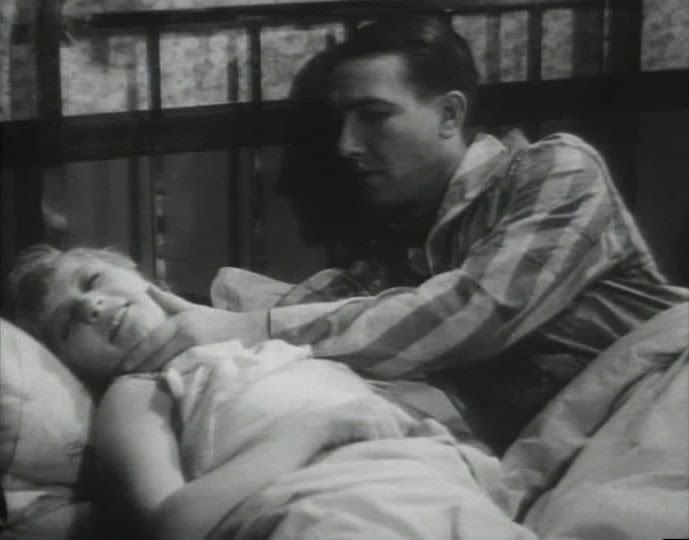
Renoir's style gives the film a deceptively off-the-cuff look, contributing to its low-key realism, but there's great precision in these seemingly casual images. In particular, Renoir often shoots frames within the frame, which call back to the film's opening, a fourth-wall-breaking Punch and Judy introduction which frames this story as an explicitly fictional narrative and promises, somewhat facetiously, that there will be no moral to the story. The prevalence of frames and mirrors surrounding these characters, creating additional layers within the film frame, is a reminder of the dramatic artificiality of this story. In one such shot, Legrand comforts Lulu, sitting on the bed and embracing her, framed by a window, flanked by flowers sticking up from the bed in front of the window. This striking shot recurs in a very different context later in the film, but these frames are everywhere: in the mirrors that reflect Legrand as he shaves, and in the deep focus shots that show Legrand's neighbors doing household chores in the windows across the way.

Even more powerful is the pivotal moment when Legrand discovers Lulu in bed with Dédé. There's a long silence as Renoir cuts to outside, the camera peering through the window at the lovers in bed, then tracking to the right to reveal Legrand standing in the doorway, looking in at them. The distance of the image reflects Legrand's sudden feeling of disconnection, as though he's floating outside of himself, looking in on this scene from a safe distance. Renoir then cuts directly to a closeup of Lulu, lamely trying to justify her actions, which shatters the shocked contemplation of the exterior shot. Renoir also gets a lot of mileage out of the slanted street in front of Lulu's house, and the twisty, shadow-strewn expressionist staircase that leads up to her flat. Her place seems to be built on unstable ground, and all these jagged, crooked lines and serpentine curves emphasize just how far off the straight and narrow path the normally conservative Legrand has wandered whenever he goes to visit her.

The film almost gleefully embraces the moral confusion of its protagonist, whose very normality ultimately allows him to, quite literally, get away with murder. Towards the end of the film, Renoir cleverly shows Legrand slouching discretely away, unnoticed, while the flashy pimp Dédé pulls up in a fancy new car. The film's conclusion suggests that Legrand, a respectable member of bourgeois society and a white collar worker, doesn't have to pay for his actions, at least not in a legal sense, when there's a far less respectable scapegoat at hand. The film ends with a weirdly tragicomic epilogue, in which Legrand and Godard meet up as hobos, years later, both of them gruff old men cackling about their shared fate. When Legrand confesses that he has become a murderer since they last met, Godard simply stares at him for a moment and then shrugs, "it takes all kinds." This cheerful amorality is part of Renoir's vicious satire of the bourgeois, and this ending serves as a prelude of sorts to Boudu Saved From Drowning, in which Renoir again directed Simon as a tramp stomping on middle class respectability; by the end of La Chienne, Simon's Legrand seems primed to become Boudu. La Chienne ends with Legrand telling Godard, without irony, "life is beautiful." As the two men walk away together, Renoir pulls back, through a window that's then revealed as the proscenium of a theater, the curtain falling on this sordid little human drama.

Friday, February 3, 2012

Limite


The Brazilian writer and poet Mario Peixoto directed his only film, Limite, when he was very young, and he never made another film. Limite thus remains as a romantic one-off artifact, an often forgotten and neglected avant-garde work. The film has a simple and iconic scenario, in which two women (Olga Breno and Tatiana Ray) and a man (Raul Schnoor) drift on a boat, their clothes worn and torn, their food supply nearly exhausted, their expressions downtrodden and miserable. As they sit in the boat, aimlessly floating on the tranquil water, they remember their pasts and tell their stories to one another. One of the women is an escapee from prison, and the man was involved in a tragic love triangle that ended with the loss of his lover, but their stories aren't the real focus of the film. The flashbacks are elliptical and abstracted, with very little true narrative content. The only intertitles appear, jarringly, in a brief stretch late in the film, during a conversation between the man and a rival suitor (Brutus Pedreira), both of them mourning their lost love. During this conversation, the film unexpectedly veers into the territory of the traditional silent melodrama, with Peixoto filming the charged glances that pass between the men while the titles relate the few lines of tense, angry dialogue that constitute almost the entirety of the film's verbal content, though there is also some onscreen text from a newspaper that relates the story of the woman's jailbreak.

These snippets of text are Peixoto's only concessions to narrative momentum. The rest of the film teeters on the edge of abstraction, and the narratives, such as they are, are vague and simple. Peixoto seems less concerned with conveying tangible details or telling particular stories so much as exploring iconic situations. He's interested in emotional content in its raw form, so the stories related through the flashbacks sketch out only the outlines of these characters' lives, emphasizing the pain and anguish they feel rather than the particular events that brought them to this state. Peixoto relies on the viewer to connect the dots, to be swept up in the emotional poetry of these often-empty natural landscapes, melancholy small town streets, overcast skies and ocean waves.

Unfortunately, it can be a challenge to do the work required by Peixoto. The film often feels as empty and uneventful as its landscapes. The film is relentlessly slow-moving, and often dull, especially in the first half when Peixoto holds many seemingly endless long shots of people simply walking, shot from multiple angles and sustained for several minutes at a time. The abstracted narratives and stark, patiently paced imagery can be trying, as there is often very little context for any given shot, and thus very little cause for the emotional investment that Peixoto demands. He's reaching for visual poetry rather than narrative, but too often I just didn't feel the poetry of his images, I couldn't access the emotions he's expressing. The imagery is generally too plain, too static and repetitive, to hold up the film in the absence of any other content.


Which is not to say that the film is entirely disappointing. Its best sequences are poetic and moving in mysterious ways that are difficult to articulate, and for every aimless shot of someone walking along a country road, there's an image of startling emotional immediacy. At one point, one of the women, upset about something, goes out to a cliff overlooking the sea and the curving shore below. The camera, looking over her shoulder, begins to sway and shake in sympathy with her mental turmoil, turning in graceful arcs from the shore out into the water, and then beginning to spin rapidly, the whole scene turning upside-down and tracing 360-degree circles. This disorientation perfectly reflects the mental state of the woman, who is wracked by a mysterious despair that drove her to this desolate outcrop.

In another sequence, the man recalls his love affair in a methodical progression of shots, most memorably a closeup of hands clasped together as he walks along a jetty with a woman, surrounded on both sides by water. The man and woman go bathing together in a lake, and afterwards he carries her out of the water like a groom carrying his bride across the threshold — is this a romantic image, or did she die? it's not quite clear — and then Peixoto inserts a montage of natural images. The whole sequence is then repeated with the man and the woman fully removed: their footprints are visible in the sand on the jetty, and then Peixoto shoots the rest of their walk with the figures absent, ending with a shot of the footprints being washed away by the waves washing up on the shore. It's a beautiful and simply powerful evocation of lost love, an affair ending, all traces of its romance being erased as it fades into memory. At moments like this, Peixoto's imagery is direct and evocative, economically stating a strong and familiar emotion with a few elegantly montaged images.

At other times, Peixoto's less direct visual poetry can be equally affecting, as when the film climaxes with a few minutes of waves crashing against rocks, frenetically collaged together with rapid editing far more jagged and fast-paced than anything else in the film. There's a literal dimension to this sequence, as a representation of the stormy seas that ultimately wreck the boat at the end of the film, but more importantly it's an entirely abstract emotional climax, a peak of frenzied feelings and desperation, the turmoil of the water standing in for the turmoil in the minds of the protagonists. The film has some excellent sequences like this (a meta scene in which a laughing audience watches a silent movie is another) but they're spaced out by long dead stretches, patience-trying sustained shots and slack pacing. Limite is not quite the lost classic of avant-garde cinema that it's often held up as, but it's definitely an interesting experiment, and in its best moments it achieves a stark emotional purity and simplicity that is very appealing indeed.

Tuesday, July 5, 2011

Partie de campagne


Jean Renoir apparently left Partie de campagne unfinished, but to watch the film as it exists, assembled into a 38-minute short from the footage he shot before abandoning the project, one would never guess. Based on a Guy de Maupassant story, it is a sumptuous, sensual, subtly moving film that extracts great and surprising pathos from a simple situation. The family of the bourgeois shopkeeper Dufour (André Gabriello) takes a weekend trip to the country for a picnic, a day of relaxation for the women and fishing for the men. Dufour brings along his wife (Jeanne Marken), his daughter Henriette (Syvlia Bataille), his old, deaf mother-in-law (Gabrielle Fontan), and Henriette's fiancé Anatole (Paul Temps). While there, a pair of local young men decide to seduce the women in the party, setting their sights on Sylvia and her mother, while the shopkeeper and Anatole remain oblivious, concerned only with a day of fishing.

It's a comic set-up, and Renoir plays it as such for much of the film. Anatole especially is a comic figure, an utter dunce who looks and acts like a dim-witted Stan Laurel to Dufour's blustery Oliver Hardy. Dufour is constantly lambasting his future son-in-law for his stupidity, and the young man simply cringes and whimpers and accepts the verbal beatings. He's obviously a poor match for the pretty, dignified Henriette, who's sensitive and sweet and loves the sensual pleasures of the countryside. Renoir, for his part, is clearly aligned with Henriette's wide-eyed appreciation of the world around her. Renoir's filmmaking is dazzling and intoxicating, wrapping the viewer in the sunny, warm atmosphere of a country day. As the party arrives at a small country inn and begins setting up for their picnic, Renoir cuts away from the bourgeoisie to the country folk, the innkeeper and his employees and friends, as they prepare to serve the guests. The young boatmen Henri (Georges d'Arnoux) and Rodolphe (Jacques Brunius) sit inside, eating and talking, with the more outgoing and sexually voracious Rodolphe trying to convince his friend that they should pursue a dalliance with the women among the new arrivals.

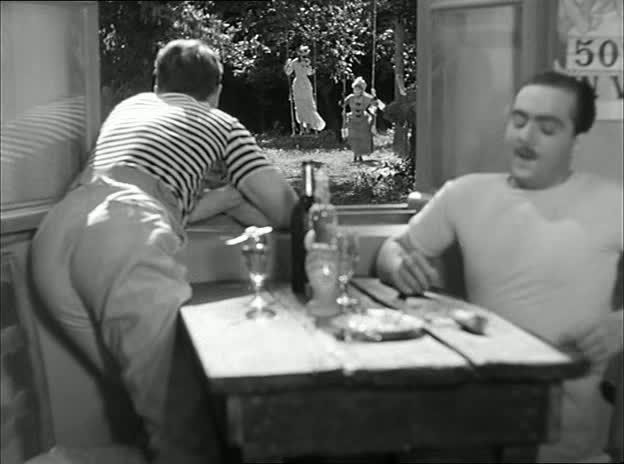
His chatter is unconvincing to Henri, who insists that his philandering days are behind him, but Rodolphe's point is made more emphatically when he throws open the window behind the two men, framing the idyllic scene outside as though it were a painting hanging on the wall. The two men in the foreground go out of focus as Renoir brilliantly frames the scene outside, a brightly lit rectangle of pure summer joy centered as a smaller frame within the film frame. Henriette and her mother swing back and forth outside, the sunlight filtering through the trees and dappling the ground with alternating spots of shadow and light. The exterior landscape is crisp and clear and invigorating in comparison to the gray fuzziness inside the inn; it's an invitation to languish in the sensual pleasures afforded by nature. Renoir's closeups of Henriette as she rides the swing are especially ravishing, as the girl smiles and laughs, her face rushing up towards the camera and towards the sky, towards the sun that beats down on her, bathing her in light.


The film meanders along in this way, lingering on scenes of beauty and peacefulness as the two young men begin their seduction against the backdrop of this natural splendor. The film is often light and funny, as the flirty, vivacious Madame Dufour instantly takes to her obvious counterpart, the predatory ladies' man Rodolphe, despite the latter's desire for the younger girl. Henriette is instead paired up with the sensitive, quiet, romantic Henri, and during a beautifully filmed boat trip, these two romances wind towards their inevitable conclusions. Henriette is especially attuned to nature, delighting in the details of life and vitality that she finds everywhere in the country. She admires a caterpillar and wonders at the richness of the tiny lives that scurry everywhere through the grass beneath her feet. Do these bugs also feel joy and sadness as people do, she wonders aloud; it is obvious that she is a girl who feels deeply and intensely, and it's hard to see what the oafish, oblivious Anatole, who virtually ignores her and wants only to go fishing, can have to offer her.

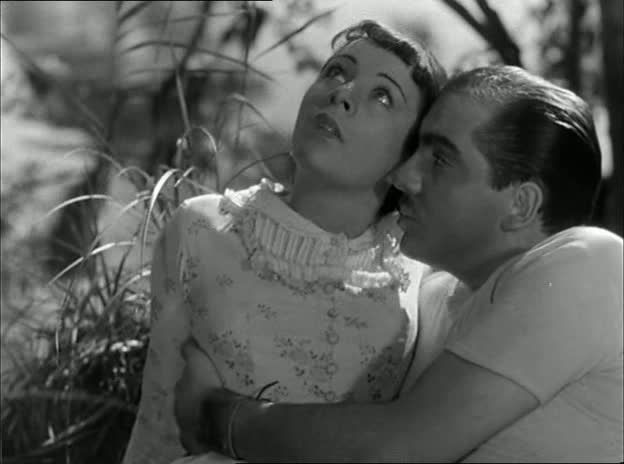
That's why, despite the film's rich humor and sensuous beauty, there's a strong undercurrent of sadness and despair running beneath its surface. Henri and Henriette spend a wonderful day on the river, as he rows her upstream towards a secluded spot where they sit together, listening to a nightingale's song, and inevitably wind up kissing amidst the reeds and tall grass. The sequence ends with a rainstorm that seems to portend the return of sadness after this brief respite of pleasure and holiday atmosphere. The wind begins to blow, shaking the trees and the reeds by the water, and the surface of the river ripples to life with tiny droplets of rain bouncing off the water, creating thousands of tiny pinprick splashes. Renoir's camera floats across the surface of the water, pulling back as though leaving this country idyll behind. This day of sunlight and celebration is over, the clouds have drifted in and the rain is falling. A title card announces that several years then pass, and that in the meantime Henriette has married Anatole.

It's possible that this sudden leap forward indicates the part of the film left unfinished, but if so the omission is only to the benefit of the film's effect. The passing over of several years of undoubted boredom and marital complacency suggests just how much was washed away by that storm, and just how fleeting the pleasure of that riverside dalliance was. After the text fills in the intervening years, Renoir returns without pause to the country river where the earlier picnic had taken place, as though no time at all had passed. The place is as beautiful as ever, and Henri still drifts along the river on his boat, but his reunion with Henriette after these missing years has a very different tone, poignant and regretful, infused with longing for what once was and might have been. It's a moving, mournful ending, cut with an undercurrent of dark humor as Henri watches his onetime lover row away, Henriette at the oars while her useless husband languishes in the boat's prow. It's the opposite of the way in which Henri once rowed her to this secluded spot to seduce her, and as he watches her row away, partially obscured by the leafy foliage overhanging the river, this last little comic touch becomes almost unbearably sad. What a wonderful, rich, warm, intelligent movie!

Wednesday, April 27, 2011

Passing Fancy


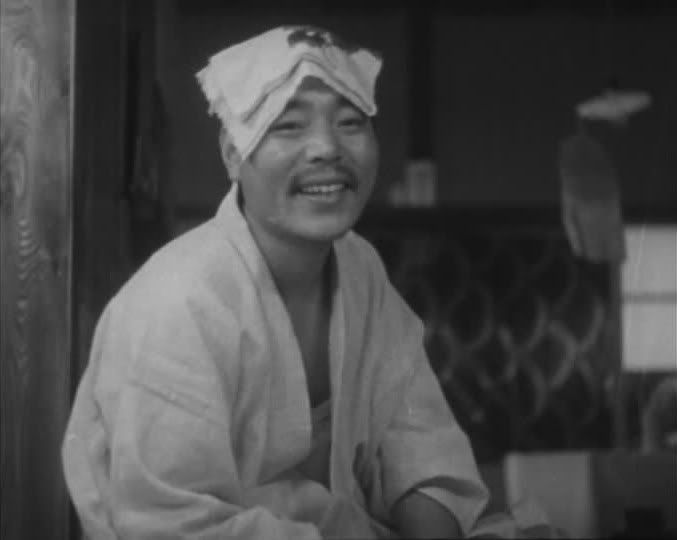
Passing Fancy is an early silent comedy by Yasujiro Ozu. Although many of Ozu's silent films are quite different from his later works, in Passing Fancy Ozu's mature style already seems to be almost fully developed. The film is a charming family comedy about the single dad Kihachi (Takeshi Sakamoto), his son Tomio (Tomio Aoki), and his friend Jiro (Den Obinata), and the tension that enters their simple lives when they meet the homeless and unemployed young woman Harue (Nobuko Fushimi). The middle-aged Kihachi immediately likes the much younger woman, helping her get a job and a place to stay at a neighborhood restaurant while courting her in his goofy but charming way. Harue, though, thinks of Kihachi as an uncle and prefers the younger Jiro, who makes sure to keep her at arm's length, though one suspects that despite his insistence that he doesn't like her, he's only pushing her away out of loyalty to his good friend.

The film is mostly shot from Ozu's familiar low vantage point, his aesthetic already well-established by this time. In his films with children, the low camera placement seems to take on an additional purpose, as the low-to-the-ground framings are perfectly suited to a child's proportions — Tomio fits comfortably within the frame no matter how low the camera is placed — while the adults seem to tower outside the frame, their legs entering the frame before the rest of their body begins to appear in view. The compositions of the film are as meticulous and deliberate as later Ozu, with a constant awareness of how objects and people are arranged within the static frames; there is no camera movement, an aesthetic choice that would be totally codified in Ozu's late color films. As in his later work, striking use is made of bottles and other household objects positioned to counterbalance the actors within the frame; often the actors are placed into the background with some domestic object highlighted in the foreground. Ozu also periodically inserts static shots of the surrounding buildings and water towers to establish the setting, early examples of the "pillow shots" that would become such a powerful aesthetic devise in the director's postwar oeuvre.

Though there are elements of drama and melancholy in Passing Fancy, the film is largely a comedy, not so much in terms of broad slapstick as in its gentle but pervasive comic tone. Even at the height of the film's downtrodden section, when Tomio falls ill and Kihachi worries that the boy might die, Ozu breaks the tragic mood with a comic series of intertitles when Tomio's teacher asks Kihachi how the kid got sick, causing Kihachi to respond that "he ate fifty sen worth of sweets all at once," then enumerating all of the different flavors of candy the boy had eaten. Obviously, the illness isn't meant to be taken entirely seriously, but Kihachi's worries are heartrending anyway. Similarly, there's a strain of comedy running through the film centering on economic concerns in Depression era Japan, a concept introduced in the most humorous possible way in the film's opening scenes. At a theatrical performance, several men in the audience see a coin purse sitting on the ground and discretely peek inside, realizing that it's empty and then discarding it, only to have another man pick it up in the hopes of finding something inside. Ozu milks this gag for its gestural comedy, and also for its suggestion of poverty so extreme and common that none of these men think twice about trying to scrounge for money anywhere they might find a few coins. The physical comedy is then extended with a sequence where several men get up and dance around as though they have bugs crawling around in their clothes, another sign of the squalor of this neighborhood.


That economic hardship defines the film in many ways. Kihachi is embarrassed by his lack of financial security, by his inability to give his child everything he'd like to, and his desire for more leads him to extravagantly give the boy a coin, which Tomio then uses to gorge on candy since he's not used to having any money at all. More seriously, Kihachi proves incapable of paying the doctor who cares for his son, and scraping together the money for the medical bills proves to be an exceedingly difficult task. It quite literally takes the efforts of nearly everyone he knows to pay the doctor, with his community of friends and neighbors coming together to help him and his son.

Ozu often seems constrained by the stylistic conventions of the silent cinema; Japan was slow to switch to sound, and though Ozu often gets by here through gestural acting within the frame, this is a rather dialogue-heavy film with a lot of information and emotion conveyed through the text. In the scene where Harue and Jiro argue over her lack of romantic feelings for Kihachi, Ozu unleashes an uncharacteristic barrage of dialogue intertitles, alternating between static, repetitive images of Harue and Jiro, with more or less the same closeup of each repeated over and over again in between titles. It's one of the moments when the limitations of silent style for Ozu become obvious, as his visual sensibility must be subsumed to the necessity of staging a lengthy and emotionally complex conversation entirely in text.

Such glitches aside, Passing Fancy is a warm and gently funny work. The film's story is minimal, which allows Ozu to develop his characters and to use his slow, observational visual sensibility to create a portrait of an era and a neighborhood. The rich sense of community, the half-comic depiction of economic woes, the emotional nuance of the characters as they make the best of their limited circumstances, it all adds up to a lovely film that's very much attuned to the social milieu in which it is set.