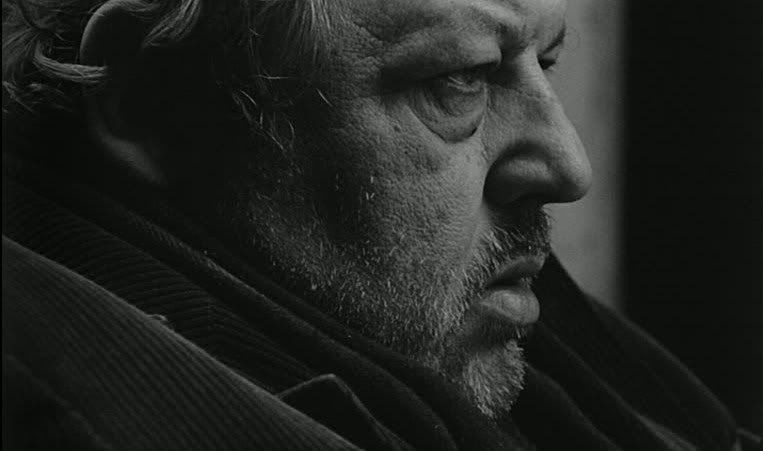
Showing posts with label Bela Tarr. Show all posts

Wednesday, March 21, 2012

The Man From London


The films of Béla Tarr have always been haunted by film noir to one degree or another. Tarr's downtrodden characters plod miserably through gloomy, shadowy wastelands, getting tangled up in plots and intrigues that briefly distract them from the otherwise unchanging stasis of their lives. In The Man From London — an adaptation of a Georges Simenon novel that was already adapted for noir films twice in the 1940s — the influence of noir is as overt as it's ever been in Tarr's work, but tellingly it is not a drastic departure from the rest of his oeuvre, only a slight shift in emphasis that brings these subcurrents to the surface. It is, typically of his work, slow-moving and stunningly beautiful, shot in a high contrast black-and-white where light sources generate hot, blinding whites that threaten to burn through the frame, while the blacks of shadowy nights are dense and inky, and the characters in the film are, at various times, swallowed up by both the darkness and the light, both representing equal threats. As with all his films since Werckmeister Harmonies, Tarr's longtime editor Ágnes Hranitzky is credited as a co-director, but this too hasn't signalled much tangible change in his art; instead, it seems a way of affirming the paramount importance of editing to his films, presumably on the basis that in a film with so few cuts, each one must be vitally important.

This is a gorgeous, mysteriously moving film, its potent chiaroscuro images buttressed by the moaning organ drones of Tarr's frequent musical collaborator Mikhály Vig, as well as the expressive sound design in which every creaking, metallic, mechanical sound of the docks is amplified into a hypnotic percussive rhythm. The Man From London is often considered lesser Tarr, whatever that means, but this film finds the Hungarian master in as fine a form as ever despite its troubled production history. The one minor problem is the distractingly bad dubbing of the actors' voices into French and English, which seems to have been done with little care for syncronizing the audio to lip movements. Even this adds to the film's powerful sense of disconnection and alienation, as does the multilingual dialogue, which Tarr has said was his preferred audio for the film even though some early screenings aired with everyone dubbed into Hungarian.

In the gorgeous, atmospheric opening, the camera watches from the windows of a high tower at a dock where ships moor, letting off passengers who shuffle across to a railroad station nearby. A railroad worker, Maloin (Miroslav Krobot), sits in the tower all night, and the camera is aligned with his perspective, tracking in slow arcs around the interior of his tower room to take in the whole dock area. There's a voyeuristic thrill to this opening sequence, as Maloin, from his godlike perspective, sees things that he is obviously not meant to see. A man on a docked boat throws a suitcase into the darkness of a nearby pier, where it's picked up by a second man. The two men later fight, and in the struggle one of them falls into the water and never resurfaces, taking the suitcase with him. When the surviving man quickly leaves, Maloin climbs down from his tower with a hook and fishes the suitcase out of the water, discovering that it's full of money.


This opening sets the tone, patiently observing as these events unfold without fuss, the camera tracking past the windows to slowly sweep across the whole scene. Down below, pools of light and shadow are stretched out across the docks, with streetlamps casting bright ovals carved out of the darkness, figures melting in and out of the dark as they prowl around. Their furtive, secretive movements avoid detection, except of course for the near-omniscient viewpoint from which Maloin watches, a viewpoint that associates him with the voyeuristic audience, watching a typical noir tale of treachery and violence. It plays almost like a silent film; there's no dialogue in the entire first half-hour except for some distant, barely overheard murmuring. No words are needed, because these are familiar cinematic archetypes, carved in light and shadow, enacting a primal noir drama for an audience hiding up above.

The details of that pantomimed opening are later filled out, when the British private detective Morrison (István Lénárt) arrives, investigating the robbery of 60,000 pounds from his employer by a man named Brown (János Derzsi), one of the men Maloin had seen in the opening. It almost doesn't matter, though, because in typical fashion, Tarr is less interested in plot mechanics than he is in the mundane routines and boring lives that continue to trudge forward uneventfully even as this investigation circles inexorably around the events of that night. Maloin grimly watches as the inspector tries to figure out where Brown and the missing money have gone, while Brown himself begins stalking the dockworker, apparently suspicious that Maloin may have seen something or retrieved the suitcase.

The plot is extremely basic, stripped down to just the essentials, and in a way the only big events in the film are those that occur during that opening half hour; everything else is simply an elaboration of the consequences of that noirish template. In one scene, the opening sequence is virtually repeated, this time with the inspector moving around in the darkness below, trying to recreate the potential chain of events, cleverly working out how the two criminals had snuck the suitcase full of money past customs, and then discovering the corpse in the harbor. This reinforces the impression that the film's story is an archetypal template, a basic form — ordinary working man stumbles across illegally gotten cache of money — that can be repeated and restated infinitely. The story's familiarity and simplicity frees Tarr to confine the narrative to the background, focusing instead on atmosphere and on the protagonist's grim, lifeless existence. Tarr even has the violent climax play out offscreen, keeping his camera trained on a closed wooden door during Maloin's final confrontation with Brown, the camera shaking slightly as if in shivery anticipation of the outcome of whatever's happening, unseen, beyond that door. If the opening encouraged a voyeuristic perspective on distant events, this scene denies and frustrates that voyeurism, granting the characters the private intimacy to carry out the conclusion of their story without any prying eyes to observe.


What's interesting about the film's study of Maloin is that he hardly seems to want the money once he has it; even in the shot where he opens the briefcase for the first time, there's not even a flicker of emotion on his face as he stares down into the case, before the camera tracks around and then angles down to peer into the open case, revealing the money inside. He retrieves the money, then dries it out, with a mechanical lack of feeling, compelled to do so by the momentum of the plot and little more. Once he has the money, it hardly helps him escape his dull life, nor his clearly unhappy marriage to a woman (Tilda Swinton) with whom he does nothing but shrilly argue.

The only way in which he ever uses the money is to help his daughter Henriette (Erika Bók), who first appears in a fascinating scene in which Maloin, walking home with the money, stops to watch her sweep the floor in the butcher shop where she works. At first, the scene seems as voyeuristic as the opening, with Maloin watching as the girl in the shop bends over to sweep, her skirt riding up so that her ass is clearly visible to anyone on the street outside. When it's revealed that she's actually his daughter, the emotional tenor of the scene subtly changes, and he becomes angry at his daughter's careless flaunting of her body, angry with the work that makes her display herself like this. His reaction is almost as if he's discovered she's a prostitute, and later he protectively pulls her out of her job, then buys her a fur in a store where the pushy salesmen chatter in excited tandem at father and daughter until they decide on a purchase.


Notably, Maloin never tries to use his newfound money to escape his grim home life, nor does he deviate from his routine or begin spending wildly, the downfall of so many noir heroes in similar situations. Like many of Tarr's characters, he's trapped by a lack of imagination, an inability to see past the dull materiality of his circumstances, to grasp at something greater that occasionally seems to be lurking just beyond his senses. At one point, as he leaves a bar, he walks, without looking, past a surreal scene of several bar patrons playing an odd game, one of them balancing a pool ball on his forehead while the other lunges at him with a chair, both of them doing this strange dance to the wheezing sound of an accordion. The scene recalls the extended dance sequences in Damnation and Sátántangó or the living diagram of the solar system in Werckmeister Harmonies, scenes where the dullness of ordinary life is interrupted by outbursts of strange exuberance, moments of sensuality and celebration. Here, this dance is relegated to the background, a momentary diversion that the main character, locked into his private hell, barely notices.

This is one of several points at which Tarr hints at something stranger and grander just outside the border of the main character's circumscribed sense of reality. The way the high-contrast photography renders light as an incandescent and impenetrable whiteness similarly suggests something beyond, an almost spiritual dimension to this otherwise prosaically grounded story. In one rapturous shot, Maloin's wife opens the glass doors leading out to their balcony and steps out into the bright light that swallows her up, nearly erasing her black-clad form in a suffusion of light, pouring over her and flooding the center of the frame with this blinding nothingness. When she then closes the shutters, the room is smoothly plunged into darkness, the light chased away by shadows; it's a beautiful and mysterious shot that suggests the ways in which these characters are closed off from light, hope, spirituality, anything that might fend off the darkness and shadows. The light is also tinged with a sense of danger, though, as though these people might burn up if exposed to its brilliance for too long. In the film's mysterious final shot, Brown's silently suffering wife (Ági Szirtes) simply stares straight ahead until the white light absorbs her, the image fading to a plain white nothingness before the credits roll.

Monday, February 13, 2012

Sátántangó


Béla Tarr's Sátántangó is an extraordinary film, gorgeous and haunting and full of unforgettable images. Even at seven-and-a-half hours long, the film is never less than enthralling, and each deliberately framed and choreographed shot is jaw-dropping, even when nothing much is actually happening within the frame. Though Tarr isn't very concerned with narrative, there is a story of sorts here, a loose one divided into twelve chapters that overlap one another chronologically and show the same scenes from different points of view as different characters' stories intersect over the course of a couple of days. The film is set in a tiny rural Hungarian village at the start of the autumn rainy season, which the villagers are now prepared to endure, miserably, until springtime. The town is grim and ugly, a few crumbling buildings spread out across the barren, dismal countryside. The place is soggy and knee-deep in mud, and it's constantly pouring, rain streaming down the grimy windows and soaking the villagers whenever they trudge through the muddy fields that surround their homes. As the film opens, the villagers have sold off their communally owned cows and are planning to split the money and abandon the village, all of them heading off to their own personal escapes.

Naturally, they're all scheming against each other, some of them planning to steal all the money and escape on their own, until their plans are all disrupted by the return of Irimiás (Mikhály Vig, who also provides the film's eerie, minimalist music), a messiah-like con artist who'd been reported as dead a year and a half ago, but who had really been in prison with his friend Petrina (Putyi Horváth). This duo's return to town disrupts all the villagers' schemes, filling them with mingled hope and fear: they know that Irimiás will have some grand plan for their money, but it's not clear if they welcome this opportunity to be shaken out of their ruts or mourn the likely loss of their long-awaited windfall to the rogue's latest brainstorm.

This tense anticipation dominates the film's first half. Irimiás and Petrina do appear in one sequence early on, but other than this, they're spoken of more than seen for the first several hours of the film. Tarr observes how the villagers await the arrival of the mysterious duo, going about their dull and listless lives in the meantime, boiling over with frustration and confusion as they wrestle with their feelings about the returning troublemakers. Tarr's preference for long, unbroken takes — either static or slowly tracking — enhances the elongated expectation. The film is "about" its duration as much as anything, about the way time passes, about the long dead moments and empty spaces that make up a day. The film's epic seven-and-a-half hour length places the viewer in the same position as the villagers, enduring long periods of stasis and nothingness, long temps mort accompanied only by the buzzing of a fly or the loud, repetitive ticking of a clock in a depressing local bar.


The film opens with a long shot of a field of cows, the soundtrack dominated by their mooing and a droning tone in the background. Eventually, the camera begins to track sideways, away from the field, gliding along past a long wall, examining the crumbling plaster and cloudy, filthy windows that offer no view into the rooms inside. The camera's movement is slow and steady, and when it finally reaches the end of the wall, it looks out again at the cows, milling around in a courtyard in the distance, watching until they all wander away, out of sight around the corner of a building, leaving behind only a chicken strutting across the muddy open space until the image fades to black. It's a fitting introduction to the patient, unshowy aesthetic of Tarr's epic, its careful observation of the minutiae of daily life and its attentiveness to the matter of time.

Later, Irimiás and Petrina wait in a town office, and Irimiás comments that there are two clocks, neither of them correct. He poetically connects this temporal confusion to the "the perpetuity of defenselessness," before adding, "We relate to it as twigs to the rain: we cannot defend ourselves." That's the essence of Tarr's perspective on time, this relentless forward flow that cannot be paused or halted, that is always charging onward regardless of what's happening in any individual life. The emphasis on the passage of time is so essential because one of Tarr's key themes here is stagnation: time passes, and yet nothing happens, everything remains the same, the people of this town continue to wallow in misery and boredom, to simply pass the time.

Futaki, dreaming of fleeing the town with his share of the money, wants only to rent a farm where he can do nothing all day, only watch "this fucking life" go by while he soaks his feet. When Irimiás and Petrina return to town, their young hanger-on Horgos (András Bodnár) fills them in on what the town is like now — which is to say, that nothing's changed, that everything is exactly as it was a year and a half ago when they left. In this context, Tarr's deliberately eventless static views and snail-paced tracking shots accentuate the numbing, narcotic pace of everyday life in a place where nothing happens, and where even the wildest dreams of the inhabitants are boring and routine.


At other times, though, Tarr finds strange beauty and even heroism in the mundane. A drunken old doctor's (Peter Berling) trip to refill a jug of fruit brandy becomes an epic journey across the wasted countryside of the village. He staggers and stumbles through the muddy fields, the rain pouring around him, the soundtrack composed only of his heavy breathing, his raspy coughs, his burps, and the plodding steps of his feet, sticking in the mud that covers both the roads and the fields. As it gets dark, the doctor's form is increasingly hidden in the unlit night, his silhouette occasionally highlighted against the distant lights of a house or the local bar. As the doctor approaches the bar, wheezing accordion music can be heard, the first hint of the drunken revelry that will play out in later scenes inside the bar. The doctor just passes by, though, staggering into the woods, glimpsing the dark trio of Irimiás, Petrina and Horgos purposefully walking by on the nearby road. Tarr makes this simple journey across a small distance seem epic, overwhelming, taking every ounce of will and strength from this unhealthy, unhappy old man. That's another aspect of Tarr's extended duration: this is an epic of the everyday, an epic of short distances, because this town and its muddy, pathetic territory is the full extent of what these people know, it is the setting for their entire lives and thus it must be epic, because everything they are and everything they do plays out here, and a trek to get some alcohol can seem as important as Odysseus' journey home, while a short cigarette break with some plump prostitutes takes the place of Odysseus' many detours and obstacles on his way back to Ithaca.

There is an obvious political dimension to the film, as well. Tarr had wanted to adapt Lázló Krasznahorkai's novel since the 80s, but he had been unable to do so because of the threat of censorship from the Hungarian Communist government. It doesn't take much reading between the lines to see that the film is a bitter satire of the failures of communalism, exposing the ways in which, while supposedly working communally towards a common purpose, people remain atomized and isolated, concerned far more with their own selfish interests than those of the group. Irimiás himself is the most obvious symbolic representative of Communist ideas. He calls himself "a servant of a great cause" and organizes people for his schemes, but the dreams of communal success that he stirs up in others are simply smokescreens for his cons and tricks. He says he's bringing people together but he actually tears them apart and scatters them, breaking up their community under the guise of rejuvenating it. The idea of working together for a common goal is a lie, a ruse, a distraction from the essential miserableness of these people's lives. They have no sense of real control over their lives — they are defenseless, a theme that percolates throughout the film — and Irimiás' grand rhetoric gives them an illusion of power, however misguided. Really, they are defenseless before him as well.


One of the film's most notorious extended scenes is the one where a young girl (Erika Bók) tortures a cat and then kills it by putting rat poison in milk. She feels hopeless, bored, abandoned, by a family that doesn't seem to care about her much, and she takes out her own torment on her defenseless pet before killing herself as well. It's an uncomfortable sequence to watch, and not only because of its implications for the characters and themes. Tarr insists that the cat was treated humanely and not truly harmed, but it's still discomfiting to see the girl flail around, swinging the cat around with her, then trapping it in a net and shoving its head into a bowl of milk. Such moments in a fiction film always shatter the illusion of a story being acted out. It's too real, and too cruel, forcing one to think not about the cruelty of this girl, whose feelings of impotence lead her to assert her power over a defenseless animal, but the cruelty of the filmmakers who demanded that the scene be shot in this way, that these things should be done to a real, defenseless living thing.

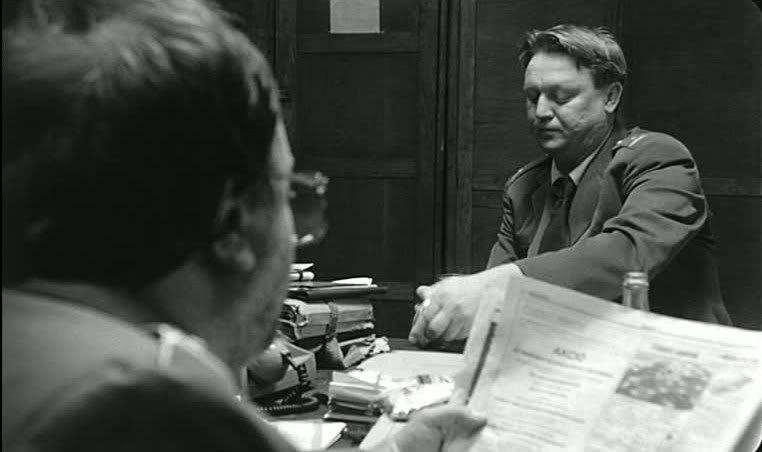
The penultimate chapter of the film resumes the commentary on the political dimensions of Irimiás' actions. This segment consists entirely of two bureaucrats translating Irimiás' vile, hateful letter about the townspeople into more discrete and official language. Nothing can be said directly, so they have to come up with euphemisms for everything, replacing "fat sow" with "overweight," and "wrinkled worm, filled with alcohol" with "elderly alcoholic, short of stature." This sequence is rich in bitter humor, mocking the bureaucratic circumspection of these office drones while also revealing the full extent of Irimiás' deceitfulness. At the same time, Tarr focuses on the humanity of the bureaucrats, whose work — cleansing language of its richness and idiosyncrasy, reducing words to a generic gray pulp — wears them down daily. They take a break from their work at one point, sitting down away from the typewriter to have a snack, eating in silence. While they eat, they drop their businesslike demeanors, and suddenly they are just men, requiring a break from the soul-numbing stupidity of their work. When they're done eating, unfortunately, they must return to the typewriter.


Tarr often enlivens the film with subtle, bittersweet humor like this. One key sequence is the lengthy drunken dance where the townspeople, anxiously awaiting Irimiás' arrival, clumsily dance and grope one another. The scene lasts around half an hour, with the repetitive accordion music wheezing out its incessantly bouncing melody, as the revelers sway and careen off one another awkwardly. The cast was really as drunk as they seem to be onscreen, lending an air of verisimilitude to their staggering steps and lunges at one another. They seem angry one moment, joyous the next, their minds clouded, erasing themselves in this celebration. In the chapter title that precedes this segment, Tarr deems the dance the "sátántangó" from which the film takes its name, and indeed there's something apocalyptic and desperate about everyone's flailing about, their wild abandon. But it's also amusing and powerful, a rare moment of celebration in the lives of people who don't often have much to celebrate. At one point, the camera pans around the room and finds one married couple eating from opposite ends of a cheese bread, devouring it like Lady and the Tramp romantically eating spaghetti together, a hilarious and ridiculous image, if also a grossly romantic one.

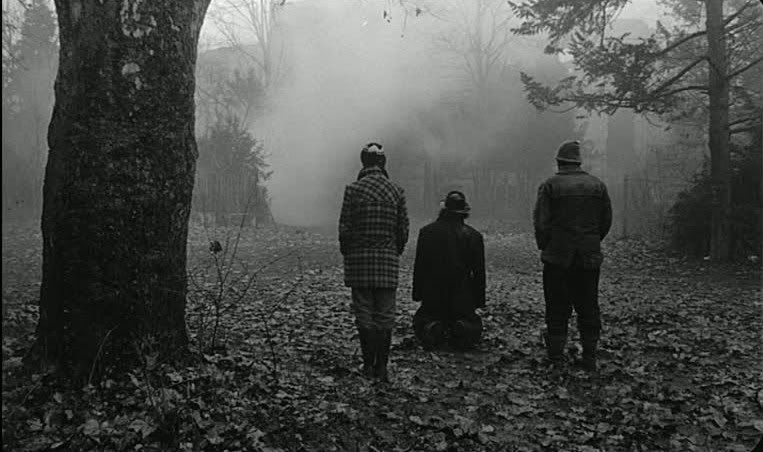
Petrina is also a rich source of comedy, playing a dopey comic foil to the messianic Irimiás, even in terms of appearance. While Irimiás is striking and foreboding in his dark trenchcoat, Christ-like beard and fedora, Petrina looks like a dumpy reject from the Three Stooges, a woolen snow cap pulled down tightly over his egg-shaped head. In a mysterious scene late in the film, Irimiás, Petrina and Horgos are walking along a road through a sparsely wooded area. Suddenly, Irimiás stops and falls to his knees in the middle of the road, staring forward as though overcome with sublime religious awe. He watches as a cloud of fog rolls past, obscuring a ruined building, then blowing away in the wind. Tarr never explains this moment or the image that prompts Irimiás' awe; it's left as a beautiful and eerie image of the huckster being overcome, momentarily, by seemingly genuine sentiment. Then Petrina breaks the mood, as the trio walks away, by irreverently asking, "you've never seen fog before or what?"

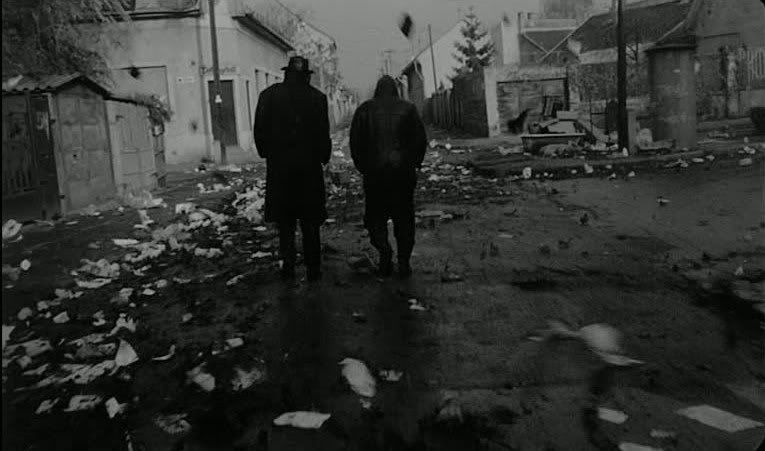
Irimiás is often associated with nearly mystical, awe-inspiring incarnations of nature. In one of the film's best shots, Irimiás and Petrina walk along a road through town as garbage flies along the ground around their feet, the wind whipping paper, cardboard boxes and other debris through the narrow path between houses. It's another somewhat apocalyptic image that's strikingly beautiful as well, capturing the stark, weather-beaten conditions of this town, but also making even this barrage of trash seem graceful and elegant.


The film is packed with gorgeous, unforgettable images like this, like the remarkable shot that keeps circling around the sleeping figures of the townspeople in the manor they've moved to at Irimiás' behest. As they sleep, and the camera twirls, the voiceover recites the dreams and nightmares of the villagers, haunted in their rest by strange visions, confused erotic fantasies, and fantastic hopes. It's a deeply affecting extended shot, because Tarr's film is all about the hopes and dreams of these ordinary, downtrodden people — and the ways in which those dreams are destroyed and corrupted by the cruel world they inhabit and the societal strictures that govern even their most secret dreams.

In the film's devastating final chapter, those dreams seem to take tangible form, writing a surreal nightmare onto the landscape of the territory as Tarr returns to the elderly doctor. He once again wanders off into the landscape, but this time, instead of stolidly plodding through the muddy fields in real time, he gets swallowed up by a strange vision, chasing the distant sound of bells to a wrecked church where a mysterious and cadaverous-looking man repetitively rings a bell and shouts. It's a strange and unsettling end to a remarkable film, and the final shot, in which the doctor slowly removes every trace of light from the image by boarding up his windows, chronicles the slow process by which the film disappears into the nothingness from which it came.

Tuesday, May 12, 2009

Unspoken Journal I: Béla Tarr


The debut issue of the Unspoken Journal is now online. This is a new online journal focusing on "contemplative cinema," which the journal's website describes as "chiefly recognizable in a series of undramatic traits such as: plotlessness, wordlessness, slowness, and minimalism." The new journal "aims to publish criticism that examines, explores and seeks theoretical understanding of developments within this cinematic terrain."

This first issue focuses, appropriately enough, on the work of Béla Tarr, one of the modern auteurs most representative of the style evoked by the term "contemplative cinema." Various articles explore specific Tarr films as well as larger trends within his oeuvre as a whole, with contributions by Edwin Mak, Harry Tuttle, Pacze Moj, Matthew Flanagan and many others. I also have an essay included in this issue, an expanded and revised version of a piece previously posted at this blog, on Tarr's film Damnation. Go check out the Unspoken Journal site for a lot of interesting reading.

Wednesday, February 4, 2009

Damnation


Hungarian filmmaker Béla Tarr is often compared to Andrei Tarkovsky, with whom he undeniably shares a certain Eastern bloc minimalism, an extreme formalist austerity expressed in a languidly moving camera that creeps through one long take after another. Tarr's images, as gracefully slow and dark as a molasses river, owe a great debt to Tarkovsky, and his film Damnation is in some ways an extension of the moody black and white opening scenes of Stalker drawn out to feature-length. In other ways, however, the more salient reference point for Tarr is perhaps Michelangelo Antonioni, who like Tarr was arguably concerned with the aestheticization of boredom, lending a certain sleek, awful beauty to the utterly dull and drab. Tarr, despite his film's references to scripture and an apocalyptic atmosphere of doom hanging over his characters, lacks Tarkovsky's overt spirituality. He's more concerned with reality, with simply staring at a scene for long enough that the viewer has time to be enthralled, bored, mystified and provoked in succession by the image. Tarr's seemingly endless takes, his extreme patience for letting a scene's natural rhythms play out — a static view held for an uncomfortably long time, a camera that creeps in a slow sideways pan to reveal the blank expanse lurking around the corner, the way that characters step out of a shot only to be picked up again, long minutes later, when the camera's slow glide finally catches up to them somewhere else — encourage a depth of focus and concentration on the material reality onscreen. This is not always true of Tarkovsky, who despite the superficial similarity in aesthetics was often reaching for something beyond the surface image, but it often is the case with Antonioni, who saw truth and beauty and depth, paradoxically, in surfaces and appearances.

Damnation is all about surfaces, too, all about the material substance of life for a rather ordinary man in a drab, lifeless, perpetually rainy Hungarian village. Karrer (Miklós Székely), growing old and alone, is disconnected from life, aimlessly wandering through his town's muddy, puddle-filled streets. He hits five bars in a single day, drinking his way through his declining years, monosyllabically grunting his way through conversations with a loquacious bartender (Gyula Pauer). He finds some peace and comfort in his desire for a singer in one of these bars, the very Lynchian Titanik with its neon sign above a simple blank storefront. The unnamed singer (Vali Kerekes) unfortunately has a husband (György Cserhalmi), and Karrer wants only to get this man out of the way, to be able to spend time with his lover, who despite her fickle transitions from solicitous to dismissive and cruel, represents his only real reason for living. This simple description of the film's story is not, however, a summary; it is, more or less, the complete content of the narrative. Tarr spreads this narrative material out so sparsely that it nearly threatens to vanish, to evaporate along with the rain that's falling almost constantly in this town. The story has no forward momentum, no detail, because its characters are so iconic, so minimal: even Karrer is little more than the sum of his damp trench coat, his thin, uncontrolled wisps of hair, the hard stubble along his cheeks, the shadows that make his eyes so difficult to read.


Tarr is not concerned with deep characterization here, and Karrer remains as much of an enigma as any of the other characters, most of whom go either unnamed or introduced so casually and obtusely that they might as well not have names. Karrer opens up only once, during a long and heartfelt monologue in which he tells the singer that she is the only one who inspires him to speak, the only person who convinces him that communication can be worthwhile — and yet what she inspires him to relate, as it turns out, is mostly a lengthy description of an old affair, a time when he tormented and ridiculed one of his lovers until she committed suicide. Why he tells this story — either to the singer or to the film's audience — is unclear, except as evidence of his profound lack of ordinary morality, his total disinterest in the vast majority of his fellow human beings. Tarr presents this shocking monologue with his characteristic straightforwardness, with a direct, unmoving single take of Karrer and the singer sitting at the breakfast table, while above the ubiquitous mining cars, hauling coal from a nearby mine, creak by on overhead cable lines. Tarr seems as interested in the rhythmic, mechanical sound of the cable cars, or in the bemused expression of the singer as she munches her breakfast, as he is in the actual content of Karrer's speech. This scene should be startling, horrifying, emotional, something; Tarr places it at such a cold, static distance, however, that it's simply numbing, just another unpleasant tangent in the story of an unpleasant life.

For much of the film, in fact, Tarr seems totally unconcerned with pleasure of any kind, perhaps because there's so little to be found in Karrer's life. Even lovemaking is boring, just something to do to fill the time, and in that respect no better or worse than Karrer's far more common habit of hanging around behind walls on rainy afternoons, voyeuristically peering out into empty space. When Karrer and the singer are having narcoleptic sex at one point, Tarr's camera grows bored and wanders off in a 360-degree spin around the room instead, crawling over the surface of the objects in the woman's room; when a mirror catches sight of the couple for an interval in the camera's radius, they seem to have just barely picked up the pace a little, so that from a distance it might even be thought that they were actually enjoying themselves. Tarr's camera simply meanders on, past the mirror to linger on the rest of the room. The film has a similar attention to sounds, to the scrape of Karrer's razor on his wiry stubble, the mechanical loops of the mining cars, the various sounds of the rain falling in puddles, on roofs, on already-damp ground, or dripping in sheets from off windowsills. The town's music also plays a crucial role in the intricate, carefully designed soundtrack, with the phlegmatic wheeze of the accordion and the sleepy pseudo-jazz of the bar bands adding to the general atmosphere of intense ennui.

The film is intimately involved with its location, with the objects and atmosphere of its place, in ways that it is not with any of its actual human characters, who serve more symbolic functions. Tarr betrays little interest in their individual psychologies. It is a cliché to say that the town itself is a character; perhaps not as much of a cliché to point out that in this film, the town is the only real character. Tarr is tracing out, through Karrer, the story of all the town's inhabitants, charting the town's moods, which based on the amount of rain that falls and the mud and muck it produces, are mostly black, foul moods. The references to Biblical plagues and destruction sent down from God do not mark out Karrer as Lot or a similar figure of Biblical misfortune; it is more likely the town itself is Gomorrah, smote for the sins of its inhabitants, plagued with gray ugly weather and congenital ennui and smileless faces. At one point, Tarr pans across a blank exterior wall that is every so often interrupted by a door. Inside, crowds of people, their hard faces as expressionless as the wall, stare disinterestedly out at the pouring rain.


And yet, strangely enough, Tarr's vision is not entirely bleak, not as long as he has room for such images of surrealistic joy as the long shot of a man dancing manically in the rain, playfully splashing in puddles and creating rhythms with the slap of his shoes on the watery ground. The film culminates with a group version of this solitary celebration, a typically languid and pedestrian dance that nevertheless offers the film's sole vision of community solidarity, of fun and pleasure. It is a moment of respite, an escape from the utter nothingness that is life for these people, a chance to seize something good. Tarr does nothing to make this moment extravagant, shooting it from the same anesthetized distance with which he captures the more prosaic events of the rest of the film. The image is static, the perspective as disinterested as ever, and yet the light and motion within the frame, the sense of measured excitement and understated happiness that's as close as these people get to celebration, communicates that this is a special moment for the village.

This vision of communal togetherness is tempered by the film's overall doom-laden atmosphere, and by the especially bleak tone of its denouement. Betrayed by his lover, Karrer betrays his friends in turn, and in an image of startlingly direct symbolism, literally descends to the level of a dog, getting down on all fours and barking and snapping at one of the mangy, ferocious-looking black mutts that roamed the town's rainy streets throughout the film. Forsaking his fellow humans and the shabby but nonetheless sincere solidarity they offer him, Karrer chooses to isolate himself for good, becoming in the process less than human, an animal fighting only for itself. This ending suggests Tarr's overriding philosophy of humanity, his belief that what truly separates us as a species is not any of the ordinary signifiers of human uniqueness, as important as they can be — not our capacity for speech or complex thought, nor our ability to build and design (industry serves as a grim backdrop in this film, not a sign of progress), nor the institutions of government and order we create, which Karrer ultimately turns to only as a hypocritical tool of revenge — but our ability to socialize, to form true connections, to exist as true communities rather than mere packs of wild dogs. When this communitarian impulse breaks down, when the bonds of human connections are severed, then humanity, like its symbolic representative Karrer, descends to growling in the streets, running mangily through the harsh elements with no protection and no hope.