Showing posts with label Korean cinema. Show all posts

Monday, October 8, 2012

Mother


Joon-ho Bong's Mother is an extraordinary character study of a woman who will do anything for her son, a film that's full of surprises, narratively and tonally, and yet always remains rooted in its intense study of the titular mother (Hye-ja Kim) and her mentally handicapped son Do-joon (Bin Won). As with Bong's previous film, The Host, Mother skillfully balances multiple tones, shifting seamlessly from oddball comedy to melodrama to mystery to a rather strange kind of psychological thriller. The shifting tones and the instability of the narrative — much of which is built around Do-joon's unreliable memory — contribute to the sense that anything can happen at any moment, that the film is constantly in a state of flux, even as it revolves unceasingly around the warped mother/son relationship at its center.

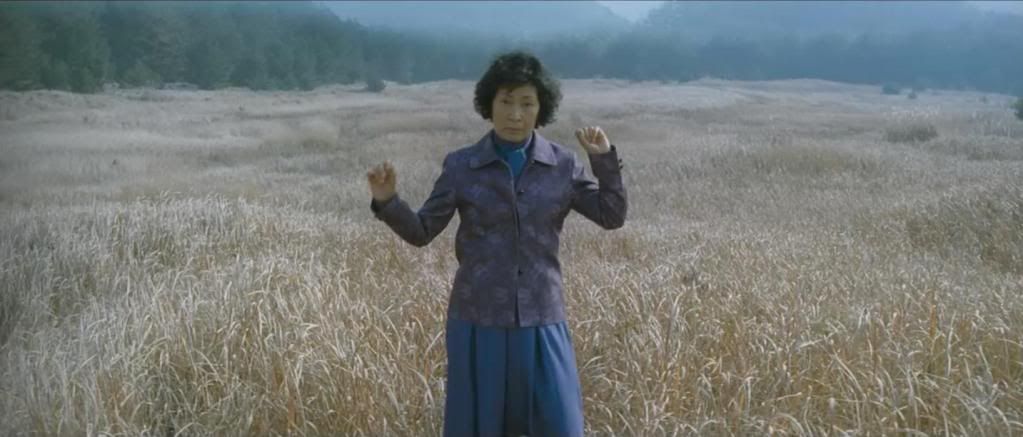
The film's brilliant opening credit sequence establishes this sense of disorientation almost immediately. The film's first image is the mother walking slowly across a large field of wheat, looking downtrodden until she climbs up a hill to approach the camera, at which point she begins swaying rhythmically and dancing, languidly and deliberately, theatrically smiling and then covering her grin with her hand. This remarkable sequence, already jarring and oddly funny, is followed by a dramatic, foreboding image of this woman bathed in shadow, staring down the camera as the film's title appears onscreen. Already, Bong seems to be announcing that this will be an unconventional film, as unattached to any single genre as Bong's ostensible monster movie The Host was.

The film's drama emerges when the amiable, slow-witted Do-joon is accused of the murder of a schoolgirl after a drunken night when he followed the girl to an abandoned house, where she was found dead the next morning. Do-joon is a somewhat goofy, innocent soul who's constantly led into trouble by his friend Jin-tae (Ku Jin). At the beginning of the film, these two chase down a group of rich professors driving a Mercedes Benz that nearly hits Do-joon and his dog. Do-joon and Jin-tae chase the car to a golf course, where they hilariously get their revenge, with Jin-tae kicking off one of the car's rearview mirrors and Do-joon flying through the air in a failed martial arts move, crashing into the pavement without connecting with the car at all. The confrontation then degenerates into a comical, absurd wrestling match in a sand trap.

The film's tone shifts once Do-joon is arrested, as he signs a confession under pressure from the police, seemingly not even fully understanding what he's signing. His mother hires a high-priced lawyer who probably costs more than she can really afford, but the lawyer, who says he's so busy that he never sits down, never seems to have much interest in Do-joon or his mother. In one hilarious sequence, he summons the mother for a conference and delivers his recommendation at a bar, surrounded by his two passed-out friends and the giggling prostitutes they've hired, who clap politely as the lawyer delivers his advice to his client. Bong continually offers up these tonally destabilizing moments that undercut the drama of the situation with bizarre comedic asides.

He also ventures at times into an eerie murder mystery as Do-joon's mother investigates the crime, since the police have closed the case after arresting her son. To aid in her investigative efforts, she enlists Jin-tae, who at times comes across as a creepy suspect himself, particularly in a tense sequence where the mother hides in Jin-tae's closet, believing that she's found evidence that he was the killer, having to sneak out of his house while he's asleep. Bong enhances the tension by emphasizing the obstacle course of trash that the mother has to gingerly step around as she sneaks out, finally knocking over a bottle of water. Bong then cuts to a taut closeup of Jin-tae's fingers dangling close to the floor, the puddle of water slowly spreading towards his hand. Even after he's seemingly exonerated as the killer, Jin-tae maintains a creepy edge, as he becomes a bad cop to the mother's good cop, tracking down kids who knew the murdered girl and beating evidence out of them, culminating in a grisly sequence in which he traps one kid in a disused ferris wheel and kicks his teeth out.

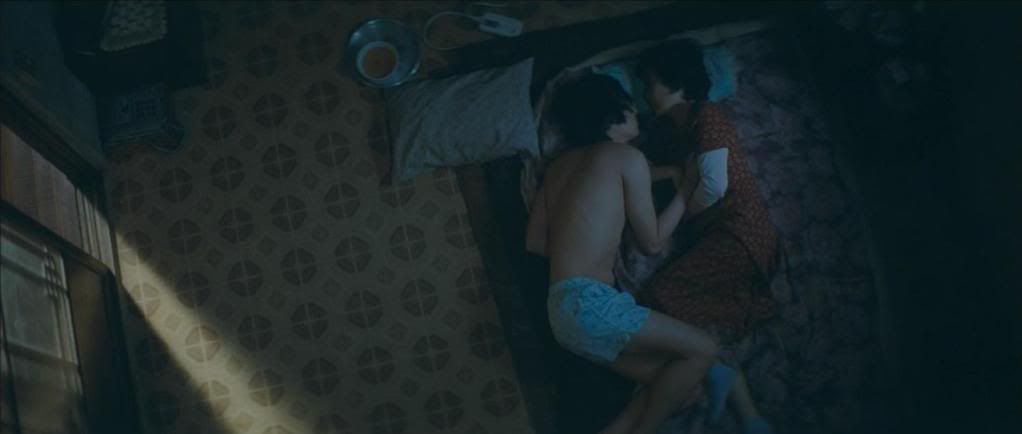
The film's uneasy tonal balance is further disrupted by the fact that, the more the mother investigates and prods at Do-joon's memory, the more unsettling facts come to life, particularly about the relationship between mother and son. Even before Do-joon's arrest, there were intimations of a strange codependency between them; they slept together in the same bed every night, and when Do-joon stumbles in drunk late one night, he collapses onto the bed and instinctively, casually cups his hand on his mother's breast as he stretches out next to her wearing only his boxers. Eventually, even more troubling revelations come to light about their past, revealing just how twisted this woman is, revealing that there's something deeply warped in her affection and protectiveness for her son.

The film's harrowing, powerful final act goes even further, taking a mother's willingness to do anything for her son to its extreme. The film's unsettlingly cheery conclusion, in which the mother takes a "thank you mothers" bus ride given to her as a gift by Do-joon, builds on the film's theme of memory. The mother, who practices acupuncture illegally, says that she knows of a special pressure point on the thigh that eases the pain of memories, allowing one to forget about the past and move on. Much of the movie rests on her trying to get Do-joon to remember, to recall details about the night of the murder that might help prove his innocence, but in the end she decides that she doesn't want all these memories stirred to the surface after all, that it's better to forget, to ease the pain with a needle and then carry on as though nothing has happened. In the film's final image, she performs this procedure and, putting her pain behind her, she stands up with the other loving mothers on the bus and begins dancing, echoing the opening credits sequence, in an image that is at once ecstatic — with the sun shining through the bus' dirty windows, flaring at the camera — and bittersweet, since it represents the triumph of repression, denial, violence and lies.

Monday, April 26, 2010

The Host


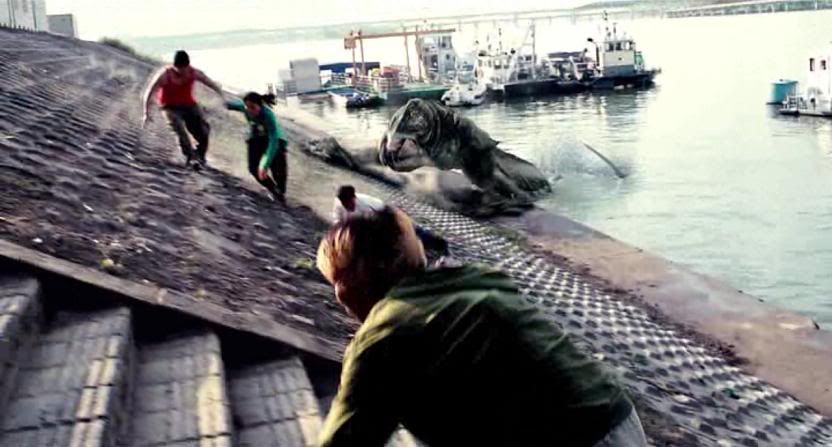
Joon-ho Bong's The Host is a delirious modern monster movie, a throwback to the classic era of the sci-fi monster: all those nakedly metaphorical beasts formed from radiation or other side effects of man's scientific progress. And much like the classic Japanese monster movies, this Korean film is aimed squarely at the fear and anger caused by a foreign target: the United States. The film opens with an awkwardly acted scene in English, in which an American researcher instructs his Korean assistant to pour a shelf of chemical bottles down the drain, despite the assistant's protestations that this will cause harm to the Han River. Cut to a few years later, and something odd is definitely going on in the river as a result. Bong's unveiling of the monster — a mutated, somewhat lame sea creature with numerous vestigial limbs and a massive, terrifying maw — is the film's best sequence, a frantic action set piece that's both absurd and terrifying.

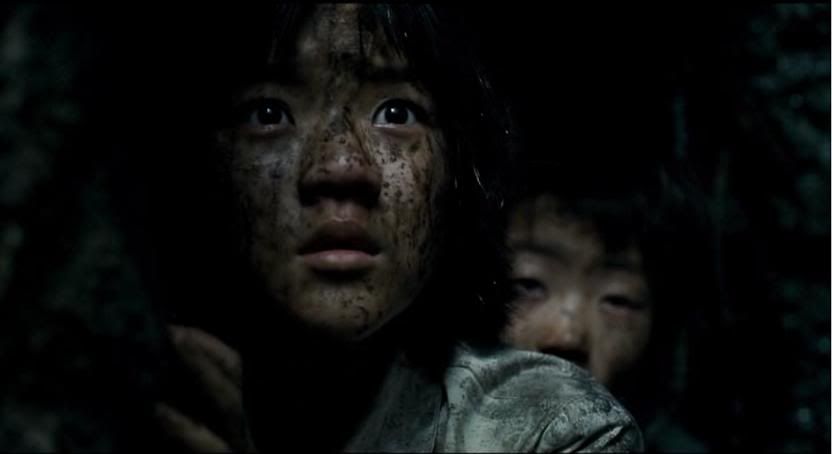
The monster appears abruptly, but before it does, it's just an ordinary day at a riverside park where Hie-bong (Hie-bong Byeon) runs a snack stand with his lazy, distracted son Gang-du (Kang-ho Song). Bong takes his time setting up the family dynamic here, because it's this family that's going to be at the center of the film once the monster does appear. Hie-bong has two children in addition to Gang-du: his educated but unemployed son Nam-il (Hae-il Park) and his athlete daughter Nam-joo (Du-na Bae), a professional archer who's just shy of being the best. When the monster shows up, Hie-bong, Gang-du, and Gang-du's daughter Hyun-seo (Ah-sung Ko) are watching Nam-joo lose a tournament on TV. Bong's presentation of the monster, interrupting this low-key domestic drama with its touches of comedy, is disarmingly offhand. The creature is an obvious CGI construction, with no attempt made to make it fit in naturally as an organic component of this otherwise realistic world: it stands out as something totally different, all glossy, slippery surfaces and distracting artificiality. As it rampages through the crowds gathered on the riverside, gobbling up some of the crowd and tossing others into the water with a flick of its tail, it is frightening and hilarious in nearly equal measures, this oddball CGI monster stalking across the riverbank as people scream and run. The artificiality of it all just makes it all the more disconcerting, especially since Bong approaches it with a goofy sense of humor, relishing the way limbs hang out of the monster's mouth after it eats up a victim, or the way the creature stumbles and somersaults down an embankment, moving awkwardly on its deformed limbs.

The human actors are, in their own way, equally stylized and artificial. They approach their parts with a broad comedic, satirical sensibility, purposefully over-emoting at every opportunity. A demonstration of grief, following the monster's assault, is a particularly good example, balanced as it is between devastating sadness and ludicrous exaggeration. The family rolls around on the floor, screaming and wrestling with one another, tearing at each other in grief and rage, and Bong switches to an overhead shot that shows them stretched out there on the ground, overcome by their feelings, expressing their loss in this embarrassingly naked way. Later, Bong's moments of political commentary are just as unfettered and raw; the film is a pretty clever, if not particularly subtle, jab at American dominance of international affairs, and the media's complicity in this dominance. Here, the Americans created the monster through their blatant lack of concern for the environment (especially the environments of the other countries they visit for cheap labor), then they invent the scare that the monster is causing a deadly disease, and then they insert themselves into the affair by offering a radical "solution" in the form of something called "Agent Yellow," a likely dangerous and carcinogenic chemical that they plan to unleash in Korea to kill the monster.


The film's guiding political concept is the idea that American foreign policy is exploitative and misguided, that the Americans oafishly cause problems and then make things even worse in trying to solve them. In this case, the terror over the supposed disease — which seems to have been made up through a combination of incompetence and a desire to cover up mistakes — creates an artificial panic that then allows the Americans to come in with a typically over-the-top, violent solution. Moreover, the Americans are deaf to concerns from other countries. In one of the film's most satirically biting scenes, Gang-du is confronted by an American doctor who takes Gang-du's insistence that his daughter is alive somewhere, imprisoned by the monster, as evidence of dementia, a sign that the disease (which he's starting to believe is fake, anyway) has taken over his brain. Gang-du cries out, in anguish, that they never listen to him, that they keep interrupting him and not letting him speak: "my words are words, too," he cries. It might as well be the filmmaker speaking, on behalf of all foreign peoples whose interests and concerns are trampled over by an intrusive, profit-motivated, military-industrial America.

Although this makes The Host sound like an unsubtle political screed, there's much more to the film than that, and the politics are approached with the same spirit of exaggeration and stylization as everything else in the film. Bong mashes together various tones and ideas with abandon, never settling into any one mode for long. The film's broad physical comedy, political satire, horror and action thus rub uncomfortably against one another, creating interesting frictions as multiple modes can coexist even within a single scene. It's all leading towards an action-packed climax in which this family, so divided and unhappy with each other, finally comes together, each of them adding their specific skills and qualities to the final confrontation with the monster. It gets to the heart of the film's implicit message: rely on family and community, ignoring the distractions and manipulations of politics. In the final scene, they turn off the TV, shutting down the American politicians using buzz words and euphemisms to absolve themselves of responsibility, and focus on enjoying the simple pleasures of family instead. It's a hard road to get to this point, though, through a lot of blood and gore.

It's a wild ride for the audience, too, thrown through the paces by Bong's free-wheeling sensibility of genre mash-ups. There are stunning action sequences, silly comedic bits with lots of slapstick falls and awkward chase scenes, moments of quiet family drama during the uncharacteristic pauses in the action, and of course the horror of the monster, who shows up every once in a while as though to remind the viewer what kind of movie this is at heart, no matter how many diversions into socio-political satire or absurdist comedy it takes along the way. The monster's most horrifying moment comes late in the film, when it suddenly stops simply slurping up victims and then spitting them out more or less intact in its sewer hideout. Instead, it vomits up a torrent of skulls and bones, the remains of its most recent victims, a seemingly never-ending stream of bodies denuded of all signs of flesh. It's all the more bracing and terrifying because Bong had avoided making the monster too bloodthirsty in the earlier stretches of the film.

In fact, there's something graceful about the monster, something even kind of poignant. It often swings through the girders beneath the bridge where it hides, doing gymnastic flips and swinging by its tail, gracefully leaping from one beam to the next. In one scene, its tail appears before it does, lazily turning in spiral patterns, strangely beautiful and hypnotic until the ungainly monster, all vicious-looking teeth and claws, comes careening out of the darkness. Even the monster's ultimate end is somewhat sad, as the creatures twists about in agony, wracked with pain, letting out a haunting cry as it turns on its back. This moment represents the ultimate victory of the family over its terror, but it's at the expense of this poor creature, deformed and mutated by circumstances beyond its control, transformed from an ordinary innocent sea creature into this monstrosity. Bong allows this ambiguity, this discomfiting affection for the monster, to linger throughout the final moments, preventing the obligatory defeat of the creature from being as entirely triumphant as one would expect.

Tuesday, July 28, 2009

Tokyo!


Tokyo! is a multi-director anthology in which three directors — Frenchmen Michel Gondry and Leos Carax and Korean Bong Joon-ho — present three individual short films, linked only by their shared setting and their different approaches to odd, surrealistic storytelling. Gondry's film is first, a quietly moving short called Interior Design, based on the great short story "Cecil and Jordan in New York" by comic artist Gabrielle Bell, who co-wrote the film with Gondry. The film is about Hiroko (Ayako Fujitani) and her filmmaker boyfriend Akira (Ryo Kase), who go to Tokyo in order to screen Akira's low-budget film and to make a start for themselves in the city. When they first arrive, they move in with Hiroko's friend Akemi (Ayumi Ito), staying in her cramped apartment while trying to find a place for themselves as well. Things are difficult, however, since only Akira is able to get a part-time job, their car is ticketed and finally impounded, and every apartment they look at is tiny and miserable. Hiroko is increasingly aimless in the city, wandering around, growing frustrated, sensing Akira's growing distance from her (and attraction to her friend Akemi instead) and sensing also Akemi's aggravation that the couple has been taking advantage of her hospitality for so long.

At this point, Hiroko undergoes a startling change, turning into a plain wooden chair. She initially runs through the streets in a panic as her legs become thin wooden sticks, but she soon becomes used to her situation, accepting and even enjoying it. She's taken home by a young musician, and stays a chair at night when he's home, while transforming back into a girl during the day so she can do what she wants, puttering around his apartment. Gondry treats the offhand surrealism of the story with much the same attitude as Bell's original comic, in which the heroine's transformation into a chair is accomplished in three panels, accompanied by the casual narration, "and so I changed myself into a chair." Other than transplanting the characters from Brooklyn to Tokyo, Gondry expands upon the original story while keeping to its basic thrust. The actual initial moment of transformation is more dramatic here, with some stunning special effects to show Hiroko's gradual process of becoming a chair.

More importantly, however, Gondry fills in the subtexts of the original story, which is about loneliness and the feeling of being ignored. Hiroko feels like she is "just the girlfriend" to Akira, who isn't exactly a successful filmmaker but still gets more attention as an "artist," while Hiroko feels left out, useless, without purpose in her life. Her transformation is thus an attempt to become valuable, to become something with a concrete use. She becomes a chair, strictly utilitarian, essential and important and yet also ordinary. It's a bittersweet, clever little film, quiet in its emotions and subtle in the way it allows its metaphors to play out. The relationship between Akira and Hiroko is portrayed well by the two young actors, who laugh and joke with one another; their relationship seems to be built on in-jokes and goofing around. They're young and not yet taking life seriously. They turn everything into a game, even serious problems like checking their finances to see how they can afford an apartment. And they're ill-prepared to really talk to one another, particularly Akira, who's too tied up in his goofy art films to really pay much attention to his girlfriend.

Hiroko's transformation is thus an escape, from a life of being ignored, and also from a life of encroaching responsibilities. She has a childlike sense of play — she sits around cutting pictures out of magazines and making collages or awkward origami — and she doesn't want to lose her little "hobbies," which for her define what she wants from the world. She doesn't want to have "ambition," as Akira keeps urging her. She just wants someone to think she's useful; she wants to feel like she has a place in the world. By the end of the film, she does. This is a wonderful, affecting film, one that does justice to one of cartoonist Bell's best stories.


The second film in this anthology is Leos Carax's incredibly strange Merde. This short opens with the titular character (Denis Lavant), emerging from a manhole cover, filthy and wild-looking in a green suit, with frizzy hair, a milky white eye, and a red beard curving off to one side like a scythe's blade. He has been dubbed "the creature from the sewers," and like a true movie monster he terrorizes the city's inhabitants, initially in bizarre, amusing ways like grabbing their cigarettes, licking them, or stealing and eating flowers and cash. But Merde's reign of terror soon becomes much darker when he emerges from the sewers with a cache of grenades he discovered beneath the streets, and begins throwing them frantically around in the streets, killing and maiming dozens of people and destroying cars and property all around him. Merde is then captured and placed on trial, defended by a visiting French lawyer, Voland (Jean-François Balmer), who is his mirror image, with a milky white eye and curved red beard, and one of the only people in the world who actually speaks Merde's guttural, gibberish language.

This film is unsettling and ambiguous, making intentional references to Japanese monster movies and their relationship to Japan's history as the only nation to be hit with a nuclear bomb, as well as exploring obvious parallels to the modern American-led "war on terror." At one point, a news broadcast asserts that Merde had once been spotted at an Al-Qaeda training camp. At his trial, the audience is filled with people with burn marks on their faces, or their heads swathed in bandages, looking like Hiroshima survivors. The film is a dense collage of references and possible meanings, incorporating stereotypical Japanese images as conceived by a Westerner, like the people at the trial who wear surgical masks or the Japanese schoolgirl who drops her coat, revealing a skimpy outfit underneath, when Merde attacks her. These images are like fever-dreams of Japan, conceived in the West through the prism of the little Japanese culture — monster movies, anime and manga, J-pop — that's popularly visible outside of Japan.

This is fitting, because one of the film's primary themes is the disconnection that comes with multiple languages and multiple cultures. Throughout the second half of the short, the entirety of the dialogue is heard three times, once in Japanese, once in French, and once in the nonsense language spoken only by Merde and Voland. This constant translation and repetition is required for everyone to understand everyone else, and the process becomes even more complex when subtitles are incorporated for audiences who speak neither French nor Japanese. The film is at least partly about the difficulty of understanding others, of grasping the thought processes behind people who seem grotesque, threatening and unusual. Is Merde insane? Is he a "racist," as one Japanese lawyer calls him? Is he a misanthrope? Is he ugly, or is he, as he says his "gorgeous" mother called him, "a pretty little boy?" Carax leaves everything ambiguous and tonally confused, constantly vacillating between outlandish horror and offbeat dark humor. This is especially apparent in the bizarre ending, in which an intertitle, superimposed over an image of a five-dollar bill with Abraham Lincoln disfigured to resemble Merde, promises further adventures of Merde in New York: "Merde in USA," a deadpan riff on Godard's Made In USA. Carax's weird, open-ended short never settles its multiple allegorical meanings and ideas, but it's an interesting, unforgettable film nevertheless.


The final short here is the most traditional and straightforward, as well as the one short that engages in a serious way with the nature of Japanese culture. Whereas the first two shorts, both by Westerners, could probably have been set anywhere and made just as much sense, Korean filmmaker Bong Joon-ho's Shaking Tokyo is more explicitly a film about Tokyo and Japan as a whole. It's the story of a "hikikomori," a Japanese word for a recluse who lives off his parents and never leaves his house, keeping his garbage carefully organized in stacks, spending his time reading and doing nothing. The unnamed central character, played by Teruyuki Kagawa, has not left his apartment in eleven years. Every year he receives a wad of money from his father, and otherwise his only contact with the outside world is his limited interaction with the delivery people who bring food and other things to his home. He never looks anyone in the eyes, simply handing over money and getting a pizza or a package in exchange.

This changes when he happens to make eye contact with a pizza delivery girl (Yû Aoi) who comes to his apartment. While steadfastly looking down, handing over his money as he takes the pizza, he catches sight of her garter belt and the thin strip of bare leg below her skirt, and it startles him into looking up at her face. At this moment, as though this man's isolation was unable to withstand such bracing contact with another person, Tokyo suffers an earthquake that shakes some of the man's possessions out of their perfect arrangements, and causes the girl to collapse on the floor in his foyer. The film's first magical realist touch is the man's discovery that the collapsed girl, who can't be woken, has dotted her body with tattoos of various buttons, indicating moods and conditions: sadness, hysteria, fear. Intrigued, he discovers a button on her exposed thigh, the spot that had so distracted him from his usually resolute avoidance of eye contact, that is marked "coma." He presses the button and the girl promptly wakes up.

This event changes the man, who soon learns that the girl, after meeting him and seeing his compulsively neat apartment, his splendid isolation, has decided to become a hikikomori as well. He thus decides to break his eleven-year isolation and venture out amongst the people of Tokyo. Instead, he finds a surreally abandoned city, its streets empty, its people staying inside — only a smiley-faced robot, delivering pizza, is visible on the streets. The man sees a woman standing behind a frosted glass door and tries to speak with her, but she simply fades back into the darkness, her ghostly form dissolving behind the glass as she steps backward. The film is a low-key examination of the isolation and disconnection of people living in a big, impersonal city like Tokyo. It's a haunting vision of a city full of people who all decide, spontaneously and all at once, to withdraw from other people, to remain in their own self-contained spaces, to avoid the crowds and the sunlight and the noise of Tokyo when it's full of people. The man's journey through this deserted metropolis becomes an attempt to find some connection, some link with another person, a reason to leave the house.

This final film isn't as adventurous or unusual as the first two, and its ending threatens to be excessively cute and hokey, but it's still an interesting short, worthwhile for the way its clever touches of imagination blend with its deadpan chronicle of everyday routine. As a whole, Tokyo! is a great collection. Its three shorts have little to do with one another, and they don't exactly fit together into a comprehensive statement of any kind, least of all about the title city — but then, why should they? Taken individually, each of these shorts is intriguing and entertaining in equal measures, and that's more than enough.