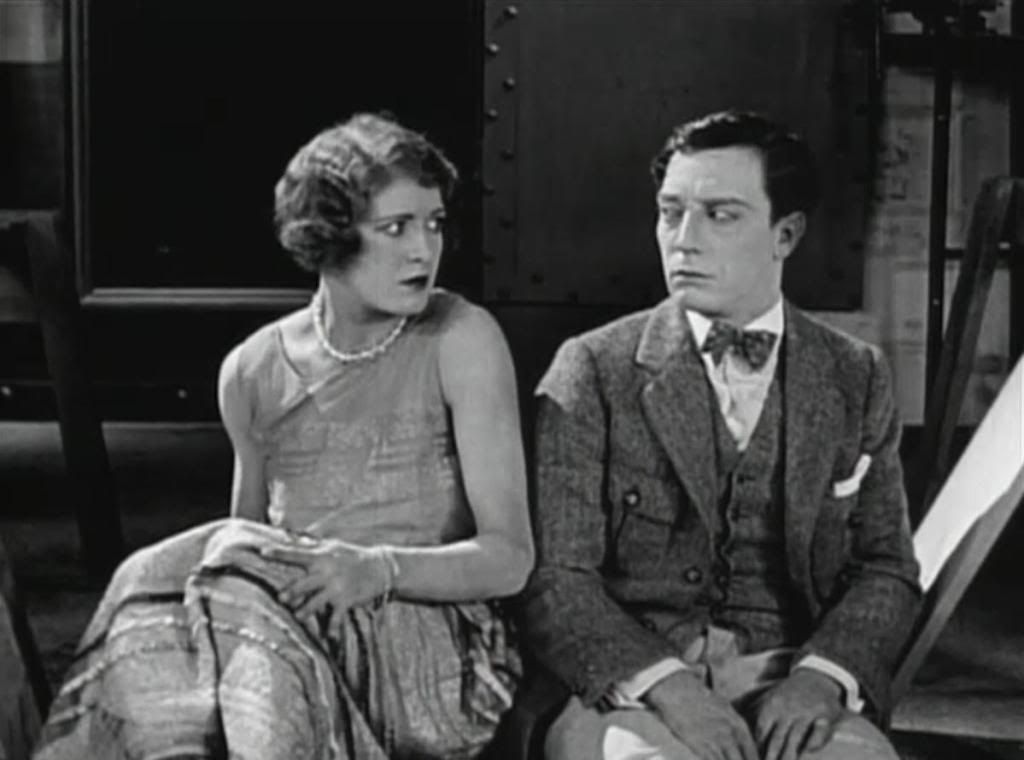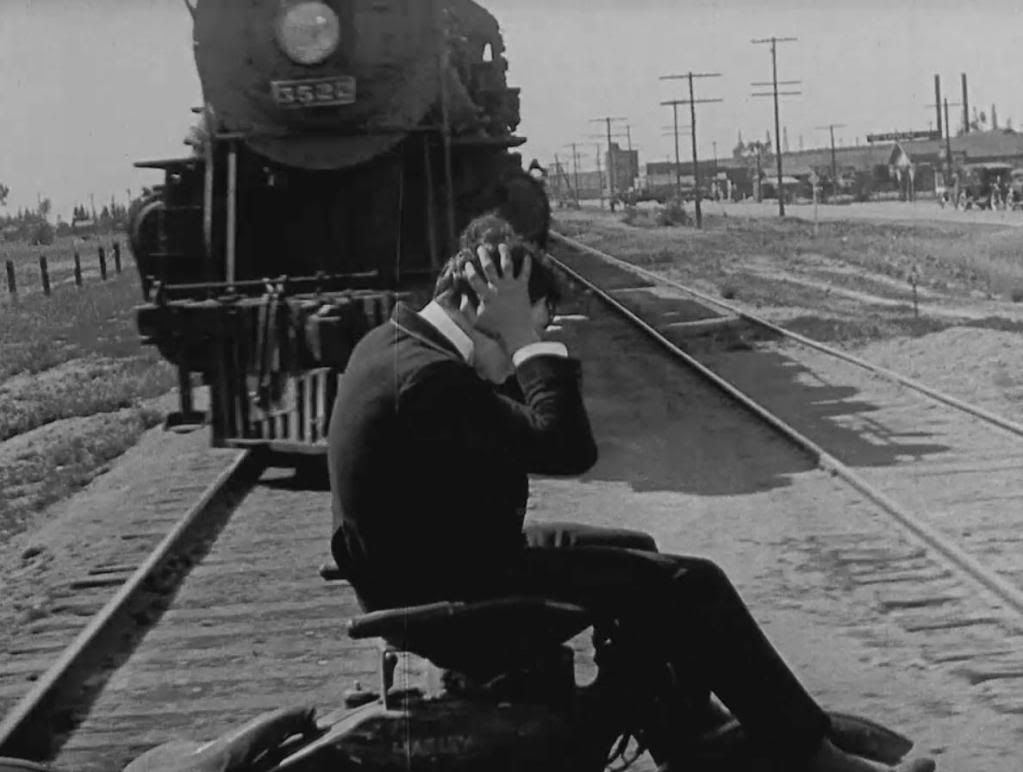
Showing posts with label Buster Keaton. Show all posts

Wednesday, November 14, 2012

Three Ages


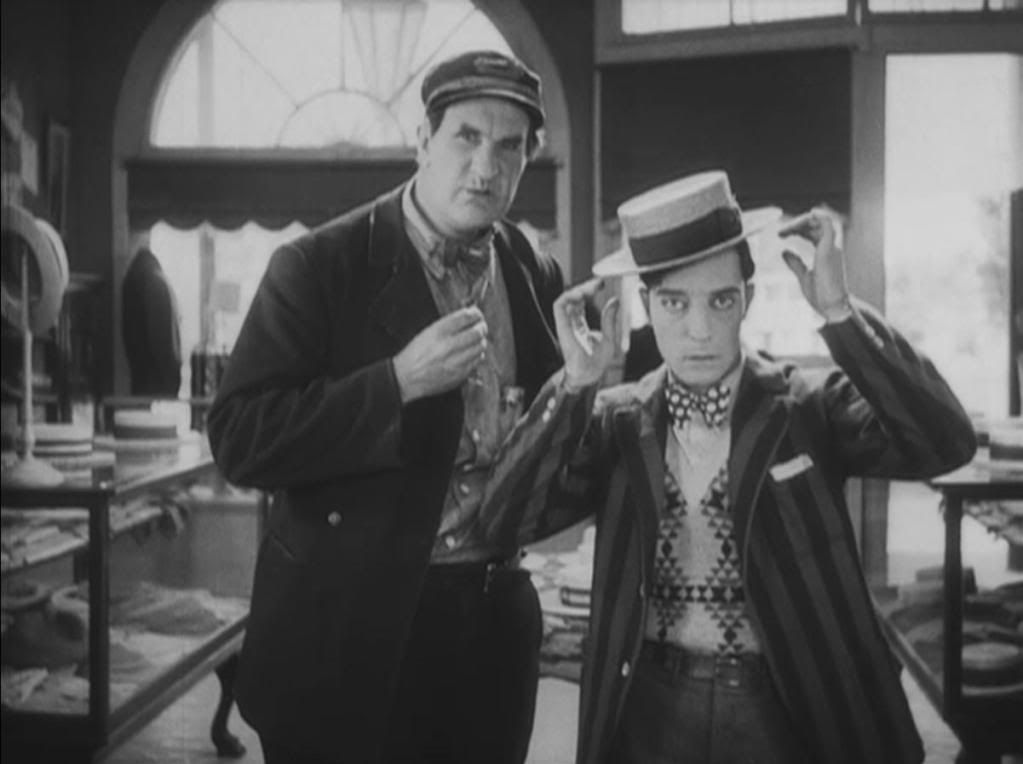
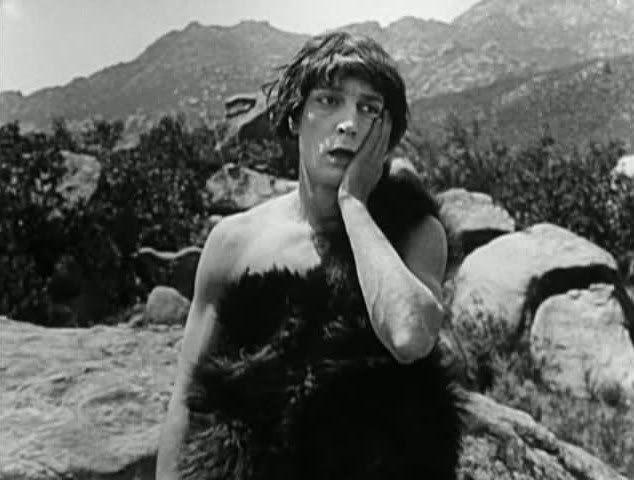
For his first feature film after a string of shorts, Buster Keaton hedged his bets slightly by making Three Ages, a parody of D.W. Griffith's Intolerance that was designed so that, if the feature had failed at the box office, it could have been split into three of the shorts that were at that time Keaton's more familiar format. The presence of co-director Edward F. Cline, who worked with Keaton on many of the comic's shorts, also announces this film's continuity with the shorter works that preceded it. The film succeeded, though, and Keaton's feature career was launched. Like the Griffith film it's based on, Three Ages relates parallel stories in multiple historical eras, in this case three romances, set in prehistoric times, the era of the Roman Empire, and modern times.

In each of these three eras, Keaton runs through the same basic story: he's a good guy pining over a girl (Margaret Leahy), who loves Keaton but is for various reasons pushed towards a more successful but brutish rival (Wallace Beery). Keaton's the lover, the sensitive guy the girl really likes, but in each of these stories he's lacking the socially accepted status symbols of masculinity and success: most obviously, in the modern story, the girl's mother compares the two suitors' bank books and finds that while Beery has a hefty account, Keaton keeps his meager savings in the "Last National Bank." In the historical stories, there are different standards — brute strength in caveman times, army titles in the Roman era — but the concept is the same, that Keaton's sensitive little lover doesn't measure up to what's expected of men, especially men trying to win a woman.

Of course, that's part of the joke, and defying expectations is essential to Keaton's comedy: this unassuming little man with the stoical expression is capable of graceful feats of daring that are as exciting as they are funny. Here, Keaton has plenty of chances to display his stunning athleticism and genius for comic staging as the various stories come to a climax with thrilling chases and contests in which Keaton must defeat his rival and win the girl. There's a football game in which Keaton performs a series of acrobatic dodges around various tacklers and scores a touchdown with the ball clutched between his feet. The Roman story climaxes with Keaton using a spear to pole-vault off a horse into a window, a gag that he'd repeat for College, though there the pole-vaulting would be performed, at much greater height, by an Olympic athlete.

Keaton's inventiveness and carefully paced gags are best displayed here in the chariot race in the Roman sequence. For this frantic race, Keaton chains together a string of hilarious, clever gags, starting with the fact that he comes to the race ready for the snow with a team of dogs and sled runners instead of wheels. The gags flow fast and furious once the race begins, too. Keaton stops to grab a spare dog from his chariot's trunk to replace a tired-out "front wheel." The dogs go off-course to chase a cat, but Keaton turns this distraction around by tying the cat to a spear and dangling it in front of the sled dog team, urging them on. Keaton is always at his best in moments like this, displaying this kind of do-anything intelligence, a canny ability to turn anything into a tool, in ways that are not only richly funny but strangely practical.

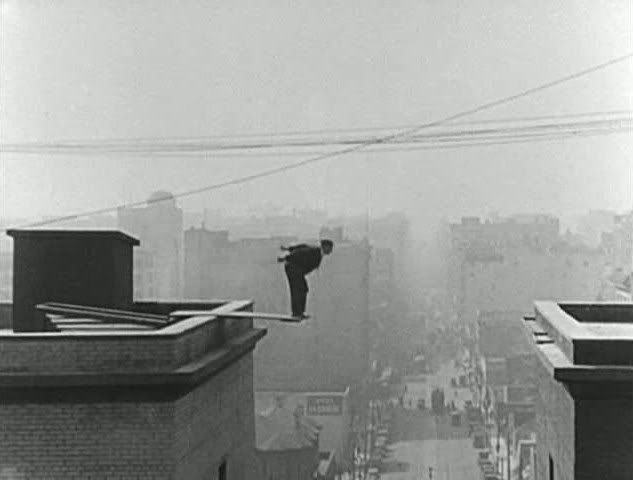
Also dazzling is the chase climax to the film's modern story, in which Keaton runs from the police in a mad race to get to the church where the girl is set to marry Beery. The scene is built around an accident: Keaton tried to perform a daredevil leap from a wooden plank across the space between two buildings, but he fell short, slipping off the second building and falling into a net. He was injured in the fall, but he then proceeded to use his mishap as the foundation of a new sequence, elaborating on it with a complex series of secondary falls, through a series of awnings, onto a drainpipe, through the window of a firehouse and down the fire pole. This is Keatonian inventiveness at its finest again, making use even of a dangerous mistake and turning it into an opportunity for what wound up being an even better gag than if he'd actually made the jump.

Three Ages is consistently driven by this kind of daring and cleverness. It's not one of Keaton's very best films, and its three-part structure makes it feel like a collection of shorts woven together rather than a true first leap into feature filmmaking — that would come soon enough with the great Our Hospitality. But it's a typically funny and frenzied Keaton film with plenty to recommend it.

Wednesday, August 29, 2012

Steamboat Bill, Jr.


Steamboat Bill, Jr. is another of Buster Keaton's absolute best films, a brilliant masterpiece of physical comedy with a premise perfectly tailored to Keaton's penchant for death-defying stunts, blending humor and action to such a degree that those two aspects of his work become inextricable. Keaton's physical feats of daring at the climax of this film represent some of his best stuntwork, both irresistibly funny and shocking in the very real sense of danger that's continually present in these obviously carefully timed and designed stunts, where just a second or an inch off could've meant disaster for the actor. It's obviously Keaton's very precise, utterly logical genius driving these stunts and gags, which is why it makes no difference that he's not the credited director; it's Keaton's unmistakeable intelligence at work here, not that of credited director Charles Reisner.

The film has a quite poignant thematic emphasis on fathers and sons, as Keaton plays an effete, intellectual college kid who tries to impress his tough, masculine riverboat captain father Steamboat Bill (Ernest Torrence), who he is meeting for the first time. When Bill first realizes that Keaton is his son, Keaton is prancing around with a violin in a manner that's obviously meant to be a parody of homosexuality — he's trying to quiet a crying baby with his antics, but his father doesn't realize this and simply looks at this spectacle as the first manifestation of his son's unmanly ways. In his beret and fancy clothes, with a wispy mustache that earns the withering contempt of his father, Keaton recalls the inept snobs of some of his earlier films, though here he's not a son of privilege. The subtext is Bill's desire that his son — even a son that he hasn't seen since he was a baby — should be an echo and a mirror of the father, hence the comedy of the scene in which the captain walks around the train station trying to figure out which man is his son. At one point, he mistakenly walks up to a black man in a gag that recalls Keaton's mistaken proposal to a black woman in Seven Chances, both jokes essentially reflecting some skittishness and subtextual discomfort with the prospect of inter-racial romances.

The heart of the film is this troubled father/son dynamic, with the father disappointed in the son he'd hoped would be a rugged tough guy like his dad, and the son who just wants to impress his dad without having to discard his entire persona. Keaton fits in better, it seems, with his father's rival, J.J. King (Tom McGuire), who runs a much more modern and fancy steamboat operation, and whose daughter Kitty (Marion Byron) is Keaton's girlfriend, much to the chagrin of both the rival fathers. This Romeo and Juliet tale of forbidden romance provides the impetus for some of the best jokes, as Keaton keeps trying to sneak away to see Kitty under the watchful and disapproving eyes of both fathers. There are countless inventive and funny sequences here, particularly an extended bit of Keaton keeping various clothes hidden under his bedrobe so he can sneak out. Byron's also a dynamic, adorable presence here, one of Keaton's best leading ladies, her cutesy energy and almost Chaplin-esque shuffling walk a nice contrast to Keaton's infamous stoicism and restraint.


Keaton has a way of enlivening even minor scenes with subtle little gestural touches, like the way he discreetly leans in to smell Kitty's hair while she's talking to him, or the way, after he's knocked out by the sheriff and thrown into the back of a car, with only his legs sticking up, he casually crosses his legs as the car takes his supposedly unconscious body to the hospital. Also hilarious is the scene where he tries to bust his father out of prison with some tools baked into a massive loaf of bread, a scene in which Keaton's whimsically pantomimes various hand signals for escape to his father while the sheriff's back is turned.

The peak of the film, though, is unquestionably the lengthy climax, one of the best of Keaton's typically frenzied final act extravaganzas, as a storm sweeps through the town, with Keaton wandering dazed and baffled through one dangerous situation after another. This whole sequence is a marvel of split-second timing and perfectly realized stunts, with whole buildings and houses falling down or blowing away with Keaton right next to them, the town being torn apart all around him, with him as the mostly untouched center of the storm, always just in the right spot to avoid otherwise certain death. Most famously, at one point the whole front wall of a house falls down and Keaton survives because he's standing precisely in the spot where the window lands. There are countless more similarly startling moments, like a house that lands on top of him and then collapses as soon as he steps out of its door, or a wall that falls as he steps through its door. At one point, he wanders onto a theatrical stage, where he pulls a chain that causes him to disappear into a trapdoor. He then tries to dive into a lake that turns out to be a painted backdrop, a realist echo of the magical dream at the center of Sherlock Jr.; the theater isn't as permeable to magical intrusions as the cinema's screen.

As these incidents pile up and the wind blows, Keaton's unceasing physical artistry becomes absolutely hypnotic, especially during the daring chain of rescues that caps off the film, with Keaton athletically leaping from one level to another on the steamboat and rigging a series of mechanical contrivances of the kind he's always loved. His bravado wins over everyone — his father, Kitty's father, and Kitty herself — so that his character wins the admiration he so intensely desires even as Keaton himself wins the admiration of any audience witnessing the very real stunts and gags he executes so flawlessly here.

Thursday, August 2, 2012

College


Buster Keaton's penultimate independent film before signing with MGM, College is not one of the silent comic's better efforts. Credited to director James W. Horne, it was, like Keaton's other silent features, actually directed almost entirely by Keaton himself, but it's a little lackluster and pedestrian compared to his other work, especially considering he'd just made his absolutely brilliant masterpiece The General.

Keaton plays a high school graduate who's eager to impress Mary (Anne Cornwall), the girl he loves, by demonstrating that he's not just a bookish intellectual but can also excel at athletics. That's certainly casting himself against type, since Keaton's primary attribute had always been his physicality and athleticism, so the fact that he spends the bulk of the film clumsily failing to pull off athletic feats might account for its lesser status. Some of the gags are amusing, but not uproariously funny by any means, and not enough of a compensation for the lack of Keaton's daring stuntwork. The middle of the film is dominated by a long section in which he tries his hand at a number of sports and track events, comically failing to clear hurdles, crashing into the pole when attempting high jumps, and best of all, doing a pole vault in which he attempts to climb the pole when it's briefly standing straight up.

It's faintly amusing, but it all lacks the clever staging and precision of Keaton's best comedy; these are simple jokes about physical incompetence and clumsiness that any slapstick comedian of the era could have pulled off, when Keaton is capable of so much more. The crew race that serves as the film's climax is also lacking in the typical excitement of Keaton's best chases and races, though there's a nice sight gag when the boat's rudder comes loose, causing Keaton to tie it to his backside and stick his rear in the water to steer. That gag pays off again after the race when Keaton's fin repeatedly slaps girls in the ass every time he turns around, causing one of them to slap him.


This film also has the dubious distinction of having the most uncomfortable blackface sequence of any of Keaton's work, with Keaton himself donning blackface to pose as a "colored waiter." It's a stupid and painfully unfunny scene that climaxes with the other, genuinely black waiters chasing after Keaton when some of his makeup rubs off.

The best part of the film is undoubtedly the very end, when a contrived rescue scenario with Mary causes Keaton to finally, belatedly display his athletic abilities. The earlier scenes of his failures now pay off as the whole world becomes an obstacle course, with Keaton dodging around pedestrians, hurdling and high-jumping over hedges, and finally pole-vaulting up through Mary's window — the latter is the one stunt Keaton himself didn't perform, subbing in an Olympic pole vaulter for that one task. This is an enjoyable and frenzied few minutes in which Keaton remakes the world as a sporting arena, taking ordinary objects and transforming them into baseball bats, discuses and javelins.

Even better, though, is the utterly unexpected and morbidly hilarious final seconds of the film, in which Keaton and Mary get married, and Keaton inserts a short little montage that rushes through the rest of their lives: coming out of the chapel together, sitting surrounded by babies and rambunctious kids, growing old together, and then a cut to a pair of side-by-side gravestones. That final image mocks and tears apart the conventional romantic ending, subverting the guy-gets-the-girl happy ending by suggesting that the end point for all this romance is ultimately only death. It's a surprisingly funny and savagely clever conclusion to a film that had otherwise been a rather slight outing for Keaton.

Thursday, July 5, 2012

The General


The General is one of the purest delights that the cinema has to offer. Its construction, and its appeal, is utterly simple, and yet there's a visual poetry to it that goes far beyond its minimalist surface. Buster Keaton's most famous feature, co-directed with Clyde Bruckman, is quite possibly also his best, and certainly the most direct, undiluted example of his kinetic, visceral comedic action. The film has not a shred of fat on it, not a wasted moment. There's none of the sometimes meandering set-up that kicks off some of Keaton's lesser features, no need here for extended exposition or narrative. It's just one great scene, one great pantomime gag, after another.

Keaton plays Johnny Gray, a train engineer on a Southern rail line during the Civil War. When the war starts, he tries to enlist and is rejected because his civilian job is too important, but his girlfriend Annabelle (Marion Mack) and her family just thinks he's a coward, so the serious young man — who, a title card informs us, loves only his train and his girl, probably in that order — is eager to prove his bravery and his masculinity. With that out of the way, the film then hurtles forward into the two extended railroad chase sequences that together comprise virtually the entirety of its running time. The film is neatly halved: in the first half, Keaton pursues a group of Union train thieves across Union lines, and in the second half he steals back his train and is chased by the Union army back across Confederate lines, in a race to warn the South before a sneak attack is sprung.

The scenario was based on a real incident from the war, and Keaton treats it with his characteristic serious comedy. In fact, it's easily his most straight-faced and least comic film, which isn't to say that it's not funny (it is!) but that its humor is subtle even for him, the gags organically incorporated into the structure of the action-packed sequences. In that respect, it resembles the thrilling action climax to Our Hospitality, and of course it also expands upon Keaton's train fascination from that film, spending virtually the entire film with one great train gag after another.


If The General isn't Keaton's funniest film, it's definitely his most astonishing, the densest of his works in terms of pure how-the-hell-did-he-do-that stunt bravado. Keaton leaps from one train car to another, throws giant beams of wood around, climbs across the front of the engine, bounces from the train to the tracks to clear obstructions, and rigs traps to trip up his pursuers. In one justly famous moment, he sits on the front of the train and throws a beam out in front of the train so that it lands on a second beam and sends them both catapulting off the tracks. It's done casually, as though there's nothing to it, as though these massive wooden blocks aren't careening around a few feet from Keaton's vulnerable figure. It's dazzling, almost more frightening than it is funny, and it displays Keaton's perfect grasp of physics-based gags, his sheer imagination, his courage, his ability to precisely map out movements and make each motion, each trajectory, both graceful and somehow funny.

A perfect example is the scene where Keaton lights a cannon to fire at the Union train, then comically dodges around when the cannon barrel lowers to point at Keaton's train instead. The punchline is typically all about trajectories: the trains turn a curve in such a way that the cannon, at the precise moment that it is fired, is once again pointing at the enemy train. The physical comedy, if it can even be called that, is inspired throughout. Keaton's a real action hero here, and his no-nonsense physicality only makes the moments when he indulges in a slapstick gag — like the scene where he throws firewood onto the train but keeps knocking the beams off — even funnier. There's also some deadpan wit in little details like the hilariously stoic portrait that Keaton gives to his girl (he's posed, of course, in front of his first love, his train). Although Keaton's the undoubted star, Mack proves a very capable foil for him, most notably in the scene where she throws tiny shreds and splinters of wood into the train's furnace, causing Keaton to, in quick succession, strangle her and kiss her.

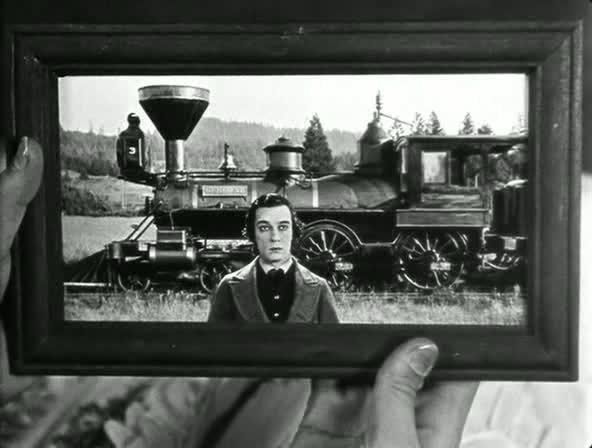
One great sequence actually takes place in a rare break from the train action, when Keaton hides under a table listening to some Union officers plot their attack. There's a lot of wonderful tension here, both comic and genuinely suspenseful, especially when one of the soldiers burns a hole in the tablecloth with a cigarette and lifts it up. For a moment, Keaton can be seen, staring out at the camera in terror from under the table, while the officer simply extinguishes the embers around the burn hole and lets the tablecloth fall again. That poignant glimpse of the frightened Keaton, looking pleadingly at the camera, is unforgettable. Soon after, there's a pair of shots that cleverly use the hole in the tablecloth to frame Keaton's eye and Annabelle's face (she'd been taken prisoner by the Union). It's appropriate that Keaton here frames and emphasizes his own eye like this, because his eye, his utterly clear and direct vision, is at its absolute peak in this marvelous film.

Thursday, June 14, 2012

Battling Butler


Battling Butler follows a familiar template for many of Buster Keaton's features, with Keaton's character starting out inept and gradually gaining in proficiency so he can get the girl. This is one of his features that actually has a bit more of a plot, with Keaton playing Alfred Butler, a snooty society heir with more than a little similarity to his hapless rich kid in The Navigator. When his parents want to toughen up the spoiled brat, they send him out into the woods for a camping trip, accompanied by a manservant (the always funny Snitz Edwards) who makes the trip anything but roughing it.

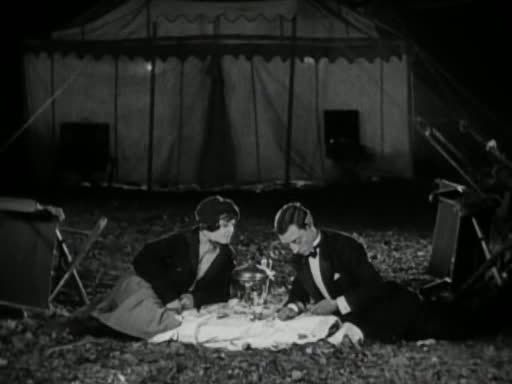
The camping scenes provide a barrage of great gags, many of them about all the amenities that Butler has lugged with him into the wilderness. But the best moment is Butler's hilarious attempt at fishing, which then leads into an equally inept attempt to shoot a duck with a shotgun while balancing, standing up, on a tiny boat. Then Butler meets a country girl (Sally O'Neil), and again as in The Navigator, immediately decides to get married. In order to impress her tough-guy family, though, he has to pose as his namesake, the boxer "Battling" Butler, which ignites the series of misidentifications and misunderstandings that drive the rest of the film.

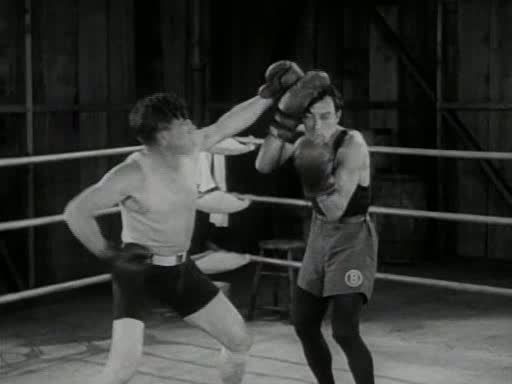
The scenes of Butler training so that he can go through with his ruse are typically inspired, with Keaton's agility and deadpan unflappability adding to the slapstick joys of these scenes. There's lots of fun with the ropes of the boxing ring, with Keaton bouncing off and around them, ducking under, getting tangled in them or literally tied to them, sliding around on the floor, all in a desperate attempt to get into the ring — followed quickly by a series of even more desperate attempts to get back out of the ring. It's not quite the most madcap or energetic of Keaton's physical performances, but it's a typically satisfying sequence of gags as the inept trainee leaps fearfully into the arms of his trainer, gets pounded, runs around the ring and keeps throwing wild punches while keeping his gaze locked, not on his opponent, but on the trainer who's trying to instruct him.


There are a few nice moments here where Keaton uses frames within the frame to highlight the separation between Butler and the girl he's married but has to continue lying to. Right after their wedding, he has to rush off to pretend to train for a fight, and as he drives away from her, the girl's face is framed in the oval back window of the car, receding into the distance as the car pulls out. Later, when she unexpectedly shows up at a training session, Butler sees her face framed in the crook of his sparring partner's arm. In the next shot, Keaton reverses the perspective so that Butler is framed in the same angular hole between the other boxer's body and arm. It's a great diptych, which visually encapsulates the idea that Butler's boxing ruse is keeping the couple apart, literally standing between them so that they can only see one another framed by a boxer's arm.

Battling Butler isn't one of Keaton's best works, and its climax is somewhat lacking in the charm and humor of the rest of the film, as well as the usual high-energy hijinks that so often erupt in the last reel of his films — though the last shot, of Keaton walking arm-in-arm with his gal while wearing a top hat, boxing trunks and gloves, is a great final image. This is mid-level Keaton, which of course means that it's still very funny, packed with fantastic set pieces and visual/physical humor.

Tuesday, May 29, 2012

Go West (1925)


Go West is one of Buster Keaton's more low-key films, but also one of his strangest, focusing on a gently sentimental romance between a man and a cow. Keaton plays an out-of-luck drifter, tellingly named Friendless, who sells off all his possessions — but forgets to take his clothes out of his dresser first, forcing him to buy them back — and heads west to try his luck as a cowboy. For much of its length, the film ambles amiably along, carefully spacing out its modest gags about Keaton's hapless attempts to become a cowboy. His efforts are unsuccessful, of course, but he does succeeding in befriending a cow named Brown Eyes by taking a rock out of her hoof, causing the animal to follow him dutifully around for the remainder of the movie. When the ranch owner sends her off to the stockyards with the rest of his cattle, Keaton follows along, hoping to rescue the damsel in distress from her fate.

It's a goofy premise, and a likeably goofy movie. The pace isn't as non-stop hilarious as Keaton's best work, and structurally it's rather similar to his previous feature, Seven Chances, with two-thirds of it drifting along a bit slowly before picking up the pace for a wild chase sequence finale — although in this case, the herd of pursuing brides from Seven Chances has been replaced by a herd of stampeding cows, chasing Keaton through the streets of Los Angeles.

This finale is the film's best part, mainly because the sight gag of all these cattle swarming through the city streets, with people fleeing in every direction while Keaton strolls casually through the throngs, is just so inherently funny. There's a madcap quality to this whole sequence, which basically has one joke — cows wandering into inappropriate places — that Keaton elaborates and riffs on over and over again, to very enjoyable comic effect. The best gags come when he complicates the scenario, as when the cows enter a clothes store where Keaton and the cows careen around with a man on roller skates, another hapless customer who flies across the store on a zip line, and an out-of-control elevator. Keaton's impeccable sense of motion and timing brings all these elements together in satisfying ways, creating loopy slapstick action that's all about kineticism for its own sake. At one point, a barber shop employee, trying to escape the cows, leaps over a wall and lands on a cow, which runs out from the other side of the wall with the man on its back; as the cow trots out of the store, he reaches over and grabs his hat on the way out. Later on, in a gag so random it's almost surreal, this cow-riding shoeshine man suddenly appears in the middle of the police station, chasing the cops out into the street.


The whole sequence memorably climaxes with Keaton putting on a devil costume so that he can attract the cows with something red. The sight of this man in a devil costume running through the streets with a herd of cows racing after him is hilarious, especially when a drunkard, stumbling upon this sight, acts unfazed and simply begins directing "traffic." In the end, Keaton's Friendless is able to lead the cows to the stockyards, making him a hero to the ranch owner, who grants Keaton any wish he wants. "I want her," a title card reads, and Keaton seems to be gesturing towards the farmer's daughter (Kathleen Myers), who'd been hanging around the fringes of the movie as a rather lackluster love interest. Of course, Keaton's actually talking about Brown Eyes, who he leads out from behind the fence that had been hiding her, and this little gag underscores the strangeness of the film, which mocks the romantic subplot with this ending, pushing the girl aside in favor of the cow.

The film takes a while to build up to that gloriously ridiculous climax, and the earlier parts of the film are much more low-key, with few truly hilarious moments. There are a few nice sight gags involving Keaton's incompetence as a cowboy, like the fact that he's equipped his horse's saddle with a rope ladder to help the diminutive ranchhand get mounted, or the tiny gun that gets lost in his massive holster, requiring him to tie it to a rope so he can draw it without digging around in the holster. There's also a quasi-serious, if not very developed, subplot with the rival ranchers who are trying to stop the cattle shipment from reaching its destination, which leads to a prolonged shootout with Keaton haplessly trying to join in. Soon after, there's one of Keaton's beloved train sequences, with him doing his bowlegged cowboy saunter across the roofs of the train cars, running towards the engine to get the runaway train under control. This sequence is brief but still has some nice gags, notably a cow spearing a mail pickup on its horns as the train rushes by, and later dumping it on an unsuspecting passenger waiting on a platform.

Go West isn't one of Keaton's best features, but as with all of his silent work it's an enjoyable comedy, even with a somewhat slower pace and fewer brilliant jokes than his peak efforts. At the very least, it has a fantastic climax, and a memorably irreverent tone towards the predictable romantic resolution that, even in one of Keaton's more sentimental pictures, confirms the artist's distinctly unsentimental sensibility.

Tuesday, April 24, 2012

Seven Chances


Seven Chances was, unlike his previous features, not a project of Buster Keaton's own choosing. It was selected by producer Joseph M. Schenck, based on a hit Broadway show, and this goofy romantic comedy is not especially well-suited to Keaton's talents. The story is very familiar, because it's been made and remade countless times since then: the lawyer Jimmie Shannon (Keaton) learns that he is set to inherit seven million dollars from his grandfather, but only on the condition that he gets married by seven o'clock on his twenty-seventh birthday, which happens to be precisely the day he receives this news. He immediately proposes to his longtime girlfriend Mary (Ruth Dwyer) — who he'd endlessly, shyly dithered in confessing his love to in the prologue, filmed with a very early Technicolor process — but she's understandably peeved when he admits that he's only proposing because of the inheritance. As a result, he has to scurry around, proposing to any girl he vaguely knows or runs into on the streets, desperate to find someone to marry by the deadline so he can receive his badly needed inheritance.

Much of the comedy in the first half of the film is fairly limited, and doesn't play at all to the physical, formally inventive strengths of Keaton. He does manage to liven up Jimmie's series of proposals and rejections with some clever visual gags, like having him toss up a note to one girl and getting a "no" response when a shower of shredded paper falls back down on his head. In another shot, he proposes to one girl on the way up a staircase, and another on the way down. Best of all is the scene where his friend (T. Roy Barnes) proposes to one girl on Jimmie's behalf, pointing over to where he thinks Jimmie is standing, except that Jimmie has wandered away, leaving behind the wrinkled old lawyer (Snitz Edwards) to smile sweetly and shyly at the girl.

Several of the proposal gags revolve around comic misunderstandings, some of them wildly inappropriate and racist: Jimmie thinks about proposing to a Jewish girl and a black maid until the former holds up a Hebrew newspaper, revealing her heritage, and the latter turns towards him, revealing her black face. There are also some unfortunate blackface shenanigans involving a dopey manservant who doggedly pursues Jimmie with the news that Mary wants to marry him after all. In another scene, Jimmie sees a woman on a poster at a stage show and sneaks into the backstage area, hoping to propose to her. While he's inside, a crate is removed from the front of the theater, revealing that the "woman" is actually Julian Eltinge, a then-famous female impersonator, so that when Keaton wanders out of the theater a moment later, looking baffled and put off, with his hat smashed around his neck, that would have been all audiences at the time would have needed to know to get the joke.


The film picks up its pace in its final twenty minutes, when Jimmie's friends place an ad in the newspaper announcing the situation and asking a bride to step forward. Understandably, more than one bride shows up, and for the remainder of the film Jimmie's on the run from a swarm of angry women in bridal veils, an army that stampedes through the streets like a massive human wave, crushing everything in its path. This is when Keaton's brand of wild physical comedy really pays off with this material, and the whole rest of the film keeps up a frenzied, manic pace that hardly lets up for a second. This elongated chase sequence is packed with great gags, like the scene where the woman stop by a brick wall and begin stripping it of bricks to throw at the runaway groom; when the women move on, the wall has entirely disappeared. They also race across a rugby match, with Keaton vaulting athletically over the line of players and the women simply crushing them flat, leaving behind a field littered with bodies, the medics bringing out stretchers to pick up the flattened athletes.

Keaton shows off his athleticism and daring throughout this chase, grabbing onto a crane and flying through the air, hanging above the women. The best sequence, though, is his half-controlled slide down a massive hill with huge rocks tumbling down after him. He dodges and ducks, racing back and forth across the slope, as the rocks careen by all around him, and even if they're very obviously not real boulders, the kineticism of the sequence is viscerally exciting in the way that Keaton's best action/comedy always is.

Keaton himself thought Seven Chances was one of his weakest features, and it's certainly not one of his strongest as a whole, but it's still fairly charming and eventually builds to that looney extended chase sequence, which makes the film worthwhile in itself. If the rest of the film doesn't have the density or consistent brilliance of Keaton's best work, it's only because that's such a high standard to uphold.

Tuesday, April 3, 2012

The Navigator


In The Navigator, Buster Keaton plays Rollo Treadway, a wealthy society heir with a very unsentimental idea of love. He simply decides one day that he'd like to get married after seeing a happy newlywed couple outside his window, and he promptly makes all the arrangements before strolling across the street to tell the woman he has in mind (Kathryn McGuire), another socialite. She says no, and Keaton, his deadpan expression never changing, just turns around and returns home without another word.

Through a mishap, the pair then winds up together on a drifting ocean liner, the only people aboard as the giant boat floats out to sea. For a while, they're unaware of each other's presence on the boat, and Keaton makes the most of the sequence where they wander around the boat, constantly missing each other by just a second, one going up a ladder while the other goes down a different ladder, darting through corridors at cross purposes, crossing paths but never so much as catching a glimpse of the other person. Keaton's sense of timing is impeccable: his comedy has a precise geometric formalism that's perfectly timed and laid out. He places his camera in ways that emphasize this timing, shooting down a long corridor with the characters running in circles, one bounding into the frame in the foreground at precisely the moment that the other disappears around the far corner, out of view.

When they finally collide into one another and realize that they're not alone on the ship, there follows a lengthy, brilliant and ultimately touching sequence in which these two spoiled rich youths struggle to fend for themselves. Earlier, Keaton's Rollo had gotten into his limo for a simple ride across the street — the car only had to make a U-turn to arrive at the destination — and had obliviously tried to take a bath in his clothes, suggesting just how helpless he is, how dependent he is on servants and luxury. When he's left on his own, the results are predictably comical, and the film's funniest sequence is the one where the two hapless socialites try to prepare breakfast, making "coffee" with a few uncrushed beans and seawater, throwing a handful of eggs into a massive pot of boiling water and then fishing around to find them again, trying and failing to open cans of food with a butcher knife.


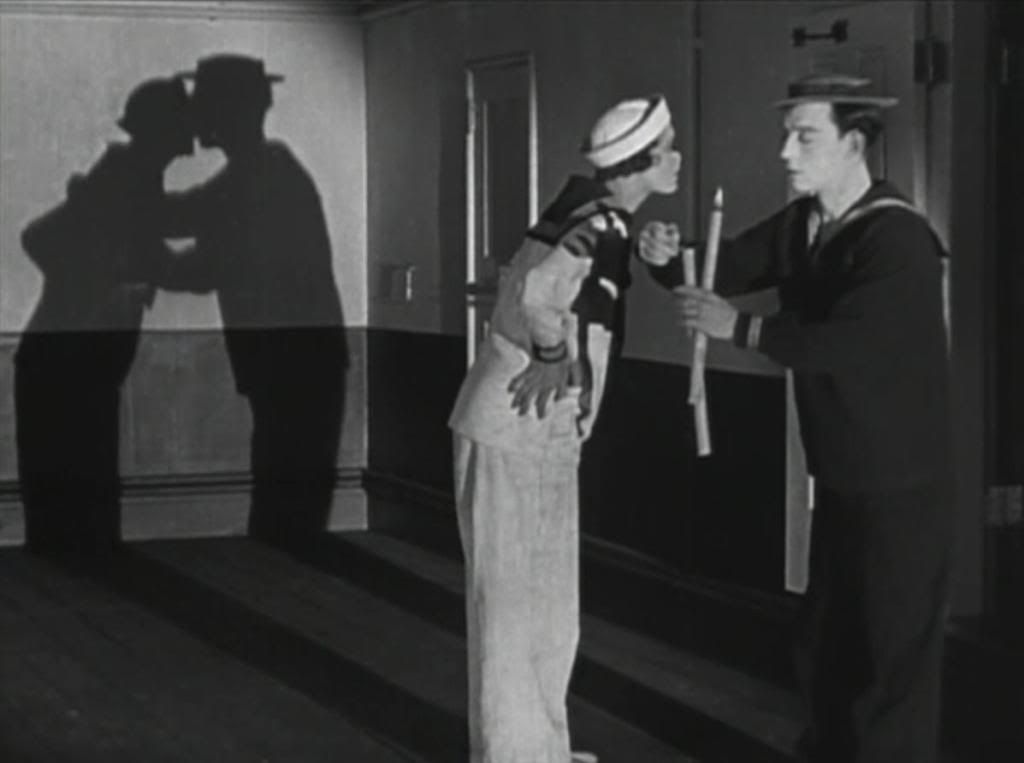
It's unrelentingly hilarious, and it pays off in a big way later in the film when a title card provides an ellipsis of several weeks, after which time the couple have adapted to their circumstances and evolved a whole succession of Rube Goldberg-esque contraptions to perform their morning chores. It's great stuff, with these wealthy, sheltered socialites learning to do things for themselves, to make inventive use of their surroundings. They perform the same tasks that they'd earlier struggled with so comically, now having remade the ship's kitchen in clever ways that demonstrate how they've learned from their mistakes, transforming the place into a complex series of levers and makeshift devices that help them through their morning tasks. They've also found shelter, after the slightly melancholy comedy of the sequence where they'd wandered all around the ship, trying to find a comfortable and safe place to sleep, spooking themselves with fireworks mistaken for candles and a creepy portrait of the ship's captain (co-director Donald Crisp) that Keaton mistakes for a sinister-looking man peering in through a porthole. Keaton's attempts to comfort and help his companion reveal a tenderness and compassion not revealed by his characteristic stoic expression and the deadpan way he'd approached romance earlier in the film. This undercurrent reaches its apex with a wonderful shot in which Keaton and McGuire struggle to light some candles while their shadows seem to kiss on the wall behind them, enacting the romance that they never quite consummate in the flesh.

After all this equally poignant and hilarious build-up, the film's final act is a bit of a letdown, as Keaton and McGuire run into an island full of cannibals and have to fend off the vicious natives. The racial caricatures are unfortunate, but mostly these sequences are disappointing simply because they're not at the same level of formal ingenuity and hilarity as the rest of the film. One exception is the famous scene where Keaton, in a diving suit, goes underwater to repair the ship's hull before the natives can reach them. It's an example of Keaton's physicality and preference for realistic stunts, as he really dives under and enacts a series of pantomime gags, like washing his hands in a bucket and then drying them off with a rag. Best of all is his fight with a pair of swordfish, one of which he wrestles into submission and then starts using its nose to duel with a second, bigger fish that appears. The submarine gag at the very end of the film is also a nice final note, especially the dazzling 360-degree spin in which everyone within the sub struggles to stay upright.

Coming after the viscerally exciting Our Hospitality and the absolutely brilliant Sherlock Jr., The Navigator feels like a bit of a step down for Keaton, but certainly not a big one. Its best gags have the director's characteristic precision and unparalleled sense of space, as well as being side-splittingly funny and thematically resonant. The film's theme is awareness: these sheltered people, locked off in a world of privilege at the beginning of the film, gradually become aware of the necessity of paying attention to the world around them, caring for other people, and working together to survive. By the end, these hapless socialites have become inventive and lively, propelled into constant motion and constantly ingenious use of everything they can lay their hands on. This includes each other, too: in one very suggestive shot, McGuire uses Keaton, in full diving gear, as a boat, straddling him and paddling back to the safety of their ocean liner.

Tuesday, March 20, 2012

Sherlock Jr.


Sherlock Jr. is one of the cinema's greatest tributes to itself, a dazzling, relentlessly inventive ode to the movies as an escape, a source of dreams and a fantastical reflection of the real world. Buster Keaton's five-reel, 45-minute short is crisply, quickly paced, with not a second of waste, not a frame that isn't absolutely essential to the film's hilarious and strangely moving vision of the cinema's magical power. Keaton plays a hapless young movie theater projectionist who's also studying to be a detective and scraping together whatever cash he can get to woo his girlfriend (Kathryn McGuire). When he's framed for the theft of a pocket watch belonging to the girl's father, Keaton tries to catch the real crook (Ward Crane) in a hilarious scene where he shadows the taller man, walking immediately behind him and mimicking his every gesture. When this fails, he returns to the movie theater, dejected, a failure as a detective and miserable over the loss of his girl.

He then falls asleep, and what follows implicitly links the cinema to dreams, as Keaton nods off in the projection booth and has an out-of-body experience, his ghostly doppelganger stepping out of his sleeping form and into the movies. It's a fantastic, and fantastically funny, sequence, as the projectionist imagines the figures on the screen transformed into ones from his real life, enacting a mystery drama derived from his own experience with the purloined watch. Except, in this dream/movie, he can actually be the hero, the world's greatest detective, Sherlock Jr., dapper and sophisticated in a top hat and nice suit, a master intellect who can outwit any criminal. It's pure wish fulfillment, as the young loser imagines that he can catch the crooks and get the girl — and then, in Keaton's master stroke, he wakes from the dream movie into another movie, the movie Keaton's making, and he gets the girl after all.

Before he can get to this point, though, he has to pass through a cinematic gauntlet in which his greatest enemy is not a petty crook but a basic cinematic tool, the edit. Once Keaton steps up onto the movie screen, he's not fully integrated into the film that's playing. He's immune to the cut, so he remains the one constant as the scene changes, which leads to some hilarious visual gags. For a few minutes, the movie on the screen, following absurdist dream logic, ceases to be a coherent drama and starts randomly cutting from one strange locale to another, always with Keaton propelled across the cut into one outrageous situation after another. He balances on the edge of a cliff, runs from hungry lions, almost gets run over by a train and the traffic on a crowded street, and gets soaked by waves while perched on a rock in the middle of a choppy sea. It's both a devilishly clever comic showcase and a lovingly meta ode to the power of this cinematic tool, which can seamlessly bridge such tremendous gaps in location, having Keaton jump into the air to dive into the water but instead land headfirst in a snowbank, his feet kicking in the air.


Keaton's projectionist eventually manages to slip into this cinema dream world, inhabiting the role of the detective, fending off the sinister maneuvers of the crooks who concoct endless death traps that he flawlessly slips around, always intuiting their evil intentions before they can spring the trap. In the movies, the hero always wins, the bad guys always fail, and one senses that this young projectionist, like so many others, was first seized by his desire to be a detective while watching screen detectives much like this one. He inhabits an archetypal role, taking on a character type that had inspired him to try to shape his real life to match the movies, to become a detective like the ones on the screen — but only in dreams or the movies can such archetypes actually exist.

The whole dream sequence is remarkably fun, and occasionally surreal, as when a mysterious cross-dressing vendor helps Keaton evade the crooks by inviting the detective to jump through his chest and somehow flip through a false wall hiding behind the vendor. That's a bit of pure movie magic that doesn't really make a shred of sense; it's a flight of fancy that could only work in the movies. The same goes for the hilarious scene where Keaton leaps through a window in which he'd previously set up a readymade disguise. Jumping through the window, he also jumps through the clothes and lands outside dressed up as an old woman. That transformation is an echo of the one that propelled Keaton into the movie universe in the first place: he passes through a screen and comes out the other side magically changed, the usual rules suspended.

The ending, in which Keaton covertly watches a movie hero to figure out the right gestures to romance his girl, suggests that, though the movies are dreams, they're dreams with tremendous power. Keaton is exploring how we learn to act by watching the movies, how we derive our templates, both romantic and professional, from the things that happen up on the screen. In this way, the movies become, not only dreams, but wellsprings of reality, feeding back into the world models of behavior, the dream influencing and reshaping reality itself.

Tuesday, February 28, 2012

Our Hospitality


Our Hospitality was the second feature Buster Keaton made, and the first that truly told a full feature-length story (the Intolerance parody Three Ages was essentially three shorts combined into a larger structure). This film, set in the early 1800s, is derived from the notorious Hatfield/McCoy feud, depicting the bloody rivalry tearing apart multiple generations of the Canfield and McKay families in the rural South. Keaton, along with co-director John G. Blystone, takes his time setting up the dramatic stakes in a prologue, in which two of the latest male heirs of these two families kill each other in a gun battle, after which the last surviving McKay, then just a baby, is sent to New York to grow up far away from the feud. The film then jumps forward twenty years, as the young McKay (Keaton) returns to the South to claim his inheritance, meets a young woman (Keaton's wife Natalie Talmadge) on the train journey, and realizes only too late that she's actually the daughter of his mortal enemies.

Because of this patient approach to the narrative, the film has a pleasant, easygoing pace as it meanders along, wandering through several different modes: deftly performed physical comedy, romance, and increasingly frenetic action that's balanced somewhere between comic slapstick and genuinely thrilling stunt extravaganzas. The film never quite becomes a manic comedy, because that's not what Keaton's after here, instead balancing the humor with the romantic drama and the carefully researched period detail. Particularly in the first half of the film, Keaton indulges in a lot of low-key humor based on the changes wrought in society since the film's 1830s setting, mocking the then-modern state-of-the-art technology and pointing out just how much progress had been made in the intervening years, to get up to the 1920s cutting edge. (Of course, seeing the film now only exaggerates this dimension of the film, since the modern viewer is even more struck by the rapid pace of change and the technological gap between past and present.)

Early on, an intertitle prepares the viewer for a shot of the New York intersection at Broadway and 42nd Street, then cuts to a dusty view of two crisscrossing dirt roads flanked by small wooden stores and homes, where a traffic pile-up of a peddle-less bicycle (a hilariously awkward conveyance in retrospect) and a horse-and-buggie causes one observer to remark, "this is gettin' to be a dangerous crossin'." Then comes the fantastic train ride, for which Keaton recreated the "Stephenson Rocket," which is basically a very small train of passenger carriages tied together and harnessed to a wood-powered engine, propelled along a shaky and uneven rail line.


The train journey, on which the bumps and mishaps of the primitive train push McKay and the Canfield daughter into intimacy, the girl clinging fearfully to the young man, is a comic masterpiece with one great gag after another. The gentle pacing gives the impression that each joke is carefully calibrated and considered, the gags spaced out, each one methodically developed and thought out. There's little trace of frantic slapstick farce in Keaton's deliberate gags, which have a formal logic and precision that makes them seem almost inevitable. At one point, the train is stopped by a donkey that's stubbornly blocking the way, and after much effort the conductor decides that it's easier to drag the tracks' path a few feet to the right than it is to move the donkey, and he creates the new curved path without fuss. Later, in one of the best gags, a mishap with a track switcher separates the engine from the rest of the train, sending them forking off on parallel paths. Keaton's staging is absolutely brilliant, shooting from directly behind the train so that at first it seems as though nothing has happened until the paths begin curving away from one another and the separation is revealed. In a subsequent shot, the distracted conductor, belatedly realizing that the rest of his train has disappeared, stands up into the foreground of the frame, comically peering all around for the missing cars, which are of course gliding along on the nearby track in the background.

This careful framing and meticulous feel for set-up means that Keaton's comedy never feels truly out of control here, and this even extends to the subsequent Southern sequences, in which McKay courts the lovely young woman he met on the train while her family tries fruitlessly to kill him to fulfill their old debt. McKay evades their attempts, at first accidentally and innocently — coming upon one of the Canfield sons trying to unjam his pistol to shoot McKay, McKay grabs it, gets it to fire, then walks away, thinking he's done a good deed — and then cleverly exploiting the rules of Southern hospitality, since he can't be killed as long as he's a guest in the Canfields' home. This leads to some funny antics with McKay dodging quickly in and out of the house, with the Canfields chasing him and firing at him the moment he sets foot past a threshold.

The film's epic finale is its real highlight, though, less comedic than truly action-packed, as McKay flees one of the Canfield sons across a steep rock face, down into a roaring river, briefly crossing paths with yet another train, before tumbling towards a waterfall for the climactic set piece in which McKay teeters on the edge of the deadly falls, trying to untangle himself from a rope in time to rescue his beloved, who's also drifting towards the precipice. Keaton performed all the stunts himself, and proves himself as adept an action hero as he is a comedian; his daring rope swing to grab the girl just as she falls off the waterfall is breathtaking. Keaton, with his mild-mannered, slightly sharp-edge face, is so unassuming that his physicality is stunning, eliciting equal amounts of shocked laughs and gasps of awe. Our Hospitality is a fantastic showcase for his many talents, both in front of and behind the camera.