Showing posts with label Ernst Lubitsch. Show all posts

Monday, September 3, 2012

Die Puppe


Ernst Lubitsch's Die Puppe is a delightfully kinky and absurd silent fantasia, a charming artifact of the master director's tenure in the German film industry before his emigration to Hollywood. Fast-paced and funny, it's a brilliant farce, a madcap and surreal confection that's a pleasure from start to finish. It's a celebration of artificiality and theatricality that opens with Lubitsch himself introducing the film by setting up a cardboard diorama, suggesting that he's about to act out a kind of cinematic puppet show.

Indeed, that's an appropriate reference point for a film that consistently deals with the slipping boundaries between the real and the artificial. This story of a girl mistaken for a doll takes place against a backdrop of blatantly cardboard sets, these flimsy-looking surroundings adding to the atmosphere of a strange fantasy, a children's puppet show with an adult theme. Lancelot (Hermann Thimig) is a fey and painfully shy young man who happens to be the only heir of his uncle, a wealthy baron (Max Kronert) who wants Lancelot to get married so that their line will carry on. The problem is that Lancelot is terrified of women, as evidenced by the comic chase sequence that results when a crowd of forty women come looking for the heir, pursuing him in their fever for such a prestigious marriage. Lancelot manages to escape to a monastery where he hides out, until his uncle puts out a newspaper ad promising a big dowry for Lancelot if he returns and gets married.

The greedy, corrupt monks concoct a clever and ridiculous plan: Lancelot will pretend to marry a life-like doll, get the money, and bring it back to the monastery. The only problem is that the doll, a perfect likeness of the dollmaker's daughter Ossi (Ossi Oswalda), is broken and replaced by the real girl, who pretends to be a doll while Lancelot carts her off for the fake wedding. What ensues is an utterly lunatic farce packed with naughty gags and innuendos. Oswalda delivers a delightful performance as the girl playing a doll, her face agilely contorting into gleeful grins and eye-rolling expressions of disdain whenever her hapless new husband isn't looking. She's clearly enjoying her ruse, and the wedding scene especially is packed with charming moments, as whenever Lancelot's back is turned, Ossi — who as a doll isn't getting any food or drink — grabs glasses of champagne to swig and gobbles down any food on the plates he leaves unattended.
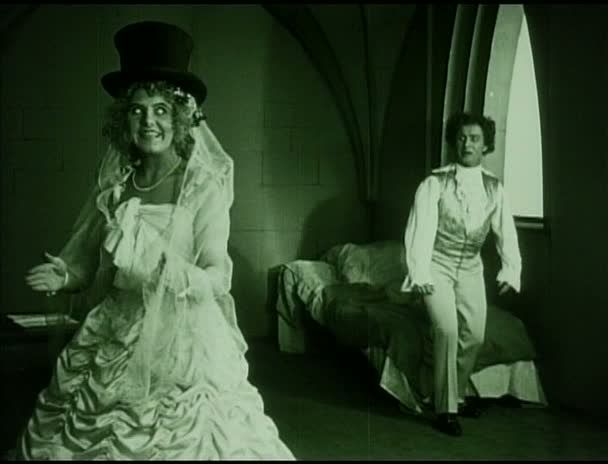

There's also plenty of sexual subtext here. Lancelot's fear of women is absurd and caricatured, as he runs in terror from the hordes of women who desire him. He's so skittish that he even flinches away from the chorus line of dolls who dance and pose for him in the dollmaker's shop; when the dolls kick up their legs, he buries his head in his arms, crying that it's too risque. He's assiduously proper to the point of repression, and it's only with what he thinks is a fake woman — and a better-behaved one than those bold dancers — that he can get used to the idea of spending time with a woman. Lubitsch plays up the naughty subtext of this "doll" seducing and toying with the man: he starts to undress her and she resists, miming that she can dress herself, and later he undresses in front of her, using her extended arms as a coat rack, much to her annoyance. For Lancelot, marriage makes him quake in terror, and he enters into it in the most unromantic fashion. He buys his wife — with the understanding that he'll be paid back and then some for marrying her, making marriage a transaction twice over.

Lubitsch surrounds this sexual farce with a toy box aesthetic that enforces the essential unreality of the whole affair. A paper moon hangs in the sky at night, its frown turning to a grin when it sees the doll kiss the man. Lancelot rides his bride to their wedding in a carriage drawn, hilariously, by some of the most unconvincing fake horses ever imagined, obviously consisting of a pair of men inside a costume, with their legs sticking out of the cloth. As the coach driver prepares to depart, he notices that one of these "horses" has lost its tail, and without fuss he stoops down, picks it up, and reattaches it. It's a wonderful little moment that would break the film's fourth wall if there were really any to break in the first place, and it's also a sign of the lightness and playfulness of Lubitsch's approach. He lets all of the film's seams show, especially in its elaborate painted sets — every bit as stylized and expressionist as the next year's The Cabinet of Dr. Caligari, albeit in a very different way.

Die Puppe suggests just how early in Lubitsch's career the director's brilliant comedic sensibility was developed. Clever, witty, and sophisticated, this is pure Lubitsch, a delightfully fluffy and fun comedy with a bit of a wicked edge to its sugary aesthetic.

Wednesday, October 19, 2011

Films I Love #55: The Shop Around the Corner (Ernst Lubitsch, 1940)


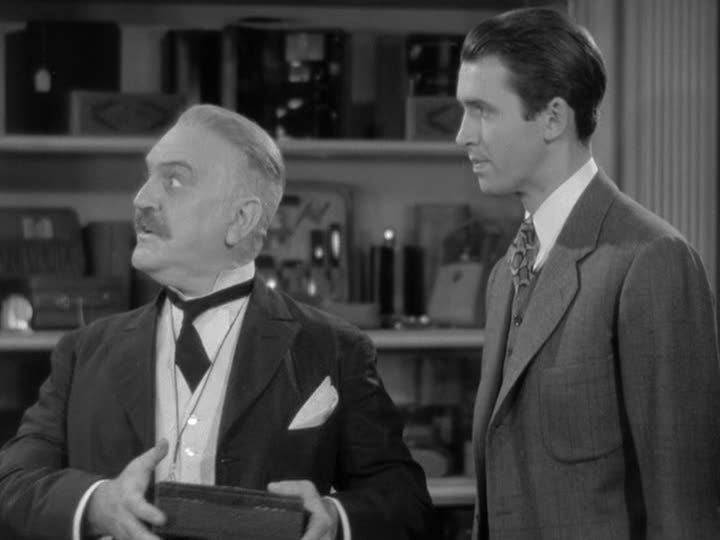
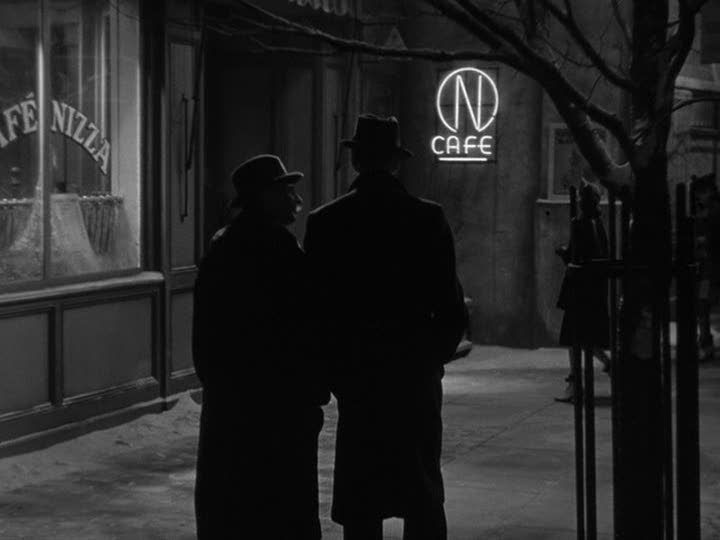
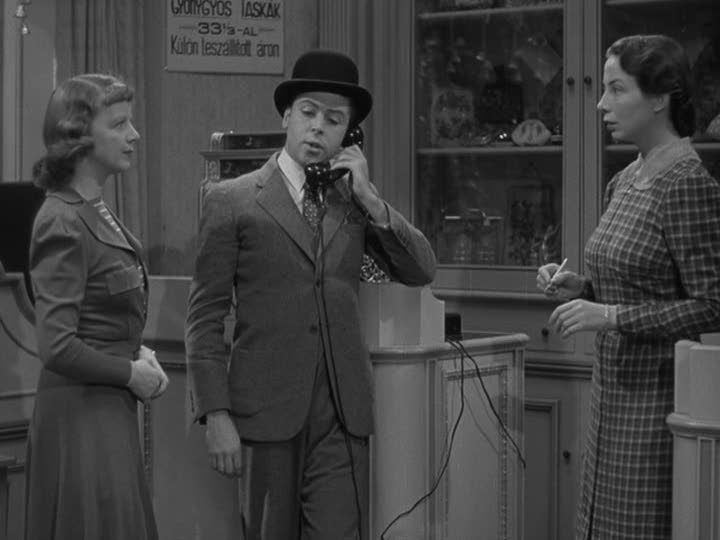
Ernst Lubitsch's The Shop Around the Corner is a rich, moving love story, a very warm film despite its snowy Christmastime setting. Although the film is focused on the antagonism of the store manager Kralik (James Stewart) and new employee Klara (Margaret Sullivan) — and of course, their eventual and inevitable realization of love for one another — in many ways it's more about everything that happens around this slowly developing romance. The film is set in a small shop in Budapest, and the texture of this shop, the daily business of the workers who gather outside every day for friendly chit-chat, is the real matter of the film. The characters are well-defined but not quirky, with just hints of low-key exaggeration lending some humorous edge to the anxious, sputtering Pirovitch (Felix Bressart) and the smart-alecky errand boy Pepi (William Tracy), who really comes into his own with a chest-swelled swagger when he gets promoted to salesman. The film's humor is gentle and quiet, with not a hint of mean-spirited mockery except, perhaps, in its portrayal of Kralik's foppish rival Vadas (Joseph Schildkraut). The film continually belies the idea that humor must be edgy or aggressive in order to be genuinely funny, as Lubitsch earns smiles, chuckles and occasionally even full-throated guffaws from his careful development of these characters and their minor foibles.

What's especially striking about the film's humor is the vein of real, deep sadness that runs through the center of it. There's a sense of loneliness in both Kralik and Karla, who separately believe they've found love in the form of someone they've never even met face-to-face, someone they've only corresponded with through letters. There's more than a hint of desperation in both characters: they invest so much into their romance-by-pen, as though it represents the last chance they each have for happiness or romance. In the process, they don't realize that the object of their love is right in front of them every day, that their relationship consists of sparring angrily by day and writing loving, romantic letters to one another by night. As such, the film is about the ideal of love as contrasted against the more prosaic but also more tangible reality: it's telling that before Kralik can reveal himself to Karla, he must adjust her expectations downward by shattering the fantasy of the letters, preparing her not only for the revelation that he's her great love, but that her great love is only a flesh-and-blood man after all. Lubitsch also has a wonderful feel for the anxieties of money, for the pressures of the working class life and the fear of losing a job, and the film makes great use of the Christmas setting for its subtle commentary on consumerism and salesmanship. It's a beautiful, funny, emotionally complex masterpiece with so much heart, so much beauty, in every image and every line that, despite its modest, unassuming surface, it winds up being an almost overwhelming experience.


Tuesday, September 1, 2009

To Be Or Not To Be


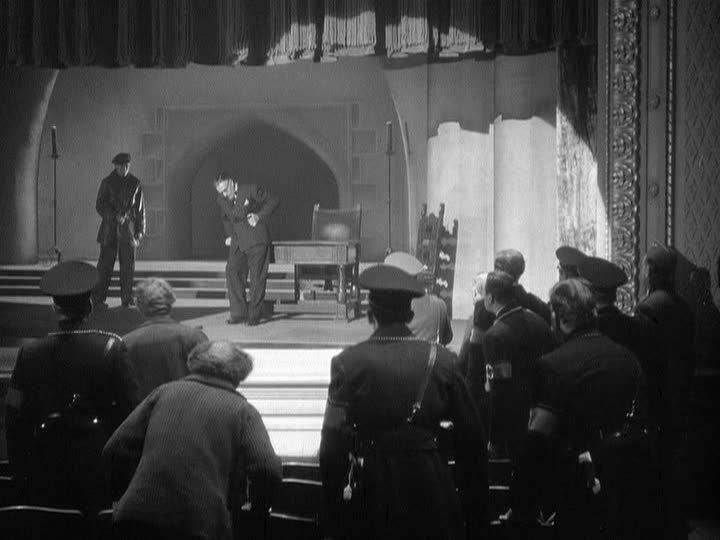
It's an irreverent, silly, lightweight World War II comedy/thriller that plays fast and loose with historical facts, including having some fun at Hitler's expense, with a grand climax at a theater, where actors mingle among the Nazi elites. And no, it's not Quentin Tarantino's Inglourious Basterds. (Though, as promised, more on that tomorrow at The House Next Door.) It's Ernst Lubitsch's To Be Or Not To Be, released in 1942, just shortly after the US finally entered World War II. It's an interesting film, mixing elements of drama and thriller plotting with lightly comic sexual wordplay and dark-edged satire. The film centers around the Polish underground resistance during the Nazi occupation, particularly the actors in a theatrical troupe who get mixed up in a plot to prevent a Nazi spy from delivering information to the gestapo. The Polish bomber pilot Sobinski (Robert Stack) returns to Warsaw on the trail of Professor Siletsky (Stanley Ridges), who is supposed to be working with the Polish resistance but instead plans to turn everything he knows over to the Nazis. In order to prevent this, Sobinski reunites with some friends back in Warsaw — or more accurately, one friend, the famed theater actress Maria Tura (Carole Lombard), and her jealous actor husband Joseph (Jack Benny), who suspects, perhaps rightly, that his wife was having an affair with the young Sobinski.

These melodramatics are pushed aside, of course, in order to foil Siletsky's planned rendezvous with the Germans, and that's when the fun really starts. The film opens slowly, particularly when dealing with the possible romance between Sobinski and Maria. These scenes, set immediately preceding the Nazi invasion of Poland, establish the characters at the theater: the domineering director Dobosh (Charles Halton), the hammy Rawitch (Lionel Atwill), the earnest Greenberg (Felix Bressart), who was born to play Shylock, and the sidelined Bronski (Tom Dugan), who doesn't even get a big break when he's asked to play Hitler in a forthcoming play. His ad-libbed line, "Heil me," does indeed, as Greenberg says, get a big laugh, though Dobosh won't allow such innovations from the lowly actors. In any event, the Hitler play gets put off by the arrival of the real Germans, and the film's uneven pacing finally begins to kick into high gear once Sobinski arrives back in Warsaw. Lubitsch skims over the details of his arrival and various escapes from the Germans, eliding much and skipping straight ahead to the sight of the young soldier sleeping in Maria's bed. This in turn leads into a complicated and very funny three-way exchange of wits between Maria and Sobinski, who are trying to halt a spy plot, and Joseph, who can't get past the fact that there's a young man in his wife's bed.

The arrival of the young man in question gets Maria and Joseph, along with the rest of the actors, embroiled in a plot to stop Siletsky and destroy all the evidence he planned to hand over to the Germans. From this point on, the film is a delight as Lubitsch revels in the deceit and disguises and elaborate performances within performances: no one is who they seem, everyone's playing a part, and life frequently imitates art. At one point, Joseph poses as a Nazi officer for Siletsky, and later finds himself in the exact opposite position, playing Siletsky in front of the real Nazi officer he'd imitated earlier. He's gratified to find that the real officer is using some of his own lines: "yes, that's how I thought you'd react," he says after the officer unknowingly repeats one of Joseph's own ad-libs, and the officer misses the hidden double meaning, the satisfaction of an actor who realizes he'd played his part well. Moreover, the officer repeats a joke that was told earlier in the Hitler comedy the theater troupe had been planning to put on, and Joseph naturally falls into the rhythms of the scene, letting it play out the way it had in the script.


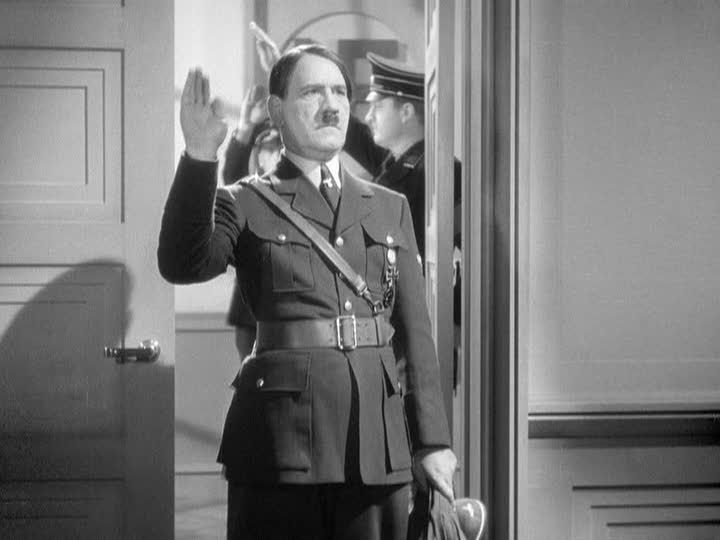
This kind of joking interplay between reality and art reaches its peak at the climax, an absurd farce in which Bronski's turn as Hitler comes in handy, and a couple of actors get to lead around an SS troupe, blithely commandeering an enemy plane for themselves. Even better is the moment when Bronski, still disguised as Hitler, sneaks into an apartment, confusing a Nazi officer who thinks the Fuhrer is here for a secret tryst. These confusions and missed meanings proliferate throughout the film, in which dual identities and fake beards are everywhere, so much so that Rawitch's line as a fake Nazi officer — "What do you have to say for yourself? Here is a man with a beard and you didn't even pull it?" — actually makes a weird kind of sense. It's great fun, but always tinged with an element of dark humor, and an acknowledgment of the genuine horror of the Nazis. Sig Ruman and Henry Victor, as a pair of bumbling Nazis, are cartoonish but also casually evil, reporting on shootings with a smug satisfaction; their tone implies, "of course we shot him." Lubitsch treats them as ridiculous, and pathetic, completely blind to their own evil. Ruman's Nazi colonel is fascinated by the Fuhrer as though Hitler was a glamorous celebrity, and he eagerly awaits anecdotes about his leader, basking in the presence of someone who's even met the great man. Lubitsch makes these characters absurd, but no less dangerous for it — they're cruel and stupid in roughly equal measures.

Siletsky, on the other hand, is not so stupid, though he is perhaps just as easily fooled by the disguises and guile of actors. He's also of course easily seduced by a pretty face, and Maria allows herself to be wooed by him at one point, woozily slurring "heil Hitler" after being kissed, as though his affection had changed her affiliations. The film all works on cartoon logic like this, and at its best it has a kind of Looney Tunes energy, as in Joseph's uncomprehending double takes upon finding Sobinski in his wife's bed. There's also of course much wit in the sexual double entendres of the script. In one of the best, Siletsky asks Maria, "should we drink to a blitzkrieg?" Her retort, delivered with a deadpan purr and a raised eyebrow: "I prefer a slow encirclement."

To Be Or Not To Be is a charming, sophisticated black comedy, one which simultaneously mocks the Nazi enemy and exposes the ugliness of the situation, the terrible things done by these ludicrous cartoons (there's a montage of Nazi street signs early on, promising multiple varieties of horrible death for various minor infractions). The film is far from perfect, and gets bogged down in its first half-hour by routine melodramatics and the boring performance of Stack as the would-be young lover. It's also marred by the periodic appearance of an overbearing "stirring" voiceover, which thankfully disappears once the main story starts coming together. A more basic problem is the inconsistent accents and the fact that Germans and Polish alike are all speaking English. This is to be expected, of course, in a Hollywood film of the time, but it's always distracting in films like this, especially ones where the differences between languages are so crucial to the plot. One inevitably wonders how the Poles keep posing as German soldiers so convincingly. The accents, some of them theatrically British and some of them more authentically eastern European, are a further distraction.

Even so, within this context Benny and Lombard deliver fine comedic performances, broad and delightfully hammy, particularly in the scenes where Maria has to convince her husband that he's a fine actor before each performance. These scenes are hilarious because it's so obvious that Maria is acting, that this is a routine and that there's no real feeling in all their melodramatic spats and tearful reunions. They're characters who, as with Lombard's earlier, similar turn opposite John Barrymore in Twentieth Century, are always acting. The film doesn't always hold together, and its nonsensical plot is just the flimsiest of excuses on which to hang its comic set pieces. But it is a weird and low-key delight all the same.