Showing posts with label French cinema. Show all posts

Monday, May 6, 2013

Inspector Bellamy


Claude Chabrol's final film, Inspector Bellamy, begins with a dedication and ends with a quote, and in between is one of the French master's most confounding, beguiling and deeply personal films, a morally engaged and somehow almost spiritual study of guilt, blame, and what it means to be "a decent guy." The film's opening dedication is to the "memory of the two Georges," meaning the mystery writer Georges Simenon, whose novels Chabrol has adapted before and whose famous Commissaire Maigret is one obvious inspiration for this film's title character, and Georges Brassens, the singer/songwriter whose music and gravesite haunt this film. The quote at the end is even more telling, a terse sign-off provided by W.H. Auden — "there is always another story, there is more than meets the eye" — that serves as a goodbye and a final statement of purpose from Chabrol himself.

The film is an ambling, lazily paced, darkly comic anti-thriller in which the vacationing famous detective Paul Bellamy (Gérard Depardieu), in the country with his wife Françoise (Marie Bunel), stumbles into a strange mystery. A former insurance agent, Leullet (Jacques Gamblin), contacts Bellamy, eager to confess that he killed a man — actually, that he wanted to kill a man, but it turned out that the man (a bum also played by Gamblin) wanted to die, so he simply allowed the bum to commit suicide. Now it's a high profile case, all over the news, but while the police (including a bumbling inspector who's much discussed but never seen) are busily hunting down Leullet, Bellamy quietly, casually investigates on his own, in his free time, between dinners with his wife and their gay friends and arguments with his resentful, no-good drunkard of a half-brother, Jacques (Clovis Cornillac).


The Leullet case is full of twists and turns and red herrings, and there's a mostly unspoken suggestion, buttressed by that Auden quote, that there's one more devilishly clever twist hidden within the film, eluding even the dogged Inspector Bellamy. Despite this, the film is not really a mystery or a thriller but a character study, using the Leullet case and Bellamy's deceptively casual pursuit of the facts to probe the character of this seemingly likable bear of a man. Depardieu, always something of a big lug, has aged into a veritable mountain, lumbering across the screen, out of breath after ascending a flight of stairs — at times he seems to be collaborating in Chabrol's gentle mockery of the actor's bulk, though he also has a sense of dignity and self-assurance that prevents the film from ever seeming mean-spirited at his expense.

Bellamy, the character, is also dignified and self-assured, or at least he seems to be, though there are periodic cracks in his friendly surface façade. He's haunted by something, some mystery hidden behind his broad, amiable face and his charmingly dogged investigative methods. There are intimations that he has at times been a drunk like his brother, and Jacques' presence causes him to reach for the bottle more frequently again. He's constantly battling with Jacques, although moments later the two very different men — bulky, aging Paul and squat, muscular young Jacques — will laugh, with only traces of bitterness, over some shared and unspoken inside joke. There's also tremendous tension with Françoise, who's sending very mixed signals: she's openly contemptuous of Jacques while urging her husband to be nicer to his brother, and in private moments there's a taut sexual chemistry between Jacques and Françoise that may or may not be a sign of an actual affair. Certainly, the lithe, maturely sexy Françoise is an awkward match for her husband, and his constant affectionate pawing of her body is deliberately silly-looking, though she mostly doesn't seem to mind.


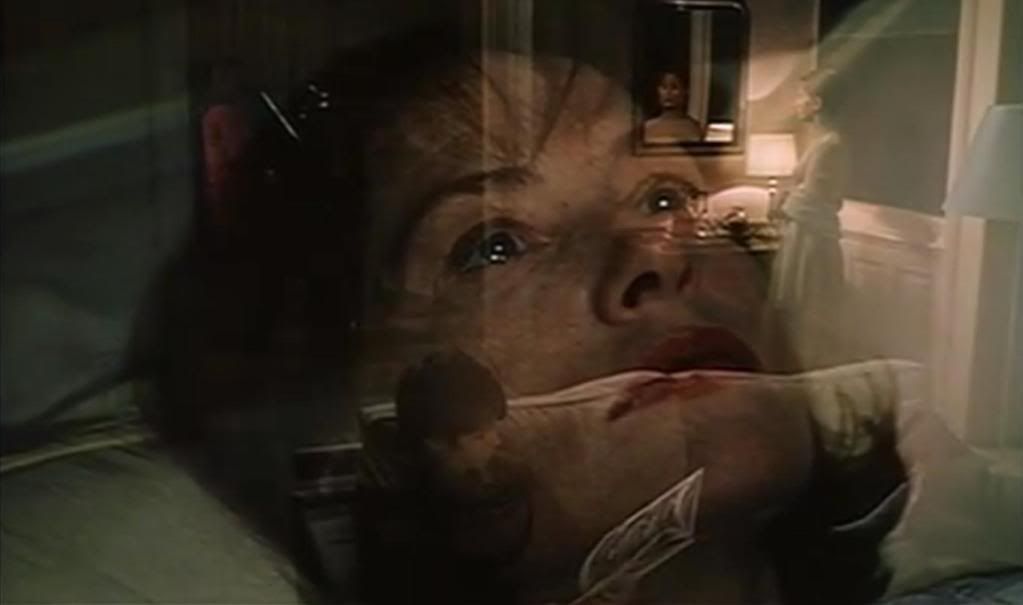
Much as Bellamy hides darker emotions behind a benign exterior, Chabrol's film is about anything but what it seems to be about on its surface. The inspector's involvement in the Leullet case stirs up something in Bellamy regarding his fractious relationship with his self-destructive brother. It's no mistake that the film's first shot and its last shot are mirror images of one another, linking Bellamy's policework with his private, personal traumas. The film is packed with doubles and mirrors, and Bellamy begins seeing himself in his suspect. At one point, the inspector wakes up screaming in the middle of the night, yelling out, "I'm a bastard." Moments later, Chabrol cuts to the inspector (initially blurry, until the image snaps into focus) listening to Leullet say the same thing, but it doesn't seem to be a flashback — the possible murderer is echoing the cop, rather than the other way around, suggesting that Bellamy's not just haunted by his case, but has some guilt of his own weighing on him. Later, that formulation is reversed when Leullet's insistence that he wants to be "a decent guy" prompts Bellamy to ask his wife if he's a decent guy, his uncertainty very obvious. Of course, he's looking in a mirror as he asks the question.

Bellamy is a sharp detective, but not necessarily in his private life. In one great scene, right as he says, "because I happen to face reality from time to time," he stumbles unseeingly towards an open manhole cover and nearly falls in, a strikingly obvious authorial intrusion that contradicts Bellamy's self-assurance, his conviction in his own decency. He's not facing reality; he doesn't even see what's right in front of him, and only his wife stops him from falling into the hole. The symbolism is crushingly obvious, and would seem heavy-handed if not for the dark humor with which Chabrol skewers this big lug's obliviousness.


Implicit in the film is the weight of guilt, and the difficulty of facing death, whether one's own or a loved one's. Death threads through the film right from the opening credits sequence, which weaves through a graveyard — with someone whistling a Brassens tune, off-camera, another clue to unraveling the Laullet mystery — before nudging off a nearby cliffside to take in a car wreck and the grisly, burnt body next to it. The film's final shot mirrors this one with another car wreck before panning up and away to gaze wistfully at the horizon instead, a simple final shot that takes on special significance as the last image of Chabrol's career.

All of this adds up to a typically dense and complex film that might just be the best film of the director's final decade. Witty, twisty, and deceptively casual in its plotting, beneath its surface, Inspector Bellamy is emotionally bracing and morally inquisitive, as surprisingly layered at its protagonist. "There is more than meets the eye," indeed.

Monday, April 22, 2013

The Night of the Hunted


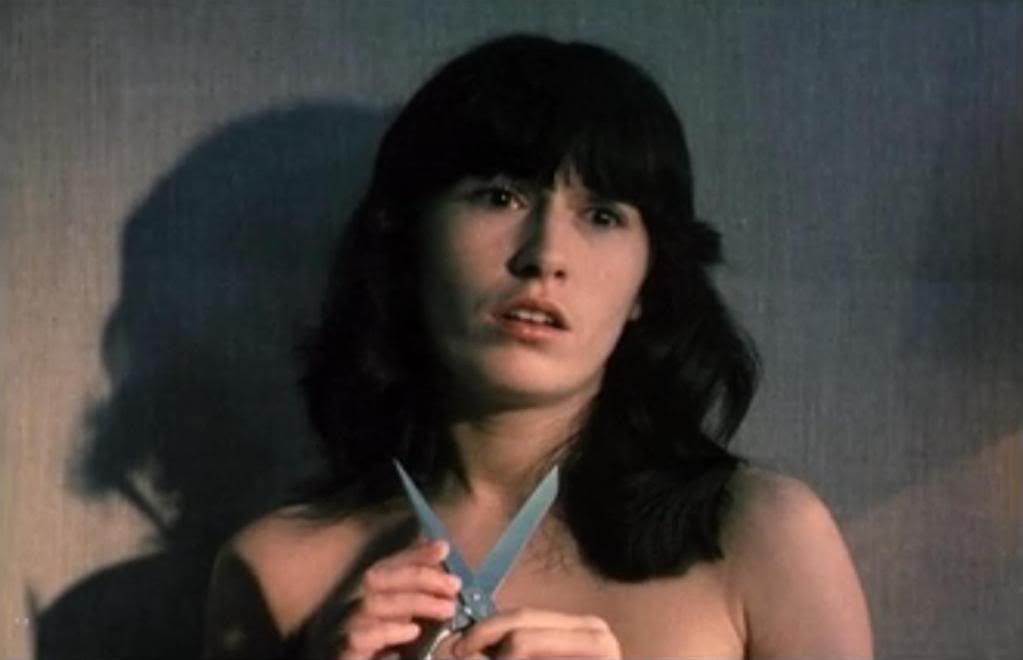
Jean Rollin's The Night of the Hunted is a typically moody, abstractly haunting film from the idiosyncratic horror auteur. More even than most of his work, this film dispenses with any actual concrete horror in favor of a vague sense of disquiet that's almost entirely psychological and mental. This is a haunting study of the nature of memory and its linkage to identity and human consciousness, and the fear here arises almost entirely from the loss of memory, from the feeling of one's sense of self slipping away with one's memory. It's about fear of the loss of self, making this an entirely existential horror film.

The film opens in the fashion of Robert Aldrich's Kiss Me Deadly: a young woman (Brigitte Lahaie), dressed only in a filmy nightie, runs out of the dark forest one night and into the path of a car driven by Robert (Alain Duclos). She tells him that her name is Elisabeth, and she's running in terror of something, but she doesn't remember what — moments later, she doesn't even remember that her name is Elisabeth. Her memories keep slipping away from her; it's not just amnesia, but the slippage of even short-term memory, so that if Robert were to be out of her sight for just a few minutes she'd forget him too. Naturally, she clings to him desperately, and he takes this confused, frightened girl back to his apartment, where he comforts her and they soon have sex, in a scene of cheesy, gratuitous softcore of the kind that Rollin almost always slotted into his films, and yet here the sex is tinged with desperation and a genuine thirst for connection. Elisabeth lives only in the present moment, she says, and she clings to each moment like a precious raft in a sea of nothingness, because each present moment is all she has to hang onto. She urges him on, demanding that he stay with her, that he not let her forget; her intense desire for a memory to cling to makes what could otherwise have been a rote, porny sex scene surprisingly poignant, both passionate and deeply sad.

Apparently, though, this whole situation doesn't leave enough of an impression on Robert, who, hapless as most male Rollin heroes, soon goes off to work, leaving Elisabeth alone to forget him, and herself, all over again. She's quickly found by the doctors she'd apparently been fleeing at the beginning of the film, and they take her to an apartment building that houses other patients, like her, whose memories are continually erased. Most of Rollin's previous work was set in the majestically ruined countryside, in crumbling ancient castles and disused graveyards, but The Night of the Hunted is an urban film, with a very different aesthetic. Rollin's haunted rural castles and fields had always been both creepy and beautiful, mingling fear and foreboding with the strange allure of death and the supernatural. In this film, though, the sinisterly blank apartment towers and concrete wastelands of the city are merely creepy, the building's surfaces and interiors as blank as the minds of the inhabitants. The building, obviously an abandoned office tower, is nearly undecorated, its walls stark white or black, and the patients, with their missing memories, wander aimlessly through these blank, sterile spaces, the austerity of their surroundings reflecting the emptiness of their lives.
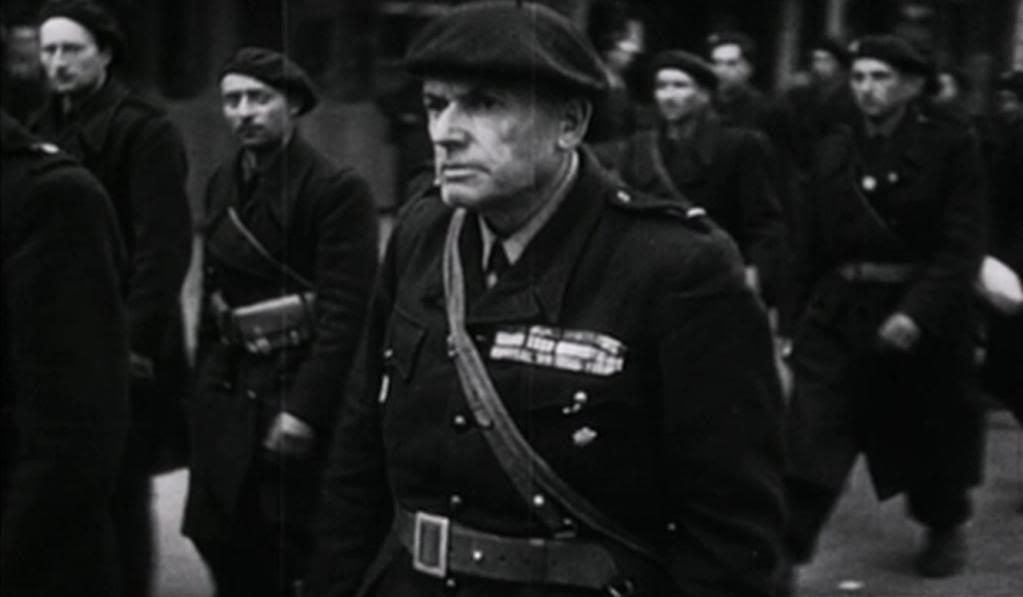

It's a haunting, disturbingly poetic film, especially in its first half, before a series of pointless sex scenes and pseudo-scientific exposition dumps disrupt the poetic vibe. At the apartment, Elisabeth meets two other women who are afflicted as she is: Catherine (Cathy Stewart), whose memory is so bad that she can't even remember how to eat, and Véronique (Dominique Journet), who Elisabeth seems to vaguely remember from her previous life. The scenes between these women are evocative and poignant, as they struggle from moment to moment to remember something, to hold onto some memory, some experience, some person who means something to them. They invent stories and memories for each other. Catherine and Elisabeth pretend that they were childhood friends, though like everything else that game too soon slips away from them. Later, they encounter a woman who's constantly searching for her lost child: she remembers, or thinks she remembers, that she once had a child, but not the child's name or even its gender.

Rollin is delving into the nature of memory and what it means to the construction of one's identity: without memory these people are nothing, no one, barely even alive, their very selves erased along with their pasts. These scenes are deeply emotional, infused with tenderness and sadness, the film's opening already forgotten because these mysteriously afflicted people truly live exclusively in the present tense. In her previous collaborations with Rollin, The Grapes of Death and Fascination, Lehaie, who started her career as a porn actress, projected a fierce carnality, a feral, sexualized violence that made her the ultimate femme fatale. She seems like almost a different actress here, her intensity transmuted into vulnerability, melancholy, a sense of loss that seems to infuse her every gesture, her every fragile, innocent expression.

The film falls apart a bit at around the halfway point, replacing this moody exploration of loss and mental anguish with a number of gratuitous scenes of violence-tinged eroticism, which seem to have come from an entirely different film. Robert also returns towards the end, and the plot is needlessly explained in multiple exposition-laden speeches delivered by the sinister doctor. But the film's final image, which compares the memory-less Elisabeth to the shambling walking dead of a zombie film, provides an effective, eerily romantic finale for a strange, and strangely affecting, film. The Night of the Hunted is ultimately uneven and flawed, only sporadically delivering on its promise and its evocative study of memory and identity. At its best, though, the film achieves the haunting quality of Rollin's other films without any of the supernatural or horror elements that generally characterized his other work.

Monday, April 15, 2013

Comedy of Power


Claude Chabrol's Comedy of Power is somewhat ironically titled, and knowingly so, because there's little that's funny about this deadpan chronicle of an investigation into the abuses of various politically connected businessmen and corrupt politicians. The film opens, disingenuously, with the usual disclaimer about the film's fictional nature, any resemblance to real people being a coincidence, and so on, when of course this film is thoroughly grounded in real world analogues. These corrupt businessmen are extremely recognizable from any number of real scandals, these men (always men, of course) who line their pockets, lavish company funds on their mistresses, funnel money off into foreign bank accounts, dodge taxes and bribe anyone who could potentially stand in their way.

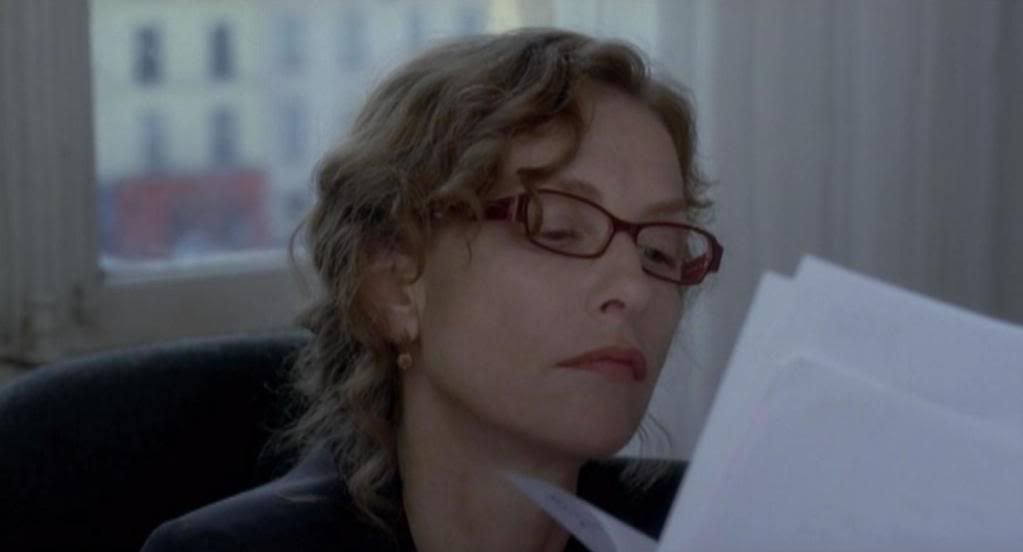
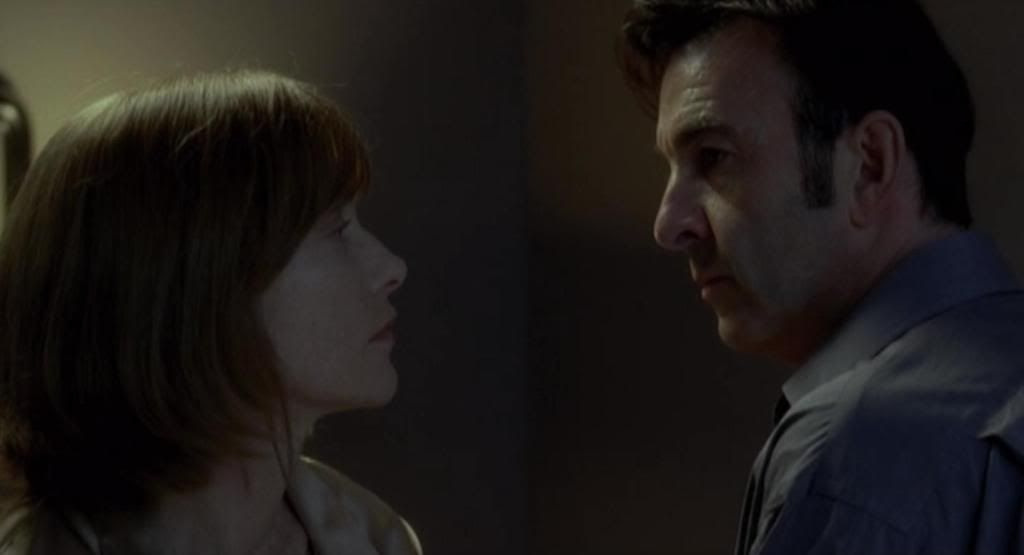
Investigating one of these scandals is Jeanne Charmant-Killman (Isabelle Huppert), a powerful judge who deposes various high-ranking corporate officers and political functionaries in an effort to trace a web of corruption and graft through the chambers of power, as high and as far as it goes. She starts with Humeau (François Berléand), the former chairman of a politically connected organization that operates in foreign countries, and she begins working up from him to more important figures in what seems to be a tremendous network of rich, powerful men. The film is very simple in form, consisting mostly of a series of conversations between Jeanne and her subjects, shot in intimate closeups that capture her brisk efficiency and their nervous, almost self-consciously boyish embarrassment at getting caught. Humeau is a mess, constantly scratching at his nervous skin condition, leaving splotchy red marks on his face as he withers under Jeanne's relentless questioning. Later, the smoother Boldi (Jean-François Balmer) confesses, chuckling shyly, that he's not used to squealing.


All these good old boys, these powerful men with their expensive lifestyles and mistresses and palatial homes, are being brought down and humbled by a petite, unassuming woman. As in many of Chabrol's late films, he's dealing with female archetypes and clichés: the victim (A Girl Cut In Two), the femme fatale (The Bridesmaid) and, here, the frigid career woman. Jeanne is a wiry bundle of nervous energy, seldom sleeping through the night, always getting up to check on some facts or think about her work. Her husband (Robin Renucci) is quietly detached from her, their marriage passionless. During interviews at work, she projects smug professionalism, asking sarcastically loaded questions and flashing quick, strained smiles that convey anything but mirth.

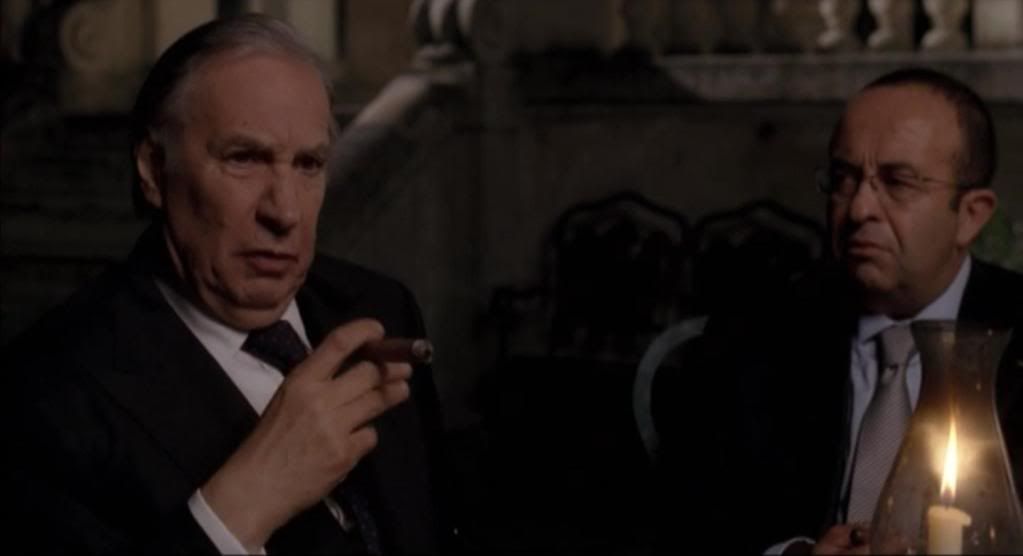
Jeanne is a bit of a stereotype, the cooly ambitious ladder-climbing bitch, but then the men she's opposing are every bit as stereotyped, because Chabrol is deconstructing this familiar male/female power dynamic, examining the ways in which male power is assumed and engrained in the very structure of society, while female power like Jeanne's is more ephemeral, requiring constant hard work to maintain, demanding every moment of her attention, and even then it can be taken away without warning at any time because she's not truly in power. The real power brokers meet in office suites with majestic views, smoking huge cigars, discussing their next move while Chabrol playfully accompanies their chats with outrageously sinister music, telegraphing their status as stereotypical big business movie villains.


Throughout the film, no matter how far Jeanne digs into these conspiracies and scandals, the business goes on as usual, the real powers untouched as the underlings and public figures take the fall and are seamlessly replaced by new, equally malleable figureheads. Towards the end of the film, these fat cats meet to analyze the damage done to their work by Jeanne's investigation and arrests, and they merely conclude, "the system held up well," that the overall structure remains intact no matter how many pawns are taken. Chabrol is powerfully conveying a sense of the fruitlessness of fighting against this kind of power from within: Jeanne dedicates her life to her work, to her sense of justice and her pride in her own competence, sacrificing private and familial happiness in the process, but what she ultimately accomplishes is a flashy show that does nothing to get to the core of the problem.

The real issue is international, and involves Western governments and businesses meddling in the Third World, as hinted at in the scene where several of these men meet with an African leader. Considering the real global stakes and the governmentally sanctioned exploitation of, as Jeanne says, countries where people routinely die of curable diseases, Jeanne's exposé of businessmen with mistresses and personal extravagances charged to corporate credit cards begins to seem petty and beside the point. If this is a "comedy of power," then the joke is on Jeanne, and it's probably being told in a smoke-filled private club by one of these untouchably powerful men.

Monday, March 4, 2013

The Bridesmaid


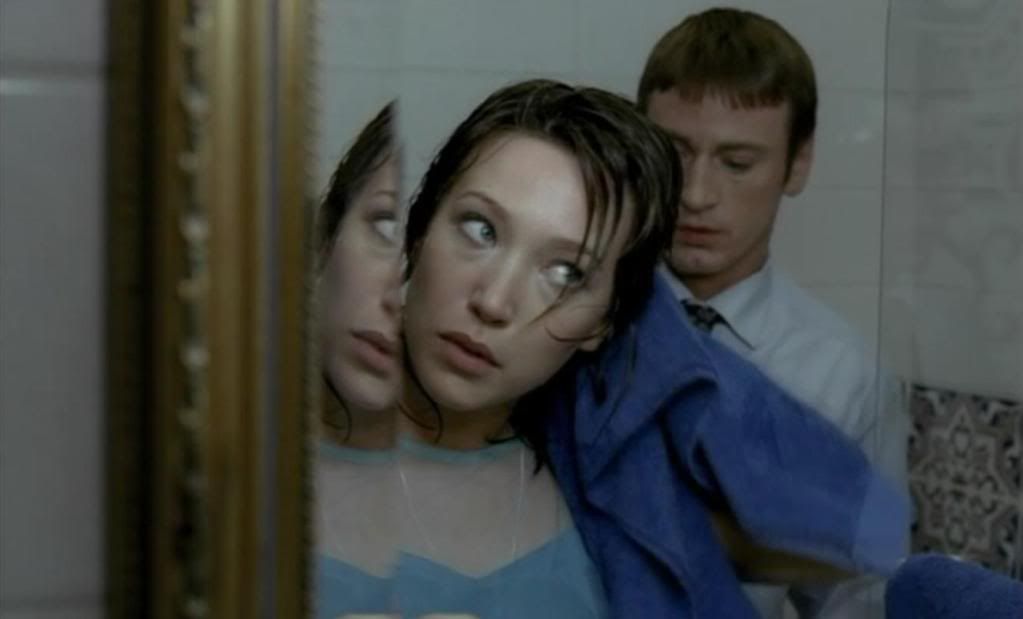
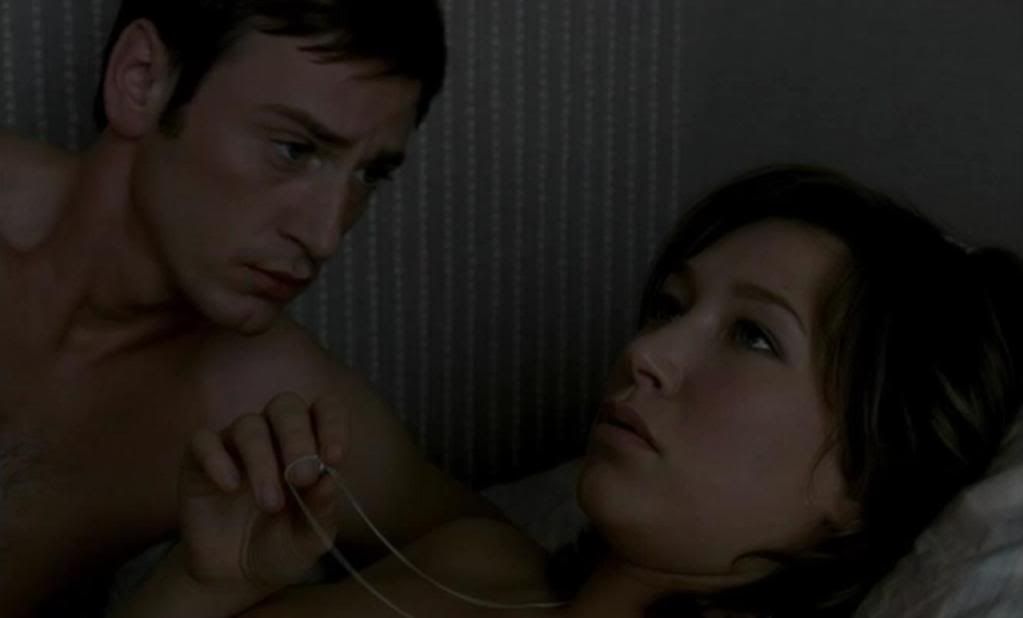
The Bridesmaid is a somewhat typical film for Claude Chabrol, a chilly, unsettling, at times darkly humorous movie that's nominally a thriller but doesn't put much emphasis at all on plot or mystery or even suspense. Philippe (Benoît Magimel) is a serious young man who falls in love with Senta (Laura Smet), a bridesmaid at his sister's wedding, a cousin of the groom. Senta, unfortunately, turns out to be utterly crazy, a lunatic femme fatale who says that the couple are fated to be together, and whose declarations of love are from the very beginning tinged with more than a hint of obsession. Philippe, who must be somewhat crazy himself, just can't stay away, even when she demands that he kill for her, and he keeps convincing himself that her crazier moments are playful performances — she's an actress, she says, who's had roles with Woody Allen and John Malkovich — rather than genuine expressions of the deeper malaise lurking behind her placid face.

Smet gives a fine, subtly creepy performance here, projecting a mild, blank exterior with an occasional slyly upturned smile, her very tranquility what makes her so unnerving. Magimel is playing a role very similar to his part in Michael Haneke's The Piano Teacher: a handsome, ambitious, slightly smug young man who gets way over his head in a relationship with stakes he doesn't fully understand. Not that Philippe is entirely normal, and there's an aura of sexual dysfunction throughout the film that feeds into the passionate affair between Philippe and Senta.
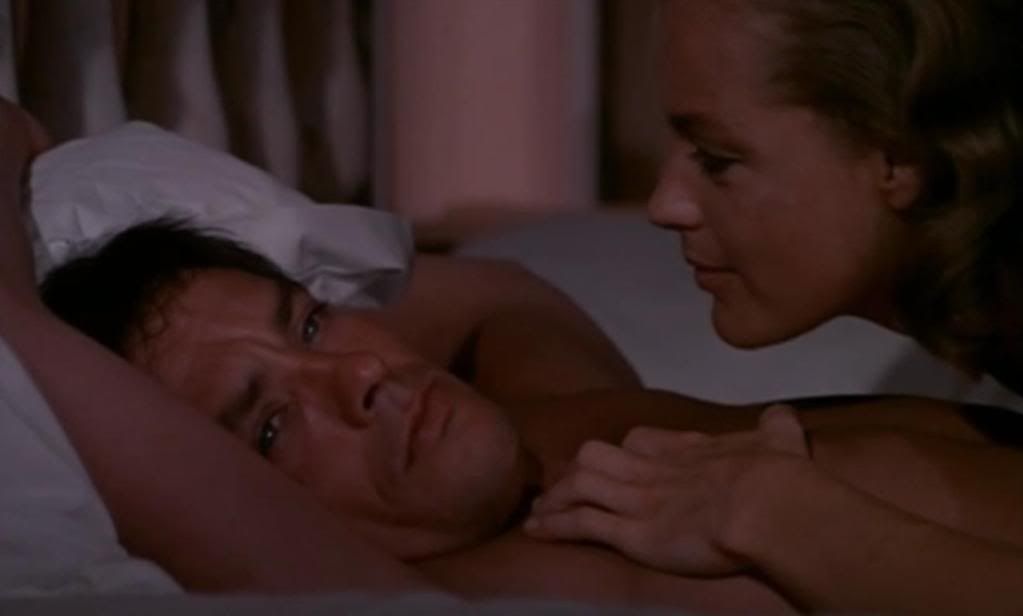
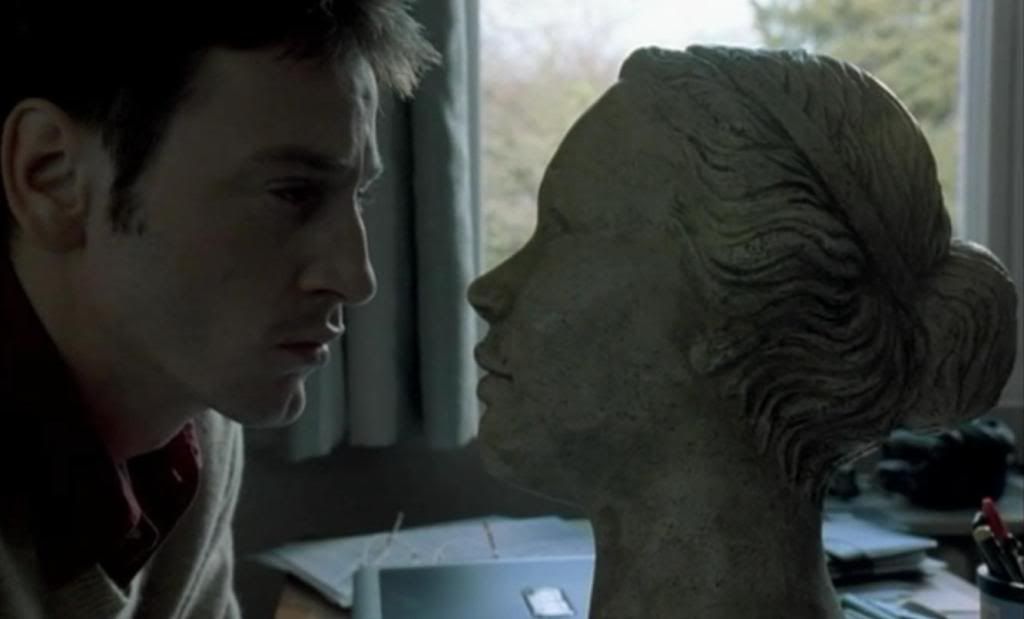
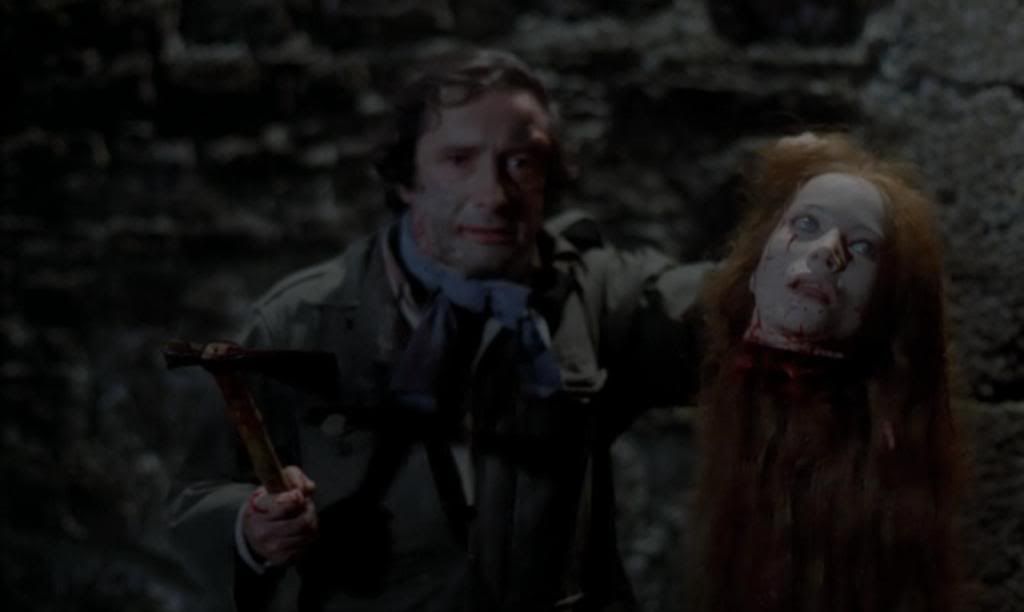
There's some awkward sexual tension between Philippe and his mother, Christine (Aurore Clément), in the opening scenes, some ambiguity in their relationship which is then transmuted into the stone carving of a woman's head that the family has dubbed Flora. Christine's boyfriend says that the statue looks like her, and when Philippe first sees Senta, he says that she looks like Flora, whereupon the camera pans over to the now-empty pedestal where the head had once sat, since they'd given it as a gift to Christine's boyfriend. Philippe steals it back and keeps it illicitly in his room, taking it out to admire when no one is around, as though it's a pornographic secret that he can only appreciate in private. This stone head is a locus of complex, unstated feelings, a surrogate for Senta with her blank, unreadable expressions, and Philippe frequently sleeps with the stone head curled up in his arms as though he's embracing a lover with an invisible body. At one point, he even holds the head tenderly and kisses Flora on the lips, kissing both his mom and his lover through this unfeeling stone, an uncomplicated stand-in for the flesh-and-blood women in his life.


Chabrol was, of course, always a big admirer of Alfred Hitchcock, whose thrillers provided something of a structuring principle for Chabrol's entire career, a central influence that he was continually mining and circling around. This is especially true here, and The Bridesmaid is built around a warped version of the murder-exchange deal from Strangers on a Train, with Senta asking Philippe to commit a murder for him, and she'll do the same for him, as a way of proving their love for one another. Chabrol doesn't delve into the suspense of the situation, since it's obvious from almost the moment she's introduced that Senta is disturbed, so the only real questions in the film arise from various misunderstandings and coincidences, with the "wrong" men being murdered. Chabrol then ends the film with a not-so-shocking but still satisfying revelation, unveiling a dessicated corpse with all the flair of Hitchcock's shot of Norman Bates' mother in Psycho — though of course Chabrol, never terribly interested in pat psychology or definitive explanations, ends the film there rather than dealing with the psychoanalytical aftermath.

There's some chilling material here, hinted at by the opening scenes in which Philippe and his family watch a TV report about a missing girl, which Chabrol uses as an opportunity to mock the exploitative, grisly sensationalism of TV news reports of violence, projecting these spectacles of suffering into meticulously decorated suburban living rooms. But the film is also darkly funny, with a subtle undercurrent of humor that tweaks the thriller and murder mystery conventions of the story; this is best seen in the moment when a police detective, tailing Philippe through a park, walks across the frame and steps in a big pile of dog shit, wiping his heel on the ground as he continues to follow his target. It's this kind of deadpan humor that cleverly shows Chabrol's slightly tongue-in-cheek perspective on this otherwise serious psychosexual thriller.

There's also a rich vein of sexual humor, since it's sex that blinds Philippe to the danger of his lover; he's having so much fun in bed that he manages to overlook the girl's obsession with murder and her strange, contradictory stories about a globe-trotting past of acting and prostitution. At one point, Philippe is talking on the phone about his home decoration job, discussing "pipework" with an elderly woman while Senta puts her hand between his legs and lowers herself to her knees in front of him. Everything becomes sexual, charged with eroticism, with passion in the bedroom tangled up with the violent passions broadcast over the TV and published in newspapers.

Monday, February 18, 2013

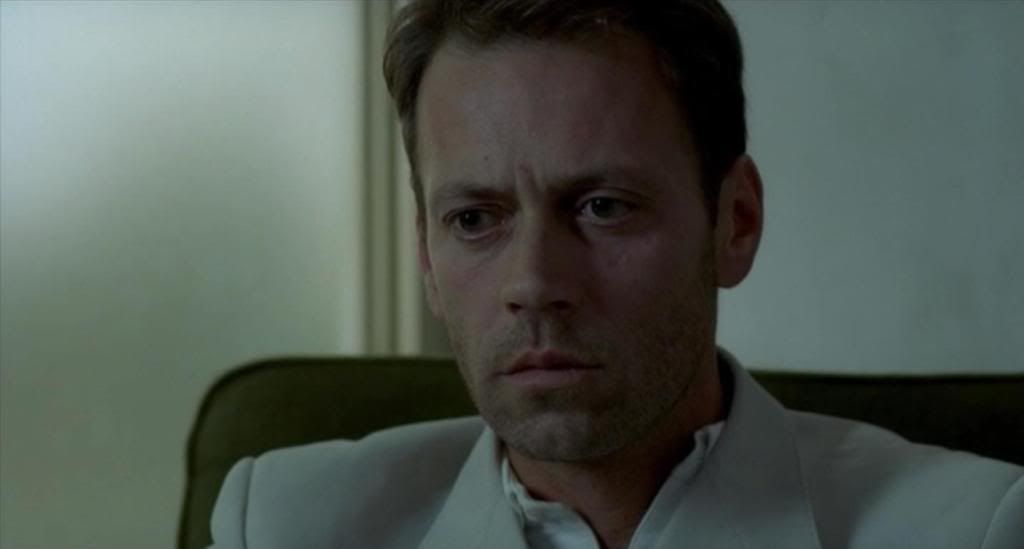
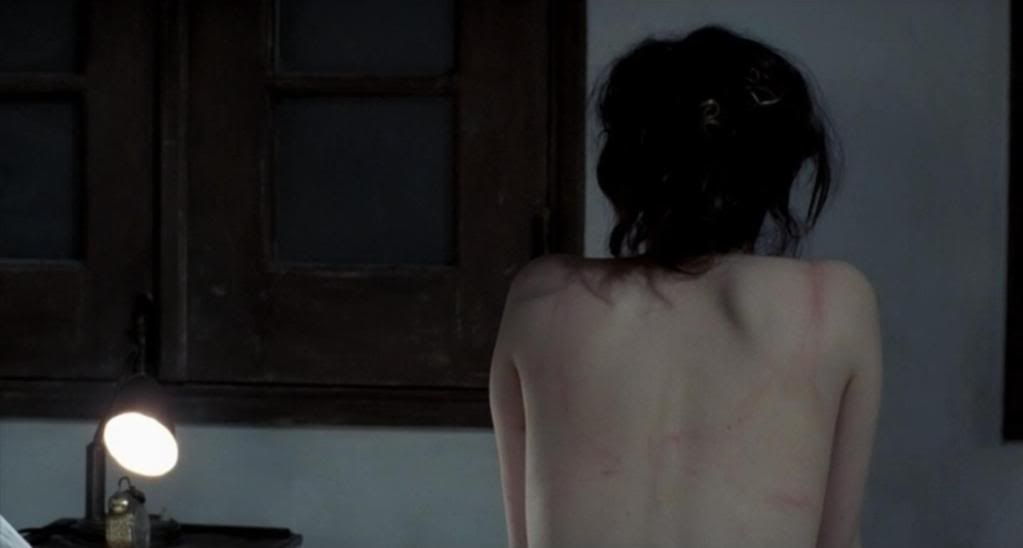
Anatomy of Hell


Catherine Breillat has never exactly been a subtle filmmaker, or a particularly easy one to grapple with. Her films are often bluntly provocative and polemical, using in-your-face, sexually explicit allegories to deliver her ideas about the essential antagonism between men and women. Anatomy of Hell is probably the ultimate Breillat film in many ways, a purely symbolic and abstracted confrontation between unnamed incarnations of female carnality and male brutality. It is also one of the director's worst films, a vile and simplistic work that wallows in its visceral images while advancing a rather nasty, limiting ideology that casts all men as vicious brutes, suggesting that while women are founts of life, men provide only death. It's familiar feminist rhetoric, here delivered in such exaggerated fashion that it seems grotesque, totally removed from anything that might shed real light on the nature of male/female dynamics.

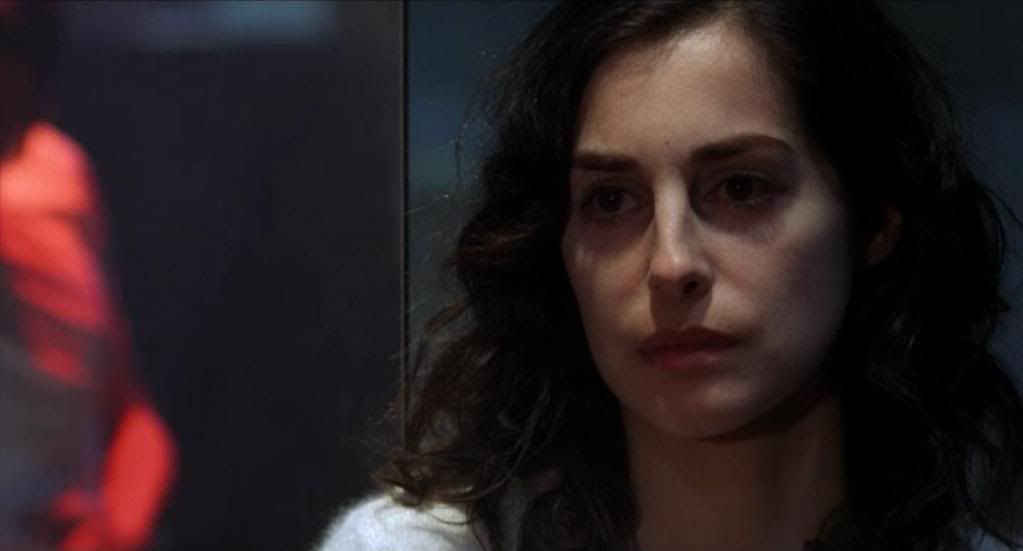
Breillat, never one to shy away from provocative imagery, has still never seemed so eager to offend as she does here, piling on so many calculatedly confrontational images that the effect is numbing rather than challenging. The film's allegorical structure focuses on the relationship between a young woman (Amira Casar) and a gay man (Rocco Siffredi), who finds her cutting her wrists in the bathroom of a gay club. When he asks her why, she responds, "because I'm a woman," which is a pretty good indication of the level of discourse Breillat is working with here. Casar represents the eternally suffering woman, subject to the hatred and disdain of men, which leads her to hate herself, to hate and deny her body. In order to deal with these feelings, she makes a deal with Siffredi: she'll pay him to come to her house, where he'll look at her naked body and talk about women.


At the root of the film is the idea that men hate women, and that perhaps gay men hate women most of all — that last being an especially repulsive concept, suggesting that gay men wouldn't be gay if only they didn't hate women so much, if only they weren't so disgusted by what's between a woman's legs. The man is gay, Breillat theorizes, because as a boy he once killed a bird, in innocent cruelty, and now he permanently associates female genitalia with the slippery guts of the bird, spilling out beneath his sneaker. He finds women disgusting, intuitively linking sex and death, and linking womanhood with his own boyhood shame and disgust — disgust with himself, and with the little pink crushed bird who'd died. Breillat seemingly extrapolates from this situation to all men, suggesting that the straight man's contempt for women is simply a less extreme version of the gay man's total disengagement from female sexuality. Breillat often locates the formation of sexuality in childhood, although not always in such a crude, blunt way. But then this film is Breillat at her crudest and most blunt, pouring out a really quite remarkable stream of outrageous ideas in between visceral scenes of sex, closeups of a bloody vagina, and other scenes carefully calibrated to offend and shock.

The film suggests that the essence of male/female relationships is hatred and self-hate, disgust and violence. Casar says she knows that Siffredi wanted to kill her during the course of one night — when he'd stood over her threateningly with a gardening implement before turning it around and sticking its blunt end inside her instead, leaving it hanging out of her at a jaunty angle. According to her, and presumably according to Breillat as well, the desire to kill a woman is "an urge all men have, that's how they are."


Breillat is dealing with all this at such a simplistic level that she winds up simply repeating clichés and stereotypes about both men and women rather than really interrogating or overturning those kinds of received ideas. Her most overt provocations — like having Siffredi and Casar share a glass of water mixed with menstrual blood from a tampon — come across as almost comically overwrought, and there's also some (presumably unintentional) comedy to be found in Siffredi's wooden line readings. Since Siffredi seems to get the bulk of the film's most torturously overwritten philosophical observations, his stiff acting — he spends much of the film staring blankly into space — only makes the film even harder to take seriously. (There's probably a joke about "stiffness" to be made here.)

With Anatomy of Hell, Breillat sets out to deconstruct misogyny, to confront it head-on. Obviously, the intent behind the film's overt presentation of a woman's body, without eroticism, is to challenge and subvert the disgust that men supposedly feel at the idea of women's body hair and menstruation. Breillat seeks simultaneously to disgust and to suggest that what she's showing is not disgusting, a contradictory dual purpose that sabotages the film; she really achieves neither aim. Breillat has, in recent years, moved away from the overt provocation represented by films like this and Romance, instead crafting increasingly nuanced works that explore her familiar themes without relying so heavily on viscera and excess. Anatomy of Hell was her last film to date in this vein, and it's the grimy, ugly bottoming-out of this approach. There was no further, or lower, to go after this, and perhaps this film's slate-clearing vitriol is what made it possible for Breillat, in the years since, to move so decisively beyond this kind of shallow provocation to the genuinely fascinating, intellectually rigorous work she's been making ever since.

Monday, February 11, 2013

The Law


Jules Dassin's The Law is a very strange, disjointed movie. A Franco-Italian co-production, set in a small Italian fishing village and starring mostly Italian actors, it is nevertheless dubbed into French, which gives one some idea of the rather odd sensibility at work here. Dassin, exiled from Hollywood after the Communist witch hunts of the 1950s, was just a few years past his first French film, the masterpiece Rififi, but The Law has little in common with that film or the tense noirs of his Hollywood period beyond a rigorous, visually sharp sensibility.

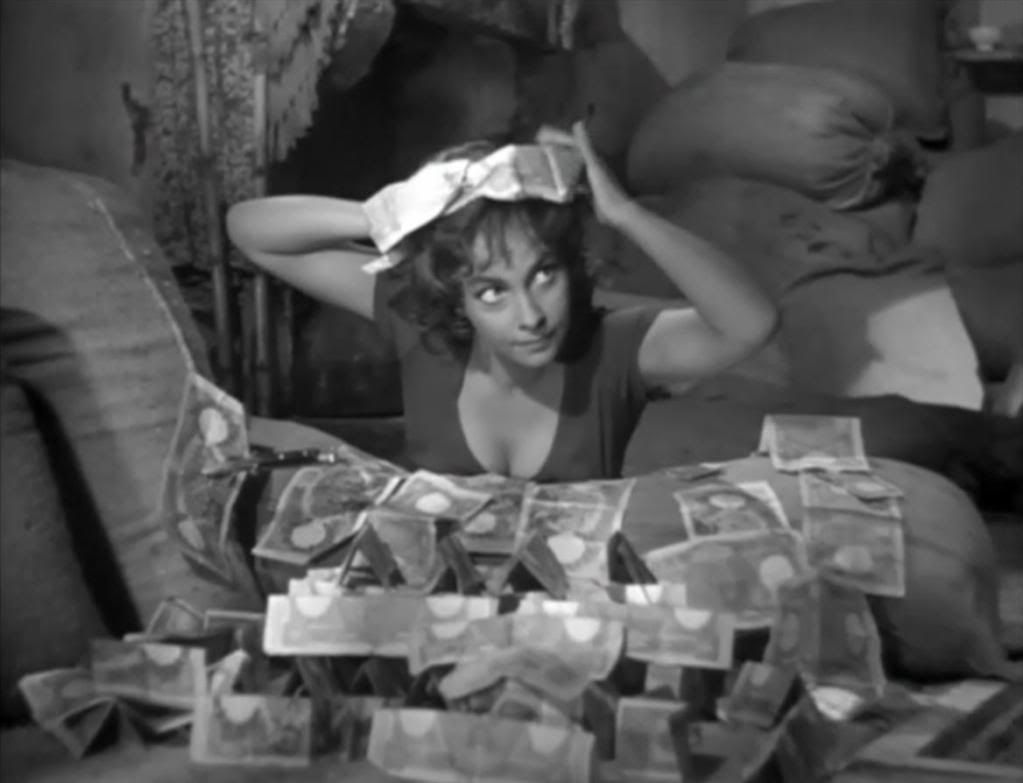
Here, Dassin applies that sensibility to a soapy melodrama adapted from a Roger Vailland novel, resulting in an uneven, tonally varied, sporadically engaging work that bounces unpredictably from cynical satire to fluffy sex comedy to over-the-top melodrama. The film is concerned with power and authority, focused on the passing of the old guard, represented by the ailing gangster boss Don Cesare (Pierre Brasseur), and the arrival of a new guard, as represented by both the would-be new boss Matteo Brigante (Yves Montand) and the government land surveyor Enrico Tosso (Marcello Mastroianni). This struggle is represented in terms of power, control, wealth and respect, but also sexuality, in the battle for the affections of Marietta (Gina Lollobrigida), the vivacious, voluptuous local beauty who all the men want.

Unsurprisingly, Lollobrigida's Marietta is the focus of the film even though there are so many subplots and intrigues going on among the other characters. Everyone seems to be engaged in clandestine amorous meetings and conspiracies, but despite the sprawling cast and meandering narrative flow, the sensual, provocative Marietta always feels like the center of it all. Lollobrigida gives a lively, spirited performance, and even the dubbing of her voice doesn't really matter, because it's a physical performance first and foremost, a performance of the body. She projects raw sexuality, and Dassin's camera obviously loves her curvy form, her cleavage-baring dresses, and the vibrant, emotionally tumultuous personality that mirrors her unbelievable form. In many ways, the film is a typical sex comedy vehicle for the considerable charms of the lead actress, who naturally steals all attention like a magnet whenever she's onscreen.


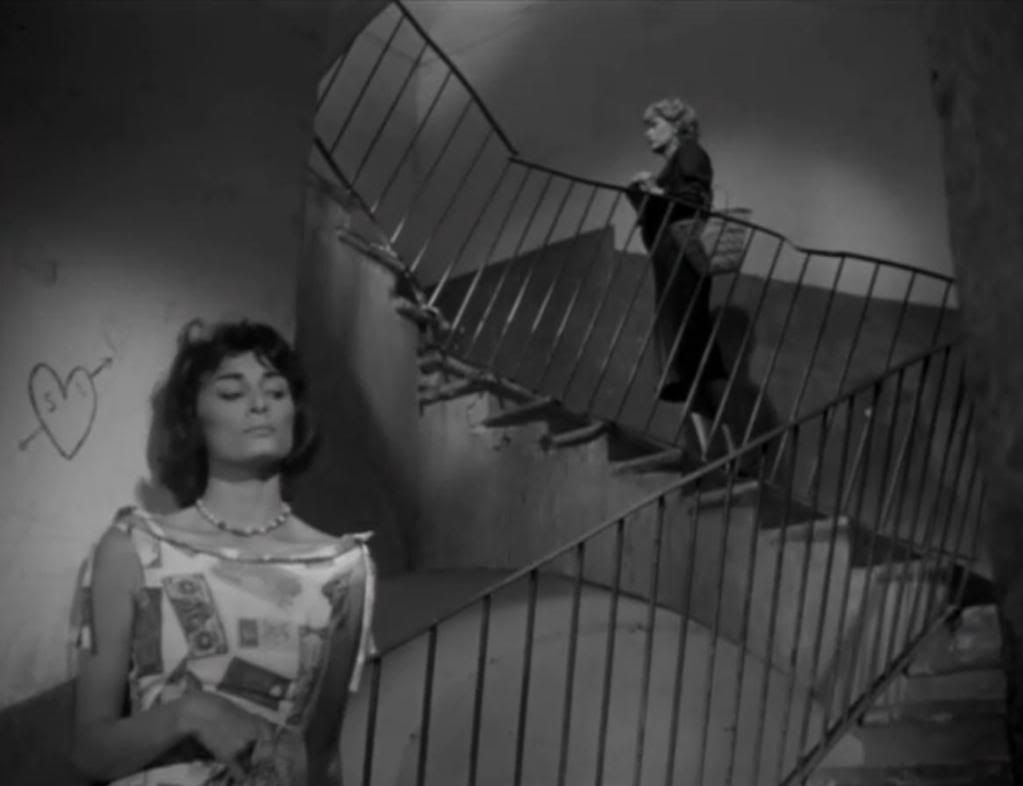
This obvious reveling in Lollobrigida's sexiness aside, there's more to the film than just another sex farce. Dassin's aesthetic is as well-defined as ever, and his probing camera swoops and glides around this small town, uncovering all the corruption and adultery that seem to be hiding in every dark corner and behind every slatted window. As Dassin's camera tracks from one window to the next in an apartment building at the beginning of the film, there's a noirish atmosphere to the rigidly posed, shadowy dioramas of distrust and discontent found behind each window. Every marriage here is unhappy, especially the one between the local judge and his wife Lucrezia (Dassin's future wife Melina Mercouri), who are seen behind slatted shutters that cast their room in barred, segmented darkness like they're locked in one of the cells in the prison just next door. There are surreptitious romantic meetings in stairwells ringed by twisted, jagged metal rails, and everything is rendered in hard lines.

The frame is constantly being segmented in this fashion: when Lucretia goes to see her young lover Francesco (Raf Mattioli), he's working on a fishing rig that criss-crosses the frame with complex patterns of lines from all the wires and beams running across the structure. This noir visual aesthetic is very well suited to portraying the cynical obsession with power in this town where they play a gambling game called "the law" that's built around humiliation and using one's (temporary) power within the game as a weapon against everyone else.

The film's grittier moments are counterbalanced by a goofy musical number in which a gang of local kids serenades Brigante with a tribute to his toughness and power. In another scene, Marietta and Enrico frolic in the water together, a scene that might've been sexy — and still kind of is — but is rendered hilarious by the presence of a flock of sheep who are also bathing all around the young lovers. It might say something that this is their best scene together: their relationship is never especially credible, and Mastroianni is wasted in general, given an underdeveloped character whose place in this narrative is never clearly defined. It's frequently obvious, at times like this, that Dassin is adapting a novel and trying to cram in too much of its text, so various threads within the story are left dangling. The film's a bit of a mess all around, but despite the stereotyped characters and tonal inconsistency, it's worth seeing for Lollobrigida's sexy mugging and the visual rigor with which Dassin traces the film's sexual and political power struggles.

Monday, January 28, 2013

Wild Reeds


In Wild Reeds, director André Téchiné dramatizes the moment right on the cusp between adolescence and adulthood, right at the moment when teens are struggling to define themselves, to cope with burgeoning sexual desires and decide what they want from life, where they're heading and what they'll be doing in the future. The film sets this awakening against the backdrop of the Algerian War, as so many French films have, juxtaposing the passage into adulthood with the loss of innocence represented by the violence and political turmoil of Algeria.

Téchiné renders this story with a wan and somewhat faded color palette, like an old photograph, worn and frayed by the nostalgia accrued in the decades between this 1962 summer and the film's production. Téchiné himself would have been 19 in the year the film is set, suggesting that he's drawing on his own experiences, his own memories of the discomfiting intimacy between his own adolescence and the background of war and confusion against which it occurred.

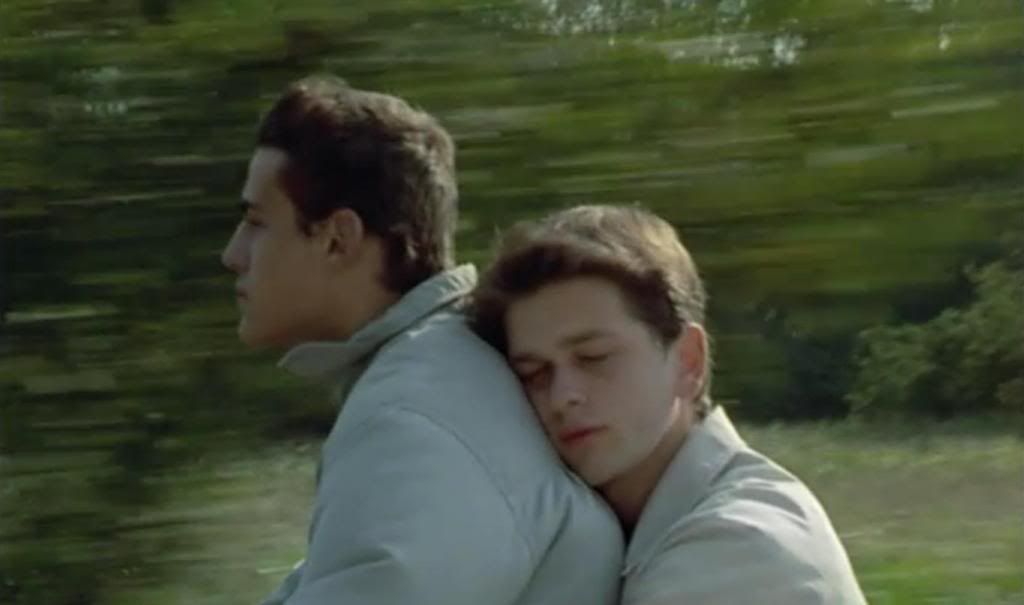
The film is elegant and delicate, the camera gently tracking around the quartet of teenagers at the story's core. There's François (Gaël Morel), who's starting to realize that he's gay, nursing an intense desire for his schoolmate Serge (Stéphane Rideau). François is also the platonic kind-of boyfriend of Maïté (Élodie Bouchez); they've been friends since childhood and are thought of as though they're dating even though nothing has ever happened between them. This neat triangle — Serge desires Maïté, who says she doesn't care about François' sudden realizations about himself, even though she's clearly shocked — is complicated by the presence of Henri (Frédéric Gorny), an arrogant and elitist youth who's immersed in the news from Algeria, where he lived until just recently.

Algeria and the politics surrounding it haunt the film, and political convictions are one of the things that these young people must come to grips with as they try to decide who they are. Henri is a far-right partisan of the French nationalist terrorist group the O.A.S., whose activities are mentioned frequently on the radio news reports that Henri's always listening to. Maïté, like her mother (Michèle Moretti), is a Communist, though one senses that she doesn't share her mother's absolutist conviction in the cause. Maïté's mother, a schoolteacher, is such a partisan that she hands out grades in her English class based on the political ideas expressed in papers, and there are references to Maïté's father leaving them because she was immersed in her cause to the exclusion of all else.


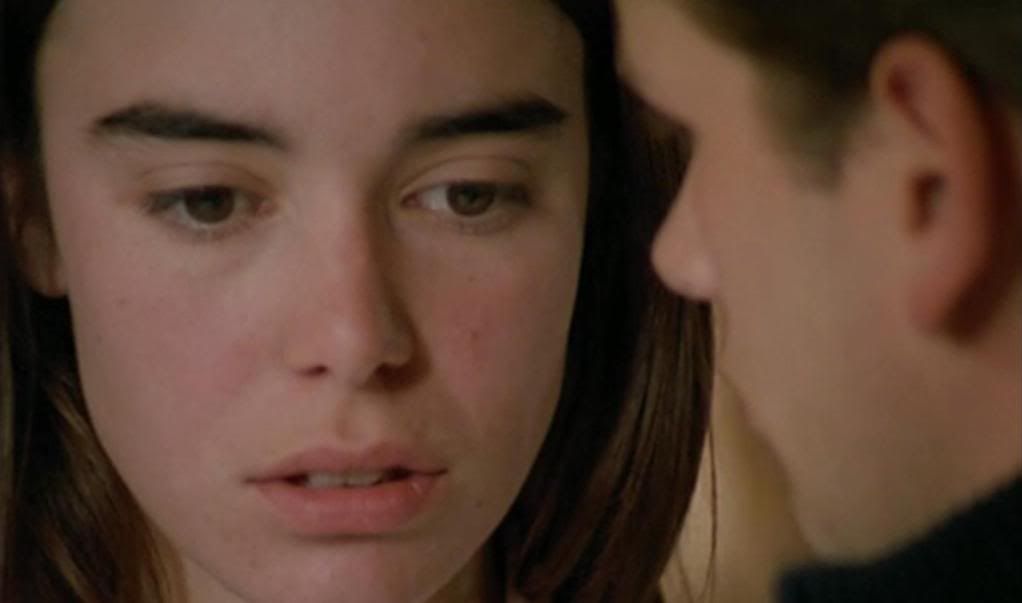
The film's dominant composition is the two-shot, as the young people pair off into different couplings, different combinations, as though experimenting to see what works. Téchiné captures them in intimate two-shots, their faces overlapping and close together, electric tension suspended in the scant space between them, their uncertainty and confusion passing between them in the glances they give each other, the hesitant intimacy of their dawning desires. For most of the film, Téchiné never even brings all of the characters together, restricting them to these alternating pairs and quasi-couples. Occasionally, Henri tries to horn in on the furtive intimacy between Serge and François, but not until the very end of the film do all the characters come together, first as a cheerful threesome that recalls Band of Outsiders or Jules and Jim, and then as a full quartet — though they quickly pair off again before the finale suggests that they're all heading in separate directions anyway.

The film is all about the contrasts and resonances between their fresh young faces. Serge, befriending François, tells him that they'll go well together because they're such different "types," and indeed they are, François delicate and boyish in contrast to the broad, tanned working class face of the farmer Serge. The sensuality between them is enhanced by the differences in their types, which is a way of saying the differences in their backgrounds, the differences in their economic class — and thus the differences in their likely futures, as Serge ultimately decides that all he wants is to stay on his family's farm, while François seems bound to graduate and head off to more intellectual pursuits.

This uncertainty about the future is what makes the film so poignant, so gently moving. It's a touching, emotionally complex film with a real sensitivity to nuance: in one scene, the confused François pays a visit to the only gay man he knows, the owner of the town's shoe store, and though the man seems uncomfortable talking about his sexuality and can't help François, Téchiné grants the man a parting closeup that is searing in its directness, capturing the expression of yearning, confusion, and recognition on his face as he watches François walk away. That shot makes it clear that the man desperately wants or needs to talk to someone, but can't find the words any more than François can.

Téchiné treats his themes with delicacy and grace, never forcing an epiphany or trying too hard to resolve the ambiguity of these relationships. Instead, the film is warm and sensuous, capturing with precision and understated emotion the time in life when everything seems hazy, when political convictions and sexual desires and ambitions about life and love and work are all up in the air, and anything might still be possible. The film, though, is about the closing of those horizons, the narrowing down of all possibilities to those few that seem appealing and likely.

Monday, December 17, 2012

Fascination


Fascination is a very apt title for a Jean Rollin film. Rollin's ethereal horror oeuvre revolves around the idea of fascination: fixation, obsession, fetishism, the irresistible allure of danger and death, great beauty tangled up with supernatural horror. His cinema repeatedly examines the fascination of the director and, often, his protagonists, with the strange, unsettling, eerie occurrences that haunt his movies. From film to film, Rollin wove together increasingly familiar images and themes that constitute the subject of his fascination: beautiful women naked or dressed only in diaphanous see-through gowns, gothic rural settings, vampirism, seduction, ruined castles lit by candles, secret societies that seem to flicker on the edges of the material world, trapped between states, their exact nature uncertain.

Fascination embodies so many of these fixations that it feels like an ultimate statement of the director's vision; perhaps not his best film but definitely one of his most characteristic, which is why it's also become, within this unusual auteur's cult, one of his most iconic works. The story is, in the usual Rollin fashion, extremely simple, a bare sketch of a scenario used to set up the dreamy, vaguely menacing atmosphere that is the film's true substance. The thief Marc (Jean-Marie Lemaire) betrays the rest of his criminal gang and flees their revenge, arriving at a nearly empty rural estate where the only residents are a pair of girls, Eva (Brigitte Lehaie) and Elisabeth (Franca Maï). Marc holds the girls prisoner while fending off his gang's attacks, but it soon becomes clear that if this is a hostage situation, who's the hostage and who's the captor might be the reverse of what Marc thinks.


Certainly, Marc believes that he's the one in control here, but a driving theme of the film is the exploration of power's relationship to gender and sexuality. Marc is a sneering, arrogant jerk, dominating these two girls from his position of power, waving his phallic gun around as a symbol of his sexual and physical dominion over them. Eva and Elisabeth sometimes play their expected roles, cowering in fear before him, but soon their show of fear and submissiveness gives way to a much more playful, mocking attitude, skewering his belief in his dominance, suggesting that they're really the ones in control. While taunting him with the prospect of sex, they actually go to bed together, in a scene of sumptuous softcore eroticism that could've come directly out of one of Rollin's adult productions. When Eva does give in to Marc, she's quite open about her motives: she wants to keep him there until nightfall, using her sexuality to lure him into what increasingly seems like a deadly trap.

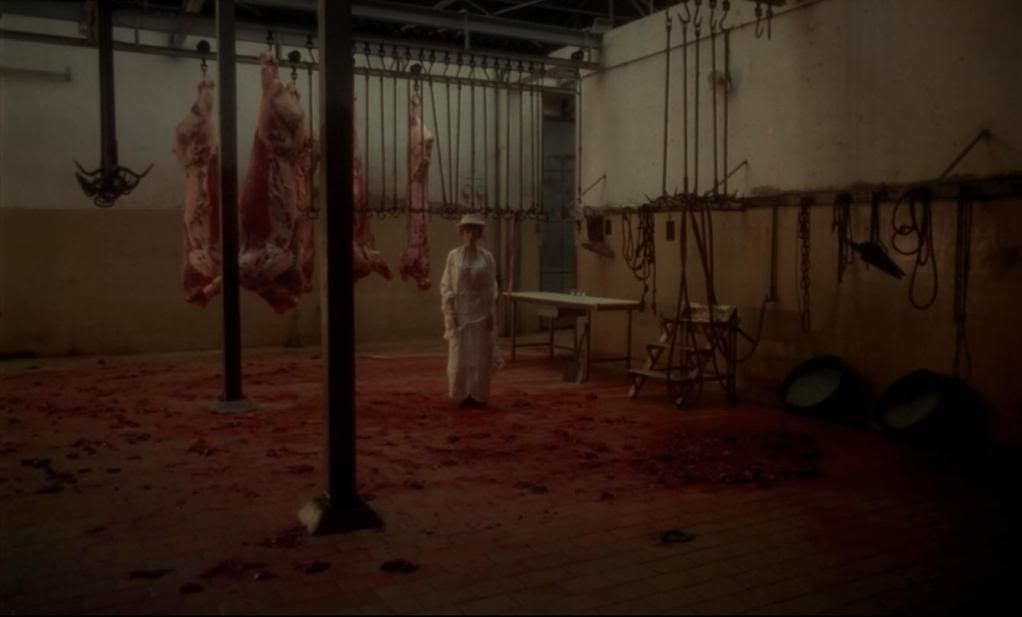
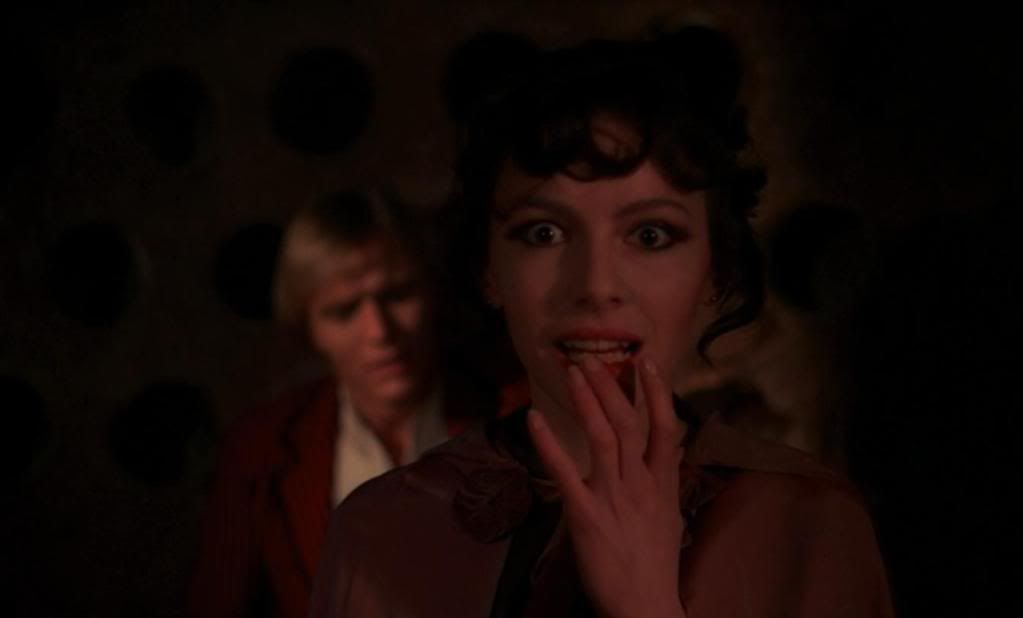
There's clearly something sinister going on here, even if the hapless, arrogant Marc laughs off all the premonitions and warnings about the fate awaiting him once midnight strikes. Elisabeth, who seems slightly less unhinged than her compatriot, warns Marc that he should flee, that something horrible is in store for him that night. Anyone who enters the orbit of these girls is trapped within "the universe of madness and death," she says, clutching the gun she's stolen from their guest. Later, the girls are joined by more members of what seems to be a blood-drinking, Satan-worshipping club of wealthy bourgeois women, but Marc still doesn't catch on. The audience is a few steps ahead of him anyway, having been warned more explicitly by the gorgeously morbid prologue in which these women daintily drank ox blood from goblets while standing in a slaughterhouse, their frilly dresses dragging in the bits of cartilage and bloody flesh strewn across the reddened floor. The leader of this club, Hélène (Fanny Magier), warns Marc, "Beware, death sometimes takes the form of seduction," but even then he treats this night like a game, so secure in his masculine superiority that it never occurs to him that he's not in control, that he's become the prey rather than the predator.


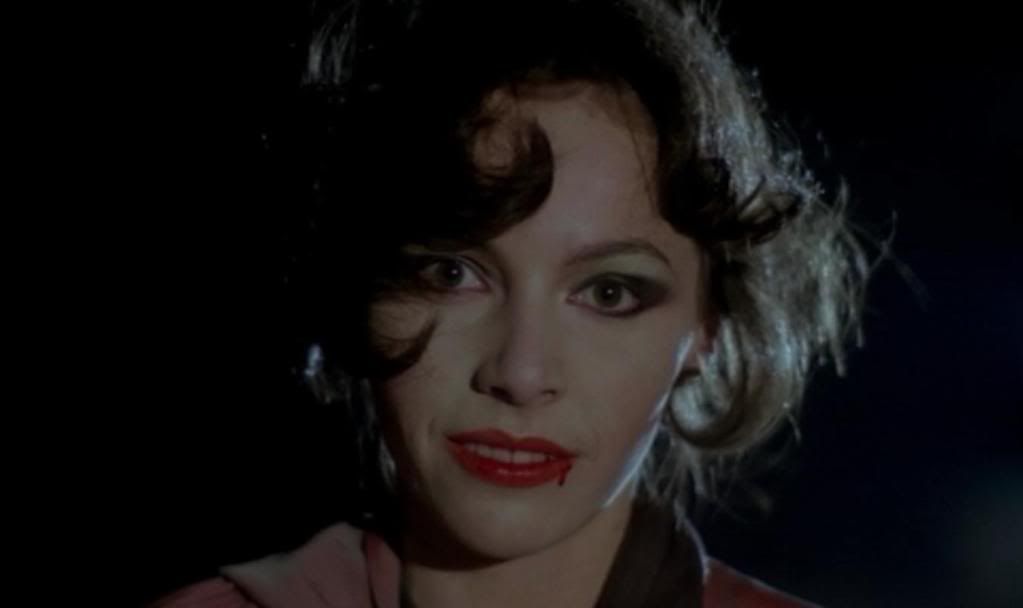
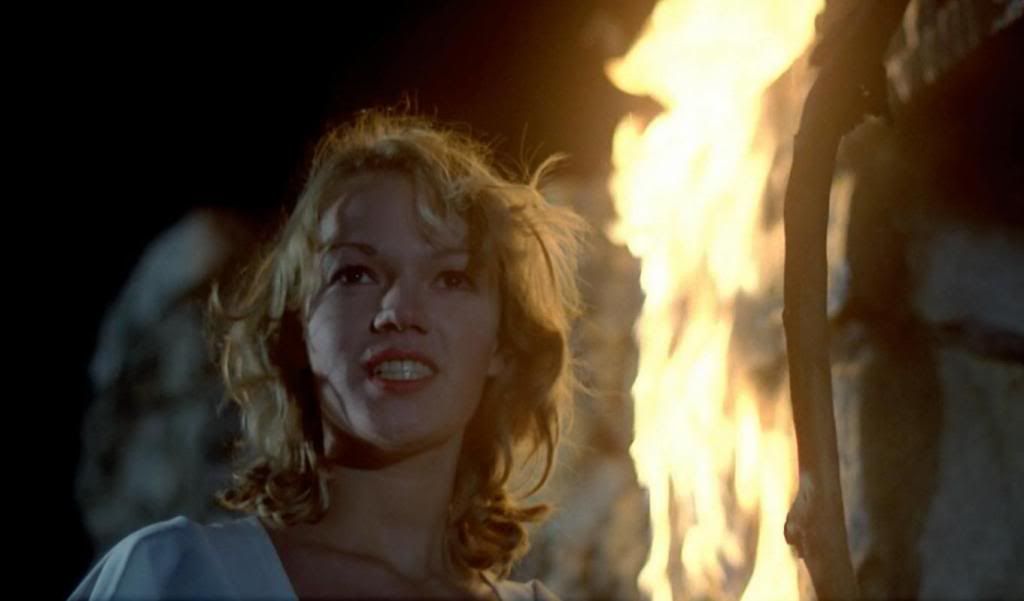
The film's most enticing predator is undoubtedly Eva, who is especially terrifying in a sequence where she methodically, ruthlessly kills the members of Marc's gang, stabbing one man in the side during sex and then prowling after the others with a black robe billowing around her naked body, a scythe held threateningly in front of her. She's a sexy, seductive grim reaper, blonde death with a vicious blade that easily outdoes Marc's puny gun as far as penetrative phallic imagery goes. Rollin had first featured Lahaie in one of his bills-paying adult film productions, then given her a small but unforgettably intense role in his moody zombie classic The Grapes of Death.

Here, she magnifies and extends the sexy insanity of her part in that film, killing with her mouth locked in a horrible/alluring rictus grin, baring her teeth and smiling as she slashes throats with her reaper's blade. There's something feral about her, an animalistic quality that somehow only makes her more appealing, and more unsettling. Rollin captures her in evocative closeups in the moments before the kill, her eyes above the blade, her lips below it. Rollin seems to be asking, which is more dangerous, the scythe or the girl who wields it? Her alluring lips, her piercing eyes, they're as deadly as a knife to the guts, and with her, one leads to the other — her beauty and sexuality are lures into death and oblivion.

The strange attractiveness of death and perversion are at the core of this film, which perfectly captures the fascination that these beautiful, deadly women hold for their victims. Rollin makes the girls and their surroundings ravishing: the mansion, lit by candelabra, is lavishly decked out with fancy furniture and paintings, the surfaces of which Rollin's camera frequently probes whenever it's not being distracted by the lovely anti-heroines. Sensual and chilling in equal measures, Fascination is a nearly comprehensive catalogue of Rollin's obsessions and themes, exploring the appeal of the macabre and the impotency of male power through this hypnotically languid horror tale.

Monday, December 3, 2012

Merci pour le chocolat


Claude Chabrol's Merci pour le chocolat cleverly wreaks havoc with the underpinnings of the bourgeois family, disrupting its stability at every turn, eating away at its foundations until the family seems to be propped up only by lies, jealousy, suspicion and violence. The film opens with a wedding, as the chocolate heiress Marie-Clarie (Isabelle Huppert) and the virtuoso pianist André (Jacques Dutronc) get married — though they've actually been married before, and are now getting remarried after the death of André's second wife. During the ceremony, Marie-Claire even quips that they're using the same rings as they had the first time around. The gossipy chatter of the guests — with Chabrol's camera, predatory as ever, endlessly circling around them — only further undercuts this institution, this ceremony, that is ordinarily seen as the bedrock of bourgeois respectability. The rest of the film will further disrupt family structures, calling into question the foundations of paternity and inheritance: in this film, parentage is always vague and uncertain, shrouded in multiple deceits.

The plot is built around a long-ago confusion regarding André's child with his second wife, Lisbeth: there had been a momentary switch when André had been shown a baby girl as his own, rather than the son who was, apparently, actually his. Now the girl, Jeanne (Anna Mouglalis), is grown up and coincidentally also training as a pianist, and when she finally hears the story, she decides to visit André. As she ingratiates herself into André's home and begins taking piano lessons from him, she gets tangled up in a strange chamber mystery as she witnesses the odd behavior of Marie-Claire, who's outwardly solicitous and pleasant but seems to be masking a deeper chilliness and some odd behavior involving the hot chocolate she makes every day. Multiple suspicions arise, mostly revolving around the death of André's second wife, who'd died in a car crash, her system full of alcohol and sleeping pills.


It's obvious, of course, what happened, though Chabrol is typically indirect. Even when Marie-Claire thinks back to the night Lisbeth (Lydia Andrei) died — the flashback is triggered by Marie-Claire's expressionless face dissolving into a scene of the family clustered around André's piano — there's no decisive indication of foul play. Instead, Chabrol's camera subtly insinuates by showing Lisbeth by the piano, walking away to go out, passing Marie-Claire, who watches the car pull away out the window and then walks over to the piano, the camera drifting over with her to watch her take the place previously occupied by André's wife.

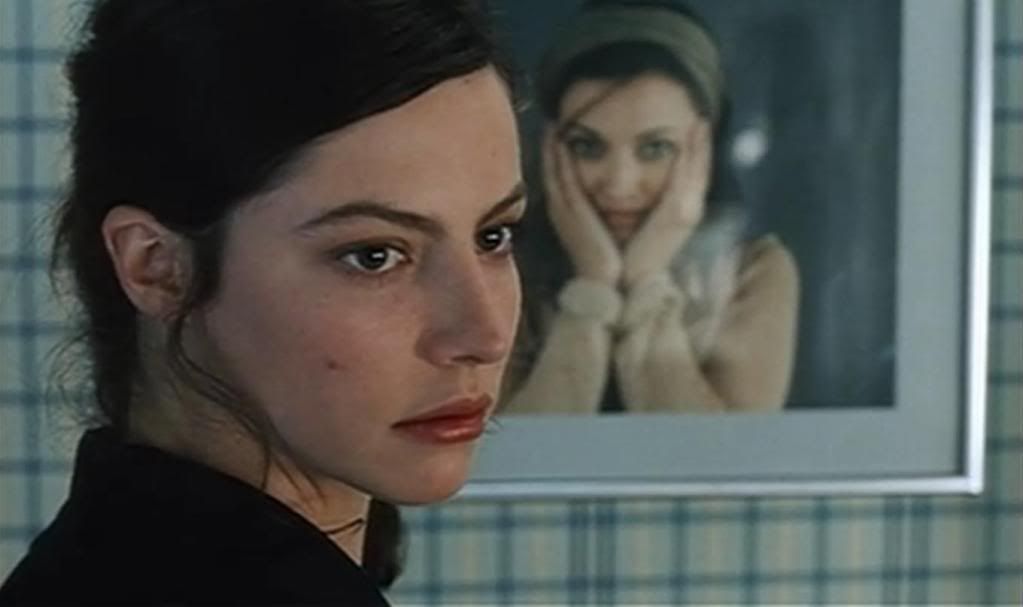
It's that stalking, insistent camera that makes all of Chabrol's thrillers so distinctive. The camera circles around the characters, probing their relationships with its ever-so-slow turns, its persistent and incremental process of tracking around them, getting closer and closer without quite ever penetrating the surface. At one point, Marie-Claire enters a room in which Lisbeth's photographs are displayed. The camera lags behind her as she walks past it into the room, staring at a point offscreen, and then the camera tracks through the empty space, finding her face again in the blurry blankness, and continues past her to reveal the photo she's staring at, a head-on self-portrait of Lisbeth resting her face in her hands. Downstairs, Chabrol's camera begins circling again, as André and Jeanne listen to a piano recording together, Jeanne resting her face in her hands exactly as Lisbeth had — the girl has seen the photo, and is obviously evoking the dead woman's pose, which suggests that in a way Jeanne is as calculating, as manipulative, as Marie-Claire herself.


But they both hide it so well. Huppert and Mouglalis deliver subtle, subdued performances, each of them presenting a lovely, friendly exterior that perhaps masks something more calculating: in Marie-Claire's case, a truly sociopathic indifference that reveals itself, chillingly, in the final scenes, and in Jeanne's case a perhaps more benign penchant for selfish scheming. After all, as soon as she hears of the mix-up with André, knowing that he's a famous pianist, she seizes the opportunity to sneak into his life, to earn his help. Chabrol, by linking these women, seems to be suggesting that the sinister evil of Marie-Claire is only the most blatant manifestation of this kind of bourgeois self-interest. At root, it's about an insistence that surfaces are all that's important: "keeping up appearances is all that counts," Marie-Claire tells the board of the chocolate company she's inherited. She's talking about chocolate packaging, but she could just as well be talking about a broader bourgeois philosophy of life, a deep-seated belief that appearance is all that matters, even if the truth has little relation to the appearance.

That ties back into all the confusion over parentage: even beyond the baby mix-up, Jeanne eventually learns that she was conceived through a sperm donation from an anonymous man, while Marie-Claire reveals that she was adopted, which means that the chocolate fortune she's inherited is not her biological right after all. Considering how important biology generally is in the ancient roots of inheritance, these biological disconnects muddy the waters, slyly chipping away at the ways in which wealth and prestige are passed down through bourgeois families. Marie-Claire, especially, is an infiltrator, an adoptee who's taken on a bourgeois mantle but is essentially in disguise, a pretender. At the end of the film, she has a startling scene — remarkably honest and direct after all this shiftiness — in which she confesses that the happy homemaker guise she presents to the world is just that, a mask, a façade. "I have a knack for doing wrong," she says mildly, her face blank, when she's finally been caught in her deceits and schemes. "Instead of loving, I say 'I love you,' and people believe me."

This is a sharp, smart, low-key thriller that revolves around all these mostly unstated tensions about family. It has a typically chilly Chabrolian tone that is periodically broken by bursts of genuine emotion, like the lengthy final shot of a wet-eyed Marie-Claire, or the scene in which André's son Guillaume (Rodolphe Pauly) remembers his mother's death in a sloppy outburst of raw feeling. As usual for Chabrol, the biggest secret here is not anything to do with the plot, but rather a bigger secret, maybe even the biggest secret, which is the essential flimsiness and silliness of bourgeois conventions, which can hide so much.

Wednesday, November 28, 2012

The Grapes of Death


The Grapes of Death marked a return to form for the idiosyncratic horror auteur Jean Rollin. After 1974's remarkable but commercially unsuccessful Lips of Blood, Rollin, unable to get even the typically miniscule budgets his particular brand of surreal, dreamlike horror required, began churning out straight-up softcore porn under the aliases Michael Gentil and Robert Xavier. The Grapes of Death, produced in 1978, four years after his last horror project, was Rollin's retreat from the adult film ghetto. It's a fantastic return, too, with Rollin tackling the zombie genre and adapting his sensual, hypnotic aesthetic to this creepy tale of a rural wine-producing region overrun by shambling, rotting, diseased and insane farmers.

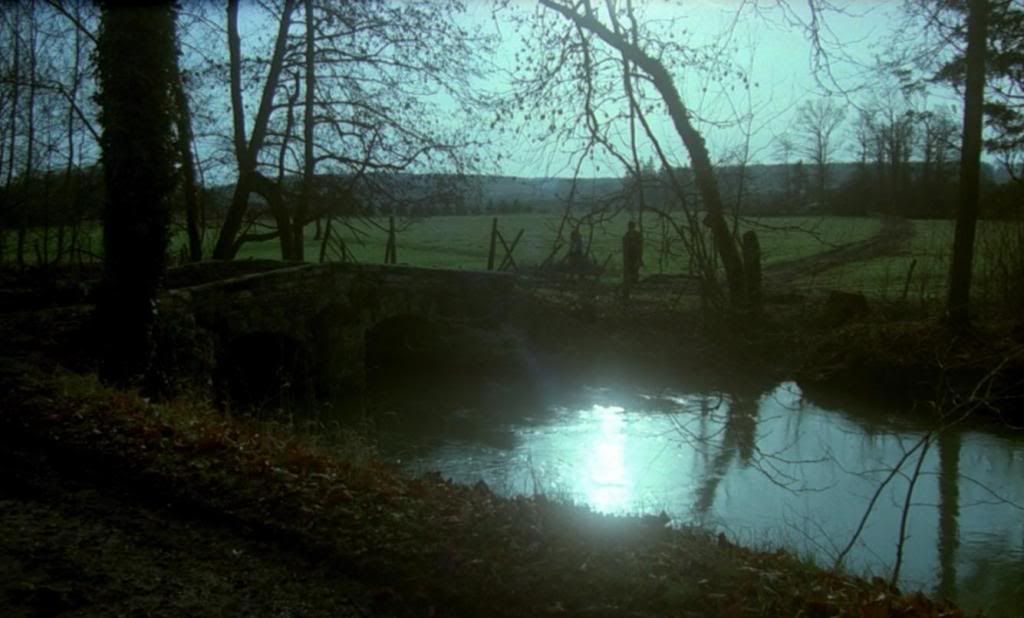
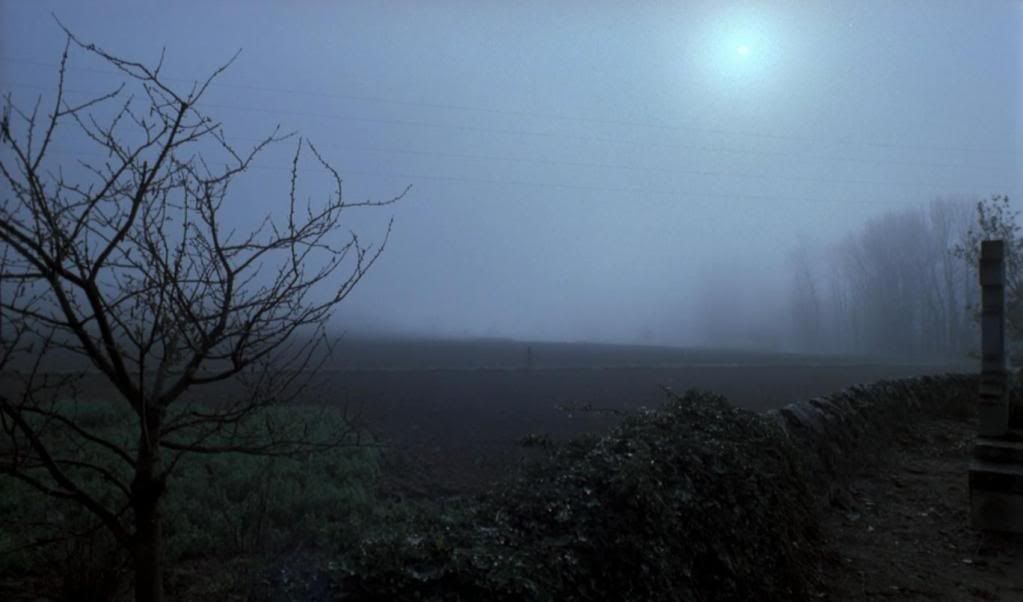
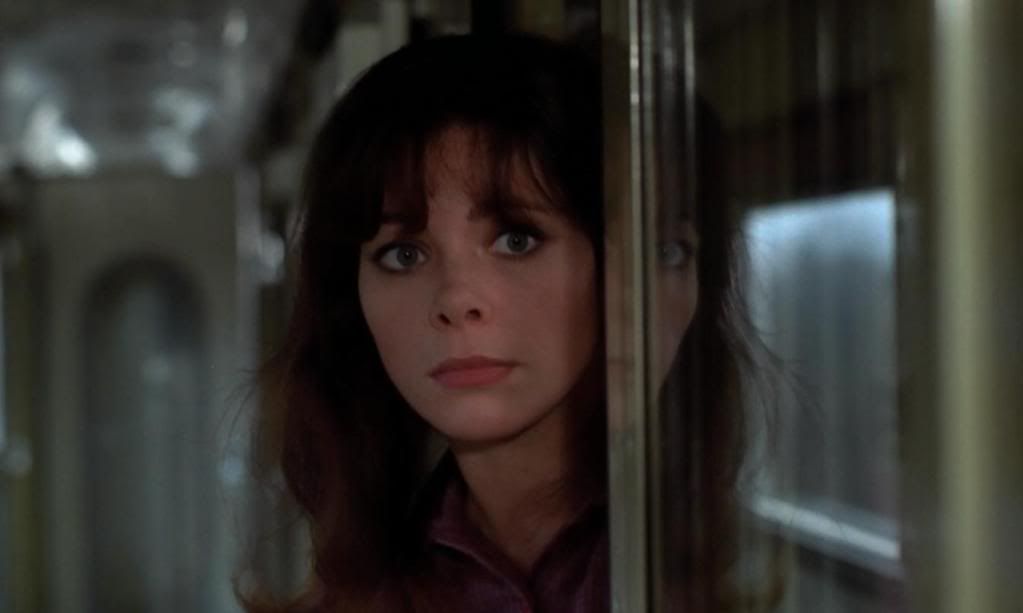
This decay of civilization is seen through the eyes of Élisabeth (Marie-Georges Pascal), a young woman who's planning to visit her fiancé at the winery he manages. Instead, her train journey is interrupted by a zombified man who kills her friend and chases her off the train into a typically desolate Rollinesque countryside. This rural landscape is alternately brightly sunny and shrouded in fog, utterly without logic or concern for continuity. The film has a strangely gorgeous, pastoral atmosphere that clashes against the periodic outbursts of sloppy gore and disgusting, smeary makeup effects. Fleeing from her zombie pursuer, Élisabeth runs across a foggy bridge, surrounded in fluffy white clouds, then runs into a large open meadow that Rollin films in a stunning wide shot, the sun a glowing blue pinprick just barely cutting through the thick soup of the fog. Élisabeth arrives at a cemetery, looming out of the fog with massive stone crosses atop its locked gate, but soon after, the fog disappears in between shots, and the heroine is running across a rocky, barren hillside, bathed in gorgeous summery sun.

Weather and landscape are both prone to this kind of slippage in Rollin's films, with their uneven regard for the niceties of continuity. The countryside itself provides many of the chills here, with this terrified young woman stumbling across this desolate, unwelcoming land, coming across crumbling stone buildings in various states of decay and destruction, as though the land was already abandoned and falling apart long before this zombie plague further decimated the region. Rollin has always loved the gothic ruin of collapsing castles and old buildings situated in bleakly beautiful, unpopulated surroundings. He makes these scenes both sinister and oddly appealing, because he's obvious fascinated by the poetic ruin of these landscapes even as he uses them as foreboding settings for tales of death and terror.


Rollin is adept at finding a languid, melancholy form of poetry in the trashy, violent, sexually charged B-movie material that drives the often fragmented narratives of his films. Here, he makes his zombies more sad than terrifying, as they stumble around, their faces melting with oozing open sores that pour multicolored liquids down their cheeks and over their foreheads. The effects are primitive and ugly, and also somewhat disgusting — especially in the disturbing scene where one zombie repeatedly smashes his head against a car's window, leaving pus-yellow streaks on the glass until he finally manages to shatter it. Rollin makes this zombie plague explicitly a kind of disease, caused by pesticides used on wine grapes, and the sufferers of the plague are in various states of mental and physical decay, some of them utterly blank, their minds erased, and others tragically seeming to understand that they're losing their minds and being possessed by violent urges.

There's a strange poignancy to these zombies. When the initial zombie is first chasing Élisabeth, he abruptly gets tired and slumps down to a seat on the railroad tracks, cradling his head in his hands, exhausted and frustrated; Rollin, interestingly, pauses to consider the emotions of the zombie, too tired to continue chasing his prey. Later, Rollin gives one of the zombies a surprisingly affecting (and creepy) death scene, using the last of his energy to bloodily kiss the severed head of the woman he'd loved and killed, whose head he'd been carrying around in front of him like a talisman ever since.


Élisabeth's journey across the countryside is structured around her encounters with various people affected in various ways by the plague. She leads the blind woman Lucie (Mirella Rancelot) through the wasteland of a ruined, burning village with dead bodies strewn everywhere, the blind woman unable to see the wreckage all around her — and later, unable to see the zombies, her former neighbors, gathering around her and slowly closing in. Towards the end of the film, Élisabeth falls in with a pair of farmers, unaffected by the disease because they drink beer instead of wine, who provide an opportunity for a sudden diversion into political commentary. The action suddenly halts for these two to briefly discuss politics, improbably connecting the zombie outbreak to the French Resistance and modern anti-militarism. It's such a clumsy and truncated bit of forced commentary that it almost feels like a parody of the kind of social issue messages that, following George Romero, have become de rigeur for zombie movies.

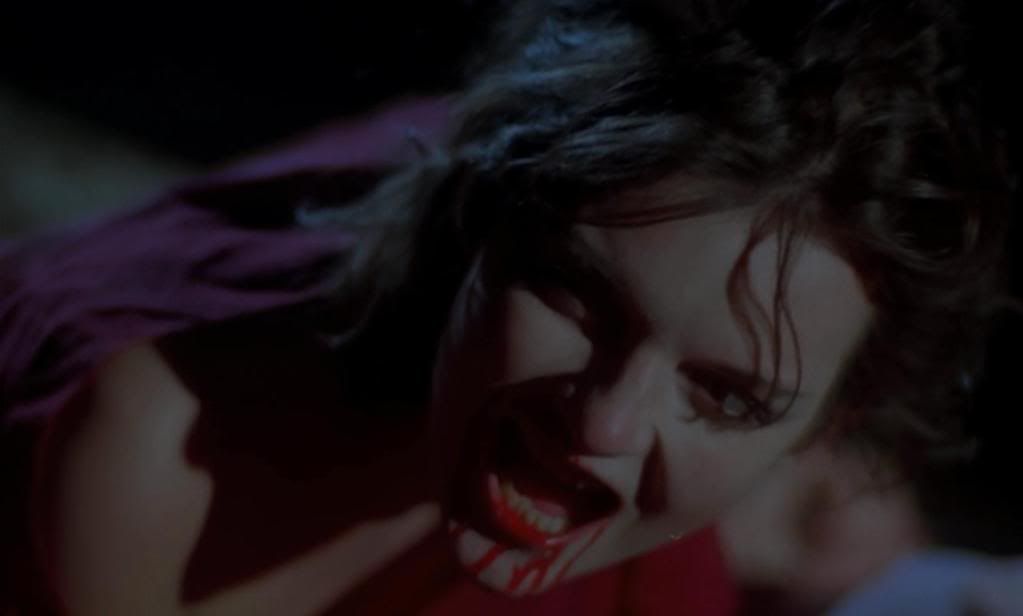
The film's most memorable cameo appearance comes from Brigitte Lahaie, an adult film actress who had appeared in one of Rollin's earlier porn ventures, and had apparently impressed the director: she'd go on to be an important muse in his next few features, and is here already a formidable screen presence. Her unnamed character (appropriately credited only as "la grande femme blonde") is a mysterious woman who Élisabeth encounters while fleeing from the zombies. Seemingly unaffected by the plague — in a typical Rollin flourish, she eagerly shows off her naked body to reveal the lack of rotting wounds — she nevertheless projects a curious, magnetic menace in her ferocious, teeth-baring smile. Her teeth permanently clenched, she looks like she's either holding back some intense inner turmoil or preparing to devour anyone in her path. She makes only a brief appearance here, but her unhinged, terrifying performance is unforgettable, especially since she also strikes some unexpected notes of poignancy within this portrayal of a deranged psychopath.

Moody, chilling, poetic and strangely moving, The Grapes of Wrath is another fantastic, utterly original horror piece from Rollin. It's slightly more straightforward and conventionally horrific than many of his earlier films, with more gore and action, but it's still primarily reliant on its dreamlike atmosphere, on the sense of an eerie journey across a haunted wasteland where the terror arises as much from the abstract aesthetics as from the actual supernatural or monstrous threat.

Monday, November 12, 2012

The Son


Jean-Pierre and Luc Dardenne's The Son is a quietly moving, remarkably intense film that hides a great deal of churning emotions beneath a deceptively placid exterior. In that, the film mirrors its protagonist, the mild-mannered and reserved Olivier (Olivier Gourmet), who seldom betrays a hint of the doubtless complex emotions bouncing around inside of him. Olivier is a carpentry teacher at a trade school, where he prepares young boys, many of them poor and from troubled homes, for careers as carpenters, gently and patiently instructing them in every small detail of the profession. When the film opens, Olivier receives a new candidate, a boy named Francis (Morgan Marinne), who he initially resists adding to his class, though he takes an immediate interest in the boy, shadowing him around the building and even following him home after class lets out.

The Dardennes build up some mystery and ambiguity around the character of Olivier right from the beginning. With his impassive, doughy face and his eyes obscured by the lenses of his glasses, he's difficult to read, his intentions and thoughts uncertain. There's an ambiguous tension here, in that it's not clear why he's taking such an interest in this boy, pushing him away by refusing to enroll him, and yet unable to resist any opportunity to catch a glimpse of the boy. The Dardennes' camera, hovering over Olivier's shoulder like a restless insect, buzzing around him but seldom catching a full head-on view of him as he stalks the boy, contributes to the somewhat sinister vibe of these scenes, the sense that something strange is going on here. The Dardennes leave the audience to wonder just what kind of man this is, his face filling the screen but his eyes not betraying any hint of what he's up to.

The mystery is eventually resolved, with the Dardennes' typical lack of fanfare, in a conversation between Olivier and his ex-wife Magali (Isabella Soupart). Her few appearances here, evincing an awkward, strained intimacy with Olivier, represent the only times when the film expands its scope beyond Olivier and Francis. For the most part, they are the only characters here, their quiet, inexpressive presences placed squarely at the center of the film. Olivier accepts Francis into his class and begins mentoring the boy, always with a dark secret from the past hanging over their interactions: Olivier knows that Francis, at the age of 11, had killed Olivier and Magali's son.


This knowledge informs the entire rest of the film, although it is never explicitly brought up again until the very end. The Dardennes adopt a restrained observational perspective, their restless handheld camera darting around as Olivier and Francis hesitantly interact, the carpenter teaching the boy, and often just staring at the boy, as though trying to process what he even thinks about this situation, what he thinks of this boy who stole his own boy from him. While Magali, when she finds out that Olivier is teaching Francis, reacts with understandable outrage and confusion — "no one would do this," she tells him, so "why you?" — Olivier seems to react with interest more than anything. It's as though he wants to understand, to make sense of the fact that his son is dead and that this seemingly normal, slightly dim-witted young kid was the cause. At one point, Olivier even steals Francis' keys and visits the boy's empty apartment on a lunch break, walking around the place and lying down on the kid's bed.

The film is intentionally somewhat distanced, despite its constant intimate closeups of Olivier: neither Olivier nor Francis is especially talkative, so most of their scenes together are nearly silent, with the only words exchanged being banal bits of carpentry instruction. The film is surprisingly affecting in its restraint: because the directors resolutely refuse to get inside of either of the central characters, the audience is left to wonder what's going on behind all these wordless, somewhat awkward moments. The tension of the early scenes lingers even after the mystery is solved, the threat of violence always implicit in the film's reserve. Is Olivier's placidness masking a deeper rage that might explode at any moment? Or is his interest in Francis driven simply by a spirit of forgiveness and a desire to understand?

The film's remarkable final sequence, in which Olvier takes Francis to a rural lumber yard on a weekend morning, answers those questions as the pair finally confront, slowly and incrementally, the truth about the pivotal event that ties them together. Even this dramatic climax is treated by the Dardennes with a sense of mundane realism, emphasizing the clumsiness and sloppiness of the chase sequence in which Olivier, after finally revealing his identity to Francis, chases the fleeing boy through the stacks of lumber. Despite how mundane it all looks, the Dardennes build a nearly unbearable tension throughout this whole sequence, the threat of tragedy or violence looming over everything; there's a sense of how fragile things are, how easily the quiet dynamic that had developed between the boy and his mentor throughout the film could suddenly turn ugly. The film's finale is a moving but ambiguous consideration of the possibility of forgiveness, with a wordless understanding passing between a man whose life had been torn apart by senseless violence, and a boy who barely even seems to understand what he did.

Wednesday, November 7, 2012

The Eye of Vichy


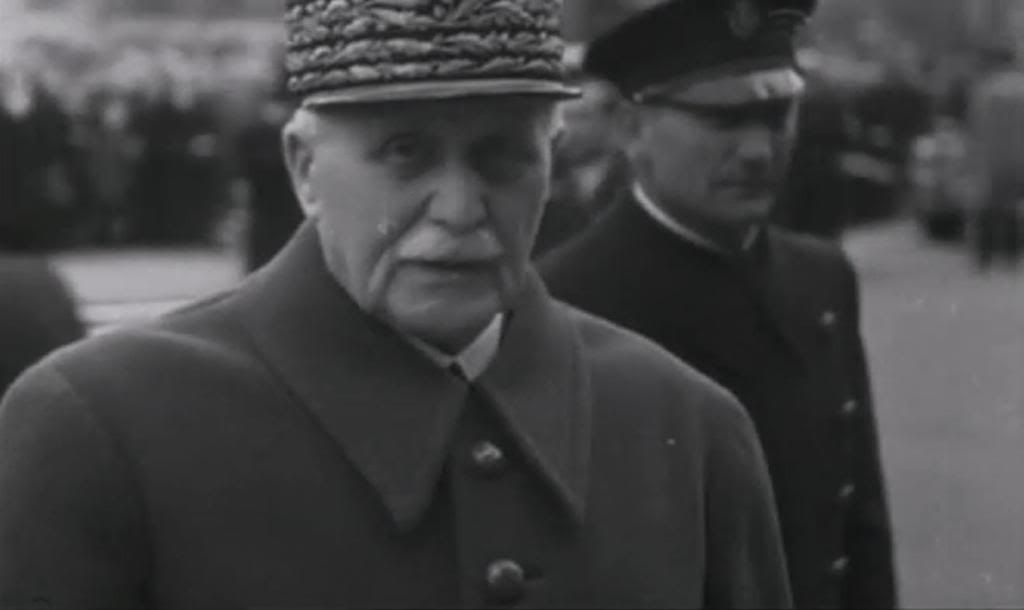
Claude Chabrol's The Eye of Vichy is a fascinating documentary that collages together newsreel footage and propaganda films from the Vichy era in France. This compilation of materials shown in French theaters between 1940 and 1944 is presented almost without comment. A narrator introduces the film with a condensed history of World War II leading up to the invasion of France and the establishment of the Vichy regime, and thereafter the narrator mostly falls silent except for providing occasional snippets of historical context. The film is thus constructed primarily from Vichy's own transmissions, the propaganda and slanted news shown to French citizens during the war. As the text at the beginning of the film says, this is France not as it actually was during this period, but as the government wished people to think it was. This is a montage of primary sources that lays bare the lies and distortions that served as a cloak for the Vichy government's sinister collaboration with the Nazis.

Much of Chabrol's fictional oeuvre is concerned with probing the pathetic absurdity and ugliness of the surface presented by bourgeois culture; his films simultaneously document the appearance and the filthy reality underneath. This documentary, otherwise so different in form and content from the rest of Chabrol's work, actually has a similar thematic focus, using the Vichy regime's self-presentation to pick at the ugly truths that are never quite obscured by the gloss of propaganda. One of Chabrol's guiding principles in his films has always been that one can tell a lot about a culture by the lies it tells (about) itself, which is why he has always been so successful in deconstructing and ridiculing bourgeois culture. Here, he turns that same incisive eye for the significance of lies on an entire government founded on lies. This seemingly straightforward presentation of those lies, with only limited overt commentary, reveals a great deal about the workings of Vichy France.

Much of the propaganda collected here is of the usual sort, idealizing and idolizing the new rulers of France — even if sometimes they're replaced, without ceremony, weeks later — and presenting rosy depictions of Franco-German harmony. One particularly twisted piece, intended to discourage French dreams of liberation, is a cartoon in which the Allies are depicted as Mickey Mouse, Popeye and Donald Duck, planning to bomb France while the British broadcast duplicitous messages of peace. Chabrol mostly lets the material stand on its own, only occasionally correcting the particularly subtle lies. The propaganda is so crude and obvious that, for the most part, no comment is needed.

At times, the propagandists can even be startlingly open about the horrors of the situation. One newsreel speaks of Resistance fighters killing two French officers, and says that 50 men have been killed in reprisal, and that 50 more will be killed tomorrow if the culprits aren't caught. It's so offhanded, so casual in the way this propaganda piece admits to mass killings — and who did they kill, exactly? Obviously, in the name of inspiring fear, the regime sometimes admitted to its own violence and repression.


Indeed, one striking feature of this footage is how often the propaganda echoes, almost subconsciously, the atrocities committed by the Nazis and their allies. The newsreels repeatedly show trains running between France and Nazi Germany, but of course these are not the trains loaded with Jewish prisoners, destined for the concentration camps. Instead, the films show trains leaving for Germany full of French unemployed people, supposedly going to Germany to work, waving goodbye with a smile as the train rolls out of the station towards the east. The trains also bring back French prisoners of war from Germany, with sentimental scenes of returning soldiers embracing their wives, childrens and dogs. In another sequence, made shortly after Germany's invasion of Russia, the French propaganda abruptly turns on the Bolsheviks with an exposé of a Soviet embassy in Paris, revealing the hidden passages and peepholes and, chillingly, some seemingly innocuous stoves that the news announcer compares, apparently without shame or irony, to crematorium ovens.

Later in the film, in one of the few overt examples of Chabrol's editorial commentary, Chabrol juxtaposes images of happy French children heading to the countryside on vacation with a dry recounting of the numbers of Jewish men, women and children arrested and shipped to camps during the same summer. The sequence continues with a documentary on the wartime gas industry in France, and another on the recycling of hair from barbershops into raw material for clothes. The narration continues to explain what the films, of course, do not, that during this period Jews were being sent en masse to Auschwitz for "immediate extermination," their bodies burnt up in ovens, their heads shaved, their possessions stripped and stolen from them before their deaths. The sequence is chilling, with the dispassionate voiceover probing the unspoken truth that Vichy hid in favor of these dry industrial documentaries, the imagery of which is nevertheless eerily resonant with the real state of things.

Another informational piece collected here celebrates the destruction of old, pre-war films to make shoe polish and nail polish, showing images of pre-war film stars melting down, piles of film stock being thrown into processing machines that turn them to muck. That disregard for celluloid must have especially galled the cinephile Chabrol, but more than that it represents an antagonistic perspective towards history and culture, a wish to erase the truths of the past and replace them with the new, manufactured history of the Nazis and Vichy. The new authoritarian regimes of the fascist block exerted complete control over the image, and any images that could not be controlled were simply destroyed. Chabrol's film is a potent and informative rejection of that ethos: rather than destroying the images of this hateful past, he assembles them into a historical record of repression and denial, incontrovertible evidence that some might like to see burnt up, recycled for consumer products. If Vichy tried to erase the past and lie about the present, this film presents these images for all to see, preserving rather than destroying the past.

Friday, October 26, 2012

The Swimming Pool


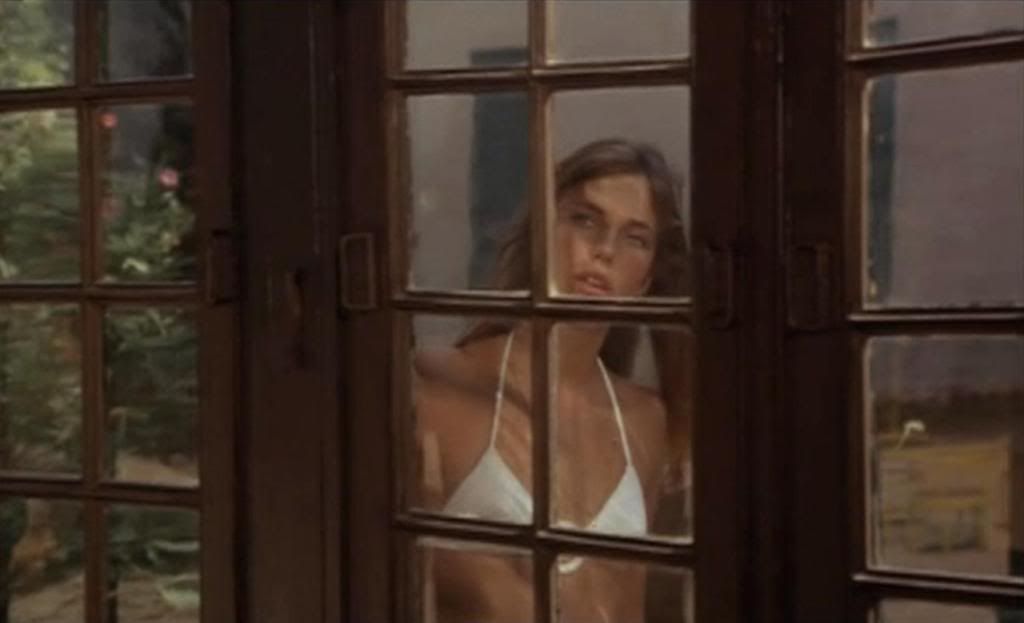
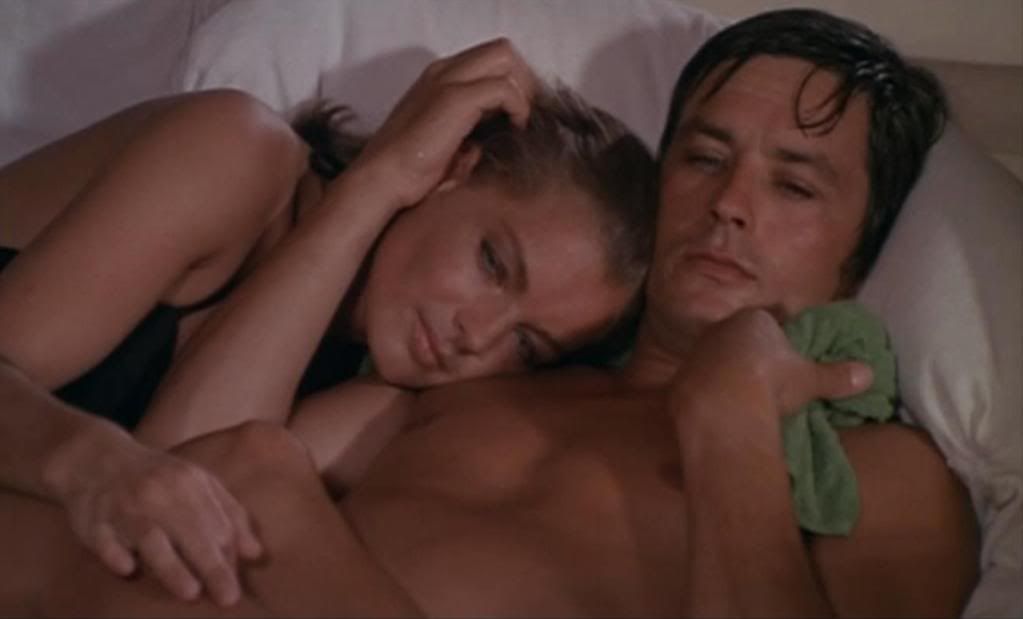
The Swimming Pool is an almost stereotypically French, stereotypically 1960s kind of movie. Directed by Jacques Deray, this languid thriller is centered around the titular pool at a Riviera villa where the settled, seemingly happy couple of Jean-Paul (Alain Delon) and Marianne (Romy Schneider) are spending a summer holiday. The film opens with an evocative, lazily sexy atmosphere of sun and water, the couple lounging their tanned bodies by the pool, wrestling poolside and passionately pawing and clawing one another. The film simmers and seethes with sex, Deray's camera sensuously drifting across the naked or near-naked bodies of the stars, capturing the clingy, sticky sensuality of these lazy summer days, their bodies warmed by the sun and sliding through the clear blue reflective water of the pool. The stars are beautiful, the scenery is beautiful, and the film has an almost savage, intense sexuality to it.

In the opening scenes, Marianne steps out of the water, sleek and dripping, and strolls around the pool to stand suggestively over Jean-Paul's reclining form, her legs slightly apart, her feet on either side of her head, so that he's staring up at her crotch. She then lays down with him and climbs on top of him, his hands scratching at her back, their bodies pressed tightly together. There's a desperate sexuality to their relationship, a raw physicality that's even more potently expressed in the somewhat later scene where Jean-Paul strips off Marianne's top and runs a tree branch across her bare skin, first gently and then whipping her with it like a lash, as though he's trying to both turn her on and to punish her, though for what it's not yet clear. When Marianne invites her former lover Harry (Maurice Ronet) and his daughter Penelope (Jane Birkin) to stay at the villa with them, the couple's seemingly happy, fulfilled relationship begins to strain, with Marianne's attraction to Harry rekindling while Jean-Paul finds his eye wandering to the coltish young body of Harry's daughter.

For a while, this simmering sexuality is enough, and the film gets by on the sexiness of its stars and the languidly beautiful imagery of their lazy summer idyll. Eventually, though, the film becomes slack, as lazy as its characters, content to set up this romantic and sexual tension without delving beyond the surface. Once Deray, working from a script co-written with Jean-Claude Carrière, sets up the basic premise of these criss-crossing desires and jealousies, the film stagnates, the tension simmering quietly but never really progressing beyond the charged exchange of glances and suggestive hints of infidelity. Even the violent climax is emotionally flat, and doesn't do nearly enough to shake up the characters.


That said, Deray provides some interest through the formal rigor with which he films this unfortunately static drama. This is a film in which nearly everything that happens can be boiled down to looks, glances, and Deray has a habit of honing in on the staring eyes of his protagonists, the camera slowly tracking in, the cuts drawing connections between one look and another. At one point, Penelope and Jean-Paul have been left alone at the villa while Marianne and Harry went out shopping together. Penelope finds Jean-Paul upstairs and stares nervously at his back, seemingly anticipating his seduction of her, and when he abruptly turns to face her, Deray captures him in closeup, his cool blue eyes taking her in, an unreadable expression on Delon's typically stoical face. At this point, Deray cuts away, not back to Penelope, but to Marianne, staring off into space, briefly distracted from her shopping by something, as though she could feel Jean-Paul's gaze, as though he were looking at her rather than the younger girl. The edit connects them even though they're apart, pairing off with others, starting to drift apart.

In another scene, later in the film, the camera tracks slowly across the couch where Jean-Paul and Penelope are sitting close together, watching a silent comedy on TV, and then begins crossing a gap that separates them from Marianne, sitting apart from them, the camera suddenly jumping and speeding up its movement as it approaches her to signify the disconnect between her and this newly forming couple. Deray also makes good use of window frames, which segment images of Penelope and Marianne in particular, the two women partioned behind glass, divided up by the games of jealousy and conquest that the men, former friends and rivals, seem to be playing here. The pool itself similarly distorts and reflects the action at the villa, creating wavery reflections in which everything is upside-down and elongated.

Deray's chilly, formally precise aesthetic makes for some striking, suggestive compositions, but one is still left with the impression that all this silent staring and affectless introspection doesn't add up to very much in the end. At its best, The Swimming Pool is sexy and sensuous, but its sexiness can only take it so far, and it's very difficult to locate the heart or the brain behind that sexy, fleshy surface.

Monday, October 22, 2012

Lips of Blood

[This piece was previously posted as a guest review at Jeremy Richey's blog Fascination: The Jean Rollin Experience, one of the Internet's very best resources on Rollin.]

Jean Rollin's best films use B-movie horror plots and low-budget production values as portholes into an eerie, unsettling dream world that ultimately has little to do with typical blood-and-gore horror movies. This is especially true of Lips of Blood, one of the director's finest works, and one of his most dreamlike and abstract. The film is a slow, sensuous study of the power of memory and the lure of childhood fantasies, a feverish dream of a film that chronicles a quest that's as much mental as physical.

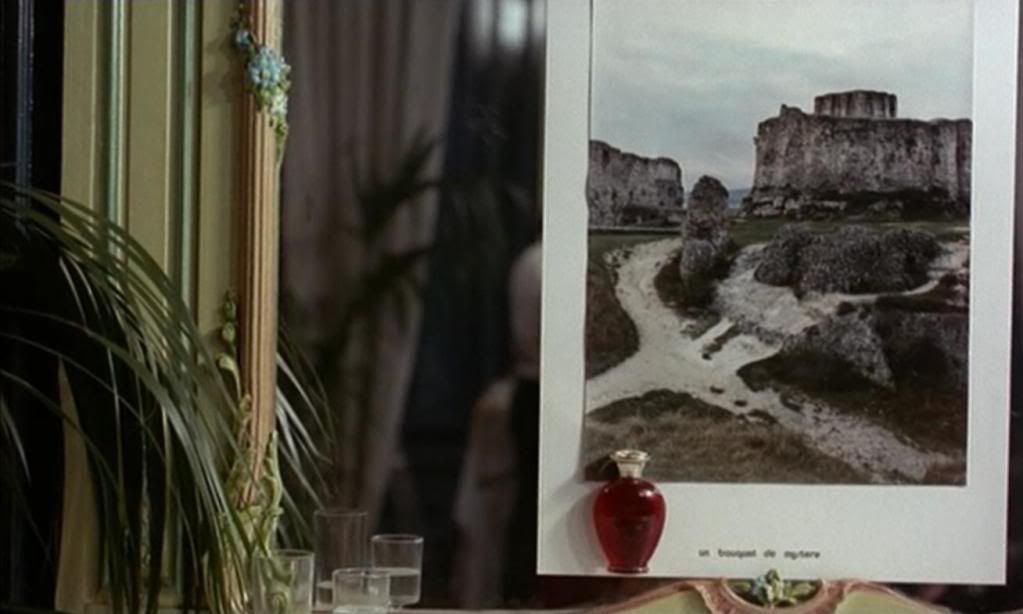
Frederic (Jean-Loup Philippe) is at a party when he sees a photograph of a ruined castle that triggers a previously suppressed childhood memory or dream. He comes to believe that he's been to this castle as a boy, and that he's forgotten it for some reason; his childhood is a blur to him, and he's long felt disconnected from the stories that his mother (Natalie Perrey) has told him about his forgotten boyhood. The photograph instantly opens a path into his memories, stirring up images of a dreamlike night that he spent in the castle, watched over by a beautiful young girl (Annie Belle) dressed in white. He'd repressed the memories of the castle and the girl, but now that they've entered his mind again, he becomes obsessed, fixated on discovering the castle's whereabouts and trying to locate the girl.


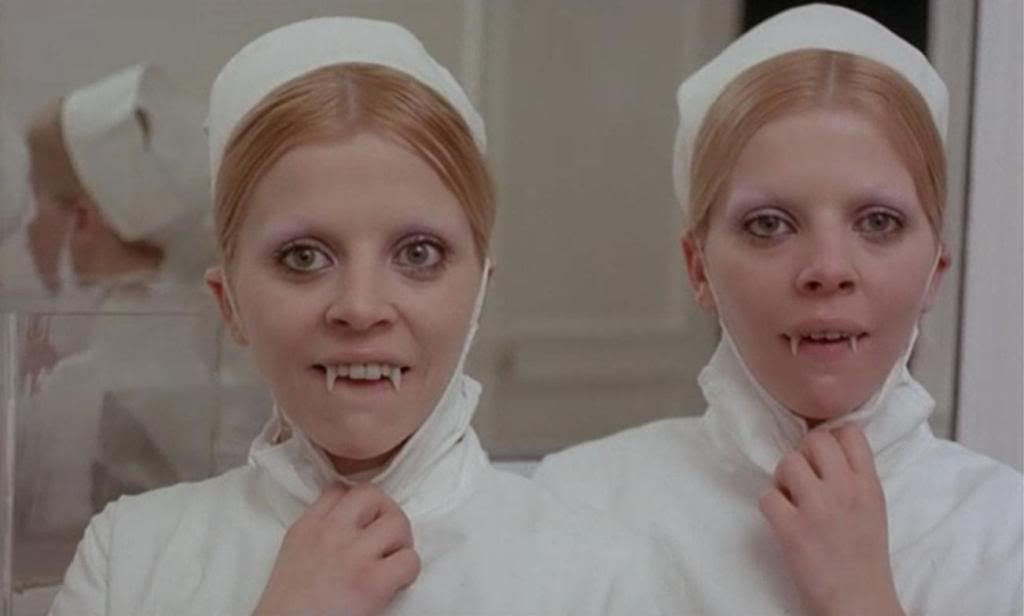
Frederic is haunted by this dreamlike memory, and the film is all about the power that this fixation has over him. At the party at the beginning of the film, he compliments a girl on her perfume, prompting her to pointedly respond, "scents are like memories; the person evaporates but the memory remains." In Frederic's case, the memory too had evaporated for twenty years, but now it's wafted back up into his senses, and he begins seeing the mysterious girl from the castle everywhere. He goes to see a movie — the poster outside is for Rollin's The Nude Vampire, but the theater's actually showing The Shiver of the Vampires, suggesting how intimately connected all these gothic vampire fantasies are — and the girl appears in the theater, beckoning him to follow her. She leads him to a crypt, where Frederic unwittingly releases a quartet of creepy vampire girls (Catherine and Marie-Pierre Castel, Anita Berglund, and Hélène Maguin) who shadow him throughout the rest of the film, continually intervening to rescue him from the mysterious forces that seem intent on stopping him from locating the castle or the girl who dwelled within it.

The film moves at a typically lethargic, dreamlike pace, blending gothic horror imagery — bats and graveyards and vampire girls clad in gauzy robes — with a weird conspiracy thriller vibe. A photographer (Martine Grimaud) who tries to tell Frederic about the castle winds up dead, another woman poses, unconvincingly, as the girl from the castle, and a mysterious assassin tracks Frederic through the night, while the vampires stalk around the fringes of the plot, fading out of the shadows. Rollin's films have often been comparable to the surreal quest narratives of his contemporary Jacques Rivette, with worse acting and more nudity, and nowhere is that comparison more relevant than here. Rollin renders the city as a quiet, nearly unpopulated stage, pools of colored light highlighted in the darkness, shadows cast large and threatening on stone walls as Frederic wanders around the city, searching for answers and chasing phantoms through the streets.

The film feels like a loosely connected series of set pieces, with Frederic's frazzled state of mind creating the sense of disorientation and confusion that dominates his increasingly desperate journey. He begins to doubt his own sanity: the girl from his memory, or his dream, pops into being and blinks out of existence just as suddenly, leading him through the night, eventually guiding him directly to the answer he seeks, the location of the castle from the photo. Meanwhile, the vampires attack and kill random people, baring their uncomfortable-looking fangs and bloodying their mouths on the necks of their victims. At one point, the Castel sisters disguise themselves as nurses in order to rescue Frederic from the mental hospital where he's been locked up by his mother, who seems to know something about all these secrets and mysteries.


Indeed, Frederic's mother provides the obligatory burst of exposition that suddenly explains the story towards the end of the film, setting up the fantastic final act in which Frederic confronts the true nature of his reawakened memories. He's found what he's been searching for, and in the final ten minutes of the film Rollin adopts a tone of lunatic celebration, reveling in the embrace of the supernatural and the bloody. The supernatural is rarely to be feared in Rollin's work. The supernatural is, instead, erotic, alluring, haunting, beautiful, a fixation for Rollin just as the castle becomes for Frederic. There is thus an air of real melancholy in the final act's confrontations between vampires and vampire hunters; Rollin's sympathies are obviously not with the men with their stakes, menacing these girls, but with the vampires themselves, so young and lovely and sensual, retreating in fear before the men. The vampires are the real victims, not to be feared or hated but desired, respected, adored, just as Frederic desires the girl from his memory, who is, of course, also a vampiress, using her power to lure him back to her, to get him to set her free.

Rollin makes the embrace of the supernatural a cause for celebration here, particularly in the ecstatic coda, in which the long-imprisoned vampire relishes her newfound freedom, taking pleasure in the sensuality of nature. Together, Frederic and his vampire love run along the striking, apocalyptic, by now very familiar beach that so often symbolizes the pathway between worlds in Rollin's work. It's here that Frederic embraces his fate and is reborn, and in the finale — at once gloriously silly and wonderfully romantic — the lovers sail off together in a coffin, heading off into a new undead existence together.