Showing posts with label Jean Renoir. Show all posts

Wednesday, September 26, 2012

Nana


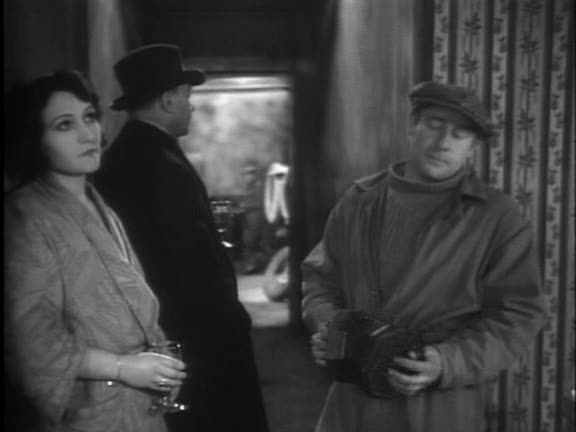
Jean Renoir's second silent feature, Nana, is a tragic, melodramatic satire based on an Emile Zola novel about a failed actress who becomes an obsession of multiple upper-class men, corrupting the noble class with her crass, vulgar ways. For the role of this remarkable young woman, Renoir cast his then-wife Catherine Hessling, the star of several of his earliest films and an actress who was, to say the least, something of an acquired taste. Bold, brash, and extremely limited in her range, Hessling was nevertheless something of an inspired choice to play the corrupting influence Nana, who leads men to their doom with her pouting and mugging, her shameless flirting and her manipulative use of her own sexuality.

It's very interesting that Renoir would cast his wife in a role like this, and the film creates some bizarre subtexts surrounding this woman. Renoir is casting his wife as a terrible actress who's stereotyped as a tramp and a seductress, not fit for serious or "elegant" roles; when she tries out for the part of an elegant duchess, her fellow performers laugh her out of the room. When she gets the part anyway through the influence of her wealthy suitor, Count Muffat (Werner Krauss), she's booed off the stage, though Renoir at least spares her that indignity with an ellipsis, showing her running offstage in tears afterwards. Nana is brash and vulgar, defiantly lower-class, but somehow she manages to attract all these stuffy upper-class men who are seduced by her sour-puss scowl and her hip-shaking insinuations of sexual abandon. When Nana gets up on stage and dances lustily, she earns raucous cheers, and Renoir highlights the class divide in the audience by showing the lower rows recklessly getting involved in Nana's bold performance, while when some of the gentlemen in the more sophisticated regions of the theater get caught up in the act, those around them display their disdain for such unfettered shows of appreciation.

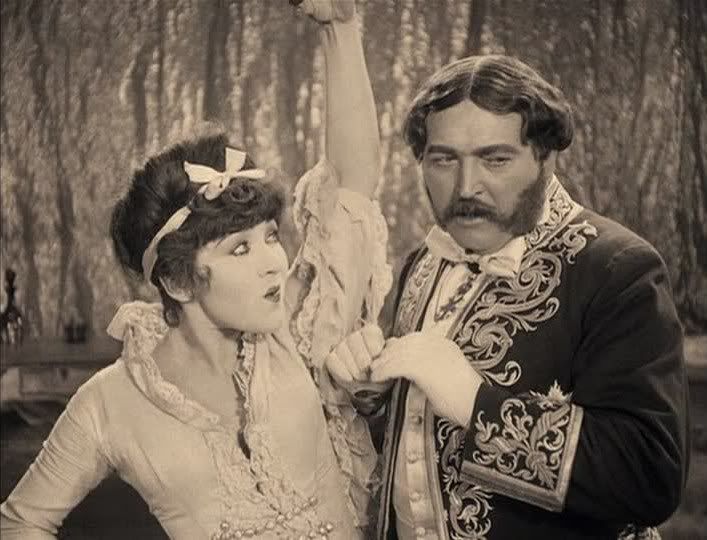
In many ways, Hessling's limited range actually makes her a perfect fit for Nana. She can be a frustrating actress, displaying the same sour expression and widened eyes for virtually every emotion from sadness to ecstasy, but Nana's not exactly supposed to be a subtle or likeable character herself. She's a force of nature, an embodiment of the lower-class invasion of the nobility, a theme that Renoir would go on to explore far more subtly and powerfully in later films, but is already at the center of this sophomore film. Nana revels in her humiliation of these wealthy men with their titles and their fortunes: in one of the film's most potent sequences, she actually makes Muffat beg like a "fat little puppy" for a piece of chocolate, placing his hands under his chin like a dog begging for a treat. She debases these men, driving them to crime and fetishism. One of her suitors, the effeminate, ineffectual young Georges (Raymond Guérin-Catelain), hides in her closet so he can smell her dresses, from which vantage point he witnesses Muffat's debasement, which seems to teach him something ugly about himself as well.
Though Nana quits the stage towards the beginning of the film, in many ways she remains an actress in her new "career" as a courtesan, performing for men, acting out a glamorous lifestyle that elevates her above her previous station into the company of sophisticated men with fancy titles. Renoir repeatedly films her luxurious room in wide shots that make it look like a stage, complete with proscenium arch. Nana leaves the theater but makes her whole life a kind of performance instead, another way in which Hessling's theatrical performance style fits this character so well.

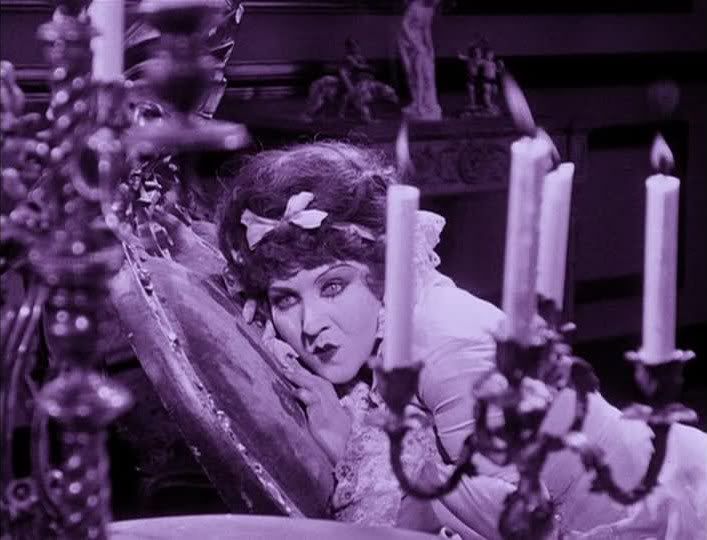
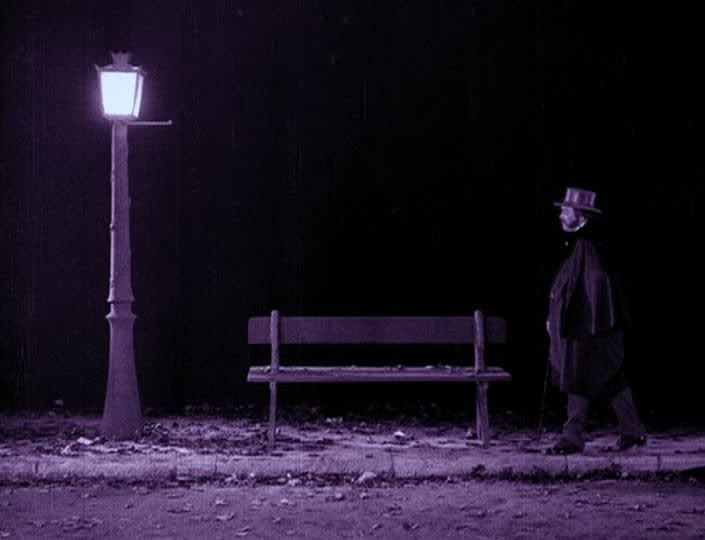
Renoir, working under the strong influence of Erich von Stroheim, adopts a lush, sophisticated, self-assured style here, very different from the blend of naturalism and surreal visual effects in his debut La fille de l'eau. The film's style is big and lavish, capturing the trappings of wealth and privilege that Nana so incongruously wraps around herself. But Renoir also movingly depicts the emptiness and melancholy lurking at the center of this lifestyle: all this money, the manipulations and seductions, leaves this gaping emotional hole that's filled with suicides and psychologically motivated illnesses and the other usual melodramatic tragedies, but also with a general atmosphere of gloom that's communicated in Renoir's elegant visual style. There are numerous shots here that capture that melancholy undercurrent: Nana reclining on her couch, her face framed by flickering candles; Muffat strolling through a dark night that closes in around him, lit up only by a lamp post high above, barely piercing the inky blackness that smothers him.

Nana is an early indication of Renoir's satirical sensibility being directed at the bourgeois and the nobility, with Hessling's Nana serving the same casually destructive role that Michel Simon would later take on in more refined, fully developed films like Boudu Saved From Drowning. Renoir was still finding his voice here, but Nana is still both a fine film in its own right and an early glimpse of the director's developing style and concerns.

Wednesday, May 23, 2012

La fille de l'eau


La fille de l'eau was Jean Renoir's first feature, the melodramatic story of young Gudule (Renoir's then-wife Catherine Hessling), whose father dies, her uncle (Pierre Lestringuez) abuses and attempts to rape her, and she's left on her own to endure a series of torments. After settling in with a group of gypsies, she's left on her own again when a conflict between the gypsies and the local farmers escalates into violence. She's then taken in by Georges (Harold Levingston), a shy young man who cares for her when she has nobody. Only the return of her drunken, nasty uncle threatens the happiness she finds with Georges and his family.

The story is fairly prosaic, and Hessling's dramatic range seems to be limited to staring at the camera with her admittedly striking eyes wide and her lips parted in an expression of terror or sadness, but there are definite signs of the director's talents in this very visually inventive debut. Some characteristic Renoir attributes are already in place here, like the naturalistic depiction of the picturesque countryside and the emphasis on class inequalities. This is especially apparent in the farmer Crepoix (Pierre Champagne), who begins harassing Gudule and the gypsies after Gudule's dog accidentally spills his bike. This petty, vindictive man physically assaults them and shatters their fishing traps, then brags about his exploits in town. Crepoix and the other farmers aren't even rich, but they're clearly at a higher social level than the nomadic gypsies, and with the exception of Georges' family, the townspeople lord this power over those beneath them.

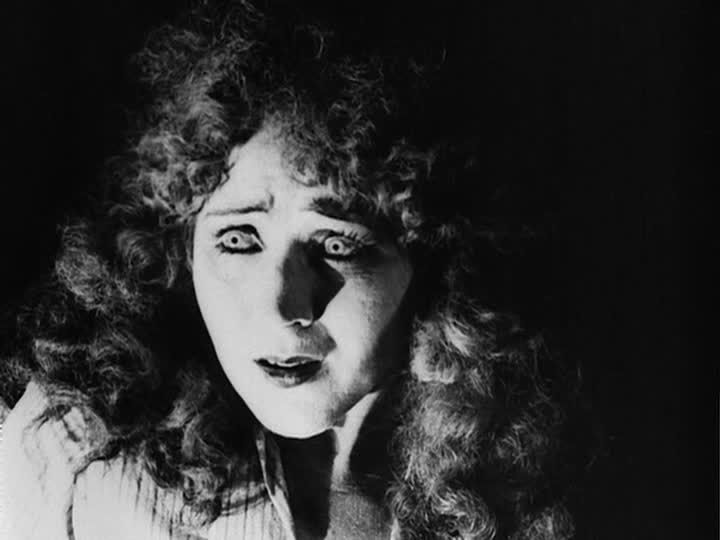
What's really interesting about the film, though, is Renoir's inventive editing and aesthetics. At several points within the film, Renoir employs a jagged, rapid cutting style that feels surprisingly modern. In one scene, Gudule witnesses the burning of the gypsies' caravan before fleeing into the woods to escape from the angry townspeople. The next morning, she falls down a quarry, and Renoir cuts to a closeup of her face, surrounded by a frizzy halo of wild hair, followed by a rapid montage of very brief shots clipped from the previous night's torment, a subjective flashback montage that emphasizes how traumatic these images are for her. Each image lasts only a second or two, calling back the haunting nighttime images of flickering flames, the faces of the locals watching happily as the caravan is engulfed by fire. Later, when Gudule's uncle returns and she runs into him on the road, Renoir cuts rapidly back and forth from one face to another, a technique that recalls the much slower, tension-building approach he'd used in the earlier scene where the uncle nearly rapes Gudule. In that scene, too, Renoir had used alternating closeups, with the uncle gradually approaching, his face filling the frame, with the camera creeping closer and closer to Gudule as well, until her face was a blurry smear of terror. Renoir also highlights just the uncle's eyes in one shot, enclosing them in a rectangle within the frame, surrounded by black, calling attention to the act of looking, the act of looking at his niece with sexual predation.


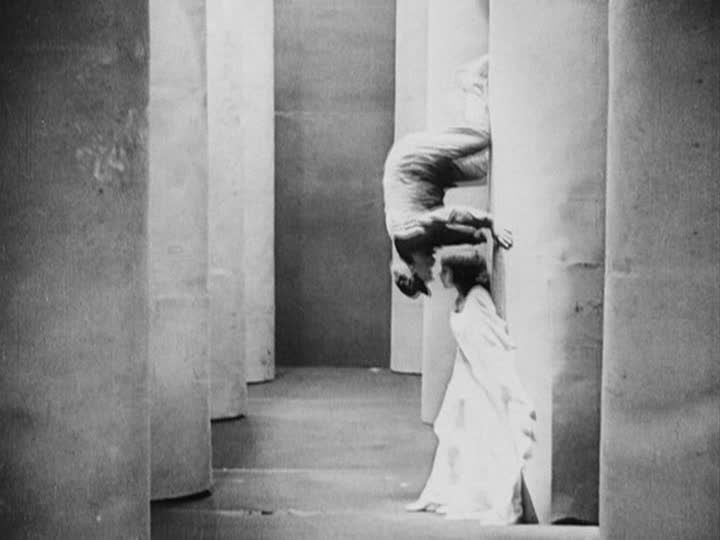
Also very noteworthy is a long sequence in which the abandoned, feverish Gudule sleeps in the woods on a rainy night and has a strange, surreal dream that provides an opportunity for Renoir to indulge in the kind of hallucinatory visual effects that he often employed in his early silents. This is an extraordinary sequence in which Gudule drifts across the countryside, superimposed in ghostly, washed-out white, while encountering a barrage of surreal imagery. She runs across her uncle — suggestively holding a snake while leering at her — and Crepoix, and the two men appear as evil sprites haunting her throughout this dream. Renoir uses multiple superimpositions, runs the film backwards to make it seem as if Gudule is flying from the ground up into a sitting perch on a tree branch, and, in one unforgettable sequence, has the two men running across the frame sideways or upside-down from Gudule's perspective.

This unsettling, effects-laden dream sequence stands out here, anticipating the even more dazzling way in which Renoir would use this kind of surreal dream in his heartbreaking The Little Match Girl. Here, it's a momentary break in the low-key reality of this film, which drifts along without much bombast despite the melodramatic plot. This is an auspicious debut for Renoir, a film that's as attentive to the beauty of nature as it is to the plight of the heroine. This is especially obvious in the tranquil early scenes of the girl and her father on their riverboat, punctuated by evocative closeups of Gudule, her hair ruffled by the wind. Despite its predictable plot, La fille de l'eau is worthwhile for its union, uncharacteristic of later Renoir, of naturalistic photography with choppy editing flurries and fantastical optical effects.

Monday, April 2, 2012

La Chienne


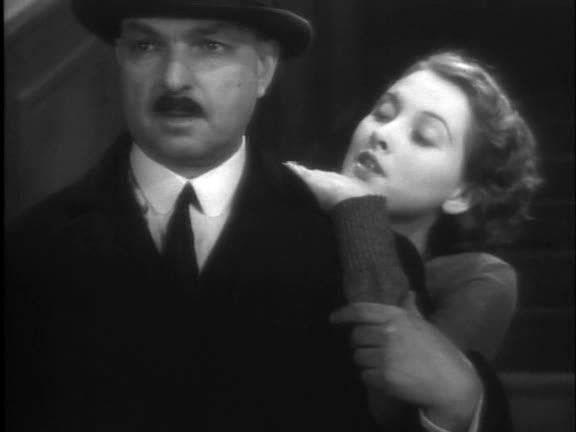
Bleak, tragic, affecting, and at times surprisingly humorous, Jean Renoir's La Chienne is the melancholy tale of a poor schlub who gets in way over his head. Maurice Legrand (Michel Simon) is a low-level cashier, a reserved, quiet guy who's the butt of everyone's jokes because of his social awkwardness and his notoriously nasty wife Adèle (Magdeleine Bérubet). She shrilly browbeats him over the most insignificant things and is constantly comparing him, unfavorably, to her dead first husband, a war hero whose dashing portrait she proudly hangs in the parlor as a reminder of all the ways in which Legrand fails to measure up. Simon delivers a sensitive, heartbreaking performance as this broken and beaten man, his tall frame constantly stooped over, his face droopy and locked into a frown of resignation. He's a forgettable lump of a man, plodding tiredly through life, his only pleasure coming from his painting — a hobby that his wife takes every opportunity to insult him about.

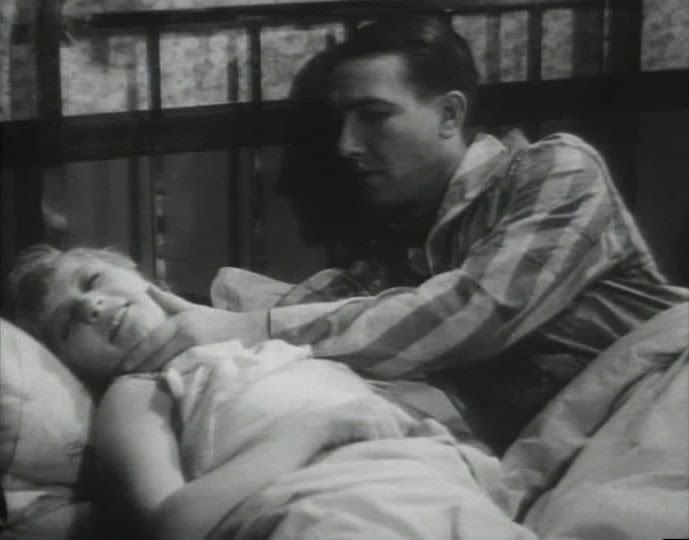
As sad as his life is, though, his attempt to escape this pathetic existence only gets him into even more trouble, when he falls in love with the prostitute Lulu (Janie Marèse). Lulu's a crass opportunist who latches onto Legrand only to get money for her pimp and boyfriend Dédé (Georges Flamant). Legrand, naïve as he is, adores Lulu and doesn't even realize that she's only using him while pining for Dédé, who's as disinterested in her as she is in Legrand. This dysfunctional love triangle plays out with brutal emotional honesty. Even as Legrand's earnest love leads him to ruin, Renoir explores the cruel irony of Lulu being mistreated in turn by Dédé, who never displays a moment of tenderness with her, roughly grabbing her face to kiss her, after which she beams with joy; she's as oblivious as Legrand is.

What's great about the film is the somewhat haphazard unpredictability of its plotting and its juggling of tones. It's a twisty film where the reversals and ironies are anything but cheap, but instead provide bitter commentary on the follies of the characters and the society in which they live. Probably the best example is the subtle humor of the scene where Adèle's "dead" husband Godard (Roger Gaillard) returns, thinking that Legrand would pay him off to stay away, but instead the unhappily married Legrand is all too eager to simply step aside, responding with exaggerated courtliness to the other man's attempted bribery. It's hilarious to watch the dawning fear on Godard's face as he desperately lowers his bribe demand and begins to realize that his plan might backfire on him.


Renoir's style gives the film a deceptively off-the-cuff look, contributing to its low-key realism, but there's great precision in these seemingly casual images. In particular, Renoir often shoots frames within the frame, which call back to the film's opening, a fourth-wall-breaking Punch and Judy introduction which frames this story as an explicitly fictional narrative and promises, somewhat facetiously, that there will be no moral to the story. The prevalence of frames and mirrors surrounding these characters, creating additional layers within the film frame, is a reminder of the dramatic artificiality of this story. In one such shot, Legrand comforts Lulu, sitting on the bed and embracing her, framed by a window, flanked by flowers sticking up from the bed in front of the window. This striking shot recurs in a very different context later in the film, but these frames are everywhere: in the mirrors that reflect Legrand as he shaves, and in the deep focus shots that show Legrand's neighbors doing household chores in the windows across the way.

Even more powerful is the pivotal moment when Legrand discovers Lulu in bed with Dédé. There's a long silence as Renoir cuts to outside, the camera peering through the window at the lovers in bed, then tracking to the right to reveal Legrand standing in the doorway, looking in at them. The distance of the image reflects Legrand's sudden feeling of disconnection, as though he's floating outside of himself, looking in on this scene from a safe distance. Renoir then cuts directly to a closeup of Lulu, lamely trying to justify her actions, which shatters the shocked contemplation of the exterior shot. Renoir also gets a lot of mileage out of the slanted street in front of Lulu's house, and the twisty, shadow-strewn expressionist staircase that leads up to her flat. Her place seems to be built on unstable ground, and all these jagged, crooked lines and serpentine curves emphasize just how far off the straight and narrow path the normally conservative Legrand has wandered whenever he goes to visit her.

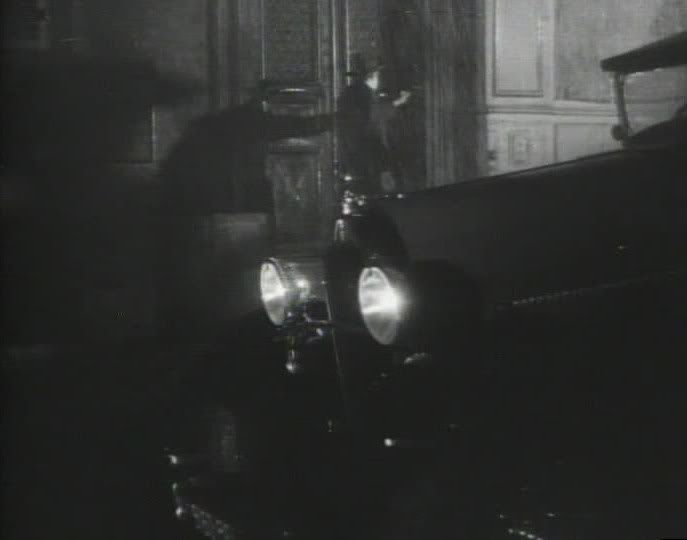
The film almost gleefully embraces the moral confusion of its protagonist, whose very normality ultimately allows him to, quite literally, get away with murder. Towards the end of the film, Renoir cleverly shows Legrand slouching discretely away, unnoticed, while the flashy pimp Dédé pulls up in a fancy new car. The film's conclusion suggests that Legrand, a respectable member of bourgeois society and a white collar worker, doesn't have to pay for his actions, at least not in a legal sense, when there's a far less respectable scapegoat at hand. The film ends with a weirdly tragicomic epilogue, in which Legrand and Godard meet up as hobos, years later, both of them gruff old men cackling about their shared fate. When Legrand confesses that he has become a murderer since they last met, Godard simply stares at him for a moment and then shrugs, "it takes all kinds." This cheerful amorality is part of Renoir's vicious satire of the bourgeois, and this ending serves as a prelude of sorts to Boudu Saved From Drowning, in which Renoir again directed Simon as a tramp stomping on middle class respectability; by the end of La Chienne, Simon's Legrand seems primed to become Boudu. La Chienne ends with Legrand telling Godard, without irony, "life is beautiful." As the two men walk away together, Renoir pulls back, through a window that's then revealed as the proscenium of a theater, the curtain falling on this sordid little human drama.

Tuesday, July 5, 2011

Partie de campagne


Jean Renoir apparently left Partie de campagne unfinished, but to watch the film as it exists, assembled into a 38-minute short from the footage he shot before abandoning the project, one would never guess. Based on a Guy de Maupassant story, it is a sumptuous, sensual, subtly moving film that extracts great and surprising pathos from a simple situation. The family of the bourgeois shopkeeper Dufour (André Gabriello) takes a weekend trip to the country for a picnic, a day of relaxation for the women and fishing for the men. Dufour brings along his wife (Jeanne Marken), his daughter Henriette (Syvlia Bataille), his old, deaf mother-in-law (Gabrielle Fontan), and Henriette's fiancé Anatole (Paul Temps). While there, a pair of local young men decide to seduce the women in the party, setting their sights on Sylvia and her mother, while the shopkeeper and Anatole remain oblivious, concerned only with a day of fishing.

It's a comic set-up, and Renoir plays it as such for much of the film. Anatole especially is a comic figure, an utter dunce who looks and acts like a dim-witted Stan Laurel to Dufour's blustery Oliver Hardy. Dufour is constantly lambasting his future son-in-law for his stupidity, and the young man simply cringes and whimpers and accepts the verbal beatings. He's obviously a poor match for the pretty, dignified Henriette, who's sensitive and sweet and loves the sensual pleasures of the countryside. Renoir, for his part, is clearly aligned with Henriette's wide-eyed appreciation of the world around her. Renoir's filmmaking is dazzling and intoxicating, wrapping the viewer in the sunny, warm atmosphere of a country day. As the party arrives at a small country inn and begins setting up for their picnic, Renoir cuts away from the bourgeoisie to the country folk, the innkeeper and his employees and friends, as they prepare to serve the guests. The young boatmen Henri (Georges d'Arnoux) and Rodolphe (Jacques Brunius) sit inside, eating and talking, with the more outgoing and sexually voracious Rodolphe trying to convince his friend that they should pursue a dalliance with the women among the new arrivals.

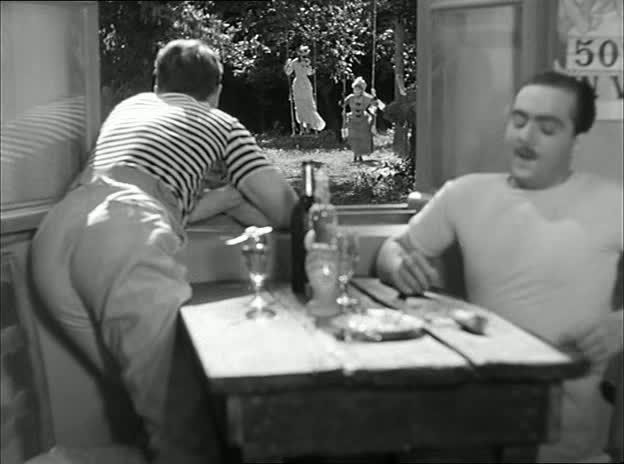
His chatter is unconvincing to Henri, who insists that his philandering days are behind him, but Rodolphe's point is made more emphatically when he throws open the window behind the two men, framing the idyllic scene outside as though it were a painting hanging on the wall. The two men in the foreground go out of focus as Renoir brilliantly frames the scene outside, a brightly lit rectangle of pure summer joy centered as a smaller frame within the film frame. Henriette and her mother swing back and forth outside, the sunlight filtering through the trees and dappling the ground with alternating spots of shadow and light. The exterior landscape is crisp and clear and invigorating in comparison to the gray fuzziness inside the inn; it's an invitation to languish in the sensual pleasures afforded by nature. Renoir's closeups of Henriette as she rides the swing are especially ravishing, as the girl smiles and laughs, her face rushing up towards the camera and towards the sky, towards the sun that beats down on her, bathing her in light.


The film meanders along in this way, lingering on scenes of beauty and peacefulness as the two young men begin their seduction against the backdrop of this natural splendor. The film is often light and funny, as the flirty, vivacious Madame Dufour instantly takes to her obvious counterpart, the predatory ladies' man Rodolphe, despite the latter's desire for the younger girl. Henriette is instead paired up with the sensitive, quiet, romantic Henri, and during a beautifully filmed boat trip, these two romances wind towards their inevitable conclusions. Henriette is especially attuned to nature, delighting in the details of life and vitality that she finds everywhere in the country. She admires a caterpillar and wonders at the richness of the tiny lives that scurry everywhere through the grass beneath her feet. Do these bugs also feel joy and sadness as people do, she wonders aloud; it is obvious that she is a girl who feels deeply and intensely, and it's hard to see what the oafish, oblivious Anatole, who virtually ignores her and wants only to go fishing, can have to offer her.

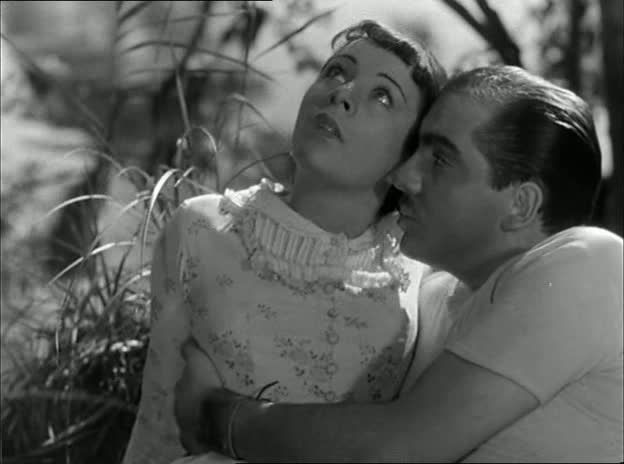
That's why, despite the film's rich humor and sensuous beauty, there's a strong undercurrent of sadness and despair running beneath its surface. Henri and Henriette spend a wonderful day on the river, as he rows her upstream towards a secluded spot where they sit together, listening to a nightingale's song, and inevitably wind up kissing amidst the reeds and tall grass. The sequence ends with a rainstorm that seems to portend the return of sadness after this brief respite of pleasure and holiday atmosphere. The wind begins to blow, shaking the trees and the reeds by the water, and the surface of the river ripples to life with tiny droplets of rain bouncing off the water, creating thousands of tiny pinprick splashes. Renoir's camera floats across the surface of the water, pulling back as though leaving this country idyll behind. This day of sunlight and celebration is over, the clouds have drifted in and the rain is falling. A title card announces that several years then pass, and that in the meantime Henriette has married Anatole.

It's possible that this sudden leap forward indicates the part of the film left unfinished, but if so the omission is only to the benefit of the film's effect. The passing over of several years of undoubted boredom and marital complacency suggests just how much was washed away by that storm, and just how fleeting the pleasure of that riverside dalliance was. After the text fills in the intervening years, Renoir returns without pause to the country river where the earlier picnic had taken place, as though no time at all had passed. The place is as beautiful as ever, and Henri still drifts along the river on his boat, but his reunion with Henriette after these missing years has a very different tone, poignant and regretful, infused with longing for what once was and might have been. It's a moving, mournful ending, cut with an undercurrent of dark humor as Henri watches his onetime lover row away, Henriette at the oars while her useless husband languishes in the boat's prow. It's the opposite of the way in which Henri once rowed her to this secluded spot to seduce her, and as he watches her row away, partially obscured by the leafy foliage overhanging the river, this last little comic touch becomes almost unbearably sad. What a wonderful, rich, warm, intelligent movie!

Tuesday, May 11, 2010

La nuit du carrefour


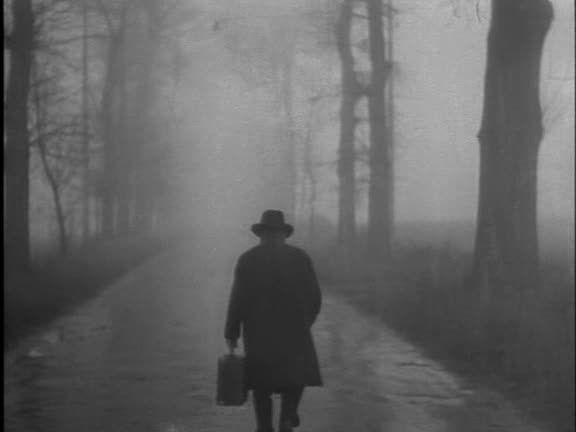
Jean Renoir's La nuit du carrefour is a rough, gritty film noir, set, as its title suggests, in a seeming perpetual night at a sleepy rural crossroads, a small settlement with just three houses and a gas station. This way station is always bathed in fog, isolated in the middle of the looming woods, where mysterious figures skulk through the dark on strange errands. A man shows up dead here, a jeweler, his body left in a stolen car in the garage of the Dutch immigrant Andersen (Georges Koudria), who insists that he's innocent. The French police suspect otherwise, but have nothing to prove it, and so they send the wily inspector Maigret (Renoir's brother Pierre) to investigate. Maigret is a great cinema detective in the traditional mold, clever and intelligent, able to piece together the facts from minimal evidence, observing every small detail and making deductions in the manner of Sherlock Holmes. In trying to make sense of this crime, he's confronted with no lack of suspects, but rather too many: Andersen's seductive sister Else (Winna Winifried), a true femme fatale; the gas station owner Oscar (Dignimont); Jojo (Michel Duran), the gas station attendant who flirts with Oscar's wife when no one (except the audience) is looking; the bourgeois Michonnet (Jean Gehret). All these people act suspiciously, creeping around, dropping knowing comments; they all seem to have some secret, to be willfully drawing suspicion to themselves, wandering through the foggy nights with guns, poisoning bottles of beer, smuggling contraband. Maigret seems to have stumbled into a confluence of odd events and shady characters.

Renoir builds this atmosphere brilliantly. His storytelling is extremely elliptical, marked by diversions that give the editing an abrupt, choppy rhythm (and it doesn't help that one reel of the film was lost outright, though such accidents seem appropriate for a film that already must have been especially loose and rough). When Andersen is first brought in for questioning, Renoir cuts away periodically to a curb-level shot of a local newsstand, capturing the passage of time through the transition from early edition to afternoon edition to evening edition to the evening paper getting swept away the next morning. Later, he frequently cuts away to some seemingly random event, some of the area's residents doing some inscrutable action, acting strangely. The night, and the fog hanging low over the tree-lined dirt roads, also serve as punctuation. At one point, in one of the most surreal interjections, Else is seen lying in her room, lazily smoking a cigarette, as a turtle crawls slowly along the bed next to her; it's baffling but evocative. The missing reel can only explain so much; at some point it becomes obvious that Renoir just doesn't seem especially concerned with narrative clarity. It's seldom clear who's shooting at whom until the obligatory parlor scene at the end, when the detective explains the film's events with such coherence and detail that one wonders how he managed to get all that out of this strange string of events.

That's part of the fun, of course, and Pierre Renoir plays the inspector with such charm and wit that his investigation, elliptical and aimless as it is, is seldom anything but entertaining to watch. Maigret always seems to have a little smirk on his lips, even when they're wrapped around a pipe. He's ahead of everyone else, and he knows it very well. Renoir lets the audience in on his deductions by drawing attention to the relevant objects at precisely the moment that Maigret notices them: a box of cigarettes that should be too expensive for its owner to afford regularly, a spare tire that doesn't match the truck that takes it. But the mystery isn't the point here. Instead, it's Renoir's power of observation that's being showcased. He's as interested in the details that reveal something about human behavior as the ones that reveal something about the mystery. This milieu is wonderfully detailed, with so much activity always going on in the fringes. It's rare that Renoir puts some action in the foreground and nothing else. The frame is always bustling, packed with nuances, like the way that, when Maigret calls the police station, the workers at the gas station go about their business all around him, while his boss at the station is surrounded by cleaning people going about their business behind him. Renoir's compositions are striking but somehow don't seem staged. There's messiness and imprecision in the way that he contrasts foreground and background, sometimes making the focus of the shot something other than what one would expect. When Maigret meets Else for the first time, the inspector and the Andersens are all in the blurry, out-of-focus background of the shot, while in the foreground, in crisp focus, a pile of furniture partially obscures the introduction. Renoir has this feel for making what might be considered "wrong" seem right: it feels real and unscripted, a casual introduction that will soon acquire a more pointed, artificial feel as Else begins her kittenish seduction of the inspector.


This is a film where setting and geography are very important. The crossroads, this small locale with a limited set of characters and places, is the site of most of the film's actions, and the denouement depends on the movement of characters between the area's three houses and the gas station. Earlier, the inspector's first visit to the Andersens' home is marked by his methodical examination of the drawing room, walking around the space as Else watches and describes some of the objects he sees; he stops by a music box, a record player, a box of cigarettes on the mantel, a tub of water in the next room. Renoir's camera motion and editing give the sequence the feel of an arc, tracing a curved line as the inspector circles the young woman, using the room and its objects to gauge her.

Else, of course, turns out to be crucial to the plot. She's a femme fatale in the classic sense, a treacherous woman with a dark past, and she's characterized as using sex to get her way. She tries it with the inspector, too, and nearly succeeds, and Renoir's presentation of her makes her so irresistible that it's not hard to see why: the light glistens off the buttons on her shirt, making her arms sparkle, and her bare leg, with a high stocking, is constantly creeping out into the open through the slit up the side of her dress. In the true noir tradition, she's the cause of all the problems for the men, trapping and corrupting men through her sexuality; the denouement is cleverly ambiguous, too, about whether she's really reformed in the end or not, as the inspector pushes her off in the right direction but not before her sly smile and instinctively sexy posture suggest that she's still got other ideas. It's typically sexist, to the extent that the femme fatale archetype is always about the dangerousness of female sexuality, but at the same time Else is such a compelling example of the form that she makes such concerns moot. Despite her few moments of weepy contrition, she enjoys being dangerous and destructive, and we enjoy watching her.

What's most refreshing about the film, though, is that Renoir approaches it all with such a wryly comic sensibility. Not that he doesn't take the mystery seriously, but that he's observing these noirish twists and turns with a slightly detached sense of irony. This comedic perspective is apparent in Maigret's slightly bumbling assistant Lucas (Georges Térof), who at one point has an entirely mimed and very funny interplay with Else when he believes that Andersen has poisoned a pot of tea; nothing is said, and the moment isn't emphasized, but is instead allowed to play out entirely in gestures in an offhand way. Later, a doctor (Max Dalban) shows up and keeps repeating the same laconic phrase ("Where is the patient?") over and over again to anyone who will listen, with the same drawling and intrinsically funny voice, and encounters only brush-offs and insults despite the fact that a man is badly wounded somewhere. Renoir also delights in the sarcastic, standoffish Jojo, who radiates thuggish charm and in free moments pinches the bottom of his boss' wife. These people may all turn out to be criminals and murderers of various stripes, but Renoir has some low-key affection for them too, mingled with satirical mockery. This film is smart, silly, funny, and exciting in roughly equal measures, using a mysterious murder and its aftermath as a way of closely examining this societal microcosm, pulling apart the seams to observe what's underneath.

Friday, March 19, 2010

Charleston Parade/The Little Match Girl


Charleston Parade is a totally bonkers short silent film from Jean Renoir, a nutso little experimental showcase for the animalistic eroticism of his wife, Catherine Hessling. The short is set in the then-distant future of 2028, a time in which, apparently, Europe has descended into apocalyptic disrepair while Africa is ascendant, its people traveling in globe-shaped UFO-like vehicles that hover through the air. Johnny Huggins plays an African explorer visiting the wasteland of Paris in just such a ship, and encountering the local savage Hessling, clad in skimpy shreds of lingerie and leering at him with a frankly lascivious interest. The film's conceit is especially interesting for its era since it more or less reverses the typical depictions of black men and white women in films of the time. Huggins plays in minstrel makeup, his big white lips often the only part of his face that shows up in the low-contrast images, but the film's narrative has the white woman feverishly pursuing the frightened black man for a change. She chases him with abandon and even ties him to a lamppost. The film doesn't exactly overturn stereotypes — Huggins' performance is pure minstrel show slapstick — but it does place them front and center for examination.

None of which should imply that Charleston Parade is a serious work about race, stereotypes, or anything else. It is, more than anything, a deeply goofy, silly film, an opportunity for Hessling to really cut loose and for Renoir to indulge in some of his more playful sensibilities. The depictions of Hessling seducing Huggins by performing a rough, sensual Charleston dance are particularly fun, as Renoir subtly slows the images into a sinuous, snake-like motion as Hessling sways and wiggles, kicking her legs high and leaping into the air like a frog. At the climax, when Hessling and Huggins perform the dance together, the images become frenzied and wild, as Renoir cuts in shots of the dancers' feet as they twirl and encircle each other, their feet bouncing wildly around.

There's also a playful crudeness to many of the effects shots, from the opening model shots of the explorer's aircraft taking off to the inserts of "angels" portrayed as disembodied heads with small wings floating beneath them; Renoir himself appears among the angels at one point, mugging broadly. At one point, Hessling hears a phone ringing, so she draws a phone on the wall in chalk, and when she's finished an actual phone fades into view atop the drawing so she can answer it. Later, when she's preparing to leave, her coat and umbrella sashay along the ground towards her, the coat crawling up to wrap itself around her and the umbrella leaping into her waiting hand. There's an offhand magic to these rough shots that's charming; the same goes for Hessling's playmate, a man in a grotesque ape costume who dances the Charleston along with her and weeps when she's about to leave. These images reveal a spirit of play and weird humor in Renoir that would later manifest itself in his kindred spirit antiheroes like Boudu. Charleston Parade is an oddity from Renoir, but it's a compelling and enjoyable oddity.


The Little Match Girl is another short silent film from Jean Renoir, based on the Hans Christian Anderson fable and starring Renoir's wife Catherine Hessling as a poor match seller named Karen. She is sent out by her family on a cold night to sell matches, but she can't find any business and she suffers in the cold and the snow, assaulted by boys with snowballs, ignored by potential upper-class customers, freezing in the dark as she peers into bright, warm, lively shops and pubs where people laugh and eat and drink. It is a maudlin but nonetheless effective piece of humanist social realism, contrasting the suffering of the poor match girl, who no one cares about, against the security and comfort of those who pass her by in the snowy streets. There is one especially potent shot in which Karen is scrambling around on the ground in front of a restaurant, desperately gathering up her wares after they've been knocked away by the boys who pelted her with snowballs. A policeman arrives and chases the boys away, then walks towards Karen. Renoir remains at ground level with Karen, on all fours in the snow, and behind her the policeman's clean, shiny boots pass by, then stop, not to help Karen, but to talk with the restaurant's owner, who had been hit with one snowball when she briefly came outside to yell at the boys for hitting her windows. The shot is utterly heartbreaking: Karen in despair on the ground, while the figure of authority, his boots in the background of the shot, ignores her to comfort the comparatively uninjured upper-class shop owner.

At around the short's halfway mark, this mix of hard realism with broad sentimentality — the match girl peering wistfully through the frosted windows of a restaurant — gives way to the crude effects and whimsical tone that Renoir also utilized in Charleston Parade. At this point, it would seem, the film becomes a surreal fantasy, a dreamlike imagining as the match girl, freezing in the snow, desperately trying to warm herself with the tiny flickering flames of her matches, instead dreams of happier things. She steps into a giant-sized toy shop, where she wanders among the toys as they come to life: ballet dancers dance, a shaggy stuffed dog balances a ball on its nose, and toy soldiers march in formation. The rough stop-motion animation effects are compelling, but what's really interesting and affecting about this diversion is that Renoir doesn't allow the fantasy to be a complete escape from reality. Although these animations are charming and playful, they are also poignant; as Karen is dancing through gauzy white curtains or juggling, or watching the toy soldiers march, it's impossible to forget that she's actually lying in the snow, alone and forgotten, losing herself in hallucinations brought on by starvation and frostbite.

In that respect, even as the film becomes a fantastical farce on its surface, it retains its edge of despairing realism: Karen has chosen to retreat from reality rather than face it any longer. It is a film above giving up, about losing one's grip on life, and this sobering undercurrent runs through even the most playful moments of the fantasy segment. Towards the end of this sequence, Renoir turns back to darker territory, introducing a toy soldier with a skull and crossbones on his hat and bone ribbing on his jacket. That's right: this film features Death as a toy soldier, pursuing Karen and her protector, another soldier, in a horse chase across the sky. The film's denouement transitions smoothly from the whimsy and escapism of Karen's wistful fantasy into a startlingly poignant depiction of the journey into the afterlife, as the dark soldier, this icon of death, throws Karen's lifeless body across his black mount and rides through the clouds with her. The rough superimpositions of these images lend a quality of eerie minimalism to the fantasy's final moments — culminating in Death, previously a forbidding, villainous figure, tenderly laying Karen down on a cliff edge beside a cross which then morphs into a budding bush. Then, the return from fantasy to the cold harshness of reality in the film's final moments only underscores that even this romantic vision of death is far from reality: the truth is sadder, more pathetic, without the heroic adventure of Karen's dream death. This is a poignant, moving, evocative short from Renoir, the cinema's premier humanist delivering a powerful depiction of how social class dictates life and death.

Monday, March 16, 2009

TOERIFC: Boudu Saved From Drowning

[This post is prompted by The Oldest Established Really Important Film Club, which will be spotlighting a different blogger-selected film every month. This month's film was chosen by Rick of Coosa Creek Cinema. Visit his site to see his thoughts on the film and to join the main discussion.]

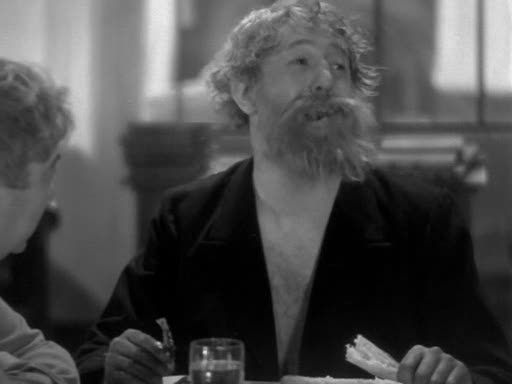
Boudu Saved From Drowning is Jean Renoir's sardonic, wryly comic take on the antagonism between bourgeois values and lower-class crudity. The title figure, Boudu (Michel Simon), is an oafish beggar, an outrageously whiskered tramp who stomps heedlessly over the supposed dignity and sophistication of middle-class respectability. When the bourgeois book store owner Lestingois (Charles Granval) saves Boudu from drowning in the river, he becomes the tramp's benefactor, feeding and clothing Boudu and giving him a place to sleep indefinitely. Lestingois is portrayed as a decent man in many ways, good-hearted and generous, willing to do good deeds for their own sake: he gives away books to young students, recognizing their romantic, poetic spirit from his own youth, and his rescue of Boudu is not motivated by the awards and kudos heaped on him by his neighbors, with which he seems mildly uncomfortable. At the same time, however, Lestingois is an avatar of bourgeois pretensions and affectations. He has a piano in his house, despite the fact that no one plays it, because respectable families simply must have one, and he carries on an affair with his plump, giggly maid Anne Marie (Sévérine Lerczinska) because his standoffish wife Emma (Marcelle Hainia) no longer interests him.

When Boudu enters this house, he completely disrupts the family's familiar routines, which had settled into a comfortable way of life. Boudu has no inclination for social graces, and never so much as thanks his benefactor for saving his life, or for the attention, gifts and food lavished on him since the rescue. Instead, the tramp runs roughshod over everything in the house, crudely defacing and mocking any hints of respectability that he comes in contact with. Boudu simply doesn't see the point of the routines and polished surfaces of bourgeois life. Confronted with a tie, he asks what it's for, and Lestingois has to admit that it's not really "for" anything, that it's not necessary at all, it's just "a piece of cloth one wears around the neck." Boudu shows the same disinclination towards learning about cleanliness. He eats messily and spills things everywhere, but sees no need to clean. When he spills wine on the table and Emma sprinkles salt on the stain to soak up the wine, he responds by pouring more wine on top of it — to soak up the salt, of course. The purpose of the fundamentals of middle class life eludes him: he eats when he's hungry, wears clothes that simply cover him in the most basic way, and doesn't really care about much of anything, besides the black dog who wanders away at the beginning of the film, initially upsetting Boudu enough to trigger a suicide attempt but then seemingly forgotten soon after.

What's interesting about Renoir's film is how thoroughly it destabilizes questions of audience sympathy, completely disrupting any attempts to figure out where the film's own sympathies might lie. Lestingois is a harmless, kindly if somewhat silly old man, an adulterer with literary pretensions who enjoys making florid, stylized declarations of love to his frivolous maid. Lestingois might be a representative of the bourgeois but he's a surprisingly sympathetic one, just as Boudu is a surprisingly unsympathetic lower-class bum; this is no simplistic social commentary piece. It's undeniable that Boudu is crass and ungrateful and often downright rotten, willfully making a mess of his host's home by wiping shoe polish on his bed and flooding his kitchen. He's also, in his treatment of women, similar to Lestingois in his flirtatiousness, and in other ways even more despicable than his host, who at worst is a dirty old man. Boudu, on the other hand, is a rapist, assaulting Lestingois' wife at one point, though Renoir makes the scene especially distasteful when, afterward, he shows the woman getting up from the bed with a big smile on her face, having at some point given in and enjoyed the rape. At the same time, Simon's performance goes a long way towards ensuring that Boudu, even at his most destructive and hateful, is at heart a lovable tramp, funny and playful and light-hearted. It's a masterful comic performance, whether in the broad gestures (the way he rolls his eyes with pleasure when eating or hitting on a girl) or the subtler touches (the stiff-kneed walk that's his closest approximation of formality).


Boudu's roughness and casual disregard for conventions finds its aesthetic equivalent in Renoir's rough, ragged visual sensibility. Renoir's images here are rarely conventional, but instead seem to have been improvised on the fly. Figures shift unpredictably in and out of focus, and the occasional coordinated camera move seems strangely at odds with the prosaic, shabby quality of the images. At one point, the camera pans across the Lestingois home, catching from a distance the action happening in rooms faintly visible down long corridors: first, Boudu and the family eating dinner, then following the maid from room to room as she putters around at her work, finally coming forward to meet the camera at the last room along the tracking shot's path. It all seems somehow accidental, the edges intentionally left frayed, glimpses of events caught haphazardly even within the context of camera moves that must have been elaborately timed and planned out. Renoir finds himself, aesthetically, somewhere between the bourgeois respectability of Lestingois and the rough carelessness of Boudu, going to great lengths in order to appear not to care. There's something endearing about the looseness of Renoir's aesthetic, which in its own way is as playful and sprightly as Simon's performance.

The film's theme of bourgeois respectability being upturned culminates in the final scene, when Boudu literally overturns an entire boat full of fancily dressed wedding guests, then proceeds to calmly, lazily swim away from his own wedding. Not only does this put a new perspective on Boudu's earlier "drowning" — he could swim all along? — but it is his flight from the threat of becoming bourgeois himself, of settling down into a loveless marriage, a copy of Lestingois' own. Boudu earlier spit into the pages of a book about marriage, so it's not so surprising that he should flee from this ultimate signifier of respectability. He's content in his tramp's rags, lying in the grass chomping on a crust of bread he's begged from strangers. Renoir's film spends its final moments with the contented Boudu on the riverbank, then tracks back along the river to find the bourgeois, soaking wet and distressed, huddled together looking miserable in the wake of Boudu's devastation. This is, in its odd way, Renoir's happy ending, embracing the anarchy of Boudu, the unfocused destructiveness that causes him to leave a messy trail of filth and garbage everywhere he goes.

Thursday, February 12, 2009

Grand Illusion


Grand Illusion is Jean Renoir's stirring humanist depiction of the complicated relationships surrounding a group of French officers imprisoned in German POW camps during World War I. The film is a dramatic account of the bravery of these soldiers as they attempt, again and again, to escape from the camps, not because conditions are so bad — the Germans treat them with remarkable civility and respect — but because of their patriotism and desire for freedom and sheer self-respect. As the noble Boeldieu (Pierre Fresnay) says, explaining his sportsman-like desire to escape, "Golf courses are for golf, tennis courts are for tennis, prison camps are for escaping." But the film is not only a prison escape movie. In fact, Renoir doesn't devote that much screen time to the actual escape attempts, condensing most of them via liberal use of ellipses. The film is much more directly concerned with the camaraderie among the soldiers, and especially the ways in which they form bonds of respect and loyalty with one another despite gaps in class and ethnicity that, in civilian life, would almost certainly have separated them irreparably.

Boeldieu is socially distinct from his fellow officers, a part of one of the last true generations of titled nobility in European high society. As a result, he comes across as aloof and haughty, constrained by manners from expressing himself openly, rarely displaying anything like emotional reactions. He stands apart from the roughness and free spirits of the other soldiers, even if they are officers like him. While the other officers take the opportunity of the Germans' hospitality to have as much fun as they possibly can under the circumstances — even putting on a hilarious stage show in which some of the men dress up in drag, sating sexual appetites so starved that even this poor imitation of femininity is exciting — Bouldieu does not partake in the festivities, always retaining his formal, noble manner. And yet it is undeniable that Bouldieu respects and even cares for his fellow soldiers, and that he earns their own admiration through his cavalier bravery and daring. He forms an especially close bond with the roughneck lieutenant Maréchal (Jean Gabin), with whom he shares so little in common that the two men can hardly be called proper friends despite their mutual respect. The same is true of Rosenthal (Marcel Dalio), a Jew who is lightly ribbed by his compatriots for his heritage, but who is proud and happy to share with them the bounty of food he receives in parcels from back home.

None of these men — there's also a bookish intellectual (Jean Dasté) and a carousing, vulgar jokester (Julien Carette), among others — would likely associate with one another outside of military life, but in these circumstances they become fast friends. Renoir frequently emphasizes their unity with group shots in which the men are tightly clustered together, leaning on one another and singing and laughing. The camera pans across their faces, so different and yet all men fighting for the same country and placed in the same situation. In them, Renoir finds beauty and humor and emotional complexity, their different backgrounds often causing them to spar or exchange joking comments, but never overwhelming their basic humanity and respect for each other.


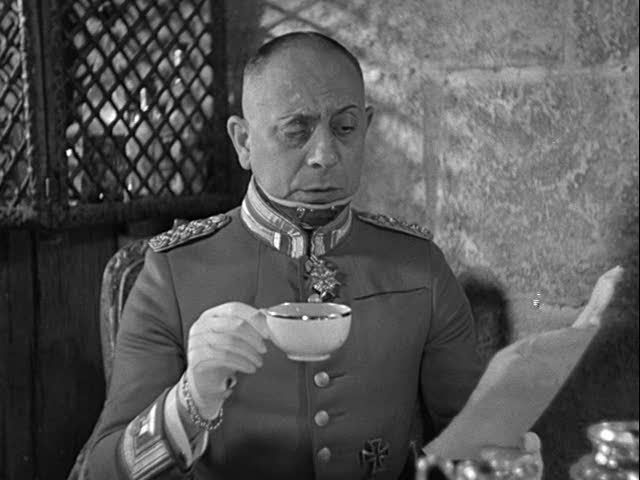
Renoir's humanism extends equally to the German side of the war, who are without fail depicted as completely and complexly as their French counterparts. There is no demonizing of the enemy here: the Germans treat their prisoners well, and are even remarkably indulgent of escape attempts. At one point, Maréchal is punished with solitary confinement for inciting the prisoners with news of French victories in the war, but even this is comparatively tame, as is the way the Germans finally punish the multiple escape attempts of the officers only by moving them to a new prison. At this new, supposedly inescapable mountain fortress, Maréchal, Bouldieu and Rosenthal find themselves under the command of the German nobleman Rauffenstein (Erich von Stroheim). Rauffenstein was the ace pilot who shot down Maréchal and Bouldieu in the first place, and who greeted his enemies then by inviting them to dinner with him. Some time later, he is badly injured, sidelined as a soldier, and he takes over as commander of this prison. Rauffenstein is, in terms of class, an equivalent of Bouldieu, and the two men quickly become friends: they share the same interests, the same social circles, the same acquaintances. Bouldieu has more in common with this enemy commander than he does with any of his fellow soldiers, and he begins spending time with Rauffenstein.

The German is less tolerant than his French counterpart, tending to view the lower classes as beneath his attention, unworthy of the aristocratic status that he and Bouldieu possess. Bouldieu quietly but forcefully argues against him, not getting much traction with his insistence that all men are worthy of respect and honor, until his actions ultimately speak louder than his words: he's willing to sacrifice himself for the sake of his "common" compatriots. Throughout the film, Renoir keeps his focus on such moral and philosophical questions rather than on the particulars of the plot. His storytelling style is elliptical and lyrical, and the editing from scene to scene is often abrupt, as though each scene lasts only as long as it needs to before rapidly fading out or simply cutting directly to a very different scene.

Renoir treats time and place very loosely, carelessly eliding details about when and where things take place. In the early scenes, he cuts directly from Maréchal and Bouldieu planning to take off on a mission, to the interior of a German base where Rauffenstein is talking about shooting down a French plane. It's obvious enough what happened in between, but Renoir's extreme elisions can sometimes seem like sloppiness. It soon becomes apparent, however, that he is simply much more interested in thematic blocks than he is in narrative progression. The film's pacing is purposefully uneven, broken up into an episodic structure in which only the key scenes are shown, the rest left for the audience to fill in the blanks. Only in the film's final section does the pace slow down for an idyllic, romantic interlude at a German farm, where the escaping Maréchal is cared for and eventually comes to love a sweet, widowed German woman (Dita Parlo), whose sadness about the harsh toll of war causes her to protect Maréchal and Rosenthal rather than turn them in. These kinds of choices are at the heart of Renoir's work: to forge connections rather than sever them, to learn the languages of others, to work towards peacetime happiness and pleasure rather than perpetuating violence and aggression.