Wednesday, March 21, 2012

The Man From London


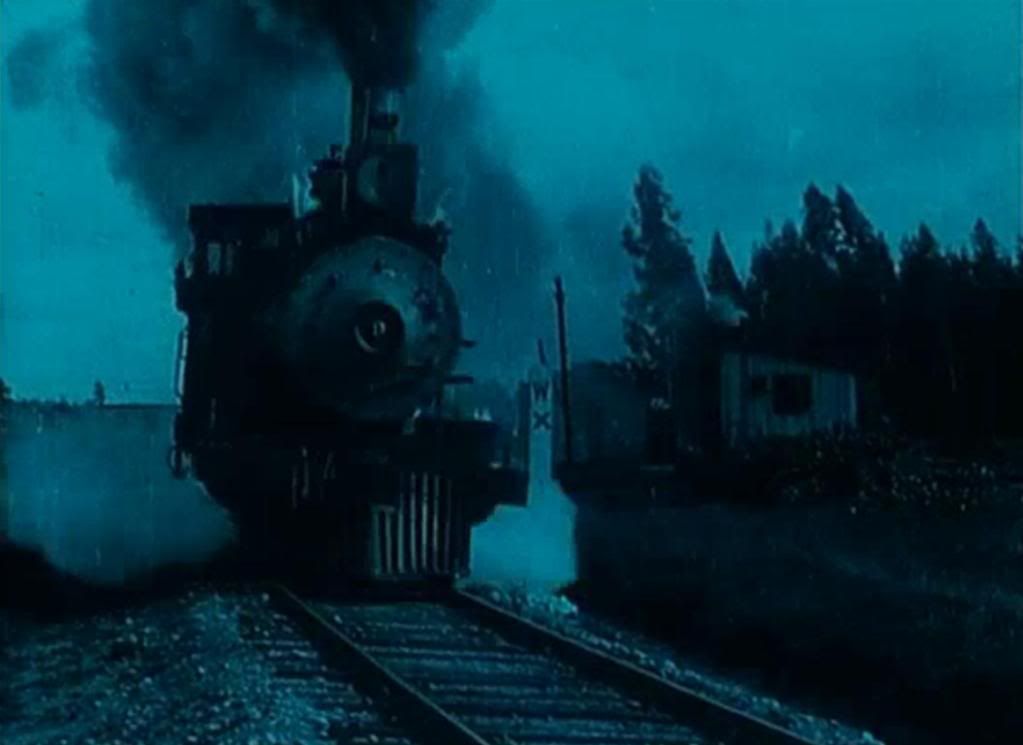
The films of Béla Tarr have always been haunted by film noir to one degree or another. Tarr's downtrodden characters plod miserably through gloomy, shadowy wastelands, getting tangled up in plots and intrigues that briefly distract them from the otherwise unchanging stasis of their lives. In The Man From London — an adaptation of a Georges Simenon novel that was already adapted for noir films twice in the 1940s — the influence of noir is as overt as it's ever been in Tarr's work, but tellingly it is not a drastic departure from the rest of his oeuvre, only a slight shift in emphasis that brings these subcurrents to the surface. It is, typically of his work, slow-moving and stunningly beautiful, shot in a high contrast black-and-white where light sources generate hot, blinding whites that threaten to burn through the frame, while the blacks of shadowy nights are dense and inky, and the characters in the film are, at various times, swallowed up by both the darkness and the light, both representing equal threats. As with all his films since Werckmeister Harmonies, Tarr's longtime editor Ágnes Hranitzky is credited as a co-director, but this too hasn't signalled much tangible change in his art; instead, it seems a way of affirming the paramount importance of editing to his films, presumably on the basis that in a film with so few cuts, each one must be vitally important.

This is a gorgeous, mysteriously moving film, its potent chiaroscuro images buttressed by the moaning organ drones of Tarr's frequent musical collaborator Mikhály Vig, as well as the expressive sound design in which every creaking, metallic, mechanical sound of the docks is amplified into a hypnotic percussive rhythm. The Man From London is often considered lesser Tarr, whatever that means, but this film finds the Hungarian master in as fine a form as ever despite its troubled production history. The one minor problem is the distractingly bad dubbing of the actors' voices into French and English, which seems to have been done with little care for syncronizing the audio to lip movements. Even this adds to the film's powerful sense of disconnection and alienation, as does the multilingual dialogue, which Tarr has said was his preferred audio for the film even though some early screenings aired with everyone dubbed into Hungarian.

In the gorgeous, atmospheric opening, the camera watches from the windows of a high tower at a dock where ships moor, letting off passengers who shuffle across to a railroad station nearby. A railroad worker, Maloin (Miroslav Krobot), sits in the tower all night, and the camera is aligned with his perspective, tracking in slow arcs around the interior of his tower room to take in the whole dock area. There's a voyeuristic thrill to this opening sequence, as Maloin, from his godlike perspective, sees things that he is obviously not meant to see. A man on a docked boat throws a suitcase into the darkness of a nearby pier, where it's picked up by a second man. The two men later fight, and in the struggle one of them falls into the water and never resurfaces, taking the suitcase with him. When the surviving man quickly leaves, Maloin climbs down from his tower with a hook and fishes the suitcase out of the water, discovering that it's full of money.


This opening sets the tone, patiently observing as these events unfold without fuss, the camera tracking past the windows to slowly sweep across the whole scene. Down below, pools of light and shadow are stretched out across the docks, with streetlamps casting bright ovals carved out of the darkness, figures melting in and out of the dark as they prowl around. Their furtive, secretive movements avoid detection, except of course for the near-omniscient viewpoint from which Maloin watches, a viewpoint that associates him with the voyeuristic audience, watching a typical noir tale of treachery and violence. It plays almost like a silent film; there's no dialogue in the entire first half-hour except for some distant, barely overheard murmuring. No words are needed, because these are familiar cinematic archetypes, carved in light and shadow, enacting a primal noir drama for an audience hiding up above.

The details of that pantomimed opening are later filled out, when the British private detective Morrison (István Lénárt) arrives, investigating the robbery of 60,000 pounds from his employer by a man named Brown (János Derzsi), one of the men Maloin had seen in the opening. It almost doesn't matter, though, because in typical fashion, Tarr is less interested in plot mechanics than he is in the mundane routines and boring lives that continue to trudge forward uneventfully even as this investigation circles inexorably around the events of that night. Maloin grimly watches as the inspector tries to figure out where Brown and the missing money have gone, while Brown himself begins stalking the dockworker, apparently suspicious that Maloin may have seen something or retrieved the suitcase.

The plot is extremely basic, stripped down to just the essentials, and in a way the only big events in the film are those that occur during that opening half hour; everything else is simply an elaboration of the consequences of that noirish template. In one scene, the opening sequence is virtually repeated, this time with the inspector moving around in the darkness below, trying to recreate the potential chain of events, cleverly working out how the two criminals had snuck the suitcase full of money past customs, and then discovering the corpse in the harbor. This reinforces the impression that the film's story is an archetypal template, a basic form — ordinary working man stumbles across illegally gotten cache of money — that can be repeated and restated infinitely. The story's familiarity and simplicity frees Tarr to confine the narrative to the background, focusing instead on atmosphere and on the protagonist's grim, lifeless existence. Tarr even has the violent climax play out offscreen, keeping his camera trained on a closed wooden door during Maloin's final confrontation with Brown, the camera shaking slightly as if in shivery anticipation of the outcome of whatever's happening, unseen, beyond that door. If the opening encouraged a voyeuristic perspective on distant events, this scene denies and frustrates that voyeurism, granting the characters the private intimacy to carry out the conclusion of their story without any prying eyes to observe.


What's interesting about the film's study of Maloin is that he hardly seems to want the money once he has it; even in the shot where he opens the briefcase for the first time, there's not even a flicker of emotion on his face as he stares down into the case, before the camera tracks around and then angles down to peer into the open case, revealing the money inside. He retrieves the money, then dries it out, with a mechanical lack of feeling, compelled to do so by the momentum of the plot and little more. Once he has the money, it hardly helps him escape his dull life, nor his clearly unhappy marriage to a woman (Tilda Swinton) with whom he does nothing but shrilly argue.

The only way in which he ever uses the money is to help his daughter Henriette (Erika Bók), who first appears in a fascinating scene in which Maloin, walking home with the money, stops to watch her sweep the floor in the butcher shop where she works. At first, the scene seems as voyeuristic as the opening, with Maloin watching as the girl in the shop bends over to sweep, her skirt riding up so that her ass is clearly visible to anyone on the street outside. When it's revealed that she's actually his daughter, the emotional tenor of the scene subtly changes, and he becomes angry at his daughter's careless flaunting of her body, angry with the work that makes her display herself like this. His reaction is almost as if he's discovered she's a prostitute, and later he protectively pulls her out of her job, then buys her a fur in a store where the pushy salesmen chatter in excited tandem at father and daughter until they decide on a purchase.


Notably, Maloin never tries to use his newfound money to escape his grim home life, nor does he deviate from his routine or begin spending wildly, the downfall of so many noir heroes in similar situations. Like many of Tarr's characters, he's trapped by a lack of imagination, an inability to see past the dull materiality of his circumstances, to grasp at something greater that occasionally seems to be lurking just beyond his senses. At one point, as he leaves a bar, he walks, without looking, past a surreal scene of several bar patrons playing an odd game, one of them balancing a pool ball on his forehead while the other lunges at him with a chair, both of them doing this strange dance to the wheezing sound of an accordion. The scene recalls the extended dance sequences in Damnation and Sátántangó or the living diagram of the solar system in Werckmeister Harmonies, scenes where the dullness of ordinary life is interrupted by outbursts of strange exuberance, moments of sensuality and celebration. Here, this dance is relegated to the background, a momentary diversion that the main character, locked into his private hell, barely notices.

This is one of several points at which Tarr hints at something stranger and grander just outside the border of the main character's circumscribed sense of reality. The way the high-contrast photography renders light as an incandescent and impenetrable whiteness similarly suggests something beyond, an almost spiritual dimension to this otherwise prosaically grounded story. In one rapturous shot, Maloin's wife opens the glass doors leading out to their balcony and steps out into the bright light that swallows her up, nearly erasing her black-clad form in a suffusion of light, pouring over her and flooding the center of the frame with this blinding nothingness. When she then closes the shutters, the room is smoothly plunged into darkness, the light chased away by shadows; it's a beautiful and mysterious shot that suggests the ways in which these characters are closed off from light, hope, spirituality, anything that might fend off the darkness and shadows. The light is also tinged with a sense of danger, though, as though these people might burn up if exposed to its brilliance for too long. In the film's mysterious final shot, Brown's silently suffering wife (Ági Szirtes) simply stares straight ahead until the white light absorbs her, the image fading to a plain white nothingness before the credits roll.

Tuesday, March 20, 2012

Sherlock Jr.


Sherlock Jr. is one of the cinema's greatest tributes to itself, a dazzling, relentlessly inventive ode to the movies as an escape, a source of dreams and a fantastical reflection of the real world. Buster Keaton's five-reel, 45-minute short is crisply, quickly paced, with not a second of waste, not a frame that isn't absolutely essential to the film's hilarious and strangely moving vision of the cinema's magical power. Keaton plays a hapless young movie theater projectionist who's also studying to be a detective and scraping together whatever cash he can get to woo his girlfriend (Kathryn McGuire). When he's framed for the theft of a pocket watch belonging to the girl's father, Keaton tries to catch the real crook (Ward Crane) in a hilarious scene where he shadows the taller man, walking immediately behind him and mimicking his every gesture. When this fails, he returns to the movie theater, dejected, a failure as a detective and miserable over the loss of his girl.

He then falls asleep, and what follows implicitly links the cinema to dreams, as Keaton nods off in the projection booth and has an out-of-body experience, his ghostly doppelganger stepping out of his sleeping form and into the movies. It's a fantastic, and fantastically funny, sequence, as the projectionist imagines the figures on the screen transformed into ones from his real life, enacting a mystery drama derived from his own experience with the purloined watch. Except, in this dream/movie, he can actually be the hero, the world's greatest detective, Sherlock Jr., dapper and sophisticated in a top hat and nice suit, a master intellect who can outwit any criminal. It's pure wish fulfillment, as the young loser imagines that he can catch the crooks and get the girl — and then, in Keaton's master stroke, he wakes from the dream movie into another movie, the movie Keaton's making, and he gets the girl after all.

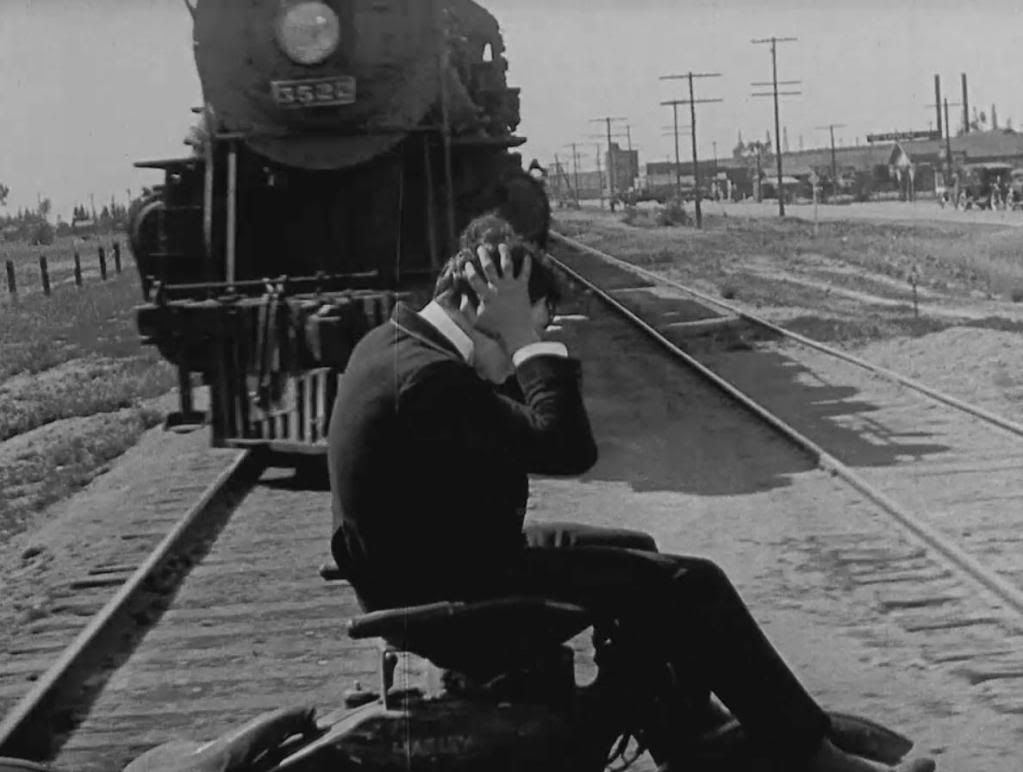
Before he can get to this point, though, he has to pass through a cinematic gauntlet in which his greatest enemy is not a petty crook but a basic cinematic tool, the edit. Once Keaton steps up onto the movie screen, he's not fully integrated into the film that's playing. He's immune to the cut, so he remains the one constant as the scene changes, which leads to some hilarious visual gags. For a few minutes, the movie on the screen, following absurdist dream logic, ceases to be a coherent drama and starts randomly cutting from one strange locale to another, always with Keaton propelled across the cut into one outrageous situation after another. He balances on the edge of a cliff, runs from hungry lions, almost gets run over by a train and the traffic on a crowded street, and gets soaked by waves while perched on a rock in the middle of a choppy sea. It's both a devilishly clever comic showcase and a lovingly meta ode to the power of this cinematic tool, which can seamlessly bridge such tremendous gaps in location, having Keaton jump into the air to dive into the water but instead land headfirst in a snowbank, his feet kicking in the air.


Keaton's projectionist eventually manages to slip into this cinema dream world, inhabiting the role of the detective, fending off the sinister maneuvers of the crooks who concoct endless death traps that he flawlessly slips around, always intuiting their evil intentions before they can spring the trap. In the movies, the hero always wins, the bad guys always fail, and one senses that this young projectionist, like so many others, was first seized by his desire to be a detective while watching screen detectives much like this one. He inhabits an archetypal role, taking on a character type that had inspired him to try to shape his real life to match the movies, to become a detective like the ones on the screen — but only in dreams or the movies can such archetypes actually exist.

The whole dream sequence is remarkably fun, and occasionally surreal, as when a mysterious cross-dressing vendor helps Keaton evade the crooks by inviting the detective to jump through his chest and somehow flip through a false wall hiding behind the vendor. That's a bit of pure movie magic that doesn't really make a shred of sense; it's a flight of fancy that could only work in the movies. The same goes for the hilarious scene where Keaton leaps through a window in which he'd previously set up a readymade disguise. Jumping through the window, he also jumps through the clothes and lands outside dressed up as an old woman. That transformation is an echo of the one that propelled Keaton into the movie universe in the first place: he passes through a screen and comes out the other side magically changed, the usual rules suspended.

The ending, in which Keaton covertly watches a movie hero to figure out the right gestures to romance his girl, suggests that, though the movies are dreams, they're dreams with tremendous power. Keaton is exploring how we learn to act by watching the movies, how we derive our templates, both romantic and professional, from the things that happen up on the screen. In this way, the movies become, not only dreams, but wellsprings of reality, feeding back into the world models of behavior, the dream influencing and reshaping reality itself.

Monday, March 19, 2012

The Umbrellas of Cherbourg


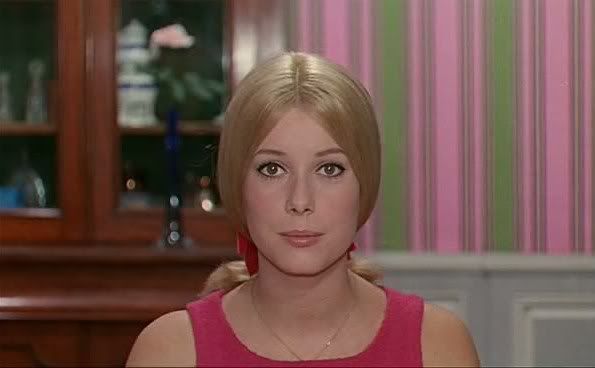
The Umbrellas of Cherbourg is one of the most moving and heartbreaking love stories in the cinema, an absolutely stunning musical masterpiece that sets its bright, colorful visual palette and sweet, soaring music against an increasingly bittersweet emotional range. Divided into three parts — departure, absence, and return — Jacques Demy's sublime musical is the story of a love affair haunted by the separation of war. Geneviève (Catherine Deneuve) is a young girl madly in love with the mechanic Guy (Nino Castelnuovo), but their sweet, innocent affair is torn apart when Guy is called up into the army, sent to Algeria for two years. As in so many French films of this era, Algeria looms large, a tear in the fabric of life, an absence that's felt at home in the missing young men, the years of longing and waiting.

The film is an interesting type of musical in which every single line is sung, but it rarely feels like there's a proper song: instead, all of the dialogue is more-or-less naturalistic speech that's simply sung instead of spoken. Even the most banal lines, like Guy's interactions with customers and his boss at the gas station where he works, are liltingly timed to Michel Legrand's alternately jazzy and romantic music. This style can be somewhat distracting and artificial at first but it quickly comes to seem as natural as if the characters were simply speaking. By setting everything to song, it never seems as if the music is interrupting the diegesis, cutting off the naturalistic flow of life with a musical number. Rather, life itself, with all its joys and tragedies, its banal incidents, its great loves and great sadnesses, has been transformed into one big musical number, a 90-minute musical number that encompasses both the innocent sweetness of young love and the much more complex, melancholy, mysterious loves and losses that build up over the course of the years.

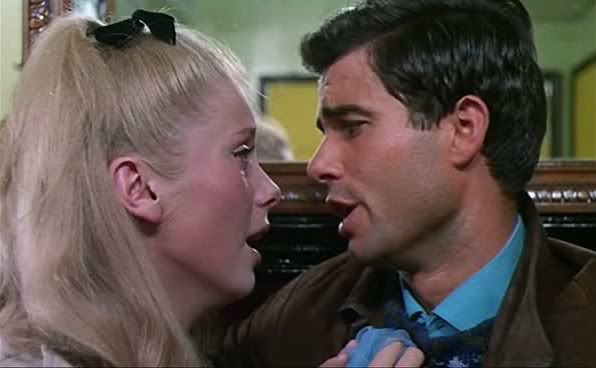
The first part of the movie, which is almost saccharine-sweet with its constant tender embraces and cooing declarations of love, ends with Guy and Geneviève being split apart as he heads off to the army and the war. At one point during their goodbyes, he says that he knows she'll wait for him, but Demy films it in a way that suggests exactly the opposite. Before that point, he'd captured the young lovers in a two-shot, huddling together in a booth at a bar, but then Demy pans right to focus on Guy's face as he stares off into space, away from Geneviève, saying that he's sure she'll wait. Because she's not in the frame, one is left to wonder if he's being presumptuous, demanding that she wait rather than letting her say it herself. Demy then pans back to Geneviève, who demurely agrees, but the damage has been done: Demy's cinematic separation of the lovers at this decisive moment has seemingly fated them to separation in life as well. The camera's graceful movements all but inform us: Geneviève will not wait.


This is followed — after a goodbye sexual dalliance in Guy's bed, next door to the room where his godmother, Élise (Mireille Perrey), lays dying — by the deeply romantic sadness of the lovers' parting at a train station. Demy's camera tracks backward as Guy backs away from Geneviève in the station's bar, a gap of negative space opening up between them, expanded by the camera's movement away from them. Then Geneviève desperately runs to fill that gap, but outside the process begins again, as Guy steps onto the train, which begins rolling forward, Demy's camera tracking along with it. Geneviève follows alongside it for a few more moments, repeating "I love you," but once she stops walking, both train and camera continue rolling along, leaving her ever further in the distance, her figure shrinking into the background as the train departs the station, smoke billowing onto the platform to further obscure her from view.

In Guy's absence, Geneviève learns that she's pregnant with his child, but over time she also realizes that, contrary to what she'd believed, she can imagine herself living without him. Earlier, when Geneviève was grieving over her departed love, her mother (Anne Vernon) told her that, "people only die of love in movies," a line that, since this is after all a movie, would seem to be freighted with tragic foreshadowing. But this is a movie that uses its deceptively artificial aesthetic to cut right to the core of some very real emotions, and Demy has something much sadder and more complex in store for Geneviève than the melodramatic convention of dying from a broken heart.

At the heart of this dazzling musical is the revelation that life is not often as neat as the movies, that the romantic ideals of musicals are seldom fulfilled as cleanly as Hollywood happy endings would imply. At one point, Geneviève sings, "I would have died for him. Why aren't I dead?" She looks right into the camera with a tearful, red-eyed expression, genuinely confused and hurt by the realization that her love for Guy has been fading in his absence, that she's been able to go on with her life and even entertain thoughts about another man, when before Guy left she'd sworn to wait for him forever. She'd imagined that life would be like a melodrama, that she couldn't live without her lover, but she finds that in reality, unlike the movies, memories can fade, life can go on, and there are endings that aren't quite happy, but aren't quite unhappy either, that the sadness and the pleasure of life can be tangled and intertwined so completely that it's difficult to separate one from the other.


The other man who enters Geneviève's life in Guy's absence knows this truth very well indeed. Roland (Marc Michel) is a successful diamond dealer and world traveler who becomes friendly with Geneviève and her mother after Guy leaves. Roland comes to the film several years after the events of Demy's first feature Lola, in which he got his heart broken by the title character of that film and set off on the adventures that apparently made him a rich man. He never forgot Lola, of course, as evidenced by the sequence where he tells Geneviève's mother about his past and Demy cuts away to a graceful circular pan around the market where Roland and Lola had last met in the earlier film. It's a melancholy callback, a metatextual sequence that suggests that film is memory, that to remember Lola is to remember the events and the locations of that other film, briefly weaving them into this new film. Roland's interactions with Geneviève and her mother also recall the earlier film, in that Geneviève's mother is obviously attracted to Roland — as a mother had been in the other film, while he pined over Lola — but Roland is infatuated with Geneviève herself.

Their love affair lacks the passion of Geneviève and Guy's love: Roland courts the girl by asking her mother for her hand in marriage, before he's even spoken much to Geneviève herself. It's a very unromantic affair, and Geneviève's decision to marry him seems to be more pragmatic than anything, influenced by his stability and the fact that he's not swayed in his love for her when he learns that she's already pregnant with another man's child. Their wedding is conveyed with a few economical shots, starting with a tracking shot through a bridal shop filled with mannequins in gowns, in the midst of which Geneviève, staring into the camera through the thin gauze of a white veil, seems as plastic and distant as the mannequins, her expression blank and unreadable. Demy cuts immediately to a very similar shot of Geneviève at her wedding, still staring blankly into the camera, then pulling back to a two-shot of the couple kneeling, their hands piously pressed together in prayer, an image of formally, religiously sanctioned love very different from the passionate clenches of Geneviève and Guy from the film's first section.

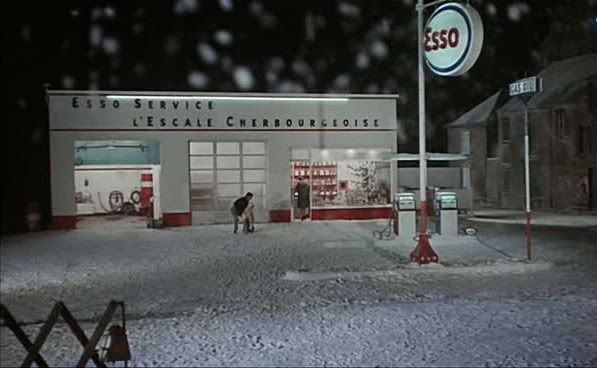
Guy also gets his own bittersweet ending, as Geneviève disappears for the film's final section and Guy finally returns from the war with a limp and a haunted expression, only to realize that his love is not waiting for him. Instead, he's gradually awoken out of his self-pity by the patience and caring of his godmother's long-suffering nurse, Madeleine (Ellen Farner), who Demy had repeatedly hinted was harboring a shy crush on Guy. It is perhaps telling that Demy establishes a visual parallel between Geneviève and Roland's wedding and the shot of Guy and Madeleine at Élise's funeral, also sitting side by side in a prayerful posture. As with Geneviève and Roland, this is not a relationship of great passion, and it might be thought that Guy is just settling for a second choice, but Demy intentionally leaves it ambiguous just how much or little he actually feels for Madeleine. This is especially true of the deeply affecting final scene, in which, years later, Geneviève and Guy finally meet again, at the snowbound gas station that Guy now owns and lives at with his wife and their son. It's a beautiful and mysterious scene, overflowing with complex emotions that mostly go unstated in the polite, slightly cool conversation of the former lovers. Demy masterfully resists resolving the tension or answering any of the questions left lingering about these two characters and their paths in life. Instead, they briefly meet and part, separating just as Guy's new wife returns, and Demy's camera drifts up and away, through the fluttering snowflakes, the gas station a little oasis of light in the darkness of the night, as though the happy domestic scene that now plays out is encased in a snowglobe.

Friday, March 16, 2012

Four National Film Preservation Foundation shorts

[This post is a teaser for the third annual For the Love of Film blogathon and fundraiser, which will be running from May 13-18. This year, hosts Marilyn Ferdinand, Farran Smith Nehme and Roderick Heath have dedicated the week to Alfred Hitchcock, whose early (non-directorial) work "The White Shadow" will be the beneficiary of any money earned during the event. The following post provides capsules for some of the films currently screening at the National Film Preservation Foundation website's Screening Room. Be sure to donate!]

Ramona is an early D.W. Griffith one-reel short, an adaptation of a novel by Helen Hunt Jackson that dramatized the mistreatment of Native Americans throughout history via an inter-racial love story, not the kind of message movie that one would associate with the future director of Birth of a Nation. A young Spanish girl named Ramona (Mary Pickford) falls in love with a Native American improbably named Alessandro (Henry B. Walthall), with predictably tragic results. The young couple elopes, fleeing her disapproving family, but everywhere they turn, they only encounter "the whites" who keep pushing the Native Americans aside, claiming, "this is our land!" wherever Alessandro and Ramona show up.

The acting is extremely over-the-top: when Ramona is trying to resist her attraction for Alessandro, she sees him playing a guitar, listens briefly, and then recoils in terror, running away with her arms in the air, and throws herself down at an altar to pray. If a title card hadn't already prepared viewers for the fact that she was going to fight against her growing love for the young man, one would be hard-pressed to guess just why she was so suddenly hysterical. There are horror movie heroines who react more sedately to the sight of invading alien monsters. There's lots of hand-waving and dramatic gesticulating here; Ramona's mother (Kate Bruce), reacting with horror to her daughter's dalliance with a Native American, seems to have abruptly contracted epilepsy, her hands shaking and flailing about, locked into claws as she points in random directions all around her head. Most of the cast just runs around through every scene with hands raised, pointing dramatically off towards some unseen point beyond the camera.

This histrionic acting style aside, the film is well-directed, and Griffith's staging within the static frame is impeccable. He frequently frames some foreground action against a dramatic natural backdrop of hills and mountains stretching off into the distance, contrasting the human-scale romantic story against the imposing grandeur of the landscape, as though suggesting that this one little story is part of a grander historical struggle. One scene that suggests this especially well is the one where Alessandro's village is destroyed by white settlers who are driving off the natives. Griffith's camera is angled down from a high cliff, looking down at the village in the valley, mostly obscured by clouds of smoke as wagons rush by and the slaughter commences. In the foreground, Alessandro throws his arms around in despair and tears at his hair as a few white cowboys run past with guns drawn, casually killing another Native American man as they pass. These striking compositions provide some interest in an otherwise rather slight film that rushes through its narrative as a series of clipped moments, seemingly under the assumption, very reasonable at the time, that virtually everyone in the audience would have been familiar with the story already.


The Lonedale Operator is a one-reel Western actioner directed by D.W. Griffith and written by future Keystone mastermind Mack Sennett. The film demonstrates Griffith's famous development of suspense-building, cross-cutting action montages, in this case built around a simple scenario of a train station payroll robbery. A young girl (Blanche Sweet) takes over telegraph duties for her sick father, while a pair of criminals plan to steal the payroll bag that's been dropped off into her care. The first half of the very short film builds a little character through some flirtatious sparring between the girl and a train engineer who's courting her, and then the second half settles into a propulsive editing rhythm as the crooks try to break into the telegraph office.

Griffith cuts quickly back and forth from the girl in the office, sending out a message for help, to the criminals trying to break down the door outside, to the engineer rushing to her rescue on his train. The rhythm of the editing gradually speeds up as the criminals get closer to breaking in and the train gets closer to the station. It's a simple but effective way of ratcheting up the tension. The payoff is a nice last-minute gag in which the crooks break in before the rescue party has arrived, but the clever girl manages to outwit the robbers by making them think she has a gun. The ending defuses all the tension with some low-key humor, having the robbers exaggeratedly bow to the girl once they realize they've been outsmarted, and this resolution hints at Sennett's comedic sensibility, abruptly replacing the sense of impending danger with a witty sight gag.


Robert C. Bruce was a premiere director of what were known in the early cinema as "scenics," short documentary travelogues from exotic locales. Bruce's Tropical Nights is a prime example of the genre, the first film released from a 1920 expedition to the Caribbean, where he traveled through the islands and shot numerous brief, poetic, beautifully photographed little slices of reality.

The film is purely about the sensory experience of a locale, presenting one gorgeous, blue-tinted image after another of this tropical island paradise. The photography is lovely: trees swaying in the wind, scenic vistas looking out over the ocean, moonglow rippling on the water, dramatic storm clouds gathering on the horizon, but never any rain. The prosaic title cards only interrupt the poetic flow of these images with bland objective descriptions. Bruce's images hardly require the accompaniment, because there's obviously a keen photographic sensibility to these static views of beautiful natural scenes. People only occasionally enter the shot, but when they do they're often looking off in the same direction as the camera, as awed as the photographer by these lovely views. The presence of these spectators within the film merely confirms the "hey look" attitude of the film, which builds a contemplative mood as it chronicles the progress of the moon across the sky, the gentle flow from sunset to sunrise, with nothing but moody blue beauty in between.


Keystone comedienne Mabel Normand was a prolific comic actress in the silent era, and in 1914-15 she made the transition to director as well, making her one of the earliest female directors in Hollywood. Won In a Closet was her second directorial film (her first is presumed lost) and it's a madcap, silly farce that displays the fledgling director's likeably goofy screen presence and her feel for slapstick. The fluffy little story of Mabel's romance with a dopey-looking neighbor (Charles Avery) is just set-up for the extended sequence where her father and his mother get trapped in a closet together, prompting a ridiculous series of misunderstandings and slapstick pile-ups.

The slapstick is all but completely unmotivated here, with little connection to reality: everyone's just constantly running around, falling on their asses, colliding into each other for no apparent reason, and Normand herself switches on a dime from a sweet, coy young lover to a manic hysteria case. It's all pretty silly, of course, but there is one nice shot along the way, an inventive split-screen in which Mabel and her boyfriend walk towards one another, the two sides of the screen eventually coming together when they wind up on opposite sides of the same tree. That shot suggests a witty visual sensibility that matches Normand's charming screen persona.