Wednesday, April 11, 2012

M (1931)


Fritz Lang's M was the director's first sound film, and the penultimate film he made in Germany before emigrating to the USA, fleeing the encroaching takeover of the Nazi party. It is, even today, a strikingly modern film, tackling a very sensitive subject from a surprising angle. Lang's classic tells the story of the search for a child killer who's terrorizing a German city, eluding capture while kidnapping and murdering children that he meets on the streets, luring them with candy and toys. And yet the film is not concerned with the mystery of these killings — the murderer is identified very early on as Hans Beckert (Peter Lorre) — nor is it a thriller focusing on the fear of the victims, which is the conventional approach to films about psychopathic serial killers. Instead, Lang focuses on the paranoia and other effects that these killings have on the city, as well as the killer's own feelings of terror and confusion.

Indeed, Lang accomplishes the miraculous feat of making the killer an almost sympathetic figure in some ways, a figure to be pitied as much as despised or feared. Beckert is portrayed by Lorre as a weak, pathetic, fearful man overcome by compulsions and desires that he can't control. He's pathetic and vile, but his actions are portrayed unambiguously as the product of a mental disfigurement that he is hopeless to resist, and that apparently a stay in a mental hospital could not cure. The film does a remarkable job of portraying Beckert's crimes as a sickness, very different from the usual sort of crime, a product of a diseased mind that, as Beckert exclaims at the film's climax, "really can't help it." He is a desperate man, writing letters to the police and the newspapers that all but beg for them to catch him and stop him, and Lorre's bug-eyed, sweaty performance is incredibly powerful. After one of his crimes, Lang inserts a shot of Beckert looking in the mirror, pulling down the corners of his mouth with his extended middle fingers, stretching his face into a scowl of misery. Later, echoing this shot, he is innocently window-shopping and happens to catch a reflection of a little girl standing behind him; his face becomes deformed, his idle chores forgotten, and he begins whistling "The Hall of the Mountain King," the signature tune that stands for his compulsions.

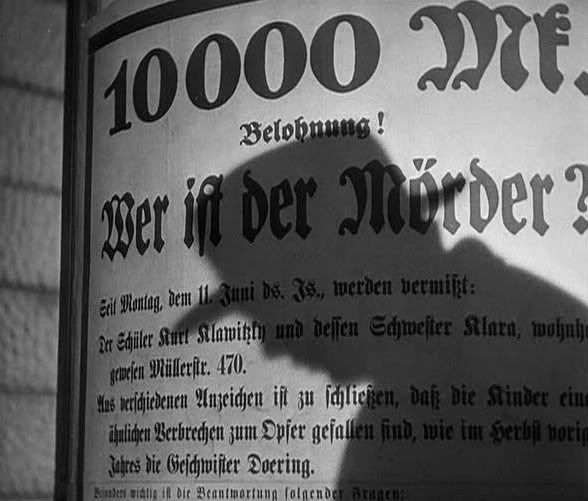
That song is virtually the only music in the film, which has no proper score and only uses whatever scant music appears within the diegesis. Towards the beginning of the film, Beckert's whistling precedes his first visual appearance, as he approaches a young girl, whistling, his shadow cast onto a poster announcing a reward for the killer's capture. It's a sinister image, and the whole scene is chilling for the suggestive way that it chronicles Beckert's predation without any overt violence. The girl's death is signaled with an evocative pair of shots: her ball rolling out of the bushes in a remote, overgrown area, followed by a shot of the smiling, human-shaped balloon that Beckert had bought for her, now drifting freely, getting tangled up in power lines. Meanwhile, at home the girl's mother fruitlessly calls out for her, expecting her home from school, and Lang cuts from the mother at the window, yelling the girl's name, to a series of static, empty, eerily silent shots of the apartment building's staircase and basement, devoid of life or movement. Lang elegantly uses such minimalist aural and visual symbols to tell his story, often replacing images of people talking with images of their shadows reflected on walls.

Lang is also concerned with depicting the killer's effect on the city. People are riled up and paranoid, and they begin responding with suspicion and violence at the least provocation: innocent men are accosted by mobs on the streets, friends accuse one another, anonymous letters point fingers at various random men, whose houses are searched and ransacked for clues by the police. The criminal underworld is also stirred up, as the police conduct raids of red light districts and bars, trying to uncover anyone the least bit suspicious, working on the assumption that the killer must be a shady character in general. These raids cause the criminal gangs, eager to catch the killer and end this intensified police activity, to start pursuing the killer themselves, aided by a network of beggars keeping an eye out for any sign of the murderer.

The general atmosphere of suspicion and persecution suggests a social and political response to this crime that is, in fact, disconnected from its origin. The cops raid bars without discrimination, arresting anyone whose papers are not in order, an eerie premonition of the ways in which the Nazis would shortly begin treating citizens. Lang was at this time growing increasingly concerned about the Nazis' ascent to power, even as his own wife Thea von Harbou, who co-wrote M with him, joined the party, alienating her from the partly Jewish Lang. Thus the film depicts a multifaceted nightmare where fear waits in every direction: a mother's fear for her child's safety, a criminal's fear of being apprehended, but also the more general fear of the innocent being sucked into the vicious whirlwind of a society riven by hysteria, as in the scenes where innocent men suffer in various ways for Beckert's crimes.
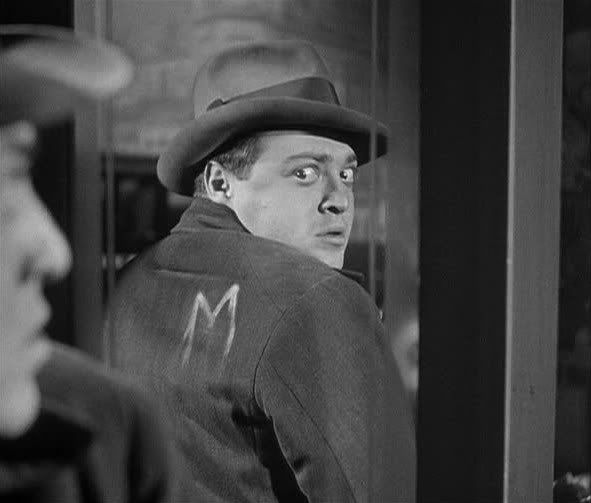

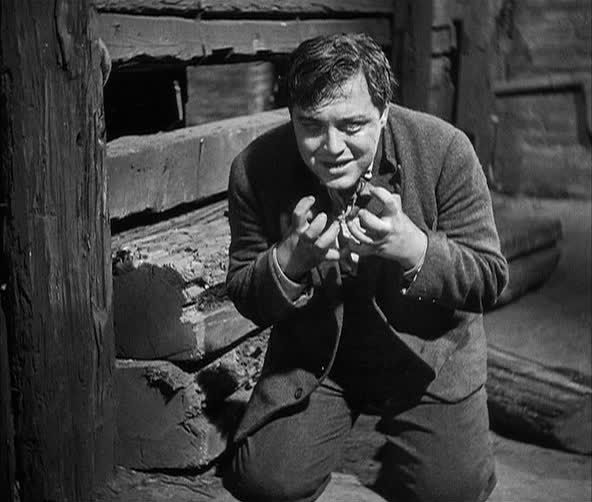
What's most interesting about M is the degree to which Lang lets all these different currents run together without emphasizing one over the other. Lang cuts between different segments of society — at one point blending together a meeting of the police and a meeting of some gangster bosses to ironically point out the similarities between cops and crooks — and different characters, never building a real solid central presence. Lorre's Beckert comes closest to fulfilling that role, though he's almost entirely absent for the first half of the film, only occasionally appearing as a reminder of the one man who's generating all the chaos in the city. Much of the film's second half, though, seems to stick closest to Beckert's perspective, particularly in the harrowing sequences where the killer is pursued through the streets by beggars, eventually cornered in the attic of a building, where the criminals track him down. The beggars even mark him with an "M" drawn in chalk on his jacket — another striking bit of Nazi foreshadowing — and the scene where he discovers this mark in a mirror recalls all the earlier mirror shots involving Beckert. Lang, interestingly, has crafted a suspense sequence in which nobody could possibly be rooting for Beckert to get away, and yet his terror, his increasing desperation, is nevertheless potently communicated by Lorre's performance and the shadowy, expressionistic mise en scène. Further enhancing the tense atmosphere is the fact that Lang shot many scenes entirely silent, only occasionally piercing the hush with bursts of clamoring police sirens or the shouts of the killer's pursuers.

M is many things: a powerful depiction of violent malaise, a searing critique of the death penalty and vigilante justice, a psychological study of fear and guilt, a vision of societal violence and fear that serves as a prelude to the rise of the Nazi Party. It remains such an affecting film in large measure because of how deftly Lang weaves together all these ideas, destabilizing audience expectations at every turn. Even today, so long after it was made, the bravery and modernity of Lang's ideas and his cinematic approach to this material is bracing and impressive.

Tuesday, April 10, 2012

Hangman's House


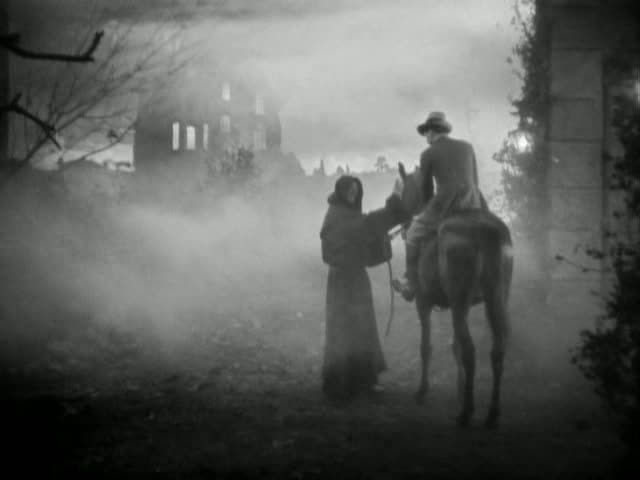
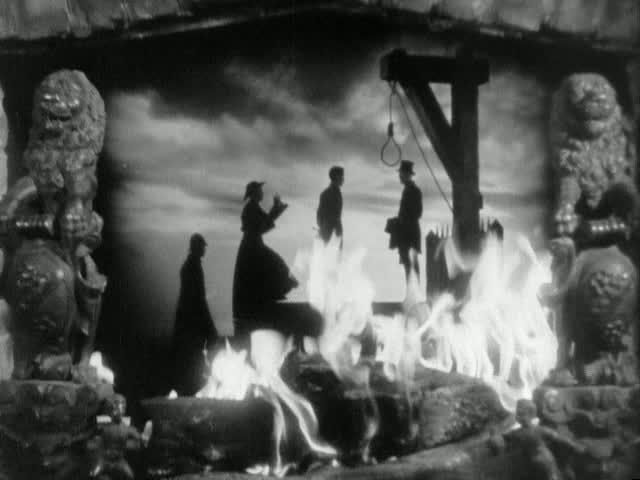
John Ford's Hangman's House is an overlooked expressionist classic from the director's silent era, a moody and evocative melodrama in which revenge, guilt and suppressed desire flow through the foggy Irish moors. It's a film that's swathed in fog, set in and around a creepy Gothic mansion that seems like it should be housing a 1930s Universal horror flick, populated with mad scientists and lurching monsters. Instead, it's the home of the bitter old hanging judge James O'Brien (Hobart Bosworth), who Ford introduces in a remarkable shot with the camera looking out from inside the old man's fireplace, the flames flickering up at both the aged, stooped judge and the proud portrait of him in his prime, hanging on the wall behind him. The fireplace stands in for Hell, its flames passing fiery judgment on the bitter old man's life, a life spent sending men to their deaths. He sees visions of the men he's hanged, acted out in silhouette dioramas within the flames, or the faces of the men and their families floating in the fire, summoning him to join them.

O'Brien, on his deathbed, ends his life with one last ugly act, forcing his daughter Conn (June Collyer) to marry the no-good John D'Arcy (Earle Foxe), rather than her longtime sweetheart Dermot (Larry Kent). The plot's a bit of a mess, actually, and the script rushes through the set-up so that any emotional motivations seem clipped and obscure. For that reason, it's hard to say why Conn's father pushes her off on D'Arcy, who he seems to think will give his daughter a successful life even though a title card comes right out and all but calls D'Arcy a sleazeball, or why she goes along with it so easily. In any event, she's soon trapped in a marriage to a man who goes out of his way to prove he's a villain: drinking, gambling, snitching, and in one horrifying scene, actually shooting his wife's beloved horse after it had won a race where he'd bet on another horse.

This Gothic melodrama is juxtaposed against the presence of the outlaw Citizen Hogan (future Ford regular Victor McLaglen in his second appearance for the director), who has returned to Ireland from a stint in the Foreign Legion in order to get revenge on D'Arcy for the scoundrel's treatment of Hogan's sister. Hogan, in the film's opening scene, gets as good an introduction as O'Brien does, receiving a telegram at the dinner table, apparently giving him the news about his sister's suicide. "I've got to kill a man," an intertitle reads, and then the camera tracks back woozily to the end of the table, as all the men toast to him, wishing him luck. Hogan is a cheery and exuberant spirit of vengeance, an exile from Ireland whose return makes him misty-eyed with nostalgia and a love for his home country, even as he sets out on his dark errand. In that he seems like a surrogate for the director, who's using this lurid story to express his own love for the country, to capture some of its romance in these expressionist landscapes. Hogan drifts through the fog in a series of near-comical disguises — a monk, a blind beggar — that never quite fool anyone, what with his hulking form and his infamous reputation. He's death come calling with a ready smile and a twinkle in his eye, a distinctly Irish Grim Reaper.


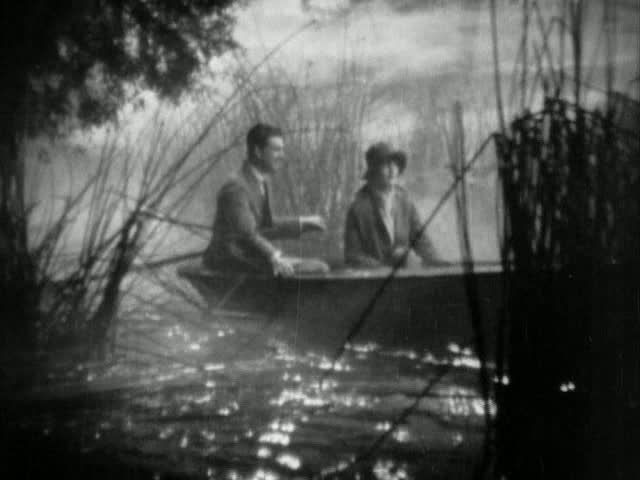
The film is visually sumptuous, with Ford liberally applying fog and shooting through a hazy soft focus to disguise the minimalist studio set and lend a dreamy atmosphere to the surroundings. There are several contemplative scenes set in the area around O'Brien's Gothic home, with the house's towers looming up through the fog, twisted trees erupting from the rocky soil, and colorful local characters appearing on the foggy paths. At one point, Conn and Dermot go to see Hogan, taking a boat ride through a beautifully eerie swamp, surrounded by reeds, the hazy fog swallowing up everything around them. The film's fuzzy aesthetic is enthralling throughout, paying tribute to Ford's German Expressionist influences and foreshadowing the continuation of that line of influence in the later Hollywood horror cycles.

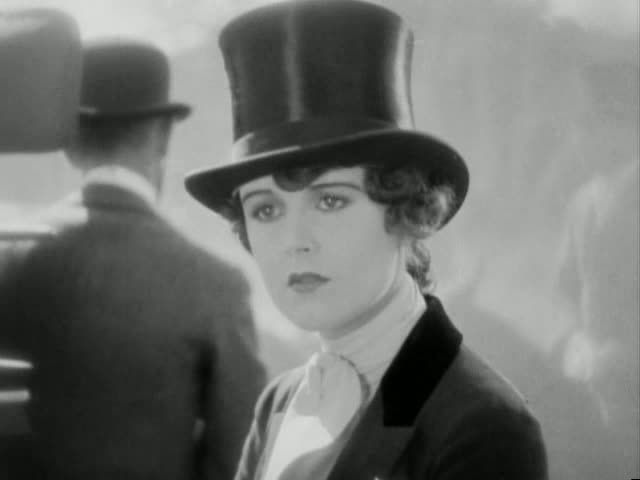
When the film ventures out into the daylight, as it does for the central horse race, it remains compelling, capturing the traditions and activities of the Irish countryside. At the race, a very young John Wayne makes his first visible appearance onscreen, as an extra watching the race. But more importantly, the race is viscerally thrilling, much of it shot from below with the horses seeming to jump over the camera, and Ford's cutaways to an excited Hogan are charming. There's charm, too, in Conn's sweet romance with Dermot, which strangely enough continues unabated even after she marries another man, at least in part because Conn, who dresses in masculine, androgynous clothes, seems more interested in taking endless strolls through the fog than actual romance or sexuality.

The film ends by cycling back to the beginning's evocation of Hell in a fireplace, exploding in a fiery climax that lights up the night and at least temporarily clears the fog. It's a beautiful resolution, communicated entirely in hellish, harrowing images of the titular mansion being engulfed in flames, the fire making it look like a cathedral glowing in the darkness, giving it a bright stained glass quality, shimmering in the hazy night. Hangman's House is silent Ford at his best, taking a less-than-coherent melodrama and making it a moving ode to the director's beloved Ireland with a gorgeous visual style that channels and magnifies the story's potent emotions.

Monday, April 9, 2012

Les bonnes femmes


Les Bonnes Femmes was Claude Chabrol's fourth feature, but in many ways it feels like his true debut, the first of his films in which his style is fully developed. Here, Chabrol largely forgoes the melodramatic and narrative elements of his first two films, as well as the brief detour into lurid Hitchcockian bombast that was À double tour. After that bigger-budget production, he returned to the street-level realism of his first two features, adopting an even rougher and looser style than even those films, while also sharpening his razor-sharp, unpredictable wit. The film follows a group of four young women who all work as salesgirls in an appliance store that never seems to get any customers. They stand around all day, bored and chatting, fending off the lecherous advances of their elderly boss, gossiping and talking about love. The four women are very different. Jane (Bernadette Lafont) is a wild party girl who loves to drink and laugh; she's dating a soldier but won't pass up dalliances with other men whenever he's not around. Rita (Lucile Saint-Simon) is happily engaged, though her fiancé Henri (Sacha Briquet) is something of a snob who obviously thinks she's uneducated and is afraid of what his cultured parents will think of her. Jacqueline (Clotilde Joano) is the romantic of the group, a serious young woman who is breathlessly waiting for a true love to come along and sweep her off her feet. Ginette (Stéphane Audran) is more mysterious and independent; she's the only one of the group who doesn't define herself in terms of men, instead sneaking off every night to sing in a variety show, simply because she loves to perform. Out of all the women, she's the only one who's doing something for herself, not seeming to think about men or romance, only doing what she wants to do because she enjoys it — even though she's also strangely embarrassed of her late-night theatrics.

Through his observation of the other three women, Chabrol is exploring the nature of relationships between men and women, and the portrait he paints is not a pretty one. The film is often pitched as a comedy, sometimes even a broadly hilarious one, but percolating underneath its surface humor are some very bitter, cynical conclusions about the nature of romantic love. There are three different templates for love on display here. The most traditional is the relationship between Rita and Henri. They love each other, and she seems happy — she sighs just thinking that he loves her — but the scene where he takes her to meet his parents over lunch reveals the cracks in their seemingly perfect romance. Before his parents show up, he barrages Rita with a series of admonitions and warnings, telling her what she should and shouldn't say, what she should order, and trying to hurriedly catch her up on some details about Michelangelo so she'll appear to know something about art. He's condescending towards her, and in the process reveals some of the uglier undercurrents of this relationship.


A different template for male behavior is provided by the duo of boisterous ladies' man Marcel (Jean-Louis Maury) and his older, out-of-shape friend Albert (Albert Dinan). These two pick up Jane and Jacqueline at the beginning of the film, loudly and laughingly hitting on the girls until finally the more flirtatious Jane gives in and agrees to go out with them that night. They take the girls out for dinner and to a strip club, then, after Jacqueline breaks away from them, they both bring Jane back to Albert's apartment. They're boorish and loutish, putting their hands all over her, clumsily trying to get her to agree to a ménage à trois before she finally just goes off with Marcel alone. Later, the girls run into Marcel and Albert again, at a swimming pool, but this time, they've already gotten what they want from these particular girls, so they just act like even more overt assholes, dunking the girls underwater and chasing them around the pool. Chabrol is obviously dealing with male archetypes here, and while Henri represents the spoiled mama's boy who seems nice enough except for his condescension and pretensions, Marcel and Albert are the perpetually single jerks who are only interested in women for sex, for a night of fun and no more.

Jacqueline stays away from men like this, even politely rejecting the advances of the boyish young guy who sweetly asks her out at her job. She's possessed by the romantic notion of true love, and she thinks she's found it in the form of a mysterious man with a motorcycle, André (Mario David), who's been following her around constantly, stalking her while she's out with friends or at work, but never approaching her directly. She builds up this mystery man into her ideal, and believes that she's in love with him even though she's never met him. When she finally does meet him and begins dating him at the end of the film, Chabrol presents their relationship as exactly the kind of idyllic love that she had imagined it to be, briefly allowing the film to get swept up in Jacqueline's romantic reveries. And then, chillingly, a love scene in a deserted forest area seamlessly transitions into a murder, as André strangles his new lover to death and leaves her limp body in the dirt. Chabrol shoots the scene in such a way that it's ambiguous where lovemaking ends and murder begins: a wide shot shows the two lovers lowering themselves to the ground, André climbing on top of Jacqueline, and then Chabrol cuts to a closer perspective that partially obscures the view of what's going on, as André begins strangling her. One doesn't even notice the moment at which her moans of passion become anguished bird calls of terror and pain.


This turn of events is foreshadowed by the scene where a middle-aged co-worker shows Jacqueline a grisly souvenir, a handkerchief soaked in the blood of a man who'd been publicly executed for killing women. She'd romanticized this man, this killer, referring to him as "so pale and handsome" that all the girls who saw his death were swooning and overwhelmed. Jacqueline looks at the handkerchief with wide eyes and quietly listens to this story, and it's hard to know what she's thinking. This woman may be older than the young women in the film, but it seems that she has not learned any lessons by growing older, she has not rid herself of the naïve romanticism that leads these women to allow themselves to be won over, repeatedly, by cruel, brutish men who don't respect them.

The twist, in the film's final minutes, may seem abrupt, but it's all part of Chabrol's deliberate rejection and subversion of the conventions of romanticism, particularly the kind of goopy Hollywood romanticism offered up by the movies. Chabrol opts instead for gritty, near-documentary realism in many scenes, and the sudden intrusion of narrative at the end of the film only serves to shatter these women's remaining illusions about love and men. Chabrol is rejecting the narrative of romantic love in the most jarring way possible, briefly hinting that everything's going to work out wonderfully for this couple, before abrasively tearing apart the Hollywood happy ending. The formation of the couple, the goal and raison d'etre of so much romantic cinema, is here tragic and deadly rather than cheery. This should have been the obvious destination, though: not only does Chabrol offer several visual clues in which André looks sinister and unsettling even before his true nature is revealed, but the film is scored to a driving thriller soundtrack that seems incongruously creepy and foreboding for much of the movie, until the ending makes sense of it.

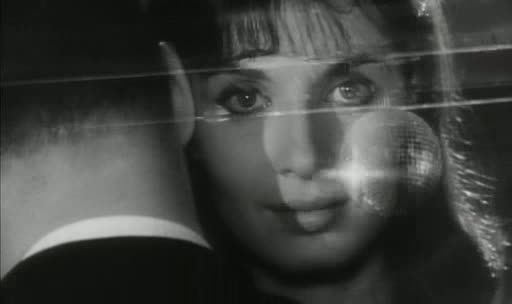
Chabrol then drives the point home with a brilliant coda in which a new, anonymous young woman, shy and reserved like Jacqueline was, sits at a table in a club until a man (whose face is never shown) comes up to her and asks her to dance. As they dance, the woman staring pointedly into the camera, while romantic music plays and a disco ball glistens overhead, but the previous scene with André and Jacqueline makes the scene foreboding and sinister. What kind of man is this? What fate awaits this trusting young woman who just wants to find love? Will she be killed — or will she just get her heart broken?

Friday, April 6, 2012

Shirin


The immersive, emotional power of the cinema is the subject of Abbas Kiarostami's formal experiment Shirin, in which the director focuses on the faces of a cinema audience full of women while they watch a film. The women are watching, supposedly, a recording of a stage production of a classical Persian poem relating the tragic tale of Shirin and Khosrow, rulers of ancient lands who fall in love but are forever kept apart by war and political circumstances. Kiarostami never shows what these women are watching, though: Shirin consists entirely of a series of static closeups of the women in the audience as they watch the film, with the soundtrack and dialogue providing the text of the story but not the images.

The women watch in silence, their eyes darting back and forth to take in the action, rapt and immersed in the emotionally draining narrative of the doomed lovers. The flickering, pulsing light of the screen lights up their faces or shrouds them in shadows, so that the events of Shirin's tale are reflected in the faces of the spectators, in their mute reactions and the light that plays across their faces or shines in their often watery eyes. They smile at the romantic or humorous moments, and stare with enraptured sadness at the tragic scenes, their eyes glossy, their cheeks streaked with tears. Kiarostami is crafting a tribute to the power of the cinema, a tribute to the power of narrative, to move and to charm us, to produce intense emotional reactions. The narrative plays out, not in concrete images of events happening, but in the faces of those who watch the film, whose faces change and shift subtly in response to the unseen events onscreen.


The women's faces, young and old, are all striking and beautiful, which provides one clue to the fact that many (if not all) of the women in the film are in fact not ordinary spectators but famous Iranian actresses, some of whom had appeared in Kiarostami's films previously. Kiarostami even includes some shots of the French actress Juliette Binoche, whose presence in the crowd might be taken as a way of signaling the fact that the women in the film are actresses to Western audiences who might not be familiar with the Iranian stars. The women's status as performers adds an additional layer to the film, causing one to doubt their reactions, to wonder how much of this work is artifice and how much is reality. Kiarostami is often concerned with problematizing the boundaries between documentary and fiction, and here he does so by presenting these emotional reactions with no way of knowing whether the women are genuinely moved and entertained by what they're watching or if they're simply acting, performing every bit as much as the actors in the play they're watching.

For that matter, we can only assume that they are even watching anything at all, that the film's premise is sincere and not a further bit of gamesmanship. As it turns out, though it's impossible to tell from Kiarostami's film, they're not actually watching the movie that they seem to be watching. They're not even sitting in an actual movie theater, but in Kiarostami's living room. There are clues in the presentation of the film itself that not everything here is to be taken at face value, so to speak. The way in which Kiarostami films each of these women in intimate, nearly head-on closeups itself shatters the illusion, since in an actual movie theater, a camera this close to an audience member couldn't help but be distracting, breaking the immersion in the narrative that Kiarostami is seemingly capturing here. It's a paradox: the women onscreen seem to be totally engaged by what they're watching, but the fact that they're being filmed, seemingly with a camera placed almost directly in front of them and not too far away, suggests that they couldn't possibly be as engaged and immersed as they seem to be.


This suggests a familiar problem of documentary film, in that it is difficult to capture unscripted reality because the mere presence of a camera transforms a situation, causing people to consciously or unconsciously act differently than they would without a camera's presence. Thus Kiarostami is continually raising questions about film, performance, emotion, documentary and fiction. Is what we're seeing real? No, it's not: these women are actors playing spectators, aware that they're being filmed and that an audience of actual spectators will someday see these performances. But even if they weren't actors, even if these weren't performances, would this be "real"? Or does the camera's mere presence already signal that there's a layer of artifice here that makes it impossible to view the women onscreen as simple spectators in an ordinary theater?

At the same time, Shirin suggests just how powerful the lure of narrative can be, because even though in many ways the film deconstructs and frustrates the narrative potential of the cinema by denying visual access to the story, it proves that it's possible to get swept up in a great story even without the images. The narrative component of the film is like a radio play or an audio book, the dialogue and sound effects telling the story even in the absence of the accompanying visuals. It's a predictably tragic but compelling melodramatic tale, the kind of archetypal doomed romance that nearly every culture has produced at one time or another, and its effect is amplified because the film's audience is watching another audience react to the story with seemingly real emotion.

It's also a story with special resonance for women. Kiarostami films only women; there are men in the audience, glimpsed stone-faced and staring in the background of the frame sometimes, but they are never the focus of the shot. It's not their emotional reactions that Kiarostami is interested in here. That's because the tragedy of Shirin is primarily a woman's tragedy. It's a the story of a woman who devotes her life to a great love, but finds that her love, and her life, is wasted because of the foolish ambitions, the thirst for power, the violence and pettiness, of men, including the man who she loves and who claims to love her so intensely. There is great significance in choosing this particular story, a story about a woman betrayed by the political games and senseless wars of men, a woman who wanted only peace and love and was instead made a pawn in various struggles over power and thrones. Thus the women who appear in the film are not only crying at a tear-jerking romantic tragedy but a film that reflects their own lives, their own absence of power in relationships with men, their own struggles in a country ruled by violence and male hypocrisy. Even in such an ostensibly apolitical film, this political subtext subtly and potently burbles up.