Thursday, March 15, 2012

The Cabinet of Dr. Caligari


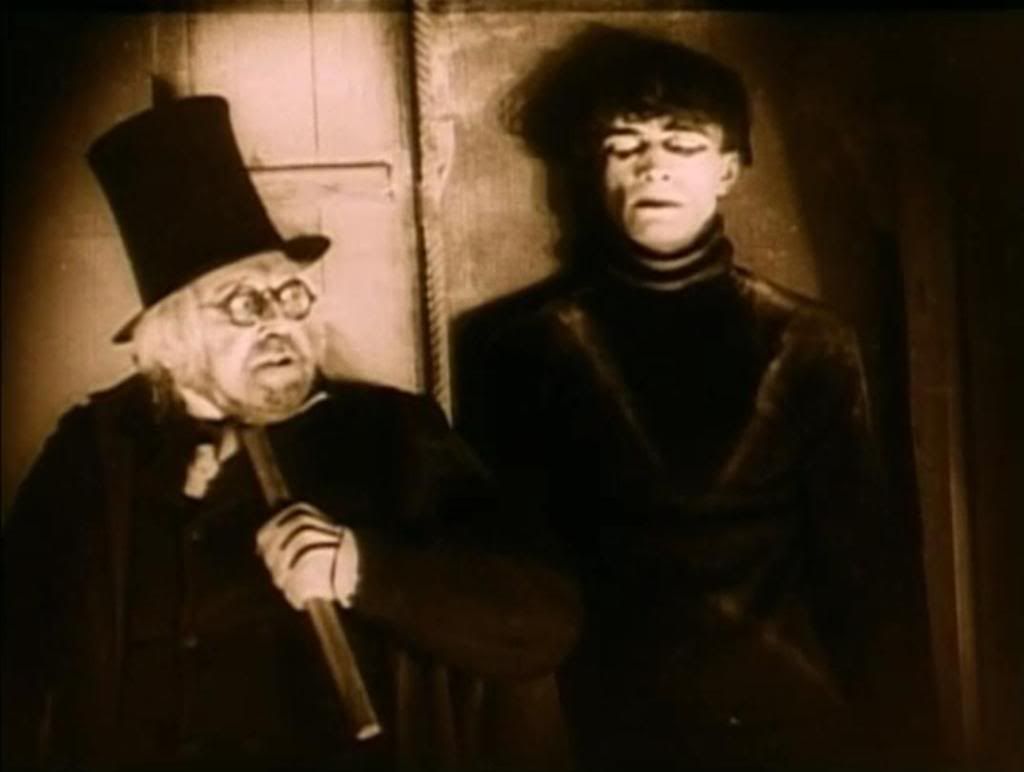
Robert Wiene's The Cabinet of Dr. Caligari is one of the classics of the German Expressionist style, a defining work of the era. A story of madness and murder, it's sometimes cited as the first true horror movie ever made, and in any event it undoubtedly provided a powerful template for much of the horror to come. Caligari (Werner Krauss) is a carnival showman with a macabre and sensational show in which the somnambulist Cesare (Conrad Veidt) tells fortunes, correctly predicting death for anyone who dares to seek his advice — which of course begs the question of how Caligari ever gets any repeat business, but such logical questions are outside the purview of a movie that's simply about a widespread and seemingly contagious insanity. Just how contagious is foreshadowed in the opening, in which Francis (Friedrich Feher), telling the story of Caligari to a companion, observes a woman in white (Lil Dagover) go sleepwalking past in a daze, staring straight ahead and taking no notice of the two men. "That's my fiancée," Francis says, in a darkly humorous suggestion that this story's insanity might be catching, spreading from the mad doctor and his zombie-like killer assistant to those they come in contact with.

Cesare is a terrifying prototype for the movie monster to come, dressed all in black, tall and sleek with a heavily made up face and a gruesome smile rimmed with lipstick, his eyes hidden by deep pools of black. He lurches and plods through his actions with a dreamy slowness, killing in his sleep, a walking nightmare. In one key moment, Cesare advances on the sleeping woman, with her inert form in the foreground, stretched out amidst the fluffy white finery of her bedsheets, while the black-clad sleepwalker advances step by plodding step in the background. His progress is deliberately slow and inexorable, gradually moving towards the moment when the creepy killer, prefiguring countless movie boogeymen to come, raises his knife to stab his latest victim and finds that, inexplicably, he is unable to go through with it — as with so many of his descendants, the man within the monster has suddenly been awakened by the sight of helpless female beauty.

Cesare isn't the only one in the film who seems to be moving in his sleep. The whole film has a soporific quality that infuses it with the quality of a dream, and many of the other performances — particularly Dagover as the damsel in distress — have the same drowning-in-molasses quality, a deliberate slowness to every gesture. It's as though Cesare is simply an exaggerated caricature of the other characters in the film, who are in truth as deeply asleep as he is and only pretending otherwise. This is just one of the film's many perverse touches; its strangeness lies much deeper than the macabre surface of the narrative, which makes it all the more unsettling.
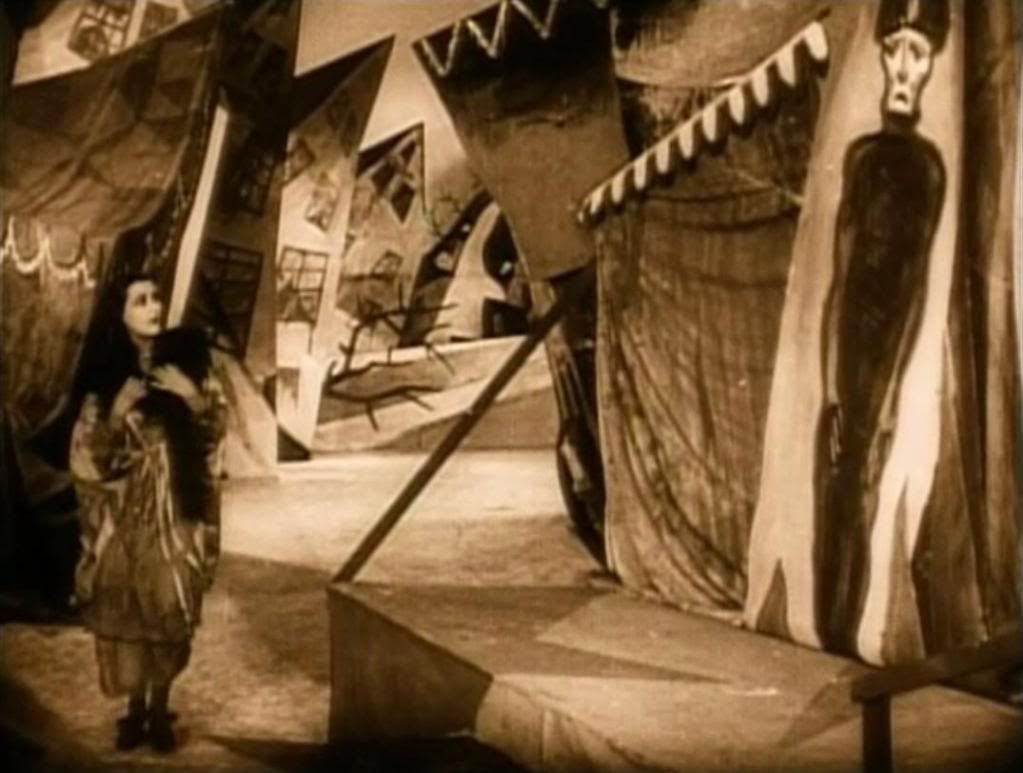

The first of Cesare's nighttime crimes is seemingly motivated by Caligari's petty desire for revenge, but there's no rationale for the rest of the pair's actions, and indeed the second murder — killing a man who Cesare had just publicly predicted would die by morning — could only serve to draw suspicion to their act. These crimes are inherently irrational, feeding into and arising from a world that seems to have gone mad at some fundamental level. Within the narrative, it's Caligari who's gone mad — or Francis, if the tacked-on twist ending is to be believed — but the madness seems not to emanate from any one person. The madness is rooted in the world itself, in the twisted design of the buildings and streets in which this drama plays out, in the beautifully baroque distortions that reveal the warped ugliness underneath the appearance of order and normality that we think of as reality. This film presents a world that looks as perverse and frightening as it feels to the people living in it — which must have been a very resonant truth to the people of Germany in the fragmented, despairing time between the two World Wars.

The film's buildings are inescapably mad, leaning over, all odd angles, seemingly on the verge of collapse. This is like no architecture ever seen, it's an architecture of the mind, as flimsy as a thought, the shadows painted on in jagged shapes that have no relation to any light source or object that could conceivably conspire to cast such a shadow. Everything has become unmoored, the foundations of reality itself twisted until the world resembles a nightmare, with everyone strolling around as if nothing's wrong while the buildings all around them totter and lean ominously, and the shadows stretch out, disconnected from physicality, potentially hiding all sorts of horrors. At the flashback climax of the film, Caligari staggers around the town, seeing the famous words "you must become Caligari" floating in the air everywhere around him, drawn in the tree limbs or graffitied on the walls of the buildings, evaporating as soon as he gets too close. The world is literally egging him on to madness here, but even when it's not so blatant about it, the design of everything from the buildings to the spiky dangling plants to the seemingly unstable streets whispers and screams madness; there is no way to exist within such a destabilized and distorted world and remain sane.

Wednesday, March 14, 2012

The Lawless


Joseph Losey's second film, The Lawless, is an inelegant liberal polemic about racism in a small town divided between a middle class white community and a poor, ramshackle neighborhood of Mexican-American fruit pickers who work on the local farms. Tensions are high between the young white kids and the Latinos, and they explode at a dance in the Mexican neighborhood when a few white guys crash the party — they hate the Mexicans but aren't above hitting on their women, joking that "those tomato-pickers have some pretty tomatoes." In the ensuing riot, the young Mexican Paul (Lalo Rios), scared of what will happen to him, goes on the run, stealing a car and, through a series of increasingly unlikely mishaps, making himself look more and more guilty, like a guy on a crime spree.

It's an obvious message movie about the eagerness of white America to railroad a poor young immigrant who they're only too willing to believe is an incarnation of malice and violence. Tied up in this drama is the newspaperman Larry Wilder (Macdonald Carey, coming off as a budget Jimmy Stewart), who had once been a crusader for controversial causes and big stories, but had now abandoned that for the quiet small town life he thought he wanted. He struggles with his conscience, trying to stay out of it, as he watches the racist passions of his town inflamed by unscrupulous reporters, thugs and bullies, and hatemongers. The film's script (by Daniel Mainwaring, adapting his own novel) is on-the-nose and obvious, hammering its points in with a complete lack of subtlety. The performances are also, for the most part, flat and amateurish, contributing to the sense of a clunky drama that's got its heart in the right place but falters in the execution. Only Gail Russell really shines as the young Mexican journalist Sunny Garcia, who serves as the sweet, wide-eyed, sensual voice of conscience gently nudging the jaded Wilder back towards engagement and activism.

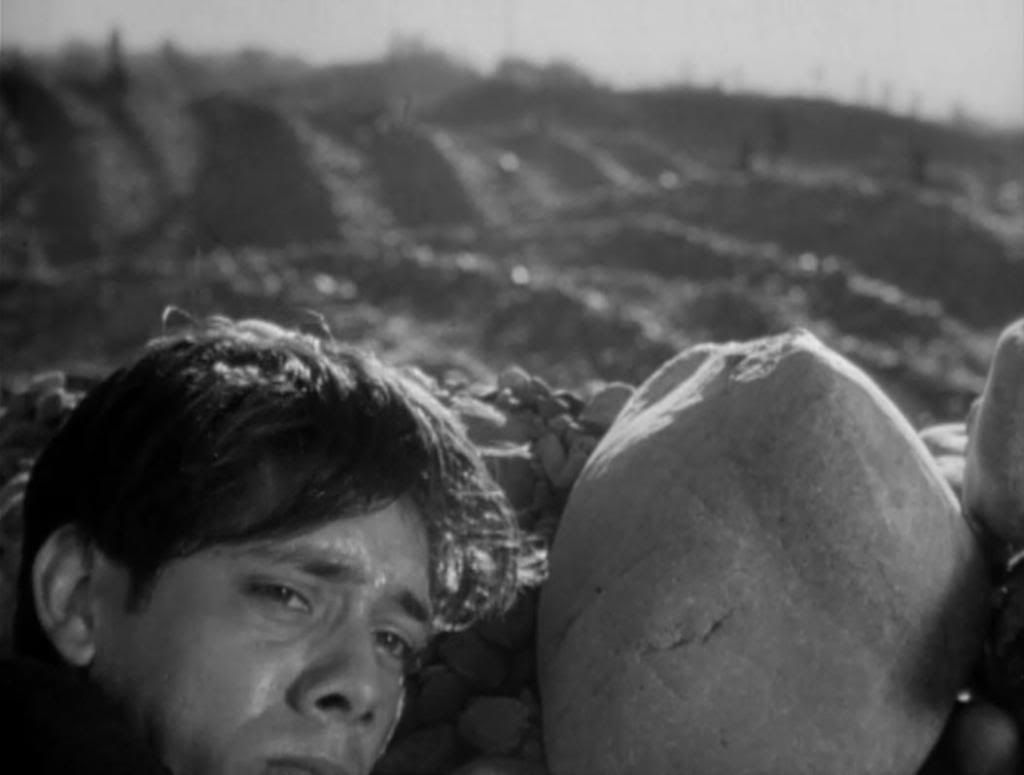
Still, it's an effective polemic, and at times also a genuinely interesting movie. Losey forgoes music for long stretches, letting much of the film play out in ascetic silence, a sure sign of a low budget, but he uses this spartan aesthetic very effectively. The scene where the fugitive Paul is tracked to a riverside farm by the police is stunning and tense, as the increasingly frenzied Paul stumbles and runs, growing desperate, while lines of deputies advance steadily in pursuit. The terrain is rocky, covered in gravel, and the soundtrack contains only the clinking sounds of footsteps kicking the pebbles around. The camera tracks across the open field, taking in the bleak, wasted landscape of rocks and dirt as the men with shotguns spread out on their search. Losey's compositions are simple but striking, like an unbalanced closeup of Paul, his face shunted to the bottom of the frame beneath a rock ledge, while the focus is wracked from his terrified face in the foreground to the pursuers closing in on him and then back again.

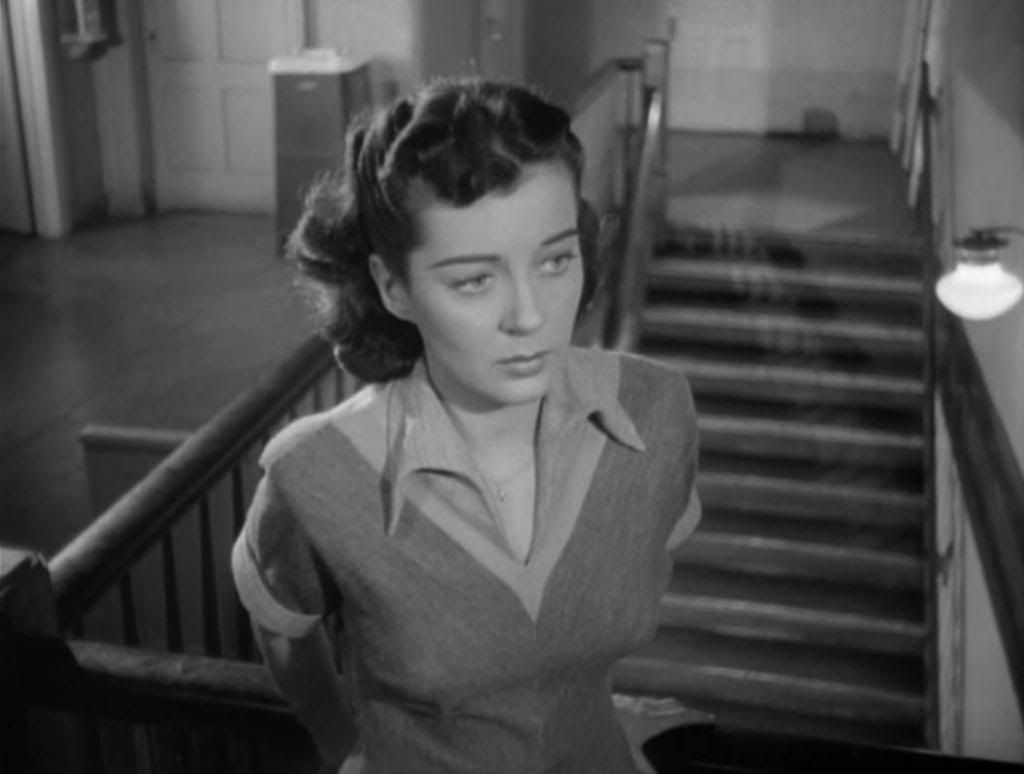
Later, after his capture, as Wilder goes to see if he can convince the police to let Paul's parents see the boy, Losey remains with the parents, waiting on a bench. Everything remains silent, and Losey's camera simply sits still and watches, until Paul's father, without exaggeration or melodrama, lowers his head into his hands, overcome by the fear and emotion of this moment. When Wilder comes out and says that they can see Paul, Losey's camera remains out in the hall, watching from a distance, through the frame of a doorway, as Paul embraces his parents, leaving some respectful space for this intimate moment. This scene is followed by a confrontation between Wilder and Sunny, as he says he's bowing out and she accepts it, saying she understands while her face subtly conveys her disappointment. As he walks away down the staircase, Losey shoots from behind Sunny, watching him from the railing above, until he disappears from view; the angle of the shot places the two figures briefly side by side even though they're separated by the stairs, moving apart. The quiet and simplicity of these shots only makes them more affecting, unshowy but powerfully staged.


In other scenes — incidental moments, really — Losey is charmingly attuned to the low-key sensual pleasures of small town life, the things that make places like this so appealing when they're not self-destructing in orgies of racist violence. In one scene, Wilder and Sunny walk down an empty suburban street at night, and pass an old man burning autumn leaves by the curb. They stop briefly to watch, with Wilder cheerfully inhaling the smell and relishing it, then stroll on, seriously discussing the loss of Wilder's journalistic drive. But as they walk and talk, the fire lingers in the background, glimpsed in a reflection in the windows of the shops along the street, its smoke drifting into the frame over the heads of the two journalists.

There's also a surprising sensuality to a shot of Paul walking into his backyard, the camera following him, looking out past the clothesline to the freight train running past on the nearby tracks, then following him back to the crude shower hidden behind some scrap wooden boards by the house. Losey then cuts to a silhouette of a young man seen through the frosted glass of his shower, while a woman offscreen tells him to fill the ice bucket. It's a pointedly ironic cut, juxtaposing the poverty of the Mexican neighborhood, where what modern conveniences they have are jerry-rigged, against the wealth and luxury of the white neighborhood, which might otherwise have been taken for granted. The house in the white neighborhood is utterly ordinary, the kind of basic suburban home that might appear in countless other Hollywood movies without anyone thinking twice; Losey's class conscious juxtaposition of this everyday luxury against the poverty of those on the other side of town is a radical gesture for its time, as is the choice to tell such a racially charged story in the first place.

These racial themes explode most wildly in the scene where Paul supposedly assaults a young white girl, but in fact simply startles her by his mere presence — and presumably his race — causing her to turn around and start to run so blindly that she slams her head off a wooden beam. It's a darkly comical and jarring slapstick bit, delivering a sad joke about race and sex, and about the unsettling potency of stories about dark-skinned men assaulting white women. At the film's tense climax, all these prejudices finally erupt into exactly the lynch mob that seemed to have been simmering into formation all along. The destructive finale is then tempered by, refreshingly, just a hint of hope, a suggestion that the willingness to speak out against injustice is the first step on what's sure to be a long and difficult process of change. As an early effort from Losey, The Lawless is rough and sometimes clumsy (as in a fight scene where everyone is very obviously not landing any punches) and most of its cast is undistinguished. It wears its B-movie production values on its sleeve, alongside its bleeding-heart politics, but it's an interesting little film that already suggets the director's political interests and his keen photographic eye.

Tuesday, March 13, 2012

Battleship Potemkin


Sergei Eisenstein's propaganda classic Battleship Potemkin has been absorbed so thoroughly into both film history and pop culture that its real revolutionary power is easy to underestimate or overlook — it's all too easy to deem it a museum relic, but even now, it's much too potent, too emotionally raw and technically vital, for that sedately respectful fate. Eisenstein's dramatic recreation of a 1905 pre-Bolshevik mutiny on a tsarist battleship was deliberately calibrated as a piece of propaganda to be as affecting and as provocative as possible, and it succeeds in that respect even now, even with its impact dulled by years of distance and the countless references to this film that have been integrated into other works.

The film is a love letter to ordinary sailors, representatives of the working class, and there's real tenderness and even sensuality in the depictions of the sailors at work, before their revolt. They lounge, shirtless and muscular, in hammocks that sway with the rocking of the ship. They work with a near-mechanical precision, their faces serene with the knowledge of a job well done, whether they're oiling and washing the ship's big, jutting guns or performing kitchen duties with regimented choreography. When the first officer appears, he's immediately distinguished from the other men by his slightly effete manner, his remoteness and smugness; Eisenstein's closeup of this man immediately marks him as a villain, particularly as contrasted against the earthy, sweaty romanticism of the images of the working men. The immediate cause for the rebellion is the sailors' insistence that they should have better food, a demand that the officers summarily reject despite the maggots crawling on the meat, shown in squirmy closeups that leave no doubt about the contempt that these upper-class representatives have for those beneath them.

There follows a tense confrontation between officers and sailors that ends with the ship guards refusing to fire on their comrades, and the sailors overthrowing their superiors to take over the ship themselves. Eisenstein's famous command of fast-paced montage builds tension brilliantly, cutting from the faces of the guardsmen to the officers ordering them to fire to the sailors urging them to rebel, with shots from around the ship spliced into this frantic montage as a way of drawing out the suspense even more. Eisenstein also edits in closeups of a caricatured chaplain who provides an outrageously unflattering view of religion. Somewhat comically, the priest is depicted as a wild-haired mystic lunatic who, during the tense showdown between the officers and the sailors, beats his cross threateningly against the palm of his hand and prays for the sailors to change their ways. Religion, this suggests, is just a tool of the upper-class, the cross as much a weapon to beat down the sailors as the guns of the officers. The priest is made to look like a combination of a bible epic Moses and a frizzy-haired hobo, the wind shuffling his hair and thick beard into a disheveled mess, very disreputable-looking indeed. Of course, as imposingly crazy as he looks, his cross is no protection once the working class rebels.


The film's most famous sequence is the massacre on the Odessa Steps, an incident that was invented for the film by Eisenstein, drawing on the fact that there were riots in Odessa in support of the rebel sailors, and that tsarist troops did reportedly fire into the crowds. The scene is a dazzling showcase for Eisenstein's theories of montage, methodically cycling between long views in which crowds of bodies go tumbling frantically down the steps, fleeing the advancing lines of tsarist troops, and fragmented closeups in which various individual citizens scream in terror before being gunned down or trampled underfoot. The fragmentation enhances the suspense, too, especially in the now-iconic shot of a baby carriage's wheel teetering on the edge of a step. Eisenstein draws out the moment by repeatedly cutting away from it, so that without using actual slow motion he makes it seem as though the scene is playing out at half-speed, each second ticking by perceptibly, each little detail emphasized.

Despite its violence and its polemical message, Battleship Potemkin is also a strikingly beautiful film. Eisenstein lovingly photographs the faces of the sailors and the working class people who celebrate them in the streets of Odessa. The closeups are direct but somewhat romanticized. Even if few of the characters stand out — typical of Soviet cinema, this is a film about a class as a whole rather than about individuals — distinctive individual faces are often highlighted in the crowd. Eisenstein applies a similar romanticism to the ship itself, admiring its glossy hard surfaces, its sweeping curves, the way it looks silhouetted against the choppy ocean. The nighttime images of the ship gliding across the water, moonlight rippling on the water, everything cloaked in shadow or mist, are particularly sensuous and gorgeous, with a sharp photographic sensibility that only contributes to the feeling that the film is a documentary snapshot rather than a fictionalized propaganda piece. And that's why it remains so effective: its realism, its formal and cinematic beauty, only make the abuses it depicts seem even more vile. The film is as much about glorifying labor and rhapsodizing on the nobility of the working class as it is about vilifying the ruling classes.

Monday, March 12, 2012

Demonlover


Olivier Assayas' Demonlover is a bleak, enthralling depiction of the soulless, corporatized world to come. It's a David Lynch nightmare for the Internet era, picking up on the paranoid, identity-warping vibe of Lost Highway and Mulholland Dr., and blending that atmosphere with a culture that's being digitized, stripped of its humanity, made sleek and robotic to mirror video games, porn, entertainment, and the horrible intersections between them. It's a harrowing and widely misunderstood film that only gradually reveals the truly dark soul lurking within its examination of a high-stakes international business deal.

Indeed, the film opens as a conventional, if dreamily paced, corporate espionage thriller, involving a prospective French/Japanese/American deal to distribute Japanese-made animated porn on the Internet. Diane (Connie Nielsen) is a corporate spy, a double agent pretending to work for Volf (Jean-Baptiste Malarte) while actually working for his competitor, planning to sabotage the deal in any way she can. Diane eliminates a corporate rival by drugging her and setting her up to get attacked, then rises up to take her place, so that she can personally oversee the deal and be in the best position to execute her plan when the time comes. Assayas parallels this ruthless corporate culture with images of Japanese porn in which sleek women with balloon-like breasts and no pubic hair — which couldn't be shown at all in Japan at one time — fight using "sex magic" and are defiled by penis-shaped eels. This is a film about the increasing inhumanity of our global culture: the Japanese animators demo a new 3D style in which the women somehow look even more plastic and fake than in the traditional animation, eerily human-looking but sanitized, stripped of personality, their eyes empty. Later, at a club, a group of actual human singers are similar glossy and robotic, moving as though driven by internal gears, smiling robotically as they perform.


The implication is that this worldwide culture is being subsumed by entertainment that removes the humanity from performance, business, and especially sex. Everything is fetishistic, remote from human experience, and often degrading, focused on mechanical repetition and a violent, misogynistic attitude towards women, who are treated as submissive vessels for unwilling penetration. There's something Pavlovian about it all, as though this digital, inhuman culture is teaching us how to act in the real world: Diane watches a porn in which a red, veined dildo mechanically thrusts in and out of a woman's mouth, and she reflexively wipes her own mouth with the back of the hand, as though salivating in response to these images.

The plot soon comes to involve the sadomasochistic, illegal website Hellfire Club, which depicts women — dressed up as icons of feminine power and strength — being defiled and tortured, while club members can type in requests for specific scenarios. The site shows women dressed as Wonder Woman, Lara Croft, Storm from the X-Men, and Emma Peel of British TV series The Avengers, all of them tied and chained to beds, electrocuted, tormented, staring accusingly up at the camera, and at the viewer. Assayas' Irma Vep dealt with the fetishization of the female action hero and the female form, but Demonlover takes it a step further, exploring the male desire to see these supposedly empowering embodiments of female power stripped and destroyed, to see them malleably twisted to whatever sick fantasy can be bought with a credit card and Internet access.

Gender is a big part of what Assayas is exploring here. Diane, for being efficient and businesslike at work, is routinely called a "cold bitch" by nearly everyone she meets — the only one who likes her is her American counterpart, Elaine (Gina Gershon), another ruthless businesswoman. Diane's coworker, Hervé (Charles Berling) wants her, turned on by precisely her chilly manner at work, her precision and ability to do her work without letting feelings get in the way. Of course, as the second half increasingly shows, this is only a facade for Diane, who is not nearly as soulless or as professional as she would like everyone to believe. She's a double agent, but it's as though her real secret is that she's still human in a world that's being repopulated by robots who only fake humanity, and often not very convincingly. Assayas pulls the rug out from under the viewer in the film's second half, after a pivotal sequence in which Diane is caught spying by Elaine, a scene that recalls Maggie Cheung's action hero roleplaying in Irma Vep. The two women get into a vicious fight that ends with them both bloody and passing out. The screen fades to black, and this proves to be a real Mulholland Dr. zoom-into-the-blue-box moment, because when Diane (yes, one wonders if that Lynchian name is significant) wakes up, everything seems to have shifted around her. The blood in the halls has been cleaned up, not that any of the hotel's guests, obliviously enjoying their vacations, seemed to notice the mess in the first place. Elaine has been cleaned up too, and she utterly disappears from the film, never to be mentioned or seen again, reflecting the total disposability and insignificance of any individual to the corporate mass media machine.


Everything shifts at work, too, as Diane slowly loses her power and everyone around her is revealed, one by one, as a double agent of one kind of another, including her former punching bag assistant Elise (Chloë Sevigny), who now takes control and has Diane reporting to her. The film becomes more and more destabilizing after this point, with the ground continually shifting below the feet of both Diane and the viewer. No one can be trusted, no one is loyal to anyone or anything, and everyone is only out for themselves. Diane thus transitions seamlessly from being a player within this system to being its docile, acquiescent victim, allowing herself to be led to her ruin. She was already sublimated to the system, complicit in its dehumanization, so she's very slow to resist when the system finally turns on her.

Assayas reflects his theme with the cool, glossy beauty of the cinematography, and with a soundtrack that vacillates between the dreamy lyricism of Sonic Youth's score and the grating, grinding noise of the industrial/metal selections that are dotted throughout the film. Every city looks the same, because they're primarily glimpsed as blurry lights from the back of a corporate car or from sleek, modern hotels and conference rooms. This plays into why these people are so unrooted, so disconnected from normal human relations. They don't even have countries or languages, really, and throughout the dialogue they're continually slipping between French, English and Japanese as though they forget what language they're speaking at any given moment.

The film is gorgeous and strangely haunting, playing out with the surreal logic and graceful imagery of a dream, which it increasingly becomes as Diane loses control. The apex of this theme of slipping control comes during a sex scene between Hervé and Diane that starts as a consensual seduction but abruptly turns into a rape, as though the scene had suddenly gone off track and become something totally different from what it started as. The next morning, Hervé wakes the sleeping Diane with tender caresses, very different from the brutal way he'd treated her before. These inconsistencies and disjunctions introduce ambiguity and uncertainty into the scene — encompassing even its startling, bloody resolution — to blur the line between sex as a romantic connection between individuals and sex as just another tool of control and domination.


Nearly the whole world is colonized in that way in Assayas' film, which offers precious little respite. There are momentary cracks in the strenuous inhumanity — Elise and Elaine going shoe-shopping and gossiping like stereotypical girls; Diane playing racquetball with a friend, disrupting her carefully maintained stoicism by actually getting sweaty — but such breaks are rare. Another is the very funny, strangely sexy shot of Elise in her downtime, lying naked in bed playing video games, intently driving her avatar to slaughter and happily kicking her legs in the air like a kid, contentedly playing. It's both a tossed-off non-sequitur and a key to the film, because in many ways Assayas is exploring a world where everything has been turned into one big video game, where the human cost of actions is not really considered any more than anyone thinks about hacking apart pixels to get to the end of a level.

That shot of Elise playing games is connected to the film's final scene, in which an unnamed suburban boy steals his dad's credit card to log onto the Hellfire Club, typing in a violent fantasy that he wants to see happen to a favorite female comic book character. He makes the request, but then barely pays attention as it is carried out on his computer monitor, doing his homework and paying no more attention to it than he would to any other ephemeral, disposable piece of entertainment. As he does his work, barely glancing at the screen, the woman whose torture he's paid for stares out at him, implicating him — and by extension, all consumers of the voyeuristic, exploitative modern culture — in her destruction.

This is a frightening film, a work of unsettling sci-fi that barely feels like sci-fi because the future world it depicts is maybe just a few steps ahead of our own. At times, it doesn't even seem exaggerated at all, as in the scene where Diane, Elaine and their peers meet to discuss a monopolistic deal that has been purposefully constructed to drive a competitor out of business. Assayas is suggesting that this ruthless corporate ethic is at the root of the dehumanizing culture on display in this film. And the participants treat it like a game, destroying one another to get to the top, where really they've only been set up as the next target for those below them. The film is an unforgettable satire of a globalist corporate culture that seems determined to turn people into video game characters or doll-like mannequins, just more grist for the pop culture machine.