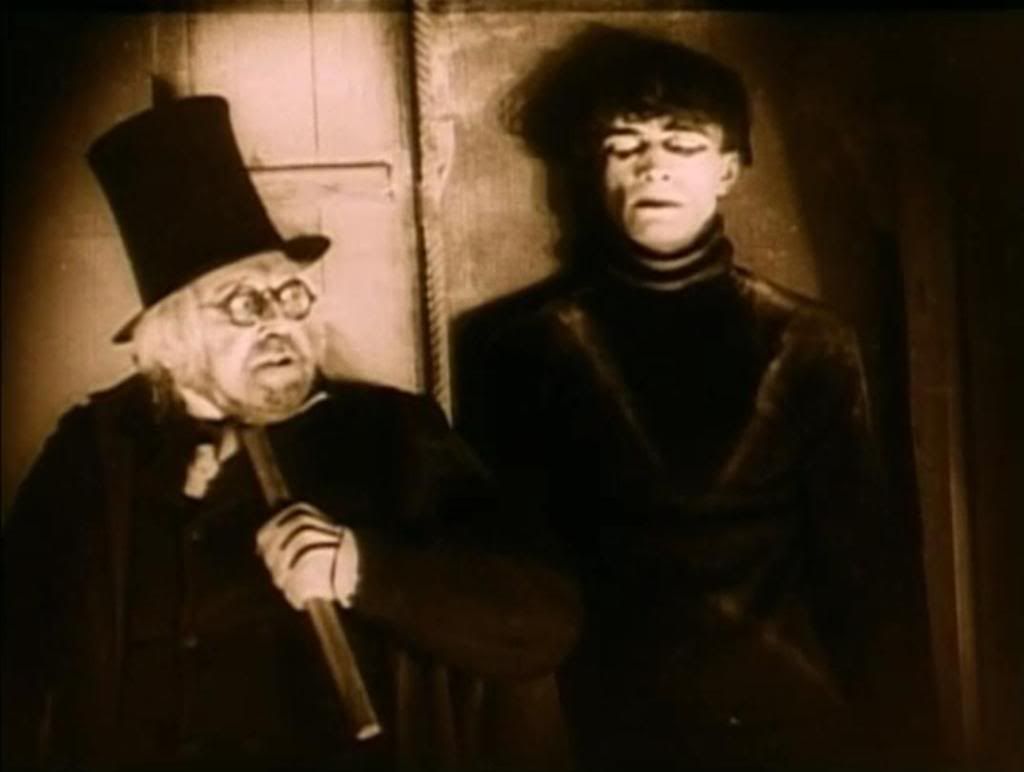
Robert Wiene's The Cabinet of Dr. Caligari is one of the classics of the German Expressionist style, a defining work of the era. A story of madness and murder, it's sometimes cited as the first true horror movie ever made, and in any event it undoubtedly provided a powerful template for much of the horror to come. Caligari (Werner Krauss) is a carnival showman with a macabre and sensational show in which the somnambulist Cesare (Conrad Veidt) tells fortunes, correctly predicting death for anyone who dares to seek his advice — which of course begs the question of how Caligari ever gets any repeat business, but such logical questions are outside the purview of a movie that's simply about a widespread and seemingly contagious insanity. Just how contagious is foreshadowed in the opening, in which Francis (Friedrich Feher), telling the story of Caligari to a companion, observes a woman in white (Lil Dagover) go sleepwalking past in a daze, staring straight ahead and taking no notice of the two men. "That's my fiancée," Francis says, in a darkly humorous suggestion that this story's insanity might be catching, spreading from the mad doctor and his zombie-like killer assistant to those they come in contact with.
Cesare is a terrifying prototype for the movie monster to come, dressed all in black, tall and sleek with a heavily made up face and a gruesome smile rimmed with lipstick, his eyes hidden by deep pools of black. He lurches and plods through his actions with a dreamy slowness, killing in his sleep, a walking nightmare. In one key moment, Cesare advances on the sleeping woman, with her inert form in the foreground, stretched out amidst the fluffy white finery of her bedsheets, while the black-clad sleepwalker advances step by plodding step in the background. His progress is deliberately slow and inexorable, gradually moving towards the moment when the creepy killer, prefiguring countless movie boogeymen to come, raises his knife to stab his latest victim and finds that, inexplicably, he is unable to go through with it — as with so many of his descendants, the man within the monster has suddenly been awakened by the sight of helpless female beauty.
Cesare isn't the only one in the film who seems to be moving in his sleep. The whole film has a soporific quality that infuses it with the quality of a dream, and many of the other performances — particularly Dagover as the damsel in distress — have the same drowning-in-molasses quality, a deliberate slowness to every gesture. It's as though Cesare is simply an exaggerated caricature of the other characters in the film, who are in truth as deeply asleep as he is and only pretending otherwise. This is just one of the film's many perverse touches; its strangeness lies much deeper than the macabre surface of the narrative, which makes it all the more unsettling.
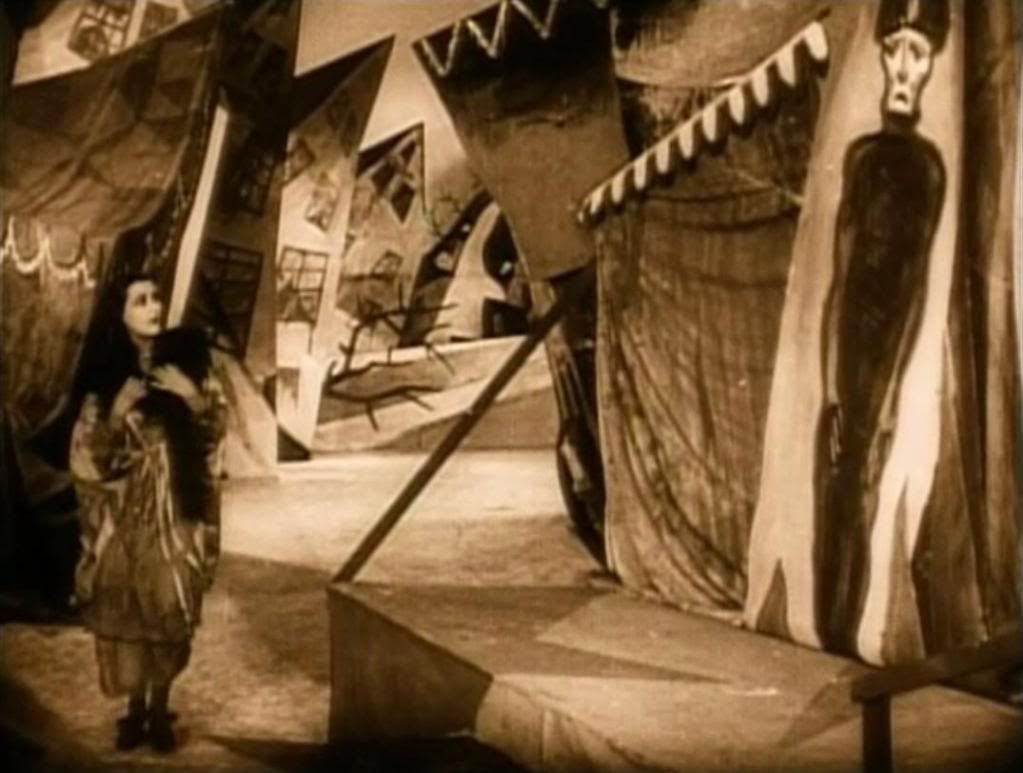
The first of Cesare's nighttime crimes is seemingly motivated by Caligari's petty desire for revenge, but there's no rationale for the rest of the pair's actions, and indeed the second murder — killing a man who Cesare had just publicly predicted would die by morning — could only serve to draw suspicion to their act. These crimes are inherently irrational, feeding into and arising from a world that seems to have gone mad at some fundamental level. Within the narrative, it's Caligari who's gone mad — or Francis, if the tacked-on twist ending is to be believed — but the madness seems not to emanate from any one person. The madness is rooted in the world itself, in the twisted design of the buildings and streets in which this drama plays out, in the beautifully baroque distortions that reveal the warped ugliness underneath the appearance of order and normality that we think of as reality. This film presents a world that looks as perverse and frightening as it feels to the people living in it — which must have been a very resonant truth to the people of Germany in the fragmented, despairing time between the two World Wars.
The film's buildings are inescapably mad, leaning over, all odd angles, seemingly on the verge of collapse. This is like no architecture ever seen, it's an architecture of the mind, as flimsy as a thought, the shadows painted on in jagged shapes that have no relation to any light source or object that could conceivably conspire to cast such a shadow. Everything has become unmoored, the foundations of reality itself twisted until the world resembles a nightmare, with everyone strolling around as if nothing's wrong while the buildings all around them totter and lean ominously, and the shadows stretch out, disconnected from physicality, potentially hiding all sorts of horrors. At the flashback climax of the film, Caligari staggers around the town, seeing the famous words "you must become Caligari" floating in the air everywhere around him, drawn in the tree limbs or graffitied on the walls of the buildings, evaporating as soon as he gets too close. The world is literally egging him on to madness here, but even when it's not so blatant about it, the design of everything from the buildings to the spiky dangling plants to the seemingly unstable streets whispers and screams madness; there is no way to exist within such a destabilized and distorted world and remain sane.